
5 Ways to Teach ABA Daily Living Skills for Independence
Table of Contents
Building Independence with ABA Daily Living Skills
Building on in-home ABA therapy, we teach independence through daily living skills. Our ABA daily living skills program helps children master essential functional life skills—adaptive behavior activities like dressing, grooming, and meal preparation that build self-sufficiency.
- Dressing
- Grooming
- Meal preparation
- Household chores
Our BCBAs use task analysis to break each routine into small, teachable steps and apply positive reinforcement as each step is mastered. Practicing in your home in Salt Lake City or Utah County means your child learns where they live. Caregivers learn prompting and reinforcement right alongside us, embracing our family-centered care.
According to the Association for Science in Autism Treatment, ABA is the most widely supported evidence based autism treatment for daily living skills. We celebrate the power of small steps: each mastered step builds confidence and reduces frustration. Our team tailors targets to your child’s age, abilities, and your family’s priorities. Please note that results may vary. Consult a licensed healthcare professional for diagnosis or medical advice. Now that we understand the importance of daily skills, let’s explore how we teach morning routines step by step.
Preparing to Teach Daily Living Skills at Home
Teaching your child ABA daily living skills at home is a powerful way to foster independence while taking advantage of the natural practice opportunities your household provides. Start by choosing one manageable task—like brushing teeth or getting dressed—and perform a task analysis, breaking the skill into small, teachable steps.
Gather the materials you’ll need: visual supports like picture schedules, preferred reinforcers, and any adaptive equipment that makes the task easier. Consistency matters; schedule practice at the same time each day so the routine becomes predictable. The power of small steps shows that steady, daily efforts can lead to meaningful progress. As you teach these functional life skills, you’re also embedding adaptive behavior activities that boost your child’s confidence in real-world settings.
Here’s a simple preparation checklist:
- Identify a target daily living skill
- Break it into steps (task analysis)
- Collect visual aids and reinforcers
- Set a consistent daily practice time
By methodically teaching ABA daily living skills, you’re laying a foundation for independence that reaches far beyond a single task. Once you’ve laid this groundwork, you’re ready to begin the step-by-step teaching process. Our team at Golden Touch ABA Therapy provides caregiver coaching and evidence-based support to help you implement these strategies effectively. Families in the area can turn to our ABA therapy in Davis County for personalized guidance.
Identify Key Daily Living Skills for Your Child
We understand that every child is unique, and identifying the right ABA daily living skills is the first step toward greater independence. Daily living skills include practical, age-appropriate tasks such as dressing, brushing teeth, and meal preparation. A personalized assessment by a BCBA helps pinpoint the specific self-help routines that matter most for your child.
Common skill categories include:
- Self-care (hygiene, dressing, feeding)
- Home management (tidying up, laundry, simple cooking)
- Community participation (shopping, safety awareness)
- Social and leisure skills (greetings, turn-taking, play)
Our in-home approach allows families to practice these functional life skills in a warm and welcoming environment. By working in your home, we ensure that skills transfer naturally to daily routines. At Golden Touch ABA Therapy, our ABA therapy in Eagle Mountain services bring evidence-based support directly into your home. Our team creates a tailored plan that focuses on the skills most meaningful to your family. We partner with you to prioritize goals, using the power of small steps to build confidence through adaptive behavior activities. Remember to consult a licensed healthcare professional for personalized medical advice.
Once you’ve identified the key skills, our next section explores how we teach those skills through structured ABA techniques.
Break Down Skills with Task Analysis
We teach ABA daily living skills by breaking them down into small, manageable steps: a method called task analysis. This approach deconstructs complex routines like brushing teeth or getting dressed into observable, sequential actions, giving both therapists and learners a clear roadmap. At Golden Touch ABA, our Board Certified Behavior Analysts (BCBAs) design individualized task analyses (learn more about BACB certification) to teach functional life skills in a supportive, in-home setting.
Because we believe in the power of small steps and family-centered care, we share these task breakdowns with families to reinforce progress at home.
For example, when targeting daily living skills in ABA therapy such as toothbrushing, the process can be broken into six clear steps:
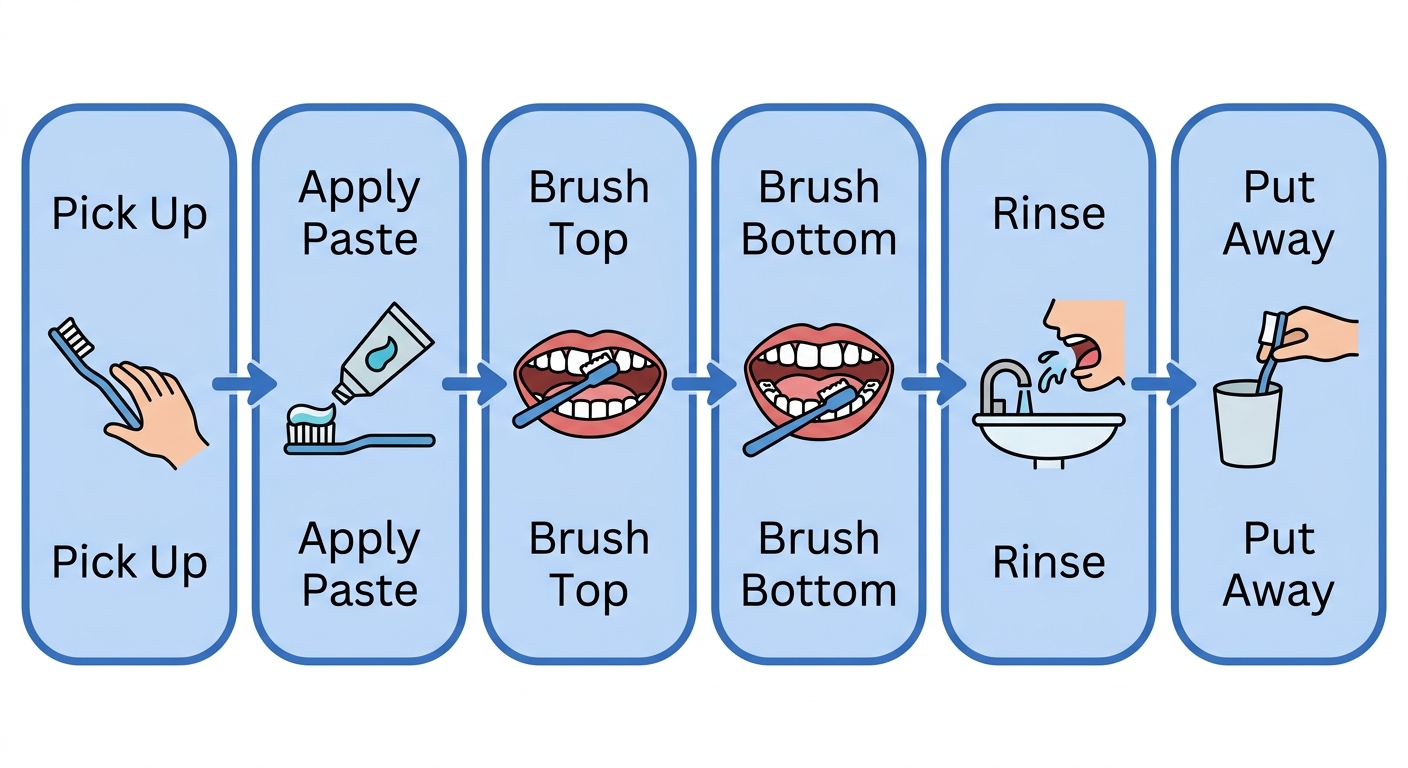
Toothbrushing task analysis broken into six simple steps for ABA learners.
This systematic approach ensures each small step is mastered before moving to the next, building confidence and independence. Once the steps are defined, therapists use forward or backward chaining to teach them in sequence. Our FAQ provides a detailed illustration of task analysis applied to handwashing, demonstrating how adaptive behavior activities become manageable through careful structuring.
Set Up Your Home for Successful Learning
Now that we understand how ABA daily living skills lay the foundation for growth, let’s focus on the environment where these skills are practiced. At Golden Touch ABA, our in-home ABA therapy model thrives when the home is arranged to support learning. A thoughtfully prepared space helps children develop functional life skills and adaptive behavior skills naturally as they go about their day.
Designate a quiet, distraction-free area for focused learning sessions. Use visual schedules and labeled bins to promote predictability and independence. Place communication boards and reward systems at your child’s eye level to encourage easy access. Consistent daily routines help your child anticipate transitions and reduce anxiety. Weave learning into everyday moments like mealtime, dressing, and play to reinforce skills in context. Keep rooms safe and clutter-free to minimize sensory overload and allow relaxed movement.
When your home becomes a partner in learning, the upcoming routines for mastering daily living skills feel more natural and successful.
Prompt and Fade to Teach New Routines
When teaching aba daily living skills, therapists use prompting and fading—offering cues, then gradually removing them. Prompting can be verbal, physical, or visual. Fading transfers control to natural cues.
We adjust support using a prompt hierarchy, such as least-to-most prompting, based on progress. For instance, your child might start toothbrushing with hand-over-hand guidance, move to a visual schedule, and then do it alone. We teach functional life skills like hand washing and room cleaning through adaptive behavior activities. Our BCBAs and RBTs collect data to tailor prompt levels, providing just-right support. This reduces prompt dependence and fosters smoother transitions. By fading in small steps, we harness the power of small steps to build independence. At Golden Touch ABA, prompting and fading are central to our in-home therapy, helping children master everyday routines. Through consistent aba daily living skills practice, children gain confidence. Next, we’ll show a step-by-step example of prompting for a morning routine.
Reinforce Small Wins and Build Momentum
Progress in ABA daily living skills happens one small step at a time. When we celebrate each achievement, your child builds the confidence and motivation to keep learning.
We teach daily living skills in ABA by breaking complex tasks into manageable micro-steps. For instance, brushing teeth becomes a series of simple actions: picking up the toothbrush, applying toothpaste, and brushing the front teeth first. These adaptive behavior activities give your child clear, achievable goals. Positive reinforcement follows each success, whether it is verbal praise, a favorite activity, or a token system that tracks progress.
As a parent or caregiver, you are essential to building momentum. The encouragement you provide between therapy sessions at home helps functional life skills stick and generalize to daily routines. At Golden Touch ABA Therapy, the power of small steps guides our evidence-based approach in Salt Lake County, Utah County, Weber County, Davis County, and across Arizona and Maryland. We emphasize family-centered care because consistent practice turns small wins into lasting independence.
Results vary for every child, but steady reinforcement creates real progress. When you look ahead, tracking gains and adjusting goals keeps the journey moving forward.
Help Your Child Generalize Skills Across Routines
At Golden Touch ABA, we integrate aba daily living skills into every session to help your child build essential functional life skills. Skill generalization is the ability to use a learned behavior across different settings, people, and times—and in-home ABA therapy makes this easier because skills are practiced in your child’s own home and community.
Our BCBAs and RBTs coach parents on consistent prompting and reinforcement, weaving adaptive behavior activities into everyday moments. For example, we’ll embed tooth-brushing into your child’s morning routine, turn mealtimes into language-practice opportunities, and build calming techniques into bedtime. Each small step adds up, and we celebrate every success.
Generalization takes time, but the power of small steps keeps progress steady. In our warm and welcoming environment, we partner with your family to create a personalized plan that fits your unique routines. Reach out to your BCBA to explore how we can support your child’s growth across all the moments that matter.
Monitor Progress and Celebrate Milestones
After setting goals for daily living skills, we monitor progress in ABA daily living skills training through careful data collection. Our BCBAs and RBTs use objective measures—frequency, duration, and trial-by-trial recording—to track each child’s advancement toward personalized goals. The Behavior Analyst Certification Board (BACB) requires that all treatment decisions be grounded in data, and we communicate this progress openly with families.
We celebrate every small milestone, knowing they build confidence and motivation for the learner and whole family. Because our care is family-centered, caregivers actively participate in monitoring progress during in-home sessions and practice at home. Even modest gains, like holding a toothbrush independently or waiting a few seconds longer, are powerful steps forward.
These adaptive behavior activities mark real-world progress in functional life skills such as hygiene, communication, and waiting. By recording each attempt and success, our team can pinpoint exactly which skills are improving, and those data-based celebrations reinforce the child’s motivation. Outcomes vary for each child, so we celebrate effort and progress rather than promising specific results.
Consistent tracking also helps us recognize when a strategy needs adjusting, so we can adapt the plan as needed, a topic we explore next.
Overcoming Common Obstacles in Daily Living Skills Training
When guiding children through ABA daily living skills, families and therapists often encounter roadblocks that seem to slow momentum. These moments are a normal part of learning and signal valuable opportunities for growth.
Common obstacles we see include:
- Limited generalization of skills to new settings.
- Resistance or low motivation during practice.
- Inconsistent routines between therapy and home life.
- Environmental distractions that interrupt focus.
Breaking tasks into small, manageable steps through task analysis reduces feelings of overwhelm and builds steady momentum. We pair this approach with positive reinforcement that’s tailored to the learner’s unique preferences, which often increases engagement and cooperation even during challenging moments.
Prompting and fading techniques help children gain independence without frustration. We provide the right level of support initially, then gradually step back as confidence builds. To strengthen generalization, we practice adaptive behavior activities in natural, real-world contexts — during mealtime, in the bathroom, or while getting dressed at home.
Caregiver involvement and consistent follow-through are critical for lasting progress. When families use the same strategies we introduce during daily living skills instruction, functional life skills become woven into everyday routines. In our in-home ABA therapy model, we bring strategies right into your living room, kitchen, and backyard, making generalization more seamless.
Celebrating small wins reinforces the power of small steps and keeps motivation high. Every step forward matters. With patience, tailored support, and a warm and welcoming environment, we see children make meaningful strides toward independence. Although individual progress varies, our family-centered care approach keeps the focus squarely on each learner’s unique journey.
Continuing the Journey Toward Independence
We believe that developing daily living skills is at the heart of every child’s growth. Through ABA daily living skills training, children and adolescents learn essential tasks like dressing, grooming, and meal preparation—functional life skills that build confidence and autonomy. Our approach integrates adaptive behavior activities into every session, helping each individual strengthen communication, social interactions, and self-care.
Family-centered care is central to our work. We equip parents and caregivers with the tools to support their child’s progress in everyday settings. The power of small steps creates lasting change, and our warm and welcoming environment ensures that learning feels natural and encouraging. Our evidence-based practices form the foundation of everything we do.
For families near Spring Lake, our in-home ABA therapy in Spring Lake, Utah brings personalized support to your home, reinforcing ABA daily living skills in familiar surroundings. If you’re ready to explore how ABA can help your loved one move toward greater independence, we’re here to guide the next step.
