
ABA Therapy CPT Codes: Complete Guide for Providers
Table of Contents
- Decoding ABA Therapy CPT Codes: A Guide for Families
- Understanding ABA Therapy CPT Codes
- Billing Code Differences and Telehealth Coverage
- Practical Steps for Accurate ABA Coding and Insurance Claims
- State Autism Insurance Mandates and 2026 Updates
- Frequently Asked Questions About ABA Therapy Billing
- Navigating ABA Billing with Confidence
Decoding ABA Therapy CPT Codes: A Guide for Families
Navigating the world of ABA therapy often begins with understanding how insurance works, and at the heart of it are ABA therapy CPT codes. These are the standardized billing codes insurance companies use to identify each specific service your child receives during their in-home ABA therapy.
Understanding medical necessity for ABA therapy is key to seeing why certain codes are approved. Our guide explains that medical necessity is the standard insurers use to determine if treatment is reasonable and required. This documentation is what allows us to bill a specific CPT code for the services delivered by our team.
Each CPT code represents a unique service, and we’re here to help you review your statements with confidence. Here are the most common codes you will see:
- 97151: A behavioral assessment conducted by a BCBA to create your child’s initial or ongoing treatment plan.
- 97153: Direct one-on-one therapy provided by a Registered Behavior Technician (RBT) to build new skills.
- 97155: Protocol modification, where a BCBA supervises the treatment plan and adjusts goals based on your child’s progress.
- 97156: Caregiver training delivered by a BCBA or RBT to help you integrate evidence-based practices at home.
We advise you to cross-check these codes on your Explanation of Benefits (EOB) with the sessions your child actually attended to catch any potential mistakes. As part of our family-centered care, we are always here to answer your questions about ABA therapy billing codes, even as coverage details can vary by insurance plan. Please remember that insurance coverage is always subject to verification and is not guaranteed.
Understanding ABA Therapy CPT Codes
Current Procedural Terminology (CPT) codes serve as the standardized language for billing medical and behavioral health services, including ABA therapy CPT codes used in autism treatment. When we deliver in-home Applied Behavior Analysis therapy, our team uses specific Category I CPT codes from the American Medical Association to document each session type accurately. These codes help ensure that your child’s treatment is properly recorded, supporting transparent communication with insurers and allowing us to focus on what matters most: your child’s progress in a warm and welcoming environment.
The most common CPT codes for ABA therapy break down into three distinct categories based on who provides the service and the nature of the session. Each code is billed in 15-minute units, so the total units on a claim reflect the exact duration of care delivered. Understanding these codes gives you insight into how treatment sessions are structured and why different team members play different roles in your child’s plan.
The following table compares the most frequently used Category I CPT codes for ABA therapy, including their descriptions, typical applications, and billing unit values.
| Code | Description | Typical Use | Billing Unit |
|---|---|---|---|
| 97153 | Adaptive behavior treatment by protocol | Direct one-on-one therapy by RBT under BCBA supervision | 15 minutes |
| 97155 | Adaptive behavior treatment with protocol modification | BCBA modifying treatment plan during session with client | 15 minutes |
| 97156 | Family adaptive behavior treatment guidance | Parent/caregiver training and guidance sessions | 15 minutes |
97153 represents the direct, one-on-one therapy that most families picture when they think of ABA services. A Registered Behavior Technician (RBT) implements the treatment protocol designed by a Board Certified Behavior Analyst (BCBA), working with your child on specific skill-building or behavior-reduction goals. Because RBTs deliver the bulk of hands-on therapy hours, 97153 is often the most frequently billed code in a comprehensive treatment plan. Our BCBAs maintain close supervision over every session, ensuring that evidence-based practices guide each interaction.
When the BCBA needs to modify the treatment plan during a session, we use 97155. This code applies when the supervising analyst is present and actively adjusting the protocol based on real-time observations. For example, if a particular reinforcement strategy isn’t producing the expected engagement, the BCBA can revise the approach immediately and document that clinical decision. This dynamic oversight ensures that your child’s program evolves as their needs change.
Family-centered care is at the heart of 97156, the code for family adaptive behavior treatment guidance. These sessions focus on parent and caregiver training, equipping you with the strategies and confidence to reinforce therapeutic techniques outside of formal therapy hours. Whether we are working on communication prompts, behavior management, or daily living skills, 97156 sessions strengthen the consistency between our team’s work and your family’s routines. We believe in the power of small steps, and caregiver guidance sessions often become the foundation for lasting progress at home.
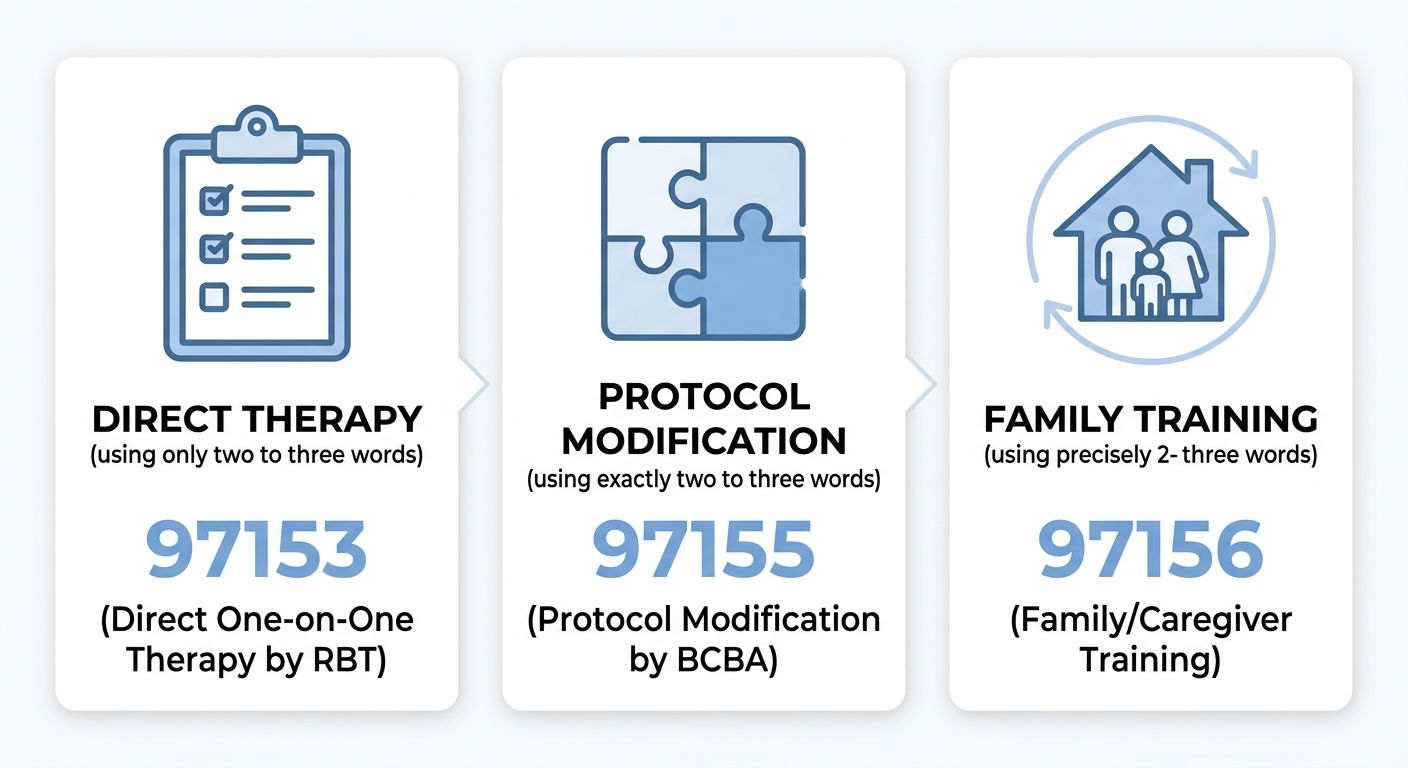
Common ABA therapy CPT codes visualized for easy reference.
Proper code selection depends on who is providing the service and what the session is designed to accomplish. Only RBTs working under BCBA supervision should deliver services billed under 97153, while 97155 and 97156 require the direct involvement of the supervising analyst. Misapplying codes can trigger claim denials or audits, which is why our team carefully documents every session and matches the code to the clinical activity performed.
Beyond accurate billing, these codes connect directly to the concept of medical necessity for ABA therapy. Insurers typically require that the services billed under 97153, 97155, and 97156 be supported by documentation showing that treatment is medically necessary. Our internal resources explain how a formal autism diagnosis, documented functional impairments, and a reasonable expectation of improvement all contribute to establishing that necessity. By aligning CPT codes with thorough clinical records, we help families navigate the authorization process while keeping the focus on high-quality, individualized care.
Understanding ABA therapy CPT codes is a valuable step toward understanding the overall treatment process. In the next section, we’ll explore how these codes fit into insurance coverage and benefits verification — because knowing what your plan covers starts with knowing how your child’s services are coded and submitted.
Billing Code Differences and Telehealth Coverage
Moving from general billing challenges, we focus on specific ABA therapy CPT codes that shape accurate claims. At Golden Touch ABA Therapy, family-centered care guides our documentation, ensuring each session is coded correctly for reimbursement.
97153 vs. 97155: Direct Therapy and Protocol Modification
97153 applies to direct therapy by an RBT, such as discrete trial training or incidental teaching, delivered one-on-one. It captures face-to-face time in 15-minute units. For example, when teaching a child to request items, the technician follows the treatment plan and tracks minutes. Meanwhile, 97155 is used when the BCBA oversees and modifies the protocol during a session—adjusting reinforcement or prompting strategies based on real-time observation. This code accounts for clinical supervision and adaptation, not direct implementation. Distinguishing between implementation and protocol modification prevents billing errors and supports compliance. Our team helps families navigate these ABA therapy CPT codes with clarity.
Initial Assessment Codes and Telehealth Modifiers
Before therapy begins, 97151 covers the initial assessment, including the treatment plan and behavior evaluation. This code establishes the child’s baseline and must be supported by robust documentation. For telehealth, we append modifier 95 for synchronous video sessions or GT for interactive audio/video, as required by payers. Accurate modifier use confirms that services meet the medical necessity for ABA therapy criteria. However, aba therapy insurance coverage for virtual visits can vary, and state autism insurance mandates may influence payer policies. We handle the verification process so families can experience the power of small steps in a warm and welcoming environment.
To clarify these distinctions, compare telehealth and in-person billing:
| Aspect | In-Person | Telehealth |
|---|---|---|
| CPT Codes Used | Standard codes (97153, 97155, etc.) | Same codes plus appropriate modifier |
| Required Modifier | None | 95 (synchronous) or GT (interactive audio/video) |
| Billing Unit | 15-minute increments | Same 15-minute increments |
| Payer Coverage | Standard for most plans | Varies by plan; may require prior authorization |
The table highlights that core coding remains consistent, while modifiers and prior authorizations add complexity. We verify benefits for each family, advocating for coverage where possible. With these foundations in place, precise unit calculation ensures billing integrity.
Calculating Billing Units Accurately
Converting therapy minutes into billable units follows strict rules:
- Track total minutes per code, such as 97153, for the session.
- Use the mid-session rule: at least 8 minutes of a 15-minute block counts as one unit. For 23 minutes, bill 1 unit; for 24 minutes, bill 2 units.
- Never combine minutes from different codes—calculate units separately.
- Align units with the prescribed treatment plan to support medical necessity.
Proper unit calculation prevents audits and claim denials. Remember, insurance coverage is subject to verification and is not guaranteed. Staying current on ABA therapy CPT codes safeguards your practice. In the next section, we’ll review practical claim submission steps and common errors to avoid.
Practical Steps for Accurate ABA Coding and Insurance Claims
To ensure accurate reimbursement and avoid claim denials, we recommend following these practical steps. Understanding ABA therapy CPT codes is essential for any provider or caregiver navigating the insurance landscape. Here at Golden Touch ABA Therapy, we believe in family-centered care and the power of small steps to make big progress.
Verifying Insurance Coverage for ABA Therapy
We guide families through the verification process to avoid surprise bills. Start by asking your insurance provider: Is ABA therapy a covered benefit? Does it require prior authorization and what documentation is needed? Are there visit caps or age limits? Always request a written benefit summary listing exclusions and copays. Our team helps you gather the diagnostic report and Letter of Medical Necessity required by most insurers.
Understanding your plan type is just as important, because coverage rules differ significantly. Some state autism insurance mandates require fully-insured health plans to cover ABA therapy, but self-funded employer plans are regulated by federal ERISA law instead. It’s important to understand that some employer health plan exemptions may limit coverage even if your state has a mandate. The table below contrasts the two most common plan structures to help you anticipate your coverage and appeal rights.
| Feature | Fully-Insured Plan | Self-Funded Plan |
|---|---|---|
| Regulated by State Mandates | Yes — must comply with state autism insurance laws | No — exempt from state mandates under ERISA |
| Coverage for ABA Therapy | Often covered if state mandate exists | Varies by employer; not guaranteed |
| Appeal Rights | Available through state insurance department | Available through ERISA/federal claims process |
| Premium Structure | Fixed premium paid to insurer | Employer pays actual claims + administrative fees |
If your plan is fully-insured in a state with an autism mandate, you’re more likely to have robust coverage. For self-funded plans, verify benefits directly with the plan administrator and be prepared for a federal appeals process if needed. Always consult with your insurance provider before services begin.
Documenting Therapy Sessions for Reimbursement
Once coverage is confirmed, thorough documentation is the foundation for successful reimbursement. For common ABA therapy CPT codes such as 97155 (treatment modification), 97153 (technician-delivered therapy), and 97156 (family guidance), session notes must include key elements. We recommend that every note contain the date and time of service, the setting (home, community), a clear description of the activities performed, the client’s response to interventions, and the data collected — such as frequency, duration, or latency of target behaviors. The note should tie directly to the treatment plan goals and demonstrate how the session promoted meaningful progress.
Compliance with payer documentation standards is critical. Many insurers require notes to be completed within 24 hours, signed by the rendering provider, and to contain objective, measurable information. At Golden Touch ABA Therapy, our BCBAs and RBTs follow a standardized checklist to ensure every note meets these expectations. Please remember that outcomes vary, and this information does not replace professional medical advice. Insurance coverage is subject to verification and is not guaranteed. Please review our Privacy Policy and Terms & Conditions for more information about how we handle your data.
Common Coding Errors to Avoid
Even with verified coverage and detailed notes, coding mistakes can lead to claim denials. A frequent error is unbundling codes, such as billing both 97155 and 97153 on the same day without proper documentation of separate services. This often results in rejections. Another common mistake is inappropriate use of Modifier 59. This modifier should only be applied when two distinct procedural services are performed during the same session, and the note must clearly justify the separation. Using it without support invites audits. Unit rounding errors are also common. ABA is billed in 15-minute units. Under the 8-minute rule, a 53-minute session should be billed as three units, not four. Double-check your calculations and stay informed about payer-specific rounding rules.
We recommend auditing claims before submission and maintaining clear communication with your billing team. Careful verification, thorough documentation, and accurate coding will reduce denials and let you focus on delivering family-centered care. In the next section, we’ll discuss state mandates in more detail.
State Autism Insurance Mandates and 2026 Updates
While the federal mental health parity law sets important baselines, state autism insurance mandates are what truly require many health plans to include ABA therapy insurance coverage. These laws mandate that state-regulated plans cover evidence-based autism treatments like Applied Behavior Analysis, preventing insurers from excluding them as experimental or educational.
A critical detail families must understand is that not all health plans must follow these rules. According to the U.S. National Library of Medicine, self-funded employer plans are exempt from state mandates under ERISA, while fully-insured plans—where the employer buys insurance from a carrier—are generally bound by them.
To illustrate how protections differ, the table below compares annual benefit limits and age caps across four representative states.
| State | Annual Benefit Limit | Age Limit | Important Notes |
|---|---|---|---|
| California | No annual dollar cap | Up to age 18 (some plans up to 21) | Coverage required for all plans regulated by DMHC |
| Texas | $30,000 (ages 0-3), $60,000 (ages 4-8), $36,000 (ages 9-15) | Up to age 15 (with exceptions) | Limits vary by age group; some plans have higher caps |
| New York | No annual dollar cap | No age limit specified | Coverage required for all state-regulated plans |
| Florida | $36,000 per year | Up to age 18 | Self-funded plans exempt; no annual cap for fully-insured |
As the table shows, state-level coverage requirements range from generous, no-cap policies in California and New York to the tiered caps in Texas and the flat limit in Florida. These variances mean that your child’s age and your employer’s plan type can dramatically affect what ABA services are accessible.
State autism insurance mandates can evolve through new legislation or administrative updates, so it’s wise to verify current rules with your state insurance department. We recommend using the interactive tools and benefits eligibility support we offer to help you navigate these complexities. Insurance coverage is subject to verification and is not guaranteed. With a clearer picture of what state laws provide, the next step is understanding how those benefits translate into the CPT codes and billing processes that providers use every day.
Frequently Asked Questions About ABA Therapy Billing
What is medical necessity for ABA therapy?
Medical necessity is the clinical justification insurers require to cover ABA therapy. Our team compiles evidence like a formal autism diagnosis, a functional behavior assessment, and an individualized treatment plan to show why services are essential for skill-building and behavior reduction. Without this documentation, authorization may be denied.
How do I verify my ABA therapy insurance coverage?
We verify benefits before treatment begins by contacting your insurer directly. Our team reviews the details of your plan, confirms whether we are in-network or out-of-network, and explains any copays, deductibles, or visit limits you might have. This step ensures transparency and helps families plan for their in-home ABA therapy journey.
What are the most common CPT codes for ABA therapy?
Common ABA therapy CPT codes include 97151 for assessments and 97153–97158 for treatment services. Codes like 0362T and 0373T may also appear for specific interventions. Accurate coding is part of our evidence-based practices and helps align clinical documentation with insurer requirements.
Does my state have autism insurance mandates?
Many states have autism insurance mandates requiring certain plans to cover ABA therapy, but rules vary widely. Our team stays current on state autism insurance mandates in Utah, Arizona, and Maryland to help families understand what their policy may include. We recommend consulting a licensed healthcare professional for diagnosis or medical advice.
How does billing work for in-home ABA therapy?
Billing is handled by our administrative team after each session using the appropriate ABA therapy CPT codes. We submit claims directly to your insurance provider and track authorizations to maintain continuity of care. Families receive updates so they can focus on family-centered care rather than paperwork.
Why isn’t insurance coverage for ABA therapy guaranteed?
Even with a strong medical necessity case, coverage depends on your specific plan’s benefits and the insurer’s policies. Initial authorization does not guarantee ongoing payment, and reauthorization may require updated documentation. Insurance coverage is subject to verification and is not guaranteed; results may vary, and no guaranteed outcomes are implied.
What role does the BCBA play in billing?
The BCBA designs the treatment plan and writes the letter of medical necessity that supports billing. Supervisory hours, protocol modifications, and caregiver training are coded under the BCBA’s credentials. The power of small steps is reflected in the BCBA’s ongoing data review, which helps justify continued authorization.
How does an RBT contribute to billing?
The RBT delivers one-on-one therapy under BCBA supervision, and their direct service hours are billed using treatment codes. Session notes and data collected by the RBT provide objective evidence of progress, reinforcing the medical necessity documentation our team submits.
Our team is here to support your family through every step of the billing process. Please contact us with questions about your specific coverage. Privacy Policy applies to collection and use of your personal information, and Terms & Conditions govern website use and limit liability.
Navigating ABA Billing with Confidence
Understanding insurance billing is a vital part of your family’s journey with in-home ABA therapy. This process involves submitting claims for services identified by ABA therapy CPT codes — standardized medical codes that ensure assessment, treatment, and supervision are properly documented.
Navigating aba therapy insurance coverage can feel overwhelming, from pre-authorizations to detailed documentation, but our insurance assistance team is here to help. We offer free benefits verification and guide you through private insurance or options supported by state autism insurance mandates. Insurance coverage is subject to verification and is not guaranteed.
Resources
- Who Can Write a Letter of Medical Necessity for ABA
- Explore Surgeon General Guidelines for ABA Medical Necessity
- Understand How Insurance Determines Medical Necessity for ABA
- Discover Insurer Criteria for ABA Medical Necessity
- Discover the Four Required Documents for ABA Medical Necessity
- Get the Complete Insurance Guide for ABA Medical Necessity
- Explore ABA Therapy Coverage Limits in Utah by Insurance
- Explore NCBI’s Biomedical and Genomic Databases
