
ABA Therapy Waitlist in Salt Lake City: Fast Intake Process
Table of Contents
- Finding ABA Therapy Without the Waitlist in Utah, Arizona, and Maryland
- Understanding the Causes of ABA Therapy Waitlists
- Evaluating ABA Providers with Immediate Openings
- Steps to Secure Fast Enrollment in ABA Therapy
- Maximizing the Benefits of In-Home ABA Therapy
- Common Questions About ABA Therapy Waitlists
- Taking the Next Step Toward ABA Therapy Without the Wait
Finding ABA Therapy Without the Waitlist in Utah, Arizona, and Maryland
Aba therapy waitlist issues often leave families feeling stuck, but Golden Touch ABA Therapy offers a different path. We provide in-home ABA therapy with no waitlist across Utah, Arizona, and Maryland, so your child can start receiving support without delay.
We’ve streamlined the aba therapy intake process so families can move forward quickly. After an initial assessment and insurance verification, our team coordinates a start date that works for you. There’s no long delay — with our no-waitlist approach, your child can begin therapy right away. This means your family can access immediate aba therapy without the typical weeks of waiting.
Our experienced BCBAs and RBTs deliver personalized, family-centered care right in your home. We believe in The power of small steps — each session builds on the last, creating measurable progress in a warm and welcoming environment. Our evidence-based practices ensure every small step is meaningful. Through our in-home ABA therapy, we focus on building communication, social, and daily living skills. For an immediate estimate of benefits, try our Interactive ABA Roadmap, which provides a quick assessment and helps you understand what services may be available.
If you’re ready to skip the wait and get started, reach out to our team today. We’ll guide you through the next steps and help you access the support your child deserves. Please note that results may vary, and insurance coverage is subject to verification. As always, consult a licensed healthcare professional for your child’s individual needs.
Understanding the Causes of ABA Therapy Waitlists
To understand why ABA therapy waitlist delays occur, it’s helpful to explore the primary factors driving them. According to the U.S. National Institutes of Health (via NCBI), rising autism diagnosis rates have led to an unprecedented demand for ABA therapy services. This increase means more families are seeking BCBA-supervised sessions, which often extends wait times significantly. Our team at Golden Touch ABA sees this consistently — the need for specialized, evidence-based care simply outpaces the supply in many areas.
Beyond the high demand, limited numbers of certified therapists further inflate the waitlist for autism therapy. Many regions struggle to recruit enough BCBAs to meet community needs, particularly when families require in-person support. Complicating matters, the ABA therapy intake process can introduce additional delays. Complex insurance verification and lengthy paperwork requirements slow down the start of therapy, even when a provider appears to have an opening. As Golden Touch ABA’s internal FAQ notes, navigating approvals, authorizations, and billing codes is a common pain point for families.
The following table summarizes the most common waitlist causes and actionable solutions.
| Cause | Solution |
|---|---|
| High demand for BCBA-supervised therapy | Expand search to in-home providers with available BCBAs |
| Limited number of certified therapists in certain regions | Consider providers serving multiple states like Golden Touch ABA |
| Complex insurance verification and intake processes | Work with providers that offer insurance assistance |
Fortunately, there are practical steps families can take to find immediate ABA therapy for their loved ones. Broadening the search radius to include in-home providers can bypass many of these hurdles: therapists who travel to your home, such as those at Golden Touch ABA, often have more flexible availability. Additionally, choosing a provider that serves multiple states can help avoid regional therapist shortages. Working with a team that offers insurance assistance streamlines the intake process, ensuring paperwork and approvals do not become barriers. For children with more intensive needs — often described as low functioning autism — waitlists can be especially long, but in-home ABA therapy frequently provides a shorter path to the personalized support they require.
By recognizing these causes and implementing targeted solutions, families can move beyond the frustration of waiting. The next section will explore specific steps to find immediate ABA therapy openings, from questions to ask providers to understanding the intake timeline.
Results may vary; consult a licensed professional for individual advice.
Evaluating ABA Providers with Immediate Openings
Beginning ABA therapy shouldn’t feel like an endless waiting game, yet many families encounter ABA therapy in Maryland and across the country only to find discouraging three-to-six-month delays. Understanding how to identify providers with genuine, immediate openings can transform your family’s timeline from frustrating to empowering. At Golden Touch ABA Therapy, we believe that families seeking immediate ABA therapy deserve clear, actionable criteria for evaluating their options, and this overview helps you spot the difference between a provider that can start within days and one that requires months of patience.
A provider with a shortened ABA therapy waitlist typically shares several defining characteristics that go beyond simply having an available therapist. These organizations often maintain flexible scheduling protocols that allow them to match families with clinical teams quickly, rather than operating on rigid, semester-based intake cycles. Dedicated insurance verification teams handle the administrative legwork in parallel with clinical preparations, meaning your child’s treatment plan isn’t stalled while waiting for authorization calls. Multi-county or multi-state coverage further distinguishes these providers, as they can distribute demand across a wider geography and shift resources toward areas with the most urgent needs. When you call a provider, asking directly about their current average time from first contact to first session reveals whether they truly have capacity or are simply building a list for future openings.
Key Criteria for Identifying Providers with No Waitlist
Finding providers that offer no-waitlist ABA therapy requires looking beyond marketing claims and examining operational capabilities. The most reliable indicators include a dedicated intake coordinator who responds within one business day, transparent communication about current staffing levels in your specific area, and a willingness to schedule an initial assessment within the same week of your inquiry. We recommend verifying therapist credentials through the Behavior Analyst Certification Board (BACB) certificant registry, which allows you to confirm that any assigned BCBA holds an active, unrestricted certification. This step ensures that speed doesn’t compromise quality, as the BACB sets rigorous standards for professional conduct and ongoing education that all certified behavior analysts must maintain.
Another critical factor is the provider’s approach to insurance. Organizations that invest in internal insurance assistance teams, rather than expecting families to self-verify benefits independently, often demonstrate operational maturity that correlates with faster starts. They can simultaneously process authorizations while scheduling assessments, eliminating sequential delays. Ask whether the provider handles Medicaid, commercial plans, and any secondary coverage, and how long their average authorization turnaround takes. The combination of credential transparency and proactive insurance support strongly predicts a provider’s ability to deliver on their promise of quick-start ABA programs rather than just collecting intake forms for later review.
Comparing Provider Types: In-Home vs. Center-Based Availability
In-home ABA therapy fundamentally shifts the availability equation because it removes facility constraints from the scheduling process. When a provider delivers services in your child’s natural environment, they can assign a Registered Behavior Technician (RBT) and supervising BCBA to your home without waiting for a dedicated treatment room or clinic slot to open. This model thrives on distributed resources, meaning that a provider with clinicians living throughout a metropolitan area can match families to nearby therapists far more flexibly than a center that must manage limited physical space. We design our treatment plans around your home’s rhythm, creating a warm and welcoming environment where learning unfolds naturally rather than in an unfamiliar clinical setting.
Center-based programs, while offering valuable peer interaction and structured learning spaces, inherently face capacity ceilings tied to their physical footprint. Each therapy room can accommodate only so many concurrent sessions, and expanding capacity often requires leasing, build-out, and regulatory approvals that take months. Families pursuing center-based services frequently encounter waitlists driven not by therapist shortages but by square footage limitations. In contrast, the in-home model allows providers to grow their clinical team proportionally with demand, adding BCBAs and RBTs who immediately serve families across a distributed geography. This structural advantage explains why many families seeking immediate ABA therapy find faster starts with providers that prioritize home-based delivery while still offering the same evidence-based, family-centered care that defines quality treatment.
The Role of Provider Network Size in Wait Times
Organizations that operate across multiple states or counties hold a meaningful advantage in reducing local waitlists, as they can redistribute demand across a broader network when capacity tightens in one region. A provider serving Salt Lake County, Utah County, and Davis County in Utah, or maintaining offices from Baltimore to Phoenix, can shift clinical resources toward communities with the most pressing needs while continuing to accept new families everywhere. This networked approach means that even if your specific zip code has high demand, the organization’s aggregate staffing levels may still support a rapid start. At Golden Touch ABA Therapy, our multi-state presence—including our Maryland office in Baltimore—enables us to coordinate scheduling and maintain shorter wait times than single-location providers that depend entirely on one office’s limited bandwidth.
Before selecting a provider, consider how their geographic reach affects both immediate availability and long-term continuity. A provider with regional depth can offer backup therapists if your primary RBT is unavailable, ensuring your child’s progress continues without interruption. This resilience stems from network size, not just staffing numbers. The table below compares the practical differences you can expect when evaluating providers with immediate openings against those operating from a single location with typical waitlist constraints.
The following table contrasts providers with immediate openings against typical long-waitlist providers across the dimensions most relevant to families starting their ABA journey.
| Provider Characteristic | Immediate Opening Provider | Typical Waitlist Provider |
|---|---|---|
| Wait time | Less than 2 weeks | 3–6 months |
| Initial assessment | Scheduled within days | Scheduled weeks out |
| Service areas | Multi-state coverage | Single location |
| Insurance assistance | Dedicated support | Self-verify |
The differences illustrated above extend beyond simple convenience into the realm of developmental momentum. When your child waits six months for an initial assessment, critical windows for early intervention narrow, and families often report increased stress navigating the gap between diagnosis and treatment. Providers offering multi-state coverage and dedicated insurance support address both the clinical and administrative bottlenecks that cause those delays. As you evaluate your options, remember that the ABA therapy intake process is explored in greater detail in the next section, where we walk through what to expect after you select a provider and schedule that crucial first assessment.
Prioritize providers that combine credential transparency, in-home delivery, and broad geographic coverage. Verify BCBA certifications independently through the BACB registry, ask pointed questions about current wait times in your specific area, and observe whether the provider handles insurance complexities on your behalf. These criteria, applied consistently, lead you toward organizations capable of honoring their commitment to evidence-based practices without asking your family to wait months for the support you need right now.
Steps to Secure Fast Enrollment in ABA Therapy
Navigating an aba therapy waitlist can feel overwhelming, but getting started with in-home support doesn’t have to be a drawn-out process. At Golden Touch ABA Therapy, we designed every step of the intake process to move families from initial contact to active sessions as smoothly and quickly as possible. The power of small steps begins the moment you reach out—our team works to minimize wait times for ABA therapy while still making sure every child receives a thoughtful, individualized start. Whether you are looking for immediate aba therapy or simply want to understand the typical aba therapy intake process, knowing the pathway can help you secure quick enrollment steps with confidence.
How the Intake Process Works for In-Home ABA Therapy
Starting in-home ABA therapy with us follows a friendly, structured sequence so nothing gets overlooked. The first step is making initial contact by calling our office or filling out the online form on our website. After that, our team connects your family with a Board Certified Behavior Analyst (BCBA) who guides the next phase. The BCBA’s work is grounded in standards set by the Behavior Analyst Certification Board, which means the professional overseeing your child’s plan meets rigorous national requirements. During the intake conversation, we gather basic information about your child’s strengths and needs and confirm which of our service areas in Utah, Arizona, or Maryland fits your location.
Once the initial details are collected, we move into assessment scheduling and goal setting. A BCBA completes a thorough evaluation in your home, observing your child’s current skills and identifying areas where our support can make the biggest impact. We then collaborate with you to turn those observations into clear, measurable goals that become the foundation of a personalized treatment plan. Throughout this stage, our priority is keeping the conversation warm and practical so families feel informed rather than rushed.
The following table offers a quick view of how the intake process moves across states, based on Golden Touch ABA location and onboarding resources.
| Step | Utah | Arizona | Maryland |
|---|---|---|---|
| Initial contact | Online form or phone | Online form or phone | Online form or phone |
| Assessment scheduling | Within 1 week | Within 1 week | Within 1–2 weeks |
| Insurance verification | Assisted by provider | Assisted by provider | Assisted by provider |
| Therapy start | Within 2 weeks of assessment | Within 2 weeks of assessment | Within 3 weeks of assessment |
Families in Arizona and Utah can often see an assessment scheduled as quickly as within one week, while Maryland timelines may extend slightly. Even with that variation, every state benefits from having our staff handle insurance verification as a core part of the intake process, removing one of the biggest administrative hurdles caregivers face.
Insurance Verification and Eligibility Steps
Insurance verification doesn’t need to be a source of delay when you have the right support. We take the lead on contacting your plan to verify benefits, check eligibility requirements, and clarify any co-payment or deductible details before services begin. To keep this phase moving, we recommend gathering a few documents early: a copy of your insurance card, your child’s diagnosis report, and, if applicable, a referral from a pediatrician. Having those items ready often trims wait times for ABA therapy significantly.
Once we receive the information from your carrier, we walk you through what is covered and what, if any, out-of-pocket responsibilities may apply. Because every policy is different, we encourage families to review the results with us during a short phone call or secure message exchange. This step not only confirms coverage but also builds confidence that the financial side of care is settled before sessions begin. By handling insurance verification internally, we help families sidestep the paperwork confusion that so often interrupts the aba therapy intake process and makes it easier to move toward quick enrollment steps.
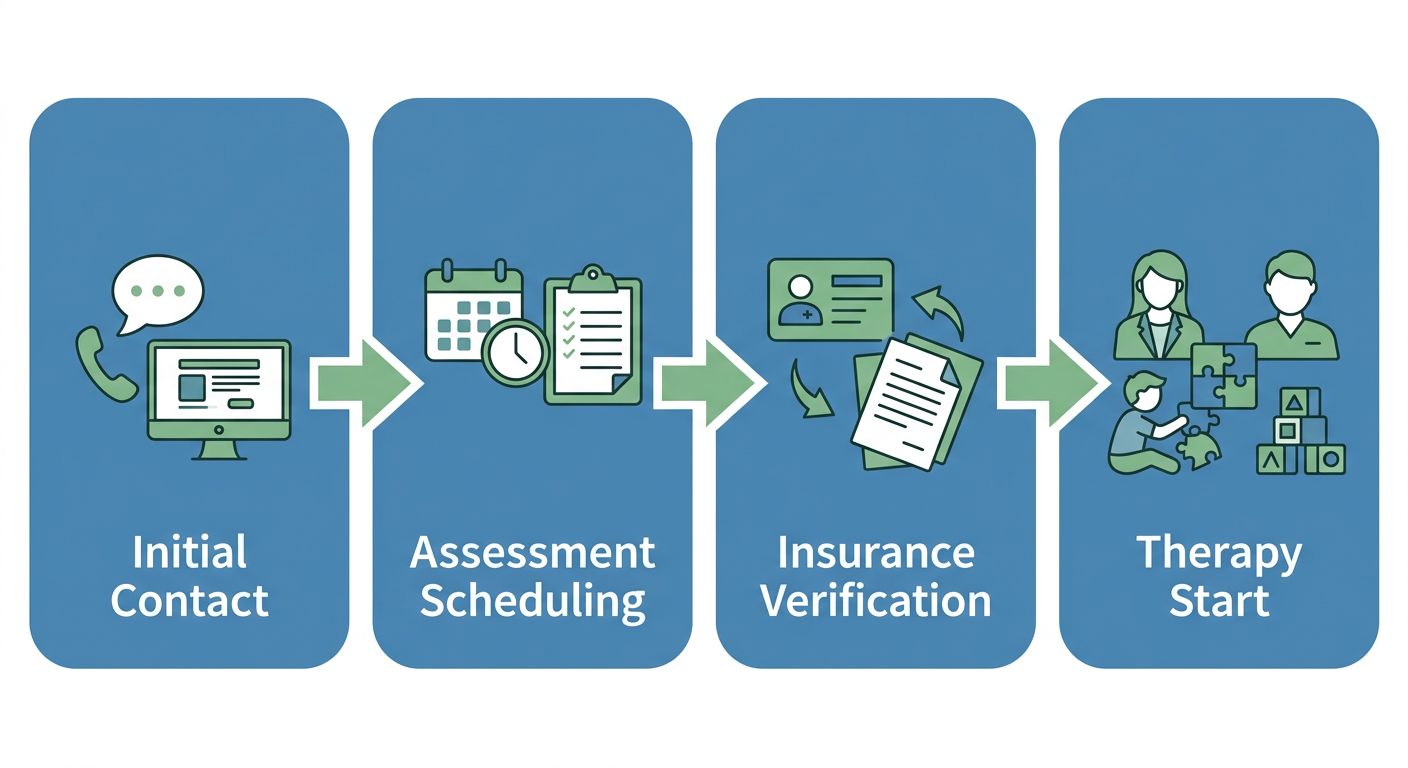
Four-step enrollment process for ABA therapy without waitlist.
Scheduling Your Initial Assessment Without Delay
After intake approval, the next priority is getting the initial assessment on the calendar. We recommend being as flexible as possible with your availability—scheduling during weekday mornings or early afternoons often opens more opportunities across our three-state service area. Our scheduling coordinators work directly with families in Utah, Arizona, and Maryland to align BCBA availability with days and times that fit your household. When a guardian can accommodate a wider window of time, it frequently shortens the gap between intake and that first in-home visit.
We also suggest confirming contact preferences early so our team can reach you immediately if an earlier slot opens. Whether we call your mobile number or send a text notification, staying responsive keeps the timeline tight. Once the assessment is completed, we finalize the personalized treatment plan and match your child with a Registered Behavior Technician (RBT) who will deliver direct therapy under the BCBA’s supervision. In Utah and Arizona, therapy commonly begins within two weeks of the assessment, and in Maryland we target a start within three weeks—still far quicker than the extended aba therapy waitlist many families anticipate. Insurance coverage is subject to verification and results may vary. Families ready to take the first step can use our online form or phone line to start the process today.
Maximizing the Benefits of In-Home ABA Therapy
After understanding how in-home ABA therapy works, the next step is learning how to get the most from every session. Our approach centers on delivering therapy in your child’s natural environment, which research consistently shows promotes better generalization of skills to everyday life. We believe in family-centered care and work closely with you to create a warm and welcoming environment where your child feels safe, supported, and ready to learn.
Many families searching for an aba therapy waitlist solution find that our in-home model removes common delays. By offering immediate aba therapy opportunities through a streamlined aba therapy intake process, we help children begin building essential skills without the long waiting periods that can slow developmental progress.
The following table compares key differences between in-home and center-based ABA therapy models across four important factors families consider when making their decision.
| Factor | In-Home ABA Therapy | Center-Based ABA Therapy |
|---|---|---|
| Setting | Child’s natural environment | Clinical setting |
| Supervision | BCBA-led, direct observation | BCBA-led, periodic observation |
| Family involvement | Highly integrated | Moderate |
| Scheduling flexibility | High (in-home times) | Fixed hours |
In-home therapy stands out for its deep integration of family participation and its flexibility, which reduces the stress of commuting and rigid schedules. When therapy happens where a child actually lives, the skills practiced during sessions transfer more naturally to daily routines, making every moment a potential learning opportunity.
Research from NCBI biomedical information reinforces that ABA interventions delivered in home and community settings produce meaningful, measurable outcomes. This evidence-based foundation guides our BCBA-led supervision model, where every session receives direct observation and real-time adjustments to the treatment plan. Parent and caregiver involvement is not just encouraged—it is a core part of how we practice. Our BCBAs provide hands-on training so you can reinforce strategies between sessions, turning the power of small steps into lasting progress.
Regular data collection and progress monitoring allow our team to refine interventions and demonstrate measurable gains over time. We also assist with insurance eligibility to make services more accessible. As you prepare to move forward, the next section walks through the specific steps to begin—from the initial intake process through insurance verification.
Results may vary; consult a licensed professional for medical advice.
Common Questions About ABA Therapy Waitlists
We understand just how hard it can be to sit on an ABA therapy waitlist while you wait for your child to begin the services they need. We believe in the power of small steps, which is why the team at Golden Touch ABA is committed to moving families through the process as smoothly and quickly as possible.
How long is the wait for ABA therapy?
Wait times for an ABA waiting list vary widely depending on your location, insurance verification, and the current availability of our clinical team. In many cases, families can anticipate waiting anywhere from a few weeks to a couple of months. We work hard to minimize this wait period by providing family-centered care and in-home services designed to start sooner than traditional clinic models.
What can I do to get ABA therapy faster?
Completing your paperwork and verifying insurance benefits right away are the most effective ways to shorten your time on the waitlist for ABA services. Our team also offers a streamlined ABA therapy intake process that includes a behavioral assessment to identify your child’s specific needs without delay. For families actively seeking faster access, immediate ABA therapy is sometimes an option when a BCBA or RBT has an opening in your area, so we encourage you to reach out directly to discuss current availability.
Taking the Next Step Toward ABA Therapy Without the Wait
You’ve learned how ABA therapy builds communication, independence, and daily living skills through evidence-based practices. Now the question is: where do you begin? Many families facing an aba therapy waitlist feel stuck, but our in-home program offers a different path — one with immediate openings and a simple start.
Immediate aba therapy begins with a single, no-pressure step. Our Interactive ABA Roadmap is a free online tool that helps you quickly outline your child’s needs, and our streamlined aba therapy intake process removes the guesswork. Here is the straightforward progression:
- Complete the quick Interactive ABA Roadmap from home.
- Speak with our team for a warm, welcoming conversation.
- Schedule an in-home assessment at a time that fits your life.
- Receive a personalized plan built around your child and family.
- Begin therapy with flexible scheduling and caregiver training.
We pair every child with a dedicated team, and our insurance assistance specialists verify benefits to reduce barriers. This is family-centered care that values the power of small steps. Results vary for each child, and insurance coverage is subject to verification; we do not guarantee specific outcomes. Reach out today — your next step is closer than you think.
Resources
- Understand Low Functioning Autism and ABA Billing
- Get In-Home ABA Therapy for Children with Autism
- Find In-Home ABA Therapy in Maryland with BCBA Support
- Learn About Golden Touch ABA Therapy Process
- Find In-Home ABA Therapy in Arizona with BCBA Care
- Get ABA Therapy Services Accepting Most Insurance
- Explore ABA Therapy for Children with Evidence-Based Techniques
- Access NCBI Biomedical Databases for Research
- Explore Behavior Analyst Certification Board Resources
