
Functional Communication Training Autism: Complete Guide for Parents
Table of Contents
- Understanding Functional Communication Training for Autism
- How Golden Touch ABA Integrates Functional Communication Training
- Comparing Communication Approaches in ABA Therapy
- Cost and Value Considerations for In-Home FCT
- Choosing the Right ABA Provider for Functional Communication Training
- Empowering Communication Through In-Home ABA Therapy
Understanding Functional Communication Training for Autism
Within ABA therapy, evidence based autism treatment includes functional communication training autism—often called functional communication training (FCT). This evidence-based approach teaches a replacement behavior—a socially acceptable communication act that serves the same purpose as the challenging behavior. For non-verbal learners, we often integrate augmentative and alternative communication (AAC) tools like sign language or picture cards.
Here’s what FCT involves:
- Replacement behavior: a new, functional way to communicate.
- Reinforcement: rewarding the new way while withholding reinforcement for the old behavior.
- Augmentative and alternative communication: adaptive methods giving your child a voice.
That’s the core of functional communication training autism. FCT is backed by research from the Association for Science in Autism Treatment (ASAT) and the National Center for Biotechnology Information (NCBI). In our in-home therapy, we weave FCT into daily routines with family-centered care at the core, embracing the power of small steps in a warm and welcoming environment. Results vary; consult your BCBA for an individualized plan. In the following section, we’ll walk through how to implement FCT at home with your support team.
How Golden Touch ABA Integrates Functional Communication Training
Building on this evidence base, functional communication training autism strategies drive our in-home ABA therapy. At Golden Touch ABA, we translate these practices into plans tailored to your child’s communication needs.
Our in home ABA therapy in Utah begins with a BCBA-led functional behavior assessment to uncover your child’s communicative intent. We then design an FCT for autism program targeting an equivalent replacement behavior — a sign, picture exchange, or speech-generating device — that we weave into daily routines like meals and play. We provide these services to families across Salt Lake County and Utah County.
We incorporate augmentative and alternative communication (AAC) tools, from low-tech PECS to speech-generating apps, and train both your child and family members on their use. Our BCBA and RBT team tracks progress through frequency, duration, or latency data and adjusts the plan as needed. Parent and sibling training is essential, because consistent support across all caregivers helps your child generalize skills. We teach you to prompt, reinforce, and fade prompts over time.
Appropriate communication is always reinforced, while challenging behaviors are addressed with ethical extinction in a safe home environment. With each small step — the power of small steps — your child builds lasting skills. Results may vary. In the next section, see how this approach produced measurable gains for a child in our program.
Comparing Communication Approaches in ABA Therapy
Every child with autism has a unique way of learning to communicate, and functional communication training autism allows us to tailor our approach to each child’s strengths. At Golden Touch ABA Therapy, we know that selecting the right communication method is a crucial step in helping children express their wants and needs without frustration. The following table compares the most common communication options we integrate into FCT.
| Communication Method | Description | Advantages | Best Suited For | Role of FCT |
|---|---|---|---|---|
| Vocal Speech | Natural vocal output is reinforced when the child approximates or produces a word that matches the desired function | Most natural; no device needed; generalizes across settings | Children with some vocal ability but limited functional communication | FCT identifies a replacement word and reinforces it while withholding reinforcement for problem behavior |
| Picture Exchange Communication System (PECS) | A low-tech AAC system where the child hands a card to a communication partner | Simple to learn; no spoken language required; portable | Nonverbal children or children with limited fine motor skills for sign language | FCT teaches the child to exchange the card instead of engaging in problem behavior to request |
| Speech-Generating Device (SGD) | Dynamic display device (e.g., iPad with AAC app) that generates voice output | Voice output is highly reinforcing; can build vocabulary; adaptable | Children who can navigate visual displays and need a robust, scalable system | FCT programs the device with mands that replace problem behavior; data collection on device use |
| Sign Language | Uses American Sign Language (ASL) or modified signs as a form of manual communication | No equipment needed; can be used across all environments; fine motor practice | Children with strong motor imitation skills and families willing to learn signs | FCT shapes the sign as a replacement behavior and reinforces its use to access wants and needs |
Our clinical team draws on evidence-based practices, including research accessed through the NCBI biomedical databases, to determine which augmentative and alternative communication method will be most effective. The Association for Science in Autism Treatment (ASAT) also provides guidelines confirming that each of these AAC options can successfully establish a replacement behavior when taught through functional communication training.
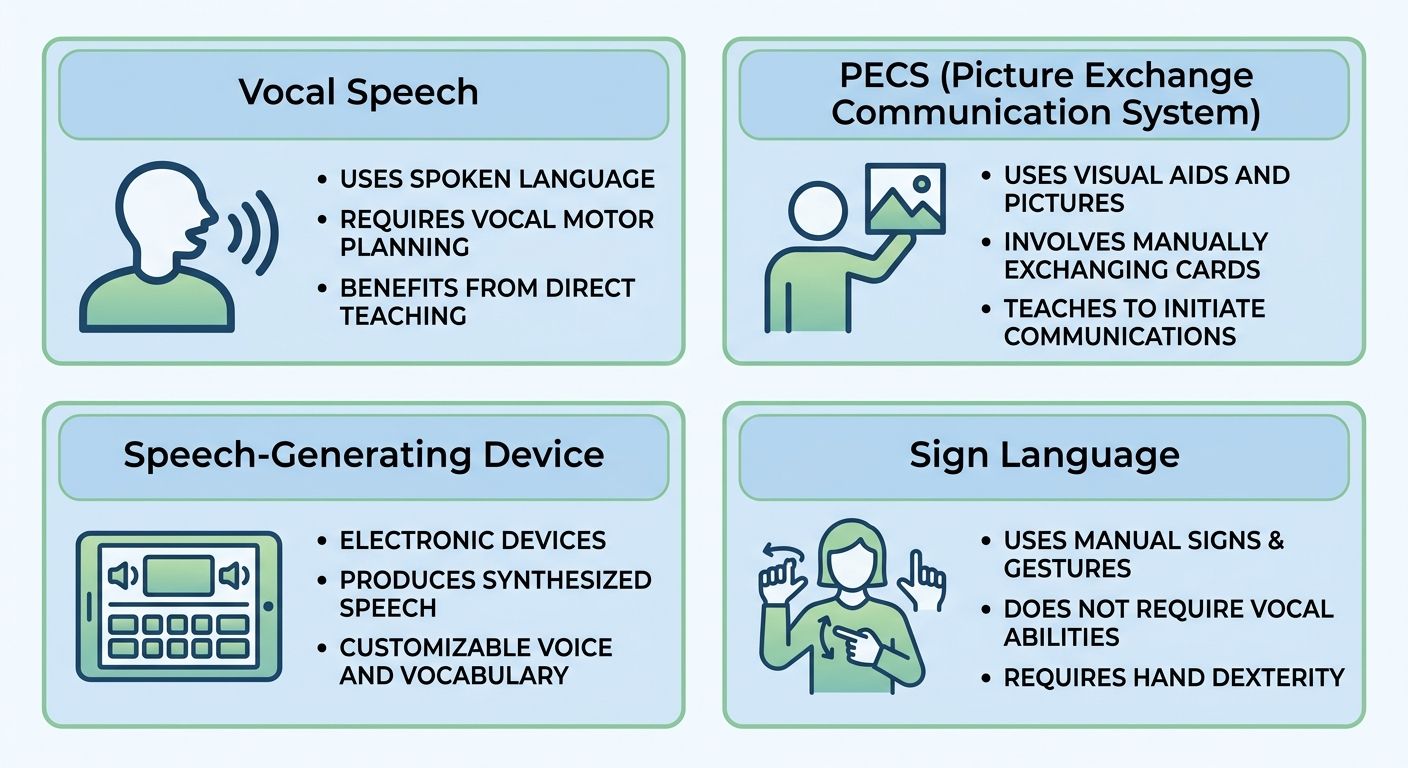
Comparison of communication methods in ABA therapy for parents.
The best method is always the one that fits the child’s existing skills and family context, and our thorough assessment process ensures this match is made thoughtfully. We celebrate every small step forward, knowing that a personalized plan builds a strong foundation for lasting communication and connection.
Cost and Value Considerations for In-Home FCT
Functional Communication Training autism therapy is an evidence-based ABA technique that replaces challenging behaviors with functional communication. By teaching your child a replacement behavior—such as using augmentative and alternative communication (AAC) tools like picture exchange or speech-generating devices—FCT can dramatically improve daily interactions and reduce frustration.
The cost of in-home FCT varies based on session frequency, your child’s individual needs, and your insurance plan. At Golden Touch ABA Therapy, we help families explore does insurance cover ABA therapy in Utah and assist with benefits verification so you can make the most of your coverage.
Because every therapy plan is uniquely designed, we provide custom quotes rather than standard pricing. Contact us for a personalized estimate that considers your child’s goals and insurance details.
Insurance coverage is subject to verification and is not guaranteed; results may vary; consult a licensed healthcare professional. Early investment in FCT often reduces the need for more intensive interventions later—supporting both your child’s long-term development and your family’s financial well‐being. The Association for Science in Autism Treatment (ASAT) recognizes FCT as an evidence‐based practice backed by research.
We’re here to help you navigate costs and coverage. Reach out today for a custom plan and insurance check.
Choosing the Right ABA Provider for Functional Communication Training
Choosing an ABA provider who excels at functional communication training autism is key to building meaningful communication. At Golden Touch ABA, we pair your child with a BCBA skilled in teaching communication skills for autism.
When evaluating a provider, look for these essentials:
- BCBA expertise: Seek a clinician with deep experience in functional communication training and teaching replacement behavior.
- In-home delivery: In-home therapy lets your child practice communication skills in real-life settings where they are needed most.
- AAC support: A provider that embraces augmentative and alternative communication tools—from picture cards to speech-generating devices—ensures your child’s voice is heard in whatever form it takes.
- Parent training: Regular caregiver coaching helps your child generalize communication across daily routines, making progress stick.
We combine these elements in our in-home ABA therapy programs, and our approach to functional communication training autism ensures tailored plans for every child. Maryland families can access ABA therapy in Prince George’s County through us, and we also serve Weber and Davis Counties in Utah. Custom pricing and insurance verification assistance make beginning therapy simple.
Once you’ve identified a qualified provider, verify insurance coverage and schedule an initial assessment. Individual results vary; consult a licensed professional for diagnosis, and remember insurance coverage is not guaranteed.
Empowering Communication Through In-Home ABA Therapy
Building on our in-home ABA approach, we use functional communication training for children with autism, an evidence-based practice supported by the Association for Science in Autism Treatment, to teach alternative ways to express needs instead of problem behavior. At Golden Touch ABA, we incorporate augmentative and alternative communication tools like picture exchange systems for non-verbal children, and the core of FCT is the replacement behavior: our clinicians identify what a child’s challenging action is communicating and teach a more adaptive skill.
In our family-centered model, caregivers learn to reinforce these strategies throughout daily routines, so functional communication training for autism becomes part of everyday life. While results vary, each step forward is a celebration — and we’ll next explore how measurable outcomes track that progress.
