
ABA Therapy Reimbursement Rates 2026: Complete Guide
Table of Contents
- Navigating ABA Therapy Reimbursement Rates in 2026
- Key Factors Behind ABA Therapy Reimbursement Rates
- Major 2026 Reimbursement Changes for In-Home ABA Therapy
- Choosing an In-Home ABA Provider Under New Reimbursement Rates
- Adapting to 2026 Rate Changes: Strategies for Families and Providers
- Common Questions About ABA Therapy Reimbursement Rates
- Securing Quality In-Home ABA Therapy for Your Child
Navigating ABA Therapy Reimbursement Rates in 2026
Navigating ABA therapy reimbursement rates in 2026 can feel overwhelming for families seeking support. Once you understand how ABA therapy works, the next step is understanding the financial landscape, which is where our team steps in to provide clarity and guidance.
Reimbursement rates are influenced by a combination of factors, including your specific insurance provider, whether the plan is private or through Medicaid, and your geographic location. For families in Salt Lake City and across our Utah, Arizona, and Maryland service areas, rates can also shift based on annual policy updates from insurers and state programs. This is why we never provide a one-size-fits-all number; instead, our experts conduct a personalized insurance benefits verification. This process allows us to review your plan’s deductibles, out-of-pocket maximums, and coverage for in-home ABA therapy, giving you a clear picture before treatment begins.
Our team stays current on ABA therapy reimbursement rates in 2026 to provide accurate guidance, but the most effective way to understand your costs is to reach out for a customized assessment. We are committed to making family-centered care accessible, and that starts with transparent, supportive financial conversations. To begin the reimbursement process, contact us for a free eligibility check.
Insurance coverage is subject to verification and is not guaranteed.
Key Factors Behind ABA Therapy Reimbursement Rates
Understanding what shapes aba therapy reimbursement rates 2026 is critical for families and providers planning for care. These rates are not uniform; they are driven by a combination of legislative decisions, contractual negotiations, and provider qualifications. Now let’s examine the key factors that actually drive these reimbursement rates, starting with how funding sources create different rules for providers.
Medicaid rates are established directly by state legislation, which leads to significant variation across the country. For instance, in California’s Medi-Cal program, the state sets its fee schedule through official policy, as seen in the medicaid aba therapy policy detailed by the Department of Health Care Services. This means a provider’s reimbursement for in-home ABA therapy can look very different from one state to the next, depending on that year’s approved budget. According to data from the National Center for Biotechnology Information, evidence-based practices like ABA therapy are recognized as medically necessary, which helps inform why states prioritize these rates, but the final dollar amounts are always a policy decision.
Private insurance reimbursement works through a different mechanism. Rates are not set by a single government body but are instead negotiated between employer health plans and provider networks. This system offers more flexibility, but it is often less transparent, as contracts differ widely between insurers. A family’s coverage for our family-centered care services is generally stable for the plan year, though providers must carefully manage their network contracts. The stability of private coverage contrasts sharply with the Medicaid system, where coverage can shift yearly with state budget cycles. This is a core reason why we help families verify their benefits—reimbursement for a service like in-home ABA therapy depends heavily on the payer’s specific rules.
The following table highlights the structural differences between these two primary funding sources.
| Factor | Medicaid | Private Insurance |
|---|---|---|
| Rate Determination | Set by state legislation; varies widely by state | Negotiated between employer/plan and provider networks |
| Coverage Consistency | Requires annual state budget approval; may change yearly | Stable for plan year but subject to network contracts |
| Provider Eligibility | Must meet state Medicaid requirements and be enrolled as a Medicaid provider | Must be credentialed with the specific insurance network |
This side-by-side view reveals that the source of funding directly dictates the predictability and administrative burden associated with each payer. Our experience shows that navigating these differences is a vital step in creating a warm and welcoming environment where the power of small steps can truly shine, free from administrative surprises.
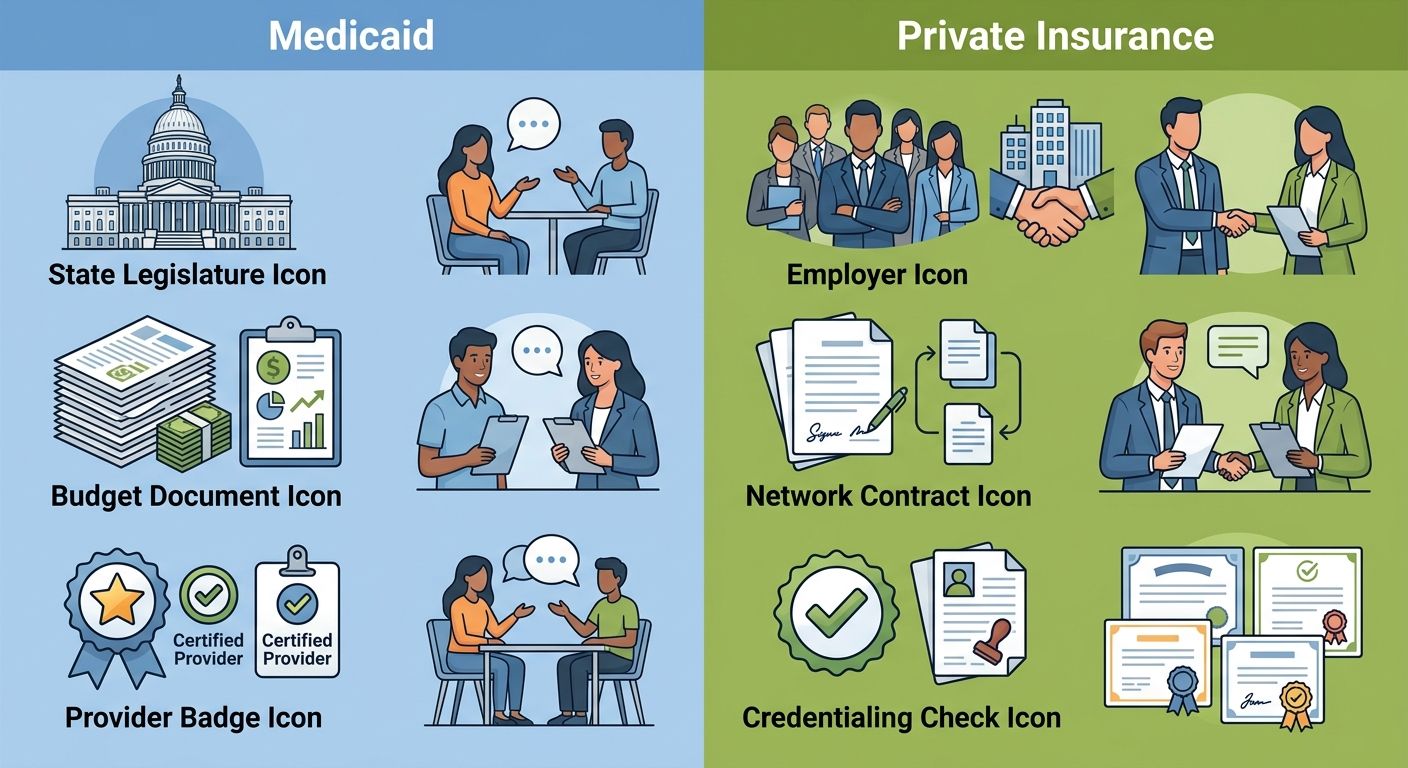
Comparison of Medicaid and private insurance reimbursement for ABA therapy
Beyond funding, provider eligibility is a crucial gatekeeper for reimbursement. To receive Medicaid payments, a provider must not only be a licensed clinician but also be formally enrolled as a state Medicaid provider, meeting all specific state requirements. Private insurance, however, requires a separate process: our Board Certified Behavior Analysts must be credentialed with each individual insurance network. This dual layer of eligibility underscores why aba therapy reimbursement rates 2026 are tied to a provider’s administrative capacity as much as their clinical expertise. Understanding these factors is the first step; next we’ll explore how to navigate them to protect your access to care.
Disclaimer: Insurance coverage is subject to verification and is not guaranteed. Reimbursement varies and consultation with a professional is recommended.
Major 2026 Reimbursement Changes for In-Home ABA Therapy
Looking ahead to 2026, several key reimbursement changes will shape the landscape for in-home ABA therapy. As a provider committed to family-centered care, we are tracking these aba therapy reimbursement rates 2026 updates closely to help families understand what to expect. These shifts in public payer fee schedules may affect access to aba therapy for children across our service areas in Utah, Arizona, and Maryland. While many state Medicaid programs are adjusting rates to balance budgets, we continue to assist families with insurance verification so they can focus on their child’s progress.
Medicaid Rate Adjustments Across States
Medicaid rate adjustments for 2026 reflect a mix of state budget cycles, legislative actions, and Medicaid rebalancing efforts. In Utah, rate-setting is influenced by annual legislative appropriations and the state’s efforts to manage overall behavioral health expenditures. According to state Medicaid fee schedule historical data, the projected rate for CPT 97153 is expected to see a modest decrease of approximately 2%. This adjustment aligns with broader budget rebalancing, though access to in-home ABA therapy remains a priority for Utah’s Division of Integrated Healthcare.
In Arizona, the projected 3.6% reduction in the average Medicaid rate for CPT 97153 is tied to the state’s managed care contracting cycles and cost-containment measures. Arizona’s Medicaid program periodically reviews fee schedules against provider cost reports, and the 2026 update reflects an attempt to align rates with updated utilization data. We are monitoring these changes to ensure families in Arizona continue to receive evidence-based practices through their coverage.
Maryland’s projected decrease of about 1.8% is relatively modest, reflecting the state’s All-Payer Model dynamics and the Maryland Department of Health’s approach to maintaining stable provider networks. These adjustments underscore the importance of verifying benefits with your specific payer, as actual reimbursement rates can vary significantly. As the California Department of Health Care Services (DHCS) demonstrates in its Medi-Cal rate-setting processes, state governments use complex methodologies to determine appropriate fees for ABA therapy services.
CPT Code 97153 Reimbursement Updates
CPT code 97153 is the most commonly used billing code for ABA therapy, covering adaptive behavior treatment by a technician under the supervision of a Board Certified Behavior Analyst (BCBA). This code represents the direct, face-to-face therapy sessions that form the core of in-home ABA therapy, making its reimbursement rate critical for both provider sustainability and family access.
The 2026 reimbursement updates for CPT 97153 show a trend toward modest reductions across several state Medicaid programs. For our families, these 2026 reimbursement changes for ABA therapy highlight the importance of understanding how public payer rates can influence service availability. As noted by the National Center for Biotechnology Information (NCBI) at the U.S. National Library of Medicine, government health research on healthcare reimbursement trends emphasizes that rate adjustments often reflect broader economic factors rather than changes in the clinical value of services.
While Medicare does not typically cover ABA therapy for children, trends in commercial payer rates often follow Medicaid benchmarks. We encourage families to view these projected figures as industry benchmarks rather than guaranteed reimbursement amounts. Your specific out-of-pocket costs and coverage levels depend entirely on your insurance plan’s contract with providers. Our team helps navigate these complexities, ensuring that warm and welcoming environment we create in your home is supported by clear financial understanding.
State-by-State Comparison of Autism Therapy Reimbursement
To illustrate the projected changes in 2026, we’ve compiled a comparison of Medicaid fee schedule data for CPT 97153 across our three primary service states. The following table represents estimated average rates based on state Medicaid fee schedule historical data and provider reports and legislative updates for 2026.
| State | 2025 Average Rate (Medicaid) | 2026 Projected Rate | Change (%) |
|---|---|---|---|
| Utah | $12.50 per unit | $12.25 per unit | -2% |
| Arizona | $14.00 per unit | $13.50 per unit | -3.6% |
| Maryland | $13.75 per unit | $13.50 per unit | -1.8% |
Importantly, these figures are drawn from public payer data and represent industry-wide projections. The power of small steps in therapy progress depends on consistent, uninterrupted care, which financial predictability supports. For a precise understanding of what your family’s insurance plan covers, we recommend contacting us directly. Actual reimbursement rates vary by payer contract and benefits eligibility; contact Golden Touch ABA Therapy for a custom quote based on your insurance plan.
As we navigate these evolving payer landscapes together, our commitment to family-centered care and evidence-based practices remains unwavering. Understanding these shifts helps families and providers anticipate what 2026 will bring for ABA therapy access. Results may vary; consult a licensed healthcare professional for medical advice. Insurance coverage is subject to verification and is not guaranteed.
Choosing an In-Home ABA Provider Under New Reimbursement Rates
In light of these reimbursement changes, choosing the right provider matters more than ever. With aba therapy reimbursement rates 2026 shifting across Medicare, Medicaid, and private insurance plans, families must evaluate providers carefully. When selecting an aba therapy provider, ask detailed questions about insurance, credentials, and the steps to begin therapy confidently.
Golden Touch ABA offers flexible scheduling and insurance navigation to help mitigate these challenges.
Questions to Ask About Insurance and Reimbursement
Understanding aba therapy reimbursement rates 2026 is key to avoiding unexpected out-of-pocket costs and finding a provider who respects your family’s financial boundaries. We at Golden Touch ABA recommend that families ask prospective providers these critical questions during the initial conversation to ensure full transparency:
- Network participation: Are you in-network with my specific health insurance plan?
- Rate acceptance: Do you accept the updated 2026 reimbursement rates for ABA services?
- Cost estimates: Will I receive a Good Faith Estimate before therapy begins?
- Balance billing: Is balance billing prohibited, and how do you handle coverage gaps?
- Out-of-pocket costs: What copays, deductibles, or coinsurance amounts should I expect?
- Authorization support: Do you assist with prior authorization and ongoing reauthorization requests?
Transparent answers to these questions help protect your family from surprise bills and ensure a smooth start to services.
Evaluating Provider Credentials and Experience
A provider’s qualifications directly impact the quality of care your child receives, especially as new reimbursement rates for ABA therapy place pressure on staffing models. Start by verifying that the supervising Board Certified Behavior Analyst (BCBA) holds current certification through the Behavior Analyst Certification Board (BACB). You can confirm credentials instantly by searching the public BACB registry at bacb.com.
Next, ask about supervision frequency. We recommend confirming that the BCBA provides at least weekly oversight of your child’s program rather than occasional check-ins. Inquire about the RBT-to-BCBA ratio on the team, since rate cuts can sometimes lead providers to stretch supervision too thin. At Golden Touch ABA, we maintain high supervision standards because we believe evidence-based practices deliver the best outcomes when supported by consistent, hands-on clinical guidance. Also confirm RBTs receive ongoing training and consistent team assignments week to week. Consistency matters in in-home ABA therapy, and a provider committed to family-centered care will prioritize stable, well-supervised teams even in a changing reimbursement environment.
Steps to Verify Coverage and Begin Therapy
Once you have selected an in-home ABA therapy provider, follow these steps to begin services. We at Golden Touch ABA guide you through every stage.
- Contact your insurance company to confirm ABA benefits and verify network status.
- Request a custom quote based on your coverage details and treatment plan.
- Schedule a free consultation or complete our interactive ABA roadmap assessment.
- Submit eligibility checks and intake forms with required diagnostic documentation.
- Begin therapy with a trial period for observation, plan refinement, and comfort in a warm and welcoming environment where the power of small steps builds lasting progress.
These steps help you find the right fit. Contact Golden Touch ABA today for a free consultation and custom quote.
Disclaimer: Results may vary and are not guaranteed. Consult a licensed healthcare professional for diagnosis or medical advice. Insurance coverage is subject to verification and is not guaranteed. Please review our Privacy Policy and Terms & Conditions for additional information.
Adapting to 2026 Rate Changes: Strategies for Families and Providers
With the aba therapy reimbursement rates 2026 adjustments approaching, families and providers are reexamining how they plan for care. We believe proactive preparation can ease this transition and safeguard access to compassionate, family-centered care.
Key strategies for navigating these changes:
| Factor | In-Home ABA Therapy | Center-Based ABA Therapy |
|---|---|---|
| Reimbursement Stability | Depends on state policy; cuts can reduce availability | Typically more stable facilities funding |
| BCBA Oversight | Typically requires travel; supervision ratios may be affected by rate cuts | On-site supervision common |
| Cost to Family | Out-of-pocket may increase if rates drop and providers adjust copays | Varies by clinic structure |
Drawing on biomedical data from the National Center for Biotechnology Information (NCBI), our approach to the aba therapy reimbursement rates 2026 is grounded in evidence-based research. Here is how each strategy works.
Negotiate with Insurers. Families can request single-case agreements when their provider is out-of-network, a critical step as reimbursement rates for applied behavior analysis adjust. We recommend having your child’s diagnosis and treatment plan ready when calling your insurer. Providers strengthen these negotiations by compiling outcome data that shows measurable progress, increasing the likelihood of approval.
Leverage State Resources. State autism waiver programs in Utah, Arizona, and Maryland may offer supplemental funding to offset rate changes for ABA therapy. Contact your state Medicaid or disability agency to check eligibility. Our team at Golden Touch ABA can supply the clinical documentation — assessment reports and progress notes — that agencies require.
Optimize Provider Efficiency. Choosing a provider that uses group supervision and remote parent training can reduce out-of-pocket costs without sacrificing quality. These models lower operational overhead while maintaining strong outcomes. Our In-home ABA therapy already integrates these efficiencies, reflecting our belief in the power of small steps toward affordable, sustainable care.
As the 2026 reimbursement adjustments take effect, we are here to help. Contact us for personalized guidance and a custom quote. Results may vary; consult a licensed healthcare professional for diagnosis or medical advice. Insurance coverage is subject to verification. Our Privacy Policy applies.
Common Questions About ABA Therapy Reimbursement Rates
ABA therapy reimbursement rates 2026 vary widely based on your insurance plan, provider network, and state regulations. At Golden Touch ABA, we help families understand what to expect. Here are answers to the questions we hear most often.
What Factors Influence Reimbursement Rates?
Reimbursement amounts depend on your specific policy’s deductibles, copayments, and coinsurance. State mandates, such as those in Maryland, can also affect coverage, while self-funded employer plans may not follow the same rules. We always verify benefits to give you a clear picture.
How Does BCBA Certification Affect Reimbursement?
Most insurers require that a Board Certified Behavior Analyst oversee therapy for it to be reimbursed. Holding BACB certification shows that your clinical supervisor meets the highest professional standards, which helps maintain coverage eligibility.
Does Golden Touch ABA Accept Medicaid?
We work with many families in Utah, Arizona, and Maryland, including those with Medicaid coverage. Because Medicaid benefits can differ by plan, we recommend contacting us so we can check your individual coverage for in-home ABA therapy.
How Can I Verify My Benefits for 2026?
Contact Golden Touch ABA and our team will handle the benefits verification process for you. Since reimbursement rates are subject to change, reaching out ensures you have the most current information. Insurance coverage is subject to verification and is not guaranteed.
Securing Quality In-Home ABA Therapy for Your Child
Building on the importance of early intervention discussed previously, securing quality in-home ABA therapy starts with verifying a provider assigns a BCBA to supervise treatment and train RBTs directly in your home. At Golden Touch ABA Therapy, we build individualized plans from comprehensive behavioral assessments with measurable goals rooted in ABA methodology. In-home ABA therapy in a warm and welcoming environment promotes family-centered care, and our caregiver training helps skills generalize beyond sessions. Data-driven progress monitoring keeps every session evidence-based.
In our next section on Navigating Insurance Coverage and Reimbursement Options for ABA Therapy, we will help you verify your benefits.
Resources
- Learn About 2026 Out-of-Pocket Maximums for ABA Therapy
- Discover How Insurance Plan Variables Affect ABA Therapy Costs
- Explore State Mandates and Out-of-Pocket Maximums for ABA
- Guide to Estimating ABA Therapy Costs with Insurance in 2026
- Access Biomedical and Genomic Databases at the NCBI Portal
- Discover Medi-Cal Initiatives and Behavioral Health Transformation
- Find BACB Certification Standards and Update Information
