
Low Functioning Autism: Complete Guide to Symptoms and Support
Table of Contents
- Understanding Low Functioning Autism
- Basics of Low Functioning Autism
- Exploring Severe Autism Symptoms and Diagnosis
- Managing Level 3 Autism at Home
- Advanced Strategies for Low Functioning Autism
- Frequently Asked Questions About Low Functioning Autism
- Supporting Children with Low Functioning Autism
Understanding Low Functioning Autism
While autism manifests on a spectrum, low functioning autism represents the more severe end, characterized by significant challenges in communication, social interaction, and daily living skills. This form of autism spectrum disorder (ASD) requires very substantial support to help individuals navigate everyday life. For a comprehensive autism spectrum disorder overview, established medical resources outline the full range of severity levels.
According to the National Center for Biotechnology Information (NCBI), an authoritative medical database entry for clinical definitions, the DSM-5 classifies this as level 3 autism, involving profound deficits in social communication and restricted, repetitive behaviors that severely limit functioning. Core symptoms of severe autism often include limited or no verbal abilities, reliance on nonverbal cues like gestures, and intense repetitive actions that disrupt routines. Many individuals experience co-occurring intellectual disabilities and sensory sensitivities, making environments overwhelming. Early signs in children, such as minimal eye contact or delayed speech by age two, typically emerge around 12 to 18 months.
Low functioning autism affects about 25-30% of people with ASD, based on severity metrics from clinical classifications. Early diagnosis is crucial, as timely interventions like behavioral therapies can improve outcomes and quality of life. At Golden Touch ABA Therapy, we emphasize family-centered care through evidence-based practices to address these needs.
Unlike milder forms, profound autism demands intensive support without diminishing anyone’s inherent value—everyone on the spectrum deserves understanding and accommodation. Recognizing these traits is the first step toward effective support strategies, explored further below.
Basics of Low Functioning Autism
Building on the autism spectrum, low functioning autism represents the most severe end of autism spectrum disorder (ASD). We at Golden Touch ABA Therapy often see how this form, aligned with level 3 autism, requires substantial support in social communication and restrictive behaviors, as outlined in DSM-5 criteria. According to the National Institutes of Health, cited as an authoritative medical database entry providing foundational ASD classifications, individuals with low functioning autism face profound challenges that impact daily life significantly. The National Center for Biotechnology Information, referenced as a comprehensive academic textbook excerpt on ASD clinical features, describes these as severe impairments in social interaction, communication, and adaptive functioning. This overview helps families recognize the need for tailored interventions early on.
Low functioning autism, sometimes called severe autism, profoundly affects communication and independence. Individuals often exhibit severely limited verbal skills, such as being nonverbal or using only minimal speech, relying instead on alternative methods like picture exchange systems or assistive devices. Social engagement presents major hurdles, including little to no eye contact, minimal reciprocal interaction, and difficulty understanding others’ emotions. Daily adaptive behaviors, like eating, dressing, or toileting, demand high levels of assistance, limiting personal autonomy. Recognizing early signs of autism is crucial for timely intervention in cases of low functioning autism, allowing for support that builds on small, meaningful progress.
These symptoms highlight why low functioning autism demands intensive, family-centered care in a warm and welcoming environment. Repetitive behaviors and sensitivity to changes can further complicate routines, but evidence-based practices make a real difference over time.
To clarify distinctions within the spectrum, the following table outlines key differences between high and low functioning autism:
| Aspect | High Functioning Autism | Low Functioning Autism |
|---|---|---|
| Often verbal with advanced language, may struggle with social nuances. | Can manage personal care with minimal support. | Desires connections but faces challenges in understanding cues. |
| Limited or no verbal speech, relies on alternative communication methods. | Requires substantial assistance for basic self-care. | Significant impairments, often minimal engagement. |
This comparison shows how low functioning autism intensifies support needs compared to high functioning forms. For instance, while those with high functioning autism might navigate independence with some guidance, individuals with low functioning autism benefit from comprehensive therapies like ABA to address core deficits. These differences underscore the impact on quality of life, emphasizing the role of individualized plans in fostering skills and reducing challenges without stigma.
At Golden Touch ABA Therapy, we focus on the power of small steps through in-home ABA therapy, helping families in areas like Salt Lake City navigate these realities. Understanding these basics informs effective support strategies, such as ABA therapy explored next, promoting better outcomes for every child.
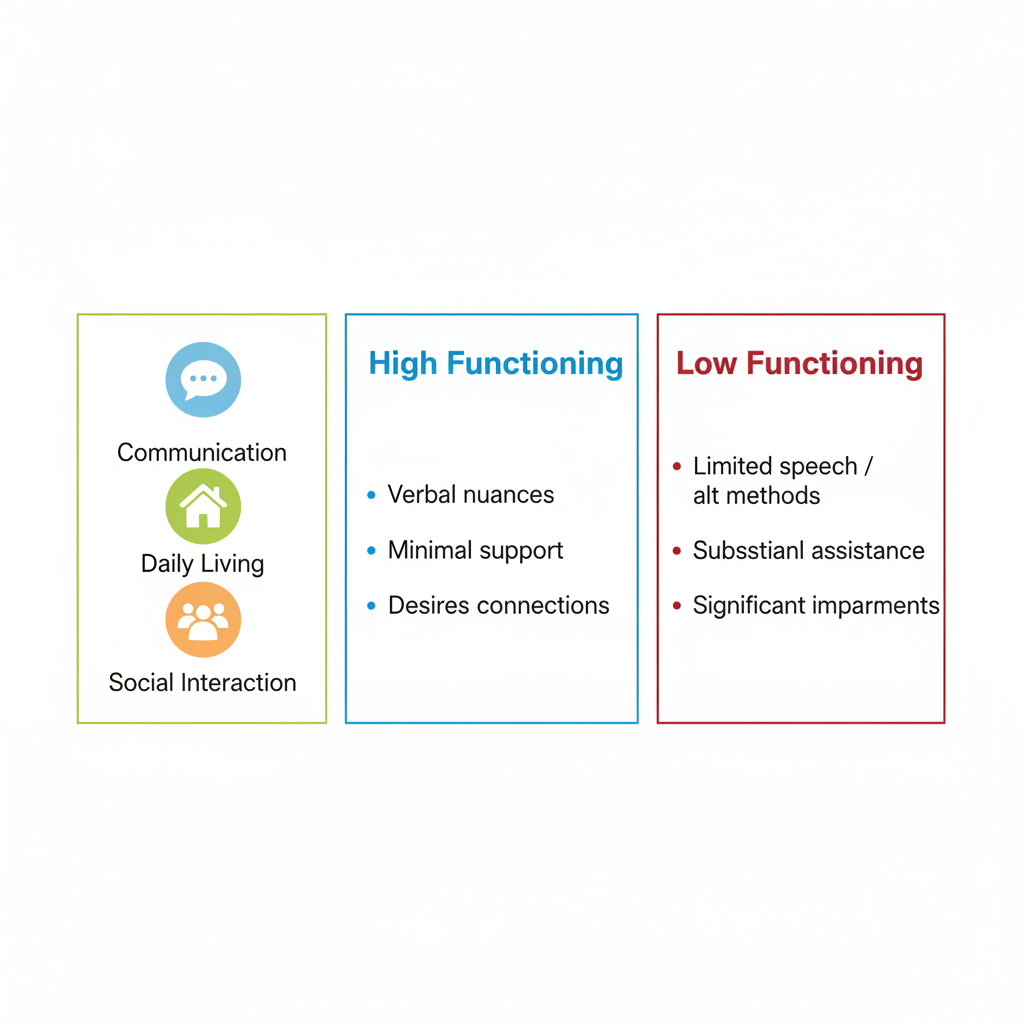
Key differences in high vs low functioning autism illustrated visually
Exploring Severe Autism Symptoms and Diagnosis
At Golden Touch ABA Therapy, we understand the challenges families face when navigating autism spectrum disorder. Severe autism, often referred to as level 3 on the DSM-5 spectrum, represents the most profound form of this condition, where children require substantial support for daily functioning. According to the National Center for Biotechnology Information, this level involves severe deficits in social communication and restricted, repetitive behaviors that significantly impair independence. Low functioning autism affects about 1 in 31 children, as recent data shows, making early recognition crucial for families seeking effective care.
Recognizing Symptoms of Low Functioning Autism
Children with low functioning autism, or level 3 autism, often exhibit symptoms that profoundly impact their daily lives, requiring constant support from caregivers. Recognizing these early helps families access the right interventions, like our in-home ABA therapy, to build skills gradually.
- Severe social withdrawal: A child may avoid eye contact and show no interest in peers.
- Nonverbal communication: Many remain largely nonverbal, relying on gestures or cries to express needs.
- Intense repetitive behaviors: Actions like hand-flapping or lining up toys rigidly persist.
- Extreme sensory sensitivities: Overreactions to sounds or textures can cause meltdowns.
- Minimal self-care abilities: Independence is limited, with children needing full assistance for tasks like dressing or eating.
| Symptom Category | Level 1 (High Functioning) | Level 2 (Moderate) | Level 3 (Low Functioning) |
|---|---|---|---|
| Social Communication | Mild difficulties in social interactions. | Marked deficits requiring support. | Severe impairments without support. |
| Repetitive Behaviors | Simple routines with flexibility. | Intense routines interfering moderately. | Inflexible behaviors causing distress. |
Diagnostic Process for Level 3 Autism
- Initial screening by pediatricians: Using tools like the M-CHAT.
- Referral to specialists: Comprehensive evaluations including the ADOS-2.
- Multidisciplinary team assessments: Review by psychologists and therapists.
- Final DSM-5 classification: Based on support needs.
- Post-diagnosis recommendations: Developing support plans like early intervention ABA.
Managing Level 3 Autism at Home
Daily Living Challenges and Strategies
Families navigating level 3 autism at home frequently encounter hurdles in establishing routines. To overcome these, we recommend visual schedules and timer cues to signal transitions. Pair these with sensory-friendly zones and picture exchange systems to build non-verbal expression.
| Factor | Clinic-Based | Home-Based (e.g., Golden Touch ABA) |
|---|---|---|
| Environment Comfort | Unfamiliar setting may increase anxiety. | Natural home environment promotes comfort and generalization. |
| Family Involvement | Limited direct observation opportunities. | Active caregiver training and collaboration. |
Family Support and Engagement
Caregivers play a pivotal role acting as primary advocates. Training programs empower caregivers with ABA techniques like de-escalation methods and positive reinforcement. Resources on autism care military families provide models for integrating therapy into unique lifestyles.
Advanced Strategies for Low Functioning Autism
Advanced strategies require targeted interventions like Applied Behavior Analysis (ABA). One key technique is Discrete Trial Training (DTT) and Natural Environment Teaching (NET).
| Technique | Description | Benefits for Low Functioning |
|---|---|---|
| Discrete Trial Training (DTT) | Structured teaching of skills in small steps. | Builds foundational skills like communication. |
| Natural Environment Teaching (NET) | Learning in everyday settings. | Enhances independence in home routines. |
Frequently Asked Questions About Low Functioning Autism
What is low functioning autism?
Low functioning autism is a severe autism spectrum disorder where individuals need extensive daily support.
How is it different from high functioning autism?
Low functioning autism demands full-time assistance for safety and routines, whereas high functioning allows greater independence.
Supporting Children with Low Functioning Autism
Address sensory needs with weighted blankets and track progress with data sheets. Consult certified ABA experts for ongoing support through family-centered care.
This article was researched and written with the assistance of AI tools.
Resources
- Discover Early Autism Signs in Infants for Timely Intervention
- Track Early Autism Signs with Checklists for Better Outcomes
- Access In-Home ABA Therapy in Utah Counties and Cities
- Schedule Personalized In-Home ABA Therapy in Salt Lake County
- Verify ABA Therapy Availability in Utah via Contact and Site
- Document Early Autism Signs at Home for Effective Therapy
- Explore ABA Therapy Services and Resources in Utah Areas
- Understand Autism Prevalence and Interventions for Military Families
- Learn About Autism Spectrum Disorder Symptoms and Diagnosis
- Explore Mothers’ Journeys with Profound Autism Support Strategies
