
ABA Therapy for School Success: A Comprehensive Guide for Parents
Table of Contents
- How ABA Therapy Helps Children Succeed at School
- How ABA Therapy Supports Classroom Success
- School Readiness Skills ABA Therapy Builds
- Improving Focus and Behavior for the School Day
- How BCBAs Work with Teachers and School Teams
- ABA Therapy and IEP Goals: A Family-School Partnership
- Helping Your Child Reach Their Potential at School and Home
How ABA Therapy Helps Children Succeed at School
ABA therapy for school success enhances kids’ communication, social and independence skills that will help them succeed in the classroom. Through our in-home programs we’ll build these foundational skills in a comfortable, natural environment where children feel confident practicing new behaviors.
According to the CDC, behavioral approaches like ABA have the most robust clinical evidence among autism interventions, supporting progress across educational, home, and community environments. We work closely with families to reinforce these skills between sessions, ensuring techniques practiced at home carry over into school routines. Parent coaching empowers caregivers to support their child’s growth, creating consistency that bridges therapy and classroom success.
Key Takeaways
- We witness first-hand how ABA therapy for school success helps children carry the skills they build at home into the classroom.
- ABA therapy for school success in Utah is used to build on the skills that kids learn from home each day.
- The same basic skills that we teach kids at home, such as attention, routine, and the ability to understand and follow directions, affect the way they manage themselves during the school day.
- The consistency between home and school will be vital when children start making progress.
- Our team knows that progress in ABA therapy for school success begins when families and educators work together.
How ABA Therapy Supports Classroom Success
We witness first-hand how ABA therapy for school success helps children carry the skills they build at home into the classroom. Behavioral approaches, such as ABA, have the strongest clinical evidence for addressing autism symptoms, per the CDC, and these gains transfer best when therapy is woven into daily routines that mirror school expectations. Our programs include many activities targeting communication, social interactions, independence, and decreasing inappropriate behaviors in order to help kids be better equipped to participate and learn once back at school.
It makes sense that the consistency between home and school would matter because not everything taught at home necessarily translates into children’s other settings. But ABA is good precisely because it teaches skills that can fit in school as well as outside school in homes, communities etcetera. ABAI’s 1990 position was that educational placement should reflect a child’s actual skill levels rather than labels, and that instruction should be adjusted using data until it’s effective for the individual student. We design each plan to include fluency, combining accuracy and speed, so skills stick for the long term and are more likely to hold up under the demands of a classroom. This fluency focus ensures children can apply what they’ve learned smoothly in school routines.
Ultimately, a child-centered education means identifying and sticking to key targets of improvement and altering pace according to how fast the student is achieving those objectives. It also implies changing what we’re teaching them if we learn through feedback that some students are ready for a new lesson while others need some extra support before moving onto something else. Teachers should be able to gauge from their performance whether a student has achieved a certain benchmark, without comparing them against other kids’ ability. Teachers respond accordingly based on the children’s growth, whether that involves using signals such as hand-raising to talk in class, paying attention to multi-step instructions, or shifting focus from one activity to another. Practicing these skills in natural settings like the home helps children gain confidence that carries over to the classroom environment.
The skills described here will serve as a foundation for building the specific abilities that ABA teaches children in order to be successful at school.
School Readiness Skills ABA Therapy Builds
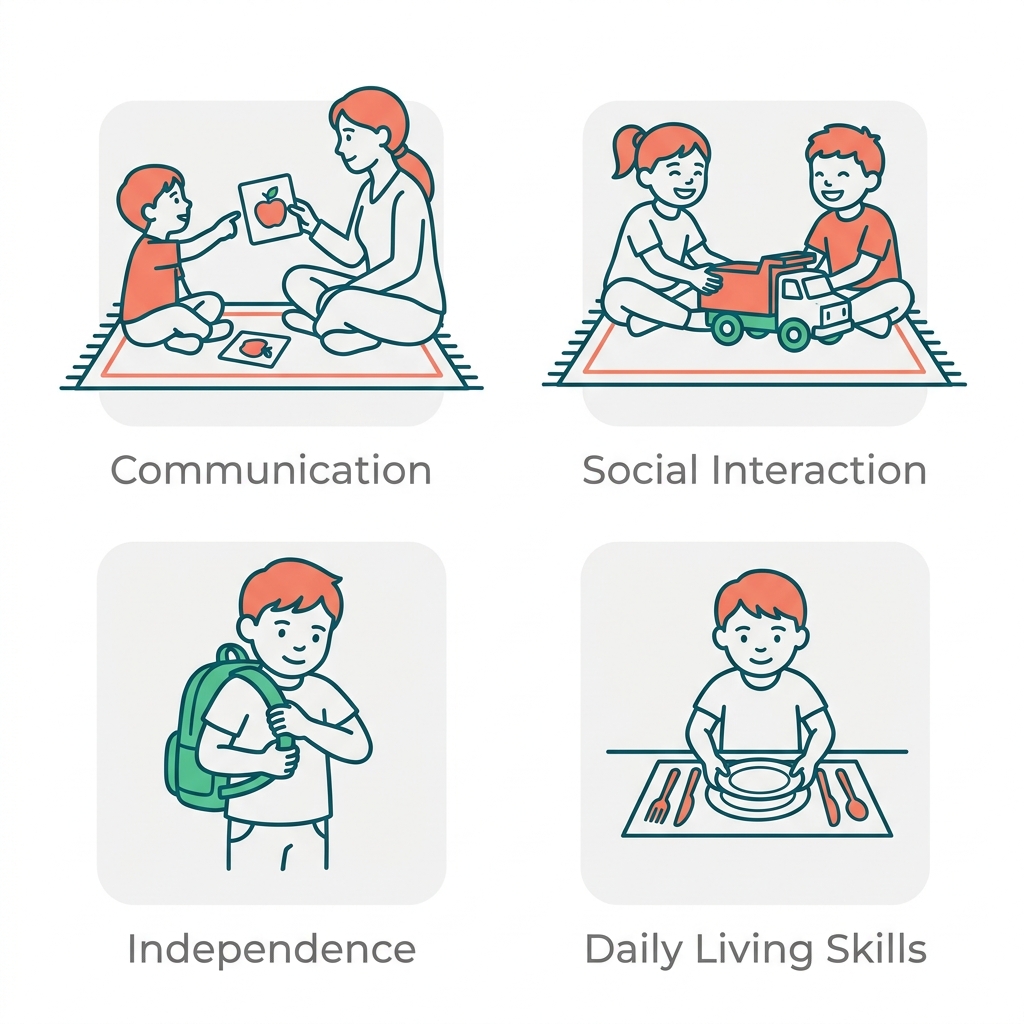
ABA therapy for school success in Utah is used to build on the skills that kids learn from home each day. Using play-based, natural environment teaching strategies, ABA therapy helps children develop the communication, social interaction, and daily living skills they’ll require for success in the classroom.
We concentrate on these three key areas because they will help kids when they start school. For example, we improve their communication skills with games and activities around the house. We teach our kids about taking turns while playing and talking together, and we show how to explain their feelings during story time and request what they need in a few simple words. All of this happens easily within play-time, without being stressful. These activities encourage clear expression and understanding. We also work on building relationships between them, helping them interact well with others. When they’re playing with us or their friends we model things such as sharing, turn taking, cooperation, joint attention, eye contact, and positive social starts. Children learn to wait their turn, initiate social interactions, and feel more comfortable in group settings through that modeled cooperative play. This helps them engage confidently with peers and teachers. Then, there’s improving independence and daily living skills like following simple instructions, managing transitions, and handling routines. All of this is done gradually over time in lots of different places and times. This helps your child navigate school days with greater confidence.
Parents have a big part to play here, too. With the guidance of our clinicians, they can learn new ways to work on those skills as well as others in mealtimes, games, and daily routines at home, which helps reinforce them when the kids return to school. Reducing stress levels among the kids also speeds up the rate of acquiring all the needed skills.
Children take along this ability as they make their way from home into the classroom and thus, are more able to get involved in what’s going on around them, listen when asked, and also relate positively to both teacher and peers.
Improving Focus and Behavior for the School Day
The same basic skills that we teach kids at home, such as attention, routine, and the ability to understand and follow directions, affect the way they manage themselves during the school day. When a child has trouble focusing, he might miss part of a teacher’s instruction or be unable to sit still long enough to join other kids working on something together, which makes him miss out on some of his own learning.
Understanding why certain actions occur can help make them easier to control. For example, misbehaving kids might want our attention, want to avoid something hard, or just have a hard time regulating their own sensory needs. The FBA allows us to observe which circumstances lead up to bad behavior and what follows those behaviors as well, so we’ll understand better how to stop them from occurring again next time. By putting together plans for teaching new responses to problems and strategies for dealing with stressors, we provide tools that students can immediately begin using when they feel overwhelmed. Some studies have found that when teachers conduct their own analysis, it is clear what causes each behavior to happen in class. As opposed to simply guessing based on past experiences or anecdotal evidence, functional assessments allow teachers to target specific needs more effectively.
Small shifts matter a lot here. For example, teachers can help students stay focused by providing step-by-step instructions on assignments and group work, posting class rules somewhere students will see them, and consistently enforcing those expectations. Assigning kids roles based on their strengths, rather than using punitive measures, often reduces disruptions more effectively. This approach helps create a structured learning space that lets young minds explore freely without feeling like they’re walking on eggshells all day long. If rules are made known and followed through with consistency, students understand what kinds of behavior can be expected, as well as why certain actions lead to certain results.
When consistent support is present during a child’s normal instructional time at school, children gain confidence and teachers gain time to teach. By working together—our therapists, families, and educators—we can turn challenges into opportunities for growth, ensuring every child has the tools they need to succeed.
How BCBAs Work with Teachers and School Teams
The consistency between home and school will be vital when children start making progress. If certain methods are used at home, then those methods should also be applied to children in the school setting. The reason why this works is because children know exactly what to expect in both places. Once again, if they understand that they have to follow rules within each environment, then they’ll feel more confident overall. When it is ensured that everything taught to them here applies there too, they won’t feel like they’re getting conflicting information.
Our team works closely with school teams to implement home-based ABA therapy. BCBAs design individualized programs and supervise RBTs who implement interventions in the home. Teachers receive weekly progress data so they can see how strategies translate to classroom performance. In addition to providing progress information, we also offer practical tools such as visual schedules and reinforcement systems that teachers may be able to incorporate into their instruction plans. These tools help maintain consistency in behavioral expectations and reduce the cognitive load on educators by offering ready-to-use resources.
Measuring each skill for accuracy and speed is critical because how fast a child can use their skills without pausing is also key. School teams will work together with BCBAs to figure out if this skill has been carried over into other areas. This means looking at how well the student uses the skill outside of the therapy session, rather than just when they’re sitting on the couch with their BCBA. The idea is to make sure children demonstrate objective, measurable progress so we know our interventions have actually worked to meet the needs of those children as they’ve changed over time.
For families, the first step is straightforward: our BCBA conducts a comprehensive assessment to identify strengths and areas for growth. We encourage parents to verify their BCBA’s credentials through the Behavior Analyst Certification Board (BACB) public registry and to share the assessment insights with their school team. This shared foundation makes collaboration smoother and sets the stage for meaningful progress in the classroom. By starting with a clear understanding of the child’s needs, families and educators can work together to create a cohesive support plan that aligns with the child’s goals.
ABA Therapy and IEP Goals: A Family-School Partnership
Our team knows that progress in ABA therapy for school success begins when families and educators work together. An Individualized Education Plan (IEP) is a legally mandated, collaborative plan created by a multidisciplinary team that includes both school staff and family members to support a child’s overall development. The Center on PBIS emphasizes that behavioral support goals should be integrated into holistic student development planning, ensuring that every child’s unique needs are addressed through a unified approach.
Behavioral Goals in an IEP will be stronger when families are involved. When you have an IEP in place your goal is to make sure that this plan is meaningful and is going to work. If there is a good framework that can be put in place then a parent can better ask what kinds of support they want the schools to provide, especially if these behaviors that are being taught during the course of therapy are going to translate into behaviors expected in class as well. In many ways, having this family involvement is also similar to what we see in our in-home ABA therapy programs, where BCBAs and RBTs work closely with parents to reinforce progress across settings. So parents might share things observed during their home session so that the school team understands more about their child’s generalization.
To bridge home progress with school supports, parents can start by gathering observations from home sessions and identifying the child’s top behavioral priorities. Sharing these priorities with the school team and agreeing on how progress will be communicated keeps everyone aligned. These steps create a foundation for aba therapy for school success that carries learning across settings. By focusing on collaboration, we help children generalize skills and reach their potential both at home and in the classroom.
To be prepared to have successful IEP meetings, parents should review what work the student did recently, look at new issues cropping up, and list out any support measures they feel might help their children succeed in both school as well as at home. Bring home-based observations as concise summaries to show the school team how well the child does at home, and also point out what additional reinforcements can provide better support.
Frequently Asked Questions
How can ABA therapy help my child succeed in the classroom?
ABA therapy builds communication, social interaction, independence, and daily living skills in a child’s natural home environment. These skills are designed to transfer to school routines so children can participate and learn more effectively in the classroom.
Does ABA therapy collaborate with school IEP goals?
ABA therapy aligns with school IEP goals by integrating individualized behavioral supports into the child’s overall development plan. BCBAs and school teams share progress data and practical tools to maintain consistency across home and school settings.
What specific skills does ABA therapy target to improve school readiness?
ABA therapy targets communication skills, social interaction, independence, and daily living skills. These are taught through play-based activities and routines that mirror school expectations to prepare children for classroom participation.
How do BCBAs coordinate with teachers to support a child in school?
BCBAs design individualized programs and supervise RBTs who implement interventions at home. They provide teachers with weekly progress data and tools like visual schedules to ensure consistent behavioral expectations in the classroom.
Can in-home ABA therapy help improve my child’s behavior and focus at school?
In-home ABA therapy teaches attention, routine-following, and direction-following skills in a comfortable setting. These skills are designed to help children manage themselves better during the school day, reducing distractions and improving focus.
Helping Your Child Reach Their Potential at School and Home
When kids’ progress at school is reinforced at home by their families, this collaborative support bridges that gap through consistent, data-driven support. Home-based ABA therapy teams work alongside parents, helping them create daily activities where children can learn new behaviors. With weekly reports about how their child progresses on certain tasks, the therapy team adapts its teaching methods accordingly. Additionally, the therapy team trains parents to use their lessons in situations outside regular therapy sessions.
We serve children/youth from age 1 through 21 years old within his/her own environment, mainly working collaboratively with school staff and family members. Each child’s program varies depending on how the child responds to each intervention but the goals focus on making sure the child makes progress and can maintain skills over time. For families ready to take the next step, contact our team today at (801) 630-5443 or info@goldentouchaba.com.
Start Your Child’s Journey Today
You’ve now seen how in-home ABA therapy builds the communication, social, and independence skills children carry into the classroom. From play-based learning in familiar surroundings to parent coaching that reinforces progress between sessions, every element works toward school success. Our team of BCBAs and RBTs creates personalized treatment plans for children and young adults aged 1 to 21 across Utah, including Salt Lake City. Because skills are practiced in the natural home environment, they tend to generalize more easily to school routines. Every child’s path is unique, and results may vary based on individual circumstances. If you’d like to learn more or schedule a consultation, call us at (801) 630-5443 or reach out through our website. We’d be glad to help your child take the next step toward reaching their potential at school and home.
Start Your Child’s Journey Today
Resources
- Strengthen Family Participation in IEP Behavior Goals
- Apply Proven Classroom Behavior Management Strategies From CDC
- Understand Every Student's Right to Effective Education
- Access Positive Proactive Support Resources for Students With Disabilities
- Learn About Proven Autism Treatment and Intervention Options
