
ABA Therapy Cost with Insurance 2026: A Complete Guide for Parents
Table of Contents
- Understanding ABA Therapy Costs with Insurance in 2026
- Before You Begin: Key Information to Gather
- Gather Your Insurance Policy and Benefits Information
- Understand Your Out-of-Pocket Costs and Deductibles
- Verify Your Insurance Coverage for ABA Therapy
- Calculate Coinsurance and Estimated Costs per Session
Understanding ABA Therapy Costs with Insurance in 2026
Navigating ABA therapy cost with insurance 2026 is often the first concern for families. As our team at Golden Touch ABA explains, insurance coverage can substantially lower what you pay out of pocket, though your exact cost depends on your plan’s deductibles, copays, and coverage limits. That’s why insurance verification for ABA therapy is a critical first step—we review your benefits to clarify what your policy covers before services begin, so you can focus on your child’s progress. We’ll also explain your plan’s coverage limits and help you understand any visit caps.
Your actual ABA therapy cost with insurance 2026 also depends on whether your plan must comply with the autism insurance mandate in your state. While many state mandates require certain regulated plans to cover ABA therapy, self-funded employer plans (ERISA) are often exempt. In states like Utah, the mandate covers ABA therapy up to age 9, while Arizona extends coverage to age 16, but ERISA plans are not bound by these rules. Because coverage varies, checking your plan’s ABA therapy out-of-pocket maximum helps you estimate your worst-case financial responsibility. It’s a useful figure for budgeting, though actual bills will reflect your specific deductible and copay structure. Results vary, and coverage is not guaranteed and is always subject to verification; we encourage you to contact us for a personalized benefits check.
Before You Begin: Key Information to Gather
At Golden Touch ABA Therapy, we know that gathering the right information makes insurance verification for ABA therapy smoother. ABA is a science based autism treatment, and we want to help you check your coverage. Knowing what’s required simplifies checking ABA therapy coverage and helps you plan for potential costs.
Based on our experience, these are the key items you’ll need:
- Your insurance card, including member ID, group number, and payer contact information.
- A formal autism diagnosis with ICD-10 code F84.0 or a prescription from a licensed professional.
- The treatment plan or behavioral assessment prepared by your child’s Board Certified Behavior Analyst (BCBA).
- Any prior authorization (pre-auth) numbers you may have received.
- Your child’s date of birth and relevant medical history.
If you have any questions, our team is here to help you verify these details.
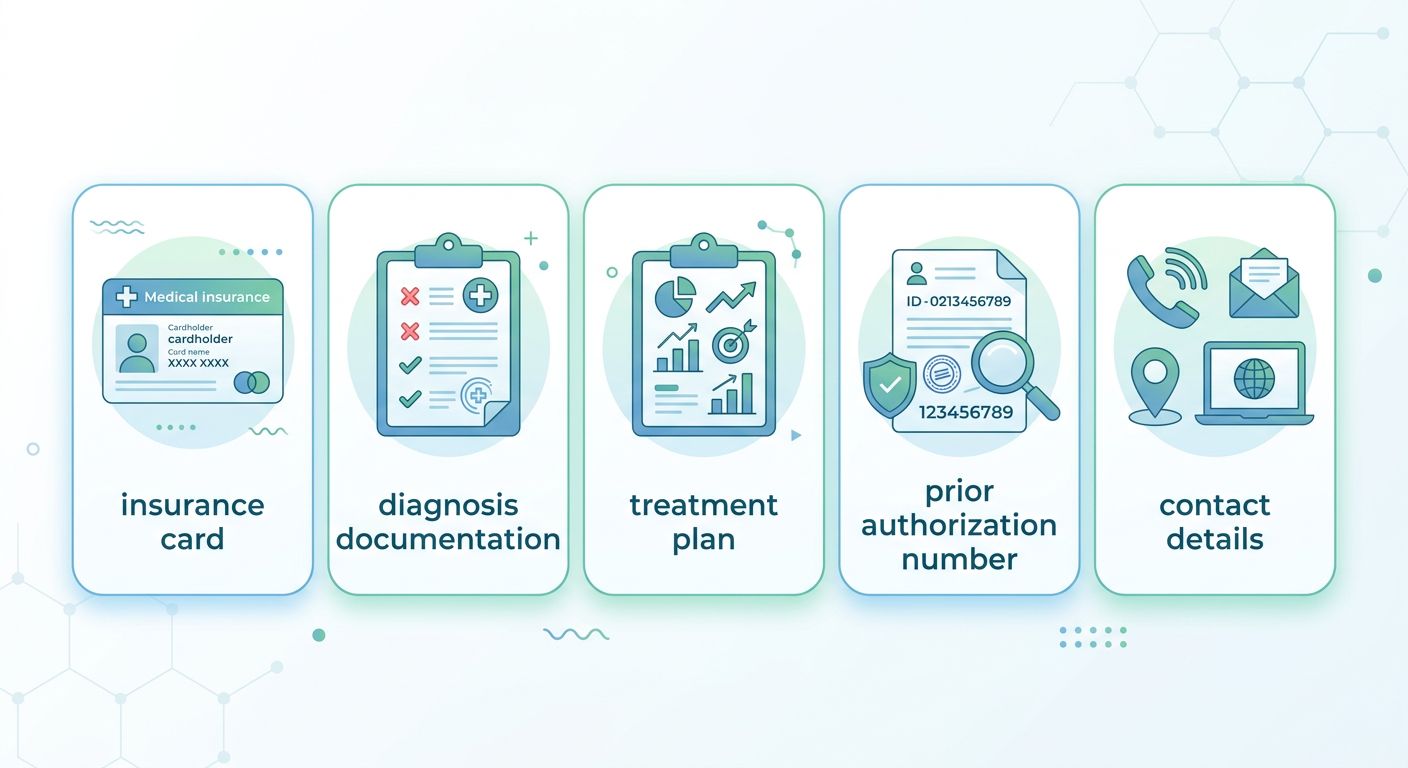
Essential documents and information for ABA insurance verification.
With these items in hand, you’re ready to begin the ABA therapy insurance verification process. Our team at Golden Touch ABA Therapy can assist with each step, from calling your insurer to confirming prior authorizations and benefits. Knowing your coverage helps you plan for costs and avoid surprises, so you can focus on your child’s progress. Once you’ve gathered these documents, the next step is submitting them for verification. Please remember that insurance coverage is subject to verification and is not guaranteed.
Gather Your Insurance Policy and Benefits Information
Before you can understand your costs, you need to know what your plan covers. Start by locating your insurance member ID card. Note your member ID, group number, and the customer service phone number. These details are essential when you begin the insurance verification for ABA therapy.
Gather the following items:
- Your insurance card with member ID, group number, and phone
- Your benefits summary or plan document
- Any pre-authorization or referral forms
- A copy of your child’s autism diagnosis report
Review your plan by calling member services or checking the benefits summary. Ask specifically about ABA therapy coverage and whether your state’s autism insurance mandate applies. Confirm if pre-authorization, a referral, or proof of medical necessity is required. Also ask about your out-of-pocket maximum so you understand your financial responsibility.
Our insurance assistance team can handle this step for you. Golden Touch ABA will guide you through the verification process and contact your insurer on your behalf. According to our team, the process often takes only a few days once you provide the documents.
Once you have your documents ready, the verification process can begin — covered in the next section. Please note that insurance coverage is subject to verification and is not guaranteed.
Understand Your Out-of-Pocket Costs and Deductibles
Understanding your coverage is the first step, but knowing your out-of-pocket costs brings real clarity. As you explore ABA therapy cost with insurance in 2026, these expenses generally encompass deductibles, copays, and co-insurance. The deductible is the amount you must pay before insurance begins to contribute. Once met, copays (a set fee per session) or co-insurance (a percentage of costs) often apply. Our insurance verification for ABA therapy gives families a clear picture of their financial responsibility, though it does not guarantee coverage. The autism insurance mandate operating in many states may limit maximum out-of-pocket costs, but specific rules hinge on your state and plan. Golden Touch ABA’s team walks you through these details, answers questions, and provides a custom quote after verification. Because actual costs differ for each family, we encourage you to contact us for a personalized breakdown. Insurance coverage is subject to verification and is not guaranteed.
Verify Your Insurance Coverage for ABA Therapy
Understanding the potential cost of ABA therapy with insurance in 2026 starts with a clear insurance verification for ABA therapy process. The most direct route is to call the number on the back of your insurance card and ask specifically about your plan’s coverage for Applied Behavior Analysis for autism. Before you call, gathering your insurance ID and policy details will speed up the conversation.
- Ask about your ABA therapy benefits: Inquire about the specific coverage for autism treatment, including any age limits or required pre-authorizations.
- Define your cost-sharing details: Clarify your plan’s deductible, your copay or coinsurance per session, and the total ABA therapy out-of-pocket maximum for the year.
- Request a written summary: Secure a written benefits summary from the insurer to identify any annual visit restrictions or financial caps, as coverage varies by plan, provider network, and state.
We understand this can feel overwhelming, which is why our team offers complimentary assistance to help you verify your child’s ABA benefits. We can guide you through the nuances of your policy to clarify your coverage situation.
Insurance coverage is subject to verification and is not guaranteed. Once you have a clearer picture, we invite you to connect with our insurance assistance team for a personalized benefits check. Studies indexed in the biomedical research database affirm that evidence-based practices like ours are key to effective family-centered care. From here, you can confidently take the next step: scheduling a free assessment to begin therapy.
Calculate Coinsurance and Estimated Costs per Session
Estimating your aba therapy cost with insurance 2026 starts with understanding coinsurance—the percentage you pay after your deductible. Here’s a simple process:
- Verify your benefits—we can run your insurance plan.
- Check your deductible status—if unmet, you’ll pay the full session rate.
- Apply your coinsurance rate—once the deductible is met, multiply the session fee by your percentage.
Your plan’s out-of-pocket maximum protects you by capping annual spending; once you reach that ABA therapy out-of-pocket maximum, the insurer pays 100% of allowed amounts for the rest of the year. Insurance verification for ABA therapy is therefore essential, and our team at Golden Touch ABA can review your benefits to explain your specific deductible, coinsurance, and out-of-pocket limits.
Because costs vary widely by carrier and individual plan, we encourage you to contact us for a personalized estimate of the cost of ABA therapy with insurance. Sessions are supervised by Board Certified Behavior Analysts (BCBAs), certified by the Behavior Analyst Certification Board. Keep in mind that insurance‐covered ABA therapy expenses are subject to verification and not guaranteed.
Explore State Mandates and Grant Opportunities
Families often wonder how state mandates and grant opportunities can help lower the ABA therapy cost with insurance. In Maryland, a state mandate requires insurance coverage for autism therapy, including ABA, which can make treatment more accessible for your child. Our team offers insurance verification for ABA therapy to help you understand how state mandates apply to your plan and what benefits you may have.
Beyond insurance, grant opportunities such as state-funded programs or nonprofit awards may further offset ABA therapy costs. We assist families in our service areas—including in Utah, Maryland, and Arizona—by navigating these options and providing personalized guidance. Every plan is different, so coverage and grant availability vary; we cannot guarantee specific outcomes, and verification is subject to plan terms.
Reach out for a free benefits check. We’re here to help you take the first step—because the power of small steps can lead to meaningful progress.
Reach Your Out-of-Pocket Maximum to Maximize Coverage
Now that you understand the basics of insurance coverage for ABA therapy, let’s look at a key strategy: reaching your out-of-pocket maximum to get the most out of your plan. This is the annual cap on what you pay for covered services. Managing ABA therapy cost with insurance 2026 starts here. According to Golden Touch ABA’s insurance FAQ, the out-of-pocket maximum usually applies to ABA therapy, and once you meet it, your insurer pays 100% of covered ABA sessions for the rest of the plan year.
Scheduling ABA sessions early in the plan year can help you reach your annual out-of-pocket limit sooner, unlocking full coverage for the rest of the year. Because each insurance plan sets its own maximum out-of-pocket cap, getting insurance verification for ABA therapy is essential. Our team at Golden Touch ABA helps families understand their plan details and schedule accordingly. Insurance coverage is subject to verification and is not guaranteed; some non-covered services may still apply. The power of small steps — every session moves you closer to the cap. Ready to check your plan’s out-of-pocket maximum? Our team can help with insurance verification — reach out to us today.
Request a Custom Quote and Finalize Your Decision
Understanding the ABA therapy cost with insurance 2026 can feel overwhelming, but we make it simple with a personalized custom quote. We tailor every quote to your child’s unique needs, goals, and location while handling insurance verification for you. This includes clarifying your out-of-pocket maximum and any plan limitations, so you know exactly what to expect before making a commitment. As explained in our FAQ on cost with insurance, coverage depends on your specific policy, which is why we take the time to verify your benefits thoroughly.
There’s never any obligation to move forward after receiving your quote—you can review everything at your own pace. We accept Medicaid and most major insurance plans, though each plan is verified individually to confirm your exact benefits. When you’re ready to begin, simply contact us by phone, email, or try our interactive ABA roadmap tool to start the process. Insurance coverage is subject to verification and is not guaranteed. Please consult a licensed healthcare professional for diagnosis or medical advice.
Troubleshooting Common Insurance Coverage Issues
Insurance verification for ABA therapy is a critical first step, but it doesn’t guarantee that your child’s services will be covered. At Golden Touch ABA, we help families in Salt Lake City, Utah County, Weber County, and Davis County in Utah, as well as in Arizona and Maryland, understand exactly what their plan requires before treatment begins.
Even after verification, claims can still be denied. Common reasons include:
- Lack of demonstrated medical necessity – the insurer may not see the therapy as essential.
- Out‐of‐network status – your provider isn’t in the plan’s network.
- Insufficient documentation – missing reports or progress notes.
- Exceeded session limits – hitting annual or lifetime visit caps.
We strongly recommend securing pre‐authorization before starting ABA services. This process confirms that the insurer agrees the treatment is medically necessary and outlines what they will pay. Understanding your ABA therapy out‐of‐pocket maximum is equally important because it caps your total annual spending, protecting you from runaway costs.
If a claim is denied, you can appeal. Our team guides families through collecting a letter of medical necessity from the BCBA, treatment plans, and progress data to build a strong case. As you plan for aba therapy cost with insurance 2026, keep in mind that deductibles, copays, and coverage limits can shift each year, so early planning makes a real difference.
You don’t have to navigate these challenges alone. Our insurance assistance service is here to help you untangle denials, understand benefits, and take the next small step forward. Remember, insurance coverage is subject to verification and is not guaranteed, but we’ll work alongside you to pursue every possible option.
Navigating ABA Therapy Costs with Confidence
Managing the ABA therapy cost with insurance 2026 starts with understanding your plan’s deductibles, co-pays, and out-of-pocket maximums. A thorough insurance verification reveals exactly what your policy covers so you can plan with confidence. We help families focus on therapy, not financial uncertainty.
Once we complete the insurance verification for ABA therapy, we outline your ABA therapy out-of-pocket maximum and any co-pay responsibilities. We break down the ABA therapy cost with insurance 2026 through example scenarios on our FAQ page, but your estimate depends on your specific benefits. That personalized insight helps you budget realistically. Reach out for insurance assistance and benefits eligibility support—our team will walk you through the process and answer your questions. Please remember that insurance coverage is subject to verification and is not guaranteed, but we’re here to help every step of the way.
Resources
- Understand Arizona’s Autism Insurance Mandate for ABA
- Differentiate State Mandates from ERISA for ABA Coverage
- Explore Maryland’s Autism Mandate Covering Therapy to Age 21
- Secure ABA Coverage Through State Insurance Mandates
- Compare Autism Mandate Age Limits Across States AZ MD UT
- Verify Your Health Plan for ABA Mandate Coverage
- Prove Medical Necessity for ABA Under State Mandates
- Find Science-Based Autism Treatment Information at ASAT
- Access Biomedical Research Databases via NCBI
- Get Certified as an ABA Professional with BACB
Table of Contents
- Understanding the Role of BCBA Supervision in In-Home ABA Therapy
- The Role of a BCBA in an In-Home ABA Program: Supervision Fundamentals
- How Often Does a BCBA Supervise Home-Based RBT Sessions?
- Verifying Credentials and Understanding RBT Supervision Requirements
- BCBA Supervised Fieldwork: Ensuring Competent Therapy Delivery
- Frequently Asked Questions About BCBA Supervision for Home Therapy
- Empowering Your Child’s Progress Through Quality BCBA Supervision
Understanding the Role of BCBA Supervision in In-Home ABA Therapy
BCBA supervision for home therapy is the ongoing oversight that ensures every in-home ABA therapy session delivers the highest standard of care. At Golden Touch ABA Therapy, a Board Certified Behavior Analyst guides each RBT on your child’s team, verifying that treatment plans are implemented with precision and compassion. This supervisory relationship is the foundation of effective, ethical therapy delivered in a warm and welcoming environment.
Our BCBAs adapt behavioral strategies to the natural rhythms of your home, making everyday moments opportunities for growth. The Behavior Analyst Certification Board establishes clear RBT supervision requirements, mandating that technicians receive a minimum percentage of supervised hours each month to maintain certification. This oversight extends beyond clinical monitoring and includes caregiver training so families feel empowered to reinforce skills between sessions. We believe in the power of small steps, and consistent BCBA supervision for home therapy transforms those steps into meaningful progress.
Through initial assessments, data analysis, and direct observation that mirror the rigor of BCBA supervised fieldwork, our BCBAs refine each child’s individualized plan while upholding evidence-based practices and ethical codes that protect client safety. For families navigating insurance, sessions are categorized under specific ABA therapy CPT codes that reflect the nature of BCBA oversight and direct RBT service delivery. This structure reflects our commitment to family-centered care, where parents and caregivers become active partners in their child’s development. Results may vary; consult a licensed healthcare professional for medical advice.
The Role of a BCBA in an In-Home ABA Program: Supervision Fundamentals
At Golden Touch ABA, we believe that meaningful progress in in-home ABA therapy begins with strong clinical supervision. BCBA supervision for home therapy provides the foundation for everything we do—it shapes how we design programs, support families, and guide our team members toward measurable outcomes. When a family invites us into their home, they are trusting us with something precious, and it is the Board Certified Behavior Analyst who carries the primary responsibility for ensuring that trust is well-placed. This section explores the fundamentals of BCBA supervision, clarifying what a BCBA does, how they collaborate with families, and how their role differs from that of the Registered Behavior Technician.
As the clinical leader of every in-home team, the BCBA serves as both supervisor and program designer. Their work begins long before the first therapy session takes place, starting with a comprehensive behavioral assessment that identifies a child’s strengths, skill deficits, and specific areas of need. Using evidence-based practices, they develop an individualized treatment plan with clear, measurable goals—whether that means improving communication, building daily living skills, or reducing behaviors that interfere with learning. Once therapy is underway, the BCBA monitors progress through ongoing data analysis, making adjustments to teaching strategies and intervention protocols as the child grows and changes. This continuous cycle of assessment, planning, and refinement ensures that every hour of therapy remains purposeful and aligned with the family’s priorities.
The following table highlights the key differences between these two essential roles on the therapy team.
| Aspect | BCBA | RBT |
|---|---|---|
| Role | Supervisor and program designer | Implementer under supervision |
| Qualifications | Master’s degree + BCBA certification | High school diploma + RBT certification |
| Responsibilities | Assess, plan, monitor progress | Deliver therapy, collect data |
| Supervision ratio | Directs and trains RBTs | Receives supervision from BCBA |
This distinction matters because both professionals bring complementary strengths to the team. The RBT works directly with the child day to day, delivering the therapy sessions and collecting real-time data on skill acquisition and behavior. The BCBA, in turn, analyzes that data to evaluate whether the program is working and provides hands-on training to ensure the RBT is implementing procedures correctly. Understanding the ABA practitioner requirements for each role helps families appreciate the depth of expertise supporting their child’s progress.
To become a BCBA, an individual must earn a master’s degree in behavior analysis or a closely related field and complete bcba supervised fieldwork under the guidance of a qualified supervisor. This intensive clinical training typically involves 1,500 to 2,000 hours of hands-on practice, during which the trainee learns to conduct assessments, write treatment plans, and oversee direct implementation. After completing the required fieldwork, candidates must pass the national certification examination administered by the Behavior Analyst Certification Board, or BACB. This rigorous process ensures that every BCBA possesses the clinical judgment necessary to handle the complexity and nuance of autism intervention in real-world settings.
The rbt supervision requirements are similarly structured but designed as an entry-level pathway. An RBT must be at least 18 years old, hold a high school diploma, and complete a 40-hour training program covering foundational ABA principles, ethical conduct, and skill-building techniques. A BCBA then directly observes the candidate performing essential tasks—such as collecting data, implementing behavior reduction plans, and following session protocols—through a hands-on competency assessment. Once certified, the RBT must receive ongoing supervision from a BCBA at least five percent of the total hours they spend delivering therapy each month, a standard established and enforced by the BACB to safeguard treatment quality.
What makes our approach at Golden Touch ABA especially meaningful is the emphasis on family-centered care. BCBA supervision extends well beyond the child alone—it involves regular caregiver training sessions where parents learn the same reinforcement and prompting strategies used during therapy. We collaborate with families to set goals that reflect their daily routines and long-term aspirations, whether that means mastering toothbrushing before bedtime, ordering a meal at a restaurant, or joining a sibling in a play activity. By embedding treatment within the natural environment of the home, we honor the power of small steps taken consistently over time, and we see the warm and welcoming environment of the family’s own space as the ideal setting for lasting change.
BCBA supervision also plays a critical role in upholding treatment fidelity. When an RBT implements a skill acquisition program or a behavior intervention plan, the BCBA periodically observes sessions—either in person or through secure video review—to verify that the techniques are being delivered as designed. If drift occurs, the BCBA provides immediate feedback, modeling the correct procedure and offering practical coaching until the RBT reaches competency. This ongoing oversight protects the integrity of the program and gives families confidence that their child is receiving high-quality care rooted in evidence-based practices.
Looking ahead to how these roles function day to day, it is important to recognize that the BCBA and RBT operate as a collaborative unit. The BCBA sets the direction, but the RBT is the person who turns that vision into hundreds of teachable moments each week, whether during play, snack time, or community outings. In our next section, we will examine the specific responsibilities of the RBT, exploring how they carry out the BCBA’s carefully crafted plan and contribute their own insights to the ongoing evolution of treatment. Results may vary for each child, and we encourage families to consult a licensed healthcare professional for guidance specific to their situation.
How Often Does a BCBA Supervise Home-Based RBT Sessions?
Now that you understand who provides therapy, let’s look at how often a BCBA supervises these sessions. BCBA supervision for home therapy is a cornerstone of quality in-home ABA, ensuring that your child’s program stays effective and that your RBT receives the guidance needed to deliver consistent, evidence-based care. We design supervision schedules around your family’s needs while following professional standards, so you can feel confident that oversight is both structured and responsive.
Direct in-home observation typically occurs weekly or bi-weekly. The Behavior Analyst Certification Board recommends that a BCBA provide at least 5% of the total hours an RBT spends delivering therapy—meaning BCBA supervision for home therapy includes regular on-site visits where we watch sessions, model techniques, and give immediate feedback. This hands-on approach helps maintain rbt supervision requirements and ensures treatment fidelity. Telehealth supervision is often conducted weekly as well and can supplement direct visits, giving us flexibility to check in between in-person observations while still meeting ABA practitioner requirements.
The purpose of this oversight goes beyond compliance: we use supervision to support RBT skill development, adjust intervention strategies in real time, and keep you, the family, fully informed. Whether we’re in your living room or connecting through a secure video call, our focus remains on creating a warm, collaborative environment where progress is celebrated. The following table compares the two main supervision methods we use:
| Method | Frequency | Requirements | Benefits |
|---|---|---|---|
| Direct in-home observation | Typically weekly or bi-weekly | BACB recommends at least 5% of RBT hours | Hands-on interaction, immediate feedback |
| Telehealth supervision | Often weekly, can supplement direct | Allowed per BACB; state-specific regulations | Flexibility, reduced travel time |
Direct observation lets us see your child’s natural routines and gives us the chance to coach the RBT in the moment, which is why many families prefer this in-person connection. Telehealth supervision adds another layer of support—when schedules get tight or a quick check-in is needed, we can observe via video and still meet the bcba supervised fieldwork standards that guide our profession. State regulations and individual insurance policies influence the exact balance, but most clients experience a blend of these two methods.
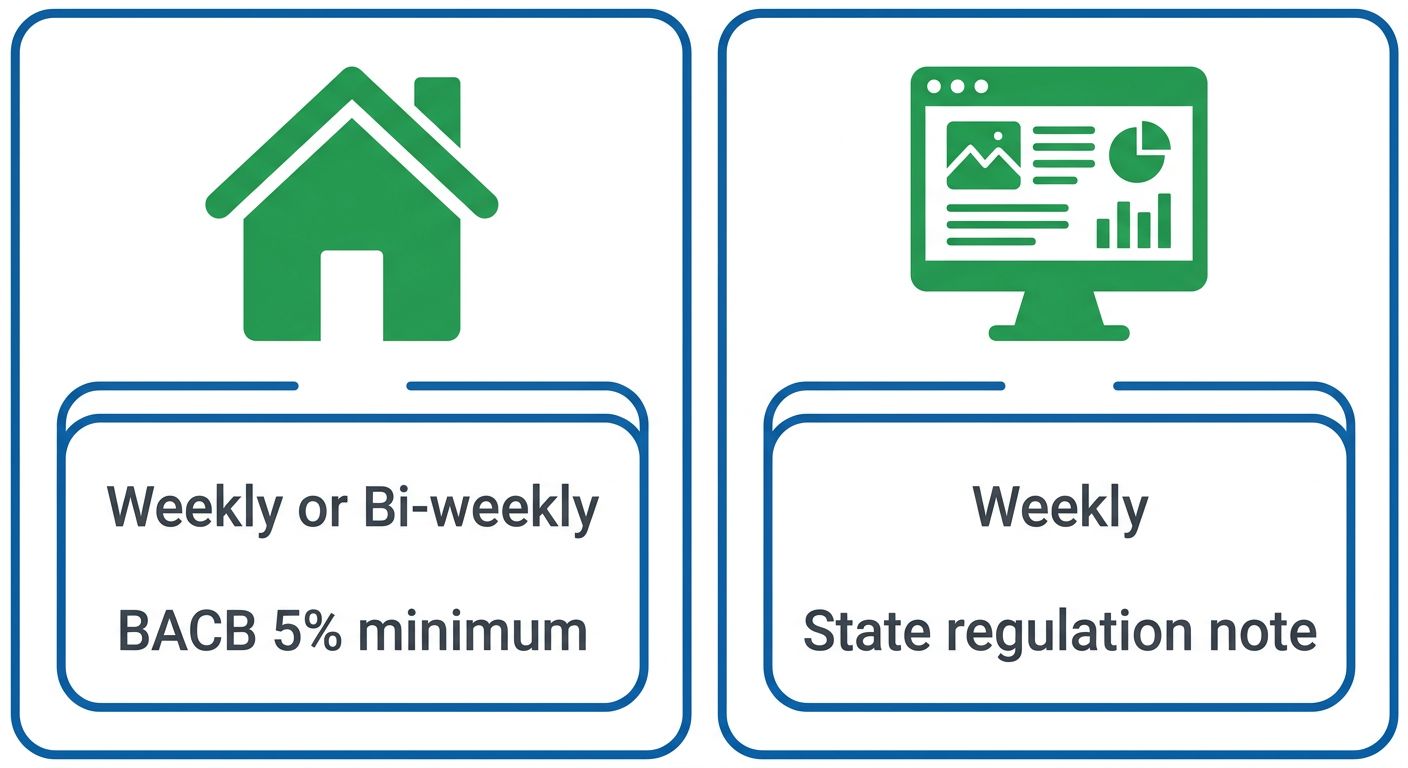
Comparison of in-home vs telehealth BCBA supervision frequency.
We schedule supervision based on more than just BACB minimums. Your BCBA considers your child’s treatment goals, the complexity of the behavior plan, and input from you and the RBT when determining how often to visit. Insurance providers also play a role, as they may stipulate certain supervision benchmarks. Because of these variables, we avoid guaranteeing a fixed frequency. Instead, we stay flexible and transparent, adjusting oversight as your child progresses and as your family’s circumstances change. As an organization rooted in family-centered care, we believe that BCBA oversight should feel like a partnership—we are here to listen, explain, and adapt.
You can expect consistent communication from your supervising BCBA whether the session is in person or remote. Many families ask how often they should see their BCBA, and while weekly or bi-weekly contact is common, we tailor the rhythm to what works best for you. This supervision structure ensures high-quality care; keep reading to learn what qualifications your BCBA should have.
Verifying Credentials and Understanding RBT Supervision Requirements
When you choose in-home ABA therapy for your child, understanding BCBA supervision for home therapy is crucial to ensuring your child receives safe, quality care. At Golden Touch ABA, we believe that transparency around qualifications builds trust, so we encourage families to verify the credentials of the professionals who will work with them. This section walks you through how to confirm a BCBA’s certification and explains the supervision standards that Registered Behavior Technicians (RBTs) must meet.
How to Verify a BCBA’s Credentials for Your Child’s Care
Verifying a BCBA’s credentials is a straightforward process that ensures your child’s therapist has the required training and ethical standing. Begin with the official Behavior Analyst Certification Board (BACB) registry. Here’s a step-by-step guide:
- Visit the BACB website and locate the certificant registry search tool.
- Enter the BCBA’s full name or certification number into the search fields.
- Review the search results to confirm that the BCBA holds an active, current certification — look for the BACB certification status and expiration date.
- Verify that the certificant is in good standing with no disciplinary actions or inactive status.
- For an extra layer of assurance, check that the BCBA meets any state-specific licensure requirements, as some states require additional credentials beyond BACB certification. You can usually find this by searching your state’s behavior analyst licensing board website.
At Golden Touch ABA, every supervising BCBA holds an active BACB certification and undergoes rigorous internal review. We invite you to ask us for certification details — it’s part of our commitment to family-centered care. The BACB registry is the authoritative source for verifying that your child’s supervising professional has met the national standards for behavior analysis. Taking these steps helps you feel confident that the person overseeing your child’s therapy has the expertise needed to design and monitor an effective in-home program. State licensure may require an additional verification; always confirm that your provider complies with local regulations. Remember, a BCBA who is certified but also licensed in your state offers an extra level of oversight and adherence to local professional standards.
Now that you understand how to check credentials, let’s examine the supervision requirements that ensure RBTs deliver therapy with continuous professional oversight.
RBT Supervision Requirements: What Parents Should Know
The BACB establishes specific RBT supervision requirements to maintain quality and safety in ABA therapy. At Golden Touch ABA, we follow these mandates closely because we know that consistent supervision directly impacts your child’s progress. The core standard: at least 5% of the RBT’s total service hours each month must include direct observation by a qualified BCBA. This observation can occur in person or via live video review, and it must happen regularly — not clustered into one day. For example, an RBT providing 20 hours of therapy per week would need at least one hour of direct BCBA observation each week.
Supervision goes beyond simple observation. It involves several components that together ensure the RBT applies the treatment plan faithfully and adapts when needed:
- Direct in‑person observation: The BCBA watches the RBT work with your child in the home, noting technique and interaction.
- Video review: For remote oversight or when in-person visits aren’t possible, the BCBA reviews recorded sessions to assess fidelity.
- Feedback meetings: After observation, the BCBA meets with the RBT to discuss strengths, areas for improvement, and any adjustments to the behavior plan.
- Performance evaluations: Periodic formal reviews track the RBT’s development and ensure they meet all competency standards, including BCBA supervised fieldwork hours when applicable.
Our team integrates these activities into a structured supervision schedule so that every RBT receives ongoing, meaningful guidance. We encourage parents to ask about supervision logistics when selecting a provider — questions like “How often will a BCBA observe my child’s session?” or “What does a typical feedback session look like?” can reveal a lot about a practice’s commitment to quality. At Golden Touch ABA, we make sure our BCBAs are intimately involved in your child’s care, not just occasional visitors. We structure our in-home programs so that every family benefits from robust BCBA supervision for home therapy.
Understanding these credentialing and supervision standards puts you in a stronger position to advocate for your child. In our next section, we’ll explore what a typical ABA therapy session looks like in your home, from the initial assessment to ongoing skill building. Please remember that therapy outcomes vary and you should consult a licensed healthcare professional for a medical diagnosis or personalized advice.
BCBA Supervised Fieldwork: Ensuring Competent Therapy Delivery
BCBA supervision for home therapy is the cornerstone of quality assurance at Golden Touch ABA. We call it BCBA supervised fieldwork — the ongoing clinical oversight that ensures every therapy session aligns with your child’s individualized treatment plan. This process maintains fidelity to evidence-based practices while creating a warm and welcoming environment where families feel supported and informed. We document supervisory feedback and progress notes to ensure continuity of care and clear communication regularly.
Our ongoing clinical supervision meets and exceeds the standards set by the Behavior Analyst Certification Board (BACB). Under these requirements, a BCBA must directly observe a meaningful portion of therapy hours each month and conduct regular face-to-face meetings with RBTs. This monitoring catches technique drift immediately, keeping every interaction effective and ethical. Supervisors review session data, adjust goals as needed, and coach RBTs on subtle behavioral strategies so interventions remain tailored and measurable. According to Golden Touch ABA’s clinical protocols, such rigorous oversight is central to our family-centered care model.
Because we deliver in-home ABA therapy, fieldwork supervision takes place right where your child lives and plays. Our BCBAs model strategies in real-life situations, turning parents into confident partners. In the home setting, we practice skills in daily routines to generalize learning and empower families to reinforce progress. RBT supervision requirements include direct coaching during sessions, where BCBAs review behavior plans and offer instant feedback, so your therapy team works as a unified, highly skilled unit.
Families experience the power of small steps: every milestone builds on expert guidance. While each journey is unique, this layered supervision keeps treatment dynamic, responsive, and always rooted in the best available research.
Results may vary; consult a licensed professional for diagnosis or treatment decisions.
Frequently Asked Questions About BCBA Supervision for Home Therapy
After learning about the essential role of bcba supervision for home therapy, families often have questions about how this process works within their daily routine. We provide clear answers to help you feel confident and informed.
What is BCBA supervision for home therapy?
Our Board Certified Behavior Analyst oversees every aspect of your child’s in-home ABA therapy program, ensuring it is personalized and effective. This clinical direction guarantees that teaching strategies are implemented correctly and adapted as your child progresses.
How often does a BCBA supervisor visit during in-home ABA?
The frequency of supervision sessions aligns with rbt supervision requirements and typically includes regular in-person and remote check-ins. We adjust the schedule to fit your family’s needs while maintaining the highest standard of clinical oversight.
What are the requirements for BCBA supervision in an in-home setting?
BCBAs complete extensive graduate education and hands-on training through bcba supervised fieldwork before earning their credential. Our supervisors bring this rigorous experience into your home, coordinating directly with your child’s therapist.
How does BCBA supervision benefit my child and their RBT?
Ongoing BCBA oversight provides your RBT with real-time feedback and in-the-moment training, creating a warm and welcoming environment for learning. This collaborative model supports our family-centered care philosophy and helps your child build skills faster.
Can BCBA supervision be conducted remotely or does it require in-person visits?
We use a hybrid model that combines in-person visits with secure remote observation to offer flexible support. This ensures we can maintain consistent supervision regardless of daily schedules or location challenges.
As a core piece of our evidence-based practices, regular BCBA oversight connects every small success to the power of small steps. This seamless clinical support prepares your family to confidently move toward discussing insurance and next steps with our team.
Empowering Your Child’s Progress Through Quality BCBA Supervision
BCBA supervision is the professional oversight provided by a Board Certified Behavior Analyst who guides your child’s in-home therapy and tracks meaningful progress. Through careful, data-informed adjustments and the direct involvement of our clinical team, each session evolves to support your child’s individual needs.
At Golden Touch ABA, we pair every family with a dedicated BCBA who designs a truly individualized treatment plan. An RBT implements that plan right in your home under close BCBA guidance during home-based therapy, ensuring every small step forward is celebrated. This collaborative, evidence-based approach helps create measurable growth while honoring the power of family-centered care, without promising any specific outcome. It naturally sets the stage for the way our RBTs deliver those thoughtfully crafted plans.
Resources
- Understand ABA Therapy Billing Units and CPT Codes
- Discover ABA Practitioner Requirements and Supervision Standards
- Discover the RBT Certification Process and Requirements
- Compare ABA Practitioner Tiers: RBT, BCaBA, and BCBA
- Discover RBT Training Aligned with BACB Task List
- Compare BCBA and RBT Roles and Training Requirements
- Explore Certification Paths for RBT and BCBA Practitioners
- Explore BACB Certification Requirements and Professional Resources
Table of Contents
Top Features of Best ABA Therapy in New Jersey
Discovering the best aba therapy in New Jersey starts with key features that make aba therapy for autism truly effective. At Golden Touch ABA Therapy, we prioritize personalized, evidence-based care to support your child’s growth.
Here are our top features:
- Individualized Treatment Plans: BCBAs create custom plans from behavioral assessments, as recommended by Autism Speaks.
- In-home ABA Therapy: We deliver sessions in a warm, familiar environment for comfort and progress.
- Family-Centered Care: Our training empowers caregivers, aligning with Autism Society insights on family roles.
- Evidence-Based Practices: Ongoing tracking ensures measurable results with proven methods.
- Flexible Scheduling & Insurance Help: We assist with benefits for seamless access.
Ready to experience these? Contact us for a custom quote and ABA therapy near me Newark tailored to your family. Results may vary.
1. Personalized Treatment Plans
Building on our commitment to evidence-based practices, we at Golden Touch ABA Therapy craft personalized treatment plans for each child, making us a leader in the best aba therapy available. These plans address unique needs, strengths, and family goals for aba therapy for autism, fostering real progress through family-centered care.
Explore our ABA services with this step-by-step process:
- Conduct a behavioral assessment to pinpoint target behaviors.
- Collaborate with families in goal-setting sessions.
- Design interventions using proven methods, supervised by our BCBAs per Behavior Analyst Certification Board (BACB) standards.
- Implement in-home ABA therapy sessions by trained RBTs, with ongoing adjustments and caregiver training via our interactive ABA roadmap.
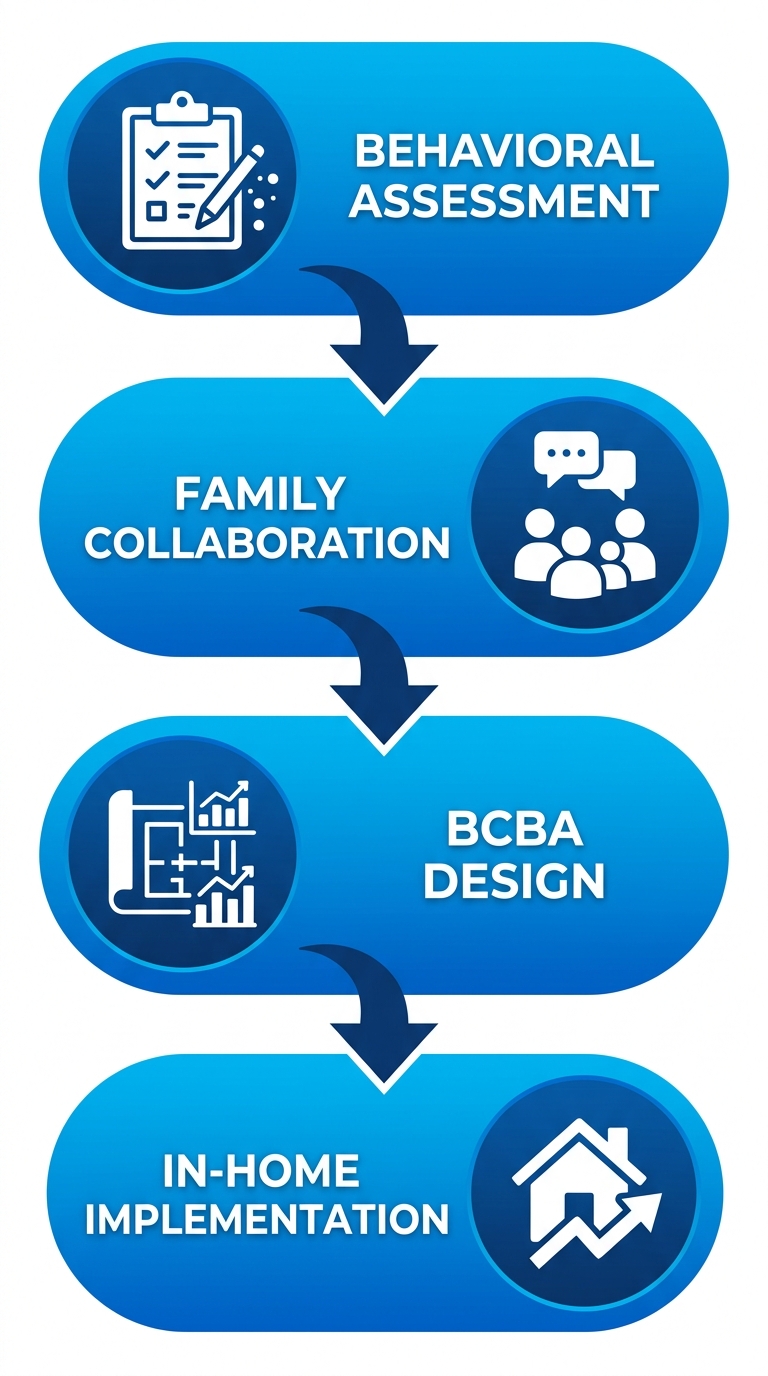
Four key steps in Golden Touch ABA personalized treatment plans
We offer flexible scheduling and insurance assistance—contact us for a custom quote. The power of small steps shines in our warm and welcoming environment. Results may vary. This foundation leads into our comprehensive behavioral evaluations—reach out today for your initial assessment.
2. In-Home Comfort Sessions
Building on foundational ABA principles, our In-Home Comfort Sessions take ABA therapy to where your child feels safest—right in their own home. We deliver the best aba therapy through in-home ABA therapy, fostering a warm and welcoming environment that minimizes anxiety and supports natural learning for children with autism.
Our sessions leverage the power of small steps in everyday settings. Key advantages include:
- Individualized treatment plans tailored to your child’s needs, like aba therapy for autism focusing on communication and independence.
- RBT-delivered therapy under BCBA supervision for consistent progress.
For example, services similar to autism ABA therapy in Lakewood highlight home-based benefits, as noted by Crystal Care ABA, an industry example of accessible care. We emphasize family-centered care with caregiver training to reinforce skills at home, flexible scheduling, and our interactive ABA roadmap tool for tracking. Evidence-based practices ensure measurable outcomes, though results may vary.
Complementing in-home care, explore our clinic-based options for added support. Contact us for custom plans and insurance assistance.
3. BCBA Expert Supervision
Building on your custom plan, our BCBAs provide expert oversight as part of the best aba therapy available through Golden Touch ABA Therapy. A Board Certified Behavior Analyst (BCBA) holds a graduate degree, passes the rigorous BACB exam, and completes supervised fieldwork, per the Behavior Analyst Certification Board (BACB) standards as the official certifying authority.
Our BCBAs conduct initial assessments and craft individualized behavior intervention plans for in-home ABA therapy. They deliver at least 5% direct monthly supervision of RBT sessions, reviewing real-time data to refine protocols. This ensures evidence-based practices tailored to each child.
Key benefits include:
- Skill generalization for families, promoting consistency at home.
- Progress monitoring with timely adjustments for optimal gains.
- Enhanced aba therapy for autism outcomes, supported by high-impact research from the Association for Behavior Analysis International (ABAI), like studies on autism interventions. ABA excels as a core therapy, complementing mental health therapies autism when needed, in our family-centered care approach where BCBAs train caregivers during sessions.
This supervision empowers our RBT team and your family for lasting progress with the power of small steps. Contact us for a custom quote. Results may vary based on individual circumstances.
4. RBT Skilled Implementation
Building on BCBA-designed plans, our Registered Behavior Technicians (RBTs) bring them to life through skilled implementation, delivering the best aba therapy in a child’s natural environment. As a core part of our In-home ABA therapy, RBT-delivered therapy receives close supervision by BCBAs to ensure precise execution of individualized behavior plans.
Our RBTs undergo rigorous certification, including 40-hour training, competency assessments, and ongoing supervision per BACB standards. Practical provider insights on RBT delivery standards highlight how this prepares them for effective evidence-based practices in daily sessions.
During visits, RBTs collect real-time data, apply prompting techniques like discrete trial training or natural environment teaching, and adjust strategies based on feedback. These top-rated ABA therapy approaches, as highlighted in the most cited behavior analysis articles, support meaningful progress in aba therapy for autism.
RBTs also empower families through hands-on guidance in family-centered care, training caregivers on reinforcement strategies. Our interactive ABA roadmap tool aids implementation tracking. Results may vary. Contact us for a custom quote on RBT services with insurance assistance.
5. Family-Centered Training
Building on our RBT-delivered sessions, we extend support through family training, providing one of the best ABA therapy experiences through family involvement. At Golden Touch ABA Therapy, we prioritize Family-centered care to empower caregivers in every step of the journey.
Our BCBA-led sessions teach reinforcement techniques, data tracking, and daily routine integration. For inspiration, consider autism family support stories like Tricia D. and her son Blake, referenced by Autism Speaks as a real-life example of family resilience amid autism challenges.
In our in home aba therapy, families gain confidence implementing strategies, enhancing aba therapy for autism at home. The power of small steps builds lasting skills, making us a top-rated choice for the best ABA therapy.
Families report smoother home implementation and greater assurance and increased confidence. Results may vary. Contact us for a custom quote on personalized training plans, leading to measurable family-involved outcomes.
6. Evidence-Based Strategies
Building on these benefits, we implement proven strategies that define the best aba therapy for children with autism. Evidence-based practices drive progress through the power of small steps, ensuring measurable outcomes in our family-centered care. Our in-home ABA therapy incorporates leading ABA therapy methods tailored to each child.
We use Discrete Trial Training (DTT) to break skills into small components with clear prompts and reinforcements. This approach thrives in our warm and welcoming environment, making aba therapy for autism highly effective at home.
Natural Environment Teaching (NET) builds skills in everyday contexts, with family involvement at the core. As industry examples like Crystal Care ABA show for regional practices, this fosters natural growth through play.
Pivotal Response Training (PRT) targets motivation via child-led activities, aligning with our individualized plans for in home aba therapy.
Delivered by RBTs under BCBA supervision, these strategies support lasting gains. Results may vary. Ready to start with these evidence-based approaches? Contact us for your custom plan and interactive ABA roadmap tool.
7. Progress Tracking Tools
With your child’s plan in place, our progress tracking tools bring it to life. We empower families through our Interactive ABA Roadmap tool, a standout feature of the best aba therapy. This online dashboard visualizes skill acquisition and behavioral milestones in real-time, accessible anytime for family-centered care.
Daily Data Logging
Our RBTs, under BCBA supervision, track target behaviors during in home aba therapy sessions using evidence-based practices like ABC charts and skill probes. Weekly BCBA reviews ensure data-driven adjustments for effective aba therapy for autism.
Quarterly Progress Reports and Family Training
We share customized reports with graphs showing improvement percentages and goal attainment rates. Caregivers learn to monitor home progress during family training sessions. Results may vary (no guaranteed outcomes).
These tools foster transparency and trust in our in home aba therapy. They ensure accountability—reach out today for your custom ABA roadmap. Contact us for a custom quote.
8. Insurance Assistance Support
At Golden Touch ABA Therapy, we provide dedicated insurance assistance to simplify access to the best aba therapy for children with autism. This family-centered care ensures families can focus on their child’s progress through in-home ABA therapy without insurance hurdles.
Our step-by-step process begins with an initial insurance verification call, followed by a thorough review of benefits and eligibility, including Medicaid. We handle submission of prior authorizations and offer ongoing claims support. Using evidence-based practices, our documentation strengthens approvals for aba therapy for autism. Our team also monitors claim responses, follows up with payers to resolve denials, coordinates additional documentation, and keeps families informed promptly at every step of the authorization process.
We train caregivers on using insurance effectively and provide flexible scheduling around coverage. Contact us today for a personalized insurance eligibility check. Insurance coverage is subject to verification and is not guaranteed.
Elevate Your Child’s Future with ABA
Imagine unlocking your child’s potential with the best aba therapy at Golden Touch ABA Therapy. Our in-home ABA therapy empowers families through evidence-based practices like discrete trial training for communication, naturalistic teaching for daily living skills, and peer play for social growth. Aba therapy for autism builds independence, though results may vary.
As shared in an inspiring real-life testimonial by Autism Speaks about Tricia D. and her son Blake, families thrive with dedicated support. The Autism Society champions such proven interventions as foundational for autism development. We deliver personalized in-home ABA therapy with BCBA supervision and family-centered care including caregiver training. Start elevating your child’s future today—try our interactive ABA roadmap tool or contact us for a custom quote.
This article was researched and written with the assistance of AI tools.
Resources
- Get No-Waitlist ABA Therapy for Autism in Newark
- Start ABA Therapy Quickly with No Waitlist in NJ
- Access In-Home Play-Based ABA Therapy in Lakewood
- Find Best Individualized ABA Therapy in New Jersey
- Build Personalized ABA Therapy Plans via Assessments
- Perform Behavioral Assessments for Autism Therapy Plans
- Complete Fast BCBA Assessments for Quick ABA Start
- Explore Mental Health Therapies for Autistic Individuals
- Discover Top-Cited Behavior Analysis Articles from 2025
- Learn Inspiring Autism Family Stories and Resources
- Apply Autism Society Principles for Therapy Choices
- Achieve BCBA Certification for Supervising Behavior Services
