
Therapist Layton Utah: Your Complete Guide to Finding Help
Table of Contents
- Finding a Qualified Therapist in Layton, Utah
- Therapy Options in Layton, Utah
- Behavioral Therapy Services Available in Layton
- Selecting a Qualified Therapist in Layton, Utah
- Taking the First Step Toward Therapy in Layton
- Building a Supportive Therapy Journey in Layton
Finding a Qualified Therapist in Layton, Utah
Finding a qualified therapist in Layton, Utah starts with verifying professional credentials. While you may consider an anxiety therapist in Layton, Utah or neurofeedback therapist in Layton, Utah, for ABA services the critical credential is BCBA certification—check the BACB registry at bacb.com.
When evaluating providers, ask about experience with communication, social skills, and age-specific needs. Our comprehensive ABA therapy services include in-home sessions that support skill generalization. We prioritize parent training and flexible scheduling, with BCBA oversight and RBT implementation, so small steps yield big results.
We invite you to a free initial consultation to see if our warm, welcoming environment is the right fit for your family. This information is for educational purposes and is not a substitute for professional medical advice; consult a healthcare or behavioral health professional.
Therapy Options in Layton, Utah
When looking for a therapist in Layton, Utah, families have two main ABA therapy settings to consider: in-home and center-based. At Golden Touch ABA Therapy, we specialize in in-home ABA delivered in Layton and the neighboring Weber and Davis county areas, creating treatment plans in the child’s own home. While some families may also explore a neurofeedback therapist in Layton, Utah or an anxiety therapist in Layton, Utah for other mental health needs, ABA is the evidence-based approach for autism spectrum disorder. The following comparison highlights the key differences.
| Feature | In-Home ABA Therapy | Center-Based Therapy |
|---|---|---|
| Environment | Child’s natural home setting; promotes skill generalization in real-life contexts | Clinical or classroom setting; structured environment with fewer real-world distractions |
| Scheduling | Flexible in-home visits Monday–Friday, 8 AM–5 PM; accommodates family routines | Fixed center hours; may require travel and strict appointment slots |
| Family Involvement | Direct parent coaching and collaboration during sessions; caregivers observe and participate | Limited observation opportunities; family involvement often occurs through scheduled meetings |
| Cost Considerations | Insurance verification and prior authorization support available; costs vary by plan | Often lower hourly rates but may include additional facility fees or transportation costs |
| Progress Monitoring | Data-driven behavior plans with weekly progress reports; adjustments made responsively | Periodic progress reviews; less frequent direct observation of natural behaviors |
Understanding these differences can help families in Layton decide which setting fits their needs. The Utah Division of Services for People with Disabilities (DSPD) provides state disability resources, and the CDC offers national autism data.
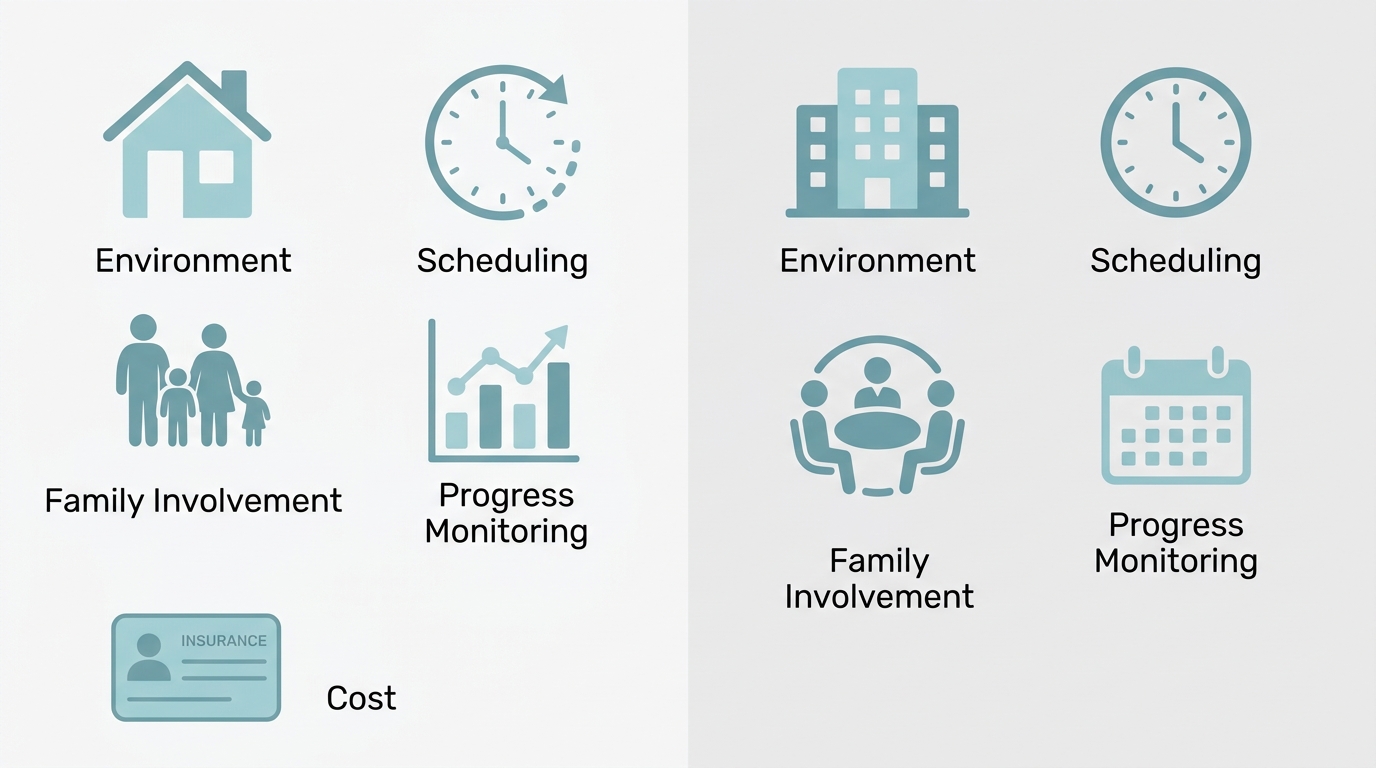
In-home versus center-based ABA therapy comparison
For choosing mental health therapist guidelines, families can consult the CDC’s recommendations. Please note that results may vary based on individual circumstances, and this information is for educational purposes and is not a substitute for professional medical advice.
Behavioral Therapy Services Available in Layton
For families searching for a therapist in Layton Utah, Golden Touch ABA Therapy offers a full range of behavioral therapy services tailored to children and young adults with autism. We bring compassionate, evidence-based care directly into your home, creating a familiar setting where learning flourishes.
Our in-home ABA therapy services encompass:
- In-Home ABA Therapy – the core of our program, using positive reinforcement to teach critical skills.
- Communication Skills – enabling children to express needs, follow instructions, and engage in conversation.
- Social Skills – practicing turn-taking, sharing, and building friendships.
- Daily Living & Independence – developing self-care, routines, and household participation.
- Problem Behavior Reduction – our anxiety therapist in Layton Utah helps replace challenging behaviors, such as anxiety-driven outbursts, with functional communication and coping strategies.
- Parent Training – empowering caregivers with hands-on coaching and consistent strategies.
- BCBA Assessments – designing and monitoring individualized treatment plans.
- RBT-Delivered Sessions – consistent, engaging one-on-one support under BCBA supervision.
Our Layton-based therapy team collaborates with your family to tailor every session to your child’s unique strengths and daily routines. All our services follow the clinical guidelines of the American Academy of Pediatrics, providing counseling services in Layton, Utah, for pediatric mental health backed by rigorous research. We deliver these strategies in your own home, using a ‘Small Steps That Yield Big Results’ approach that celebrates every milestone. With consistent effort, many children make steady progress, though results vary based on individual circumstances.
Each service is supervised by a Board Certified Behavior Analyst (BCBA) – learn more about our team below.
Selecting a Qualified Therapist in Layton, Utah
Once you decide on ABA therapy, the next step is selecting a qualified therapist in Layton, Utah. The right professional can make a meaningful difference in your child’s journey.
Look for therapists who hold Board Certified Behavior Analyst (BCBA) certification or are supervised by one. Registered Behavior Technicians (RBTs) should receive training and oversight from a BCBA, and experience with in-home therapy and family collaboration is key. For example, Golden Touch ABA Therapy’s team includes BCBAs and RBTs who work closely with families in the home to help children build skills. This collaborative approach ensures that progress continues during daily routines. We recommend visiting their website to see how a qualified therapist operates.
While you may come across a neurofeedback therapist in Layton, Utah or an anxiety therapist in Layton, Utah, ABA therapy requires specific behavioral credentials. For broader support, explore disability services in Utah to connect with additional resources.
After choosing a therapist, you can expect an initial assessment and personalized plan designed around your child’s unique needs. Please remember that results vary based on individual circumstances, and this information is not a substitute for professional medical advice.
Taking the First Step Toward Therapy in Layton
If you’re ready to help your child build new skills, finding the right therapist in Layton is an important step. We proudly serve families across Layton, UT, making it simple to get started with individualized, in-home ABA therapy.
Begin by calling our office or filling out a contact form to connect with our friendly intake team. A Board Certified Behavior Analyst (BCBA) will then schedule a personalized assessment right in your home, where your child feels most comfortable. Our ABA therapy programs are tailored to your child’s strengths and goals, using their natural environment to promote learning and skill generalization.
Throughout the process, your ABA therapist in Layton will collaborate closely with your family, providing parent training and regular progress updates so skills carry over beyond sessions. Early intervention can make a lasting difference, as the Centers for Disease Control and Prevention (CDC) underscores the importance of timely support.
Reach out to our team today to begin. This information is for educational purposes and is not a substitute for professional medical advice. Results may vary based on individual circumstances. Consult with a qualified behavioral health professional.
Building a Supportive Therapy Journey in Layton
In Layton, Utah, finding the right therapist for your child is the first step toward a supportive therapy journey. Whether families are searching for an anxiety therapist in Layton or a neurofeedback therapist in Layton, building a supportive ABA therapy journey starts with Golden Touch ABA Therapy. We provide In Home ABA Therapy in a Warm and Welcoming Environment, embracing the philosophy that Small Steps That Yield Big Results. Our therapists work closely with families to integrate strategies into everyday routines, making progress feel natural and sustainable. Through personalized plans and consistent collaboration, we help children develop communication, social, and daily living skills right where they feel most comfortable.
Resources
Table of Contents
- The Foundation of Family Training in ABA Therapy
- Why Family Training Is Essential in ABA Therapy
- Integrating Family Training into In-Home ABA Sessions
- What Parent Training in ABA Therapy Covers
- Virtual Options for Family Training in ABA Therapy
- Generalizing ABA Skills at Home Through Family Training
- Your Family’s Role in Unlocking ABA Success
The Foundation of Family Training in ABA Therapy
At Golden Touch ABA Therapy, we believe that family training in ABA therapy is not simply an add-on to treatment — it is the cornerstone of meaningful, lasting progress. Our approach centers on family-centered care because we understand that children thrive when learning extends beyond structured sessions and into the comfort of their homes and everyday routines.
When parents and caregivers are actively engaged, they gain practical strategies to reinforce skills in the moment, whether during mealtimes, play, or bedtime. This daily practice is essential for generalizing ABA skills at home — that is, helping a child use a new skill across different people, places, and situations. Without it, gains made during therapy can fade. The leading autism advocacy organizations, including Autism Speaks, confirm that active family participation is an integral component of effective ABA therapy, and the Autism Society identifies parent and caregiver training as a core evidence-based element of treatment. For a comprehensive look at the principles behind this approach, see our ABA therapy overview.
Ultimately, robust parent involvement in ABA therapy creates consistency between our BCBAs, RBTs, and your home — the very consistency that transforms small steps into life-changing outcomes.
Why Family Training Is Essential in ABA Therapy
At Golden Touch ABA Therapy, we believe that family training in ABA therapy is the bridge between clinical sessions and everyday life. When families understand and apply behavioral strategies, progress doesn’t stop when the therapist leaves—it becomes woven into the fabric of daily routines, from morning wake-ups to bedtime stories. This family-centered care approach transforms parents from passive observers into active partners, creating a therapeutic environment that surrounds the child with consistent support.
Creating a Consistent Learning Environment
ABA therapy reaches its full potential when skills are practiced across all settings, not just during one-on-one sessions. Family training ensures that the strategies our BCBAs and RBTs introduce are carried over into mealtimes, bath time, and playtime. This consistency helps children understand that expected behaviors apply everywhere, not only with their therapist.
Parents learn to turn everyday moments into natural teaching opportunities. Getting dressed becomes a chance to practice communication and sequencing, while brushing teeth reinforces self-care routines. For more information on evidence-based practices, see autism society resources. Generalizing ABA skills at home means that learning is continuous, not confined to scheduled therapy blocks.
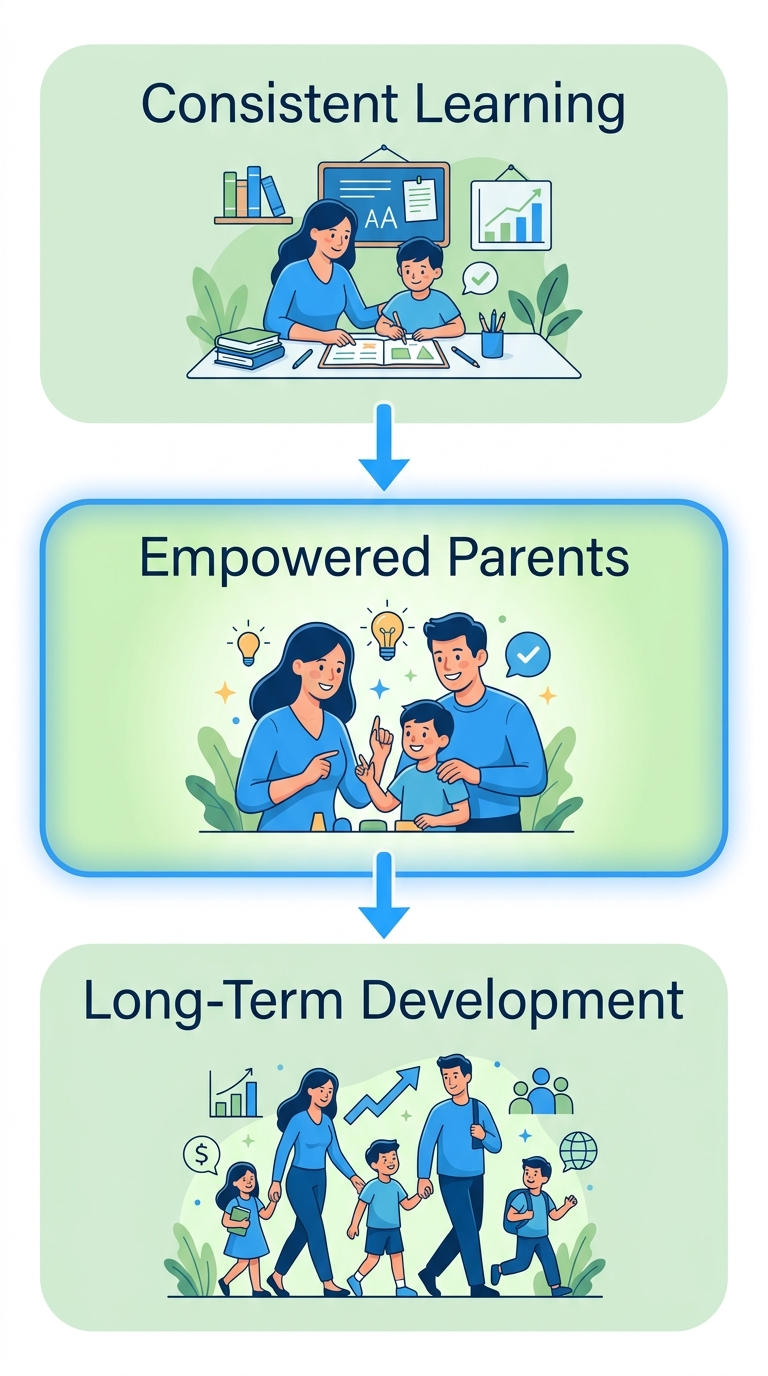
A three-stage process flow showing how ABA parent training empowers families and improves child development outcomes.
With this foundation of consistency, families begin to see meaningful changes in behavior that last beyond therapy hours and strengthen the parent-child relationship.
Empowering Parents and Caregivers
Family training provides parents with concrete tools that build confidence and reduce feelings of helplessness. Parent involvement in ABA therapy shifts the role from worried observer to capable co-therapist, equipped with strategies that work. Caregivers gain a clear understanding of why behaviors occur and how to respond, which lowers stress and fosters a sense of partnership in their child’s progress.
Our team walks alongside families, teaching them to identify antecedents, reinforce positive behaviors, and redirect challenges calmly. For example, a parent who learns to use a visual schedule can smooth morning transitions independently, without waiting for the therapist’s next visit. This empowerment transforms daily caregiving tasks into purposeful interactions, reinforcing progress at every turn.
Long-Term Impact on Child Development
Consistent family involvement in ABA therapy leads to stronger skill maintenance and generalization over time. According to the Autism Society, quality ABA programs recommend active family participation as a standard, evidence-based component. Without this carryover, skills learned in the clinic often fail to transfer to home, school, or community settings—the very environments where they matter most.
When caregivers practice family training ABA therapy strategies during daily life, children demonstrate improved communication, social engagement, and adaptive skills that endure for months and years. Over 20 scientific studies confirm that intensive, long-term therapy involving families produces meaningful gains.
Integrating Family Training into In-Home ABA Sessions
A key reason families succeed with in-home therapy is the emphasis on training parents as active partners, not passive observers. We believe the power of small steps starts with the whole family, which is why in-family training in ABA therapy is woven directly into every session. Our approach to parent involvement in ABA therapy turns everyday moments into meaningful teaching opportunities, fostering true generalization.
Collaborative Goal Setting with the BCBA
Our Board Certified Behavior Analysts meet with you to understand your family’s unique daily life and priorities. Together, we select two to three priority skills to target, such as requesting, toilet training, or tantrum reduction, and formally include them in the child’s personalized Behavior Intervention Plan. This collaborative process ensures that therapy aligns with what matters most to you, creating a warm and welcoming environment where your perspective shapes our evidence-based practices.
In-the-Moment Coaching During Sessions
During a home session, your child’s therapist will pause to model a specific technique for you, like a prompting hierarchy. After the brief demonstration, they will hand the interaction over to you, providing immediate, supportive feedback right in the moment. This live coaching is a cornerstone of our family-centered care, empowering you to confidently apply new strategies and naturally supporting generalizing ABA skills at home.
Structured Parent Training Components
Our in-family training in ABA therapy uses a clear, four-part framework to build your confidence:
- Brief Instruction: We start by clearly explaining the targeted skill and the strategy behind it.
- Therapist Role-Play: Your therapist will demonstrate the procedure, showing you exactly what the interaction should look like.
- Parent Practice: You practice the technique with your child while the therapist provides gentle, real-time coaching.
- Data Tracking: We use simple data sheets so you can see your child’s progress.
What Parent Training in ABA Therapy Covers
Parents are often the most powerful agents of change in a child’s development. In family training in ABA therapy, the focus is on equipping you with practical, evidence-based strategies. Golden Touch ABA Therapy offers a structured program led by a BCBA who delivers weekly coaching right in your home.
Understanding ABA Principles
You will learn to identify your child’s triggers and use positive reinforcement—like praise or a favorite toy—to encourage desired behaviors, creating a warm and welcoming environment for learning. We also demystify techniques like prompting and shaping, showing you how to gently guide your child toward mastering a new skill.
Implementing Behavior Support Plans
Managing challenging behaviors can be stressful, but with the right plan, you can navigate these moments calmly. A BCBA conducts a thorough behavioral assessment to design a written behavior support plan (BSP) tailored to your child. Central to generalizing ABA skills at home is the data collection sheet we provide, helping you track progress and celebrate victories.
Building Daily Living and Communication Skills
True independence begins with mastering the tasks of everyday life. Our training turns self-care routines like dressing, toothbrushing, and handwashing into teachable moments. For children who are non-verbal or minimally verbal, we provide coaching on communication systems such as the Picture Exchange Communication System (PECS), sign language, or AAC devices.
Virtual Options for Family Training in ABA Therapy
Family training has adapted to modern schedules through flexible, evidence-based practices.
Remote Coaching and Telehealth Models
Remote coaching through telehealth allows a BCBA to connect with your family using secure video calls. Your ABA therapist can model behavior strategies and observe your home interactions in real time in a comfort-first environment.
Benefits of Online Training for Busy Families
Online training reduces travel time and scheduling conflicts. One major advantage of this family-centered care is the ability to record virtual sessions for future review, which reinforces learning and supports generalizing ABA skills at home.
Combining Online and In-Person Training
A hybrid approach blends weekly virtual check-ins with monthly in-person visits. Referencing guidelines from ABAI events helps ensure our hybrid coaching stays aligned with professional standards.
Generalizing ABA Skills at Home Through Family Training
Generalization is the cornerstone of lasting progress. We help you weave skill-building into everyday life, ensuring that therapy truly sticks.
Using Natural Opportunities Throughout the Day
Effective parent involvement transforms routine moments into learning opportunities. Mealtime, bath time, and playtime become environments for practicing requests, self-care, and social interaction. These consistent, small interactions are what make generalization achievable.
Strategies for Maintaining Skills Across Settings
We coach families to vary the setting by moving practice from the kitchen table to the backyard. Simple changes, such as using different objects or involving other household members, help a child understand that the skill is universal.
Involving Siblings and Extended Family
We welcome siblings and grandparents into the training process. Teaching a sibling how to initiate games or allowing grandparents to use consistent communication cards builds a broader, more supportive community for your child.
Your Family’s Role in Unlocking ABA Success
For a broad introduction to our method, see our ABA therapy overview. Your active participation, supported by your dedicated BCBA, bridges the gap between sessions and daily life, creating a path toward lasting progress.
This article was researched and written with the assistance of AI tools.
Resources
- Get Tailored ABA Therapy with Initial Behavioral Assessment
- Access Immediate ABA Therapy Without Waitlist
- Find No-Waitlist ABA Behavioral Assessments in New Jersey
- Get Individualized ABA Therapy with Standardized Assessment
- Learn ABA Treatment Planning with Family Training Workshops
- Explore ABA Assessments Using Standardized Tools
- Access No-Waitlist ABA Therapy with Behavior Analysis
- Discover Evidence-Based ABA Therapy Overview
- Find Autism Support and Safety Resources
- Explore ABAI Conventions and Professional Development
