
Bcba vs Rbt Roles in Therapy: Complete Guide to Requirements
Table of Contents
- Understanding BCBA vs RBT Roles in Therapy
- Golden Touch ABA Therapy’s Clinical Team Structure
- Comparing BCBA and RBT Roles and Responsibilities
- Funding ABA Therapy: Insurance, Coverage, and Professional Compensation
- Why In‑Home ABA Therapy with Expert Oversight Matters
- Making the Right Choice for Your Child’s Behavioral Health
Understanding BCBA vs RBT Roles in Therapy
Understanding BCBA vs RBT roles in therapy reveals two distinct and complementary positions that make in-home ABA services work. According to Golden Touch ABA Therapy, the Board Certified Behavior Analyst (BCBA) designs and supervises each child’s personalized program, following national certification standards set by the Behavior Analyst Certification Board. The Registered Behavior Technician (RBT) is the trained staff member who implements that plan directly with the child during sessions, working under the BCBA’s close supervision to ensure fidelity. In our in-home model, RBTs deliver the hands-on teaching while our BCBA team provides ongoing oversight and adjustments. Together, these roles create a supportive structure where therapy stays consistent and responsive to your child’s progress. We invite families into this partnership within a warm and welcoming environment, and knowing how these roles interact helps you see the collaborative clinical team that stands behind every session.
Key Takeaways
- When comparing BCBA vs RBT roles in therapy, key differences are their core responsibilities.
- We help families check on what health insurance covers for ABA therapy as well as verify whether their insurance provides coverage and authorization for autism treatment directly with their company.
- Effective in-home ABA therapy depends on structured oversight from a board-certified behavior analyst, who directs every aspect of a child’s program.
- Choosing the best in-home ABA therapy for your child comes down to expertise — a Board Certified Behavior Analyst (BCBA) designing the plan and a Registered Behavior Technician (RBT) implementing it in routines.
Golden Touch ABA Therapy’s Clinical Team Structure
The clinical team at Golden Touch ABA Therapy includes two key components that function in partnership to bring about customized in-home ABA therapy: Board Certified Behavior Analysts develop and oversee each child’s program, while Registered Behavior Technicians provide the daily one-on-one sessions under close, ongoing guidance.
Our commitment to clinical excellence means following the Behavior Analyst Certification Board’s supervision standards without exception. The BACB requires that RBTs be supervised by a qualified professional, and competency assessments for RBTs must be conducted by a BCBA. Our supervisors complete the BACB’s required 8-hour supervision training, use standardized competency-assessment packets, and document progress with data-driven reports. We adhere to these protocols to maintain treatment fidelity and ensure that every hour of therapy reflects the most current evidence-based practices.
With our team structure grounded in BACB certification standards, each family in Salt Lake County and beyond receives consistent, high-quality care. It will help you understand what happens during therapy when we break down the specific roles of our BCBA supervisors vs our RBT technicians. We also make sure caregivers learn techniques that they can put into practice on a regular basis as well.
Comparing BCBA and RBT Roles and Responsibilities
When comparing BCBA vs RBT roles in therapy, key differences are their core responsibilities.
BCBA vs RBT: Key Role Differences in Home-Based ABA
| Aspect | Board Certified Behavior Analyst (BCBA) | Registered Behavior Technician (RBT) |
|---|---|---|
| Primary Role | Designs and oversees behavior intervention plans; conducts assessments | Implements the intervention plans under close supervision; collects session data |
| Certification Process | Requires graduate degree, supervised fieldwork (≥60% unrestricted activities), and BCBA exam | Requires high school diploma, 40-hour training, passing RBT exam, and ongoing supervision |
| Supervision Relationship | Acts as supervisor for RBTs and BCBA candidates | Must practice under the close supervision of a BCBA or BCaBA |
| Work Activities | Primarily unrestricted activities (e.g., assessment, plan design, supervision) | Primarily restricted activities (e.g., implementing plans, data collection, direct therapy) |
| Supervisor Training Required | Must complete an 8-hour supervision training before supervising RBTs | Not applicable |
| Competency Assessment | BCBAs (and BCaBAs) can conduct competency assessments for RBTs | Must pass a competency assessment before beginning work |
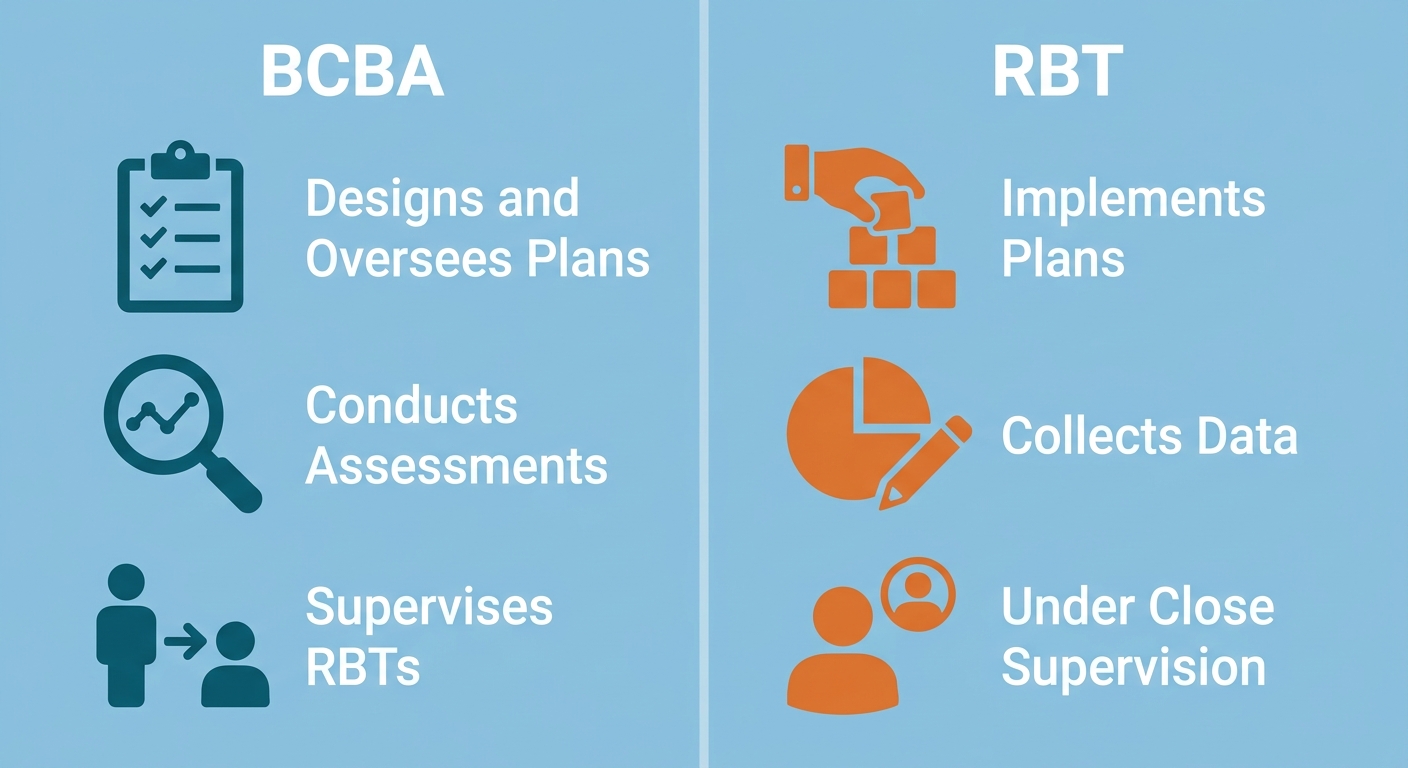
These role differences affect how ABA services are billed and reimbursed.
Funding ABA Therapy: Insurance, Coverage, and Professional Compensation
We help families check on what health insurance covers for ABA therapy as well as verify whether their insurance provides coverage and authorization for autism treatment directly with their company. Many private health insurances will usually pay for ABA therapy in Utah. The Behavior Analyst Certification Board (BACB) is responsible for setting certification requirements as well as establishing supervision regulations which can also be used for paying these professionals. Below are some important differences in supervision responsibilities and certification levels that differentiate BCBAs from RBTs.
| Aspect | Board Certified Behavior Analyst (BCBA) | Registered Behavior Technician (RBT) |
|---|---|---|
| Supervisory status | Acts as RBT Supervisor or Requirements Coordinator | Works under direct BCBA supervision |
| Required supervisor training | Completes an 8-hour supervision training based on BACB curriculum | Completes a 40-hour RBT training program |
| Competency assessment | Holds exclusive authority to conduct RBT initial and recertification assessments | Must be assessed by a BCBA; cannot conduct assessments |
BCBA and RBT pay differ because they have different levels of certification and responsibility. Even though there are no standard BCBA or RBT salaries in any particular area or years of experience, these salaries differ, with BCBAs generally higher because they take responsibility for clinical supervision and program planning.
Why In-Home ABA Therapy with Expert Oversight Matters
Effective in-home ABA therapy depends on structured oversight from a board-certified behavior analyst, who directs every aspect of a child’s program. We pair this expert with a registered behavior technician, who works directly with the child during each session. The technician implements the plan under ongoing guidance, while the analyst monitors progress through detailed data collection and makes real-time adjustments. This daily collaboration turns a written plan into a dynamic, responsive experience that adapts to the child’s needs and helps skills generalize beyond therapy hours.
Additionally, the Behavior Analyst Certification Board (BACB) adds a further layer of quality assurance by requiring supervisors to complete an 8-hour supervision training and to conduct regular competency assessments for technicians. As such, all of our supervisors have met this standard set forth by BACB. Thus, families can trust that their child’s care reflects the highest professional benchmarks.
There are three easy steps for beginning our service: you attend a free consultation followed by an assessment to learn more about your child’s abilities and difficulties. Then, a board-certified behavior analyst creates an individually tailored program of treatment, and therapy begins in your home with ongoing oversight from the same analyst. We work closely with families to make sure schedules are convenient and that there’s consistency.
If parents can learn more about this multi-faceted supervisory structure, it can help them make a confident, informed decision for their child’s behavioral health.
Common Questions About BCBA and RBT Roles
What is the difference between a BCBA and an RBT in home-based therapy?
A Board Certified Behavior Analyst designs and oversees the therapy program, while a Registered Behavior Technician delivers the direct one-on-one sessions under the BCBA’s close supervision. BCBAs require a graduate degree, supervised fieldwork, and a certification exam. RBTs need a high school diploma, a 40-hour training, and must pass an exam and competency assessment.
Does a BCBA or an RBT write the individualized treatment plan?
The Board Certified Behavior Analyst writes the individualized treatment plan. They conduct assessments and design behavior intervention plans, while Registered Behavior Technicians implement the plan during therapy sessions under the BCBA’s ongoing oversight.
Who provides the direct one-on-one therapy during a home visit?
Registered Behavior Technicians provide the direct one-on-one therapy during a home visit. They work under the close supervision of a Board Certified Behavior Analyst to carry out the child’s personalized program and collect session data.
Making the Right Choice for Your Child’s Behavioral Health
Choosing the best in-home ABA therapy for your child comes down to expertise — a Board Certified Behavior Analyst (BCBA) designing the plan and a Registered Behavior Technician (RBT) implementing it in routines. Understanding the BCBA vs RBT roles in therapy helps families see how expert supervision pairs with hands-on delivery to ensure progress. We offer a free consultation to discuss your child’s needs and begin a personalized journey. We know results can vary by individual circumstances, and insurance coverage depends on each family’s plan. This information is for educational purposes and is not a substitute for professional medical advice; consult a healthcare or behavioral health professional.
Start Your Child’s ABA Journey
Now that you understand the distinct roles of BCBAs and RBTs in ABA therapy, you can see how expert oversight and hands-on implementation work together to support your child’s progress. Our practice brings this collaborative model to families in Salt Lake City, Utah, and throughout surrounding counties like Davis and Weber. Our teams follow rigorous BACB certification standards, ensuring your child receives evidence-based care tailored to their unique strengths. With a dedicated BCBA designing the program and an RBT delivering daily sessions under supervision, you’ll have a clear, structured path to meaningful outcomes. We invite you to schedule a free consultation to discuss how in-home therapy can benefit your child. Taking this step connects you with a compassionate team focused on your family’s goals. Begin the journey toward brighter possibilities today.
Start Your Child’s ABA Journey
Resources
Table of Contents
- Exploring ABA Practitioner Requirements: Your Path to a Rewarding Career
- Registered Behavior Technician and BCBA: Key Certification Paths
- Benefits of Becoming a Certified ABA Practitioner
- Steps to Achieve RBT or BCBA Certification
- Best Practices for Success in ABA Therapy
- Start Your Journey as an ABA Practitioner
Exploring ABA Practitioner Requirements: Your Path to a Rewarding Career
Understanding aba practitioner requirements is the first step toward joining a field that changes lives. At Golden Touch ABA Therapy, we see firsthand how dedicated professionals make a difference every day. The requirements to become an ABA therapist fall into three main certification levels, each with its own educational and training path.
- Board Certified Behavior Analyst (BCBA): This advanced role requires a master’s degree in behavior analysis or a related field. You must also complete supervised fieldwork, with bcba fieldwork requirements including a minimum of 1,500 concentrated experience hours under a qualified supervisor, and pass the national certification exam.
- Board Certified Assistant Behavior Analyst (BCaBA): This role requires a bachelor’s degree, supervised experience, and a certification exam, operating under the supervision of a BCBA.
- Registered Behavior Technician (RBT): An ideal starting point for many, this level requires a high school diploma, completion of a 40-hour training program, and passing a rbt competency assessment and the RBT exam. RBTs work directly with clients and are supervised by a BCBA.
Ongoing supervision is essential for all roles, ensuring our team delivers the highest quality family-centered care and adheres to strict ethical guidelines grounded in evidence-based practices. Certification requirements vary by state and are subject to change; verify with the Behavior Analyst Certification Board (BACB). By meeting these ABA career requirements, you begin a journey where the power of small steps leads to incredible progress.
Registered Behavior Technician and BCBA: Key Certification Paths
Understanding the aba practitioner requirements is a powerful first step toward a rewarding career in autism therapy. Whether you are exploring entry-level options or aiming for advanced clinical leadership, the field of Applied Behavior Analysis offers structured certification pathways. Both the Registered Behavior Technician and the Board Certified Behavior Analyst credentials prepare you to make a real difference. In fact, each role qualifies you as an ABA therapist, though the scope of practice, training, and responsibility differ greatly. At Golden Touch ABA Therapy, we see how the power of small steps in certification leads to big changes for the families we serve.
Becoming a Registered Behavior Technician (RBT)
A Registered Behavior Technician is an entry-level credential perfect for those beginning their journey with aba practitioner requirements. To qualify, you must be at least 18 years old and hold a high school diploma or equivalent. The path then requires a 40-hour training program that covers the RBT Task List, as outlined by Golden Touch ABA Therapy. After completing your coursework, you must pass a rbt competency assessment administered by a qualified BCBA. This hands-on evaluation confirms your skills in several domains:
- Measurement and data collection during therapy sessions
- Implementing behavior reduction and skill acquisition plans
- Maintaining professional boundaries and ethical conduct
Finally, you must pass the official RBT exam to become fully certified. At Golden Touch ABA Therapy, we often provide paid training to help you meet these aba practitioner requirements and begin offering family-centered care.
Board Certified Behavior Analyst (BCBA): Advanced Fieldwork and Exam
A Board Certified Behavior Analyst represents the graduate-level certification for those designing and supervising ABA programs. Golden Touch ABA Therapy confirms that BCBA fieldwork requirements are rigorous—you need to earn a master’s degree in behavior analysis or a closely related field and complete supervised fieldwork hours. Typically, this means 1,500 to 2,000 hours of practical experience under a qualified supervisor. These bcba fieldwork requirements allow you to apply evidence-based practices before sitting for the national board exam. Passing this comprehensive test certifies you to work independently, conduct behavioral assessments, and create individualized treatment plans. Recognizing how challenging this pathway can be, we offer free BCBA supervision to help you meet your goals, embracing the power of small steps toward your advanced credential.
Comparing RBT and BCBA Roles
The differences between an RBT and a BCBA revolve around direct implementation versus program design. Our team at Golden Touch ABA Therapy highlights that an RBT works one-on-one with children under close BCBA supervision, faithfully carrying out behavior plans. A BCBA, however, conducts the initial assessments, writes those plans, and oversees the RBTs on the team. This structure allows for family-centered care while maintaining high-quality, evidence-based practices. Career progression is a natural part of this relationship; many RBTs use their experience to meet BCBA fieldwork requirements and eventually become analysts. Now that you compare these roles side by side, the next section will guide you through the specific application steps for each certification.
Benefits of Becoming a Certified ABA Practitioner
Now that you understand what an ABA practitioner does, let’s explore the benefits of becoming certified for this rewarding career path. Meeting the aba practitioner requirements is your gateway to a profession that combines meaningful work with robust career prospects. As the prevalence of autism diagnoses rises and insurance mandates expand, the demand for qualified professionals continues to grow, making it an ideal time to enter the field.
Career Opportunities and Job Stability
The need for skilled behavior technicians and analysts has never been greater. Families actively seek compassionate providers who can deliver in-home ABA therapy, and organizations like ours are consistently looking for dedicated individuals to serve communities across Utah, Arizona, and Maryland. As an ABA therapist, you enter a field experiencing rapid growth, driven by wider recognition of the effectiveness of evidence-based practices. This translates into exceptional job stability, as certified practitioners are essential to meeting the therapeutic needs of children and adolescents. The career ladder is clear, from becoming a Registered Behavior Technician (RBT) to achieving the role of a Board Certified Behavior Analyst (BCBA), each step offering increased responsibility and reward. Working through the bcba fieldwork requirements opens doors to advanced roles in clinical supervision and program management, ensuring your career can evolve with your ambitions.
Making a Tangible Difference in Children’s Lives
Beyond job security, the personal fulfillment in this field is profound. You will witness the power of small steps firsthand as you work directly with children, helping them build essential communication, social, and daily living skills. In our family-centered care model, you aren’t just working with a child; you’re empowering an entire family with strategies that create a warm and welcoming environment at home. According to our internal resources, ABA therapy helps children with autism by building essential life and academic skills through positive reinforcement. Being the person who facilitates that growth—teaching a child to express their needs or navigate a social situation for the first time—offers a unique and deep sense of accomplishment that few other careers can provide. This tangible difference reinforces the value of your work every day.
Support and Professional Growth at Golden Touch ABA Therapy
We believe that supporting our team is the foundation of delivering exceptional care. At Golden Touch ABA Therapy, your professional growth is a priority from day one, whether you are completing your rbt competency assessment or accruing hours toward BCBA certification. Our experienced BCBAs provide ongoing supervision, helping you refine your techniques and master interventions like Discrete Trial Training and Natural Environment Teaching. We foster a collaborative atmosphere where you can advance your career along a clear pathway, from mastering direct therapy delivery to designing comprehensive treatment plans. By working with us, you gain the training, mentorship, and real-world experience needed to become a highly skilled and confident practitioner. Once you recognize these benefits, the next step is understanding the requirements to become a certified ABA practitioner with Golden Touch.
Results may vary; consult a licensed healthcare professional for medical advice.
Steps to Achieve RBT or BCBA Certification
Now that you have a better understanding of the roles in the field, let’s walk through the steps to become a certified ABA professional. The aba practitioner requirements differ depending on whether you start as a Registered Behavior Technician (RBT) or aim for the Board Certified Behavior Analyst (BCBA) credential. At Golden Touch ABA Therapy, we believe in the power of small steps, and we are here to support you on this rewarding journey.
Enrolling in an RBT Training Program
Your first step as a future RBT is to find and complete an approved 40-hour training program. The course covers the foundations of Applied Behavior Analysis, ethical practice, and skill-building strategies. You can locate qualified training through online providers or by connecting with local ABA organizations. We at Golden Touch ABA Therapy guide aspiring practitioners toward reputable training options and offer resources to help you get started.
The rbt competency assessment preparation begins with mastering the material in your coursework. When selecting a program, ensure the curriculum is based on the current Registered Behavior Technician Task List from the Behavior Analyst Certification Board (BACB). Requirements can vary by state, so it is wise to confirm the specific aba practitioner requirements in your area before enrolling.
Completing the Competency Assessment and Exam
After your 40-hour training is complete, the next milestone is the RBT competency assessment. This is a hands-on evaluation conducted by a qualified BCBA or BCaBA supervisor who observes you demonstrating key ABA skills with a client. It is not just a test of knowledge but a showcase of your ability to apply what you have learned in a practical session.
Once you pass this competency evaluation, you are eligible to apply for the official RBT exam administered by the BACB. The exam is a computer-based test that checks your understanding of the task list content. Creating a study schedule, reviewing your course notes, and completing practice questions are great ways to build your confidence. Taking this exam step by step—the power of small steps—will help you succeed.
Pursuing BCBA Certification: Fieldwork and Examination
For those who wish to advance their career, the BCBA certification route opens doors to independent clinical practice. The journey begins with earning a master’s degree in behavior analysis or a closely related field from a qualifying institution. After your degree, you must meet the bcba fieldwork requirements, which involve 1,500 hours of supervised independent fieldwork under a qualified BCBA supervisor.
We provide comprehensive BCBA supervision and training to help dedicated RBTs grow into analysts. Our team creates a warm and welcoming environment where you can hone your clinical judgment and ethical decision-making. The final step is passing the BCBA examination, a comprehensive test that evaluates your mastery of advanced behavior-analytic concepts. Once you obtain your certification, remember that both RBT and BCBA credentials require ongoing renewal and supervision to stay current with best practices and ethical standards. Certification is not just a finish line—it is the start of a lifelong career in evidence-based, family-centered care.
Best Practices for Success in ABA Therapy
The effectiveness of Applied Behavior Analysis (ABA) therapy is built on more than just a treatment plan; it relies on strong foundational practices that guide our clinical team every day. By understanding aba practitioner requirements and embracing continuous improvement, we ensure every child receives the highest quality care. Here at Golden Touch ABA Therapy, we focus on three critical pillars: rigorous supervision, steadfast ethical commitment, and meaningful family collaboration.
Maintaining Supervision and Competency Requirements
Providing effective therapy starts with a well-supported clinical team. The ongoing supervision of our Registered Behavior Technicians (RBTs) by a Board Certified Behavior Analyst (BCBA) is a cornerstone of our model. This process isn’t just a formality; it involves continuous review of client progress, direct observation, and detailed documentation to ensure fidelity. According to our internal guidelines for supervision best practices, regular meetings are scheduled to discuss cases and adjust strategies as needed. Meeting aba practitioner requirements like the RBT competency assessment is essential for initial certification and continued development.
For our BCBAs, staying current is equally critical. Adhering to bcba fieldwork requirements involves maintaining detailed records of ongoing supervision activities and professional growth. We treat these renewal protocols as opportunities to refine expertise, not just check boxes. By embedding this rigorous structure, we ensure our team in Utah and beyond delivers consistently excellent care that translates into meaningful progress for the children we serve.
Staying Current with Ethical Guidelines
Ethical integrity is the backbone of trust in any therapeutic relationship. Our clinical team adheres strictly to the Behavior Analyst Certification Board (BACB) ethical code, as outlined by Golden Touch ABA Therapy’s internal ethical guidelines. This commitment to ethics means we always prioritize client dignity, confidentiality, and the use of evidence-based practices. For our RBTs, this includes mandatory continuing education that goes beyond basic compliance to explore nuanced topics in client care and professional conduct.
We believe that true competency is measured by both skill and character. Every decision, from initial assessment to data analysis, is filtered through this ethical lens. Our RBTs and BCBAs regularly participate in training that reinforces how to navigate complex situations with compassion and professionalism. This unwavering focus ensures that our in-home environment remains a safe, respectful space where therapy is always conducted with the child’s best interest at heart.
Building Strong Family Partnerships
We know that a family-centered care approach is the true catalyst for lasting change. You are the expert on your child, and we are the experts on behavior analysis. When these worlds unite, children thrive. We actively collaborate with you by providing parent training sessions and consistent communication, ensuring strategies used in therapy can be reinforced naturally at home. This collaboration transforms our sessions into a unified effort, creating a warm and welcoming environment where every small victory is celebrated together.
This partnership embodies the power of small steps. Progress in in-home ABA therapy often looks like a patient, gradual unfolding of skills rather than a sudden transformation. By working closely with your family, we witness the daily moments — a new word, a shared smile, improved independence — that build a brighter future. While every journey is unique and results may vary, this collective dedication ensures we’re not just teaching skills; we’re building a supportive community around your child that fosters lifelong confidence and resilience.
Start Your Journey as an ABA Practitioner
Understanding ABA practitioner requirements is the first step toward a rewarding career helping children with autism learn and grow. Two primary certification paths exist—the advanced Board Certified Behavior Analyst (BCBA) and the entry-level Registered Behavior Technician (RBT)—each with its own education, training, and supervision demands.
A BCBA designs and oversees individualized treatment plans. This role requires a master’s degree in a related field and completion of BCBA fieldwork requirements that include 1,500 to 2,000 supervised hours of hands-on practice. At Golden Touch ABA Therapy, we provide free, supportive BCBA supervision that turns those hours into meaningful, real-world experience in a warm and welcoming environment.
An RBT works directly with children, putting treatment plans into action under BCBA guidance. The path starts with a high school diploma, a 40-hour training program, and passing the RBT competency assessment, which a BCBA administers to verify skills like data collection and behavior reduction. Our team at Golden Touch ABA not only offers the required assessment but also paid RBT training, making it easier to build competence while you earn.
We believe in the power of small steps and family-centered care, giving every practitioner the mentorship and individualized support they need to succeed. When you join us, you become part of a practice that values evidence‑based approaches and open collaboration with the families we serve.
Ready to see your own path? Explore our interactive ABA roadmap tool on the website—it’s a personalized way to assess your next move and take that first small step toward a career in ABA therapy.
Resources
- Learn How to Become an ABA Therapist and Coordinate Care
- Explore Career Paths for ABA Therapists with Paid Training
- Find ABA Therapist Jobs with Competitive Pay and Benefits
- Understand Low-Functioning Autism and Tailored ABA Support
- Compare ABA Therapist Salaries and Compensation Packages
- Understand RBT and BCBA Responsibilities in ABA Therapy
- Explore ABA Therapist Jobs in New Jersey with High Demand