
Early Intervention ABA: Complete Guide for Autism Toddlers
Table of Contents
- Discovering Early Intervention ABA Therapy
- Core Principles of Early Intervention ABA
- Exploring Early Intervention Programs in Depth
- Applying Early ABA Therapy in Daily Life
- Advanced Techniques in Early ABA Therapy
- Common Questions on Early Intervention ABA
- Embracing Early ABA for Brighter Futures
Discovering Early Intervention ABA Therapy
At Golden Touch ABA Therapy, we believe that early action changes lives for children with autism. Early intervention ABA is a proven approach starting before age 3, offering the best chance for neurodevelopmental growth in toddlers facing challenges like delayed speech or social withdrawal. By using positive reinforcement and data-driven techniques, this therapy builds essential skills in communication, social interaction, and independence, reducing problematic behaviors along the way.
Imagine a young child struggling to make eye contact during playtime—ABA therapy for toddlers addresses this through tailored, in-home sessions that feel natural and supportive. Our team of Board Certified Behavior Analysts (BCBAs) designs individualized plans, while Registered Behavior Technicians (RBTs) deliver hands-on care with family-centered involvement. We draw from evidence like early intensive behavioral intervention, which research shows improves IQ, language, and adaptive skills significantly. Studies indicate children starting before age 3 show 47% greater gains in key areas, underscoring the power of prompt behavioral therapy initiation.
In this guide, we explore the fundamentals of early intervention for autism, from initial assessments and insurance assistance to our interactive ABA roadmap tool. We’ll cover implementation strategies, measurable outcomes, and advanced tips for timely ABA support for young children with autism. Remember, results may vary, so consult a licensed professional for personalized advice.
Our in-home ABA therapy creates a warm and welcoming environment, emphasizing evidence-based practices to empower families every step of the way.
Core Principles of Early Intervention ABA
Now that we understand the basics, let’s explore the core principles that make early intervention ABA so effective for young children on the autism spectrum. At Golden Touch ABA Therapy, we prioritize evidence-based techniques to support toddlers right when their brains are most adaptable, leveraging neuroplasticity to build essential skills during this critical window.
Early intervention ABA focuses on addressing core challenges like communication delays and social difficulties through structured yet flexible methods. One key principle is the use of positive reinforcement to encourage desired behaviors, creating a supportive learning environment in the home. We draw from established autism treatment options that emphasize individualized plans tailored to each child’s unique needs.
The principles can be outlined as follows:
- Assessment-Driven Planning: We begin with comprehensive evaluations, such as the VB-MAPP, to pinpoint a toddler’s strengths and areas for growth. This tool helps identify skill gaps in areas like manding or social play, ensuring goals are realistic and targeted.
- Evidence-Based Teaching Strategies: Techniques like discrete trial training break down skills into small, manageable steps, while natural environment teaching embeds learning into daily routines. For ABA therapy for toddlers, this means practicing turn-taking during playtime rather than in isolation.
- Data Collection and Progress Monitoring: Every session involves tracking behaviors and skill acquisition to measure outcomes objectively. This allows us to adjust plans dynamically, celebrating small victories that lead to bigger gains.
- Family Involvement: Parents are active partners, receiving training to reinforce skills at home. This collaboration fosters consistency and empowers families to support their child’s development long-term.
In practice, consider a two-year-old named Alex who struggles with expressing needs. Our initial ABA strategies for autism spectrum toddlers start with simple prompts for autism behavioral support, like using pictures to request toys. Over time, Alex gains confidence, reducing frustration and enhancing independence.
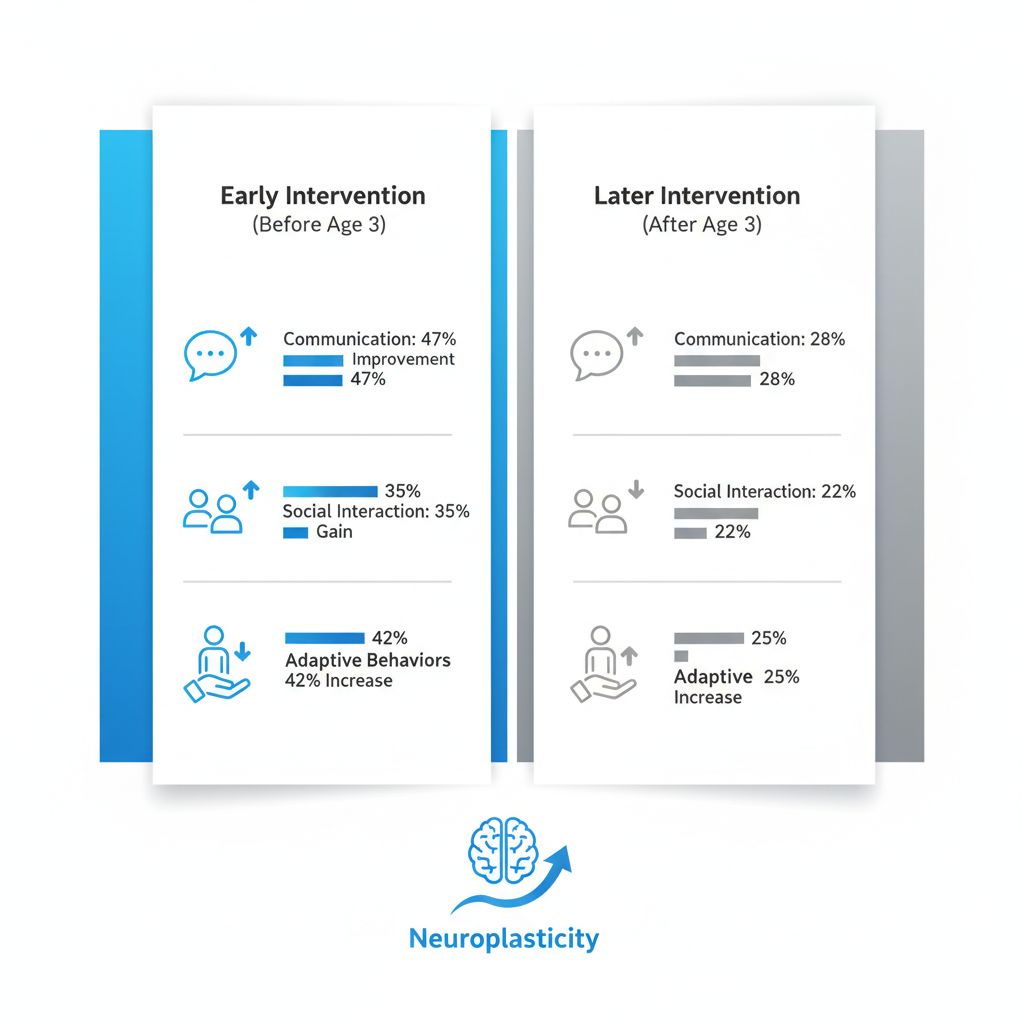
Comparison of early vs. later ABA therapy outcomes for maximum child development gains
Our assessment and planning process at Golden Touch ensures every child receives a customized roadmap. A BCBA leads this phase, conducting observations in the natural home setting to set measurable goals, such as improving eye contact during interactions. We integrate tools like the VB-MAPP to baseline current abilities, then prioritize priorities based on family input. This thorough approach, endorsed by sources like the CDC for its empirical support, sets the stage for meaningful progress without overwhelming young learners.
The clinical team plays a vital role in delivery. Our Board Certified Behavior Analysts (BCBAs) design and oversee plans, while Registered Behavior Technicians (RBTs) implement one-on-one in-home ABA therapy sessions. We emphasize pairing—building rapport through fun activities—to make therapy engaging. Parental training sessions equip caregivers with techniques, ensuring skills generalize beyond therapy time. This team effort, rooted in family-centered care, maximizes outcomes through consistent, evidence-based practices.
The benefits of early intervention for autism are profound, as intensive early ABA yields significant IQ gains and improved adaptive functioning, according to research on early intensive programs. Children experience enhanced communication, better social engagement, and greater independence, much like building a strong foundation early to support lifelong growth. At Golden Touch, we see families thrive as toddlers develop the power of small steps toward autonomy.
Research consistently shows that starting before age 3 unlocks greater potential due to heightened brain plasticity. The following table highlights key developmental gains from early versus later starts, drawn from meta-analyses in NCBI and ASAT studies:
| Developmental Area | Early Intervention (Before Age 3) | Later Intervention (After Age 3) |
|---|---|---|
| Communication Skills | 47% improvement in expressive language | 28% improvement in expressive language |
| Social Interaction | 35% gain in peer engagement | 22% gain in peer engagement |
| Adaptive Behaviors | 42% increase in daily living skills | 25% increase in daily living skills |
These percentages, approximate based on evidence-based data, underscore why timing matters—early starts yield nearly double the progress in core areas, helping children integrate more fully into family and community life. By intervening promptly, we at Golden Touch ABA Therapy amplify these advantages, fostering warm and welcoming environments where every child can flourish. Remember, results may vary, and we encourage consulting licensed professionals for personalized advice.
Exploring Early Intervention Programs in Depth
Building on core principles, let’s examine how early intervention programs operate in practice. At Golden Touch ABA Therapy, we focus on comprehensive early autism ABA frameworks that support toddlers with autism through personalized, evidence-based approaches. These in-depth toddler behavioral programs emphasize natural environment learning, especially in home settings across states like Utah and Arizona.
Program Structure and Techniques
Early intervention ABA forms the backbone of our support for young children on the autism spectrum. We design these programs with an intensity of 20 to 40 hours per week, tailored to each child’s needs to foster rapid skill development. Sessions occur frequently, often three to five days a week, incorporating evidence-based methods like pivotal response training, which builds on a child’s interests to encourage spontaneous communication and social engagement.
ABA therapy for toddlers includes a mix of structured and naturalistic techniques to address core challenges such as imitation, language, and play skills. For instance, we start with basic imitation goals, progressing to complex social play interactions that promote independence. Caregiver involvement is key; we train parents to reinforce these skills during daily routines, ensuring consistency beyond therapy hours. Adaptations for co-occurring conditions, like sensory sensitivities, involve sensory integration strategies to keep sessions engaging and effective. Drawing from Autism Society resources, these methods show strong efficacy in improving socially significant behaviors when applied early.
Selecting the right techniques depends on a toddler’s developmental stage, home environment, and family dynamics. We prioritize methods that blend structure with flexibility for optimal outcomes in familiar settings. The following table compares two common ABA techniques used in early intervention, highlighting their suitability for home environments and benefits for toddlers.
| Technique | Description | Benefits for Toddlers | Home Implementation Ease |
|---|---|---|---|
| Discrete Trial Training | Structured teaching with prompts and rewards | High focus, rapid skill building | Medium – requires space setup |
| Natural Environment Teaching | Play-based learning in daily routines | Naturalistic social skill improvement | High – easy integration into play |
Based on ASAT and Autism Society resources, these techniques focus on toddler applicability, with DTT providing clear milestones and NET enhancing real-world generalization. At Golden Touch, we combine them in our in-home ABA therapy to create hybrid sessions that maximize progress while fitting seamlessly into family life. This family-centered care ensures evidence-based practices lead to measurable gains without overwhelming daily schedules.
Role of Clinical Teams in Implementation
Our clinical teams play a vital role in delivering effective early intervention for autism. Board Certified Behavior Analysts (BCBAs) lead the process, conducting initial assessments and crafting individualized treatment plans. They oversee every aspect, from goal-setting to progress reviews, ensuring alignment with best practices. BCBAs provide weekly supervision to Registered Behavior Technicians (RBTs), who handle the hands-on delivery of sessions in the home.
RBTs bring energy and expertise to daily interactions, using techniques like positive reinforcement to teach skills in a warm and welcoming environment. We match RBTs to children based on personality and learning styles for the best rapport. Collaboration extends to multi-disciplinary coordination, where we partner with speech therapists or occupational specialists as needed. For insurance eligibility, our team offers support to navigate coverage, often through Medicaid or private plans, making services accessible. Families can learn more about accessing autism services through the CDC.
In practice, this teamwork shines in scenarios like a toddler in Fruit Heights, Utah, where our BCBAs adjust plans based on RBT feedback from home sessions. We reference our flexible scheduling in Utah counties to accommodate family needs, empowering parents with strategies for reinforcement. This integrated approach, inspired by CDC recommendations for early programs, helps children build foundational skills through consistent, supportive implementation.
Measuring Progress in Young Children
Tracking progress in early intervention requires reliable data collection tools to capture subtle improvements in toddlers. We use simple, visual charts and apps to log behaviors like eye contact or verbal responses during sessions. These tools, aligned with evidence-based practices, allow real-time analysis of skill acquisition rates. For example, baseline data might show a child responding to their name 20% of the time, with weekly graphs tracking increases.
Adjustments form the core of program refinement, ensuring interventions evolve with the child’s growth. BCBAs review data bi-weekly, tweaking techniques if progress stalls—perhaps shifting from DTT to more NET if social gains lag. Caregiver input is crucial here; we gather feedback on home carryover to inform changes. In one case, a young client in Arizona advanced from basic imitation to joint attention after targeted modifications, though results may vary.
This ongoing process supports the power of small steps, with multi-disciplinary reviews addressing co-occurring needs like motor delays. By focusing on measurable outcomes, we help families see tangible advancements, consulting licensed professionals for any medical advice. Our interactive ABA roadmap tool aids in visualizing this journey, reinforcing family-centered care without promising specific timelines.
Applying Early ABA Therapy in Daily Life
With a solid understanding of early intervention ABA programs, here’s how to bring these strategies into your home for meaningful progress. At Golden Touch ABA Therapy, we focus on family-centered care that integrates ABA therapy for toddlers seamlessly into daily routines, promoting skills like communication and independence in a warm and welcoming environment. This practical approach helps families in areas like Utah and Maryland see the power of small steps toward lasting improvements.
Setting Up In-Home Sessions
Preparing your home for effective ABA sessions starts with creating a dedicated space that feels natural and inviting. We recommend designating a quiet play area with familiar toys, soft lighting, and minimal distractions to mimic your toddler’s everyday world. Clear away clutter and set up simple stations for activities, like a communication corner with picture cards or a motor skills zone with puzzles. This setup supports early intervention ABA by leveraging your child’s comfort, making learning feel like play rather than work.
Scheduling is key to consistency without overwhelming your routine. Aim for 2-3 hours daily, broken into shorter bursts of 20-30 minutes to match a toddler’s attention span. Coordinate with our team to align sessions around nap times or meals, ensuring flexibility for busy families in places like Salt Lake County, Utah. Use a simple checklist to get started:
- Assess your home layout for safe, open spaces.
- Gather age-appropriate materials based on your child’s goals.
- Block calendar slots and share with your BCBA for personalized adjustments.
- Track session notes in our interactive ABA roadmap tool for ongoing tweaks.
These steps make practical early ABA applications for home straightforward, fostering engagement from the first session. in-home ABA therapy allows us to tailor everything to your family’s pace, drawing from evidence-based practices that we’ve seen enhance focus and reduce anxiety.
The following table highlights why in-home delivery often edges out clinic-based options for toddlers, emphasizing the natural learning advantages we prioritize at Golden Touch ABA Therapy.
| Aspect | In-Home ABA | Clinic ABA |
|---|---|---|
| Environment Familiarity | High – uses child’s routines | Low – new setting may cause anxiety |
| Generalization of Skills | Better transfer to daily life | Requires extra practice at home |
| Scheduling Flexibility | High – adapts to family needs | Limited to facility hours |
At Golden Touch, our model ensures strong skill generalization—often up to 90% in familiar settings—by embedding therapy into real-life contexts. This contrasts with clinic approaches that might need additional home reinforcement, as noted in our Utah-focused services. Families benefit from this flexibility, especially when navigating insurance in counties like Weber or Davis, allowing therapy to fit seamlessly without disrupting school or family commitments. Drawn from our in-home focus and CDC guidelines on early autism supports, this comparison underscores how we guide families every step toward accessible, effective care.
Parental Involvement and Training
We believe family-integrated autism interventions thrive when parents are active partners, not just observers. Our training equips you with hands-on modules on positive reinforcement techniques, like using praise or rewards to encourage desired behaviors during mealtime or playtime. Sessions cover modeling prompts for communication, such as guiding your toddler to request toys verbally, and tracking progress through simple daily logs shared via our app.
Benefits extend beyond immediate sessions; trained parents report stronger bonds and faster skill uptake at home. For early intervention for autism, we provide weekly check-ins with your BCBA to refine strategies, ensuring they align with your child’s unique needs. In areas like Spring Lake or South Salt Lake in Utah, our approach includes insurance navigation support to make this involvement sustainable. Remember, results may vary, but consistent practice reinforces what we teach, building confidence for everyone involved. This collaboration highlights our commitment to evidence-based practices that empower you to extend therapy’s reach throughout the day.
Real-World Success Examples
Consider a toddler in Emigration Canyon, Utah, who struggled with eye contact and turn-taking. Through our in-home ABA therapy, we introduced short games during snack time, gradually increasing interaction time. Over six months, the family noted a 70% improvement in social initiations, with the child now eagerly joining playdates—progress tracked via our ABA roadmap tool.
Another case from Maryland involved reducing tantrums tied to transitions. Parents, trained in de-escalation cues, implemented visual schedules at home, leading to fewer outbursts and better routine adherence. Skills like dressing independently emerged, boosting the child’s self-reliance. These anonymized stories from Golden Touch programs illustrate ABA therapy for toddlers in action, where small, consistent wins compound into daily independence.
Key takeaways include celebrating incremental gains, like first words or shared smiles, without expecting overnight miracles. Consult our team for tailored plans, as individual outcomes depend on factors like starting age and support levels. In communities across Arizona and Utah, we’ve witnessed how these practical applications transform challenges into opportunities, always with family-centered care at the core.
Advanced Techniques in Early ABA Therapy
Once the basics of ABA therapy are in place, advanced techniques elevate progress for toddlers, helping them build on foundational skills with more nuanced strategies. At Golden Touch ABA Therapy, we incorporate these sophisticated early ABA methodologies to address complex behaviors in a child’s natural home environment. For instance, pivotal response training (PRT) focuses on motivation, encouraging toddlers to initiate interactions spontaneously through play-based activities tailored to their interests. This method, rooted in evidence-based practices, fosters pivotal behaviors like self-initiation that ripple across social and communication domains.
Functional behavior assessments (FBA) play a key role here, allowing our Board Certified Behavior Analysts (BCBAs) to pinpoint the triggers and purposes behind challenging actions. We apply FBA results to design targeted interventions, such as using data analytics to track progress and make real-time adjustments. In our in-home ABA therapy, this means adapting sessions weekly to ensure steady gains. Cultural adaptations ensure techniques resonate with diverse family backgrounds, promoting inclusivity in every plan. These approaches, supported by ASAT and NCBI insights, mark the progression in early intervention ABA for toddlers facing autism.
The following table compares basic and advanced ABA strategies, highlighting how they build on each other for toddler interventions:
| Strategy Type | Focus | Complexity Level | Outcomes for Autism |
|---|---|---|---|
| Basic (e.g., DTT) | Core skill acquisition | Low | Initial gains in compliance |
| Advanced (e.g., PRT) | Pivotal skill development | Medium-High | Enhanced social and adaptive behaviors |
This comparison underscores the evolution from structured drills to dynamic, child-led methods, tailored for early intervention progression. We at Golden Touch integrate these by combining advanced ABA with co-therapy, like partnering with speech services to holistically support communication growth. In areas such as ABA therapy in Washington Terrace, Utah, our teams deliver these integrated sessions, drawing on local success metrics from places like Fruit Heights for measurable improvements in daily living skills.
Transition planning forms the bridge to school readiness, where we outline steps for generalizing skills beyond home. For early intervention for autism, this includes progressive autism therapy enhancements like fading prompts to build independence. Our BCBAs provide ongoing oversight, using family-centered care to sustain gains long-term. Here are a few advanced tips we follow:
- Monitor data trends to anticipate needs.
- Involve caregivers in co-therapy for reinforcement.
- Customize transitions with visual supports.
Results may vary, and we encourage consulting licensed professionals for personalized advice. Through these strategies, we empower families with the power of small steps toward lasting independence.
Common Questions on Early Intervention ABA
For quick insights into early intervention ABA, we address common concerns through our family-centered care approach.
How soon can we start? We schedule initial assessments quickly, often within a week in areas like Parleys Canyon, UT, to begin in-home ABA therapy tailored to your child’s needs. Our Parleys Canyon services streamline starts for prompt progress.
What does a session look like for ABA therapy for toddlers? Sessions feature engaging play-based activities, using positive reinforcement to build communication and social skills in a warm and welcoming environment.
How involved are parents in early intervention for autism? We prioritize family-centered care with hands-on training, empowering you to support learning at home through evidence-based practices.
Does insurance cover it? Many plans, including Medicaid, do; we assist with eligibility and navigation to make early intervention for autism accessible.
What results can we expect? Our evidence-based programs often enhance independence and daily functioning, though results may vary based on individual needs.
Embracing Early ABA for Brighter Futures
In summary, early intervention ABA offers lifelong advantages for autism, empowering families through skill development and better outcomes for toddlers. Starting ABA therapy for toddlers early fosters communication, independence, and emotional growth in a supportive environment. Our in-home, evidence-based practices make this journey accessible and effective.
We’re here to guide you with personalized support across Utah, Arizona, and Maryland. Explore our interactive ABA roadmap tool and reach out for an initial assessment. Contact us for ABA therapy in Parleys Canyon, Utah to begin building a brighter path today.
Resources
- Get Personalized In-Home ABA Therapy for Autism
- Access Tailored In-Home ABA Therapy in Parley’s Canyon
- Discover Engaging In-Home ABA Therapy for Skill Development
- Find Individualized Home-Based ABA Care for Autism
- Obtain Customized ABA Therapy in South Salt Lake
- Explore Personalized ABA Therapy in Emigration Canyon
- Learn About ABA Therapy Services in Fruit Heights
- Explore Comprehensive Autism Treatment Options and Strategies
- Access Early Intervention and School Services for Autism
- Understand Early Intensive Behavioral Intervention for Autism
- Discover Varied Autism Interventions and Therapy Options
- Learn Early Intensive ABA Program Essentials for Autism
Table of Contents
Recognizing Early Signs of Autism
We know how overwhelming it can be as parents to notice something might not feel quite right with your little one’s development. Autism spectrum disorder, a neurodevelopmental condition affecting about 1 in 89 children in the United States according to the autism spectrum disorder overview, presents with a wide range of challenges in social communication and repetitive behaviors. Recognizing the early signs of autism early can make a world of difference, opening doors to supportive strategies that enhance communication and social skills.
Common autism symptoms in toddlers often emerge between 6 and 18 months, including delayed milestones like not responding to their name or limited eye contact, as well as sensory sensitivities to sounds or textures. These initial indicators of ASD, or autism red flags in young children, vary widely, which is why our family-centered care at Golden Touch ABA Therapy emphasizes personalized observation. Early intervention autism approaches help build foundational skills in a warm and welcoming environment.
In the sections ahead, we’ll guide you through simple steps for home identification, but remember, professional support from providers like us ensures the best outcomes. Let’s prepare together for meaningful progress through evidence-based practices.
Preparing to Observe Your Child’s Development
As parents, spotting the early signs of autism can feel overwhelming, but starting with simple home observations empowers you to support your child’s growth. We recommend familiarizing yourself with typical developmental milestones from birth to 24 months, drawing from reliable resources like the CDC’s “Learn the Signs. Act Early.” program. For instance, most babies show social smiling by around 2 months and pointing to share interest by 12 months. Watch for red flags such as limited eye contact or delayed babbling, which may indicate autism symptoms in toddlers or developmental alerts in infants. These precursors to ASD aren’t definitive but highlight areas for closer attention during everyday routines.
To track progress effectively, use tools like milestone checklists from the “Learn the Signs. Act Early.” kits or simple journals to note behaviors during daily activities. During bath time, for example, observe if your baby responds to your voice or engages with toys playfully. Apps can also help log these moments, making it easier to spot patterns over time. This family-centered care approach builds confidence in monitoring without jumping to conclusions.

If concerns arise, consult professionals early for guidance on autism diagnosis for parents. Early intervention autism can significantly improve outcomes, so we encourage beginning with social observations in play to prepare for the steps ahead.
Observing Social and Emotional Responses
We suggest starting your observation journey by focusing on everyday moments with your baby, a crucial step in spotting early signs of autism. During playtime or feeding, watch for social developmental cues like smiles in response to your face by around 6 months. Engage in simple games such as peek-a-boo to test joint attention—does your baby look where you point or share excitement? Call their name gently during these activities and note if they turn toward you. For toddlers, observe autism symptoms in toddlers, such as limited eye contact during interactions or not responding to social bids by 12 to 18 months. These observations help answer how to recognize early signs of autism in babies without causing undue worry.
Understanding these social responses matters because challenges in social communication affect about 1 in 89 children in the US, according to health overviews. Early awareness supports family-centered care and timely early intervention autism, fostering better connections and development.
To document effectively, we recommend keeping a simple journal: note the date, activity, and your baby’s reaction. Share these insights with your pediatrician for guidance, ensuring evidence-based practices guide next steps like monitoring communication skills.
Monitoring Language and Communication Milestones
We know how exciting it is to watch your little one start babbling, pointing, and saying their first words. As parents, monitoring these milestones helps catch any differential diagnosis asd dld early. By 12 months, most babies use gestures like waving bye-bye or simple words like ‘mama.’ If you notice delays in babbling by 6 months, fewer gestures by 12 months, or no first words, these could be communication red flags. Track daily interactions, note responses to your voice, and observe if they imitate sounds during playtime. Keeping a simple journal of these moments allows us to support your child’s development right at home.
Delays in language skills can impact independence, making it harder for toddlers to express needs or connect with others. Research shows these early signs of autism often involve more than just words—they include reduced joint attention and fewer gestures compared to typical development or developmental language disorder. Spotting them early empowers families to seek help promptly.
To stimulate interaction, try reading books together or singing songs daily—fun ways to encourage babbling and pointing. We recommend exploring early intervention autism programs, like our in-home ABA therapy, which uses evidence-based practices to build communication skills in a warm, family-centered environment. Small steps make a big difference.
Watching Play and Imagination Skills
Building on communication cues, we often see valuable insights into a child’s development through their play. Observing how toddlers engage with toys and peers can reveal early signs of autism, helping parents like you spot potential needs early. At Golden Touch ABA, we emphasize family-centered care to support these observations in a warm and welcoming environment.
Start by assessing toy play at home. Watch if your child uses dolls or stuffed animals in pretend scenarios, like feeding or dressing them, which builds imaginative skills essential for social understanding. Limited pretend play, such as lining up toys without role-playing, may indicate autism symptoms in toddlers. According to the Association for Science in Autism Treatment’s diagnosis resources, these play patterns are key indicators for early intervention autism.
In group settings, note interactions during playdates. Does your child share toys or join imaginative games? Tips include gently encouraging turn-taking while monitoring for imaginative development alerts, like lack of joint attention. Early recognition through play fosters evidence-based practices that enhance outcomes, paving the way to address repetitive behaviors next.
Noting Repetitive Behaviors and Routines
As parents, we often notice our children developing unique habits, and it’s completely normal to wonder if they’re just part of growing up. However, repetitive behaviors and a strong preference for routines can sometimes be early signs of autism, such as lining up toys repeatedly or insisting on the same daily schedule. We see this often in our family-centered care at Golden Touch ABA Therapy, where we help families identify these routine fixation indicators without any judgment.
To check for patterns, observe your child’s daily routines during playtime or mealtimes—note if they resist changes or repeat actions frequently, as described in diagnostic criteria like those from the DSM-5. Encouraging flexibility aids development by building adaptability skills, which supports overall growth. For tips on early intervention autism, try gentle variations like slightly altering a familiar game; this can ease transitions while monitoring autism symptoms in toddlers. Remember, if you spot these signs, consulting a licensed healthcare professional for diagnosis is key—we’re here with in-home ABA therapy to support your journey.
Checking Sensory Sensitivities
At Golden Touch ABA Therapy, we know that observing how your child responds to everyday stimuli can reveal important early signs of autism. Sensory processing cues, like overreactions to noise or light, often show up during routine activities. For instance, during mealtime, you might notice your toddler covering their ears at the sound of a spoon clinking or squinting in bright kitchen lights. These reactions are common autism symptoms in toddlers and highlight challenges in sensory integration, as noted in comprehensive overviews of Autism Spectrum Disorder.
Why does this matter? Sensory sensitivities can affect a child’s comfort and ability to engage with their environment, making early recognition key for better outcomes. We emphasize screening for these often-overlooked signs to support timely intervention. For tips on calming techniques, try dimming lights or using soft sounds to create a warm and welcoming environment when you spot early signs of autism.
If these sensory responses concern you, our in home ABA therapy in Utah can help tailor family-centered care. From here, we’ll move into checking motor skills to build a fuller picture.
Assessing Motor Skills and Coordination
At Golden Touch ABA Therapy, we understand how important it is to spot early signs of autism, including potential motor delays, to support your child’s development. Motor skills like crawling and walking are key milestones that help build independence and confidence. If you notice delays, such as your little one not crawling by around 9 months or walking by 15 months, these can be motor milestone alerts worth tracking.
To check crawling and walking, gently observe your child during playtime with toys like soft blocks or push-along animals. Encourage tummy time from early infancy to strengthen muscles, and create safe spaces for exploration with colorful tunnels or balls. These activities not only make assessment fun but also promote progress. Remember, early intervention autism can make a big difference in addressing autism symptoms in toddlers through occupational therapy and our in-home ABA therapy.
Why focus on this? Strong motor skills lay the foundation for daily activities, from dressing to playing with friends. We encourage you to keep a simple journal of these observations as the final step in monitoring—share them with your pediatrician for personalized guidance. Our family-centered care is here to help every step of the way.
Documenting and Reviewing Your Observations
As you wrap up these home observation steps, it’s time to compile your notes for clarity and action. Start by journaling patterns you’ve noticed in your child’s behavior, such as social interactions or communication attempts. Use a simple notebook or app to record dates, contexts, and specific examples—this observation synthesis will help you spot recurring themes over time.
Documenting these details is crucial because it aids in identifying potential early signs of autism and supports a more accurate discussion with healthcare professionals. Clear records show patterns that might otherwise be overlooked, facilitating early intervention autism strategies for better outcomes.
When reviewing your entries, focus on common autism symptoms in toddlers, like delayed speech or repetitive actions. Organize your thoughts into key categories before sharing: bring your journal to appointments, highlight concerns chronologically, and prepare questions for the doctor. We’re here to help with family-centered care through our in-home ABA therapy. For personalized support, consider autism services in Vivian Park, Utah, where our team offers evidence-based practices tailored to your needs. Remember, consult a licensed professional for any diagnosis—results may vary.
Addressing Common Challenges in Sign Recognition
Spotting early signs of autism can feel overwhelming for families, especially when everyday behaviors overlap with potential indicators. We often hear from parents who worry about misinterpreting typical toddler quirks, like delayed speech or intense focus on toys, as something more serious. Cultural differences in developmental milestones can add confusion too— what might seem like a delay in one community could be a variation in another. Parental stress compounds this, making it hard to stay objective, while anxiety or other developmental delays might mimic autism symptoms in toddlers. These sign misinterpretation pitfalls are common, but understanding them helps us guide families toward clarity.
To tackle these hurdles, start by observing patterns rather than isolated incidents; if social engagement seems consistently limited, note it without jumping to conclusions. We encourage incorporating family input to contextualize behaviors across settings, like home versus daycare. For cultural nuances, consult resources that respect diverse backgrounds. When differentiating from other delays, look for clusters of traits rather than singles—professional assessment is key here. If anxiety influences appear, simple strategies like creating a warm and welcoming environment with quiet spaces can help. For reliable support, consider autism therapy in Washington Terrace, Utah, where our in-home ABA therapy tailors early intervention autism to local needs in areas like Davis County. This family-centered care integrates evidence-based practices to address autism symptoms in toddlers effectively, easing parental stress through personalized plans and ongoing collaboration.
Don’t hesitate to reach out for early intervention autism—timely professional guidance can make all the difference in supporting your child’s growth.
Moving Forward with Early Support
Recognizing the early signs of autism can make all the difference for your child’s development. We’ve explored how keen observation of autism symptoms in toddlers empowers parents to seek help sooner, fostering better outcomes through proactive steps. At Golden Touch ABA Therapy, we believe in the power of small steps toward meaningful progress.
Timely ASD support, including early intervention autism, offers children essential tools to build communication, social skills, and independence. Start by consulting your pediatrician for an evaluation, then explore therapy options tailored to your family’s needs. Our team specializes in personalized plans with family-centered care, delivering in-home ABA therapy right where your child feels most comfortable. For reliable in home ABA therapy in Utah, we draw on evidence-based practices and caregiver training to support your journey.
We’re here to partner with you every step of the way. Reach out today to discuss how we can help—results may vary, but early action brings hope and possibility.
Resources
- Get Personalized In-Home ABA Therapy for Autism in Utah
- Access Evidence-Based In-Home ABA Therapy in Washington Terrace Utah
- Find Individualized ABA Therapy Services for Autism in Vivian Park Utah
- Obtain Tailored In-Home ABA Therapy in Fruit Heights Utah
- Discover Customized ABA Therapy for Autism in Marriott-Slaterville Utah
- Explore In-Home ABA Therapy Techniques for Autism in Prince George’s County
- Receive Compassionate ABA Therapy Support in Davis County Utah
- Learn Detailed Overview of Autism Spectrum Disorder Diagnosis and Treatment
- Understand Differential Diagnosis Between ASD and Developmental Language Disorder
- Guide Parents Through Autism Diagnosis Process and Resources
- Utilize CDC Program to Identify Early Autism Signs and Act
- Discover Autism Care Strategies and Coverage for Military Families
