
ABA Therapy for School Success: A Comprehensive Guide for Parents
Table of Contents
- How ABA Therapy Helps Children Succeed at School
- How ABA Therapy Supports Classroom Success
- School Readiness Skills ABA Therapy Builds
- Improving Focus and Behavior for the School Day
- How BCBAs Work with Teachers and School Teams
- ABA Therapy and IEP Goals: A Family-School Partnership
- Helping Your Child Reach Their Potential at School and Home
How ABA Therapy Helps Children Succeed at School
ABA therapy for school success enhances kids’ communication, social and independence skills that will help them succeed in the classroom. Through our in-home programs we’ll build these foundational skills in a comfortable, natural environment where children feel confident practicing new behaviors.
According to the CDC, behavioral approaches like ABA have the most robust clinical evidence among autism interventions, supporting progress across educational, home, and community environments. We work closely with families to reinforce these skills between sessions, ensuring techniques practiced at home carry over into school routines. Parent coaching empowers caregivers to support their child’s growth, creating consistency that bridges therapy and classroom success.
Key Takeaways
- We witness first-hand how ABA therapy for school success helps children carry the skills they build at home into the classroom.
- ABA therapy for school success in Utah is used to build on the skills that kids learn from home each day.
- The same basic skills that we teach kids at home, such as attention, routine, and the ability to understand and follow directions, affect the way they manage themselves during the school day.
- The consistency between home and school will be vital when children start making progress.
- Our team knows that progress in ABA therapy for school success begins when families and educators work together.
How ABA Therapy Supports Classroom Success
We witness first-hand how ABA therapy for school success helps children carry the skills they build at home into the classroom. Behavioral approaches, such as ABA, have the strongest clinical evidence for addressing autism symptoms, per the CDC, and these gains transfer best when therapy is woven into daily routines that mirror school expectations. Our programs include many activities targeting communication, social interactions, independence, and decreasing inappropriate behaviors in order to help kids be better equipped to participate and learn once back at school.
It makes sense that the consistency between home and school would matter because not everything taught at home necessarily translates into children’s other settings. But ABA is good precisely because it teaches skills that can fit in school as well as outside school in homes, communities etcetera. ABAI’s 1990 position was that educational placement should reflect a child’s actual skill levels rather than labels, and that instruction should be adjusted using data until it’s effective for the individual student. We design each plan to include fluency, combining accuracy and speed, so skills stick for the long term and are more likely to hold up under the demands of a classroom. This fluency focus ensures children can apply what they’ve learned smoothly in school routines.
Ultimately, a child-centered education means identifying and sticking to key targets of improvement and altering pace according to how fast the student is achieving those objectives. It also implies changing what we’re teaching them if we learn through feedback that some students are ready for a new lesson while others need some extra support before moving onto something else. Teachers should be able to gauge from their performance whether a student has achieved a certain benchmark, without comparing them against other kids’ ability. Teachers respond accordingly based on the children’s growth, whether that involves using signals such as hand-raising to talk in class, paying attention to multi-step instructions, or shifting focus from one activity to another. Practicing these skills in natural settings like the home helps children gain confidence that carries over to the classroom environment.
The skills described here will serve as a foundation for building the specific abilities that ABA teaches children in order to be successful at school.
School Readiness Skills ABA Therapy Builds
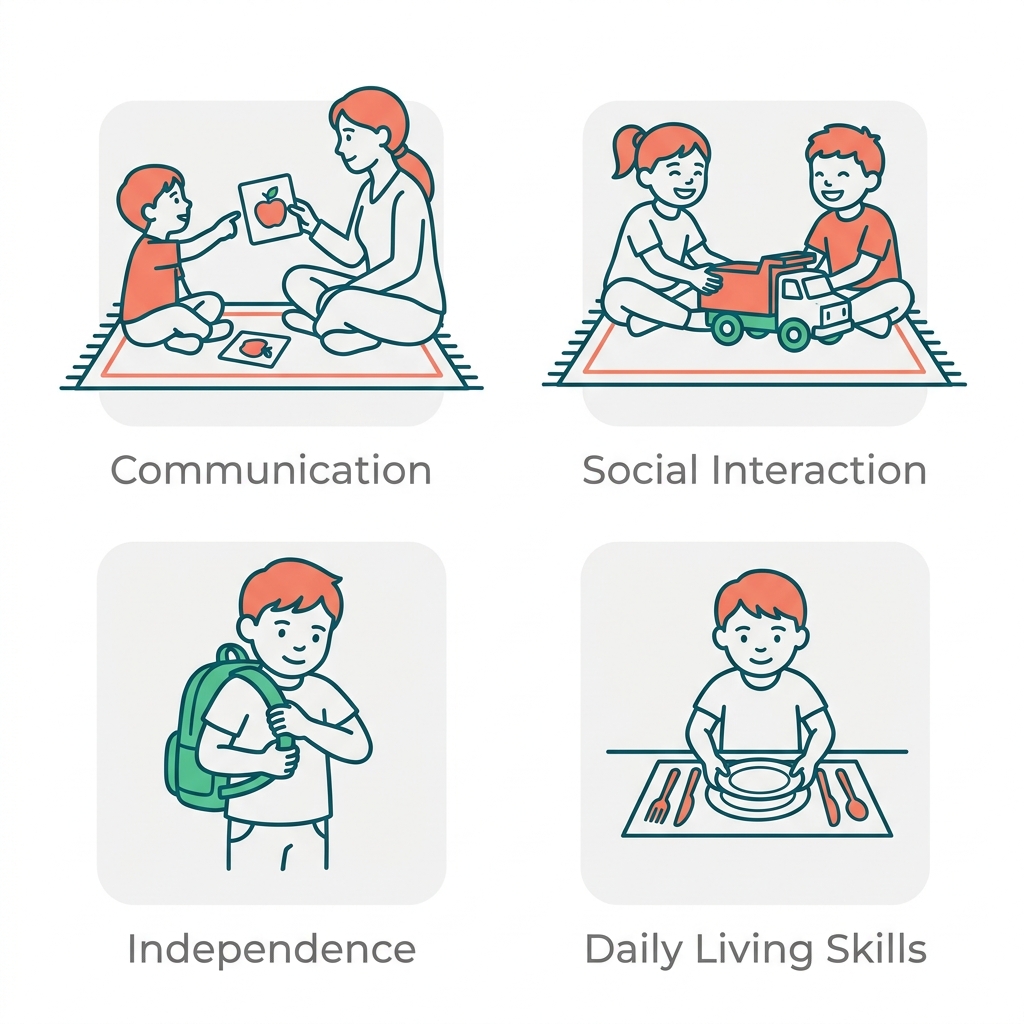
ABA therapy for school success in Utah is used to build on the skills that kids learn from home each day. Using play-based, natural environment teaching strategies, ABA therapy helps children develop the communication, social interaction, and daily living skills they’ll require for success in the classroom.
We concentrate on these three key areas because they will help kids when they start school. For example, we improve their communication skills with games and activities around the house. We teach our kids about taking turns while playing and talking together, and we show how to explain their feelings during story time and request what they need in a few simple words. All of this happens easily within play-time, without being stressful. These activities encourage clear expression and understanding. We also work on building relationships between them, helping them interact well with others. When they’re playing with us or their friends we model things such as sharing, turn taking, cooperation, joint attention, eye contact, and positive social starts. Children learn to wait their turn, initiate social interactions, and feel more comfortable in group settings through that modeled cooperative play. This helps them engage confidently with peers and teachers. Then, there’s improving independence and daily living skills like following simple instructions, managing transitions, and handling routines. All of this is done gradually over time in lots of different places and times. This helps your child navigate school days with greater confidence.
Parents have a big part to play here, too. With the guidance of our clinicians, they can learn new ways to work on those skills as well as others in mealtimes, games, and daily routines at home, which helps reinforce them when the kids return to school. Reducing stress levels among the kids also speeds up the rate of acquiring all the needed skills.
Children take along this ability as they make their way from home into the classroom and thus, are more able to get involved in what’s going on around them, listen when asked, and also relate positively to both teacher and peers.
Improving Focus and Behavior for the School Day
The same basic skills that we teach kids at home, such as attention, routine, and the ability to understand and follow directions, affect the way they manage themselves during the school day. When a child has trouble focusing, he might miss part of a teacher’s instruction or be unable to sit still long enough to join other kids working on something together, which makes him miss out on some of his own learning.
Understanding why certain actions occur can help make them easier to control. For example, misbehaving kids might want our attention, want to avoid something hard, or just have a hard time regulating their own sensory needs. The FBA allows us to observe which circumstances lead up to bad behavior and what follows those behaviors as well, so we’ll understand better how to stop them from occurring again next time. By putting together plans for teaching new responses to problems and strategies for dealing with stressors, we provide tools that students can immediately begin using when they feel overwhelmed. Some studies have found that when teachers conduct their own analysis, it is clear what causes each behavior to happen in class. As opposed to simply guessing based on past experiences or anecdotal evidence, functional assessments allow teachers to target specific needs more effectively.
Small shifts matter a lot here. For example, teachers can help students stay focused by providing step-by-step instructions on assignments and group work, posting class rules somewhere students will see them, and consistently enforcing those expectations. Assigning kids roles based on their strengths, rather than using punitive measures, often reduces disruptions more effectively. This approach helps create a structured learning space that lets young minds explore freely without feeling like they’re walking on eggshells all day long. If rules are made known and followed through with consistency, students understand what kinds of behavior can be expected, as well as why certain actions lead to certain results.
When consistent support is present during a child’s normal instructional time at school, children gain confidence and teachers gain time to teach. By working together—our therapists, families, and educators—we can turn challenges into opportunities for growth, ensuring every child has the tools they need to succeed.
How BCBAs Work with Teachers and School Teams
The consistency between home and school will be vital when children start making progress. If certain methods are used at home, then those methods should also be applied to children in the school setting. The reason why this works is because children know exactly what to expect in both places. Once again, if they understand that they have to follow rules within each environment, then they’ll feel more confident overall. When it is ensured that everything taught to them here applies there too, they won’t feel like they’re getting conflicting information.
Our team works closely with school teams to implement home-based ABA therapy. BCBAs design individualized programs and supervise RBTs who implement interventions in the home. Teachers receive weekly progress data so they can see how strategies translate to classroom performance. In addition to providing progress information, we also offer practical tools such as visual schedules and reinforcement systems that teachers may be able to incorporate into their instruction plans. These tools help maintain consistency in behavioral expectations and reduce the cognitive load on educators by offering ready-to-use resources.
Measuring each skill for accuracy and speed is critical because how fast a child can use their skills without pausing is also key. School teams will work together with BCBAs to figure out if this skill has been carried over into other areas. This means looking at how well the student uses the skill outside of the therapy session, rather than just when they’re sitting on the couch with their BCBA. The idea is to make sure children demonstrate objective, measurable progress so we know our interventions have actually worked to meet the needs of those children as they’ve changed over time.
For families, the first step is straightforward: our BCBA conducts a comprehensive assessment to identify strengths and areas for growth. We encourage parents to verify their BCBA’s credentials through the Behavior Analyst Certification Board (BACB) public registry and to share the assessment insights with their school team. This shared foundation makes collaboration smoother and sets the stage for meaningful progress in the classroom. By starting with a clear understanding of the child’s needs, families and educators can work together to create a cohesive support plan that aligns with the child’s goals.
ABA Therapy and IEP Goals: A Family-School Partnership
Our team knows that progress in ABA therapy for school success begins when families and educators work together. An Individualized Education Plan (IEP) is a legally mandated, collaborative plan created by a multidisciplinary team that includes both school staff and family members to support a child’s overall development. The Center on PBIS emphasizes that behavioral support goals should be integrated into holistic student development planning, ensuring that every child’s unique needs are addressed through a unified approach.
Behavioral Goals in an IEP will be stronger when families are involved. When you have an IEP in place your goal is to make sure that this plan is meaningful and is going to work. If there is a good framework that can be put in place then a parent can better ask what kinds of support they want the schools to provide, especially if these behaviors that are being taught during the course of therapy are going to translate into behaviors expected in class as well. In many ways, having this family involvement is also similar to what we see in our in-home ABA therapy programs, where BCBAs and RBTs work closely with parents to reinforce progress across settings. So parents might share things observed during their home session so that the school team understands more about their child’s generalization.
To bridge home progress with school supports, parents can start by gathering observations from home sessions and identifying the child’s top behavioral priorities. Sharing these priorities with the school team and agreeing on how progress will be communicated keeps everyone aligned. These steps create a foundation for aba therapy for school success that carries learning across settings. By focusing on collaboration, we help children generalize skills and reach their potential both at home and in the classroom.
To be prepared to have successful IEP meetings, parents should review what work the student did recently, look at new issues cropping up, and list out any support measures they feel might help their children succeed in both school as well as at home. Bring home-based observations as concise summaries to show the school team how well the child does at home, and also point out what additional reinforcements can provide better support.
Frequently Asked Questions
How can ABA therapy help my child succeed in the classroom?
ABA therapy builds communication, social interaction, independence, and daily living skills in a child’s natural home environment. These skills are designed to transfer to school routines so children can participate and learn more effectively in the classroom.
Does ABA therapy collaborate with school IEP goals?
ABA therapy aligns with school IEP goals by integrating individualized behavioral supports into the child’s overall development plan. BCBAs and school teams share progress data and practical tools to maintain consistency across home and school settings.
What specific skills does ABA therapy target to improve school readiness?
ABA therapy targets communication skills, social interaction, independence, and daily living skills. These are taught through play-based activities and routines that mirror school expectations to prepare children for classroom participation.
How do BCBAs coordinate with teachers to support a child in school?
BCBAs design individualized programs and supervise RBTs who implement interventions at home. They provide teachers with weekly progress data and tools like visual schedules to ensure consistent behavioral expectations in the classroom.
Can in-home ABA therapy help improve my child’s behavior and focus at school?
In-home ABA therapy teaches attention, routine-following, and direction-following skills in a comfortable setting. These skills are designed to help children manage themselves better during the school day, reducing distractions and improving focus.
Helping Your Child Reach Their Potential at School and Home
When kids’ progress at school is reinforced at home by their families, this collaborative support bridges that gap through consistent, data-driven support. Home-based ABA therapy teams work alongside parents, helping them create daily activities where children can learn new behaviors. With weekly reports about how their child progresses on certain tasks, the therapy team adapts its teaching methods accordingly. Additionally, the therapy team trains parents to use their lessons in situations outside regular therapy sessions.
We serve children/youth from age 1 through 21 years old within his/her own environment, mainly working collaboratively with school staff and family members. Each child’s program varies depending on how the child responds to each intervention but the goals focus on making sure the child makes progress and can maintain skills over time. For families ready to take the next step, contact our team today at (801) 630-5443 or info@goldentouchaba.com.
Start Your Child’s Journey Today
You’ve now seen how in-home ABA therapy builds the communication, social, and independence skills children carry into the classroom. From play-based learning in familiar surroundings to parent coaching that reinforces progress between sessions, every element works toward school success. Our team of BCBAs and RBTs creates personalized treatment plans for children and young adults aged 1 to 21 across Utah, including Salt Lake City. Because skills are practiced in the natural home environment, they tend to generalize more easily to school routines. Every child’s path is unique, and results may vary based on individual circumstances. If you’d like to learn more or schedule a consultation, call us at (801) 630-5443 or reach out through our website. We’d be glad to help your child take the next step toward reaching their potential at school and home.
Start Your Child’s Journey Today
Resources
- Strengthen Family Participation in IEP Behavior Goals
- Apply Proven Classroom Behavior Management Strategies From CDC
- Understand Every Student's Right to Effective Education
- Access Positive Proactive Support Resources for Students With Disabilities
- Learn About Proven Autism Treatment and Intervention Options
Table of Contents
- ABA Therapy for School-Age Children: What Parents Need to Know
- Before You Begin ABA Therapy with Your School-Age Child
- Assess Your Child’s Current Behavioral and Communication Skills
- Set Measurable Goals with Your BCBA
- Coordinate ABA Therapy with School and IEP Goals
- Create a Consistent In-Home Therapy Schedule
ABA Therapy for School-Age Children: What Parents Need to Know
Is your school-age child facing challenges with social skills, classroom routines, or growing independence? You’re not alone. ABA therapy for school age children is an evidence-based approach that uses positive reinforcement to teach adaptive skills and reduce challenging behaviors through individualized goals. Golden Touch ABA offers in-home ABA therapy tailored specifically to school-age children, bringing therapy into your home to build real-world skills in a warm and welcoming environment.
Our therapists collaborate with you to carry over strategies at home and support school readiness by reinforcing the communication and self-regulation skills essential for classroom success. We believe in the power of small steps, breaking complex skills into manageable achievements through family-centered care.
ABA therapy can also complement your child’s IEP goals for autism, ensuring progress aligns with educational objectives.
- Results vary; always consult a healthcare professional for medical advice.
In the sections below, we explore how in-home ABA therapy can boost school readiness and complement IEP goals for autism.
Before You Begin ABA Therapy with Your School-Age Child
Before you begin autism therapy for your elementary-aged child, a little preparation on the front end can help set the stage for a smooth, confident start. We want to make sure you feel supported in this process, so here are a few steps to consider before the first session even begins.
First, a Board Certified Behavior Analyst, or BCBA — the professional certified by the Behavior Analyst Certification Board (BACB) to design and oversee treatment — will conduct a comprehensive assessment of your child’s unique strengths and needs. This assessment informs the individualized goals that your clinical team will work toward. In-home ABA therapy gives us the advantage of observing your child in their natural environment, where real-life skills are built.
Next, review your insurance benefits early. Our team offers free assistance to help you understand your coverage so you can focus on your child’s care. You’ll also want to bring any current school documents — including IEP goals for autism — to your BCBA’s attention. Aligning home and school strategies encourages family-centered care and creates a consistent thread of support for your learner.
With a complete picture of your child’s needs, your BCBA will craft a plan that fits seamlessly into your schedule. As you prepare for this partnership, remember that progress is a gradual journey; every child’s path toward school readiness and independence unfolds at a pace shaped by their own hard work and the consistency of the support around them.
Now that you know what to line up, the next step is meeting your team and getting started with a personalized consultation.
Assess Your Child’s Current Behavioral and Communication Skills
Before we can set goals, let’s look at where your child is now. The first step in choosing aba therapy for school age children is understanding their current abilities, especially in school readiness. Our family-centered approach values your insights as you observe your child’s communication and behavior patterns in a warm and welcoming environment.
Pay attention to both verbal and non-verbal communication, such as using words, gestures, or AAC devices. Also note behaviors like transitions, tantrum frequency, or self-stimulatory actions, and assess social strengths, including whether your child engages in parallel or cooperative play. These observations are foundational for setting meaningful iep goals for autism like increasing mands and social initiations. A qualified professional with BCBA certification will then perform a comprehensive evaluation, using evidence-based practices to develop a tailored program.
This home assessment helps us see the full picture, connecting your child’s current skills to the power of small steps in therapy. By identifying targeted objectives together, we prepare for a smooth transition into an individualized plan that supports growth and independence. Our team is here to guide you through this family-centered process every step of the way.
Set Measurable Goals with Your BCBA
After your child’s initial assessment reveals their strengths and areas for growth, the next step in aba therapy for school age children is to sit down with your BCBA and turn those insights into clear, measurable goals. We believe in family-centered care, so these objectives are created together — not dictated by the therapist alone. The targets are specific, measurable, and woven into your child’s daily routines, focusing on skills like transitions and peer interaction to build classroom preparedness. Your BCBA also aligns these home targets with IEP goals for autism so school-based objectives are supported. For example, a goal might be to increase on-task behavior during a 10-minute table activity from 2 minutes to 8 minutes over 8 weeks. Our team of RBTs, who hold the registered behavior technician certification, implements these plans, and progress is tracked session by session and shared in regular updates. Every child is different, so results may vary, but we believe in the power of small steps.
Coordinate ABA Therapy with School and IEP Goals
After setting meaningful therapy targets at home, aligning those goals with your child’s Individualized Education Program (IEP) is a natural next step.
When the Board Certified Behavior Analyst (BCBA) communicates regularly with school staff, therapy data can directly inform classroom strategies. Our in-home team tracks targeted behaviors — from task initiation to following instructions — which teachers can use to update IEP goals for autism and measure progress. Parents often find it helpful to invite their BCBA to IEP meetings, as this provides valuable behavioral insights and reinforces consistent strategies across both environments.
In our home sessions, we emphasize school readiness skills such as following multi-step directions, staying on task, and building social connections. Using the same prompts and reinforcement at home and in the classroom reduces confusion and helps children generalize newly learned skills more confidently.
Want to learn more about how we partner with families and schools? Reach out today to talk about coordinating autism therapy in Washington Terrace, Utah with your child’s educational team.
Create a Consistent In-Home Therapy Schedule
Once the space is ready, the next step is building a consistent in-home therapy schedule. We recommend starting aba therapy for school age children by selecting two or three fixed time slots each week and treating them as non-negotiable appointments. A predictable rhythm helps your child transition from the school day to therapy with less resistance, and it reinforces the skills practiced during sessions.
A steady routine is the heartbeat of family-centered care. Prepare a dedicated, distraction-free area and pair each session with a simple before-routine—like a snack and a brief chat about the day. This warm, welcoming cue signals to your child that it’s time to focus and engage. We encourage you to lean on your BCBA or RBT for strategies when life disrupts the schedule; they can help you adjust while preserving momentum.
Consistently following a schedule can strengthen school readiness and support progress toward your child’s iep goals for autism. Committing to small, regular sessions often builds confidence and lasting skills.
Practice Social Skills Through Everyday Interactions
We know that the best way for school-age children enrolled in ABA therapy for school age children to grow socially is through the small, natural moments that fill each day. With guidance from your child’s BCBA, everyday routines become powerful opportunities to practice skills identified in the treatment plan, opening the door to school readiness and meaningful IEP goals for autism.
An easy, low-pressure starting point is taking turns during a family board game. A therapist from Golden Touch ABA can coach you on how to prompt your child to wait and then offer enthusiastic, immediate praise for a successful turn. A second example is practicing a simple greeting when ordering at a cafe counter; the BCBA might suggest focusing on just one moment of eye contact during the brief exchange. The goal is to begin with manageable steps that support peer interactions and avoid creating anxiety, and then gradually build toward longer, more complex conversations.
These everyday interactions are most effective when they’re brief, positive, and connected directly to the skills your BCBA has prioritized. Our team helps you weave these moments into your family’s unique rhythm, ensuring that every small success builds toward growing social confidence and building communication skills for school and beyond.
Monitor Progress and Adjust Goals as Needed
After goals are set, the next step is to track your child’s progress closely. For school-age children receiving ABA therapy, monitoring progress is key to making sure therapy is working and adapting to their evolving needs. We track development continuously through data collection during every session, recording trial-by-trial responses and skill acquisition. This real-time information helps our BCBAs see what’s working and where small adjustments can make a big difference.
Parents can support this process by keeping a simple home log of observed behaviors and new skills, noting anything that seems easier or more challenging at home. These notes, combined with our data, create a fuller picture of your child’s growth. Signs of progress often show up as increased independence, improved communication, reduced challenging behaviors, or progress toward school readiness and iep goals for autism. We review goals regularly—usually weekly or bi-weekly—and suggest adjustments when a child has consistently met a target for several sessions or when a goal no longer fits their developmental priorities.
As you monitor progress and adjust goals, you’ll build a clearer picture of your child’s growth. We encourage you to ask questions during caregiver training and collaborate on setting new, slightly more challenging targets. Progress looks different for every child—some days bring big leaps, other days quiet wins—but the power of small steps is always at the heart of our family-centered care. Golden Touch ABA Therapy is here to help you shape a plan that reflects your child’s unique journey, and we would love to talk through a personalized progress strategy whenever you are ready.
Prepare for School Readiness and Independence
Once your child is making progress at home, we also focus on preparing them for the classroom. Our in-home aba therapy for school age children builds school readiness by teaching the routines and independence skills that lead to classroom success. We practice transitioning between activities, following multi-step instructions, and handling bathroom independence during familiar in-home sessions, so these abilities feel natural before the first day of school.
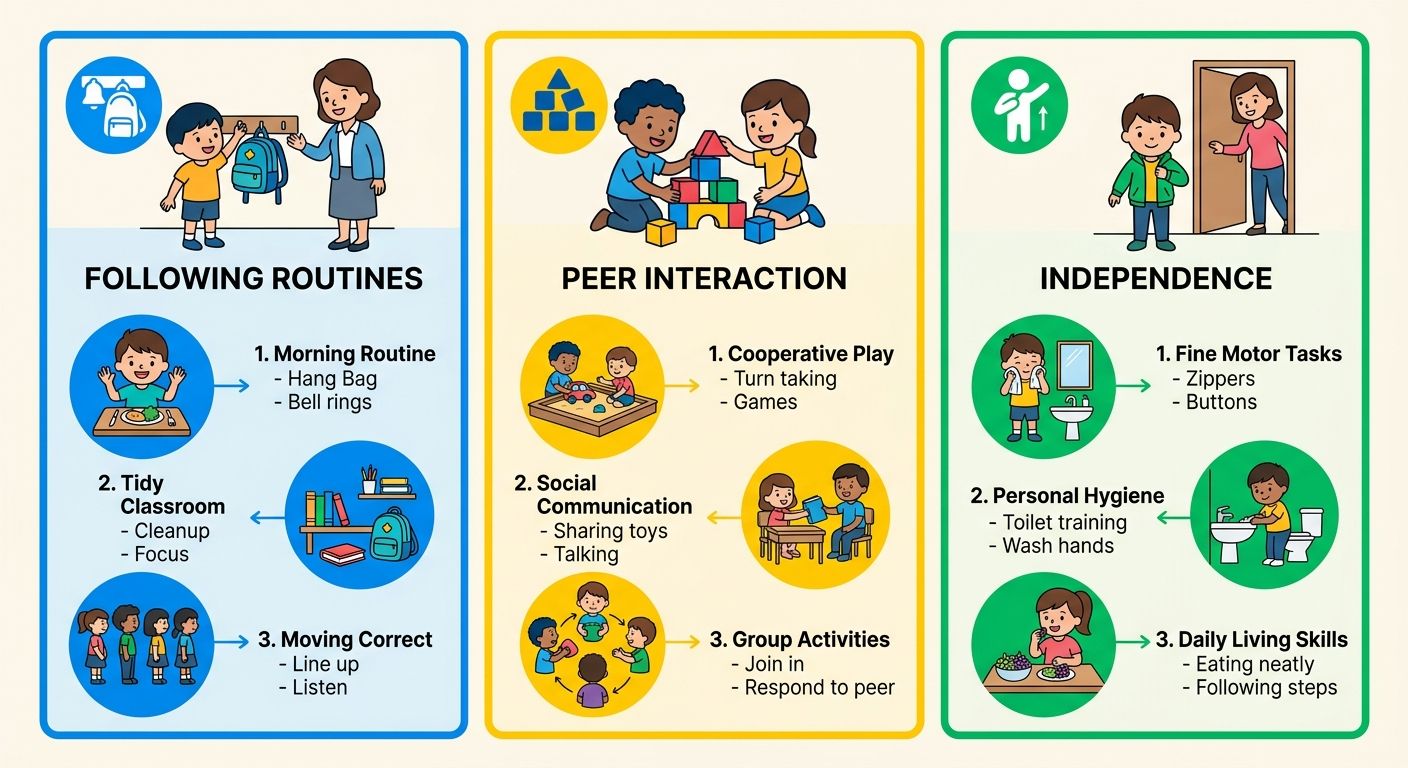
Three key school readiness skills developed through in-home ABA therapy
Strong school readiness also means reducing problem behaviors that interfere with learning, such as difficulty with transitions or following teacher directions. Our BCBAs and RBTs weave these targets into each session, and the data we collect often becomes the baseline for measurable iep goals for autism—giving your child’s team clear, observable objectives to track.
Parents play a vital role, too. Using ABA strategies consistently at home helps children practice independence during daily routines like dressing and packing a backpack. To learn more about in-home support in Arizona, visit our Arizona location page.
This information is for educational purposes. Consult a licensed healthcare professional for medical advice. Results may vary.
Overcoming Common Challenges in In-Home ABA Therapy
Even with a strong foundation, every family encounters a few bumps along the way—here’s how we help you navigate them. When you begin aba therapy for school age children, the transition to regular in-home sessions can sometimes bring resistance, especially from a child who is tired after a busy day. We partner with you to make sessions feel natural and engaging by incorporating your child’s favorite toys and activities right in their living room. This child-led approach, guided by your dedicated BCBA, helps transform reluctance into cooperation.
We also know that caregiver involvement can feel like a significant addition to an already full plate. Our family-centered model turns this dynamic on its head: rather than adding extra work, we weave caregiver training into everyday moments. Our therapists provide simple strategies you can use during dinner, playtime, or bedtime routines, so building school readiness behaviors at home quickly becomes second nature.
Scheduling conflicts are another common hurdle, but the in-home model itself is the most direct solution. Our team offers flexible scheduling that works around your family’s rhythm, not the other way around. If you’re struggling to see how far your child has come, the interactive ABA roadmap provides a clear, simple snapshot of every small win, showing how daily sessions reinforce broader objectives, including iep goals for autism. Rest assured, every challenge has a workable, compassionate answer—and our team is in your corner every step forward.
Discover how our ABA roadmap can illuminate your child’s path forward.
Putting It All Together: Next Steps for Your Child’s Development
In summary, ABA therapy for school age children provides an evidence-based pathway to strengthen the social, communication, and adaptive skills that form the foundation for classroom success. We at Golden Touch ABA craft personalized in-home treatment plans aligned with each child’s unique school readiness milestones and their IEP goals for autism, ensuring every session builds meaningful classroom preparedness.
The power of small steps drives our warm, family-centered approach. Our dedicated BCBAs and RBTs work collaboratively with your family, offering flexible scheduling that fits seamlessly into your daily routine. Discover how our customized support can make a difference — reach out to Golden Touch ABA for a custom quote or complete our interactive ABA roadmap to explore the next step. Together, we will nurture your child’s confidence and skill-building for school success.
Results may vary. Consult a licensed healthcare professional for diagnosis or medical advice.
Resources
- Get Personalized In-Home ABA Therapy in Washington Terrace
- Engage Children with Play-Based In-Home ABA Therapy
- Get Multistate ABA Therapy with Certified Analysts
- Find Personalized ABA Therapy in Taylorsville, Utah
- Find In-Home ABA Therapy Services Across Arizona
- Get In-Home ABA Therapy with Evidence-Based Techniques
- Discover ABA Therapy Services for Ages 1-21
- Find Details on BCBA Certification and Process
- Explore Registered Behavior Technician Certification Process