Functional Communication Training Autism: Complete Guide for Parents
Table of Contents
- Understanding Functional Communication Training for Autism
- How Golden Touch ABA Integrates Functional Communication Training
- Comparing Communication Approaches in ABA Therapy
- Cost and Value Considerations for In-Home FCT
- Choosing the Right ABA Provider for Functional Communication Training
- Empowering Communication Through In-Home ABA Therapy
Understanding Functional Communication Training for Autism
Within ABA therapy, evidence based autism treatment includes functional communication training autism—often called functional communication training (FCT). This evidence-based approach teaches a replacement behavior—a socially acceptable communication act that serves the same purpose as the challenging behavior. For non-verbal learners, we often integrate augmentative and alternative communication (AAC) tools like sign language or picture cards.
Here’s what FCT involves:
- Replacement behavior: a new, functional way to communicate.
- Reinforcement: rewarding the new way while withholding reinforcement for the old behavior.
- Augmentative and alternative communication: adaptive methods giving your child a voice.
That’s the core of functional communication training autism. FCT is backed by research from the Association for Science in Autism Treatment (ASAT) and the National Center for Biotechnology Information (NCBI). In our in-home therapy, we weave FCT into daily routines with family-centered care at the core, embracing the power of small steps in a warm and welcoming environment. Results vary; consult your BCBA for an individualized plan. In the following section, we’ll walk through how to implement FCT at home with your support team.
How Golden Touch ABA Integrates Functional Communication Training
Building on this evidence base, functional communication training autism strategies drive our in-home ABA therapy. At Golden Touch ABA, we translate these practices into plans tailored to your child’s communication needs.
Our in home ABA therapy in Utah begins with a BCBA-led functional behavior assessment to uncover your child’s communicative intent. We then design an FCT for autism program targeting an equivalent replacement behavior — a sign, picture exchange, or speech-generating device — that we weave into daily routines like meals and play. We provide these services to families across Salt Lake County and Utah County.
We incorporate augmentative and alternative communication (AAC) tools, from low-tech PECS to speech-generating apps, and train both your child and family members on their use. Our BCBA and RBT team tracks progress through frequency, duration, or latency data and adjusts the plan as needed. Parent and sibling training is essential, because consistent support across all caregivers helps your child generalize skills. We teach you to prompt, reinforce, and fade prompts over time.
Appropriate communication is always reinforced, while challenging behaviors are addressed with ethical extinction in a safe home environment. With each small step — the power of small steps — your child builds lasting skills. Results may vary. In the next section, see how this approach produced measurable gains for a child in our program.
Comparing Communication Approaches in ABA Therapy
Every child with autism has a unique way of learning to communicate, and functional communication training autism allows us to tailor our approach to each child’s strengths. At Golden Touch ABA Therapy, we know that selecting the right communication method is a crucial step in helping children express their wants and needs without frustration. The following table compares the most common communication options we integrate into FCT.
| Communication Method | Description | Advantages | Best Suited For | Role of FCT |
|---|---|---|---|---|
| Vocal Speech | Natural vocal output is reinforced when the child approximates or produces a word that matches the desired function | Most natural; no device needed; generalizes across settings | Children with some vocal ability but limited functional communication | FCT identifies a replacement word and reinforces it while withholding reinforcement for problem behavior |
| Picture Exchange Communication System (PECS) | A low-tech AAC system where the child hands a card to a communication partner | Simple to learn; no spoken language required; portable | Nonverbal children or children with limited fine motor skills for sign language | FCT teaches the child to exchange the card instead of engaging in problem behavior to request |
| Speech-Generating Device (SGD) | Dynamic display device (e.g., iPad with AAC app) that generates voice output | Voice output is highly reinforcing; can build vocabulary; adaptable | Children who can navigate visual displays and need a robust, scalable system | FCT programs the device with mands that replace problem behavior; data collection on device use |
| Sign Language | Uses American Sign Language (ASL) or modified signs as a form of manual communication | No equipment needed; can be used across all environments; fine motor practice | Children with strong motor imitation skills and families willing to learn signs | FCT shapes the sign as a replacement behavior and reinforces its use to access wants and needs |
Our clinical team draws on evidence-based practices, including research accessed through the NCBI biomedical databases, to determine which augmentative and alternative communication method will be most effective. The Association for Science in Autism Treatment (ASAT) also provides guidelines confirming that each of these AAC options can successfully establish a replacement behavior when taught through functional communication training.
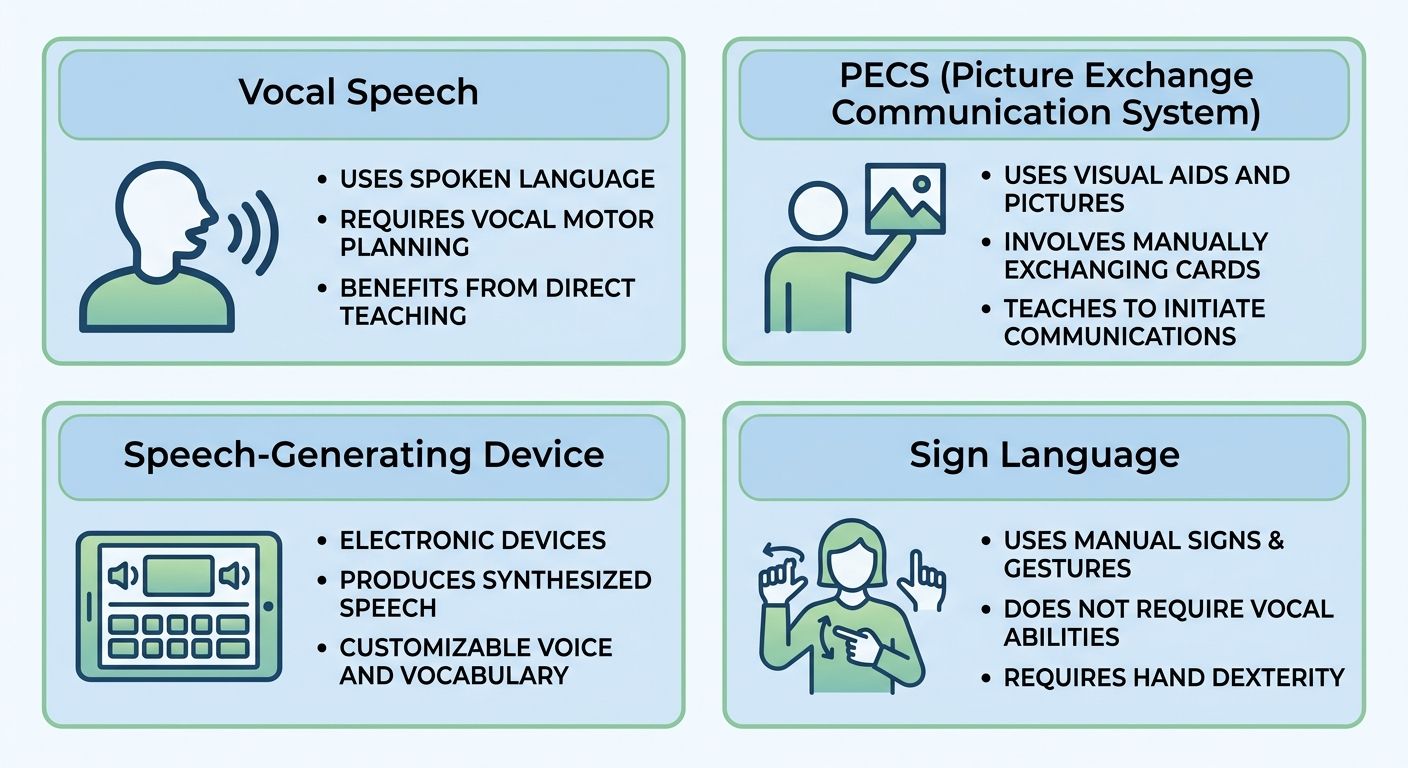
Comparison of communication methods in ABA therapy for parents.
The best method is always the one that fits the child’s existing skills and family context, and our thorough assessment process ensures this match is made thoughtfully. We celebrate every small step forward, knowing that a personalized plan builds a strong foundation for lasting communication and connection.
Cost and Value Considerations for In-Home FCT
Functional Communication Training autism therapy is an evidence-based ABA technique that replaces challenging behaviors with functional communication. By teaching your child a replacement behavior—such as using augmentative and alternative communication (AAC) tools like picture exchange or speech-generating devices—FCT can dramatically improve daily interactions and reduce frustration.
The cost of in-home FCT varies based on session frequency, your child’s individual needs, and your insurance plan. At Golden Touch ABA Therapy, we help families explore does insurance cover ABA therapy in Utah and assist with benefits verification so you can make the most of your coverage.
Because every therapy plan is uniquely designed, we provide custom quotes rather than standard pricing. Contact us for a personalized estimate that considers your child’s goals and insurance details.
Insurance coverage is subject to verification and is not guaranteed; results may vary; consult a licensed healthcare professional. Early investment in FCT often reduces the need for more intensive interventions later—supporting both your child’s long-term development and your family’s financial well‐being. The Association for Science in Autism Treatment (ASAT) recognizes FCT as an evidence‐based practice backed by research.
We’re here to help you navigate costs and coverage. Reach out today for a custom plan and insurance check.
Choosing the Right ABA Provider for Functional Communication Training
Choosing an ABA provider who excels at functional communication training autism is key to building meaningful communication. At Golden Touch ABA, we pair your child with a BCBA skilled in teaching communication skills for autism.
When evaluating a provider, look for these essentials:
- BCBA expertise: Seek a clinician with deep experience in functional communication training and teaching replacement behavior.
- In-home delivery: In-home therapy lets your child practice communication skills in real-life settings where they are needed most.
- AAC support: A provider that embraces augmentative and alternative communication tools—from picture cards to speech-generating devices—ensures your child’s voice is heard in whatever form it takes.
- Parent training: Regular caregiver coaching helps your child generalize communication across daily routines, making progress stick.
We combine these elements in our in-home ABA therapy programs, and our approach to functional communication training autism ensures tailored plans for every child. Maryland families can access ABA therapy in Prince George’s County through us, and we also serve Weber and Davis Counties in Utah. Custom pricing and insurance verification assistance make beginning therapy simple.
Once you’ve identified a qualified provider, verify insurance coverage and schedule an initial assessment. Individual results vary; consult a licensed professional for diagnosis, and remember insurance coverage is not guaranteed.
Empowering Communication Through In-Home ABA Therapy
Building on our in-home ABA approach, we use functional communication training for children with autism, an evidence-based practice supported by the Association for Science in Autism Treatment, to teach alternative ways to express needs instead of problem behavior. At Golden Touch ABA, we incorporate augmentative and alternative communication tools like picture exchange systems for non-verbal children, and the core of FCT is the replacement behavior: our clinicians identify what a child’s challenging action is communicating and teach a more adaptive skill.
In our family-centered model, caregivers learn to reinforce these strategies throughout daily routines, so functional communication training for autism becomes part of everyday life. While results vary, each step forward is a celebration — and we’ll next explore how measurable outcomes track that progress.
Resources
Table of Contents
- Finding Autism Therapy Providers in Maryland
- Maryland’s Autism Therapy Landscape
- In-Home ABA Therapy Availability in Maryland
- Important Considerations for Maryland Families
- Beginning ABA Therapy for Your Child in Maryland
- Your Path to ABA Therapy in Maryland
- Resources
Finding Autism Therapy Providers in Maryland
Finding the right autism therapy providers in Maryland starts with knowing what to look for. Once you understand how ABA therapy works, the next step is connecting with a team that can bring support directly to your doorstep. We offer in-home ABA therapy in Maryland designed to create a warm and welcoming environment where your child feels safe to learn and grow.
Our Board Certified Behavior Analysts (BCBAs) supervise every step, while skilled Registered Behavior Technicians (RBTs) deliver evidence-based practices during one-on-one sessions. Family-centered care means we involve you directly, offering caregiver training so progress continues between visits. We also provide insurance assistance and an interactive ABA roadmap tool to clarify the path ahead. The power of small steps guides our approach, and many families see meaningful gains with early intervention autism in Maryland. Results may vary, but our evidence-based approach aims for meaningful progress. Reach out to our Maryland team to learn how in-home ABA therapy in Maryland can fit into your family’s routine.
Maryland’s Autism Therapy Landscape
In Maryland, we see a diverse landscape of autism therapy providers in Maryland, offering a wide range of in-home ABA therapy options, though the concentration of services varies by county. Families researching providers will find many options listed on industry directories such as in-home ABA therapy in Maryland. The table below breaks down the coverage across several key counties to help you quickly identify the support available in your area.
| County | ABA Therapy Coverage | Types of Services Available | Notes |
|---|---|---|---|
| Anne Arundel County | Multiple in-home providers including Golden Touch ABA | In-home ABA, BCBA supervision, parent training | Proximity to Baltimore expands options |
| Baltimore County | High concentration of ABA providers | In-home, clinic-based, early intervention | Some providers may have waitlists |
| Montgomery County | Strong coverage with many BCBAs and RBTs | In-home, school collaboration, telehealth | Medicaid accepted by several agencies |
| Prince George’s County | Growing number of in-home providers | In-home ABA, parent coaching, insurance assistance | Check county-specific Medicaid policies |
| Howard County | Several trusted ABA agencies | In-home therapy, social skills groups, family support | Waitlists common; early contact advised |
Montgomery and Baltimore counties maintain the highest density of Board Certified Behavior Analysts (BCBAs) and Registered Behavior Technicians (RBTs), and many providers in these areas accept Medicaid, according to industry directories. Families in Howard and Prince George’s counties should note that waitlists can be common, so contacting providers early and verifying county-specific Medicaid policies are essential first steps. For families with younger children, early intervention autism in Maryland programs are widely available in these counties, offering parent training and BCBA-supervised therapy to build foundational skills from an early age.
With this landscape in mind, every family’s journey begins by identifying their local in-home ABA therapy in Maryland options and reaching out for a personalized assessment. Insurance coverage is subject to verification; results may vary.
In-Home ABA Therapy Availability in Maryland
Families seeking compassionate autism therapy providers Maryland can now access in-home ABA therapy Maryland from Golden Touch ABA Therapy right in their own communities. Our services bring the power of small steps to homes across the state, creating a warm and welcoming environment where children feel comfortable and supported as they learn.
According to our Maryland location page, we bring personalized, family-centered care to families in multiple counties, including Baltimore County, Montgomery County, and Prince George’s County. Our clinical team, led by a Board Certified Behavior Analyst (BCBA) and supported by skilled Registered Behavior Technicians (RBTs), delivers evidence-based practices in your child’s natural environment. For families exploring early intervention autism Maryland services, our in-home approach allows learning to happen where your child already plays, eats, and interacts, making each session a natural part of daily life.
We understand that navigating coverage can feel overwhelming, so our team provides dedicated insurance assistance to help you explore your options, including private plans and Medicaid. If you are seeking ABA therapy in Maryland with Medicaid, we can help you explore your options and connect you with additional resources. Insurance coverage is subject to verification and is not guaranteed.
Once you confirm availability in your area and understand your insurance options, the next step is a personalized assessment to start your child’s journey toward meaningful growth and greater independence.
Important Considerations for Maryland Families
When searching for reliable autism therapy providers in Maryland, families should start by understanding their insurance coverage. Verifying benefits with both private plans and Maryland Medicaid is essential before committing to a program. We encourage every family to request a benefits eligibility check so there are no surprises down the road.
Recognizing the early signs of autism is the first step toward early intervention. Indicators can appear as young as 6 months, and noting delays in social smiles, babbling, or eye contact can make a critical difference. Seeking early intervention autism in Maryland leads to more effective support and improved developmental outcomes for your child.
In-home ABA therapy in Maryland offers unique advantages for busy families. Receiving care in a warm and welcoming environment eliminates travel stress and allows caregivers to participate during everyday routines. Our family-centered care model ensures that evidence-based practices are woven into your child’s natural setting.
When choosing a provider, look for BCBA supervision and individualized treatment plans that celebrate the power of small steps. Quality programs adapt to your child’s needs, and our team is ready to help you verify coverage and schedule an in-home consultation.
Results may vary. Consult a licensed healthcare professional for diagnosis.
Beginning ABA Therapy for Your Child in Maryland
Starting ABA therapy can feel overwhelming, but we are here to guide you every step of the way. Families searching for autism therapy providers in Maryland will find a warm, welcoming, and collaborative partner in Golden Touch ABA. Our process begins with a simple, no-pressure conversation so we can learn about your child and answer your questions.
We begin with a free consultation to discuss your concerns and gather preliminary information. From there, our Board Certified Behavior Analyst (BCBA) completes a comprehensive behavioral assessment in your home. This allows us to understand your child’s unique strengths and needs within their natural environment. As an expert in early intervention autism in Maryland, our BCBA then designs a personalized plan built entirely around your child. We also help your family navigate insurance by verifying your benefits and explaining your coverage in clear terms, so you can focus on what matters most.
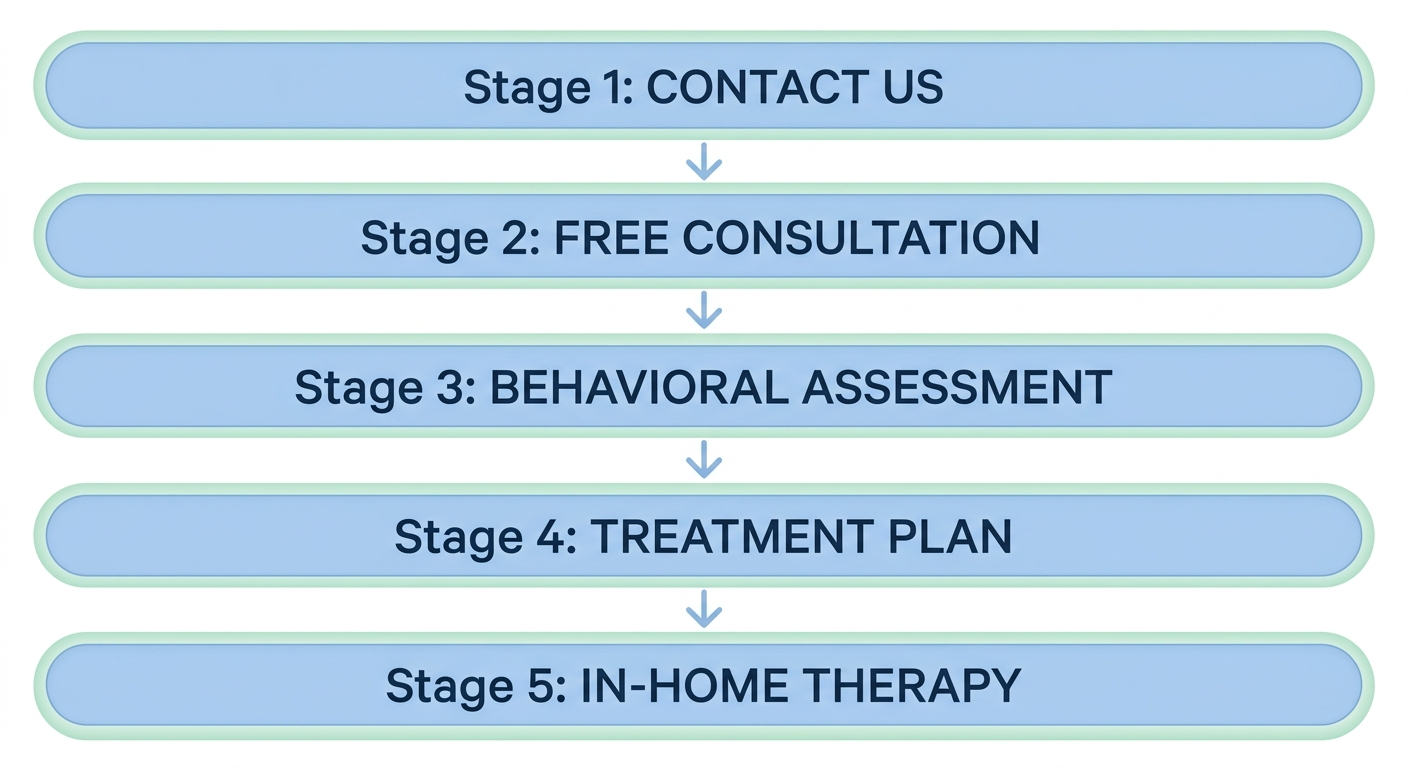
Five-step process to start in-home ABA therapy in Maryland.
Our in-home ABA therapy in Maryland sessions are delivered one-on-one by a compassionate Registered Behavior Technician (RBT) who is closely supervised by your BCBA. We believe in the power of small steps and family-centered care, which is why we incorporate ongoing caregiver training and adjust our approach based on your child’s progress. Evidence-based practices form the foundation of every session, creating a supportive structure for meaningful skill development. While every child’s journey is unique and results may vary, a consistent, early start provides the best foundation for growth. Reach out today for a custom quote and take the first step forward together.
Disclaimer: Results may vary. The information provided here is for educational purposes and does not replace consultation with a licensed healthcare professional.
Your Path to ABA Therapy in Maryland
Finding the right autism therapy providers Maryland families trust is easier than you might think. Ready to take the first step? Here’s how to start your journey with us:
- Schedule a free consultation or use our interactive ABA roadmap tool to share your child’s needs.
- Our team provides insurance verification assistance to clarify your benefits.
- A dedicated team of trained RBTs, supervised by a BCBA, delivers personalized in-home aba therapy maryland services.
While we also provide in-home ABA therapy in Utah, our Maryland families receive the same high-quality, compassionate care. Contact us today to begin.
Resources
- Get Expert In-Home ABA Therapy in Maryland
- Get In-Home ABA Therapy in Washington Terrace
- Discover Early Signs of Autism in Toddlers
- Learn Early Signs of Autism and ABA Therapy
- Find Early Signs of Autism in Infants
- Get Early Intervention ABA Therapy for Toddlers
- Discover Early Autism Signs and ABA Therapy
- Get ABA Therapy in Maryland with Bilingual Support
- Get ABA Therapy in Maryland for Children and Young Adults