
ABA Therapy Reimbursement Rates 2026: Complete Guide
Table of Contents
- Navigating ABA Therapy Reimbursement Rates in 2026
- Key Factors Behind ABA Therapy Reimbursement Rates
- Major 2026 Reimbursement Changes for In-Home ABA Therapy
- Choosing an In-Home ABA Provider Under New Reimbursement Rates
- Adapting to 2026 Rate Changes: Strategies for Families and Providers
- Common Questions About ABA Therapy Reimbursement Rates
- Securing Quality In-Home ABA Therapy for Your Child
Navigating ABA Therapy Reimbursement Rates in 2026
Navigating ABA therapy reimbursement rates in 2026 can feel overwhelming for families seeking support. Once you understand how ABA therapy works, the next step is understanding the financial landscape, which is where our team steps in to provide clarity and guidance.
Reimbursement rates are influenced by a combination of factors, including your specific insurance provider, whether the plan is private or through Medicaid, and your geographic location. For families in Salt Lake City and across our Utah, Arizona, and Maryland service areas, rates can also shift based on annual policy updates from insurers and state programs. This is why we never provide a one-size-fits-all number; instead, our experts conduct a personalized insurance benefits verification. This process allows us to review your plan’s deductibles, out-of-pocket maximums, and coverage for in-home ABA therapy, giving you a clear picture before treatment begins.
Our team stays current on ABA therapy reimbursement rates in 2026 to provide accurate guidance, but the most effective way to understand your costs is to reach out for a customized assessment. We are committed to making family-centered care accessible, and that starts with transparent, supportive financial conversations. To begin the reimbursement process, contact us for a free eligibility check.
Insurance coverage is subject to verification and is not guaranteed.
Key Factors Behind ABA Therapy Reimbursement Rates
Understanding what shapes aba therapy reimbursement rates 2026 is critical for families and providers planning for care. These rates are not uniform; they are driven by a combination of legislative decisions, contractual negotiations, and provider qualifications. Now let’s examine the key factors that actually drive these reimbursement rates, starting with how funding sources create different rules for providers.
Medicaid rates are established directly by state legislation, which leads to significant variation across the country. For instance, in California’s Medi-Cal program, the state sets its fee schedule through official policy, as seen in the medicaid aba therapy policy detailed by the Department of Health Care Services. This means a provider’s reimbursement for in-home ABA therapy can look very different from one state to the next, depending on that year’s approved budget. According to data from the National Center for Biotechnology Information, evidence-based practices like ABA therapy are recognized as medically necessary, which helps inform why states prioritize these rates, but the final dollar amounts are always a policy decision.
Private insurance reimbursement works through a different mechanism. Rates are not set by a single government body but are instead negotiated between employer health plans and provider networks. This system offers more flexibility, but it is often less transparent, as contracts differ widely between insurers. A family’s coverage for our family-centered care services is generally stable for the plan year, though providers must carefully manage their network contracts. The stability of private coverage contrasts sharply with the Medicaid system, where coverage can shift yearly with state budget cycles. This is a core reason why we help families verify their benefits—reimbursement for a service like in-home ABA therapy depends heavily on the payer’s specific rules.
The following table highlights the structural differences between these two primary funding sources.
| Factor | Medicaid | Private Insurance |
|---|---|---|
| Rate Determination | Set by state legislation; varies widely by state | Negotiated between employer/plan and provider networks |
| Coverage Consistency | Requires annual state budget approval; may change yearly | Stable for plan year but subject to network contracts |
| Provider Eligibility | Must meet state Medicaid requirements and be enrolled as a Medicaid provider | Must be credentialed with the specific insurance network |
This side-by-side view reveals that the source of funding directly dictates the predictability and administrative burden associated with each payer. Our experience shows that navigating these differences is a vital step in creating a warm and welcoming environment where the power of small steps can truly shine, free from administrative surprises.
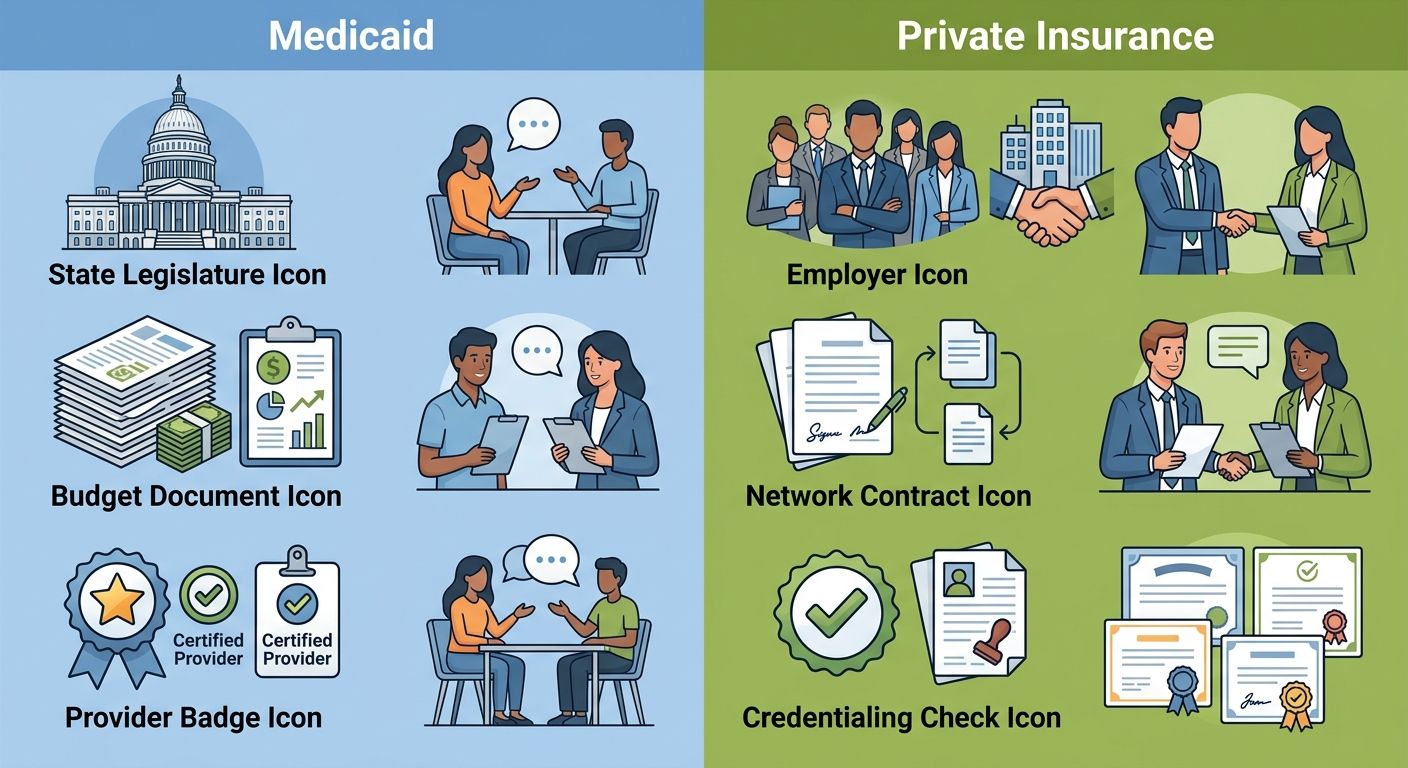
Comparison of Medicaid and private insurance reimbursement for ABA therapy
Beyond funding, provider eligibility is a crucial gatekeeper for reimbursement. To receive Medicaid payments, a provider must not only be a licensed clinician but also be formally enrolled as a state Medicaid provider, meeting all specific state requirements. Private insurance, however, requires a separate process: our Board Certified Behavior Analysts must be credentialed with each individual insurance network. This dual layer of eligibility underscores why aba therapy reimbursement rates 2026 are tied to a provider’s administrative capacity as much as their clinical expertise. Understanding these factors is the first step; next we’ll explore how to navigate them to protect your access to care.
Disclaimer: Insurance coverage is subject to verification and is not guaranteed. Reimbursement varies and consultation with a professional is recommended.
Major 2026 Reimbursement Changes for In-Home ABA Therapy
Looking ahead to 2026, several key reimbursement changes will shape the landscape for in-home ABA therapy. As a provider committed to family-centered care, we are tracking these aba therapy reimbursement rates 2026 updates closely to help families understand what to expect. These shifts in public payer fee schedules may affect access to aba therapy for children across our service areas in Utah, Arizona, and Maryland. While many state Medicaid programs are adjusting rates to balance budgets, we continue to assist families with insurance verification so they can focus on their child’s progress.
Medicaid Rate Adjustments Across States
Medicaid rate adjustments for 2026 reflect a mix of state budget cycles, legislative actions, and Medicaid rebalancing efforts. In Utah, rate-setting is influenced by annual legislative appropriations and the state’s efforts to manage overall behavioral health expenditures. According to state Medicaid fee schedule historical data, the projected rate for CPT 97153 is expected to see a modest decrease of approximately 2%. This adjustment aligns with broader budget rebalancing, though access to in-home ABA therapy remains a priority for Utah’s Division of Integrated Healthcare.
In Arizona, the projected 3.6% reduction in the average Medicaid rate for CPT 97153 is tied to the state’s managed care contracting cycles and cost-containment measures. Arizona’s Medicaid program periodically reviews fee schedules against provider cost reports, and the 2026 update reflects an attempt to align rates with updated utilization data. We are monitoring these changes to ensure families in Arizona continue to receive evidence-based practices through their coverage.
Maryland’s projected decrease of about 1.8% is relatively modest, reflecting the state’s All-Payer Model dynamics and the Maryland Department of Health’s approach to maintaining stable provider networks. These adjustments underscore the importance of verifying benefits with your specific payer, as actual reimbursement rates can vary significantly. As the California Department of Health Care Services (DHCS) demonstrates in its Medi-Cal rate-setting processes, state governments use complex methodologies to determine appropriate fees for ABA therapy services.
CPT Code 97153 Reimbursement Updates
CPT code 97153 is the most commonly used billing code for ABA therapy, covering adaptive behavior treatment by a technician under the supervision of a Board Certified Behavior Analyst (BCBA). This code represents the direct, face-to-face therapy sessions that form the core of in-home ABA therapy, making its reimbursement rate critical for both provider sustainability and family access.
The 2026 reimbursement updates for CPT 97153 show a trend toward modest reductions across several state Medicaid programs. For our families, these 2026 reimbursement changes for ABA therapy highlight the importance of understanding how public payer rates can influence service availability. As noted by the National Center for Biotechnology Information (NCBI) at the U.S. National Library of Medicine, government health research on healthcare reimbursement trends emphasizes that rate adjustments often reflect broader economic factors rather than changes in the clinical value of services.
While Medicare does not typically cover ABA therapy for children, trends in commercial payer rates often follow Medicaid benchmarks. We encourage families to view these projected figures as industry benchmarks rather than guaranteed reimbursement amounts. Your specific out-of-pocket costs and coverage levels depend entirely on your insurance plan’s contract with providers. Our team helps navigate these complexities, ensuring that warm and welcoming environment we create in your home is supported by clear financial understanding.
State-by-State Comparison of Autism Therapy Reimbursement
To illustrate the projected changes in 2026, we’ve compiled a comparison of Medicaid fee schedule data for CPT 97153 across our three primary service states. The following table represents estimated average rates based on state Medicaid fee schedule historical data and provider reports and legislative updates for 2026.
| State | 2025 Average Rate (Medicaid) | 2026 Projected Rate | Change (%) |
|---|---|---|---|
| Utah | $12.50 per unit | $12.25 per unit | -2% |
| Arizona | $14.00 per unit | $13.50 per unit | -3.6% |
| Maryland | $13.75 per unit | $13.50 per unit | -1.8% |
Importantly, these figures are drawn from public payer data and represent industry-wide projections. The power of small steps in therapy progress depends on consistent, uninterrupted care, which financial predictability supports. For a precise understanding of what your family’s insurance plan covers, we recommend contacting us directly. Actual reimbursement rates vary by payer contract and benefits eligibility; contact Golden Touch ABA Therapy for a custom quote based on your insurance plan.
As we navigate these evolving payer landscapes together, our commitment to family-centered care and evidence-based practices remains unwavering. Understanding these shifts helps families and providers anticipate what 2026 will bring for ABA therapy access. Results may vary; consult a licensed healthcare professional for medical advice. Insurance coverage is subject to verification and is not guaranteed.
Choosing an In-Home ABA Provider Under New Reimbursement Rates
In light of these reimbursement changes, choosing the right provider matters more than ever. With aba therapy reimbursement rates 2026 shifting across Medicare, Medicaid, and private insurance plans, families must evaluate providers carefully. When selecting an aba therapy provider, ask detailed questions about insurance, credentials, and the steps to begin therapy confidently.
Golden Touch ABA offers flexible scheduling and insurance navigation to help mitigate these challenges.
Questions to Ask About Insurance and Reimbursement
Understanding aba therapy reimbursement rates 2026 is key to avoiding unexpected out-of-pocket costs and finding a provider who respects your family’s financial boundaries. We at Golden Touch ABA recommend that families ask prospective providers these critical questions during the initial conversation to ensure full transparency:
- Network participation: Are you in-network with my specific health insurance plan?
- Rate acceptance: Do you accept the updated 2026 reimbursement rates for ABA services?
- Cost estimates: Will I receive a Good Faith Estimate before therapy begins?
- Balance billing: Is balance billing prohibited, and how do you handle coverage gaps?
- Out-of-pocket costs: What copays, deductibles, or coinsurance amounts should I expect?
- Authorization support: Do you assist with prior authorization and ongoing reauthorization requests?
Transparent answers to these questions help protect your family from surprise bills and ensure a smooth start to services.
Evaluating Provider Credentials and Experience
A provider’s qualifications directly impact the quality of care your child receives, especially as new reimbursement rates for ABA therapy place pressure on staffing models. Start by verifying that the supervising Board Certified Behavior Analyst (BCBA) holds current certification through the Behavior Analyst Certification Board (BACB). You can confirm credentials instantly by searching the public BACB registry at bacb.com.
Next, ask about supervision frequency. We recommend confirming that the BCBA provides at least weekly oversight of your child’s program rather than occasional check-ins. Inquire about the RBT-to-BCBA ratio on the team, since rate cuts can sometimes lead providers to stretch supervision too thin. At Golden Touch ABA, we maintain high supervision standards because we believe evidence-based practices deliver the best outcomes when supported by consistent, hands-on clinical guidance. Also confirm RBTs receive ongoing training and consistent team assignments week to week. Consistency matters in in-home ABA therapy, and a provider committed to family-centered care will prioritize stable, well-supervised teams even in a changing reimbursement environment.
Steps to Verify Coverage and Begin Therapy
Once you have selected an in-home ABA therapy provider, follow these steps to begin services. We at Golden Touch ABA guide you through every stage.
- Contact your insurance company to confirm ABA benefits and verify network status.
- Request a custom quote based on your coverage details and treatment plan.
- Schedule a free consultation or complete our interactive ABA roadmap assessment.
- Submit eligibility checks and intake forms with required diagnostic documentation.
- Begin therapy with a trial period for observation, plan refinement, and comfort in a warm and welcoming environment where the power of small steps builds lasting progress.
These steps help you find the right fit. Contact Golden Touch ABA today for a free consultation and custom quote.
Disclaimer: Results may vary and are not guaranteed. Consult a licensed healthcare professional for diagnosis or medical advice. Insurance coverage is subject to verification and is not guaranteed. Please review our Privacy Policy and Terms & Conditions for additional information.
Adapting to 2026 Rate Changes: Strategies for Families and Providers
With the aba therapy reimbursement rates 2026 adjustments approaching, families and providers are reexamining how they plan for care. We believe proactive preparation can ease this transition and safeguard access to compassionate, family-centered care.
Key strategies for navigating these changes:
| Factor | In-Home ABA Therapy | Center-Based ABA Therapy |
|---|---|---|
| Reimbursement Stability | Depends on state policy; cuts can reduce availability | Typically more stable facilities funding |
| BCBA Oversight | Typically requires travel; supervision ratios may be affected by rate cuts | On-site supervision common |
| Cost to Family | Out-of-pocket may increase if rates drop and providers adjust copays | Varies by clinic structure |
Drawing on biomedical data from the National Center for Biotechnology Information (NCBI), our approach to the aba therapy reimbursement rates 2026 is grounded in evidence-based research. Here is how each strategy works.
Negotiate with Insurers. Families can request single-case agreements when their provider is out-of-network, a critical step as reimbursement rates for applied behavior analysis adjust. We recommend having your child’s diagnosis and treatment plan ready when calling your insurer. Providers strengthen these negotiations by compiling outcome data that shows measurable progress, increasing the likelihood of approval.
Leverage State Resources. State autism waiver programs in Utah, Arizona, and Maryland may offer supplemental funding to offset rate changes for ABA therapy. Contact your state Medicaid or disability agency to check eligibility. Our team at Golden Touch ABA can supply the clinical documentation — assessment reports and progress notes — that agencies require.
Optimize Provider Efficiency. Choosing a provider that uses group supervision and remote parent training can reduce out-of-pocket costs without sacrificing quality. These models lower operational overhead while maintaining strong outcomes. Our In-home ABA therapy already integrates these efficiencies, reflecting our belief in the power of small steps toward affordable, sustainable care.
As the 2026 reimbursement adjustments take effect, we are here to help. Contact us for personalized guidance and a custom quote. Results may vary; consult a licensed healthcare professional for diagnosis or medical advice. Insurance coverage is subject to verification. Our Privacy Policy applies.
Common Questions About ABA Therapy Reimbursement Rates
ABA therapy reimbursement rates 2026 vary widely based on your insurance plan, provider network, and state regulations. At Golden Touch ABA, we help families understand what to expect. Here are answers to the questions we hear most often.
What Factors Influence Reimbursement Rates?
Reimbursement amounts depend on your specific policy’s deductibles, copayments, and coinsurance. State mandates, such as those in Maryland, can also affect coverage, while self-funded employer plans may not follow the same rules. We always verify benefits to give you a clear picture.
How Does BCBA Certification Affect Reimbursement?
Most insurers require that a Board Certified Behavior Analyst oversee therapy for it to be reimbursed. Holding BACB certification shows that your clinical supervisor meets the highest professional standards, which helps maintain coverage eligibility.
Does Golden Touch ABA Accept Medicaid?
We work with many families in Utah, Arizona, and Maryland, including those with Medicaid coverage. Because Medicaid benefits can differ by plan, we recommend contacting us so we can check your individual coverage for in-home ABA therapy.
How Can I Verify My Benefits for 2026?
Contact Golden Touch ABA and our team will handle the benefits verification process for you. Since reimbursement rates are subject to change, reaching out ensures you have the most current information. Insurance coverage is subject to verification and is not guaranteed.
Securing Quality In-Home ABA Therapy for Your Child
Building on the importance of early intervention discussed previously, securing quality in-home ABA therapy starts with verifying a provider assigns a BCBA to supervise treatment and train RBTs directly in your home. At Golden Touch ABA Therapy, we build individualized plans from comprehensive behavioral assessments with measurable goals rooted in ABA methodology. In-home ABA therapy in a warm and welcoming environment promotes family-centered care, and our caregiver training helps skills generalize beyond sessions. Data-driven progress monitoring keeps every session evidence-based.
In our next section on Navigating Insurance Coverage and Reimbursement Options for ABA Therapy, we will help you verify your benefits.
Resources
- Learn About 2026 Out-of-Pocket Maximums for ABA Therapy
- Discover How Insurance Plan Variables Affect ABA Therapy Costs
- Explore State Mandates and Out-of-Pocket Maximums for ABA
- Guide to Estimating ABA Therapy Costs with Insurance in 2026
- Access Biomedical and Genomic Databases at the NCBI Portal
- Discover Medi-Cal Initiatives and Behavioral Health Transformation
- Find BACB Certification Standards and Update Information
Table of Contents
- Understanding the Role of BCBA Supervision in In-Home ABA Therapy
- The Role of a BCBA in an In-Home ABA Program: Supervision Fundamentals
- How Often Does a BCBA Supervise Home-Based RBT Sessions?
- Verifying Credentials and Understanding RBT Supervision Requirements
- BCBA Supervised Fieldwork: Ensuring Competent Therapy Delivery
- Frequently Asked Questions About BCBA Supervision for Home Therapy
- Empowering Your Child’s Progress Through Quality BCBA Supervision
Understanding the Role of BCBA Supervision in In-Home ABA Therapy
BCBA supervision for home therapy is the ongoing oversight that ensures every in-home ABA therapy session delivers the highest standard of care. At Golden Touch ABA Therapy, a Board Certified Behavior Analyst guides each RBT on your child’s team, verifying that treatment plans are implemented with precision and compassion. This supervisory relationship is the foundation of effective, ethical therapy delivered in a warm and welcoming environment.
Our BCBAs adapt behavioral strategies to the natural rhythms of your home, making everyday moments opportunities for growth. The Behavior Analyst Certification Board establishes clear RBT supervision requirements, mandating that technicians receive a minimum percentage of supervised hours each month to maintain certification. This oversight extends beyond clinical monitoring and includes caregiver training so families feel empowered to reinforce skills between sessions. We believe in the power of small steps, and consistent BCBA supervision for home therapy transforms those steps into meaningful progress.
Through initial assessments, data analysis, and direct observation that mirror the rigor of BCBA supervised fieldwork, our BCBAs refine each child’s individualized plan while upholding evidence-based practices and ethical codes that protect client safety. For families navigating insurance, sessions are categorized under specific ABA therapy CPT codes that reflect the nature of BCBA oversight and direct RBT service delivery. This structure reflects our commitment to family-centered care, where parents and caregivers become active partners in their child’s development. Results may vary; consult a licensed healthcare professional for medical advice.
The Role of a BCBA in an In-Home ABA Program: Supervision Fundamentals
At Golden Touch ABA, we believe that meaningful progress in in-home ABA therapy begins with strong clinical supervision. BCBA supervision for home therapy provides the foundation for everything we do—it shapes how we design programs, support families, and guide our team members toward measurable outcomes. When a family invites us into their home, they are trusting us with something precious, and it is the Board Certified Behavior Analyst who carries the primary responsibility for ensuring that trust is well-placed. This section explores the fundamentals of BCBA supervision, clarifying what a BCBA does, how they collaborate with families, and how their role differs from that of the Registered Behavior Technician.
As the clinical leader of every in-home team, the BCBA serves as both supervisor and program designer. Their work begins long before the first therapy session takes place, starting with a comprehensive behavioral assessment that identifies a child’s strengths, skill deficits, and specific areas of need. Using evidence-based practices, they develop an individualized treatment plan with clear, measurable goals—whether that means improving communication, building daily living skills, or reducing behaviors that interfere with learning. Once therapy is underway, the BCBA monitors progress through ongoing data analysis, making adjustments to teaching strategies and intervention protocols as the child grows and changes. This continuous cycle of assessment, planning, and refinement ensures that every hour of therapy remains purposeful and aligned with the family’s priorities.
The following table highlights the key differences between these two essential roles on the therapy team.
| Aspect | BCBA | RBT |
|---|---|---|
| Role | Supervisor and program designer | Implementer under supervision |
| Qualifications | Master’s degree + BCBA certification | High school diploma + RBT certification |
| Responsibilities | Assess, plan, monitor progress | Deliver therapy, collect data |
| Supervision ratio | Directs and trains RBTs | Receives supervision from BCBA |
This distinction matters because both professionals bring complementary strengths to the team. The RBT works directly with the child day to day, delivering the therapy sessions and collecting real-time data on skill acquisition and behavior. The BCBA, in turn, analyzes that data to evaluate whether the program is working and provides hands-on training to ensure the RBT is implementing procedures correctly. Understanding the ABA practitioner requirements for each role helps families appreciate the depth of expertise supporting their child’s progress.
To become a BCBA, an individual must earn a master’s degree in behavior analysis or a closely related field and complete bcba supervised fieldwork under the guidance of a qualified supervisor. This intensive clinical training typically involves 1,500 to 2,000 hours of hands-on practice, during which the trainee learns to conduct assessments, write treatment plans, and oversee direct implementation. After completing the required fieldwork, candidates must pass the national certification examination administered by the Behavior Analyst Certification Board, or BACB. This rigorous process ensures that every BCBA possesses the clinical judgment necessary to handle the complexity and nuance of autism intervention in real-world settings.
The rbt supervision requirements are similarly structured but designed as an entry-level pathway. An RBT must be at least 18 years old, hold a high school diploma, and complete a 40-hour training program covering foundational ABA principles, ethical conduct, and skill-building techniques. A BCBA then directly observes the candidate performing essential tasks—such as collecting data, implementing behavior reduction plans, and following session protocols—through a hands-on competency assessment. Once certified, the RBT must receive ongoing supervision from a BCBA at least five percent of the total hours they spend delivering therapy each month, a standard established and enforced by the BACB to safeguard treatment quality.
What makes our approach at Golden Touch ABA especially meaningful is the emphasis on family-centered care. BCBA supervision extends well beyond the child alone—it involves regular caregiver training sessions where parents learn the same reinforcement and prompting strategies used during therapy. We collaborate with families to set goals that reflect their daily routines and long-term aspirations, whether that means mastering toothbrushing before bedtime, ordering a meal at a restaurant, or joining a sibling in a play activity. By embedding treatment within the natural environment of the home, we honor the power of small steps taken consistently over time, and we see the warm and welcoming environment of the family’s own space as the ideal setting for lasting change.
BCBA supervision also plays a critical role in upholding treatment fidelity. When an RBT implements a skill acquisition program or a behavior intervention plan, the BCBA periodically observes sessions—either in person or through secure video review—to verify that the techniques are being delivered as designed. If drift occurs, the BCBA provides immediate feedback, modeling the correct procedure and offering practical coaching until the RBT reaches competency. This ongoing oversight protects the integrity of the program and gives families confidence that their child is receiving high-quality care rooted in evidence-based practices.
Looking ahead to how these roles function day to day, it is important to recognize that the BCBA and RBT operate as a collaborative unit. The BCBA sets the direction, but the RBT is the person who turns that vision into hundreds of teachable moments each week, whether during play, snack time, or community outings. In our next section, we will examine the specific responsibilities of the RBT, exploring how they carry out the BCBA’s carefully crafted plan and contribute their own insights to the ongoing evolution of treatment. Results may vary for each child, and we encourage families to consult a licensed healthcare professional for guidance specific to their situation.
How Often Does a BCBA Supervise Home-Based RBT Sessions?
Now that you understand who provides therapy, let’s look at how often a BCBA supervises these sessions. BCBA supervision for home therapy is a cornerstone of quality in-home ABA, ensuring that your child’s program stays effective and that your RBT receives the guidance needed to deliver consistent, evidence-based care. We design supervision schedules around your family’s needs while following professional standards, so you can feel confident that oversight is both structured and responsive.
Direct in-home observation typically occurs weekly or bi-weekly. The Behavior Analyst Certification Board recommends that a BCBA provide at least 5% of the total hours an RBT spends delivering therapy—meaning BCBA supervision for home therapy includes regular on-site visits where we watch sessions, model techniques, and give immediate feedback. This hands-on approach helps maintain rbt supervision requirements and ensures treatment fidelity. Telehealth supervision is often conducted weekly as well and can supplement direct visits, giving us flexibility to check in between in-person observations while still meeting ABA practitioner requirements.
The purpose of this oversight goes beyond compliance: we use supervision to support RBT skill development, adjust intervention strategies in real time, and keep you, the family, fully informed. Whether we’re in your living room or connecting through a secure video call, our focus remains on creating a warm, collaborative environment where progress is celebrated. The following table compares the two main supervision methods we use:
| Method | Frequency | Requirements | Benefits |
|---|---|---|---|
| Direct in-home observation | Typically weekly or bi-weekly | BACB recommends at least 5% of RBT hours | Hands-on interaction, immediate feedback |
| Telehealth supervision | Often weekly, can supplement direct | Allowed per BACB; state-specific regulations | Flexibility, reduced travel time |
Direct observation lets us see your child’s natural routines and gives us the chance to coach the RBT in the moment, which is why many families prefer this in-person connection. Telehealth supervision adds another layer of support—when schedules get tight or a quick check-in is needed, we can observe via video and still meet the bcba supervised fieldwork standards that guide our profession. State regulations and individual insurance policies influence the exact balance, but most clients experience a blend of these two methods.
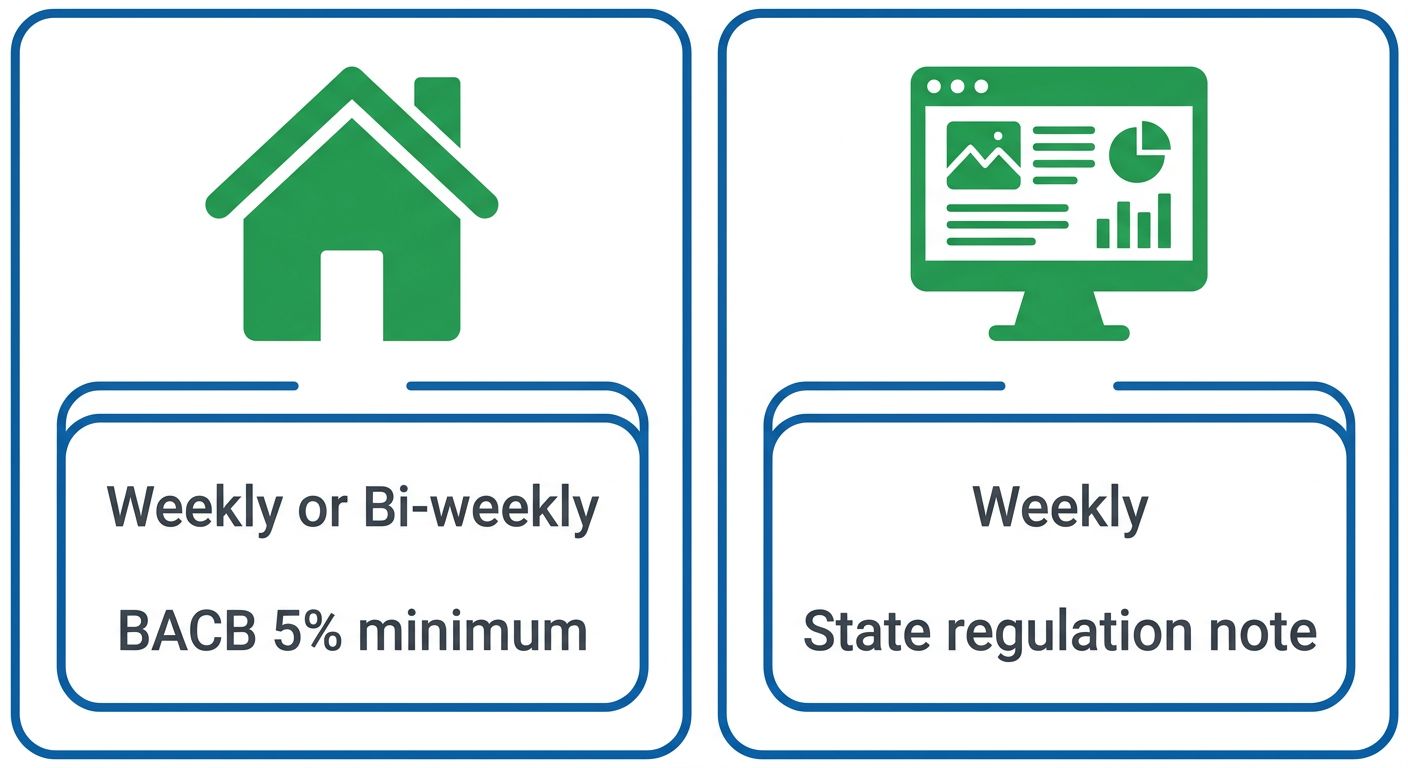
Comparison of in-home vs telehealth BCBA supervision frequency.
We schedule supervision based on more than just BACB minimums. Your BCBA considers your child’s treatment goals, the complexity of the behavior plan, and input from you and the RBT when determining how often to visit. Insurance providers also play a role, as they may stipulate certain supervision benchmarks. Because of these variables, we avoid guaranteeing a fixed frequency. Instead, we stay flexible and transparent, adjusting oversight as your child progresses and as your family’s circumstances change. As an organization rooted in family-centered care, we believe that BCBA oversight should feel like a partnership—we are here to listen, explain, and adapt.
You can expect consistent communication from your supervising BCBA whether the session is in person or remote. Many families ask how often they should see their BCBA, and while weekly or bi-weekly contact is common, we tailor the rhythm to what works best for you. This supervision structure ensures high-quality care; keep reading to learn what qualifications your BCBA should have.
Verifying Credentials and Understanding RBT Supervision Requirements
When you choose in-home ABA therapy for your child, understanding BCBA supervision for home therapy is crucial to ensuring your child receives safe, quality care. At Golden Touch ABA, we believe that transparency around qualifications builds trust, so we encourage families to verify the credentials of the professionals who will work with them. This section walks you through how to confirm a BCBA’s certification and explains the supervision standards that Registered Behavior Technicians (RBTs) must meet.
How to Verify a BCBA’s Credentials for Your Child’s Care
Verifying a BCBA’s credentials is a straightforward process that ensures your child’s therapist has the required training and ethical standing. Begin with the official Behavior Analyst Certification Board (BACB) registry. Here’s a step-by-step guide:
- Visit the BACB website and locate the certificant registry search tool.
- Enter the BCBA’s full name or certification number into the search fields.
- Review the search results to confirm that the BCBA holds an active, current certification — look for the BACB certification status and expiration date.
- Verify that the certificant is in good standing with no disciplinary actions or inactive status.
- For an extra layer of assurance, check that the BCBA meets any state-specific licensure requirements, as some states require additional credentials beyond BACB certification. You can usually find this by searching your state’s behavior analyst licensing board website.
At Golden Touch ABA, every supervising BCBA holds an active BACB certification and undergoes rigorous internal review. We invite you to ask us for certification details — it’s part of our commitment to family-centered care. The BACB registry is the authoritative source for verifying that your child’s supervising professional has met the national standards for behavior analysis. Taking these steps helps you feel confident that the person overseeing your child’s therapy has the expertise needed to design and monitor an effective in-home program. State licensure may require an additional verification; always confirm that your provider complies with local regulations. Remember, a BCBA who is certified but also licensed in your state offers an extra level of oversight and adherence to local professional standards.
Now that you understand how to check credentials, let’s examine the supervision requirements that ensure RBTs deliver therapy with continuous professional oversight.
RBT Supervision Requirements: What Parents Should Know
The BACB establishes specific RBT supervision requirements to maintain quality and safety in ABA therapy. At Golden Touch ABA, we follow these mandates closely because we know that consistent supervision directly impacts your child’s progress. The core standard: at least 5% of the RBT’s total service hours each month must include direct observation by a qualified BCBA. This observation can occur in person or via live video review, and it must happen regularly — not clustered into one day. For example, an RBT providing 20 hours of therapy per week would need at least one hour of direct BCBA observation each week.
Supervision goes beyond simple observation. It involves several components that together ensure the RBT applies the treatment plan faithfully and adapts when needed:
- Direct in‑person observation: The BCBA watches the RBT work with your child in the home, noting technique and interaction.
- Video review: For remote oversight or when in-person visits aren’t possible, the BCBA reviews recorded sessions to assess fidelity.
- Feedback meetings: After observation, the BCBA meets with the RBT to discuss strengths, areas for improvement, and any adjustments to the behavior plan.
- Performance evaluations: Periodic formal reviews track the RBT’s development and ensure they meet all competency standards, including BCBA supervised fieldwork hours when applicable.
Our team integrates these activities into a structured supervision schedule so that every RBT receives ongoing, meaningful guidance. We encourage parents to ask about supervision logistics when selecting a provider — questions like “How often will a BCBA observe my child’s session?” or “What does a typical feedback session look like?” can reveal a lot about a practice’s commitment to quality. At Golden Touch ABA, we make sure our BCBAs are intimately involved in your child’s care, not just occasional visitors. We structure our in-home programs so that every family benefits from robust BCBA supervision for home therapy.
Understanding these credentialing and supervision standards puts you in a stronger position to advocate for your child. In our next section, we’ll explore what a typical ABA therapy session looks like in your home, from the initial assessment to ongoing skill building. Please remember that therapy outcomes vary and you should consult a licensed healthcare professional for a medical diagnosis or personalized advice.
BCBA Supervised Fieldwork: Ensuring Competent Therapy Delivery
BCBA supervision for home therapy is the cornerstone of quality assurance at Golden Touch ABA. We call it BCBA supervised fieldwork — the ongoing clinical oversight that ensures every therapy session aligns with your child’s individualized treatment plan. This process maintains fidelity to evidence-based practices while creating a warm and welcoming environment where families feel supported and informed. We document supervisory feedback and progress notes to ensure continuity of care and clear communication regularly.
Our ongoing clinical supervision meets and exceeds the standards set by the Behavior Analyst Certification Board (BACB). Under these requirements, a BCBA must directly observe a meaningful portion of therapy hours each month and conduct regular face-to-face meetings with RBTs. This monitoring catches technique drift immediately, keeping every interaction effective and ethical. Supervisors review session data, adjust goals as needed, and coach RBTs on subtle behavioral strategies so interventions remain tailored and measurable. According to Golden Touch ABA’s clinical protocols, such rigorous oversight is central to our family-centered care model.
Because we deliver in-home ABA therapy, fieldwork supervision takes place right where your child lives and plays. Our BCBAs model strategies in real-life situations, turning parents into confident partners. In the home setting, we practice skills in daily routines to generalize learning and empower families to reinforce progress. RBT supervision requirements include direct coaching during sessions, where BCBAs review behavior plans and offer instant feedback, so your therapy team works as a unified, highly skilled unit.
Families experience the power of small steps: every milestone builds on expert guidance. While each journey is unique, this layered supervision keeps treatment dynamic, responsive, and always rooted in the best available research.
Results may vary; consult a licensed professional for diagnosis or treatment decisions.
Frequently Asked Questions About BCBA Supervision for Home Therapy
After learning about the essential role of bcba supervision for home therapy, families often have questions about how this process works within their daily routine. We provide clear answers to help you feel confident and informed.
What is BCBA supervision for home therapy?
Our Board Certified Behavior Analyst oversees every aspect of your child’s in-home ABA therapy program, ensuring it is personalized and effective. This clinical direction guarantees that teaching strategies are implemented correctly and adapted as your child progresses.
How often does a BCBA supervisor visit during in-home ABA?
The frequency of supervision sessions aligns with rbt supervision requirements and typically includes regular in-person and remote check-ins. We adjust the schedule to fit your family’s needs while maintaining the highest standard of clinical oversight.
What are the requirements for BCBA supervision in an in-home setting?
BCBAs complete extensive graduate education and hands-on training through bcba supervised fieldwork before earning their credential. Our supervisors bring this rigorous experience into your home, coordinating directly with your child’s therapist.
How does BCBA supervision benefit my child and their RBT?
Ongoing BCBA oversight provides your RBT with real-time feedback and in-the-moment training, creating a warm and welcoming environment for learning. This collaborative model supports our family-centered care philosophy and helps your child build skills faster.
Can BCBA supervision be conducted remotely or does it require in-person visits?
We use a hybrid model that combines in-person visits with secure remote observation to offer flexible support. This ensures we can maintain consistent supervision regardless of daily schedules or location challenges.
As a core piece of our evidence-based practices, regular BCBA oversight connects every small success to the power of small steps. This seamless clinical support prepares your family to confidently move toward discussing insurance and next steps with our team.
Empowering Your Child’s Progress Through Quality BCBA Supervision
BCBA supervision is the professional oversight provided by a Board Certified Behavior Analyst who guides your child’s in-home therapy and tracks meaningful progress. Through careful, data-informed adjustments and the direct involvement of our clinical team, each session evolves to support your child’s individual needs.
At Golden Touch ABA, we pair every family with a dedicated BCBA who designs a truly individualized treatment plan. An RBT implements that plan right in your home under close BCBA guidance during home-based therapy, ensuring every small step forward is celebrated. This collaborative, evidence-based approach helps create measurable growth while honoring the power of family-centered care, without promising any specific outcome. It naturally sets the stage for the way our RBTs deliver those thoughtfully crafted plans.
Resources
- Understand ABA Therapy Billing Units and CPT Codes
- Discover ABA Practitioner Requirements and Supervision Standards
- Discover the RBT Certification Process and Requirements
- Compare ABA Practitioner Tiers: RBT, BCaBA, and BCBA
- Discover RBT Training Aligned with BACB Task List
- Compare BCBA and RBT Roles and Training Requirements
- Explore Certification Paths for RBT and BCBA Practitioners
- Explore BACB Certification Requirements and Professional Resources
Table of Contents
- Personalized ABA Therapy in Arizona for Your Child
- Arizona Communities We Serve
- In-Home ABA Therapy Coverage and Insurance Options in Arizona
- Local Expertise: Registered Behavior Technicians and Family Support in Arizona
- Starting ABA Therapy with Golden Touch in Arizona
- Supporting Arizona Families Through In-Home ABA Therapy
Personalized ABA Therapy in Arizona for Your Child
If you’re searching for aba therapy Arizona families rely on, Golden Touch ABA is here to help. We deliver personalized ABA therapy that adapts to your child’s unique strengths and challenges. Our plans are rooted in compassionate, evidence-based care and take place in the place your child feels safest—home.
In-home ABA therapy creates a warm and welcoming environment where children learn naturally. Our in-home ABA therapy in Arizona is delivered by experienced Board Certified Behavior Analysts (BCBAs) and compassionate Registered Behavior Technicians (RBTs). They embrace the power of small steps, breaking goals into manageable wins that build confidence. Throughout the process, we provide caregiver training, assist with insurance, and offer flexible scheduling options. We partner with you every step of the way because family-centered care is at the heart of everything we do.
Explore our interactive ABA roadmap tool to chart a personalized path forward—and please keep in mind that individual results vary and are not guaranteed.
Arizona Communities We Serve
Beyond our general services, we are proud to bring in-home ABA therapy to families across Arizona. Our goal is to provide compassionate, family-centered care in every community we touch, making ABA therapy arizona families rely on both accessible and effective. We currently offer support in several key areas, and you can find detailed information about all of our ABA therapy locations.
We believe that a warm and welcoming environment is crucial for a child’s growth, which is why we deliver all our services within the comfort of your own home. Our approach, built on evidence-based practices and the philosophy of “The power of small steps,” ensures that every child receives a treatment plan tailored to their unique needs.
The following table provides a quick overview of our primary Arizona service areas:
| Service Area | In-Home Therapy | BCBA Supervision |
|---|---|---|
| Phoenix Metro | Yes | Available |
| Tucson | Yes | Available |
| Flagstaff | Yes | Available |
This consistent availability across Arizona means that families in these communities can expect the same high standard of care. Each of our core service areas—
- The Phoenix Metro area
- Tucson
- Flagstaff
—is supported by experienced Board Certified Behavior Analysts and Registered Behavior Technicians who are dedicated to fostering meaningful progress. BCBA supervision is a cornerstone of our program, ensuring that every therapy plan is guided by expert oversight and aligns with professional standards recognized by the Arizona Association for Behavior Analysis.
Now that you know where we serve, let’s explore how our therapy works and what you can expect from our dedicated team.
In-Home ABA Therapy Coverage and Insurance Options in Arizona
Understanding your insurance benefits is a critical step when arranging in-home ABA therapy for your child. At Golden Touch ABA Therapy, we know that navigating coverage can feel overwhelming, so we offer dedicated support to families seeking aba therapy arizona services. We help you explore your options, whether you have a commercial plan, employer-sponsored insurance, or state-funded coverage through Medicaid aba therapy arizona.
Our team provides complimentary insurance assistance and benefits-eligibility support. The process begins with a free benefits check, where we contact your insurance provider to verify your aba insurance arizona details and explain any applicable co-pays or deductibles. Many families use this step to confidently understand their in-home aba therapy coverage arizona before committing to an assessment.
We commonly work with:
- Arizona’s Medicaid program (AHCCCS)
- Tricare
- Major commercial insurance plans
For additional advocacy and professional standards information, the Arizona Association for Behavior Analysis (AzABA) is a valuable industry resource.
Families exploring behavioral health insurance or autism therapy coverage should know that actual benefits vary by plan. Insurance coverage is subject to verification and is not guaranteed. We encourage you to contact our Arizona team directly for a personalized eligibility assessment and custom quote and ongoing support throughout the process.
Local Expertise: Registered Behavior Technicians and Family Support in Arizona
For those seeking aba therapy Arizona, finding a provider with deep local roots and a dedicated clinical team makes all the difference. Golden Touch ABA Therapy delivers in-home ABA therapy through multiple locations across the state, bringing personalized support directly to families in their own homes.
Our therapy sessions are implemented by Registered Behavior Technicians (RBTs), certified professionals who work under the close supervision of Board Certified Behavior Analysts (BCBAs). The behavior analyst certification board establishes the rigorous certification requirements and ethical standards that govern RBT practice nationwide. We believe family involvement is key to lasting progress. Our family-centered approach includes caregiver training and collaboration, ensuring parents have the tools to reinforce skills between sessions. This partnership typically includes:
- Caregiver coaching on reinforcement strategies
- Regular progress updates and collaborative goal setting
Our local Arizona team understands the unique needs of families in our communities. We are committed to evidence-based practices delivered in a warm and welcoming environment, helping children build skills that last. Our experienced team guides you through every step, from initial questions to insurance verification. We would be happy to help — please contact us to learn more. Results may vary, and insurance coverage is subject to verification and is not guaranteed.
Starting ABA Therapy with Golden Touch in Arizona
Taking the first step toward ABA therapy in Arizona is simpler than you might expect. At Golden Touch ABA, we’ve designed our intake process to be welcoming and straightforward, guiding your family from that initial phone call to the first in-home session with warmth and clarity. We believe in creating a warm and welcoming environment from the very first conversation, answering your questions and helping you feel supported every step of the way.
Our services are delivered right in your home, where your child feels most comfortable. We proudly provide in-home ABA therapy to families across Arizona, including Phoenix, Benson, and the surrounding communities. Every session is led by a dedicated Board Certified Behavior Analyst (BCBA) — the clinician who designs and oversees your child’s plan — and implemented by a compassionate Registered Behavior Technician (RBT), who works directly with your child.
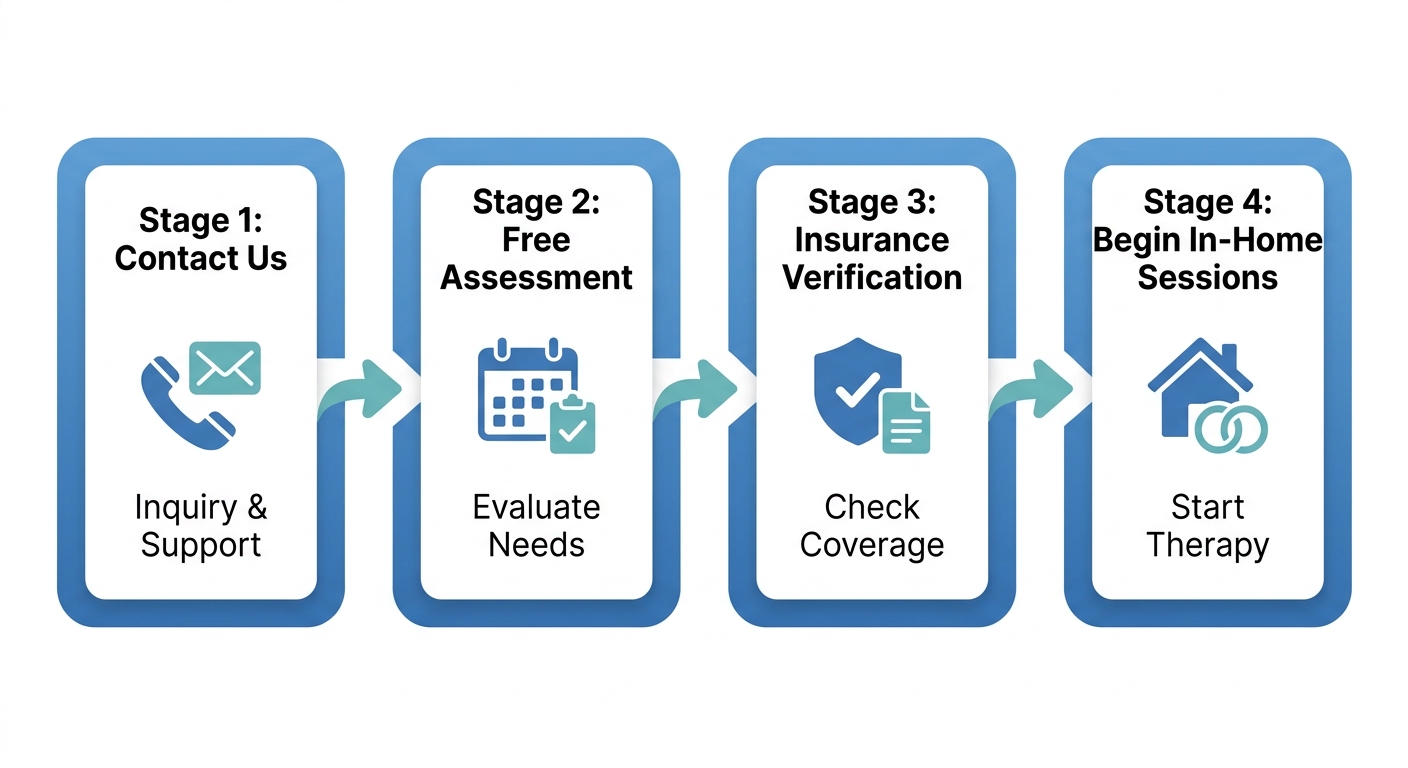
Four-step process to begin in-home ABA therapy with Golden Touch in Arizona.
Beginning ABA services in Arizona follows a clear, four-step path:
- Contact Us: Reach out via our online form or call us at 480-470-3014. A friendly team member will listen to your needs and schedule a time to talk.
- Free Assessment: We conduct a no-cost, no-obligation initial consultation to understand your child’s strengths and goals. This family-centered care approach ensures our planning includes your insights and priorities.
- Insurance Verification: We navigate the paperwork for you. Our team helps verify your insurance benefits and check eligibility, including Medicaid, so you can focus on what matters most—your child.
- Start of Therapy: An individualized, evidence-based treatment plan is created and in-home sessions begin on a schedule that works for your family.
While our hearts are firmly rooted in serving Arizona families, we also extend our reach to other communities. For instance, Golden Touch provides ABA therapy in Emigration Canyon, Utah, bringing the same dedicated, in-home support to that region. Once therapy begins here in Arizona, our team continuously monitors progress and adjusts the plan, fostering growth through the power of small steps, a journey we’ll explore in more detail next.
Supporting Arizona Families Through In-Home ABA Therapy
Expanding on ABA therapy’s benefits, we now highlight how we bring in-home ABA therapy to families across Arizona. We create a warm and welcoming environment in your home, where your child can thrive. Our family-centered care approach partners you with BCBAs and RBTs who champion the power of small steps every day. We also offer insurance and benefits eligibility support to ease your journey.
Resources
- Get In-Home ABA Therapy for Autism in Arizona
- Find ABA Therapy Services in Arizona, Maryland, Utah
- Get ABA Therapy Services in Emigration Canyon Utah
- Home-Based ABA Therapy in Eagle Mountain Utah
- Autism Therapy in Washington Terrace Utah
- Learn About Golden Touch ABA Therapy Approach
- Find In-Home ABA Therapy in Maryland
- Explore Professional Behavior Analysis in Arizona
- Get Behavior Analyst Certification Board Resources
Table of Contents
- Understanding Registered Behavior Technician Salary
- RBT Salary Basics — What You Need to Know
- Factors That Shape RBT Salary Across the Country
- Maximizing Your RBT Salary — Practical Steps and Comparisons
- Career Growth Opportunities for RBTs — From Entry Level to Advancement
- Frequently Asked Questions About RBT Salary
- Taking the Next Steps in Your RBT Career
Understanding Registered Behavior Technician Salary
Now that you understand what an RBT does, let’s look at what you can expect to earn. RBT salary is a top consideration for anyone entering the ABA field, and compensation can be influenced by several key factors. Registered behavior technicians play a vital role in delivering In-home ABA therapy, and at Golden Touch ABA, we value the dedication they bring to every session.
Several elements shape the pay for behavior techs. Certification level matters—an RBT’s earnings typically differ from those of a BCBA with advanced credentials. Years of experience and the complexity of a caseload also affect aba therapist pay rates. The setting plays a part too; an RBT working in a clinic environment may see a different behavior technician hourly rate than one providing therapy in a child’s home.
Location is another major determinant. For example, compensation for registered behavior technicians can vary between urban and suburban areas, even within the same state. In Utah, hourly rates for ABA therapists reflect local demand and cost of living. We provide Family-centered care in South Salt Lake and in Fruit Heights, and the need for compassionate RBTs in these communities helps drive competitive earnings. Golden Touch ABA delivers personalized ABA therapy in South Salt Lake, Utah, where RBTs work closely with BCBAs to implement treatment plans grounded in Evidence-based practices.
At Golden Touch ABA, we create a Warm and welcoming environment that supports professional growth. While we never list fixed figures because compensation is commensurate with experience, our custom compensation packages reflect the value we place on our team. The power of small steps applies to careers, too—we offer mentorship and benefits that add significant worth beyond base pay. Beyond salary, Golden Touch ABA offers rewarding growth opportunities—explore them in the next section.
RBT Salary Basics — What You Need to Know
Becoming a Registered Behavior Technician is a rewarding way to enter the behavioral health field, but naturally many people wonder about the financial side of this role. When researching rbt salary, it is important to look at reliable data sources and understand what shapes your earning potential, because pay varies widely based on where you work and the type of employer you join.
The U.S. Bureau of Labor Statistics collects detailed wage data that offers a clear starting point. According to the BLS, the average ABA therapy technician pay across the United States lands around $19 to $20 per hour, which translates to an annual mean wage in the low $40,000s for full-time behavioral technicians. These government figures show that RBT earnings are competitive with other entry-level healthcare support roles, though regional differences can shift the numbers noticeably. In states with higher demand for behavior technician services, the behavior technician hourly rate often sits above the national midpoint, while smaller markets may see lower averages.
Several key factors influence where your RBT pay falls within those ranges.
Key factors affecting RBT salary
- Geographic location, because cost of living and demand for ABA services shape local wage scales
- Years of hands-on experience working directly with children and families
- Work setting, such as in-home therapy versus clinic-based programs
- Employer type, including private agencies, school districts, and hospital systems
- Additional credentials or specialized training beyond the entry-level RBT certification
Because the RBT credential is designed as an entry point into the field, salaries generally start at the lower end of the behavioral health spectrum. The Behavior Analyst Certification Board sets the certification requirements but does not publish or set aba therapist pay rates, so all salary benchmarks come from third-party government data and employer-reported surveys. In practice, behavior technician pay can increase meaningfully as you gain supervised hours, demonstrate reliability, and pursue advanced training.
At Golden Touch ABA Therapy, we help families connect with dedicated RBTs who provide in-home ABA therapy built around family-centered care. While salaries are ultimately determined by each employer, RBTs who work with agencies like ours often receive benefits, mentorship, and paid training opportunities that add value beyond the base aba therapist pay rates. If you are curious about compensation specifics, we encourage you to discuss expectations directly with any prospective employer because salaries vary and are determined by the employer.
Understanding salary is just one part of the picture—next we explore how RBTs can grow their careers.
Factors That Shape RBT Salary Across the Country
Beyond the basics of the RBT role, several key factors shape how much RBTs earn in different parts of the country. Understanding how rbt salary is determined requires looking at the intersection of state-level regulations, the local demand for services, and the professional credentials a technician brings to the field. For those considering a career in Applied Behavior Analysis, this data-driven overview clarifies what drives compensation, from licensure laws to geographic cost-of-living differences.
How State Regulations and Demand Affect RBT Pay
State regulations directly affect the behavior technician hourly rate by requiring specific supervision ratios, mandating background checks, or setting training hour minimums beyond the national Registered Behavior Technician credential from the Behavior Analyst Certification Board (BACB). When a state creates a higher barrier to entry or imposes stricter ongoing oversight, the pool of available RBTs can tighten, pushing wages upward for those who meet the requirements.
Demand for in-home ABA therapy is another powerful force. In regions where autism diagnosis rates are higher or insurance mandates cover ABA more comprehensively, providers compete to staff cases, which can increase base hourly offers. According to the Bureau of Labor Statistics (BLS), the national median hourly wage for the closely related occupational category of psychiatric technicians and aides typically falls within an $18–$22 range. However, states like California and Massachusetts, where both cost of living and service demand are elevated, frequently see the upper bound of that range extended substantially. Our own experience at Golden Touch ABA confirms that in areas we serve, such as Utah, Arizona, and Maryland, wage offers must remain competitive to attract skilled technicians who deliver family-centered, evidence-based care.
Comparing Hourly Rates Across the United States
A clear picture of RBT compensation emerges when we look at average hourly rates alongside cost-of-living data. The following table highlights five states with strong wages for behavior technicians, balancing raw pay figures against how far those dollars actually go in each region.
| State | Average Hourly Rate ($) | Cost of Living Index | Demand for RBTs |
|---|---|---|---|
| California | $25 – $30 | 151.7 | High |
| Massachusetts | $24 – $28 | 134.5 | Moderate |
| New Jersey | $23 – $27 | 116.5 | High |
| Nevada | $22 – $26 | 103.7 | Moderate |
| Arizona | $21 – $25 | 97.2 | High |
Data drawn from BLS regional wage estimates and cost-of-living indices. Wages reflect typical ranges for RBT positions in each state.
Cost of living partially explains the spread: while California offers the highest raw rates, Nevada’s lower cost of living makes its $22–$26 range comparatively strong for full-time RBTs. Arizona presents a similar dynamic, where a moderate pay band meets an even more favorable cost index, potentially maximizing take-home pay for professionals working in metro areas like Phoenix. For a broader view of the highest-paying regions, see our resource on states highest RBT pay.
These geographic distinctions matter for anyone weighing relocation against career growth. A technician in New Jersey may earn a few dollars more per hour than a peer in Arizona, but Arizona’s lower housing and transportation costs can narrow or even reverse the real-income advantage. We always encourage RBTs to evaluate not just the posted wage but the full financial picture before choosing a market.
The Role of Experience and Specialization
Experience and certifications like the BCBA pathway significantly boost aba therapist pay rates because they signal deeper clinical skill and greater independence in session management. RBTs with three or more years of hands-on practice typically earn $2–$5 more per hour than entry-level colleagues, reflecting their efficiency in data collection, behavior intervention implementation, and family communication.
Specialization creates additional earning power. Technicians who develop expertise with particular populations, such as non-vocal clients or adolescents with intensive behavioral needs, often command premium wages. Many RBTs pursue a master’s degree and accumulate supervised fieldwork hours as part of the BCBA pathway, a career progression that can lead to a significant salary jump and expanded clinical responsibilities. These experience- and certification-based differences point toward the career progression opportunities available to RBTs.
Wage figures are based on public BLS data and broad industry surveys; individual employer offers may vary.
Maximizing Your RBT Salary — Practical Steps and Comparisons
Now that you have a sense of typical pay ranges, let’s dive into concrete steps you can take to maximize your earning potential. Understanding what influences RBT salary is the first move toward securing competitive, market-aligned pay. Whether you’re new to the field or a seasoned behavior technician, a few practical strategies can make a real difference in your ABA therapist earnings.
How to Research RBT Salary in Your Area
Researching your local RBT salary is simpler than you might think, but it does take a little digging beyond a quick internet search. Government resources like the Bureau of Labor Statistics (BLS) offer broad occupational outlooks, though you’ll want to pair that with real-world job board listings. Sites like Indeed or Glassdoor let you filter by location so you can see what local employers are offering for behavior technician hourly rate ranges.
In our experience, networking with other RBTs and BCBAs in your area gives you the clearest picture. Conversations with colleagues often reveal what typical RBT hourly compensation looks like when factoring in experience, certifications, and different practice settings. For example, you can explore our services in areas like ABA therapy in Sandy Hills, Utah to see the types of positions available and the compensation they offer. Knowing the landscape equips you to evaluate offers against market-based pay benchmarks.
In-Home vs Clinic-Based Salary Comparison
Beyond the numbers, the work setting plays a huge role in your overall compensation and day-to-day experience. While aba therapist pay rates can be similar in certain markets, the trade-offs between in-home and clinic-based roles are worth weighing carefully. The following table breaks down key non-monetary factors to help you decide which environment fits your career goals.
| Factor | In-Home RBT | Clinic-Based RBT |
|---|---|---|
| Average Hourly Rate | $20 – $28 | $18 – $25 |
| Scheduling Flexibility | High (daytime, after-school, weekends) | Moderate (set clinic hours) |
| Commute/Travel | Varies (mileage often reimbursable) | Fixed location, no travel |
| Supervision & Training | RBT works independently with BCBA check-ins | On-site BCBA supervision at all times |
| Benefit Packages | May include health insurance, PTO, tuition assistance | Typically includes standard clinic benefits |
Salary information is for general informational purposes and may vary. Contact Golden Touch ABA for specific compensation details regarding our positions.
Our in-home ABA therapy model means our RBTs often appreciate the flexibility and family-centered nature of the work. You might have more variety in your day and often build deep connections with a child in their natural environment. On the other hand, clinic-based roles frequently offer more immediate BCBA support and a structured team atmosphere. Both paths can offer competitive compensation when you align the role with your strengths.
Thinking through these factors helps you target positions where you’ll thrive and feel valued. When an RBT finds the right fit, both job satisfaction and earning potential tend to grow together.
Tips for Negotiating a Higher Hourly Rate
Negotiating a higher hourly rate might feel intimidating, but it’s a normal and expected part of the hiring process. We encourage you to lead with your qualifications—your RBT certification, any specialized training in behavioral assessment, and your years of hands-on experience. Employers value behavior technician hourly rate discussions when you can clearly connect your skills to better outcomes for clients.
Highlighting your willingness to work flexible hours, take on challenging cases, or support families during evenings and weekends can also strengthen your position. The demand for quality aba therapist pay rates is strong, and organizations like ours seek dedicated RBTs who bring both competence and compassion. Approach the conversation with professionalism and confidence, and you’ll often find room for improvement in the initial offer.
Negotiating well today sets the stage for growth—next, we’ll explore how advancing your career can lead to even higher compensation.
Career Growth Opportunities for RBTs — From Entry Level to Advancement
Once you have earned your RBT credential, the next step is building a long-term career. At Golden Touch ABA Therapy, we guide our team members along a clear path from entry-level behavior technician to advanced roles. Understanding your potential rbt salary is an important first step, but the career journey in In-home ABA therapy is about much more than a paycheck.
Compensation and Job Outlook for Behavior Technicians
When evaluating an rbt salary, consider the potential for advancement. Our industry offers competitive pay that grows with your expertise. According to the U.S. Bureau of Labor Statistics, the median annual wage for similar roles in 2024 was approximately $42,590. The behavior technician hourly rate often rises with experience, with entry-level aba therapist pay rates starting around $20.29 per hour. As you gain skills, your earnings increase accordingly. Learn more about RBT salary and benefits to see how your compensation can expand. The career stability is excellent, with the BLS projecting overall employment growth of 16 percent from 2024 to 2034, much faster than the average for all occupations.
Your Advancement Pathway with Us
Our warm and welcoming environment is built around professional development. The Behavior Analyst Certification Board (BACB) RBT Task List establishes your certification as a trusted, standardized foundation. From here, we support your growth through several clear routes:
- Lead RBT: Take on mentorship and advanced implementation responsibilities. We provide internal training to help you reach this level.
- Behavior Analyst in Training (BAIT): Our paid training and free BCBA supervision pathway bridges the gap between RBT and the BCBA role.
- Board Certified Behavior Analyst (BCBA): With a master’s degree and 5,000 supervised fieldwork hours, you can advance to this supervisory position. Our BCBAs direct treatment plans using evidence-based practices.
Every role is rooted in family-centered care, and we champion the power of small steps in every learner’s journey. Results may vary; career growth depends on individual effort and company needs. With the right support, your RBT certification is just the beginning of a rewarding career in behavior analysis.
Frequently Asked Questions About RBT Salary
Many aspiring behavior technicians wonder how RBT salary varies across different regions and work environments in the United States. These direct, FAQ-style answers summarize what industry data shows about earnings for Registered Behavior Technicians (RBTs).
What is the average RBT salary?
According to our salary FAQ, national averages for RBTs typically range from $35,000 to $50,000 per year. Actual ABA therapist pay rates can shift depending on certification level, years of experience, and whether the work setting is in-home or clinic-based.
How much does an RBT make per hour?
Per our hourly pay FAQ, an RBT generally earns between $15 and $25 per hour. The hourly rate for behavior technicians often increases with experience and can be higher in urban hubs or high-demand states.
Which states pay the highest for RBTs?
Our FAQ on state-by-state pay notes that locations such as California, Massachusetts, and Nevada tend to offer higher compensation. According to the U.S. Bureau of Labor Statistics regional data, these areas reflect strong demand for qualified behavioral health professionals. To explore personalized in-home support, families can learn more about our autism services in Fruit Heights, Utah.
Taking the Next Steps in Your RBT Career
When you’re ready to move forward, exploring rbt salary expectations helps you see the full picture of what this career can offer. At Golden Touch ABA Therapy, we provide a warm and welcoming environment built on family-centered care and evidence-based practices for our in-home ABA therapy teams in South Salt Lake County, Utah. Our behavior technician hourly rate and aba therapist pay rates reflect the value we place on the dedicated professionals who make the power of small steps come alive every day. If you’d like to learn more about RBT opportunities or use our interactive ABA roadmap tool, we invite you to contact us—our friendly team is here to help you take the next step.
Resources
- Get Personalized In-Home ABA Therapy in South Salt Lake
- Discover Research-Based ABA Therapy in Fruit Heights
- Explore Evidence-Based ABA Therapy in Sandy Hills Utah
- Compare RBT and BCBA Qualifications for ABA Therapists
- Get Salary Insights for ABA Therapists at Golden Touch
- Explore ABA Therapist Jobs in New Jersey Growing Market
- Learn How to Advance from RBT to BCBA
- Compare Psychiatric Technician Pay Across Industries from BLS
- Discover Psychiatric Technician Job Outlook and Salary
- Find State-by-State Wage Data for Psychiatric Technicians
- Discover the New RBT Handbook from BACB
- Review the RBT Task List and Certification Standards
