
BCBA Supervision for Home Therapy: Complete Guide for Parents
Table of Contents
- Understanding the Role of BCBA Supervision in In-Home ABA Therapy
- The Role of a BCBA in an In-Home ABA Program: Supervision Fundamentals
- How Often Does a BCBA Supervise Home-Based RBT Sessions?
- Verifying Credentials and Understanding RBT Supervision Requirements
- BCBA Supervised Fieldwork: Ensuring Competent Therapy Delivery
- Frequently Asked Questions About BCBA Supervision for Home Therapy
- Empowering Your Child’s Progress Through Quality BCBA Supervision
Understanding the Role of BCBA Supervision in In-Home ABA Therapy
BCBA supervision for home therapy is the ongoing oversight that ensures every in-home ABA therapy session delivers the highest standard of care. At Golden Touch ABA Therapy, a Board Certified Behavior Analyst guides each RBT on your child’s team, verifying that treatment plans are implemented with precision and compassion. This supervisory relationship is the foundation of effective, ethical therapy delivered in a warm and welcoming environment.
Our BCBAs adapt behavioral strategies to the natural rhythms of your home, making everyday moments opportunities for growth. The Behavior Analyst Certification Board establishes clear RBT supervision requirements, mandating that technicians receive a minimum percentage of supervised hours each month to maintain certification. This oversight extends beyond clinical monitoring and includes caregiver training so families feel empowered to reinforce skills between sessions. We believe in the power of small steps, and consistent BCBA supervision for home therapy transforms those steps into meaningful progress.
Through initial assessments, data analysis, and direct observation that mirror the rigor of BCBA supervised fieldwork, our BCBAs refine each child’s individualized plan while upholding evidence-based practices and ethical codes that protect client safety. For families navigating insurance, sessions are categorized under specific ABA therapy CPT codes that reflect the nature of BCBA oversight and direct RBT service delivery. This structure reflects our commitment to family-centered care, where parents and caregivers become active partners in their child’s development. Results may vary; consult a licensed healthcare professional for medical advice.
The Role of a BCBA in an In-Home ABA Program: Supervision Fundamentals
At Golden Touch ABA, we believe that meaningful progress in in-home ABA therapy begins with strong clinical supervision. BCBA supervision for home therapy provides the foundation for everything we do—it shapes how we design programs, support families, and guide our team members toward measurable outcomes. When a family invites us into their home, they are trusting us with something precious, and it is the Board Certified Behavior Analyst who carries the primary responsibility for ensuring that trust is well-placed. This section explores the fundamentals of BCBA supervision, clarifying what a BCBA does, how they collaborate with families, and how their role differs from that of the Registered Behavior Technician.
As the clinical leader of every in-home team, the BCBA serves as both supervisor and program designer. Their work begins long before the first therapy session takes place, starting with a comprehensive behavioral assessment that identifies a child’s strengths, skill deficits, and specific areas of need. Using evidence-based practices, they develop an individualized treatment plan with clear, measurable goals—whether that means improving communication, building daily living skills, or reducing behaviors that interfere with learning. Once therapy is underway, the BCBA monitors progress through ongoing data analysis, making adjustments to teaching strategies and intervention protocols as the child grows and changes. This continuous cycle of assessment, planning, and refinement ensures that every hour of therapy remains purposeful and aligned with the family’s priorities.
The following table highlights the key differences between these two essential roles on the therapy team.
| Aspect | BCBA | RBT |
|---|---|---|
| Role | Supervisor and program designer | Implementer under supervision |
| Qualifications | Master’s degree + BCBA certification | High school diploma + RBT certification |
| Responsibilities | Assess, plan, monitor progress | Deliver therapy, collect data |
| Supervision ratio | Directs and trains RBTs | Receives supervision from BCBA |
This distinction matters because both professionals bring complementary strengths to the team. The RBT works directly with the child day to day, delivering the therapy sessions and collecting real-time data on skill acquisition and behavior. The BCBA, in turn, analyzes that data to evaluate whether the program is working and provides hands-on training to ensure the RBT is implementing procedures correctly. Understanding the ABA practitioner requirements for each role helps families appreciate the depth of expertise supporting their child’s progress.
To become a BCBA, an individual must earn a master’s degree in behavior analysis or a closely related field and complete bcba supervised fieldwork under the guidance of a qualified supervisor. This intensive clinical training typically involves 1,500 to 2,000 hours of hands-on practice, during which the trainee learns to conduct assessments, write treatment plans, and oversee direct implementation. After completing the required fieldwork, candidates must pass the national certification examination administered by the Behavior Analyst Certification Board, or BACB. This rigorous process ensures that every BCBA possesses the clinical judgment necessary to handle the complexity and nuance of autism intervention in real-world settings.
The rbt supervision requirements are similarly structured but designed as an entry-level pathway. An RBT must be at least 18 years old, hold a high school diploma, and complete a 40-hour training program covering foundational ABA principles, ethical conduct, and skill-building techniques. A BCBA then directly observes the candidate performing essential tasks—such as collecting data, implementing behavior reduction plans, and following session protocols—through a hands-on competency assessment. Once certified, the RBT must receive ongoing supervision from a BCBA at least five percent of the total hours they spend delivering therapy each month, a standard established and enforced by the BACB to safeguard treatment quality.
What makes our approach at Golden Touch ABA especially meaningful is the emphasis on family-centered care. BCBA supervision extends well beyond the child alone—it involves regular caregiver training sessions where parents learn the same reinforcement and prompting strategies used during therapy. We collaborate with families to set goals that reflect their daily routines and long-term aspirations, whether that means mastering toothbrushing before bedtime, ordering a meal at a restaurant, or joining a sibling in a play activity. By embedding treatment within the natural environment of the home, we honor the power of small steps taken consistently over time, and we see the warm and welcoming environment of the family’s own space as the ideal setting for lasting change.
BCBA supervision also plays a critical role in upholding treatment fidelity. When an RBT implements a skill acquisition program or a behavior intervention plan, the BCBA periodically observes sessions—either in person or through secure video review—to verify that the techniques are being delivered as designed. If drift occurs, the BCBA provides immediate feedback, modeling the correct procedure and offering practical coaching until the RBT reaches competency. This ongoing oversight protects the integrity of the program and gives families confidence that their child is receiving high-quality care rooted in evidence-based practices.
Looking ahead to how these roles function day to day, it is important to recognize that the BCBA and RBT operate as a collaborative unit. The BCBA sets the direction, but the RBT is the person who turns that vision into hundreds of teachable moments each week, whether during play, snack time, or community outings. In our next section, we will examine the specific responsibilities of the RBT, exploring how they carry out the BCBA’s carefully crafted plan and contribute their own insights to the ongoing evolution of treatment. Results may vary for each child, and we encourage families to consult a licensed healthcare professional for guidance specific to their situation.
How Often Does a BCBA Supervise Home-Based RBT Sessions?
Now that you understand who provides therapy, let’s look at how often a BCBA supervises these sessions. BCBA supervision for home therapy is a cornerstone of quality in-home ABA, ensuring that your child’s program stays effective and that your RBT receives the guidance needed to deliver consistent, evidence-based care. We design supervision schedules around your family’s needs while following professional standards, so you can feel confident that oversight is both structured and responsive.
Direct in-home observation typically occurs weekly or bi-weekly. The Behavior Analyst Certification Board recommends that a BCBA provide at least 5% of the total hours an RBT spends delivering therapy—meaning BCBA supervision for home therapy includes regular on-site visits where we watch sessions, model techniques, and give immediate feedback. This hands-on approach helps maintain rbt supervision requirements and ensures treatment fidelity. Telehealth supervision is often conducted weekly as well and can supplement direct visits, giving us flexibility to check in between in-person observations while still meeting ABA practitioner requirements.
The purpose of this oversight goes beyond compliance: we use supervision to support RBT skill development, adjust intervention strategies in real time, and keep you, the family, fully informed. Whether we’re in your living room or connecting through a secure video call, our focus remains on creating a warm, collaborative environment where progress is celebrated. The following table compares the two main supervision methods we use:
| Method | Frequency | Requirements | Benefits |
|---|---|---|---|
| Direct in-home observation | Typically weekly or bi-weekly | BACB recommends at least 5% of RBT hours | Hands-on interaction, immediate feedback |
| Telehealth supervision | Often weekly, can supplement direct | Allowed per BACB; state-specific regulations | Flexibility, reduced travel time |
Direct observation lets us see your child’s natural routines and gives us the chance to coach the RBT in the moment, which is why many families prefer this in-person connection. Telehealth supervision adds another layer of support—when schedules get tight or a quick check-in is needed, we can observe via video and still meet the bcba supervised fieldwork standards that guide our profession. State regulations and individual insurance policies influence the exact balance, but most clients experience a blend of these two methods.
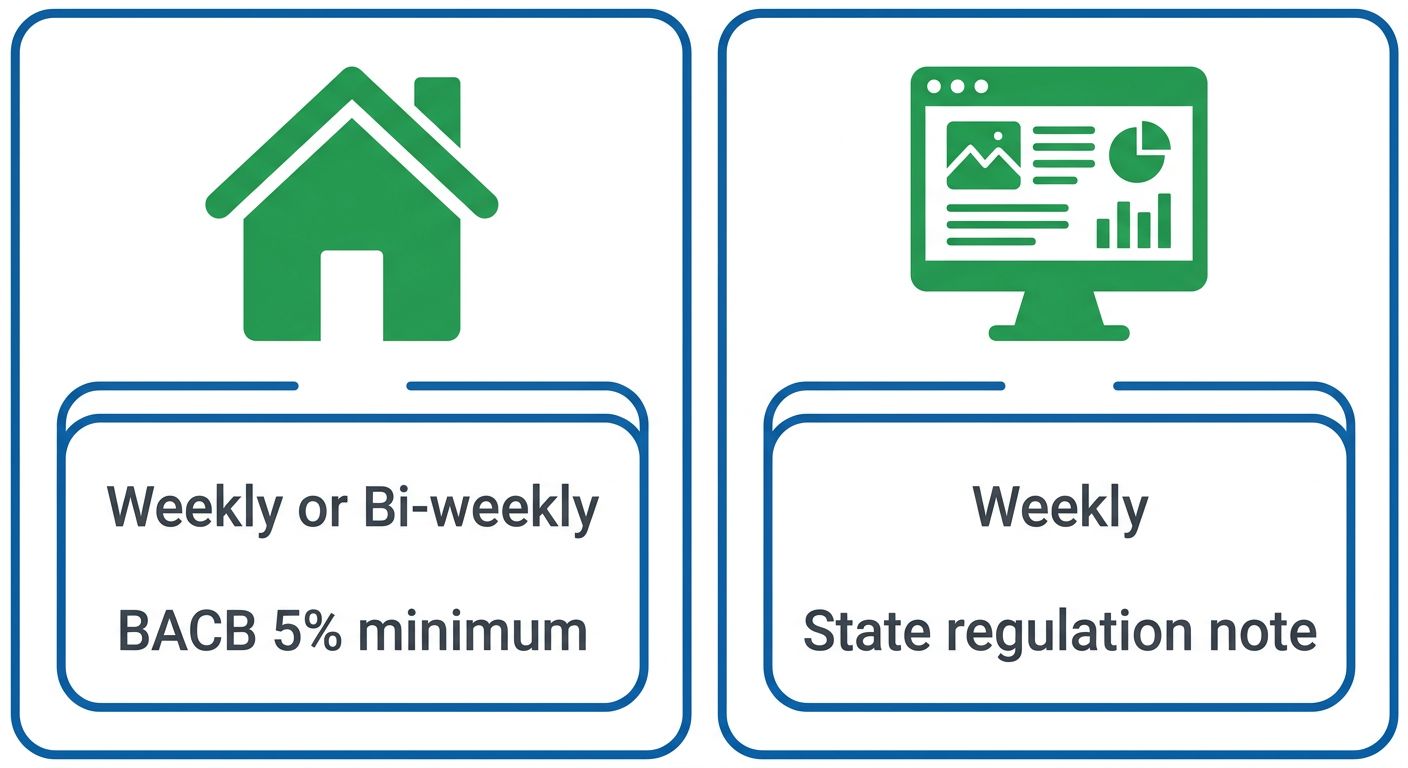
Comparison of in-home vs telehealth BCBA supervision frequency.
We schedule supervision based on more than just BACB minimums. Your BCBA considers your child’s treatment goals, the complexity of the behavior plan, and input from you and the RBT when determining how often to visit. Insurance providers also play a role, as they may stipulate certain supervision benchmarks. Because of these variables, we avoid guaranteeing a fixed frequency. Instead, we stay flexible and transparent, adjusting oversight as your child progresses and as your family’s circumstances change. As an organization rooted in family-centered care, we believe that BCBA oversight should feel like a partnership—we are here to listen, explain, and adapt.
You can expect consistent communication from your supervising BCBA whether the session is in person or remote. Many families ask how often they should see their BCBA, and while weekly or bi-weekly contact is common, we tailor the rhythm to what works best for you. This supervision structure ensures high-quality care; keep reading to learn what qualifications your BCBA should have.
Verifying Credentials and Understanding RBT Supervision Requirements
When you choose in-home ABA therapy for your child, understanding BCBA supervision for home therapy is crucial to ensuring your child receives safe, quality care. At Golden Touch ABA, we believe that transparency around qualifications builds trust, so we encourage families to verify the credentials of the professionals who will work with them. This section walks you through how to confirm a BCBA’s certification and explains the supervision standards that Registered Behavior Technicians (RBTs) must meet.
How to Verify a BCBA’s Credentials for Your Child’s Care
Verifying a BCBA’s credentials is a straightforward process that ensures your child’s therapist has the required training and ethical standing. Begin with the official Behavior Analyst Certification Board (BACB) registry. Here’s a step-by-step guide:
- Visit the BACB website and locate the certificant registry search tool.
- Enter the BCBA’s full name or certification number into the search fields.
- Review the search results to confirm that the BCBA holds an active, current certification — look for the BACB certification status and expiration date.
- Verify that the certificant is in good standing with no disciplinary actions or inactive status.
- For an extra layer of assurance, check that the BCBA meets any state-specific licensure requirements, as some states require additional credentials beyond BACB certification. You can usually find this by searching your state’s behavior analyst licensing board website.
At Golden Touch ABA, every supervising BCBA holds an active BACB certification and undergoes rigorous internal review. We invite you to ask us for certification details — it’s part of our commitment to family-centered care. The BACB registry is the authoritative source for verifying that your child’s supervising professional has met the national standards for behavior analysis. Taking these steps helps you feel confident that the person overseeing your child’s therapy has the expertise needed to design and monitor an effective in-home program. State licensure may require an additional verification; always confirm that your provider complies with local regulations. Remember, a BCBA who is certified but also licensed in your state offers an extra level of oversight and adherence to local professional standards.
Now that you understand how to check credentials, let’s examine the supervision requirements that ensure RBTs deliver therapy with continuous professional oversight.
RBT Supervision Requirements: What Parents Should Know
The BACB establishes specific RBT supervision requirements to maintain quality and safety in ABA therapy. At Golden Touch ABA, we follow these mandates closely because we know that consistent supervision directly impacts your child’s progress. The core standard: at least 5% of the RBT’s total service hours each month must include direct observation by a qualified BCBA. This observation can occur in person or via live video review, and it must happen regularly — not clustered into one day. For example, an RBT providing 20 hours of therapy per week would need at least one hour of direct BCBA observation each week.
Supervision goes beyond simple observation. It involves several components that together ensure the RBT applies the treatment plan faithfully and adapts when needed:
- Direct in‑person observation: The BCBA watches the RBT work with your child in the home, noting technique and interaction.
- Video review: For remote oversight or when in-person visits aren’t possible, the BCBA reviews recorded sessions to assess fidelity.
- Feedback meetings: After observation, the BCBA meets with the RBT to discuss strengths, areas for improvement, and any adjustments to the behavior plan.
- Performance evaluations: Periodic formal reviews track the RBT’s development and ensure they meet all competency standards, including BCBA supervised fieldwork hours when applicable.
Our team integrates these activities into a structured supervision schedule so that every RBT receives ongoing, meaningful guidance. We encourage parents to ask about supervision logistics when selecting a provider — questions like “How often will a BCBA observe my child’s session?” or “What does a typical feedback session look like?” can reveal a lot about a practice’s commitment to quality. At Golden Touch ABA, we make sure our BCBAs are intimately involved in your child’s care, not just occasional visitors. We structure our in-home programs so that every family benefits from robust BCBA supervision for home therapy.
Understanding these credentialing and supervision standards puts you in a stronger position to advocate for your child. In our next section, we’ll explore what a typical ABA therapy session looks like in your home, from the initial assessment to ongoing skill building. Please remember that therapy outcomes vary and you should consult a licensed healthcare professional for a medical diagnosis or personalized advice.
BCBA Supervised Fieldwork: Ensuring Competent Therapy Delivery
BCBA supervision for home therapy is the cornerstone of quality assurance at Golden Touch ABA. We call it BCBA supervised fieldwork — the ongoing clinical oversight that ensures every therapy session aligns with your child’s individualized treatment plan. This process maintains fidelity to evidence-based practices while creating a warm and welcoming environment where families feel supported and informed. We document supervisory feedback and progress notes to ensure continuity of care and clear communication regularly.
Our ongoing clinical supervision meets and exceeds the standards set by the Behavior Analyst Certification Board (BACB). Under these requirements, a BCBA must directly observe a meaningful portion of therapy hours each month and conduct regular face-to-face meetings with RBTs. This monitoring catches technique drift immediately, keeping every interaction effective and ethical. Supervisors review session data, adjust goals as needed, and coach RBTs on subtle behavioral strategies so interventions remain tailored and measurable. According to Golden Touch ABA’s clinical protocols, such rigorous oversight is central to our family-centered care model.
Because we deliver in-home ABA therapy, fieldwork supervision takes place right where your child lives and plays. Our BCBAs model strategies in real-life situations, turning parents into confident partners. In the home setting, we practice skills in daily routines to generalize learning and empower families to reinforce progress. RBT supervision requirements include direct coaching during sessions, where BCBAs review behavior plans and offer instant feedback, so your therapy team works as a unified, highly skilled unit.
Families experience the power of small steps: every milestone builds on expert guidance. While each journey is unique, this layered supervision keeps treatment dynamic, responsive, and always rooted in the best available research.
Results may vary; consult a licensed professional for diagnosis or treatment decisions.
Frequently Asked Questions About BCBA Supervision for Home Therapy
After learning about the essential role of bcba supervision for home therapy, families often have questions about how this process works within their daily routine. We provide clear answers to help you feel confident and informed.
What is BCBA supervision for home therapy?
Our Board Certified Behavior Analyst oversees every aspect of your child’s in-home ABA therapy program, ensuring it is personalized and effective. This clinical direction guarantees that teaching strategies are implemented correctly and adapted as your child progresses.
How often does a BCBA supervisor visit during in-home ABA?
The frequency of supervision sessions aligns with rbt supervision requirements and typically includes regular in-person and remote check-ins. We adjust the schedule to fit your family’s needs while maintaining the highest standard of clinical oversight.
What are the requirements for BCBA supervision in an in-home setting?
BCBAs complete extensive graduate education and hands-on training through bcba supervised fieldwork before earning their credential. Our supervisors bring this rigorous experience into your home, coordinating directly with your child’s therapist.
How does BCBA supervision benefit my child and their RBT?
Ongoing BCBA oversight provides your RBT with real-time feedback and in-the-moment training, creating a warm and welcoming environment for learning. This collaborative model supports our family-centered care philosophy and helps your child build skills faster.
Can BCBA supervision be conducted remotely or does it require in-person visits?
We use a hybrid model that combines in-person visits with secure remote observation to offer flexible support. This ensures we can maintain consistent supervision regardless of daily schedules or location challenges.
As a core piece of our evidence-based practices, regular BCBA oversight connects every small success to the power of small steps. This seamless clinical support prepares your family to confidently move toward discussing insurance and next steps with our team.
Empowering Your Child’s Progress Through Quality BCBA Supervision
BCBA supervision is the professional oversight provided by a Board Certified Behavior Analyst who guides your child’s in-home therapy and tracks meaningful progress. Through careful, data-informed adjustments and the direct involvement of our clinical team, each session evolves to support your child’s individual needs.
At Golden Touch ABA, we pair every family with a dedicated BCBA who designs a truly individualized treatment plan. An RBT implements that plan right in your home under close BCBA guidance during home-based therapy, ensuring every small step forward is celebrated. This collaborative, evidence-based approach helps create measurable growth while honoring the power of family-centered care, without promising any specific outcome. It naturally sets the stage for the way our RBTs deliver those thoughtfully crafted plans.
Resources
- Understand ABA Therapy Billing Units and CPT Codes
- Discover ABA Practitioner Requirements and Supervision Standards
- Discover the RBT Certification Process and Requirements
- Compare ABA Practitioner Tiers: RBT, BCaBA, and BCBA
- Discover RBT Training Aligned with BACB Task List
- Compare BCBA and RBT Roles and Training Requirements
- Explore Certification Paths for RBT and BCBA Practitioners
- Explore BACB Certification Requirements and Professional Resources
Table of Contents
- Exploring ABA Practitioner Requirements: Your Path to a Rewarding Career
- Registered Behavior Technician and BCBA: Key Certification Paths
- Benefits of Becoming a Certified ABA Practitioner
- Steps to Achieve RBT or BCBA Certification
- Best Practices for Success in ABA Therapy
- Start Your Journey as an ABA Practitioner
Exploring ABA Practitioner Requirements: Your Path to a Rewarding Career
Understanding aba practitioner requirements is the first step toward joining a field that changes lives. At Golden Touch ABA Therapy, we see firsthand how dedicated professionals make a difference every day. The requirements to become an ABA therapist fall into three main certification levels, each with its own educational and training path.
- Board Certified Behavior Analyst (BCBA): This advanced role requires a master’s degree in behavior analysis or a related field. You must also complete supervised fieldwork, with bcba fieldwork requirements including a minimum of 1,500 concentrated experience hours under a qualified supervisor, and pass the national certification exam.
- Board Certified Assistant Behavior Analyst (BCaBA): This role requires a bachelor’s degree, supervised experience, and a certification exam, operating under the supervision of a BCBA.
- Registered Behavior Technician (RBT): An ideal starting point for many, this level requires a high school diploma, completion of a 40-hour training program, and passing a rbt competency assessment and the RBT exam. RBTs work directly with clients and are supervised by a BCBA.
Ongoing supervision is essential for all roles, ensuring our team delivers the highest quality family-centered care and adheres to strict ethical guidelines grounded in evidence-based practices. Certification requirements vary by state and are subject to change; verify with the Behavior Analyst Certification Board (BACB). By meeting these ABA career requirements, you begin a journey where the power of small steps leads to incredible progress.
Registered Behavior Technician and BCBA: Key Certification Paths
Understanding the aba practitioner requirements is a powerful first step toward a rewarding career in autism therapy. Whether you are exploring entry-level options or aiming for advanced clinical leadership, the field of Applied Behavior Analysis offers structured certification pathways. Both the Registered Behavior Technician and the Board Certified Behavior Analyst credentials prepare you to make a real difference. In fact, each role qualifies you as an ABA therapist, though the scope of practice, training, and responsibility differ greatly. At Golden Touch ABA Therapy, we see how the power of small steps in certification leads to big changes for the families we serve.
Becoming a Registered Behavior Technician (RBT)
A Registered Behavior Technician is an entry-level credential perfect for those beginning their journey with aba practitioner requirements. To qualify, you must be at least 18 years old and hold a high school diploma or equivalent. The path then requires a 40-hour training program that covers the RBT Task List, as outlined by Golden Touch ABA Therapy. After completing your coursework, you must pass a rbt competency assessment administered by a qualified BCBA. This hands-on evaluation confirms your skills in several domains:
- Measurement and data collection during therapy sessions
- Implementing behavior reduction and skill acquisition plans
- Maintaining professional boundaries and ethical conduct
Finally, you must pass the official RBT exam to become fully certified. At Golden Touch ABA Therapy, we often provide paid training to help you meet these aba practitioner requirements and begin offering family-centered care.
Board Certified Behavior Analyst (BCBA): Advanced Fieldwork and Exam
A Board Certified Behavior Analyst represents the graduate-level certification for those designing and supervising ABA programs. Golden Touch ABA Therapy confirms that BCBA fieldwork requirements are rigorous—you need to earn a master’s degree in behavior analysis or a closely related field and complete supervised fieldwork hours. Typically, this means 1,500 to 2,000 hours of practical experience under a qualified supervisor. These bcba fieldwork requirements allow you to apply evidence-based practices before sitting for the national board exam. Passing this comprehensive test certifies you to work independently, conduct behavioral assessments, and create individualized treatment plans. Recognizing how challenging this pathway can be, we offer free BCBA supervision to help you meet your goals, embracing the power of small steps toward your advanced credential.
Comparing RBT and BCBA Roles
The differences between an RBT and a BCBA revolve around direct implementation versus program design. Our team at Golden Touch ABA Therapy highlights that an RBT works one-on-one with children under close BCBA supervision, faithfully carrying out behavior plans. A BCBA, however, conducts the initial assessments, writes those plans, and oversees the RBTs on the team. This structure allows for family-centered care while maintaining high-quality, evidence-based practices. Career progression is a natural part of this relationship; many RBTs use their experience to meet BCBA fieldwork requirements and eventually become analysts. Now that you compare these roles side by side, the next section will guide you through the specific application steps for each certification.
Benefits of Becoming a Certified ABA Practitioner
Now that you understand what an ABA practitioner does, let’s explore the benefits of becoming certified for this rewarding career path. Meeting the aba practitioner requirements is your gateway to a profession that combines meaningful work with robust career prospects. As the prevalence of autism diagnoses rises and insurance mandates expand, the demand for qualified professionals continues to grow, making it an ideal time to enter the field.
Career Opportunities and Job Stability
The need for skilled behavior technicians and analysts has never been greater. Families actively seek compassionate providers who can deliver in-home ABA therapy, and organizations like ours are consistently looking for dedicated individuals to serve communities across Utah, Arizona, and Maryland. As an ABA therapist, you enter a field experiencing rapid growth, driven by wider recognition of the effectiveness of evidence-based practices. This translates into exceptional job stability, as certified practitioners are essential to meeting the therapeutic needs of children and adolescents. The career ladder is clear, from becoming a Registered Behavior Technician (RBT) to achieving the role of a Board Certified Behavior Analyst (BCBA), each step offering increased responsibility and reward. Working through the bcba fieldwork requirements opens doors to advanced roles in clinical supervision and program management, ensuring your career can evolve with your ambitions.
Making a Tangible Difference in Children’s Lives
Beyond job security, the personal fulfillment in this field is profound. You will witness the power of small steps firsthand as you work directly with children, helping them build essential communication, social, and daily living skills. In our family-centered care model, you aren’t just working with a child; you’re empowering an entire family with strategies that create a warm and welcoming environment at home. According to our internal resources, ABA therapy helps children with autism by building essential life and academic skills through positive reinforcement. Being the person who facilitates that growth—teaching a child to express their needs or navigate a social situation for the first time—offers a unique and deep sense of accomplishment that few other careers can provide. This tangible difference reinforces the value of your work every day.
Support and Professional Growth at Golden Touch ABA Therapy
We believe that supporting our team is the foundation of delivering exceptional care. At Golden Touch ABA Therapy, your professional growth is a priority from day one, whether you are completing your rbt competency assessment or accruing hours toward BCBA certification. Our experienced BCBAs provide ongoing supervision, helping you refine your techniques and master interventions like Discrete Trial Training and Natural Environment Teaching. We foster a collaborative atmosphere where you can advance your career along a clear pathway, from mastering direct therapy delivery to designing comprehensive treatment plans. By working with us, you gain the training, mentorship, and real-world experience needed to become a highly skilled and confident practitioner. Once you recognize these benefits, the next step is understanding the requirements to become a certified ABA practitioner with Golden Touch.
Results may vary; consult a licensed healthcare professional for medical advice.
Steps to Achieve RBT or BCBA Certification
Now that you have a better understanding of the roles in the field, let’s walk through the steps to become a certified ABA professional. The aba practitioner requirements differ depending on whether you start as a Registered Behavior Technician (RBT) or aim for the Board Certified Behavior Analyst (BCBA) credential. At Golden Touch ABA Therapy, we believe in the power of small steps, and we are here to support you on this rewarding journey.
Enrolling in an RBT Training Program
Your first step as a future RBT is to find and complete an approved 40-hour training program. The course covers the foundations of Applied Behavior Analysis, ethical practice, and skill-building strategies. You can locate qualified training through online providers or by connecting with local ABA organizations. We at Golden Touch ABA Therapy guide aspiring practitioners toward reputable training options and offer resources to help you get started.
The rbt competency assessment preparation begins with mastering the material in your coursework. When selecting a program, ensure the curriculum is based on the current Registered Behavior Technician Task List from the Behavior Analyst Certification Board (BACB). Requirements can vary by state, so it is wise to confirm the specific aba practitioner requirements in your area before enrolling.
Completing the Competency Assessment and Exam
After your 40-hour training is complete, the next milestone is the RBT competency assessment. This is a hands-on evaluation conducted by a qualified BCBA or BCaBA supervisor who observes you demonstrating key ABA skills with a client. It is not just a test of knowledge but a showcase of your ability to apply what you have learned in a practical session.
Once you pass this competency evaluation, you are eligible to apply for the official RBT exam administered by the BACB. The exam is a computer-based test that checks your understanding of the task list content. Creating a study schedule, reviewing your course notes, and completing practice questions are great ways to build your confidence. Taking this exam step by step—the power of small steps—will help you succeed.
Pursuing BCBA Certification: Fieldwork and Examination
For those who wish to advance their career, the BCBA certification route opens doors to independent clinical practice. The journey begins with earning a master’s degree in behavior analysis or a closely related field from a qualifying institution. After your degree, you must meet the bcba fieldwork requirements, which involve 1,500 hours of supervised independent fieldwork under a qualified BCBA supervisor.
We provide comprehensive BCBA supervision and training to help dedicated RBTs grow into analysts. Our team creates a warm and welcoming environment where you can hone your clinical judgment and ethical decision-making. The final step is passing the BCBA examination, a comprehensive test that evaluates your mastery of advanced behavior-analytic concepts. Once you obtain your certification, remember that both RBT and BCBA credentials require ongoing renewal and supervision to stay current with best practices and ethical standards. Certification is not just a finish line—it is the start of a lifelong career in evidence-based, family-centered care.
Best Practices for Success in ABA Therapy
The effectiveness of Applied Behavior Analysis (ABA) therapy is built on more than just a treatment plan; it relies on strong foundational practices that guide our clinical team every day. By understanding aba practitioner requirements and embracing continuous improvement, we ensure every child receives the highest quality care. Here at Golden Touch ABA Therapy, we focus on three critical pillars: rigorous supervision, steadfast ethical commitment, and meaningful family collaboration.
Maintaining Supervision and Competency Requirements
Providing effective therapy starts with a well-supported clinical team. The ongoing supervision of our Registered Behavior Technicians (RBTs) by a Board Certified Behavior Analyst (BCBA) is a cornerstone of our model. This process isn’t just a formality; it involves continuous review of client progress, direct observation, and detailed documentation to ensure fidelity. According to our internal guidelines for supervision best practices, regular meetings are scheduled to discuss cases and adjust strategies as needed. Meeting aba practitioner requirements like the RBT competency assessment is essential for initial certification and continued development.
For our BCBAs, staying current is equally critical. Adhering to bcba fieldwork requirements involves maintaining detailed records of ongoing supervision activities and professional growth. We treat these renewal protocols as opportunities to refine expertise, not just check boxes. By embedding this rigorous structure, we ensure our team in Utah and beyond delivers consistently excellent care that translates into meaningful progress for the children we serve.
Staying Current with Ethical Guidelines
Ethical integrity is the backbone of trust in any therapeutic relationship. Our clinical team adheres strictly to the Behavior Analyst Certification Board (BACB) ethical code, as outlined by Golden Touch ABA Therapy’s internal ethical guidelines. This commitment to ethics means we always prioritize client dignity, confidentiality, and the use of evidence-based practices. For our RBTs, this includes mandatory continuing education that goes beyond basic compliance to explore nuanced topics in client care and professional conduct.
We believe that true competency is measured by both skill and character. Every decision, from initial assessment to data analysis, is filtered through this ethical lens. Our RBTs and BCBAs regularly participate in training that reinforces how to navigate complex situations with compassion and professionalism. This unwavering focus ensures that our in-home environment remains a safe, respectful space where therapy is always conducted with the child’s best interest at heart.
Building Strong Family Partnerships
We know that a family-centered care approach is the true catalyst for lasting change. You are the expert on your child, and we are the experts on behavior analysis. When these worlds unite, children thrive. We actively collaborate with you by providing parent training sessions and consistent communication, ensuring strategies used in therapy can be reinforced naturally at home. This collaboration transforms our sessions into a unified effort, creating a warm and welcoming environment where every small victory is celebrated together.
This partnership embodies the power of small steps. Progress in in-home ABA therapy often looks like a patient, gradual unfolding of skills rather than a sudden transformation. By working closely with your family, we witness the daily moments — a new word, a shared smile, improved independence — that build a brighter future. While every journey is unique and results may vary, this collective dedication ensures we’re not just teaching skills; we’re building a supportive community around your child that fosters lifelong confidence and resilience.
Start Your Journey as an ABA Practitioner
Understanding ABA practitioner requirements is the first step toward a rewarding career helping children with autism learn and grow. Two primary certification paths exist—the advanced Board Certified Behavior Analyst (BCBA) and the entry-level Registered Behavior Technician (RBT)—each with its own education, training, and supervision demands.
A BCBA designs and oversees individualized treatment plans. This role requires a master’s degree in a related field and completion of BCBA fieldwork requirements that include 1,500 to 2,000 supervised hours of hands-on practice. At Golden Touch ABA Therapy, we provide free, supportive BCBA supervision that turns those hours into meaningful, real-world experience in a warm and welcoming environment.
An RBT works directly with children, putting treatment plans into action under BCBA guidance. The path starts with a high school diploma, a 40-hour training program, and passing the RBT competency assessment, which a BCBA administers to verify skills like data collection and behavior reduction. Our team at Golden Touch ABA not only offers the required assessment but also paid RBT training, making it easier to build competence while you earn.
We believe in the power of small steps and family-centered care, giving every practitioner the mentorship and individualized support they need to succeed. When you join us, you become part of a practice that values evidence‑based approaches and open collaboration with the families we serve.
Ready to see your own path? Explore our interactive ABA roadmap tool on the website—it’s a personalized way to assess your next move and take that first small step toward a career in ABA therapy.
Resources
- Learn How to Become an ABA Therapist and Coordinate Care
- Explore Career Paths for ABA Therapists with Paid Training
- Find ABA Therapist Jobs with Competitive Pay and Benefits
- Understand Low-Functioning Autism and Tailored ABA Support
- Compare ABA Therapist Salaries and Compensation Packages
- Understand RBT and BCBA Responsibilities in ABA Therapy
- Explore ABA Therapist Jobs in New Jersey with High Demand
