
Autism Insurance Mandate Explained: Essential 2026 Guide
Table of Contents
- Navigating Autism Insurance Mandates for ABA Therapy Coverage
- What Is an Autism Insurance Mandate and Why It Matters
- How State Insurance Mandates Interact with Federal Laws: ERISA and More
- Practical Steps to Determine Your ABA Therapy Insurance Coverage
- Understanding Medical Necessity and Documentation for ABA Therapy
- Common Questions About Autism Insurance Mandates Answered
- Securing the ABA Coverage Your Child Deserves
Navigating Autism Insurance Mandates for ABA Therapy Coverage
An autism insurance mandate is a state-level law that requires certain health insurance plans to cover treatments for autism spectrum disorder, including Applied Behavior Analysis (ABA) therapy. These laws are crucial for families, as they can significantly reduce the financial burden of intensive behavioral health services. According to advocacy organizations like Autism Speaks, a majority of states have enacted some form of mandate, but the specifics of ABA therapy insurance coverage vary widely depending on where you live.
While these laws provide a strong foundation, it is essential to understand that a state mandate does not guarantee your child’s coverage. Plans that are self-funded (often provided by large employers) are regulated by federal rather than state law and are not subject to state mandates. We always encourage families to view a mandate as a powerful tool rather than a promise, and we emphasize that careful verification is the first and most important step on your journey.
The key to unlocking your benefits often lies in demonstrating medical necessity. This is typically documented through a comprehensive diagnostic evaluation and a detailed treatment plan from a licensed professional. At Golden Touch ABA, our team focuses on creating thorough, evidence-based assessments that help showcase the medical necessity of our family-centered care. To navigate this process, we recommend taking these practical steps:
- Contact your insurance provider directly to ask about specific ABA therapy benefits under your plan.
- Request a written summary of benefits and coverage limits, including any age caps or annual visit restrictions.
- Work with your clinician to provide a detailed prescription and a treatment plan that clearly outlines the medical necessity for ABA therapy.
- Inquire about pre-authorization requirements, as many plans require approval before starting services.
Verifying your unique benefits is essential because coverage is subject to verification and is not guaranteed, even with a mandate in place. Our dedicated team is experienced in helping families in the Salt Lake City area and beyond navigate these often complex insurance landscapes. If you are exploring your options for in home ABA therapy in Utah, we can assist you with the benefit verification process, so you can focus on what matters most: celebrating the power of small steps with your child.
What Is an Autism Insurance Mandate and Why It Matters
An autism insurance mandate is a state law that requires certain health insurance plans to cover the diagnosis and treatment of autism spectrum disorder. According to Autism Speaks, these laws were created because insurance companies historically excluded autism treatments, labeling them as experimental or not medically necessary. This left many families to shoulder the full cost of essential care on their own.
These mandates specifically require coverage for evidence-based therapies, making ABA therapy insurance coverage a reality for thousands of children. Most mandate laws cover Applied Behavior Analysis (ABA) therapy, along with diagnostic assessments and treatment planning. However, the details vary significantly from state to state. For instance, Arizona’s mandate covers ABA therapy up to age 16, while Maryland offers broader protections through age 21. Utah has a more limited mandate, covering ABA therapy only up to age 9. Many mandates also require a demonstration of ABA therapy medical necessity—documentation from a doctor or psychologist confirming that the treatment is essential for the child’s development.
Why does this matter for your family? Without a mandate, an insurer may deny coverage for ABA therapy, forcing you to pay entirely out-of-pocket or, heartbreakingly, to forgo treatment. These laws help families access family-centered care, allowing children to receive the support they need in their own homes. An insurance mandate for autism can dramatically lower the financial barriers to early intervention, which is critical for long-term progress.
Of course, state-level autism insurance requirements are not universal. These laws generally apply to state-regulated insurance plans; some self-funded employer plans are exempt under federal ERISA rules. This creates a patchwork of coverage across the country.
State Autism Insurance Mandates at a Glance
The following table illustrates how autism insurance mandates can differ, using three states where we provide in-home ABA therapy as an example.
| State | Mandate Coverage Age Limit | Services Covered | Year Enacted |
|---|---|---|---|
| Arizona | Up to age 16 | ABA therapy, diagnosis, treatment plans | 2008 |
| Maryland | Up to age 21 | ABA therapy, speech, occupational therapy | 2015 |
| Utah | Up to age 9 (limited mandate) | ABA therapy (limited coverage) | 2011 |
Note: This information is for illustrative purposes. Coverage is subject to verification and may vary by plan. Contact your insurance provider for specific details.
Understanding these differences is the first step in navigating your options. For families in states with limited mandates, such as those seeking out of network ABA therapy in Utah, we can help you explore all available paths to care.
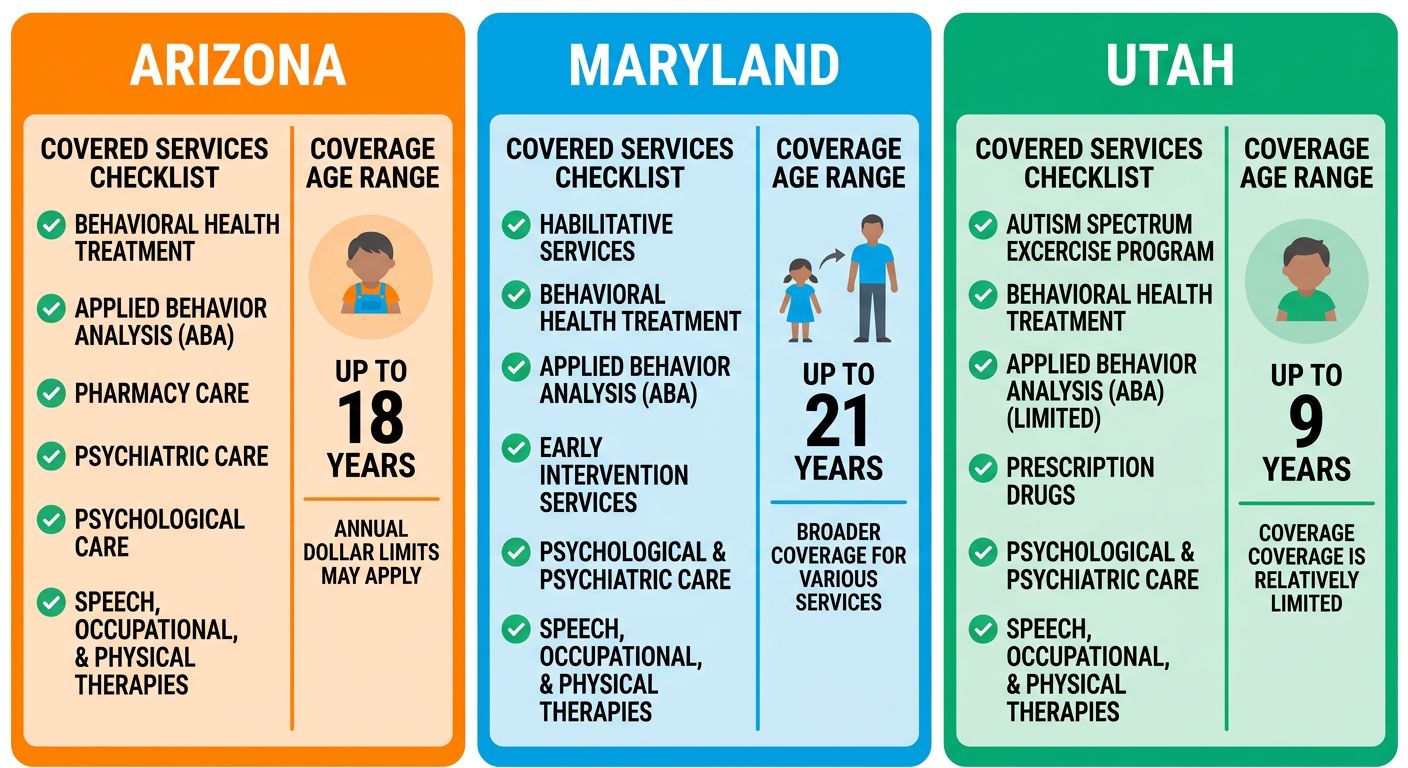
State autism insurance mandates at a glance for Arizona, Maryland, and Utah
We believe in the power of small steps. Verifying your benefits is the first small step toward unlocking the life-changing support your child deserves. Remember, insurance coverage is subject to verification and is not guaranteed. We’re here to help you understand your benefits so you can focus on what matters most: your family.
Consult a licensed healthcare professional for diagnosis or medical advice.
How State Insurance Mandates Interact with Federal Laws: ERISA and More
Many states have enacted an autism insurance mandate to help families access evidence-based therapy. But if you have a health plan through a large employer, you might be surprised to learn that federal law can override those state protections. That’s where ERISA comes in, and understanding the difference between plan types is the key to unlocking your coverage.
ERISA Plans and State Mandate Exemptions
ERISA, or the Employee Retirement Income Security Act of 1974, is a federal law that sets minimum standards for most voluntarily established health plans. When a company decides to pay employees’ medical claims directly rather than buying traditional insurance, the plan is called self-funded or self-insured. Because these plans are regulated by the U.S. Department of Labor under ERISA, they are generally exempt from state insurance mandates—including the autism insurance mandate your state may have passed. In other words, even if your state requires coverage for autism treatment, a self-funded plan isn’t legally obligated to follow that rule. That said, many self-funded plans still choose to include autism benefits because employers value robust coverage. The critical point is that the protection is voluntary, not a legal requirement. As Golden Touch ABA emphasizes, this distinction is the foundation of understanding your coverage options.
The following table breaks down the differences between state-regulated and self-funded plans so you can quickly identify where your policy stands.
| Plan Type | Regulated By | Must Follow State Autism Mandate? | Key Consideration |
|---|---|---|---|
| State-Regulated (Fully Insured) | State Insurance Department | Yes, must comply with state mandates if applicable | Coverage varies by state; check state laws |
| Self-Funded (ERISA) | Federal ERISA (Department of Labor) | Generally no, exempt from state mandates | Check plan document; may offer different autism coverage |
Reference: ERISA guidelines, Department of Labor
While a self-funded plan is not required to honor your state’s mandate, it doesn’t automatically mean there’s no autism coverage. Many employers still include behavioral health benefits, and the plan document is the final word. The Autistic Self Advocacy Network encourages families to be proactive about plan transparency, and we’re here to help you sort through the details.
Checking Your Plan Type
Figuring out whether your plan is state-regulated or self-funded takes just a few practical steps. Start by asking your company’s human resources department or benefits administrator directly, “Is our health plan self-funded or fully insured?” If you have your summary plan description or benefits booklet, look for keywords like self-funded, self-insured, or ERISA plan. A statement that the plan is “not subject to state regulation” is another clear sign of a self-funded arrangement. When you’re reviewing documents, also pay attention to ABA therapy insurance coverage language—even self-funded plans often have a behavioral health section that outlines autism services. If you’re unsure, we can help you verify your plan details during the insurance assistance process.
Implications for In-Home ABA Therapy
Whether your child receives in-home ABA therapy with a Board Certified Behavior Analyst (BCBA) and Registered Behavior Technicians (RBTs) often hinges on your plan type. If you have a fully insured plan, the state autism insurance mandate typically requires coverage for medically necessary ABA services, which can include home-based sessions. If your plan is self-funded, the coverage picture depends entirely on the employer’s chosen benefits. You may still have access to ABA therapy, but the specific criteria—such as demonstrating ABA therapy medical necessity through a comprehensive assessment—are defined by the plan, not by state law. For example, if your plan is fully insured and you are considering an out-of-network provider, check whether out of network ABA therapy in Utah is covered. Knowing your plan type is the first step to securing coverage for in-home ABA therapy. Our insurance assistance team at Golden Touch ABA Therapy can help you verify your benefits and understand what’s available under your unique plan. Please remember, insurance coverage is subject to verification and is not guaranteed.
Practical Steps to Determine Your ABA Therapy Insurance Coverage
At Golden Touch ABA Therapy, we understand that navigating your child’s insurance benefits can feel overwhelming, but taking a methodical approach makes the process much more manageable. By following a few clear steps, you can gain a clearer picture of what your plan covers and how to access the high-quality ABA therapy our team provides in a warm and welcoming environment.
Review Your Insurance Policy
The first practical action is to confirm whether your plan includes an autism insurance mandate, because this state-level requirement often sets the baseline for aba therapy insurance coverage. Start by locating your plan’s official Summary of Benefits and Coverage (SBC) — you can usually download it from your insurer’s online portal or request a printed copy.
Follow these steps to review your policy:
- Open the SBC and search for terms such as “applied behavior analysis,” “autism treatment,” or “behavioral health therapy.” Many plans list these services under a dedicated behavioral health section.
- Note any benefit limits, visit caps, or annual maximums that may apply. Some policies set a dollar cap or a maximum number of sessions for aba therapy insurance coverage.
- Check for in-network versus out-of-network provider rules; seeing an in-network provider usually lowers your costs.
- If the language is unclear, call the member services number on your insurance card and ask directly whether ABA therapy is a covered benefit under your specific plan.
Obtain Prior Authorization and Medical Necessity Documentation
Most insurance plans require prior authorization before beginning ABA services, and they nearly always ask for a formal medical necessity review. A strong medical necessity document — typically prepared by a licensed clinician — describes your child’s diagnosis, current functional impairments, and how the proposed treatment will address those needs. As Golden Touch ABA’s own FAQs explain, this letter often includes diagnostic evaluation results, standardized assessment scores, and individualized treatment goals that align with evidence-based practices (Golden Touch ABA).
To secure authorization, follow these steps:
- Contact your insurance company and ask for their prior authorization form or online portal instructions.
- Work with your child’s BCBA to compile clinical documentation, including the diagnostic report, a treatment plan with measurable objectives, and the aba therapy medical necessity statement.
- Submit the complete packet according to your insurer’s guidelines — many plans require a response within 14 calendar days.
- Follow up regularly and be prepared to provide additional information if the reviewer requests clarification.
The table below highlights key differences between Medicaid and private insurance when it comes to aba therapy insurance coverage:
| Coverage Type | State Mandate Applicable? | Medical Necessity Requirement | Out-of-Pocket Costs |
|---|---|---|---|
| Medicaid | Yes, states may have separate Medicaid mandates | Must meet EPSDT criteria; documentation required | Minimal or no cost-sharing |
| Private Insurance (State-Regulated) | Yes, subject to state laws | Must follow plan-defined medical necessity criteria | Deductibles, copays, coinsurance |
Regardless of the funding source, coverage is never guaranteed, and every plan has its own clinical review process. We strongly recommend verifying your benefits before starting any service, because even under a state autism insurance mandate, individual policy language can vary. If you run into roadblocks, do not be discouraged — persistence often pays off, and many families succeed after a second or third appeal.
Work with Your ABA Provider’s Insurance Assistance Team
You are not alone in this journey. Our dedicated insurance assistance team helps families like yours navigate the complexities of aba therapy insurance coverage every day. We can verify your benefits, submit prior authorization requests, and handle appeals on your behalf — all while you focus on what matters most. As part of our family-centered care approach, we also point families toward helpful ABA educational resources that explain the broader landscape of autism treatment options. If you feel stuck, simply reach out to us; together, we will take the next step forward — one small, meaningful stride at a time.
Understanding Medical Necessity and Documentation for ABA Therapy
When you begin exploring ABA therapy for your child, the term medical necessity quickly becomes a cornerstone of the conversation. Simply put, it is the standard insurance companies use to decide if a treatment is essential for your child’s health and ability to function. Understanding this concept is a critical first step in navigating the path to securing ABA therapy insurance coverage. Many states, including Maryland, have an autism insurance mandate that requires certain plans to cover autism treatments, but establishing the medical necessity for ABA treatment is always the key that unlocks those benefits.
At Golden Touch ABA Therapy, we believe demystifying this process is part of our commitment to family-centered care. To establish medical necessity, insurers typically look for three common elements. The table above outlines these criteria and the corresponding documentation that helps build a strong case for services.
A diagnosis of Autism Spectrum Disorder is the foundational piece, confirmed by a comprehensive diagnostic evaluation report. Next, insurers need to see evidence of significant functional impairment. This doesn’t just mean a diagnosis on paper; it means showing how challenges in communication, social skills, or daily living tasks, like getting dressed or eating, impact your child’s everyday life and that of your family. This is where detailed functional assessment results become invaluable.
Finally, there must be a demonstrated likelihood of benefit from ABA. At Golden Touch ABA Therapy, our BCBAs create a detailed, individualized treatment plan with measurable goals, showing precisely how our in-home ABA therapy will target those specific areas of impairment using evidence-based practices. This plan projects progress, giving the insurer a clear picture of why the treatment is necessary and what positive changes are expected. We see the power of small steps toward meaningful milestones as the heart of our work.
We assist families in gathering and presenting this documentation, answering questions covered in our internal resources on what medical necessity means and the exact criteria insurers review. For families seeking broader support, there are fantastic autism resources in Maryland that can provide additional guidance. Rest assured, navigating the details of medical necessity is a process we work through together, paving the way for the pre-authorization steps we’ll explore next.
Disclaimer: Insurance coverage is subject to verification and is not guaranteed. All treatment results may vary. This information is for educational purposes and does not replace consultation with a licensed healthcare professional.
Common Questions About Autism Insurance Mandates Answered
Navigating the world of ABA therapy often begins with understanding the autism insurance mandate in your state. These are laws that require many private health insurance plans to cover medically necessary treatments like ABA therapy. We understand this can feel confusing, so we’ve answered some of the most frequent questions we receive to help your family move forward.
- What is an autism insurance mandate? It’s a state law requiring certain insurers to provide ABA therapy insurance coverage for diagnosed individuals.
- How do I verify my coverage? We always recommend you contact your insurer directly, as mandates vary widely by state in terms of age limits and spending caps, but our team at Golden Touch ABA is here to walk you through the verification steps.
- What is medical necessity? For ABA therapy, medical necessity means a licensed physician has formally diagnosed your child with autism and provided a prescription stating that ABA therapy medical necessity is required for their development.
It is crucial to remember that a state mandate does not guarantee your specific plan will cover services. Insurance coverage is subject to verification and is not guaranteed. Once you have a formal diagnosis, we can help you connect with a Board Certified Behavior Analyst to document the necessity for treatment and begin the approval process.
If you have more questions about state-specific laws, we encourage you to consult the resources provided by a leading autism advocacy organization like Autism Speaks. Then, let us handle the paperwork so you can focus on what matters most—celebrating the power of small steps with your child. Ready to see how we can help with your benefits? Use our interactive roadmap to get started today.
Securing the ABA Coverage Your Child Deserves
An autism insurance mandate is a state law that requires insurers to cover ABA therapy for children with autism. To unlock coverage, your child’s treatment must be deemed an aba therapy medical necessity by a qualified provider. Our team steps in to verify your aba therapy insurance coverage, walk you through pre-authorization, and handle claims. Remember that the autism insurance mandate and specific benefits vary by plan and state, so always check your policy. Contact your insurer or use our eligibility support to get started. Insurance coverage is subject to verification.
Resources
- Get In-Home ABA Therapy for Autism in Utah
- Learn About Out-of-Network ABA Reimbursement in Utah
- Explore Out-of-Network ABA Coverage Under Utah SB195
- Navigate Cigna ABA Therapy Intake Process in Utah
- Discover Telehealth ABA Therapy CPT Codes and Modifiers
- Understand CPT Code 97151 for ABA Behavior Assessment
- Learn ABA Therapy Billing with the 8-Minute Rule
- Explore ABA Degree Programs and Career Pathways
- Find Autism Resources and Support in Maryland
- Get Support and Resources from Autism Speaks
- Explore Bierman’s Play-Based ABA and Therapy Programs
- Learn About Autistic Self-Advocacy and Disability Justice
Table of Contents
- Decoding ABA Therapy CPT Codes: A Guide for Families
- Understanding ABA Therapy CPT Codes
- Billing Code Differences and Telehealth Coverage
- Practical Steps for Accurate ABA Coding and Insurance Claims
- State Autism Insurance Mandates and 2026 Updates
- Frequently Asked Questions About ABA Therapy Billing
- Navigating ABA Billing with Confidence
Decoding ABA Therapy CPT Codes: A Guide for Families
Navigating the world of ABA therapy often begins with understanding how insurance works, and at the heart of it are ABA therapy CPT codes. These are the standardized billing codes insurance companies use to identify each specific service your child receives during their in-home ABA therapy.
Understanding medical necessity for ABA therapy is key to seeing why certain codes are approved. Our guide explains that medical necessity is the standard insurers use to determine if treatment is reasonable and required. This documentation is what allows us to bill a specific CPT code for the services delivered by our team.
Each CPT code represents a unique service, and we’re here to help you review your statements with confidence. Here are the most common codes you will see:
- 97151: A behavioral assessment conducted by a BCBA to create your child’s initial or ongoing treatment plan.
- 97153: Direct one-on-one therapy provided by a Registered Behavior Technician (RBT) to build new skills.
- 97155: Protocol modification, where a BCBA supervises the treatment plan and adjusts goals based on your child’s progress.
- 97156: Caregiver training delivered by a BCBA or RBT to help you integrate evidence-based practices at home.
We advise you to cross-check these codes on your Explanation of Benefits (EOB) with the sessions your child actually attended to catch any potential mistakes. As part of our family-centered care, we are always here to answer your questions about ABA therapy billing codes, even as coverage details can vary by insurance plan. Please remember that insurance coverage is always subject to verification and is not guaranteed.
Understanding ABA Therapy CPT Codes
Current Procedural Terminology (CPT) codes serve as the standardized language for billing medical and behavioral health services, including ABA therapy CPT codes used in autism treatment. When we deliver in-home Applied Behavior Analysis therapy, our team uses specific Category I CPT codes from the American Medical Association to document each session type accurately. These codes help ensure that your child’s treatment is properly recorded, supporting transparent communication with insurers and allowing us to focus on what matters most: your child’s progress in a warm and welcoming environment.
The most common CPT codes for ABA therapy break down into three distinct categories based on who provides the service and the nature of the session. Each code is billed in 15-minute units, so the total units on a claim reflect the exact duration of care delivered. Understanding these codes gives you insight into how treatment sessions are structured and why different team members play different roles in your child’s plan.
The following table compares the most frequently used Category I CPT codes for ABA therapy, including their descriptions, typical applications, and billing unit values.
| Code | Description | Typical Use | Billing Unit |
|---|---|---|---|
| 97153 | Adaptive behavior treatment by protocol | Direct one-on-one therapy by RBT under BCBA supervision | 15 minutes |
| 97155 | Adaptive behavior treatment with protocol modification | BCBA modifying treatment plan during session with client | 15 minutes |
| 97156 | Family adaptive behavior treatment guidance | Parent/caregiver training and guidance sessions | 15 minutes |
97153 represents the direct, one-on-one therapy that most families picture when they think of ABA services. A Registered Behavior Technician (RBT) implements the treatment protocol designed by a Board Certified Behavior Analyst (BCBA), working with your child on specific skill-building or behavior-reduction goals. Because RBTs deliver the bulk of hands-on therapy hours, 97153 is often the most frequently billed code in a comprehensive treatment plan. Our BCBAs maintain close supervision over every session, ensuring that evidence-based practices guide each interaction.
When the BCBA needs to modify the treatment plan during a session, we use 97155. This code applies when the supervising analyst is present and actively adjusting the protocol based on real-time observations. For example, if a particular reinforcement strategy isn’t producing the expected engagement, the BCBA can revise the approach immediately and document that clinical decision. This dynamic oversight ensures that your child’s program evolves as their needs change.
Family-centered care is at the heart of 97156, the code for family adaptive behavior treatment guidance. These sessions focus on parent and caregiver training, equipping you with the strategies and confidence to reinforce therapeutic techniques outside of formal therapy hours. Whether we are working on communication prompts, behavior management, or daily living skills, 97156 sessions strengthen the consistency between our team’s work and your family’s routines. We believe in the power of small steps, and caregiver guidance sessions often become the foundation for lasting progress at home.
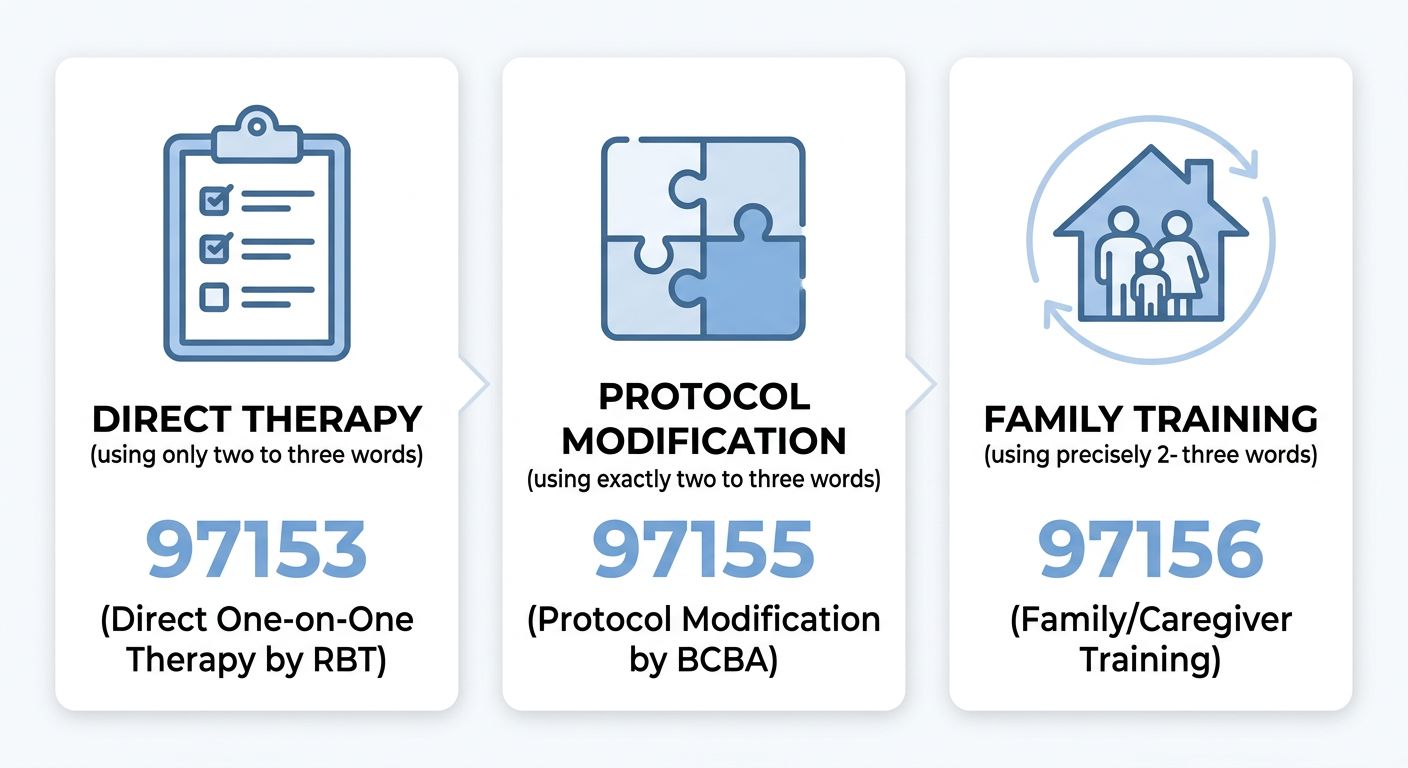
Common ABA therapy CPT codes visualized for easy reference.
Proper code selection depends on who is providing the service and what the session is designed to accomplish. Only RBTs working under BCBA supervision should deliver services billed under 97153, while 97155 and 97156 require the direct involvement of the supervising analyst. Misapplying codes can trigger claim denials or audits, which is why our team carefully documents every session and matches the code to the clinical activity performed.
Beyond accurate billing, these codes connect directly to the concept of medical necessity for ABA therapy. Insurers typically require that the services billed under 97153, 97155, and 97156 be supported by documentation showing that treatment is medically necessary. Our internal resources explain how a formal autism diagnosis, documented functional impairments, and a reasonable expectation of improvement all contribute to establishing that necessity. By aligning CPT codes with thorough clinical records, we help families navigate the authorization process while keeping the focus on high-quality, individualized care.
Understanding ABA therapy CPT codes is a valuable step toward understanding the overall treatment process. In the next section, we’ll explore how these codes fit into insurance coverage and benefits verification — because knowing what your plan covers starts with knowing how your child’s services are coded and submitted.
Billing Code Differences and Telehealth Coverage
Moving from general billing challenges, we focus on specific ABA therapy CPT codes that shape accurate claims. At Golden Touch ABA Therapy, family-centered care guides our documentation, ensuring each session is coded correctly for reimbursement.
97153 vs. 97155: Direct Therapy and Protocol Modification
97153 applies to direct therapy by an RBT, such as discrete trial training or incidental teaching, delivered one-on-one. It captures face-to-face time in 15-minute units. For example, when teaching a child to request items, the technician follows the treatment plan and tracks minutes. Meanwhile, 97155 is used when the BCBA oversees and modifies the protocol during a session—adjusting reinforcement or prompting strategies based on real-time observation. This code accounts for clinical supervision and adaptation, not direct implementation. Distinguishing between implementation and protocol modification prevents billing errors and supports compliance. Our team helps families navigate these ABA therapy CPT codes with clarity.
Initial Assessment Codes and Telehealth Modifiers
Before therapy begins, 97151 covers the initial assessment, including the treatment plan and behavior evaluation. This code establishes the child’s baseline and must be supported by robust documentation. For telehealth, we append modifier 95 for synchronous video sessions or GT for interactive audio/video, as required by payers. Accurate modifier use confirms that services meet the medical necessity for ABA therapy criteria. However, aba therapy insurance coverage for virtual visits can vary, and state autism insurance mandates may influence payer policies. We handle the verification process so families can experience the power of small steps in a warm and welcoming environment.
To clarify these distinctions, compare telehealth and in-person billing:
| Aspect | In-Person | Telehealth |
|---|---|---|
| CPT Codes Used | Standard codes (97153, 97155, etc.) | Same codes plus appropriate modifier |
| Required Modifier | None | 95 (synchronous) or GT (interactive audio/video) |
| Billing Unit | 15-minute increments | Same 15-minute increments |
| Payer Coverage | Standard for most plans | Varies by plan; may require prior authorization |
The table highlights that core coding remains consistent, while modifiers and prior authorizations add complexity. We verify benefits for each family, advocating for coverage where possible. With these foundations in place, precise unit calculation ensures billing integrity.
Calculating Billing Units Accurately
Converting therapy minutes into billable units follows strict rules:
- Track total minutes per code, such as 97153, for the session.
- Use the mid-session rule: at least 8 minutes of a 15-minute block counts as one unit. For 23 minutes, bill 1 unit; for 24 minutes, bill 2 units.
- Never combine minutes from different codes—calculate units separately.
- Align units with the prescribed treatment plan to support medical necessity.
Proper unit calculation prevents audits and claim denials. Remember, insurance coverage is subject to verification and is not guaranteed. Staying current on ABA therapy CPT codes safeguards your practice. In the next section, we’ll review practical claim submission steps and common errors to avoid.
Practical Steps for Accurate ABA Coding and Insurance Claims
To ensure accurate reimbursement and avoid claim denials, we recommend following these practical steps. Understanding ABA therapy CPT codes is essential for any provider or caregiver navigating the insurance landscape. Here at Golden Touch ABA Therapy, we believe in family-centered care and the power of small steps to make big progress.
Verifying Insurance Coverage for ABA Therapy
We guide families through the verification process to avoid surprise bills. Start by asking your insurance provider: Is ABA therapy a covered benefit? Does it require prior authorization and what documentation is needed? Are there visit caps or age limits? Always request a written benefit summary listing exclusions and copays. Our team helps you gather the diagnostic report and Letter of Medical Necessity required by most insurers.
Understanding your plan type is just as important, because coverage rules differ significantly. Some state autism insurance mandates require fully-insured health plans to cover ABA therapy, but self-funded employer plans are regulated by federal ERISA law instead. It’s important to understand that some employer health plan exemptions may limit coverage even if your state has a mandate. The table below contrasts the two most common plan structures to help you anticipate your coverage and appeal rights.
| Feature | Fully-Insured Plan | Self-Funded Plan |
|---|---|---|
| Regulated by State Mandates | Yes — must comply with state autism insurance laws | No — exempt from state mandates under ERISA |
| Coverage for ABA Therapy | Often covered if state mandate exists | Varies by employer; not guaranteed |
| Appeal Rights | Available through state insurance department | Available through ERISA/federal claims process |
| Premium Structure | Fixed premium paid to insurer | Employer pays actual claims + administrative fees |
If your plan is fully-insured in a state with an autism mandate, you’re more likely to have robust coverage. For self-funded plans, verify benefits directly with the plan administrator and be prepared for a federal appeals process if needed. Always consult with your insurance provider before services begin.
Documenting Therapy Sessions for Reimbursement
Once coverage is confirmed, thorough documentation is the foundation for successful reimbursement. For common ABA therapy CPT codes such as 97155 (treatment modification), 97153 (technician-delivered therapy), and 97156 (family guidance), session notes must include key elements. We recommend that every note contain the date and time of service, the setting (home, community), a clear description of the activities performed, the client’s response to interventions, and the data collected — such as frequency, duration, or latency of target behaviors. The note should tie directly to the treatment plan goals and demonstrate how the session promoted meaningful progress.
Compliance with payer documentation standards is critical. Many insurers require notes to be completed within 24 hours, signed by the rendering provider, and to contain objective, measurable information. At Golden Touch ABA Therapy, our BCBAs and RBTs follow a standardized checklist to ensure every note meets these expectations. Please remember that outcomes vary, and this information does not replace professional medical advice. Insurance coverage is subject to verification and is not guaranteed. Please review our Privacy Policy and Terms & Conditions for more information about how we handle your data.
Common Coding Errors to Avoid
Even with verified coverage and detailed notes, coding mistakes can lead to claim denials. A frequent error is unbundling codes, such as billing both 97155 and 97153 on the same day without proper documentation of separate services. This often results in rejections. Another common mistake is inappropriate use of Modifier 59. This modifier should only be applied when two distinct procedural services are performed during the same session, and the note must clearly justify the separation. Using it without support invites audits. Unit rounding errors are also common. ABA is billed in 15-minute units. Under the 8-minute rule, a 53-minute session should be billed as three units, not four. Double-check your calculations and stay informed about payer-specific rounding rules.
We recommend auditing claims before submission and maintaining clear communication with your billing team. Careful verification, thorough documentation, and accurate coding will reduce denials and let you focus on delivering family-centered care. In the next section, we’ll discuss state mandates in more detail.
State Autism Insurance Mandates and 2026 Updates
While the federal mental health parity law sets important baselines, state autism insurance mandates are what truly require many health plans to include ABA therapy insurance coverage. These laws mandate that state-regulated plans cover evidence-based autism treatments like Applied Behavior Analysis, preventing insurers from excluding them as experimental or educational.
A critical detail families must understand is that not all health plans must follow these rules. According to the U.S. National Library of Medicine, self-funded employer plans are exempt from state mandates under ERISA, while fully-insured plans—where the employer buys insurance from a carrier—are generally bound by them.
To illustrate how protections differ, the table below compares annual benefit limits and age caps across four representative states.
| State | Annual Benefit Limit | Age Limit | Important Notes |
|---|---|---|---|
| California | No annual dollar cap | Up to age 18 (some plans up to 21) | Coverage required for all plans regulated by DMHC |
| Texas | $30,000 (ages 0-3), $60,000 (ages 4-8), $36,000 (ages 9-15) | Up to age 15 (with exceptions) | Limits vary by age group; some plans have higher caps |
| New York | No annual dollar cap | No age limit specified | Coverage required for all state-regulated plans |
| Florida | $36,000 per year | Up to age 18 | Self-funded plans exempt; no annual cap for fully-insured |
As the table shows, state-level coverage requirements range from generous, no-cap policies in California and New York to the tiered caps in Texas and the flat limit in Florida. These variances mean that your child’s age and your employer’s plan type can dramatically affect what ABA services are accessible.
State autism insurance mandates can evolve through new legislation or administrative updates, so it’s wise to verify current rules with your state insurance department. We recommend using the interactive tools and benefits eligibility support we offer to help you navigate these complexities. Insurance coverage is subject to verification and is not guaranteed. With a clearer picture of what state laws provide, the next step is understanding how those benefits translate into the CPT codes and billing processes that providers use every day.
Frequently Asked Questions About ABA Therapy Billing
What is medical necessity for ABA therapy?
Medical necessity is the clinical justification insurers require to cover ABA therapy. Our team compiles evidence like a formal autism diagnosis, a functional behavior assessment, and an individualized treatment plan to show why services are essential for skill-building and behavior reduction. Without this documentation, authorization may be denied.
How do I verify my ABA therapy insurance coverage?
We verify benefits before treatment begins by contacting your insurer directly. Our team reviews the details of your plan, confirms whether we are in-network or out-of-network, and explains any copays, deductibles, or visit limits you might have. This step ensures transparency and helps families plan for their in-home ABA therapy journey.
What are the most common CPT codes for ABA therapy?
Common ABA therapy CPT codes include 97151 for assessments and 97153–97158 for treatment services. Codes like 0362T and 0373T may also appear for specific interventions. Accurate coding is part of our evidence-based practices and helps align clinical documentation with insurer requirements.
Does my state have autism insurance mandates?
Many states have autism insurance mandates requiring certain plans to cover ABA therapy, but rules vary widely. Our team stays current on state autism insurance mandates in Utah, Arizona, and Maryland to help families understand what their policy may include. We recommend consulting a licensed healthcare professional for diagnosis or medical advice.
How does billing work for in-home ABA therapy?
Billing is handled by our administrative team after each session using the appropriate ABA therapy CPT codes. We submit claims directly to your insurance provider and track authorizations to maintain continuity of care. Families receive updates so they can focus on family-centered care rather than paperwork.
Why isn’t insurance coverage for ABA therapy guaranteed?
Even with a strong medical necessity case, coverage depends on your specific plan’s benefits and the insurer’s policies. Initial authorization does not guarantee ongoing payment, and reauthorization may require updated documentation. Insurance coverage is subject to verification and is not guaranteed; results may vary, and no guaranteed outcomes are implied.
What role does the BCBA play in billing?
The BCBA designs the treatment plan and writes the letter of medical necessity that supports billing. Supervisory hours, protocol modifications, and caregiver training are coded under the BCBA’s credentials. The power of small steps is reflected in the BCBA’s ongoing data review, which helps justify continued authorization.
How does an RBT contribute to billing?
The RBT delivers one-on-one therapy under BCBA supervision, and their direct service hours are billed using treatment codes. Session notes and data collected by the RBT provide objective evidence of progress, reinforcing the medical necessity documentation our team submits.
Our team is here to support your family through every step of the billing process. Please contact us with questions about your specific coverage. Privacy Policy applies to collection and use of your personal information, and Terms & Conditions govern website use and limit liability.
Navigating ABA Billing with Confidence
Understanding insurance billing is a vital part of your family’s journey with in-home ABA therapy. This process involves submitting claims for services identified by ABA therapy CPT codes — standardized medical codes that ensure assessment, treatment, and supervision are properly documented.
Navigating aba therapy insurance coverage can feel overwhelming, from pre-authorizations to detailed documentation, but our insurance assistance team is here to help. We offer free benefits verification and guide you through private insurance or options supported by state autism insurance mandates. Insurance coverage is subject to verification and is not guaranteed.
Resources
- Who Can Write a Letter of Medical Necessity for ABA
- Explore Surgeon General Guidelines for ABA Medical Necessity
- Understand How Insurance Determines Medical Necessity for ABA
- Discover Insurer Criteria for ABA Medical Necessity
- Discover the Four Required Documents for ABA Medical Necessity
- Get the Complete Insurance Guide for ABA Medical Necessity
- Explore ABA Therapy Coverage Limits in Utah by Insurance
- Explore NCBI’s Biomedical and Genomic Databases