
ABA Therapy Goal Setting Techniques: Complete Guide for BCBAs
Table of Contents
- Purposeful Progress: Setting the Stage for ABA Therapy Goals
- The Foundation of Effective ABA Goal Setting
- The Advantages of Structured Goal Setting in ABA
- Crafting and Implementing Individualized ABA Goals
- Collaborating with Families and Tracking Milestones
- Embracing a Collaborative Path Forward
Purposeful Progress: Setting the Stage for ABA Therapy Goals
In ABA therapy, purposeful progress is the intentional, measurable growth achieved through thoughtful goal setting. We believe that effective treatment starts with a clear roadmap built around proven aba therapy goal setting techniques, ensuring every child’s journey is both structured and meaningful.
Goal setting serves as the foundation for effective therapy, directing assessment and guiding intervention. Our approach to ABA treatment planning begins with collaborative, purposeful goal setting to define each child’s unique starting point and potential. By partnering directly with families and our Board Certified Behavior Analysts, we identify priorities that target meaningful behaviors, fostering skills that enhance daily life and independence. We focus on smart goals in aba therapy—specific, measurable, achievable, relevant, and time-bound objectives—that bring clarity to the process. The power of small steps drives this method, where clear aba therapy operational definitions ensure measurable progress, turning broad outcomes into achievable daily wins. This commitment to evidence-based practices and family-centered care keeps therapy relevant and responsive to each child’s evolving needs.
The Foundation of Effective ABA Goal Setting
Now that we understand the importance of goal setting in ABA, let’s explore the foundation behind effective goals. Effective aba therapy goal setting techniques start with a commitment to precision and collaboration. At Golden Touch ABA Therapy, we believe that every child’s journey is unique, and our in-home approach allows us to create goals that fit naturally into your family’s daily life. By grounding our work in evidence-based practices and family-centered care, we transform broad hopes into clear, actionable steps.
Why Measurable Goals Matter in ABA
Why is it so important for therapy goals to be precise? The answer lies in the science of behavior. Measurable goals allow us to see the impact of our interventions clearly. According to the National Center for Biotechnology Information, data-driven goal setting consistently leads to improved outcomes in behavioral interventions. This means that when we define exactly what we are working on, we can reinforce progress effectively and adjust our strategies if a child is not responding. It’s the power of small steps measured and celebrated along the way.
Applying the SMART Framework to Autism Treatment
We work together as a team to ensure therapy goals are clear and achievable, which is where setting smart goals in aba therapy becomes essential. The SMART framework gives us a powerful blueprint. Let’s look at how we apply it with concrete examples from our sessions:
- Specific: We target a well-defined skill. For example, instead of a vague goal like “improve communication,” a specific goal is: “Liam will request a preferred snack by combining a one-word label with the ‘please’ sign.”
- Measurable: We can count the behavior to track progress. For social initiation, a measurable goal is: “Maya will initiate a greeting with a peer by saying ‘hi’ or waving during 4 out of 5 scheduled play opportunities at the park.”
- Achievable: The goal is challenging yet realistic. For daily living skills, an achievable goal is a small step: “Alex will independently put on one sock during the morning routine for three consecutive days.”
- Relevant: The goal targets a skill that will meaningfully improve the child’s and family’s life. Focusing on a favorite activity ensures that a communication goal truly motivates the child.
- Time-bound: Every goal has a deadline for re-evaluation. We might set a target that “Elena will use her communication card to request a break when feeling overwhelmed during 80% of opportunities by her next monthly review.”
Creating Operational Definitions for Clear Tracking
How do we make sure that something like “engagement” or “compliance” is seen the same way by every therapist and family member? This is where aba therapy operational definitions come into play. An operational definition translates a vague behavior label into something observable, objective, and countable, eliminating any guesswork.
A weak definition might state: “reduce self-stimulatory behavior.” This phrase is unclear; what does it consist of, and where does it occur? A strong, parent-friendly operational definition would be: “vocal stereotypy, defined as any instance of repetitive, non-contextual humming or squealing sounds lasting longer than three seconds, excluding singing along to music.” The difference is critical. The strong definition allows anyone on the team to know exactly when the behavior occurs and to track its frequency accurately. We can then create a plan to teach a replacement behavior that serves the same sensory need, all while collecting data that reliably shows progress. This precise tracking is a cornerstone of our evidence-based practices.
The Advantages of Structured Goal Setting in ABA
At Golden Touch ABA Therapy, we believe in the power of small steps. By breaking down larger objectives into small, measurable steps, structured goal setting unlocks a child’s potential across multiple areas, and this is why it is a cornerstone of effective ABA treatment planning. Our approach to aba therapy goal setting techniques ensures that every milestone is realistic, data-driven, and tailored to each child’s unique needs, creating a clear path toward meaningful, long-term progress.
Fostering Communication and Social Skills
One of the primary benefits of structured goal setting in ABA is the development of vital communication and social abilities. We design goals that target foundational skills, starting with simple requests for favorite items or activities, labeling emotions like happiness or frustration, and initiating play with peers. These aren’t just isolated skills; each small step builds toward deeper social connection and a greater ability for your child to express their world, turning daily interactions from sources of frustration into moments of joy. Our aba therapy goal setting techniques focus on reinforcing these attempts until they become natural parts of your child’s repertoire.
Building Functional Living Skills for Independence
Structured goal setting is instrumental in building independence through functional living skills. By defining smart goals in aba therapy, we can teach essential self-care routines in a way that promotes autonomy and builds confidence. Using task analysis, we break activities like brushing teeth, dressing, and feeding into a series of small, teachable steps, and then we use chaining to link these steps together. When families practice these routines within a warm and welcoming environment at home, the skills are more likely to generalize, helping your child navigate their day with increased self-reliance and a sense of accomplishment.
Reducing Problem Behaviors Through Targeted Goals
Addressing challenging behaviors begins with understanding their root cause, which is why our approach is grounded in a systematic assessment process. Our BCBAs conduct a thorough functional behavior assessment (FBA) to identify the specific triggers and functions of a behavior, as noted in our internal FAQ on the benefits of ABA therapy. This allows us to establish goals using aba therapy operational definitions, ensuring the target behavior and its replacement are described in clear, observable terms. The core objective is not just to stop a troubling behavior, but to teach an appropriate, functionally equivalent alternative—such as teaching a child to use a card or a sign to request a break instead of having a tantrum. This philosophy is embedded in our commitment to family-centered care, where we train and empower parents to consistently reinforce these new, positive behaviors across all settings.
Crafting and Implementing Individualized ABA Goals
Now let’s walk through how we create and implement individualized goals for every child. Effective ABA therapy goal setting techniques start with a thorough understanding of your child’s unique strengths, needs, and your family’s priorities. At Golden Touch ABA Therapy, this collaborative process is the foundation of our family-centered care, ensuring every goal we set is both meaningful and achievable.
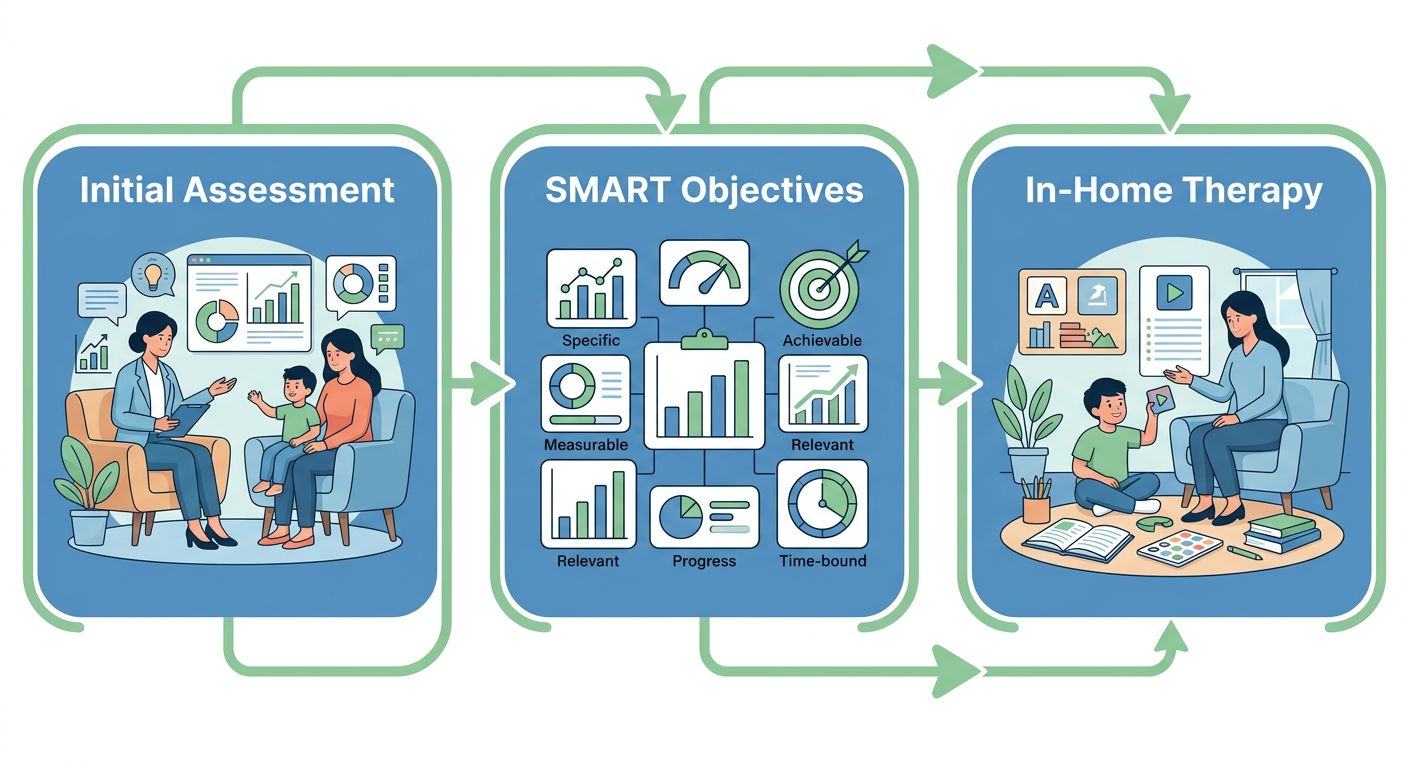
Step-by-step ABA goal-setting process for therapy
The Initial Assessment and Parent Collaboration
Our first step is a comprehensive initial assessment, which we view as a collaborative conversation. We begin with a detailed parent interview to learn about your child’s abilities, daily challenges, and what success looks like for your family. This discussion helps us identify your top priorities, whether it’s improving communication, building social skills, or increasing independence during daily routines.
Simultaneously, our Board Certified Behavior Analyst (BCBA) conducts a preference assessment, using evidence-based practices like paired-choice or free-operant methods, to discover what truly motivates your child. Identifying these powerful reinforcers is critical, as they will be the key to engaging and encouraging your child during therapy. To build a precise baseline, we also administer a skill-based evaluation, such as the VB-MAPP or ABLLS-R, which allows us to map out your child’s current abilities across various developmental domains in a warm and welcoming environment.
Writing SMART Objectives and Selecting Targets
With the assessment complete, our BCBA transforms the findings into precise, actionable SMART objectives. This means every goal is Specific, Measurable, Achievable, Relevant, and Time-bound. A cornerstone of this process involves defining targets with aba therapy operational definitions. For example, instead of a general goal like “improve communication,” we would write an objective such such as, “When presented with a preferred snack, Liam will independently request the item using a three-word phrase (e.g., ‘I want cracker’) in 4 out of 5 opportunities across two consecutive sessions.” This level of clarity ensures every team member measures progress consistently.
Aligning with standards set by the Behavior Analyst Certification Board ensures goals are ethically grounded. We prioritize goals that are socially valid—meaningful for your family’s life—and developmentally ready. Using smart goals in aba therapy, we focus first on skills that enhance safety, communication, and independence, reflecting the power of small steps that lead to lasting, positive change.
Implementing Goals Through In-Home Therapy Sessions
The heart of our program is bringing these carefully crafted goals to life during in-home ABA therapy sessions. Our Registered Behavior Technicians (RBTs) use natural environment teaching to embed goal work right into your family’s everyday routines. A goal for requesting items can be practiced during mealtime, while a goal for following instructions might be woven into a favorite play activity or the process of getting dressed.
This approach capitalizes on the child’s natural motivation and makes learning functional and fun. During these sessions, RBTs diligently collect trial-by-trial data, noting everything from the level of prompting needed to the success of an independent response. Caregiver involvement is integral to our aba therapy goal setting techniques; our RBTs will model strategies for you, and together we will practice them, ensuring skills learned in therapy naturally generalize to all aspects of life at home.
Collaborating with Families and Tracking Milestones
Once the initial assessment and treatment plan are in place, ongoing collaboration with families and careful tracking of milestones ensure the child’s progress remains on track. At Golden Touch ABA Therapy, we believe that a child’s success grows from a partnership between our clinical team and the family, with every decision rooted in data and open communication. This continuous feedback loop directly informs every aspect of a child’s ABA treatment planning, allowing us to refine strategies as the child learns and grows. Our in-home model lets us observe real-world challenges and victories, making progress monitoring a natural, integrated part of each session.
Data-Driven Progress Monitoring and Adjustments
Our Board Certified Behavior Analysts (BCBAs) continuously collect trial-by-trial data during every in-home session, recording specific metrics like frequency, duration, and interval observations to graph progress each week. This detailed tracking creates a visual story of the child’s development, making it easy to spot patterns that guide our decision-making. We rely on well-researched aba therapy goal setting techniques, including the use of smart goals in aba therapy, to frame each objective as specific, measurable, achievable, relevant, and time-bound. According to internal best practices at Golden Touch ABA, if a child demonstrates 80% mastery across three consecutive sessions, we typically move that goal into maintenance and introduce a new challenge. Conversely, if progress plateaus for two weeks, our team analyzes the data to modify the prompting hierarchy or adjust task difficulty. These formal reviews, conducted every three to six months, ensure that the treatment plan evolves right alongside the child’s unique developmental journey.
Empowering Parents Through Training and Involvement
Caregiver involvement is a cornerstone of family-centered care, and we dedicate structured time to equip parents with the tools they need to reinforce learning between sessions. Our parent training programs break down key strategies such as positive reinforcement, prompting hierarchies, and simple data tracking sheets designed for easy home use. A critical part of this training involves teaching families the aba therapy operational definitions we use to describe target behaviors, which ensures everyone on the team observes and responds to actions in the same consistent way. We maintain open lines of communication through weekly check-ins and share comprehensive progress reports during monthly family meetings, celebrating even the smallest victories. By focusing on the power of small steps, our in-home ABA therapy empowers parents to become confident, active participants in their child’s growth, transforming everyday moments into powerful learning opportunities.
Ensuring Generalization and Maintenance of Skills
A skill is only truly mastered when a child can use it naturally across different people, places, and materials, which is why we build generalization strategies directly into every program. As recommended by the Association for Science in Autism Treatment for evidence-based generalization, we practice emerging skills with at least three different people, such as parents, siblings, and visiting relatives, and in two different rooms of the home to prevent rigid, context-dependent learning. Our therapists weave natural environment teaching into routines like mealtime and play, helping new skills feel less like work and more like life. To safeguard long-term success and ensure retention, we conduct maintenance probes at one month, three months, and six months after a goal is mastered, stepping back from continuous intervention to confirm the child can perform the skill independently. This collaborative, data-informed approach builds a strong foundation for long-term success and continuous improvement in every child’s development.
Embracing a Collaborative Path Forward
Bringing everything together, we know that family-centered care is at the heart of successful ABA therapy. Effective aba therapy goal setting techniques depend on the combined efforts of parents, BCBAs, and RBTs, because no one understands a child’s daily life better than the people who share it. At Golden Touch ABA, we value the insights families bring to each session, creating a warm and welcoming environment where every voice matters.
Our ABA treatment planning FAQ outlines how individualized treatment plans are developed collaboratively, integrating a child’s unique strengths and challenges. During initial assessments, families share daily observations and priorities. These conversations help us shape SMART goals that are specific, measurable, achievable, relevant, and time-bound, ensuring they are truly meaningful. In fact, smart goals in aba therapy are most effective when they reflect the real-world needs of the child and family. This collaborative goal planning transforms abstract hopes into concrete therapeutic milestones. Regular data review and family feedback keep goals flexible; as skills are mastered or challenges shift, we adjust the plan together. As the Association for Science in Autism Treatment notes, collaboration is a hallmark of effective ABA therapy.
Through ongoing teamwork, we ensure that each milestone is practical and functional for everyday life. We invite families to partner with us in this shared journey, celebrating the power of small steps and the lasting change they bring.
Resources
- Get Family-Driven ABA Treatment Planning with BCBAs
- Find Structured ABA Treatment Planning by BCBAs
- Learn the ABA Treatment Planning Cycle for Children
- Discover Collaborative ABA Treatment Plans with BCBAs
- Get Individualized ABA Treatment Planning at Home
- Explore In-Home ABA Therapy with SMART Goals
- Monitor ABA Treatment Progress with BCBA Reviews
- Access Free Biomedical Databases and Tools at NCBI
- Find BCBA Certification and Ethics Resources
- Discover Science-Based Autism Treatment Resources
