
ABA Social Skills: Complete Early Intervention Guide
Table of Contents
Mastering Social Skills with ABA Therapy
Building on ABA fundamentals, we at Golden Touch ABA focus on aba social skills to empower children with autism in everyday interactions like turn-taking and sharing. Applied behavior analysis ABA uses evidence-based practices, as outlined in an authoritative overview from the Association for Science in Autism Treatment, highlighting techniques like prompting, modeling, and reinforcement for social growth.
The power of small steps shines in our in-home ABA therapy, delivered by RBTs under BCBA supervision in a warm and welcoming environment. We teach aba social skills through role-playing conversations, peer-mediated interventions, and group play sessions. Through family-centered care, we train caregivers to reinforce these skills at home, promoting aba early intervention for lasting progress, as detailed in our clinic’s service descriptions.
Start with our interactive ABA roadmap tool to tailor social goals. Results may vary; consult a licensed professional.
Preparing Your Family for ABA Success
Building on the evidence for ABA, here’s how we help your family prepare. At Golden Touch ABA, we believe family-centered care is key to unlocking progress in applied behavior analysis therapy. Your commitment boosts aba social skills development through our in-home ABA therapy.
We outline these practical steps, drawn from guidance in our ABA FAQ:
- Participate in behavioral assessment and ABA treatment planning with our BCBA to set SMART goals for communication and daily skills.
- Learn basic ABA techniques via our caregiver training sessions, empowering you to reinforce lessons at home.
- Create a consistent daily routine with designated therapy spaces in a warm and welcoming environment.
- Track progress using our interactive ABA roadmap tool, supporting aba early intervention.
National Center for Biotechnology Information (NCBI) research shows ABA programs with family engagement yield positive effects on adaptive behaviors and communication, with effect sizes up to g = .41. The power of small steps builds aba social skills effectively using evidence-based practices.
Contact us in Salt Lake City for insurance assistance to start. Results may vary. Once prepared, our individualized ABA treatment planning takes over.
Assess Your Child’s Social Skills Baseline
Building on those signs, let’s establish a baseline for your child’s aba social skills. This snapshot captures current abilities like eye contact, greeting others, sharing toys, responding to name, and parallel play, per Golden Touch ABA’s practical FAQ guidance for parents.
We at Golden Touch ABA recommend observing your child over one week in natural settings like home play and family interactions. Use this simple checklist:
- Makes eye contact during interactions
- Greets others verbally or with waves
- Shares toys willingly
- Responds to name promptly
- Engages in parallel play
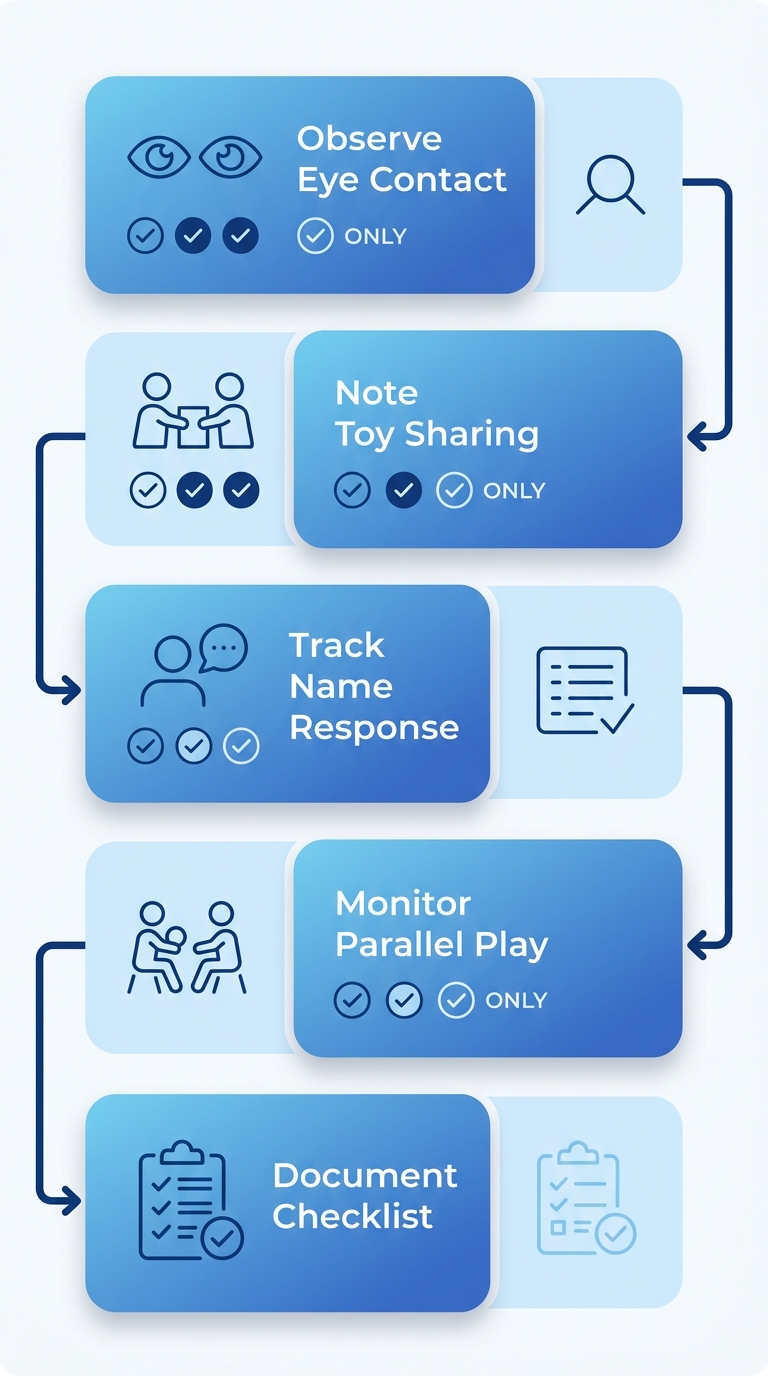
5-step ABA therapy process for child’s social skills baseline assessment
This baseline matters for tracking progress in applied behavior analysis, especially with aba early intervention for better outcomes in our family-centered care. Consistent data helps tailor in-home ABA therapy. Results may vary.
Document your notes and use our interactive ABA roadmap tool. With your baseline notes, explore our ABA treatment planning for tailored goals. Contact us for a professional BCBA evaluation.
Define Clear and Achievable Social Goals
We help families set clear social goals that build confidence one interaction at a time through applied behavior analysis. In aba early intervention, defining aba social skills targets matters because they break down complex behaviors into manageable steps, fostering real progress in a warm and welcoming environment.
Use the SMART framework for developing social skills through ABA: Specific (e.g., make eye contact during greetings), Measurable (track occurrences per session), Achievable (start with one peer), Relevant (ties to daily play), Time-bound (master in 4 weeks). During behavioral assessment as part of ABA treatment planning, families collaborate with our team for family-centered care. Examples from our experts’ practical FAQ guidance include taking turns in a 2-person game or responding to name 80% of the time.
The power of small steps and evidence-based practices shine in RBT-delivered therapy. Once defined, we move to measuring these goals in daily sessions. Results may vary; consult our professionals.
Teach Recognition of Social Cues
Building on foundational interactions, we focus on why recognizing social cues like smiles for happiness or frowns for sadness matters for children with autism. Mastering aba social skills builds confidence in everyday social exchanges through evidence-based practices.
In our in-home ABA therapy, we use video modeling: show short clips of peers displaying cues, then have kids imitate and identify them. Scripting and role-playing follow, with simple scripts for scenarios like a friend waving hi, practiced in a warm and welcoming environment. The teaching social skills TIP from the Association for Science in Autism Treatment (ASAT) offers practical, research-supported steps including modeling and feedback.
We create personalized social stories with pictures for daily aba early intervention reading, reinforce correct identifications with praise, tokens, or fun activities under BCBA supervision, and integrate into routines via family-centered care. The power of small steps tracks progress. Results may vary. These cues pave the way for advanced conversations ahead.
Practice Role-Playing for Real-Life Scenarios
Building on basic skills, we use role-playing to build aba social skills for real-life scenarios through evidence-based practices. This applied behavior analysis modeling technique, as outlined in authoritative guidelines from the Association for Science in Autism Treatment (ASAT), involves therapists or peers demonstrating interactions like greeting friends or turn-taking, then guiding children to imitate in safe sessions.
We target everyday situations such as handling playground sharing, ordering food at a restaurant, or asking for help in a store. These aba early intervention practices accelerate social development with positive reinforcement for generalization. Peer-reviewed government health research data from the National Center for Biotechnology Information (NCBI) via ABA evidence autism treatment supports gains in social skills from such modeling.
In our family-centered care with in-home ABA therapy, we train caregivers for home reinforcement. The power of small steps leads to measurable progress tracking. Results may vary (no guaranteed outcomes). This prepares children for success, leading into our progress tracking methods.
Build Peer Interactions Through Structured Groups
Beyond one-on-one practice, we build peer interactions through structured aba social skills groups as a key part of our ABA social skills training. These small, supportive settings help children with autism practice real-world social exchanges in a warm and welcoming environment.
We use evidence-based practices from applied behavior analysis, like role-playing, prompting, and reinforcement, to teach turn-taking, sharing, and conversation skills. According to a research synopsis by the Association for Science in Autism Treatment (ASAT), behaviorally-based groups with procedures such as modeling and shaping led to significant social improvements in young children.
Our in-home ABA therapy integrates these groups with family-centered care, adapting activities for peer practice at home through caregiver training. For aba early intervention, timely group exposure boosts social reciprocity. The power of small steps shines here.
These group gains extend home with caregiver support. Explore our interactive ABA roadmap tool or contact us for personalized planning and custom quotes. Results may vary.
Utilize Visual Aids and Social Stories
Building on positive reinforcement, we leverage visual aids and social stories next to boost aba social skills in our in-home ABA therapy. Tools like picture schedules and PECS make abstract concepts concrete in applied behavior analysis, helping children grasp routines and communication. They also support independence, predictable routines, and everyday communication across home and community settings for improved daily participation.
Social stories are customized narratives we create to teach behaviors like turn-taking or greetings, tailored to each child’s needs. For instance, our FAQ highlights using visual aids during transitions in aba early intervention to ease anxiety, as guided by Golden Touch ABA’s practical examples. We train families to reinforce these at home through family-centered care.
Our RBTs integrate these seamlessly in sessions for steady progress. Results may vary. These pair seamlessly with verbal prompting techniques.
Track Progress and Provide Positive Reinforcement
Once techniques are in place, we ensure success through vigilant tracking in our In-home ABA therapy. In applied behavior analysis, consistent progress tracking allows us to adjust individualized treatment plans, particularly for building aba social skills. This data-driven approach helps children make meaningful gains in communication and independence.
Golden Touch ABA, per our internal company FAQ guidance, uses daily data logs to record target behaviors, visual progress graphs shared weekly with families, and milestone celebrations to mark achievements. These methods provide clear insights into aba social skills development during sessions.
We incorporate positive reinforcement through immediate verbal praise, token economies with preferred rewards, and natural reinforcers tailored to each child’s interests in aba early intervention. This family-centered care creates a warm and welcoming environment, integrating family feedback for ongoing adjustments.
Our evidence-based practices support measurable outcomes, though results may vary. We share these insights with families for collaborative adjustments.
Addressing Challenges in Social Skills Training
While social skills training offers great benefits for children with autism, challenges like lack of skill generalization to real-world settings, low motivation during group interactions, and difficulty reading social cues often arise. At Golden Touch ABA Therapy, we tackle these hurdles in aba social skills development using evidence-based practices from applied behavior analysis. The power of small steps helps build confidence through targeted strategies.
One effective ABA technique is modeling, where therapists or peers demonstrate social behaviors for children to imitate. According to evidence-based ABA technique guidelines from the Association for Science in Autism Treatment (ASAT), this includes live modeling in real-time, video modeling for repeated viewing, and self-modeling to boost self-efficacy. These methods promote faster skill acquisition, especially for social play and communication, addressing generalization and cue-reading issues.
We at Golden Touch ABA apply these in our In-home ABA therapy, delivered by dedicated RBTs under BCBA supervision, as outlined in our internal practical guidance. This family-centered care integrates aba early intervention to enhance motivation and natural environment practice, with caregiver training for consistent support. Our approach emphasizes caregiver coaching and practice in natural contexts to promote daily-life generalization, and data-driven progress tracking helps tailor supports regularly over time. Results may vary.
Ready to overcome these challenges? Use our interactive ABA roadmap tool and contact us to tailor an ABA plan addressing your child’s needs in a warm and welcoming environment.
Sustaining Social Skill Development Long-Term
Building on early gains from aba social skills training, we at Golden Touch ABA help families maintain progress through consistent reinforcement. Regular in-home ABA therapy sessions prevent regression, as our RBT-delivered therapy supports ongoing practice in natural settings.
Family-centered care plays a key role, with caregiver training embedding social skills into daily activities like playdates or community outings. Drawing from evidence-based practices in applied behavior analysis, periodic BCBA reassessments adapt plans to evolving needs and ensure goals remain meaningful, measurable, and aligned with family priorities over time. Research from the Association for Science in Autism Treatment (ASAT) shows behaviorally-based social skills groups sustain improvements for 16-32 weeks.
Transitioning skills via aba early intervention foundations ensures long-term growth. Results may vary; insurance coverage requires verification. Reach out to us at Golden Touch ABA for your customized roadmap.
This article was researched and written with the assistance of AI tools.
Resources
- Get Personalized ABA Treatment Plans Led by BCBAs
- Discover Family Involvement in ABA Treatment Planning
- Create SMART Goals for ABA Therapy Improvement
- Monitor and Revise ABA Treatment Plans Effectively
- Develop ABA Plans Through Four-Stage Process
- Build Collaborative ABA Plans with FBA Data
- Implement Data-Driven Collaborative ABA Planning
- Master TIP for Teaching Social Skills Effectively
- Explore ABA Evidence Base for Autism Treatment
- Learn ABA Principles for Skill Acquisition
- Discover ABA Modeling Techniques for Skill Teaching
- Improve Social Skills via ABA Group Therapy
