
Positive Reinforcement Explained: Essential ABA Guide
Table of Contents
- Discovering Positive Reinforcement in ABA Therapy
- Core Principles of Positive Reinforcement
- Benefits of Positive Reinforcement for Autistic Children
- How Positive Reinforcement Works in ABA
- Best Practices for Positive Reinforcement at Home
- Empowering Families with Reinforcement Strategies
Discovering Positive Reinforcement in ABA Therapy
Building on ABA fundamentals, let’s explore positive reinforcement, a cornerstone technique in applied behavior analysis. At Golden Touch ABA Therapy, we define positive reinforcement as providing a rewarding stimulus immediately after a desired behavior to increase its future occurrence. For example, offering praise or tokens during sessions motivates children to repeat positive actions, aligning with our family-centered care.
Our approach to ABA social skills relies heavily on positive reinforcement in discrete trial training for skills like turn-taking and eye contact during in-home ABA therapy. As detailed in our internal FAQ guidance from Golden Touch ABA, these ABA reinforcement strategies build social abilities such as sharing and conversation through evidence-based practices. Under BCBA supervision, we integrate them into individualized treatment plans, focusing on small, measurable steps.
The power of small steps shines in fostering independence and reducing challenging behaviors for children on the autism spectrum. Results may vary, but our warm and welcoming environment supports steady progress for families.
Positive reinforcement pairs seamlessly with methods like prompting and fading, enhancing overall outcomes in our personalized programs. Explore our interactive ABA roadmap for tailored strategies.
Core Principles of Positive Reinforcement
Defining Positive Reinforcement in ABA
Positive reinforcement forms the cornerstone of effective behavior change in ABA therapy. At Golden Touch ABA, we define it as presenting a desirable stimulus right after a desired behavior to boost its future occurrence. This principle draws from operant conditioning, where the addition of something pleasant, like praise or a favorite toy, strengthens the behavior. For instance, when a child completes a task, we offer verbal praise or a high-five, making them more likely to repeat it.
Golden Touch ABA’s FAQ resources explain this mechanism clearly. In contrast, negative reinforcement involves removing an unpleasant stimulus to increase behavior, such as allowing a child to escape a loud noise after complying. The key difference lies in addition versus removal. Positive reinforcement builds enthusiasm through rewards, fostering a warm and welcoming environment. This approach supports incremental progress, harnessing the power of small steps in our in-home ABA therapy. We celebrate each success and adjust supports based on data.
ABA Fundamentals and Reinforcement Role
Building on this definition, let’s explore ABA fundamentals. Applied behavior analysis is an evidence-based therapy that applies behavioral principles to enhance socially significant behaviors, especially for children with autism. We at Golden Touch ABA deliver it through family-centered care in the home, creating personalized plans supervised by BCBAs.
Positive reinforcement plays a pivotal role here. It strengthens desired behaviors within individualized treatment plans, as Golden Touch ABA’s ABA-specific FAQ outlines. For example, rewarding communication attempts helps build skills naturally. Our RBTs, under BCBA guidance, integrate these practices into daily routines. This method promotes independence and reduces challenges, aligning with evidence-based practices. In our in-home ABA therapy, families actively participate, reinforcing gains for lasting impact. Our BCBAs review progress regularly and train caregivers in practical techniques.
Techniques in Applied Behavior Analysis
These principles come alive in key techniques such as discrete trial training. This structured discrete trial training method includes an antecedent (instruction), behavior (response), and consequence (feedback), with positive reinforcement following correct actions. We also use natural environment teaching, embedding rewards in play, and pivotal response training, which follows child-led interests.
Golden Touch ABA’s educational blog highlights these interventions. Common methods include:
- Discrete trial training (DTT): Breaks skills into steps, rewarding each success to build ABA social skills.
- Natural environment teaching (NET): Uses everyday moments for reinforcement.
- Pivotal response training (PRT): Encourages initiation with immediate positives.
Family-centered care ensures parents reinforce these at home, emphasizing the power of small steps toward practical applications in daily life. We prioritize routine consistency.
Benefits of Positive Reinforcement for Autistic Children
At Golden Touch ABA Therapy, we harness positive reinforcement in our in-home ABA therapy to empower autistic children toward meaningful progress. This evidence-based approach celebrates every achievement, fostering growth in a warm and welcoming environment.
Skill Development Through Reinforcement
Positive reinforcement accelerates skill development in applied behavior analysis by rewarding small successes. We at Golden Touch ABA see children respond eagerly to verbal prompts for communication, building vocabulary through consistent praise and tokens. The power of small steps shines as kids master turn-taking in paired activities, enhancing social interactions via targeted aba social skills strategies, as shared in our provider FAQ.
Independence grows too, with rewards for task completion like dressing or handwashing. Discrete trial training integrates seamlessly, breaking skills into manageable parts for quicker mastery. Therapists track progress with individualized data collection to adjust reinforcement schedules and celebrate incremental milestones in partnership with caregivers. These gains, drawn from practical insights by Golden Touch ABA, highlight evidence-based practices tailored to each child.
These skill gains pave the way for broader behavioral changes in daily life.
Long-Term Behavioral Improvements
Consistent positive reinforcement schedules in applied behavior analysis yield lasting reductions in tantrums and self-injury. Children learn alternative responses through rewards, diminishing problematic behaviors over time. Our internal therapy FAQ guidance from Golden Touch ABA notes measurable outcomes, such as increased on-task behavior from 40% to 80% in sessions. Longitudinal records allow our teams to pinpoint triggers, refine supports, and share clear progress reports with families and providers regularly.
Discrete trial training reinforces these shifts, promoting sustained progress with data-driven adjustments. Families observe fewer disruptions at home, thanks to our family-centered care. This approach builds resilience, turning challenges into opportunities for growth without promises of uniform results.
Such changes extend to families through deeper connections and shared joy.
Family and Emotional Benefits
Positive reinforcement boosts family involvement via caregiver training in applied behavior analysis techniques. Parents learn to apply rewards naturally, strengthening bonds during everyday routines. We at Golden Touch ABA foster a warm and welcoming environment where children thrive on motivation, leading to joyful interactions and reduced stress. Family-centered care ensures everyone participates, enhancing overall harmony. Caregiver coaching includes modeling, role-play, and home-based tools that help families reinforce skills across daily routines with clear steps and BCBA guidance.
Emotional well-being flourishes as kids gain confidence from praised efforts. Family-centered care ensures everyone participates, enhancing overall harmony. Practical insights from Golden Touch ABA emphasize these heartfelt advantages in in-home ABA therapy.
Results may vary. Contact us for a personalized plan tailored to your family’s needs.
How Positive Reinforcement Works in ABA
Building on the advantages of ABA therapy, positive reinforcement plays a central role in our evidence-based practices at Golden Touch ABA Therapy. In applied behavior analysis, positive reinforcement involves delivering a rewarding stimulus immediately after a desired behavior to increase its future occurrence. This approach fosters skill-building in a warm and welcoming environment during our in-home ABA therapy sessions. We pair it with natural environment teaching to promote generalization, always prioritizing family-centered care. According to the Association for Science in Autism Treatment (ASAT), an authoritative review of evidence-based ABA teaching methods highlights structured procedures that integrate reinforcement effectively.
Discrete Trial Training with Reinforcement
Discrete trial training (DTT) breaks skills into manageable steps using a three-term contingency. Here’s how it works:
- Antecedent: The therapist presents a clear stimulus or discriminative stimulus (SD), like showing a picture card and saying, “What is this?”
- Target behavior: The learner responds correctly, such as naming the item.
- Consequence: If correct, immediate positive reinforcement follows, such as praise (“Great job!”) or a token. Incorrect responses receive neutral correction without punishment, and trials repeat.
Reinforcement only follows correct responses, strengthening the behavior. In our in-home ABA therapy, this structured DTT method adapts to the child’s natural surroundings, enhancing engagement. ASAT’s review emphasizes maintaining a structured teaching environment to ensure treatment fidelity. This builds confidence through the power of small steps, with results varying by individual.
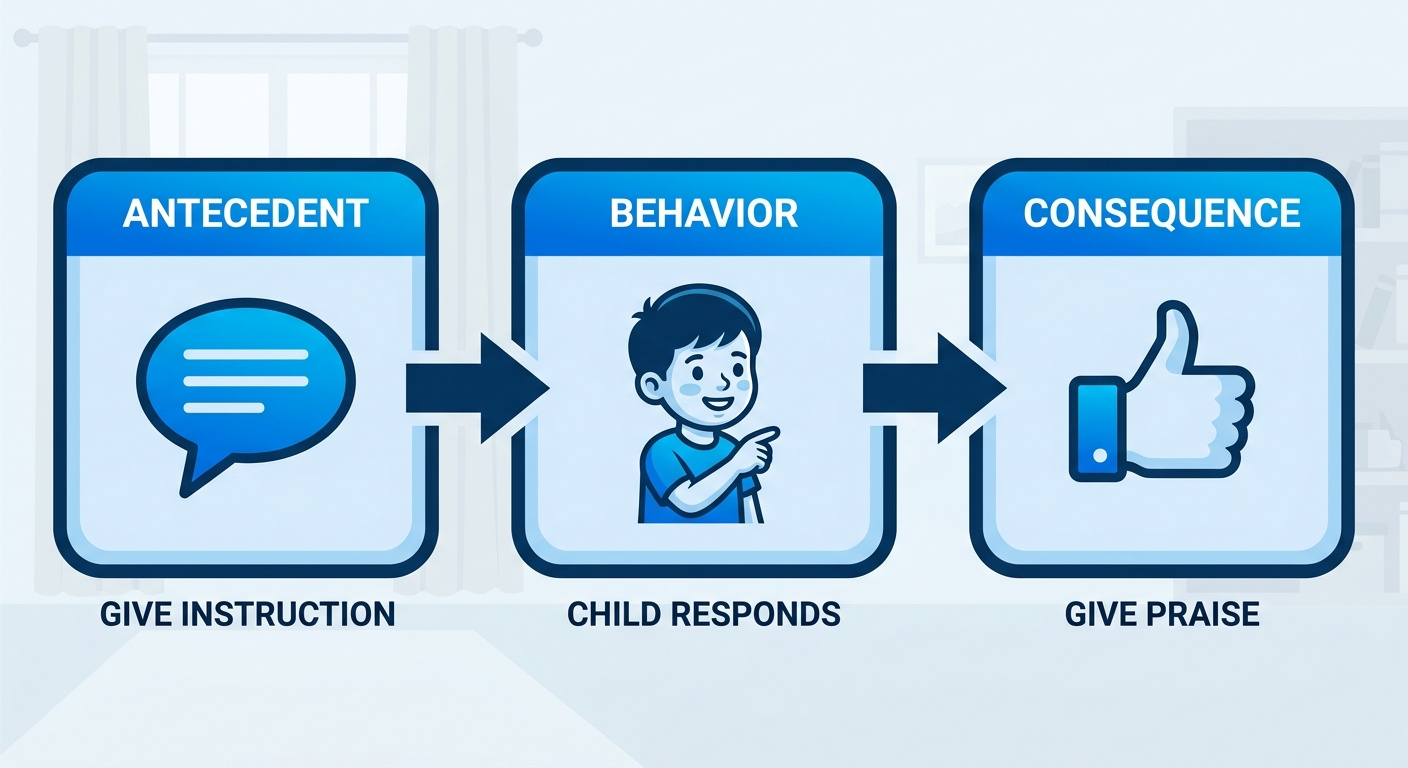
Positive reinforcement process in ABA Discrete Trial Training
The visual above illustrates this cycle, showing how consistent reinforcement drives progress in everyday home settings.
Session Examples and DTT Techniques
Consider mand training, where a child learns to request items. The therapist holds a preferred toy (antecedent), waits for the child to say “toy” (behavior), then immediately provides it with praise (reinforcement). Prompts fade from full verbal support to independence, using edible reinforcers initially.
- Session 1: Model “toy,” child echoes, earns toy + high-five.
- Session 2: Partial prompt, child independently requests.
For imitation skills, the therapist models clapping (antecedent), child imitates (behavior), receiving enthusiastic praise or a sticker.
- Use modeling for motor tasks.
- High-fives as social positive reinforcers.
Therapists reference aba teaching checklists for tracking responses and maintaining quality. These DTT techniques shine in family-centered care, blending structure with home comfort.
BCBA and RBT Implementation
Our BCBAs design reinforcement schedules and select individualized positive reinforcers via preference assessments, ensuring motivation matches the child. They supervise data collection, analyze progress, and adjust plans for optimal outcomes.
RBTs handle direct implementation: delivering prompts, providing reinforcement, and recording trials under BCBA guidance. This teamwork ensures consistency in every in-home ABA therapy session.
We emphasize compassionate delivery, promoting social interaction as noted in ASAT resources. BCBAs train RBTs ongoing, fostering growth. Results may vary, but our approach supports lasting skills. Stay tuned for how we customize plans with families for even greater impact.
Best Practices for Positive Reinforcement at Home
At Golden Touch ABA Therapy, we empower families with positive reinforcement strategies rooted in applied behavior analysis to support their child’s growth right in the home. These evidence-based practices make everyday moments opportunities for progress through consistent, immediate praise and rewards. Family-centered care starts with simple techniques you can use today. We model techniques and coach caregivers to build practical, lasting everyday confidence.
Practical Techniques and Examples
Let’s explore practical techniques for using positive reinforcement at home. Praise your child immediately after they complete a task, like putting away toys. Say, “Great job cleaning up!” with enthusiasm to build the habit.
- Token economies: Give stickers for good behaviors, such as finishing homework. Exchange them for preferred activities like extra playtime.
- Verbal praise with physical gestures: Pair “You shared so nicely!” with a high-five during social skills practice.
- Specific feedback: Note exactly what they did right, like “I love how you waited your turn at the table.”
Consistency and immediacy strengthen these connections, as National Center for Biotechnology Information (NCBI) authoritative government health data on ABA best practices highlights. We recommend practicing daily for lasting results.
DTT and Reinforcement in Natural Settings
Discrete trial training (DTT) brings structured teaching into your home with clear instructions, prompts, and reinforcements like small edibles or toys delivered right after correct responses. This builds foundational skills efficiently.
In contrast, natural environment teaching (NET) uses play-based incidental learning during routines, such as mealtime sharing. DTT shines for initial skill acquisition, while NET promotes generalization.
Home adaptation tips include:
- Start with DTT sessions at the kitchen table for tasks like matching colors.
- Fade prompts gradually into NET by reinforcing naturally during snack time.
According to NCBI data, these approaches align with professional ABA standards for effective interventions.
Parental Training with Professional Support
We offer robust parental training through Golden Touch ABA’s tools, like video models and progress trackers, to help you reinforce skills daily. Collaborate with our BCBAs for technique refinement, ensuring alignment with ABA professional standards.
Our interactive ABA roadmap guides home practice, promoting family-centered care. Golden Touch ABA resources, as our internal company materials detail, emphasize caregiver involvement for seamless therapy integration. We tailor sessions to your family’s needs in areas like Salt Lake City.
Monitoring Progress and Adjustments
Track weekly with simple charts noting reinforcement effectiveness, such as smiles after praise. Adjust by increasing praise if motivation dips.
Results may vary (no guaranteed outcomes). Consult our team for tweaks to sustain evidence-based practices and success.
Empowering Families with Reinforcement Strategies
Building on ABA fundamentals, we empower families with positive reinforcement strategies as part of our in-home ABA therapy. This core element of applied behavior analysis motivates positive behaviors through rewarding experiences like praise or fun activities, fostering growth in a warm and welcoming environment. We coach you to use everyday routines and simple progress tracking tools so families can celebrate small gains and stay aligned with individualized, measurable goals.
In discrete trial training, we break skills into small steps using evidence-based practices. A therapist gives a cue, the child responds, and correct actions earn positive reinforcers such as tokens or cheers, encouraging repetition and mastery.
Families can apply these at home with simple strategies:
- Specific praise: Say, “Great job sharing your toy!”
- Token economies: Earn stickers redeemable for privileges.
- Natural reinforcers: Offer extra playtime after tasks.
Our BCBAs supervise RBT-delivered sessions, training caregivers for consistency in family-centered care. Per our Golden Touch ABA Services overview, these ABA techniques support measurable outcomes, though results may vary (no guaranteed outcomes). Explore our interactive ABA roadmap tool or contact us for your personalized plan.
This article was researched and written with the assistance of AI tools.
Resources
- Discover In-Home ABA Therapy Services in Utah Counties
- Get 24/7 In-Home ABA Therapy for Children in Utah
- Explore Golden Touch ABA Therapy Locations Across States
- Access ABA Therapy for Low Functioning Autism in Utah
- Learn Collaborative ABA Treatment Planning with SMART Goals
- Identify Early Autism Signs in Infants and ABA Trends
- Recognize Early ASD Signs and Future ABA Innovations
- Review ABA Teaching Checklists for Therapist Training
- Explore ABA Professional Standards and Military Access Challenges
Table of Contents
- Discovering Autism Therapy in Salt Lake City
- Understanding ABA Therapy for Children
- Benefits of Autism Therapy
- How ABA Autism Therapy Works
- Best Practices in In-Home ABA Therapy
- Next Steps for Your Child’s Autism Therapy Journey
- Resources
Discovering Autism Therapy in Salt Lake City
Now, let’s focus on Salt Lake City, where families seek compassionate support for their children. If you’re discovering autism therapy in Salt Lake City, we at Golden Touch ABA Therapy are here to support your family with our specialized services.
We provide In-home ABA therapy delivered by highly trained BCBAs and RBTs, focusing on family-centered care and evidence-based practices. This approach builds autism learning partnerships with families, offering ABA therapy for children through individualized plans tailored to each child’s needs. Our team conducts behavioral assessments, provides caregiver training, and ensures flexible scheduling in a warm and welcoming environment.
Unique tools like our interactive ABA roadmap help track progress with measurable outcomes. We also assist with insurance verification to make effective autism therapy in Salt Lake City accessible. For custom needs, contact us for a personalized quote today.
The power of small steps celebrates every milestone, though results may vary. Reach out today to start your family’s journey with us in Salt Lake City. Consult a licensed healthcare professional for diagnosis or medical advice.
Discover how our ABA therapy works in detail below.
Understanding ABA Therapy for Children
At Golden Touch ABA Therapy, we deliver evidence-based autism therapy through Applied Behavior Analysis (ABA). This approach uses positive reinforcement to build skills like communication and social interaction. It begins with behavioral assessment to understand your child’s unique needs. Our in-home ABA therapy brings personalized, family-centered care right to your doorstep, including caregiver support services. Our in-home approach fits daily life. Results may vary.
What ABA Therapy Entails for Autism
ABA therapy for children with autism focuses on core principles tailored for young learners. We start with behavioral assessment through direct observation and parent input to identify strengths and challenges.
Key elements include:
- The ABC model (antecedent-behavior-consequence) to analyze what triggers actions and how to shape positive outcomes.
- Discrete trial training with prompts that fade over time, keeping sessions short and engaging for kids.
- Naturalistic environment teaching during play, making learning fun and relevant.
Therapists personalize activities based on a child’s interests and attention span to keep learning motivating. Short, play-based sessions help skills transfer from therapy into daily life. We track progress with data, celebrating the power of small steps toward bigger gains. This builds essential skills in a warm and welcoming environment.
Individualized Treatment Planning with BCBAs
Our Board Certified Behavior Analysts (BCBAs) lead individualized treatment planning with expertise. They conduct comprehensive functional assessments to pinpoint behaviors and set SMART goals for communication, social skills, and self-care.
The process involves:
- Collaborating with families as autism learning partners for caregiver training.
- Using evidence-based practices to craft flexible plans.
- Reviewing data quarterly to adjust goals and strategies.
We apply autism therapy principles when setting measurable targets and deciding when to advance goals. Caregiver coaching focuses on practical strategies families can use at home. This ensures therapy fits your child’s life perfectly. Our BCBA supervision guarantees quality in every step.
Role of RBTs in Daily Sessions
Registered Behavior Technicians (RBTs), trained under our BCBAs, handle daily RBT-delivered therapy in natural home settings. They provide one-on-one support using prompting hierarchies and reinforcement schedules.
In sessions, RBTs:
- Collect real-time data via apps for accurate tracking.
- Involve siblings and parents to extend learning.
- Embed skills into routines like mealtime or playtime.
RBTs embed teaching moments into routines so learning happens naturally without added disruption. They document progress clearly and share simple practice ideas so caregivers can reinforce skills between sessions. This family-centered care creates lasting change through the power of small steps. Ready to start your child’s journey? Explore our interactive ABA roadmap next.
Benefits of Autism Therapy
Building on our evidence-based approach, we at Golden Touch ABA Therapy welcome you to explore the transformative benefits of autism therapy. Our In-home ABA therapy uses proven practices tailored for children with autism, fostering growth in communication, independence, and behavior in a warm and welcoming environment. These gains empower families through family-centered care.
Improving Communication and Social Skills
At Golden Touch ABA Therapy, we see ABA therapy for children shine in enhancing communication and social skills through targeted interventions like prompting and modeling.
For verbal expression, our RBT-delivered therapy, supervised by BCBAs, teaches children to use words for requests, leading to clearer interactions. Non-verbal cues, such as eye contact and gestures, improve via discrete trial training, helping kids engage more confidently.
Specific gains include increased turn-taking in conversations, where a child might wait patiently during playdates, or initiating greetings with peers, building lasting friendships. Another example is expanded vocabulary use in daily routines, like naming emotions during family meals.
These advancements create meaningful connections. Results may vary. Ready to start? Our interactive ABA roadmap tool guides your custom plan, with insurance assistance.
Enhancing Independence and Daily Living
Beyond communication, ABA therapy also boosts independence by teaching essential self-care and routine skills through task analysis and chaining techniques.
In dressing, we break down steps like buttoning shirts, practicing in the child’s home for natural carryover. Hygiene routines, such as independent toothbrushing, use visual schedules for mastery.
Meal preparation examples include washing hands before eating or setting the table, promoting confidence. Following daily schedules, like transitioning from play to bedtime, reduces prompts over time.
Family-centered care includes caregiver training to reinforce these at home, ensuring sustained progress with the power of small steps. Results may vary. Explore our roadmap tool and insurance support for personalized paths.
Reducing Challenging Behaviors
Additionally, our ABA therapy for children effectively reduces challenging behaviors using functional behavior assessments, replacement behaviors, and positive reinforcement.
We identify triggers through data collection, then teach alternatives like using words instead of tantrums. Positive reinforcement rewards calm responses, fading prompts gradually.
Measurable outcomes include fewer meltdowns during transitions, tracked weekly, or decreased aggression via deep pressure techniques. Small wins, like requesting breaks, build self-regulation.
Individualized treatment planning makes this powerful. Results may vary (no guaranteed outcomes). Consult a licensed healthcare professional. Contact us for your roadmap tool and insurance assistance.
Our team measures progress collaboratively with families to ensure goals remain meaningful and adjust plans as needed over time.
Ready to see these benefits in action? Explore our interactive ABA roadmap tool.
How ABA Autism Therapy Works
At Golden Touch ABA Therapy, our autism therapy makes a real difference through personalized, evidence-based practices. We deliver in-home ABA therapy designed around your child’s unique needs, focusing on building communication, social skills, and independence. Family-centered care starts with a clear process: initial assessments, one-on-one sessions, and ongoing progress monitoring.
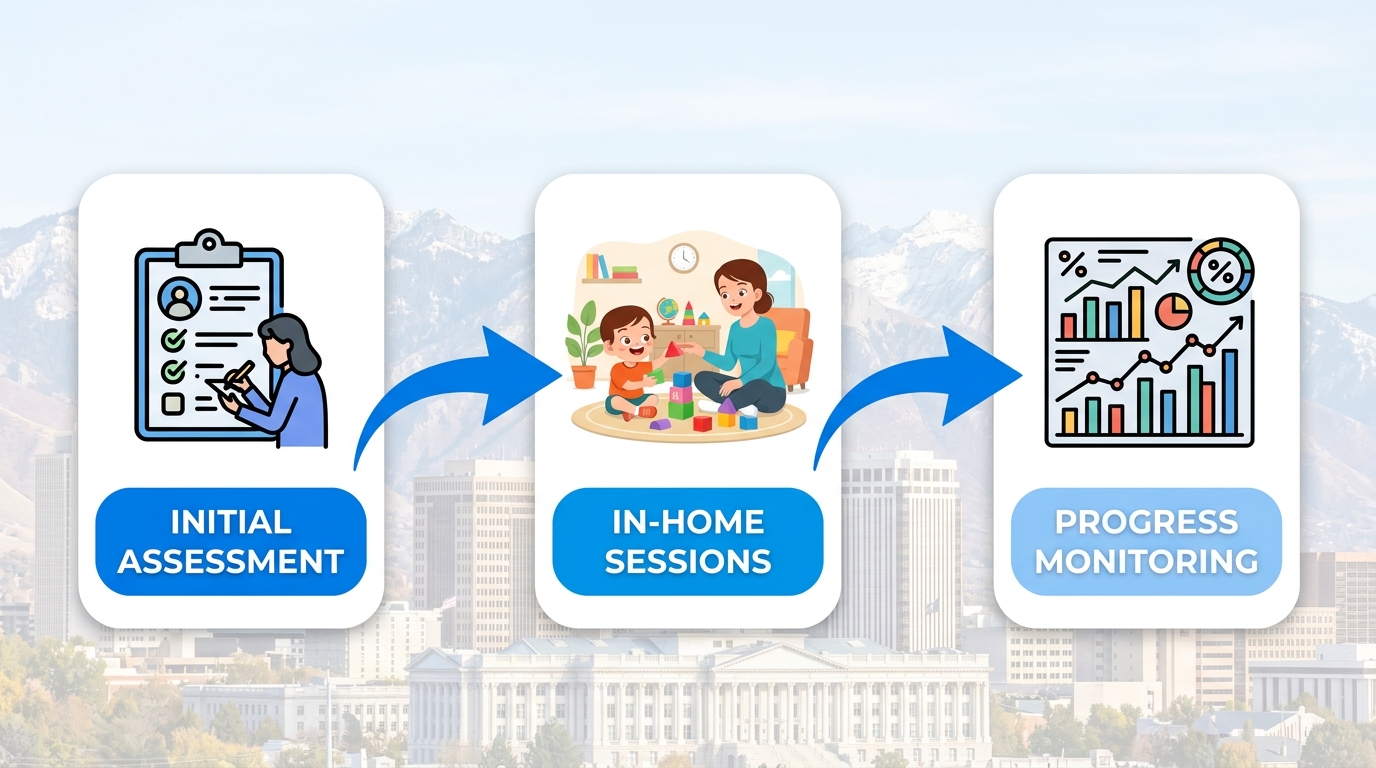
ABA autism therapy process: assessment, in-home sessions, progress monitoring.
Initial Assessments and Goal Setting
Our Board Certified Behavior Analysts (BCBAs) begin with comprehensive behavioral evaluations. They use direct observation, parent interviews, and standardized tools to pinpoint your child’s strengths, challenges, and priorities. This thorough process ensures we understand the full picture of their development.
Next, we collaborate closely with families to set personalized, measurable goals. Whether improving communication or social skills, every target reflects family input. Our interactive ABA roadmap tool visualizes this journey, making it clear and engaging. With goals set, we begin one-on-one sessions tailored to your home.
One-on-One In-Home Sessions
Our Registered Behavior Technicians (RBTs), supervised by BCBAs, conduct 1-2 hour sessions right in your child’s home. This warm and welcoming environment fits seamlessly into their daily routine, promoting natural learning. ABA therapy for children thrives here through flexible scheduling and comfort.
We employ proven techniques like discrete trial training for focused skill-building, natural environment teaching to encourage real-world application, and positive reinforcement to motivate progress. For example, a child practicing turn-taking might earn praise or a favorite toy. Like autism learning partners, we emphasize the power of small steps in a supportive setting, fostering confidence and growth.
To ensure success, we track every session meticulously.
Progress Monitoring and Adjustments
Daily data collection captures target behaviors, plotted on easy-to-read graphs and charts for clear insights. Our BCBAs review this weekly, tweaking plans based on real results to optimize outcomes. Evidence-based practices guide these evidence-based adjustments, keeping therapy dynamic and effective.
Family training sessions empower parents with strategies for consistency at home, strengthening family-centered care. We provide ongoing communication through secure parent portals, sharing updates and tips. Our clinicians collaborate with schools and providers to coordinate care when appropriate, and we tailor transitions across settings to support consistency and generalization of learned skills in daily routines. Results may vary, as every child progresses uniquely—no guarantees apply. Consult a licensed healthcare professional for diagnosis or medical advice.
Ready to see in-home ABA therapy transform your child’s life? Contact Golden Touch ABA Therapy today to start their journey.
Best Practices in In-Home ABA Therapy
Building on the foundations of ABA, here are our best practices for in-home ABA therapy delivery. At Golden Touch ABA Therapy, we focus on family-centered care and evidence-based practices to support children with autism. These strategies ensure effective, personalized support in the comfort of your home.
Choosing Qualified Providers
When selecting providers for autism therapy, prioritize those with strong credentials to deliver quality ABA therapy for children. We at Golden Touch ABA verify BCBA board certification and a minimum of two years of supervised experience for our clinicians. Our RBTs complete the required 40-hour training, ensuring competent RBT-delivered therapy under BCBA supervision.
Key criteria include:
- Verifying BACB credentials for BCBAs and RBTs
- Assessing family fit through initial consultations on communication style and scheduling flexibility
- Reviewing experience with ABA therapy programs for kids similar to your child’s needs
These steps guarantee a good match. Results may vary, but our approach maximizes potential through tailored plans and family-driven, collaborative goal setting.
Integrating Family Training
Family-centered care thrives on caregiver involvement, making family training essential in in-home ABA therapy. Training helps parents generalize skills to everyday routines, reducing therapy dependency and boosting child progress. We provide structured programs with hands-on sessions led by BCBAs, including progress tracking materials and strategies like those used by autism learning partners.
Benefits include:
- Improved skill carryover from sessions to home life
- Empowered caregivers to reinforce learning consistently
- Customized modules on behavior management and communication
Our family-centered care includes comprehensive training modules tailored to your needs. This collaboration fosters independence. Results may vary, and insurance coverage is subject to verification for these services.
Ensuring Local Accessibility
Accessibility is key for consistent ABA therapy for children, especially in Salt Lake City, Utah. Confirm in-person availability in Salt Lake City, Utah, and explore telehealth for rural spots. At Golden Touch ABA Therapy, we offer multi-state licensing across Utah, Arizona, and Maryland, with flexible scheduling for in-home ABA therapy.
Practical tips:
- Check service areas for county-level coverage in Salt Lake City, Utah
- Verify telehealth integration for broader reach
- Confirm insurance assistance and benefits support to ease access
We serve families in Salt Lake City, Utah, and beyond with flexible in-home ABA therapy scheduling to maximize accessibility. Our interactive ABA roadmap helps plan sessions seamlessly. Contact us in Salt Lake City to implement these practices today. We welcome questions from families at every stage of their care journey today. Consult a licensed healthcare professional for personalized advice, as results may vary.
Next Steps for Your Child’s Autism Therapy Journey
Now that you understand the power of ABA, here are your next steps in autism therapy. At Golden Touch ABA Therapy, we’re thrilled you’ve taken the first step toward your child’s autism therapy. We’re here to guide you every step of the way with our family-centered care and evidence-based practices.
Here are the key actions to begin:
- Fill out our contact form or use the interactive ABA roadmap tool for a quick assessment of your needs.
- Let our team assist with insurance benefits eligibility and verification—coverage is subject to verification and not guaranteed.
- Schedule an initial behavioral assessment with our highly trained BCBA to create a personalized plan.
- Start RBT-delivered ABA therapy for children through in-home ABA therapy sessions with flexible scheduling.
- Receive ongoing caregiver training and supervision from your dedicated autism learning partners.
Results may vary. Contact us today for your custom quote—our team is ready to partner with you in this warm and welcoming environment, and celebrate every meaningful milestone. Reach out today via our form below. Consult a licensed healthcare professional for advice.
Resources
- Behavior Analyst Certification Board (BACB)
- Autism Speaks: Applied Behavior Analysis Guide
- CDC: Autism Spectrum Disorder Treatment Options
This article was researched and written with the assistance of AI tools.
