
Holistic Therapy Utah: Complete Guide for Anxiety Relief
Table of Contents
- Holistic Therapy in Utah: A Path to Integrated Wellness
- Holistic Therapy Modalities and Their Benefits in Utah
- Accessing Holistic Therapy Services in Utah
- What to Consider When Choosing Holistic Therapy in Utah
- Your First Holistic Therapy Appointment in Utah: What to Expect
- Start Your Holistic Therapy Journey in Utah with Confidence
Holistic Therapy in Utah: A Path to Integrated Wellness
We’ve seen a growing interest in holistic therapy in Utah, an approach that considers the whole person—mind, body, and environment. Many families explore holistic therapy for anxiety in Utah and holistic therapy for PTSD in Utah as part of a broader wellness journey. While we don’t offer these therapies directly, our in-home ABA model naturally embraces holistic principles by working within your child’s familiar surroundings. In our Warm and Welcoming Environment, we focus on The Power of Small Steps, integrating family collaboration into every session. According to cdc public health resources, integrated approaches like these can support overall well-being. This blend of evidence-based ABA and holistic-minded care helps children reach their true potential.
Holistic Therapy Modalities and Their Benefits in Utah
When exploring holistic therapy in Utah, families often seek approaches that consider the whole child — mind, body, and behavior — rather than treating a single symptom in isolation. We believe that Applied Behavior Analysis (ABA), especially when delivered in a child’s natural home environment, fits naturally within this holistic framework. This section compares four popular modalities available to families throughout Salt Lake, Utah, Weber, and Davis Counties.
Holistic Therapy Modality Comparison in Utah
| Modality | Focus Area | Availability in Utah | Evidence Base |
|---|---|---|---|
| Neurofeedback | ADHD, anxiety, sleep disorders | Found in many clinics across Salt Lake City and Utah County | Strong evidence for ADHD; emerging support for anxiety |
| Applied Behavior Analysis (ABA) | Autism spectrum disorder, developmental disabilities, behavior reduction | Widespread across Utah; in-home options in Salt Lake, Utah, Weber, Davis Counties | Strong evidence for autism (AAP-endorsed, BACB-certified) |
| Cognitive Behavioral Therapy (CBT) | Anxiety, PTSD, depression | Widely available throughout Utah | Strong evidence for anxiety and PTSD |
| Mindfulness-Based Stress Reduction (MBSR) | Stress, anxiety, chronic pain | Moderate availability; offered at hospitals and wellness centers | Moderate evidence for stress reduction |
This comparison highlights how each option addresses distinct needs. Neurofeedback offers a targeted, clinic-based route for attention difficulties, while ABA provides comprehensive, evidence-based support for children with autism right at home. For those searching for holistic therapy for anxiety Utah, CBT and MBSR present well-supported paths, with CBT also recognized as a powerful holistic therapy for PTSD Utah residents can access broadly across the state.
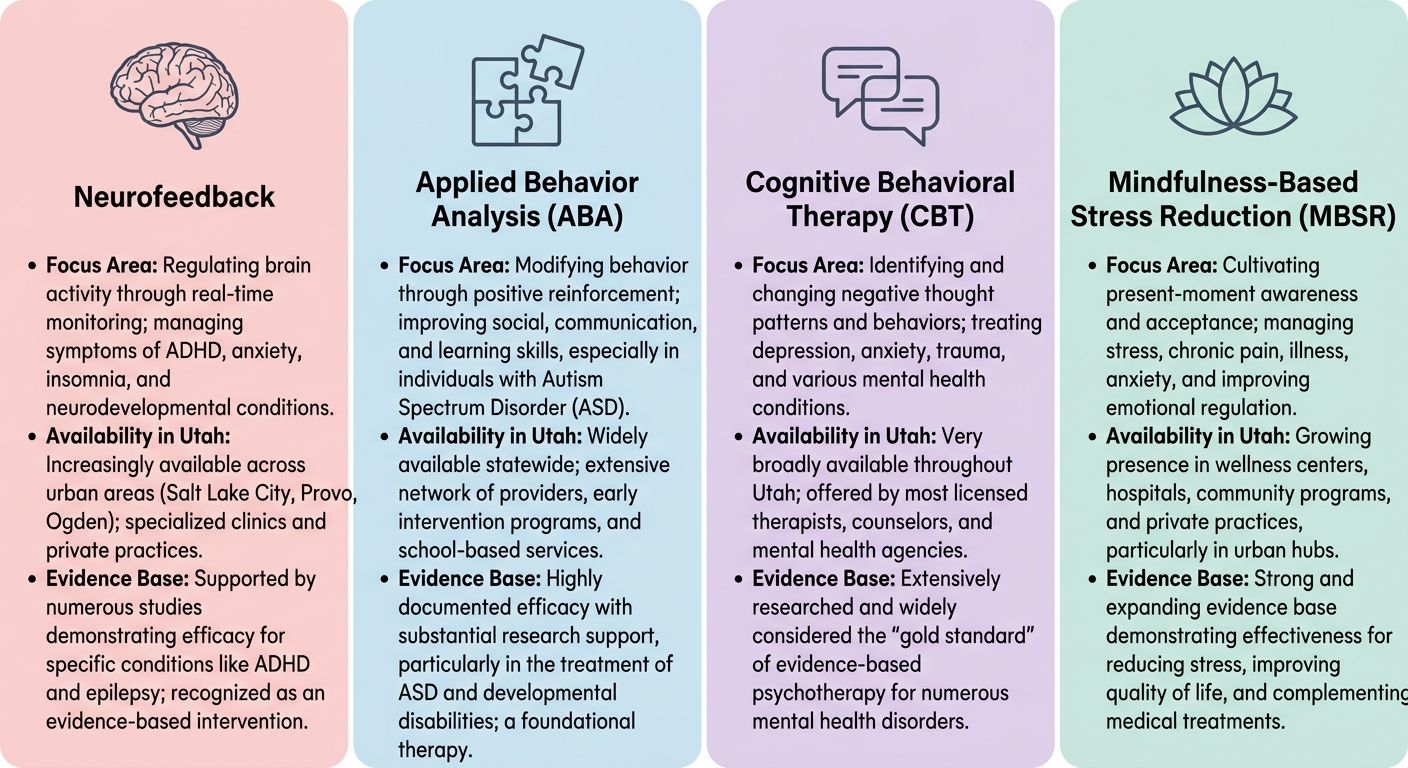
Holistic therapy modality comparison infographic for Utah families
Each approach brings its own strengths to a family’s journey. As a leading authority, the Behavior Analyst Certification Board (BACB) validates ABA’s strong evidence base for skill-building and behavior reduction. The Association for Behavior Analysis International (ABAI) further supports this, contributing to a deep body of research that guides our personalized, in-home ABA therapy. We see every day how Small Steps That Yield Big Results create meaningful change in a Warm and Welcoming Environment.
To learn more about local programs and eligibility, families can connect with utah disability services. Our team is always available to discuss how personalized, in-home ABA therapy can become part of your child’s holistic support system. This information is for educational purposes and is not a substitute for professional medical advice; consult a healthcare or behavioral health professional. Results may vary based on individual circumstances, and insurance coverage and results depend on individual plans and client factors.
Accessing Holistic Therapy Services in Utah
For families seeking holistic therapy Utah, starting ABA services with our team is a straightforward and supportive process. If you feel that In Home ABA Therapy could be the right approach for your child, here is exactly how to begin.
The Initial Consultation and Assessment
Your journey begins with a free consultation. Simply contact us, and we will schedule a time for a Board Certified Behavior Analyst (BCBA) to conduct a personalized in-home assessment. According to the American Academy of Pediatrics, ABA is an endorsed, evidence-based approach that holistically addresses communication, social skills, and daily living. For children whose challenging behaviors stem from underlying anxiety or trauma, this collaborative effort functions as a supportive holistic therapy for anxiety Utah families can trust to reduce social avoidance and build coping skills.
Understanding Your Insurance Coverage
Navigating insurance is a key part of getting started. After you submit your information, our team verifies your benefits and explains your coverage in detail, handling prior authorization so you don’t have to. Please note that insurance coverage and results depend on individual plans and client factors.
Our Utah Service Areas
We provide compassionate in-home care across Salt Lake County, Utah County, Weber County, and Davis County, creating a Warm and Welcoming Environment in cities including Salt Lake City, Sandy, Draper, West Jordan, Murray, Riverton, Provo, Orem, Lehi, Ogden, and Bountiful. Families looking for aba therapy in layton, utah, can begin with a free consultation from our multidisciplinary team of BCBAs and RBTs. This model treats behavioral challenges holistically, acting as a comprehensive holistic therapy for PTSD Utah children may need when communication difficulties result from past trauma.
This information is for educational purposes and is not a substitute for professional medical advice; consult a healthcare or behavioral health professional. Contact us today to schedule your free consultation and take the first Small Steps That Yield Big Results.
What to Consider When Choosing Holistic Therapy in Utah
Now that you understand what holistic therapy involves, finding the right provider for your child is a journey built on trust and evidence. When exploring holistic therapy in Utah, we believe the best outcomes come from blending scientific rigor with a Warm and Welcoming Environment. The American Academy of Pediatrics recommends evidence-based interventions, so it’s essential to choose a team that uses data-driven methods. For children needing holistic therapy for anxiety in Utah or holistic therapy for PTSD in Utah, this means selecting a provider who addresses behavioral challenges through personalized, in-home care that fits your family’s daily routines.
- Evidence-Based Practice: Look for licensed BCBAs who design plans supported by research. We use proven ABA techniques to help improve communication and daily living skills.
- Personalized Care: In-home therapy allows strategies to be tailored to your child’s natural environment, helping them take Small Steps That Yield Big Results.
- Parent Collaboration: A holistic approach for children in Utah should involve family training, empowering parents to guide progress outside of sessions.
- Convenient Utah Service Areas: Our team serves Salt Lake, Utah, Weber, and Davis counties, bringing care directly to your home.
We are dedicated to Helping Children Reach their True Potential by integrating support into your everyday life. This information is for educational purposes and is not a substitute for professional medical advice; consult a healthcare or behavioral health professional. Results may vary based on individual circumstances. One approach that aligns with these considerations is in-home ABA therapy.
Your First Holistic Therapy Appointment in Utah: What to Expect
Your first in-home ABA therapy appointment with us introduces you to the power of in home aba therapy delivered in a warm, familiar setting. While you may be searching for holistic therapy in Utah, our ABA approach treats the whole child at home.
The visit begins with a 60-minute BCBA-led assessment right in your living room. We start with a parent interview to discuss your concerns, daily routines, and priorities for your child. Then, we observe your child during natural activities like play, meals, and transitions to assess behavior and skills. Families seeking holistic therapy for anxiety in Utah find that our behavior-focused strategies reduce stress naturally. Within 48 hours, you receive a written summary and a proposed therapy schedule. The session is non-clinical and play-based, creating a stress-free introduction. Siblings and caregivers are welcome to participate or observe. No medical diagnosis is required to start—just a physician referral or school recommendation.
We believe in small steps that yield big results. Your BCBA will use this assessment to create a personalized plan grounded in whole-child development, much like the approach families seek when exploring holistic therapy for PTSD in Utah.
Start Your Holistic Therapy Journey in Utah with Confidence
Your holistic therapy journey in Utah begins with confidence when you choose Golden Touch ABA’s in-home, evidence-based support. We deliver personalized aba therapy in your child’s natural environment, focusing on small steps that build communication, social, and daily living skills. Our BCBA-led team creates a warm, welcoming environment, whether you’re seeking holistic therapy for anxiety Utah families trust or trauma-informed support for PTSD. Flexible scheduling adapts to your needs. Contact us to schedule a free consultation and see how we help children reach their true potential right here in Salt Lake City and throughout Utah County.
Resources
Table of Contents
- Understanding ABA Therapy Costs with Insurance in 2026
- Before You Begin: Key Information to Gather
- Gather Your Insurance Policy and Benefits Information
- Understand Your Out-of-Pocket Costs and Deductibles
- Verify Your Insurance Coverage for ABA Therapy
- Calculate Coinsurance and Estimated Costs per Session
Understanding ABA Therapy Costs with Insurance in 2026
Navigating ABA therapy cost with insurance 2026 is often the first concern for families. As our team at Golden Touch ABA explains, insurance coverage can substantially lower what you pay out of pocket, though your exact cost depends on your plan’s deductibles, copays, and coverage limits. That’s why insurance verification for ABA therapy is a critical first step—we review your benefits to clarify what your policy covers before services begin, so you can focus on your child’s progress. We’ll also explain your plan’s coverage limits and help you understand any visit caps.
Your actual ABA therapy cost with insurance 2026 also depends on whether your plan must comply with the autism insurance mandate in your state. While many state mandates require certain regulated plans to cover ABA therapy, self-funded employer plans (ERISA) are often exempt. In states like Utah, the mandate covers ABA therapy up to age 9, while Arizona extends coverage to age 16, but ERISA plans are not bound by these rules. Because coverage varies, checking your plan’s ABA therapy out-of-pocket maximum helps you estimate your worst-case financial responsibility. It’s a useful figure for budgeting, though actual bills will reflect your specific deductible and copay structure. Results vary, and coverage is not guaranteed and is always subject to verification; we encourage you to contact us for a personalized benefits check.
Before You Begin: Key Information to Gather
At Golden Touch ABA Therapy, we know that gathering the right information makes insurance verification for ABA therapy smoother. ABA is a science based autism treatment, and we want to help you check your coverage. Knowing what’s required simplifies checking ABA therapy coverage and helps you plan for potential costs.
Based on our experience, these are the key items you’ll need:
- Your insurance card, including member ID, group number, and payer contact information.
- A formal autism diagnosis with ICD-10 code F84.0 or a prescription from a licensed professional.
- The treatment plan or behavioral assessment prepared by your child’s Board Certified Behavior Analyst (BCBA).
- Any prior authorization (pre-auth) numbers you may have received.
- Your child’s date of birth and relevant medical history.
If you have any questions, our team is here to help you verify these details.
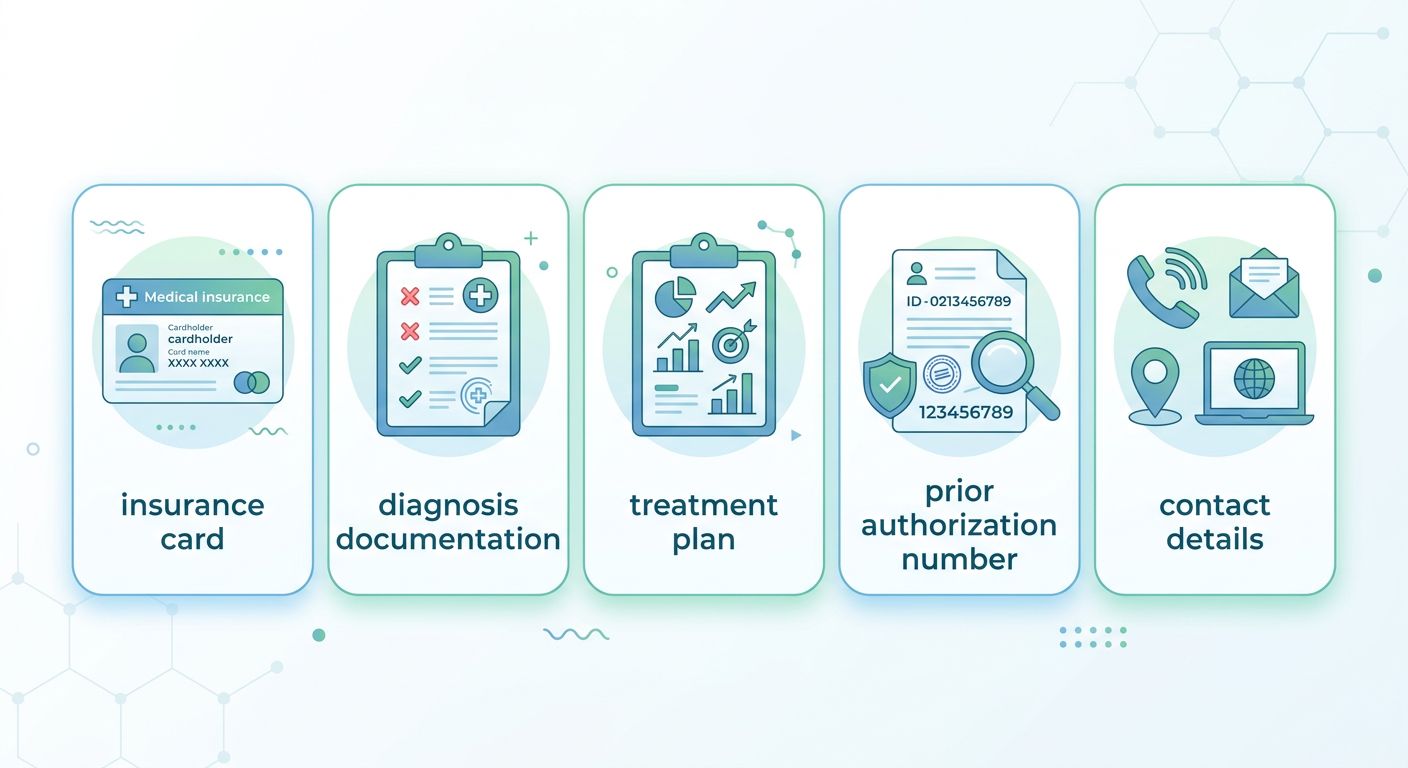
Essential documents and information for ABA insurance verification.
With these items in hand, you’re ready to begin the ABA therapy insurance verification process. Our team at Golden Touch ABA Therapy can assist with each step, from calling your insurer to confirming prior authorizations and benefits. Knowing your coverage helps you plan for costs and avoid surprises, so you can focus on your child’s progress. Once you’ve gathered these documents, the next step is submitting them for verification. Please remember that insurance coverage is subject to verification and is not guaranteed.
Gather Your Insurance Policy and Benefits Information
Before you can understand your costs, you need to know what your plan covers. Start by locating your insurance member ID card. Note your member ID, group number, and the customer service phone number. These details are essential when you begin the insurance verification for ABA therapy.
Gather the following items:
- Your insurance card with member ID, group number, and phone
- Your benefits summary or plan document
- Any pre-authorization or referral forms
- A copy of your child’s autism diagnosis report
Review your plan by calling member services or checking the benefits summary. Ask specifically about ABA therapy coverage and whether your state’s autism insurance mandate applies. Confirm if pre-authorization, a referral, or proof of medical necessity is required. Also ask about your out-of-pocket maximum so you understand your financial responsibility.
Our insurance assistance team can handle this step for you. Golden Touch ABA will guide you through the verification process and contact your insurer on your behalf. According to our team, the process often takes only a few days once you provide the documents.
Once you have your documents ready, the verification process can begin — covered in the next section. Please note that insurance coverage is subject to verification and is not guaranteed.
Understand Your Out-of-Pocket Costs and Deductibles
Understanding your coverage is the first step, but knowing your out-of-pocket costs brings real clarity. As you explore ABA therapy cost with insurance in 2026, these expenses generally encompass deductibles, copays, and co-insurance. The deductible is the amount you must pay before insurance begins to contribute. Once met, copays (a set fee per session) or co-insurance (a percentage of costs) often apply. Our insurance verification for ABA therapy gives families a clear picture of their financial responsibility, though it does not guarantee coverage. The autism insurance mandate operating in many states may limit maximum out-of-pocket costs, but specific rules hinge on your state and plan. Golden Touch ABA’s team walks you through these details, answers questions, and provides a custom quote after verification. Because actual costs differ for each family, we encourage you to contact us for a personalized breakdown. Insurance coverage is subject to verification and is not guaranteed.
Verify Your Insurance Coverage for ABA Therapy
Understanding the potential cost of ABA therapy with insurance in 2026 starts with a clear insurance verification for ABA therapy process. The most direct route is to call the number on the back of your insurance card and ask specifically about your plan’s coverage for Applied Behavior Analysis for autism. Before you call, gathering your insurance ID and policy details will speed up the conversation.
- Ask about your ABA therapy benefits: Inquire about the specific coverage for autism treatment, including any age limits or required pre-authorizations.
- Define your cost-sharing details: Clarify your plan’s deductible, your copay or coinsurance per session, and the total ABA therapy out-of-pocket maximum for the year.
- Request a written summary: Secure a written benefits summary from the insurer to identify any annual visit restrictions or financial caps, as coverage varies by plan, provider network, and state.
We understand this can feel overwhelming, which is why our team offers complimentary assistance to help you verify your child’s ABA benefits. We can guide you through the nuances of your policy to clarify your coverage situation.
Insurance coverage is subject to verification and is not guaranteed. Once you have a clearer picture, we invite you to connect with our insurance assistance team for a personalized benefits check. Studies indexed in the biomedical research database affirm that evidence-based practices like ours are key to effective family-centered care. From here, you can confidently take the next step: scheduling a free assessment to begin therapy.
Calculate Coinsurance and Estimated Costs per Session
Estimating your aba therapy cost with insurance 2026 starts with understanding coinsurance—the percentage you pay after your deductible. Here’s a simple process:
- Verify your benefits—we can run your insurance plan.
- Check your deductible status—if unmet, you’ll pay the full session rate.
- Apply your coinsurance rate—once the deductible is met, multiply the session fee by your percentage.
Your plan’s out-of-pocket maximum protects you by capping annual spending; once you reach that ABA therapy out-of-pocket maximum, the insurer pays 100% of allowed amounts for the rest of the year. Insurance verification for ABA therapy is therefore essential, and our team at Golden Touch ABA can review your benefits to explain your specific deductible, coinsurance, and out-of-pocket limits.
Because costs vary widely by carrier and individual plan, we encourage you to contact us for a personalized estimate of the cost of ABA therapy with insurance. Sessions are supervised by Board Certified Behavior Analysts (BCBAs), certified by the Behavior Analyst Certification Board. Keep in mind that insurance‐covered ABA therapy expenses are subject to verification and not guaranteed.
Explore State Mandates and Grant Opportunities
Families often wonder how state mandates and grant opportunities can help lower the ABA therapy cost with insurance. In Maryland, a state mandate requires insurance coverage for autism therapy, including ABA, which can make treatment more accessible for your child. Our team offers insurance verification for ABA therapy to help you understand how state mandates apply to your plan and what benefits you may have.
Beyond insurance, grant opportunities such as state-funded programs or nonprofit awards may further offset ABA therapy costs. We assist families in our service areas—including in Utah, Maryland, and Arizona—by navigating these options and providing personalized guidance. Every plan is different, so coverage and grant availability vary; we cannot guarantee specific outcomes, and verification is subject to plan terms.
Reach out for a free benefits check. We’re here to help you take the first step—because the power of small steps can lead to meaningful progress.
Reach Your Out-of-Pocket Maximum to Maximize Coverage
Now that you understand the basics of insurance coverage for ABA therapy, let’s look at a key strategy: reaching your out-of-pocket maximum to get the most out of your plan. This is the annual cap on what you pay for covered services. Managing ABA therapy cost with insurance 2026 starts here. According to Golden Touch ABA’s insurance FAQ, the out-of-pocket maximum usually applies to ABA therapy, and once you meet it, your insurer pays 100% of covered ABA sessions for the rest of the plan year.
Scheduling ABA sessions early in the plan year can help you reach your annual out-of-pocket limit sooner, unlocking full coverage for the rest of the year. Because each insurance plan sets its own maximum out-of-pocket cap, getting insurance verification for ABA therapy is essential. Our team at Golden Touch ABA helps families understand their plan details and schedule accordingly. Insurance coverage is subject to verification and is not guaranteed; some non-covered services may still apply. The power of small steps — every session moves you closer to the cap. Ready to check your plan’s out-of-pocket maximum? Our team can help with insurance verification — reach out to us today.
Request a Custom Quote and Finalize Your Decision
Understanding the ABA therapy cost with insurance 2026 can feel overwhelming, but we make it simple with a personalized custom quote. We tailor every quote to your child’s unique needs, goals, and location while handling insurance verification for you. This includes clarifying your out-of-pocket maximum and any plan limitations, so you know exactly what to expect before making a commitment. As explained in our FAQ on cost with insurance, coverage depends on your specific policy, which is why we take the time to verify your benefits thoroughly.
There’s never any obligation to move forward after receiving your quote—you can review everything at your own pace. We accept Medicaid and most major insurance plans, though each plan is verified individually to confirm your exact benefits. When you’re ready to begin, simply contact us by phone, email, or try our interactive ABA roadmap tool to start the process. Insurance coverage is subject to verification and is not guaranteed. Please consult a licensed healthcare professional for diagnosis or medical advice.
Troubleshooting Common Insurance Coverage Issues
Insurance verification for ABA therapy is a critical first step, but it doesn’t guarantee that your child’s services will be covered. At Golden Touch ABA, we help families in Salt Lake City, Utah County, Weber County, and Davis County in Utah, as well as in Arizona and Maryland, understand exactly what their plan requires before treatment begins.
Even after verification, claims can still be denied. Common reasons include:
- Lack of demonstrated medical necessity – the insurer may not see the therapy as essential.
- Out‐of‐network status – your provider isn’t in the plan’s network.
- Insufficient documentation – missing reports or progress notes.
- Exceeded session limits – hitting annual or lifetime visit caps.
We strongly recommend securing pre‐authorization before starting ABA services. This process confirms that the insurer agrees the treatment is medically necessary and outlines what they will pay. Understanding your ABA therapy out‐of‐pocket maximum is equally important because it caps your total annual spending, protecting you from runaway costs.
If a claim is denied, you can appeal. Our team guides families through collecting a letter of medical necessity from the BCBA, treatment plans, and progress data to build a strong case. As you plan for aba therapy cost with insurance 2026, keep in mind that deductibles, copays, and coverage limits can shift each year, so early planning makes a real difference.
You don’t have to navigate these challenges alone. Our insurance assistance service is here to help you untangle denials, understand benefits, and take the next small step forward. Remember, insurance coverage is subject to verification and is not guaranteed, but we’ll work alongside you to pursue every possible option.
Navigating ABA Therapy Costs with Confidence
Managing the ABA therapy cost with insurance 2026 starts with understanding your plan’s deductibles, co-pays, and out-of-pocket maximums. A thorough insurance verification reveals exactly what your policy covers so you can plan with confidence. We help families focus on therapy, not financial uncertainty.
Once we complete the insurance verification for ABA therapy, we outline your ABA therapy out-of-pocket maximum and any co-pay responsibilities. We break down the ABA therapy cost with insurance 2026 through example scenarios on our FAQ page, but your estimate depends on your specific benefits. That personalized insight helps you budget realistically. Reach out for insurance assistance and benefits eligibility support—our team will walk you through the process and answer your questions. Please remember that insurance coverage is subject to verification and is not guaranteed, but we’re here to help every step of the way.
Resources
- Understand Arizona’s Autism Insurance Mandate for ABA
- Differentiate State Mandates from ERISA for ABA Coverage
- Explore Maryland’s Autism Mandate Covering Therapy to Age 21
- Secure ABA Coverage Through State Insurance Mandates
- Compare Autism Mandate Age Limits Across States AZ MD UT
- Verify Your Health Plan for ABA Mandate Coverage
- Prove Medical Necessity for ABA Under State Mandates
- Find Science-Based Autism Treatment Information at ASAT
- Access Biomedical Research Databases via NCBI
- Get Certified as an ABA Professional with BACB
Table of Contents
- Understanding the Role of BCBA Supervision in In-Home ABA Therapy
- The Role of a BCBA in an In-Home ABA Program: Supervision Fundamentals
- How Often Does a BCBA Supervise Home-Based RBT Sessions?
- Verifying Credentials and Understanding RBT Supervision Requirements
- BCBA Supervised Fieldwork: Ensuring Competent Therapy Delivery
- Frequently Asked Questions About BCBA Supervision for Home Therapy
- Empowering Your Child’s Progress Through Quality BCBA Supervision
Understanding the Role of BCBA Supervision in In-Home ABA Therapy
BCBA supervision for home therapy is the ongoing oversight that ensures every in-home ABA therapy session delivers the highest standard of care. At Golden Touch ABA Therapy, a Board Certified Behavior Analyst guides each RBT on your child’s team, verifying that treatment plans are implemented with precision and compassion. This supervisory relationship is the foundation of effective, ethical therapy delivered in a warm and welcoming environment.
Our BCBAs adapt behavioral strategies to the natural rhythms of your home, making everyday moments opportunities for growth. The Behavior Analyst Certification Board establishes clear RBT supervision requirements, mandating that technicians receive a minimum percentage of supervised hours each month to maintain certification. This oversight extends beyond clinical monitoring and includes caregiver training so families feel empowered to reinforce skills between sessions. We believe in the power of small steps, and consistent BCBA supervision for home therapy transforms those steps into meaningful progress.
Through initial assessments, data analysis, and direct observation that mirror the rigor of BCBA supervised fieldwork, our BCBAs refine each child’s individualized plan while upholding evidence-based practices and ethical codes that protect client safety. For families navigating insurance, sessions are categorized under specific ABA therapy CPT codes that reflect the nature of BCBA oversight and direct RBT service delivery. This structure reflects our commitment to family-centered care, where parents and caregivers become active partners in their child’s development. Results may vary; consult a licensed healthcare professional for medical advice.
The Role of a BCBA in an In-Home ABA Program: Supervision Fundamentals
At Golden Touch ABA, we believe that meaningful progress in in-home ABA therapy begins with strong clinical supervision. BCBA supervision for home therapy provides the foundation for everything we do—it shapes how we design programs, support families, and guide our team members toward measurable outcomes. When a family invites us into their home, they are trusting us with something precious, and it is the Board Certified Behavior Analyst who carries the primary responsibility for ensuring that trust is well-placed. This section explores the fundamentals of BCBA supervision, clarifying what a BCBA does, how they collaborate with families, and how their role differs from that of the Registered Behavior Technician.
As the clinical leader of every in-home team, the BCBA serves as both supervisor and program designer. Their work begins long before the first therapy session takes place, starting with a comprehensive behavioral assessment that identifies a child’s strengths, skill deficits, and specific areas of need. Using evidence-based practices, they develop an individualized treatment plan with clear, measurable goals—whether that means improving communication, building daily living skills, or reducing behaviors that interfere with learning. Once therapy is underway, the BCBA monitors progress through ongoing data analysis, making adjustments to teaching strategies and intervention protocols as the child grows and changes. This continuous cycle of assessment, planning, and refinement ensures that every hour of therapy remains purposeful and aligned with the family’s priorities.
The following table highlights the key differences between these two essential roles on the therapy team.
| Aspect | BCBA | RBT |
|---|---|---|
| Role | Supervisor and program designer | Implementer under supervision |
| Qualifications | Master’s degree + BCBA certification | High school diploma + RBT certification |
| Responsibilities | Assess, plan, monitor progress | Deliver therapy, collect data |
| Supervision ratio | Directs and trains RBTs | Receives supervision from BCBA |
This distinction matters because both professionals bring complementary strengths to the team. The RBT works directly with the child day to day, delivering the therapy sessions and collecting real-time data on skill acquisition and behavior. The BCBA, in turn, analyzes that data to evaluate whether the program is working and provides hands-on training to ensure the RBT is implementing procedures correctly. Understanding the ABA practitioner requirements for each role helps families appreciate the depth of expertise supporting their child’s progress.
To become a BCBA, an individual must earn a master’s degree in behavior analysis or a closely related field and complete bcba supervised fieldwork under the guidance of a qualified supervisor. This intensive clinical training typically involves 1,500 to 2,000 hours of hands-on practice, during which the trainee learns to conduct assessments, write treatment plans, and oversee direct implementation. After completing the required fieldwork, candidates must pass the national certification examination administered by the Behavior Analyst Certification Board, or BACB. This rigorous process ensures that every BCBA possesses the clinical judgment necessary to handle the complexity and nuance of autism intervention in real-world settings.
The rbt supervision requirements are similarly structured but designed as an entry-level pathway. An RBT must be at least 18 years old, hold a high school diploma, and complete a 40-hour training program covering foundational ABA principles, ethical conduct, and skill-building techniques. A BCBA then directly observes the candidate performing essential tasks—such as collecting data, implementing behavior reduction plans, and following session protocols—through a hands-on competency assessment. Once certified, the RBT must receive ongoing supervision from a BCBA at least five percent of the total hours they spend delivering therapy each month, a standard established and enforced by the BACB to safeguard treatment quality.
What makes our approach at Golden Touch ABA especially meaningful is the emphasis on family-centered care. BCBA supervision extends well beyond the child alone—it involves regular caregiver training sessions where parents learn the same reinforcement and prompting strategies used during therapy. We collaborate with families to set goals that reflect their daily routines and long-term aspirations, whether that means mastering toothbrushing before bedtime, ordering a meal at a restaurant, or joining a sibling in a play activity. By embedding treatment within the natural environment of the home, we honor the power of small steps taken consistently over time, and we see the warm and welcoming environment of the family’s own space as the ideal setting for lasting change.
BCBA supervision also plays a critical role in upholding treatment fidelity. When an RBT implements a skill acquisition program or a behavior intervention plan, the BCBA periodically observes sessions—either in person or through secure video review—to verify that the techniques are being delivered as designed. If drift occurs, the BCBA provides immediate feedback, modeling the correct procedure and offering practical coaching until the RBT reaches competency. This ongoing oversight protects the integrity of the program and gives families confidence that their child is receiving high-quality care rooted in evidence-based practices.
Looking ahead to how these roles function day to day, it is important to recognize that the BCBA and RBT operate as a collaborative unit. The BCBA sets the direction, but the RBT is the person who turns that vision into hundreds of teachable moments each week, whether during play, snack time, or community outings. In our next section, we will examine the specific responsibilities of the RBT, exploring how they carry out the BCBA’s carefully crafted plan and contribute their own insights to the ongoing evolution of treatment. Results may vary for each child, and we encourage families to consult a licensed healthcare professional for guidance specific to their situation.
How Often Does a BCBA Supervise Home-Based RBT Sessions?
Now that you understand who provides therapy, let’s look at how often a BCBA supervises these sessions. BCBA supervision for home therapy is a cornerstone of quality in-home ABA, ensuring that your child’s program stays effective and that your RBT receives the guidance needed to deliver consistent, evidence-based care. We design supervision schedules around your family’s needs while following professional standards, so you can feel confident that oversight is both structured and responsive.
Direct in-home observation typically occurs weekly or bi-weekly. The Behavior Analyst Certification Board recommends that a BCBA provide at least 5% of the total hours an RBT spends delivering therapy—meaning BCBA supervision for home therapy includes regular on-site visits where we watch sessions, model techniques, and give immediate feedback. This hands-on approach helps maintain rbt supervision requirements and ensures treatment fidelity. Telehealth supervision is often conducted weekly as well and can supplement direct visits, giving us flexibility to check in between in-person observations while still meeting ABA practitioner requirements.
The purpose of this oversight goes beyond compliance: we use supervision to support RBT skill development, adjust intervention strategies in real time, and keep you, the family, fully informed. Whether we’re in your living room or connecting through a secure video call, our focus remains on creating a warm, collaborative environment where progress is celebrated. The following table compares the two main supervision methods we use:
| Method | Frequency | Requirements | Benefits |
|---|---|---|---|
| Direct in-home observation | Typically weekly or bi-weekly | BACB recommends at least 5% of RBT hours | Hands-on interaction, immediate feedback |
| Telehealth supervision | Often weekly, can supplement direct | Allowed per BACB; state-specific regulations | Flexibility, reduced travel time |
Direct observation lets us see your child’s natural routines and gives us the chance to coach the RBT in the moment, which is why many families prefer this in-person connection. Telehealth supervision adds another layer of support—when schedules get tight or a quick check-in is needed, we can observe via video and still meet the bcba supervised fieldwork standards that guide our profession. State regulations and individual insurance policies influence the exact balance, but most clients experience a blend of these two methods.
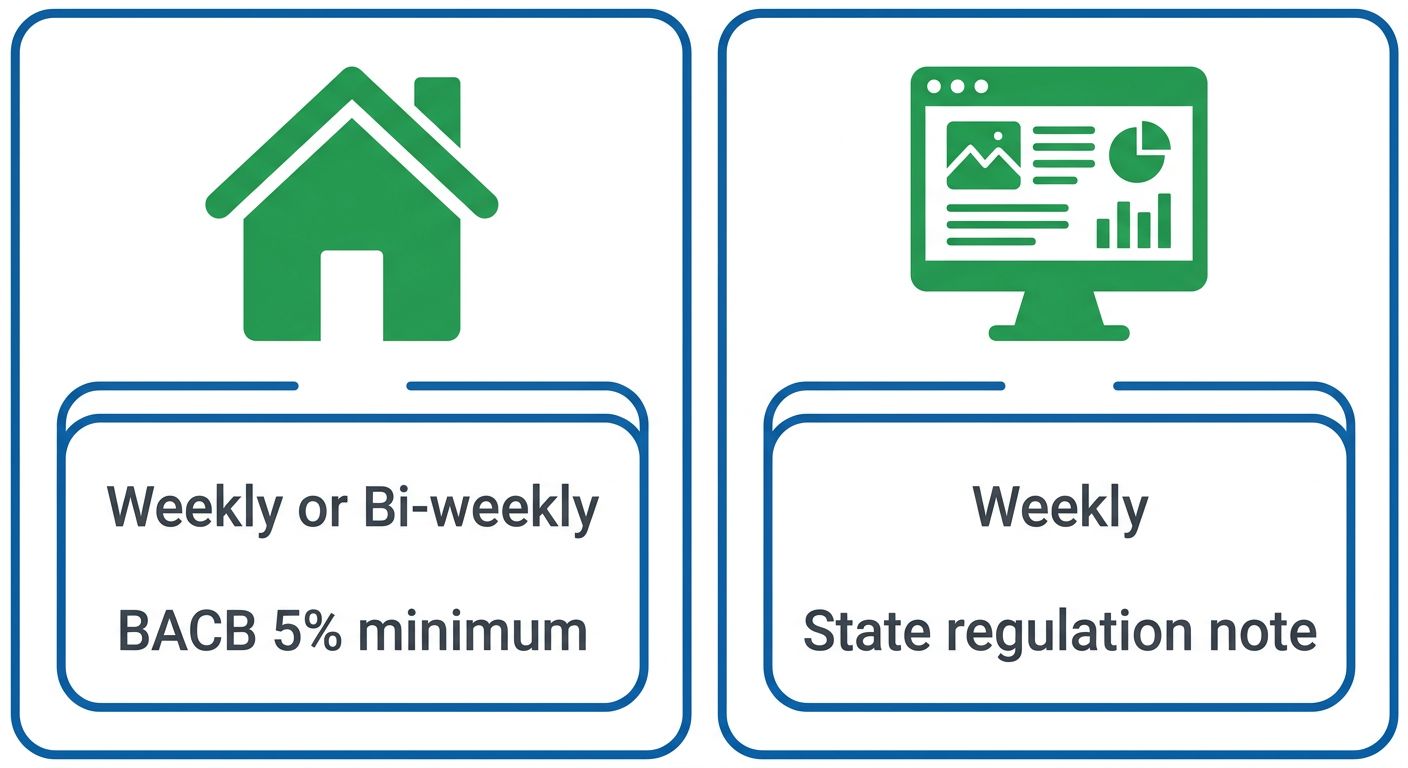
Comparison of in-home vs telehealth BCBA supervision frequency.
We schedule supervision based on more than just BACB minimums. Your BCBA considers your child’s treatment goals, the complexity of the behavior plan, and input from you and the RBT when determining how often to visit. Insurance providers also play a role, as they may stipulate certain supervision benchmarks. Because of these variables, we avoid guaranteeing a fixed frequency. Instead, we stay flexible and transparent, adjusting oversight as your child progresses and as your family’s circumstances change. As an organization rooted in family-centered care, we believe that BCBA oversight should feel like a partnership—we are here to listen, explain, and adapt.
You can expect consistent communication from your supervising BCBA whether the session is in person or remote. Many families ask how often they should see their BCBA, and while weekly or bi-weekly contact is common, we tailor the rhythm to what works best for you. This supervision structure ensures high-quality care; keep reading to learn what qualifications your BCBA should have.
Verifying Credentials and Understanding RBT Supervision Requirements
When you choose in-home ABA therapy for your child, understanding BCBA supervision for home therapy is crucial to ensuring your child receives safe, quality care. At Golden Touch ABA, we believe that transparency around qualifications builds trust, so we encourage families to verify the credentials of the professionals who will work with them. This section walks you through how to confirm a BCBA’s certification and explains the supervision standards that Registered Behavior Technicians (RBTs) must meet.
How to Verify a BCBA’s Credentials for Your Child’s Care
Verifying a BCBA’s credentials is a straightforward process that ensures your child’s therapist has the required training and ethical standing. Begin with the official Behavior Analyst Certification Board (BACB) registry. Here’s a step-by-step guide:
- Visit the BACB website and locate the certificant registry search tool.
- Enter the BCBA’s full name or certification number into the search fields.
- Review the search results to confirm that the BCBA holds an active, current certification — look for the BACB certification status and expiration date.
- Verify that the certificant is in good standing with no disciplinary actions or inactive status.
- For an extra layer of assurance, check that the BCBA meets any state-specific licensure requirements, as some states require additional credentials beyond BACB certification. You can usually find this by searching your state’s behavior analyst licensing board website.
At Golden Touch ABA, every supervising BCBA holds an active BACB certification and undergoes rigorous internal review. We invite you to ask us for certification details — it’s part of our commitment to family-centered care. The BACB registry is the authoritative source for verifying that your child’s supervising professional has met the national standards for behavior analysis. Taking these steps helps you feel confident that the person overseeing your child’s therapy has the expertise needed to design and monitor an effective in-home program. State licensure may require an additional verification; always confirm that your provider complies with local regulations. Remember, a BCBA who is certified but also licensed in your state offers an extra level of oversight and adherence to local professional standards.
Now that you understand how to check credentials, let’s examine the supervision requirements that ensure RBTs deliver therapy with continuous professional oversight.
RBT Supervision Requirements: What Parents Should Know
The BACB establishes specific RBT supervision requirements to maintain quality and safety in ABA therapy. At Golden Touch ABA, we follow these mandates closely because we know that consistent supervision directly impacts your child’s progress. The core standard: at least 5% of the RBT’s total service hours each month must include direct observation by a qualified BCBA. This observation can occur in person or via live video review, and it must happen regularly — not clustered into one day. For example, an RBT providing 20 hours of therapy per week would need at least one hour of direct BCBA observation each week.
Supervision goes beyond simple observation. It involves several components that together ensure the RBT applies the treatment plan faithfully and adapts when needed:
- Direct in‑person observation: The BCBA watches the RBT work with your child in the home, noting technique and interaction.
- Video review: For remote oversight or when in-person visits aren’t possible, the BCBA reviews recorded sessions to assess fidelity.
- Feedback meetings: After observation, the BCBA meets with the RBT to discuss strengths, areas for improvement, and any adjustments to the behavior plan.
- Performance evaluations: Periodic formal reviews track the RBT’s development and ensure they meet all competency standards, including BCBA supervised fieldwork hours when applicable.
Our team integrates these activities into a structured supervision schedule so that every RBT receives ongoing, meaningful guidance. We encourage parents to ask about supervision logistics when selecting a provider — questions like “How often will a BCBA observe my child’s session?” or “What does a typical feedback session look like?” can reveal a lot about a practice’s commitment to quality. At Golden Touch ABA, we make sure our BCBAs are intimately involved in your child’s care, not just occasional visitors. We structure our in-home programs so that every family benefits from robust BCBA supervision for home therapy.
Understanding these credentialing and supervision standards puts you in a stronger position to advocate for your child. In our next section, we’ll explore what a typical ABA therapy session looks like in your home, from the initial assessment to ongoing skill building. Please remember that therapy outcomes vary and you should consult a licensed healthcare professional for a medical diagnosis or personalized advice.
BCBA Supervised Fieldwork: Ensuring Competent Therapy Delivery
BCBA supervision for home therapy is the cornerstone of quality assurance at Golden Touch ABA. We call it BCBA supervised fieldwork — the ongoing clinical oversight that ensures every therapy session aligns with your child’s individualized treatment plan. This process maintains fidelity to evidence-based practices while creating a warm and welcoming environment where families feel supported and informed. We document supervisory feedback and progress notes to ensure continuity of care and clear communication regularly.
Our ongoing clinical supervision meets and exceeds the standards set by the Behavior Analyst Certification Board (BACB). Under these requirements, a BCBA must directly observe a meaningful portion of therapy hours each month and conduct regular face-to-face meetings with RBTs. This monitoring catches technique drift immediately, keeping every interaction effective and ethical. Supervisors review session data, adjust goals as needed, and coach RBTs on subtle behavioral strategies so interventions remain tailored and measurable. According to Golden Touch ABA’s clinical protocols, such rigorous oversight is central to our family-centered care model.
Because we deliver in-home ABA therapy, fieldwork supervision takes place right where your child lives and plays. Our BCBAs model strategies in real-life situations, turning parents into confident partners. In the home setting, we practice skills in daily routines to generalize learning and empower families to reinforce progress. RBT supervision requirements include direct coaching during sessions, where BCBAs review behavior plans and offer instant feedback, so your therapy team works as a unified, highly skilled unit.
Families experience the power of small steps: every milestone builds on expert guidance. While each journey is unique, this layered supervision keeps treatment dynamic, responsive, and always rooted in the best available research.
Results may vary; consult a licensed professional for diagnosis or treatment decisions.
Frequently Asked Questions About BCBA Supervision for Home Therapy
After learning about the essential role of bcba supervision for home therapy, families often have questions about how this process works within their daily routine. We provide clear answers to help you feel confident and informed.
What is BCBA supervision for home therapy?
Our Board Certified Behavior Analyst oversees every aspect of your child’s in-home ABA therapy program, ensuring it is personalized and effective. This clinical direction guarantees that teaching strategies are implemented correctly and adapted as your child progresses.
How often does a BCBA supervisor visit during in-home ABA?
The frequency of supervision sessions aligns with rbt supervision requirements and typically includes regular in-person and remote check-ins. We adjust the schedule to fit your family’s needs while maintaining the highest standard of clinical oversight.
What are the requirements for BCBA supervision in an in-home setting?
BCBAs complete extensive graduate education and hands-on training through bcba supervised fieldwork before earning their credential. Our supervisors bring this rigorous experience into your home, coordinating directly with your child’s therapist.
How does BCBA supervision benefit my child and their RBT?
Ongoing BCBA oversight provides your RBT with real-time feedback and in-the-moment training, creating a warm and welcoming environment for learning. This collaborative model supports our family-centered care philosophy and helps your child build skills faster.
Can BCBA supervision be conducted remotely or does it require in-person visits?
We use a hybrid model that combines in-person visits with secure remote observation to offer flexible support. This ensures we can maintain consistent supervision regardless of daily schedules or location challenges.
As a core piece of our evidence-based practices, regular BCBA oversight connects every small success to the power of small steps. This seamless clinical support prepares your family to confidently move toward discussing insurance and next steps with our team.
Empowering Your Child’s Progress Through Quality BCBA Supervision
BCBA supervision is the professional oversight provided by a Board Certified Behavior Analyst who guides your child’s in-home therapy and tracks meaningful progress. Through careful, data-informed adjustments and the direct involvement of our clinical team, each session evolves to support your child’s individual needs.
At Golden Touch ABA, we pair every family with a dedicated BCBA who designs a truly individualized treatment plan. An RBT implements that plan right in your home under close BCBA guidance during home-based therapy, ensuring every small step forward is celebrated. This collaborative, evidence-based approach helps create measurable growth while honoring the power of family-centered care, without promising any specific outcome. It naturally sets the stage for the way our RBTs deliver those thoughtfully crafted plans.
Resources
- Understand ABA Therapy Billing Units and CPT Codes
- Discover ABA Practitioner Requirements and Supervision Standards
- Discover the RBT Certification Process and Requirements
- Compare ABA Practitioner Tiers: RBT, BCaBA, and BCBA
- Discover RBT Training Aligned with BACB Task List
- Compare BCBA and RBT Roles and Training Requirements
- Explore Certification Paths for RBT and BCBA Practitioners
- Explore BACB Certification Requirements and Professional Resources
Table of Contents
- Discovering Positive Reinforcement in ABA Therapy
- Core Principles of Positive Reinforcement
- Benefits of Positive Reinforcement for Autistic Children
- How Positive Reinforcement Works in ABA
- Best Practices for Positive Reinforcement at Home
- Empowering Families with Reinforcement Strategies
Discovering Positive Reinforcement in ABA Therapy
Building on ABA fundamentals, let’s explore positive reinforcement, a cornerstone technique in applied behavior analysis. At Golden Touch ABA Therapy, we define positive reinforcement as providing a rewarding stimulus immediately after a desired behavior to increase its future occurrence. For example, offering praise or tokens during sessions motivates children to repeat positive actions, aligning with our family-centered care.
Our approach to ABA social skills relies heavily on positive reinforcement in discrete trial training for skills like turn-taking and eye contact during in-home ABA therapy. As detailed in our internal FAQ guidance from Golden Touch ABA, these ABA reinforcement strategies build social abilities such as sharing and conversation through evidence-based practices. Under BCBA supervision, we integrate them into individualized treatment plans, focusing on small, measurable steps.
The power of small steps shines in fostering independence and reducing challenging behaviors for children on the autism spectrum. Results may vary, but our warm and welcoming environment supports steady progress for families.
Positive reinforcement pairs seamlessly with methods like prompting and fading, enhancing overall outcomes in our personalized programs. Explore our interactive ABA roadmap for tailored strategies.
Core Principles of Positive Reinforcement
Defining Positive Reinforcement in ABA
Positive reinforcement forms the cornerstone of effective behavior change in ABA therapy. At Golden Touch ABA, we define it as presenting a desirable stimulus right after a desired behavior to boost its future occurrence. This principle draws from operant conditioning, where the addition of something pleasant, like praise or a favorite toy, strengthens the behavior. For instance, when a child completes a task, we offer verbal praise or a high-five, making them more likely to repeat it.
Golden Touch ABA’s FAQ resources explain this mechanism clearly. In contrast, negative reinforcement involves removing an unpleasant stimulus to increase behavior, such as allowing a child to escape a loud noise after complying. The key difference lies in addition versus removal. Positive reinforcement builds enthusiasm through rewards, fostering a warm and welcoming environment. This approach supports incremental progress, harnessing the power of small steps in our in-home ABA therapy. We celebrate each success and adjust supports based on data.
ABA Fundamentals and Reinforcement Role
Building on this definition, let’s explore ABA fundamentals. Applied behavior analysis is an evidence-based therapy that applies behavioral principles to enhance socially significant behaviors, especially for children with autism. We at Golden Touch ABA deliver it through family-centered care in the home, creating personalized plans supervised by BCBAs.
Positive reinforcement plays a pivotal role here. It strengthens desired behaviors within individualized treatment plans, as Golden Touch ABA’s ABA-specific FAQ outlines. For example, rewarding communication attempts helps build skills naturally. Our RBTs, under BCBA guidance, integrate these practices into daily routines. This method promotes independence and reduces challenges, aligning with evidence-based practices. In our in-home ABA therapy, families actively participate, reinforcing gains for lasting impact. Our BCBAs review progress regularly and train caregivers in practical techniques.
Techniques in Applied Behavior Analysis
These principles come alive in key techniques such as discrete trial training. This structured discrete trial training method includes an antecedent (instruction), behavior (response), and consequence (feedback), with positive reinforcement following correct actions. We also use natural environment teaching, embedding rewards in play, and pivotal response training, which follows child-led interests.
Golden Touch ABA’s educational blog highlights these interventions. Common methods include:
- Discrete trial training (DTT): Breaks skills into steps, rewarding each success to build ABA social skills.
- Natural environment teaching (NET): Uses everyday moments for reinforcement.
- Pivotal response training (PRT): Encourages initiation with immediate positives.
Family-centered care ensures parents reinforce these at home, emphasizing the power of small steps toward practical applications in daily life. We prioritize routine consistency.
Benefits of Positive Reinforcement for Autistic Children
At Golden Touch ABA Therapy, we harness positive reinforcement in our in-home ABA therapy to empower autistic children toward meaningful progress. This evidence-based approach celebrates every achievement, fostering growth in a warm and welcoming environment.
Skill Development Through Reinforcement
Positive reinforcement accelerates skill development in applied behavior analysis by rewarding small successes. We at Golden Touch ABA see children respond eagerly to verbal prompts for communication, building vocabulary through consistent praise and tokens. The power of small steps shines as kids master turn-taking in paired activities, enhancing social interactions via targeted aba social skills strategies, as shared in our provider FAQ.
Independence grows too, with rewards for task completion like dressing or handwashing. Discrete trial training integrates seamlessly, breaking skills into manageable parts for quicker mastery. Therapists track progress with individualized data collection to adjust reinforcement schedules and celebrate incremental milestones in partnership with caregivers. These gains, drawn from practical insights by Golden Touch ABA, highlight evidence-based practices tailored to each child.
These skill gains pave the way for broader behavioral changes in daily life.
Long-Term Behavioral Improvements
Consistent positive reinforcement schedules in applied behavior analysis yield lasting reductions in tantrums and self-injury. Children learn alternative responses through rewards, diminishing problematic behaviors over time. Our internal therapy FAQ guidance from Golden Touch ABA notes measurable outcomes, such as increased on-task behavior from 40% to 80% in sessions. Longitudinal records allow our teams to pinpoint triggers, refine supports, and share clear progress reports with families and providers regularly.
Discrete trial training reinforces these shifts, promoting sustained progress with data-driven adjustments. Families observe fewer disruptions at home, thanks to our family-centered care. This approach builds resilience, turning challenges into opportunities for growth without promises of uniform results.
Such changes extend to families through deeper connections and shared joy.
Family and Emotional Benefits
Positive reinforcement boosts family involvement via caregiver training in applied behavior analysis techniques. Parents learn to apply rewards naturally, strengthening bonds during everyday routines. We at Golden Touch ABA foster a warm and welcoming environment where children thrive on motivation, leading to joyful interactions and reduced stress. Family-centered care ensures everyone participates, enhancing overall harmony. Caregiver coaching includes modeling, role-play, and home-based tools that help families reinforce skills across daily routines with clear steps and BCBA guidance.
Emotional well-being flourishes as kids gain confidence from praised efforts. Family-centered care ensures everyone participates, enhancing overall harmony. Practical insights from Golden Touch ABA emphasize these heartfelt advantages in in-home ABA therapy.
Results may vary. Contact us for a personalized plan tailored to your family’s needs.
How Positive Reinforcement Works in ABA
Building on the advantages of ABA therapy, positive reinforcement plays a central role in our evidence-based practices at Golden Touch ABA Therapy. In applied behavior analysis, positive reinforcement involves delivering a rewarding stimulus immediately after a desired behavior to increase its future occurrence. This approach fosters skill-building in a warm and welcoming environment during our in-home ABA therapy sessions. We pair it with natural environment teaching to promote generalization, always prioritizing family-centered care. According to the Association for Science in Autism Treatment (ASAT), an authoritative review of evidence-based ABA teaching methods highlights structured procedures that integrate reinforcement effectively.
Discrete Trial Training with Reinforcement
Discrete trial training (DTT) breaks skills into manageable steps using a three-term contingency. Here’s how it works:
- Antecedent: The therapist presents a clear stimulus or discriminative stimulus (SD), like showing a picture card and saying, “What is this?”
- Target behavior: The learner responds correctly, such as naming the item.
- Consequence: If correct, immediate positive reinforcement follows, such as praise (“Great job!”) or a token. Incorrect responses receive neutral correction without punishment, and trials repeat.
Reinforcement only follows correct responses, strengthening the behavior. In our in-home ABA therapy, this structured DTT method adapts to the child’s natural surroundings, enhancing engagement. ASAT’s review emphasizes maintaining a structured teaching environment to ensure treatment fidelity. This builds confidence through the power of small steps, with results varying by individual.
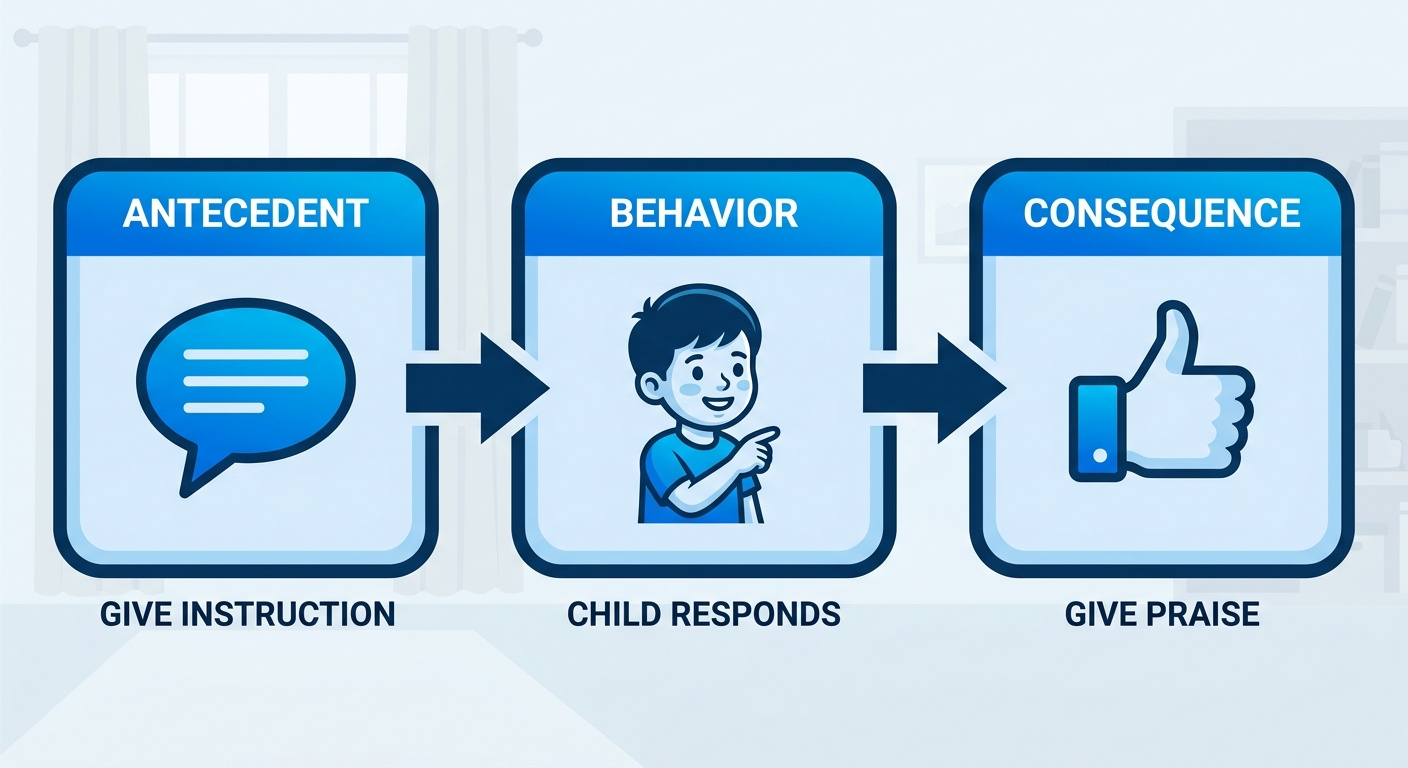
Positive reinforcement process in ABA Discrete Trial Training
The visual above illustrates this cycle, showing how consistent reinforcement drives progress in everyday home settings.
Session Examples and DTT Techniques
Consider mand training, where a child learns to request items. The therapist holds a preferred toy (antecedent), waits for the child to say “toy” (behavior), then immediately provides it with praise (reinforcement). Prompts fade from full verbal support to independence, using edible reinforcers initially.
- Session 1: Model “toy,” child echoes, earns toy + high-five.
- Session 2: Partial prompt, child independently requests.
For imitation skills, the therapist models clapping (antecedent), child imitates (behavior), receiving enthusiastic praise or a sticker.
- Use modeling for motor tasks.
- High-fives as social positive reinforcers.
Therapists reference aba teaching checklists for tracking responses and maintaining quality. These DTT techniques shine in family-centered care, blending structure with home comfort.
BCBA and RBT Implementation
Our BCBAs design reinforcement schedules and select individualized positive reinforcers via preference assessments, ensuring motivation matches the child. They supervise data collection, analyze progress, and adjust plans for optimal outcomes.
RBTs handle direct implementation: delivering prompts, providing reinforcement, and recording trials under BCBA guidance. This teamwork ensures consistency in every in-home ABA therapy session.
We emphasize compassionate delivery, promoting social interaction as noted in ASAT resources. BCBAs train RBTs ongoing, fostering growth. Results may vary, but our approach supports lasting skills. Stay tuned for how we customize plans with families for even greater impact.
Best Practices for Positive Reinforcement at Home
At Golden Touch ABA Therapy, we empower families with positive reinforcement strategies rooted in applied behavior analysis to support their child’s growth right in the home. These evidence-based practices make everyday moments opportunities for progress through consistent, immediate praise and rewards. Family-centered care starts with simple techniques you can use today. We model techniques and coach caregivers to build practical, lasting everyday confidence.
Practical Techniques and Examples
Let’s explore practical techniques for using positive reinforcement at home. Praise your child immediately after they complete a task, like putting away toys. Say, “Great job cleaning up!” with enthusiasm to build the habit.
- Token economies: Give stickers for good behaviors, such as finishing homework. Exchange them for preferred activities like extra playtime.
- Verbal praise with physical gestures: Pair “You shared so nicely!” with a high-five during social skills practice.
- Specific feedback: Note exactly what they did right, like “I love how you waited your turn at the table.”
Consistency and immediacy strengthen these connections, as National Center for Biotechnology Information (NCBI) authoritative government health data on ABA best practices highlights. We recommend practicing daily for lasting results.
DTT and Reinforcement in Natural Settings
Discrete trial training (DTT) brings structured teaching into your home with clear instructions, prompts, and reinforcements like small edibles or toys delivered right after correct responses. This builds foundational skills efficiently.
In contrast, natural environment teaching (NET) uses play-based incidental learning during routines, such as mealtime sharing. DTT shines for initial skill acquisition, while NET promotes generalization.
Home adaptation tips include:
- Start with DTT sessions at the kitchen table for tasks like matching colors.
- Fade prompts gradually into NET by reinforcing naturally during snack time.
According to NCBI data, these approaches align with professional ABA standards for effective interventions.
Parental Training with Professional Support
We offer robust parental training through Golden Touch ABA’s tools, like video models and progress trackers, to help you reinforce skills daily. Collaborate with our BCBAs for technique refinement, ensuring alignment with ABA professional standards.
Our interactive ABA roadmap guides home practice, promoting family-centered care. Golden Touch ABA resources, as our internal company materials detail, emphasize caregiver involvement for seamless therapy integration. We tailor sessions to your family’s needs in areas like Salt Lake City.
Monitoring Progress and Adjustments
Track weekly with simple charts noting reinforcement effectiveness, such as smiles after praise. Adjust by increasing praise if motivation dips.
Results may vary (no guaranteed outcomes). Consult our team for tweaks to sustain evidence-based practices and success.
Empowering Families with Reinforcement Strategies
Building on ABA fundamentals, we empower families with positive reinforcement strategies as part of our in-home ABA therapy. This core element of applied behavior analysis motivates positive behaviors through rewarding experiences like praise or fun activities, fostering growth in a warm and welcoming environment. We coach you to use everyday routines and simple progress tracking tools so families can celebrate small gains and stay aligned with individualized, measurable goals.
In discrete trial training, we break skills into small steps using evidence-based practices. A therapist gives a cue, the child responds, and correct actions earn positive reinforcers such as tokens or cheers, encouraging repetition and mastery.
Families can apply these at home with simple strategies:
- Specific praise: Say, “Great job sharing your toy!”
- Token economies: Earn stickers redeemable for privileges.
- Natural reinforcers: Offer extra playtime after tasks.
Our BCBAs supervise RBT-delivered sessions, training caregivers for consistency in family-centered care. Per our Golden Touch ABA Services overview, these ABA techniques support measurable outcomes, though results may vary (no guaranteed outcomes). Explore our interactive ABA roadmap tool or contact us for your personalized plan.
This article was researched and written with the assistance of AI tools.
Resources
- Discover In-Home ABA Therapy Services in Utah Counties
- Get 24/7 In-Home ABA Therapy for Children in Utah
- Explore Golden Touch ABA Therapy Locations Across States
- Access ABA Therapy for Low Functioning Autism in Utah
- Learn Collaborative ABA Treatment Planning with SMART Goals
- Identify Early Autism Signs in Infants and ABA Trends
- Recognize Early ASD Signs and Future ABA Innovations
- Review ABA Teaching Checklists for Therapist Training
- Explore ABA Professional Standards and Military Access Challenges
Table of Contents
Top Features of Best ABA Therapy in New Jersey
Discovering the best aba therapy in New Jersey starts with key features that make aba therapy for autism truly effective. At Golden Touch ABA Therapy, we prioritize personalized, evidence-based care to support your child’s growth.
Here are our top features:
- Individualized Treatment Plans: BCBAs create custom plans from behavioral assessments, as recommended by Autism Speaks.
- In-home ABA Therapy: We deliver sessions in a warm, familiar environment for comfort and progress.
- Family-Centered Care: Our training empowers caregivers, aligning with Autism Society insights on family roles.
- Evidence-Based Practices: Ongoing tracking ensures measurable results with proven methods.
- Flexible Scheduling & Insurance Help: We assist with benefits for seamless access.
Ready to experience these? Contact us for a custom quote and ABA therapy near me Newark tailored to your family. Results may vary.
1. Personalized Treatment Plans
Building on our commitment to evidence-based practices, we at Golden Touch ABA Therapy craft personalized treatment plans for each child, making us a leader in the best aba therapy available. These plans address unique needs, strengths, and family goals for aba therapy for autism, fostering real progress through family-centered care.
Explore our ABA services with this step-by-step process:
- Conduct a behavioral assessment to pinpoint target behaviors.
- Collaborate with families in goal-setting sessions.
- Design interventions using proven methods, supervised by our BCBAs per Behavior Analyst Certification Board (BACB) standards.
- Implement in-home ABA therapy sessions by trained RBTs, with ongoing adjustments and caregiver training via our interactive ABA roadmap.
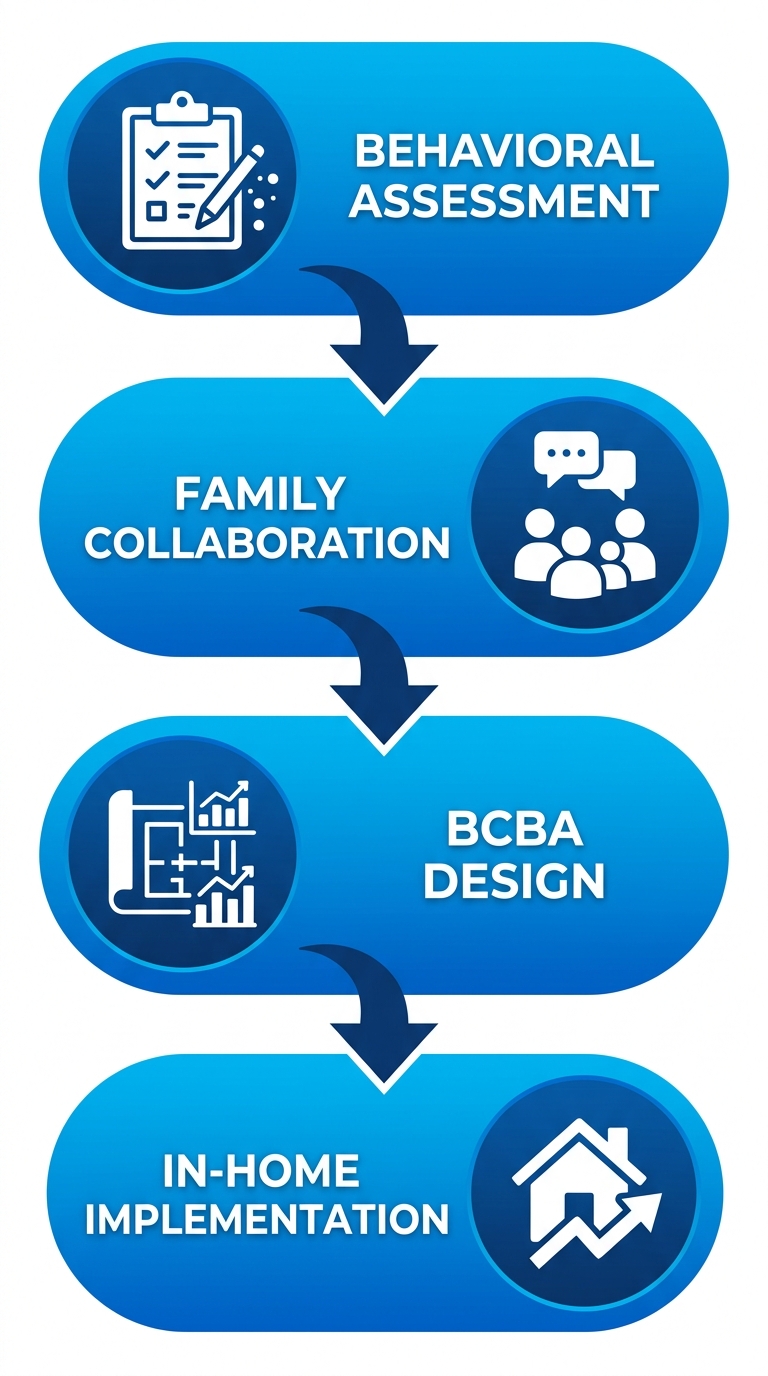
Four key steps in Golden Touch ABA personalized treatment plans
We offer flexible scheduling and insurance assistance—contact us for a custom quote. The power of small steps shines in our warm and welcoming environment. Results may vary. This foundation leads into our comprehensive behavioral evaluations—reach out today for your initial assessment.
2. In-Home Comfort Sessions
Building on foundational ABA principles, our In-Home Comfort Sessions take ABA therapy to where your child feels safest—right in their own home. We deliver the best aba therapy through in-home ABA therapy, fostering a warm and welcoming environment that minimizes anxiety and supports natural learning for children with autism.
Our sessions leverage the power of small steps in everyday settings. Key advantages include:
- Individualized treatment plans tailored to your child’s needs, like aba therapy for autism focusing on communication and independence.
- RBT-delivered therapy under BCBA supervision for consistent progress.
For example, services similar to autism ABA therapy in Lakewood highlight home-based benefits, as noted by Crystal Care ABA, an industry example of accessible care. We emphasize family-centered care with caregiver training to reinforce skills at home, flexible scheduling, and our interactive ABA roadmap tool for tracking. Evidence-based practices ensure measurable outcomes, though results may vary.
Complementing in-home care, explore our clinic-based options for added support. Contact us for custom plans and insurance assistance.
3. BCBA Expert Supervision
Building on your custom plan, our BCBAs provide expert oversight as part of the best aba therapy available through Golden Touch ABA Therapy. A Board Certified Behavior Analyst (BCBA) holds a graduate degree, passes the rigorous BACB exam, and completes supervised fieldwork, per the Behavior Analyst Certification Board (BACB) standards as the official certifying authority.
Our BCBAs conduct initial assessments and craft individualized behavior intervention plans for in-home ABA therapy. They deliver at least 5% direct monthly supervision of RBT sessions, reviewing real-time data to refine protocols. This ensures evidence-based practices tailored to each child.
Key benefits include:
- Skill generalization for families, promoting consistency at home.
- Progress monitoring with timely adjustments for optimal gains.
- Enhanced aba therapy for autism outcomes, supported by high-impact research from the Association for Behavior Analysis International (ABAI), like studies on autism interventions. ABA excels as a core therapy, complementing mental health therapies autism when needed, in our family-centered care approach where BCBAs train caregivers during sessions.
This supervision empowers our RBT team and your family for lasting progress with the power of small steps. Contact us for a custom quote. Results may vary based on individual circumstances.
4. RBT Skilled Implementation
Building on BCBA-designed plans, our Registered Behavior Technicians (RBTs) bring them to life through skilled implementation, delivering the best aba therapy in a child’s natural environment. As a core part of our In-home ABA therapy, RBT-delivered therapy receives close supervision by BCBAs to ensure precise execution of individualized behavior plans.
Our RBTs undergo rigorous certification, including 40-hour training, competency assessments, and ongoing supervision per BACB standards. Practical provider insights on RBT delivery standards highlight how this prepares them for effective evidence-based practices in daily sessions.
During visits, RBTs collect real-time data, apply prompting techniques like discrete trial training or natural environment teaching, and adjust strategies based on feedback. These top-rated ABA therapy approaches, as highlighted in the most cited behavior analysis articles, support meaningful progress in aba therapy for autism.
RBTs also empower families through hands-on guidance in family-centered care, training caregivers on reinforcement strategies. Our interactive ABA roadmap tool aids implementation tracking. Results may vary. Contact us for a custom quote on RBT services with insurance assistance.
5. Family-Centered Training
Building on our RBT-delivered sessions, we extend support through family training, providing one of the best ABA therapy experiences through family involvement. At Golden Touch ABA Therapy, we prioritize Family-centered care to empower caregivers in every step of the journey.
Our BCBA-led sessions teach reinforcement techniques, data tracking, and daily routine integration. For inspiration, consider autism family support stories like Tricia D. and her son Blake, referenced by Autism Speaks as a real-life example of family resilience amid autism challenges.
In our in home aba therapy, families gain confidence implementing strategies, enhancing aba therapy for autism at home. The power of small steps builds lasting skills, making us a top-rated choice for the best ABA therapy.
Families report smoother home implementation and greater assurance and increased confidence. Results may vary. Contact us for a custom quote on personalized training plans, leading to measurable family-involved outcomes.
6. Evidence-Based Strategies
Building on these benefits, we implement proven strategies that define the best aba therapy for children with autism. Evidence-based practices drive progress through the power of small steps, ensuring measurable outcomes in our family-centered care. Our in-home ABA therapy incorporates leading ABA therapy methods tailored to each child.
We use Discrete Trial Training (DTT) to break skills into small components with clear prompts and reinforcements. This approach thrives in our warm and welcoming environment, making aba therapy for autism highly effective at home.
Natural Environment Teaching (NET) builds skills in everyday contexts, with family involvement at the core. As industry examples like Crystal Care ABA show for regional practices, this fosters natural growth through play.
Pivotal Response Training (PRT) targets motivation via child-led activities, aligning with our individualized plans for in home aba therapy.
Delivered by RBTs under BCBA supervision, these strategies support lasting gains. Results may vary. Ready to start with these evidence-based approaches? Contact us for your custom plan and interactive ABA roadmap tool.
7. Progress Tracking Tools
With your child’s plan in place, our progress tracking tools bring it to life. We empower families through our Interactive ABA Roadmap tool, a standout feature of the best aba therapy. This online dashboard visualizes skill acquisition and behavioral milestones in real-time, accessible anytime for family-centered care.
Daily Data Logging
Our RBTs, under BCBA supervision, track target behaviors during in home aba therapy sessions using evidence-based practices like ABC charts and skill probes. Weekly BCBA reviews ensure data-driven adjustments for effective aba therapy for autism.
Quarterly Progress Reports and Family Training
We share customized reports with graphs showing improvement percentages and goal attainment rates. Caregivers learn to monitor home progress during family training sessions. Results may vary (no guaranteed outcomes).
These tools foster transparency and trust in our in home aba therapy. They ensure accountability—reach out today for your custom ABA roadmap. Contact us for a custom quote.
8. Insurance Assistance Support
At Golden Touch ABA Therapy, we provide dedicated insurance assistance to simplify access to the best aba therapy for children with autism. This family-centered care ensures families can focus on their child’s progress through in-home ABA therapy without insurance hurdles.
Our step-by-step process begins with an initial insurance verification call, followed by a thorough review of benefits and eligibility, including Medicaid. We handle submission of prior authorizations and offer ongoing claims support. Using evidence-based practices, our documentation strengthens approvals for aba therapy for autism. Our team also monitors claim responses, follows up with payers to resolve denials, coordinates additional documentation, and keeps families informed promptly at every step of the authorization process.
We train caregivers on using insurance effectively and provide flexible scheduling around coverage. Contact us today for a personalized insurance eligibility check. Insurance coverage is subject to verification and is not guaranteed.
Elevate Your Child’s Future with ABA
Imagine unlocking your child’s potential with the best aba therapy at Golden Touch ABA Therapy. Our in-home ABA therapy empowers families through evidence-based practices like discrete trial training for communication, naturalistic teaching for daily living skills, and peer play for social growth. Aba therapy for autism builds independence, though results may vary.
As shared in an inspiring real-life testimonial by Autism Speaks about Tricia D. and her son Blake, families thrive with dedicated support. The Autism Society champions such proven interventions as foundational for autism development. We deliver personalized in-home ABA therapy with BCBA supervision and family-centered care including caregiver training. Start elevating your child’s future today—try our interactive ABA roadmap tool or contact us for a custom quote.
This article was researched and written with the assistance of AI tools.
Resources
- Get No-Waitlist ABA Therapy for Autism in Newark
- Start ABA Therapy Quickly with No Waitlist in NJ
- Access In-Home Play-Based ABA Therapy in Lakewood
- Find Best Individualized ABA Therapy in New Jersey
- Build Personalized ABA Therapy Plans via Assessments
- Perform Behavioral Assessments for Autism Therapy Plans
- Complete Fast BCBA Assessments for Quick ABA Start
- Explore Mental Health Therapies for Autistic Individuals
- Discover Top-Cited Behavior Analysis Articles from 2025
- Learn Inspiring Autism Family Stories and Resources
- Apply Autism Society Principles for Therapy Choices
- Achieve BCBA Certification for Supervising Behavior Services
Table of Contents
- Discovering ABA Therapists at Golden Touch ABA Therapy
- Fundamentals of ABA Therapy
- Deep Dive into ABA Therapist Training
- Practical Steps for ABA Careers and Services
- Advanced ABA Opportunities in NJ and Beyond
- ABA Therapist FAQ
- Elevate Skills and Care with Golden Touch ABA
Discovering ABA Therapists at Golden Touch ABA Therapy
At Golden Touch ABA Therapy, we deliver in-home ABA therapy through dedicated aba therapists who make a real difference for children with autism. These professionals implement evidence-based practices, supporting families with personalized treatment plans that build communication and independence skills. According to the Behavior Analyst Certification Board (BACB), ABA effectively treats autism spectrum disorder and developmental disabilities across all ages.
We seek qualified aba therapists for roles like Registered Behavior Technicians (RBTs), Board Certified Behavior Analysts (BCBAs), and Behavior Analysts in Training (BAITs). Key qualifications include BACB certifications such as RBT or BCBA. Explore ABA careers Golden Touch to apply: submit your resume online, then prepare for interviews focused on experience and passion for family-centered care. Golden Touch ABA Therapy careers highlight competitive aba therapist salary—RBTs earn $19–$22/hour, BCBAs $87,000–$100,000/year, plus sign-on bonuses, health insurance, and paid time off. We provide paid indirect hours and BCBA supervision for BAITs, ongoing professional development, and clear pathways for advancement across Utah, Arizona, and Maryland within our expanding locations. The aba therapist job outlook shines with growing demand for autism services in Utah, Arizona, and Maryland.
Ready to join our team and embrace the power of small steps? Visit our careers page today!
Fundamentals of ABA Therapy
Building on ABA’s proven efficacy for children with autism, we at Golden Touch ABA Therapy embrace the fundamentals of this evidence-based approach. ABA therapy applies principles of learning and behavior to increase desirable behaviors while decreasing problematic ones, particularly in autism spectrum disorder contexts. As a scientific method, it relies on data collection and progress monitoring to ensure measurable improvements in communication, social skills, and independence.
According to professional association guidelines from the Association for Science in Autism Treatment, a quality ABA program includes seven essential components:
- Qualified staff with proper credentials
- Effective teaching procedures using reinforcement
- Parent training for family involvement
- Ongoing evaluation of progress
- Functional behavioral assessment
- Individualized behavior intervention plans
- Comprehensive supervision of sessions
These elements form the backbone of our in-home ABA therapy at Golden Touch ABA Therapy, creating a warm and welcoming environment tailored to each child’s needs.
In our practice, the BCBA (Board Certified Behavior Analyst) plays a pivotal role, designing individualized treatment plans, supervising therapy sessions, and assessing client progress. This requires a master’s degree and BCBA certification, as outlined by official standards from the Behavior Analyst Certification Board. BCBAs oversee teams to ensure evidence-based practices drive outcomes. Meanwhile, the RBT (Registered Behavior Technician), or aba therapist on the front lines, delivers one-on-one therapy in home settings, implements BCBA plans, and collects behavioral data. RBTs need a high school diploma and RBT certification. The aba therapist salary offers competitive compensation, aligning with a promising aba therapist job outlook for dedicated professionals in this growing field.
At Golden Touch ABA Therapy, our interdisciplinary teams exemplify seamless collaboration. BCBAs provide strategic oversight, while RBTs execute daily interventions, often alongside speech therapists or occupational experts. This teamwork, rooted in family-centered care, enhances skill acquisition through consistent reinforcement and real-time adjustments. Families in Salt Lake City and surrounding areas benefit from coordinated scheduling and insurance assistance, fostering trust and efficiency. Such collaboration not only accelerates progress but also empowers parents as active partners, amplifying the power of small steps toward independence.
ABA Therapist Roles Comparison
| Role | Responsibilities | Qualifications |
|---|---|---|
| BCBA | Designs treatment plans, supervises sessions, assesses progress | BCBA certification, master’s degree |
| RBT | Delivers one-on-one therapy, implements plans, collects data | RBT certification, high school diploma |
This structured division of roles at Golden Touch ABA Therapy maximizes expertise at every level. Families gain significant advantages from this team dynamic, including personalized parent training that equips caregivers to reinforce skills at home. Ongoing BCBA supervision ensures fidelity to plans, while RBTs build rapport in natural environments. Progress data informs adjustments, promoting sustainable gains in daily living and social abilities. Our family-centered care integrates parents fully, boosting engagement and long-term success. Results may vary, but this collaborative model consistently delivers meaningful outcomes for autism families.
Deep Dive into ABA Therapist Training
Certification Pathways for ABA Therapists
To excel as an aba therapist at Golden Touch ABA Therapy, understanding certification pathways is essential. We prioritize Registered Behavior Technician (RBT) credentials for entry-level roles, requiring a high school diploma followed by a 40-hour training program focused on ethics, measurement, and skill acquisition. This leads to passing the BACB RBT exam, making it accessible for those starting their careers in in-home ABA therapy. For advanced positions, the Board Certified Behavior Analyst (BCBA) path demands a master’s degree in behavior analysis or related field, plus 5,000 supervised hours of fieldwork, culminating in the rigorous BACB BCBA exam.
At Golden Touch ABA Therapy, we offer free BCBA supervision for RBTs, aligning with our hiring preferences for ABA therapy in Taylorsville, Utah, where local expertise drives family-centered care. These certifications not only boost aba therapist salary potential but also open doors to leadership in autism support. Golden Touch ABA insights highlight how certified professionals thrive in our warm and welcoming environment.
Training Levels Comparison
| Certification | Education Required | Exam Details |
|---|---|---|
| RBT | High school + 40-hour training | BACB RBT exam |
| BCBA | Master’s degree + 5000 supervised hours | BACB BCBA exam |
Daily Responsibilities in In-Home Sessions
In our in-home ABA therapy sessions, ABA therapists implement individualized behavior intervention plans tailored to each child’s needs. Daily tasks include one-on-one therapy focusing on skill-building, such as communication and social engagement, in the natural home environment. Real-time data collection tracks progress metrics like response rates and behavior reductions, ensuring evidence-based practices guide adjustments.
Evidence-Based Techniques Used
ABA therapists at Golden Touch ABA employ proven methods like Discrete Trial Training (DTT), a structured approach with antecedent, stimulus, response, and reinforcement sequences. Natural Environment Teaching (NET) integrates learning into play, capturing incidental opportunities during daily activities.
Practical Steps for ABA Careers and Services
Applying for ABA Therapist Positions
Ready to pursue a career as an aba therapist? At Golden Touch ABA, we make applying straightforward via goldentouchaba.com/careers. Start by visiting our careers page to view open positions for Registered Behavior Technicians (RBTs), Board Certified Behavior Analysts (BCBAs), and Behavior Analysts in Training (BAITs).
Salary Expectations Across the US
Aba therapist salary expectations vary widely across the US. At Golden Touch ABA, we enhance compensation with benefits including health insurance, dental and vision coverage, paid time off, sign-on bonuses, and paid training for professional development.
| Role | Average Salary | Experience Level |
|---|---|---|
| RBT | $40,000 – $50,000 | 0-2 years |
| BCBA | $70,000 – $100,000+ | 5+ years |
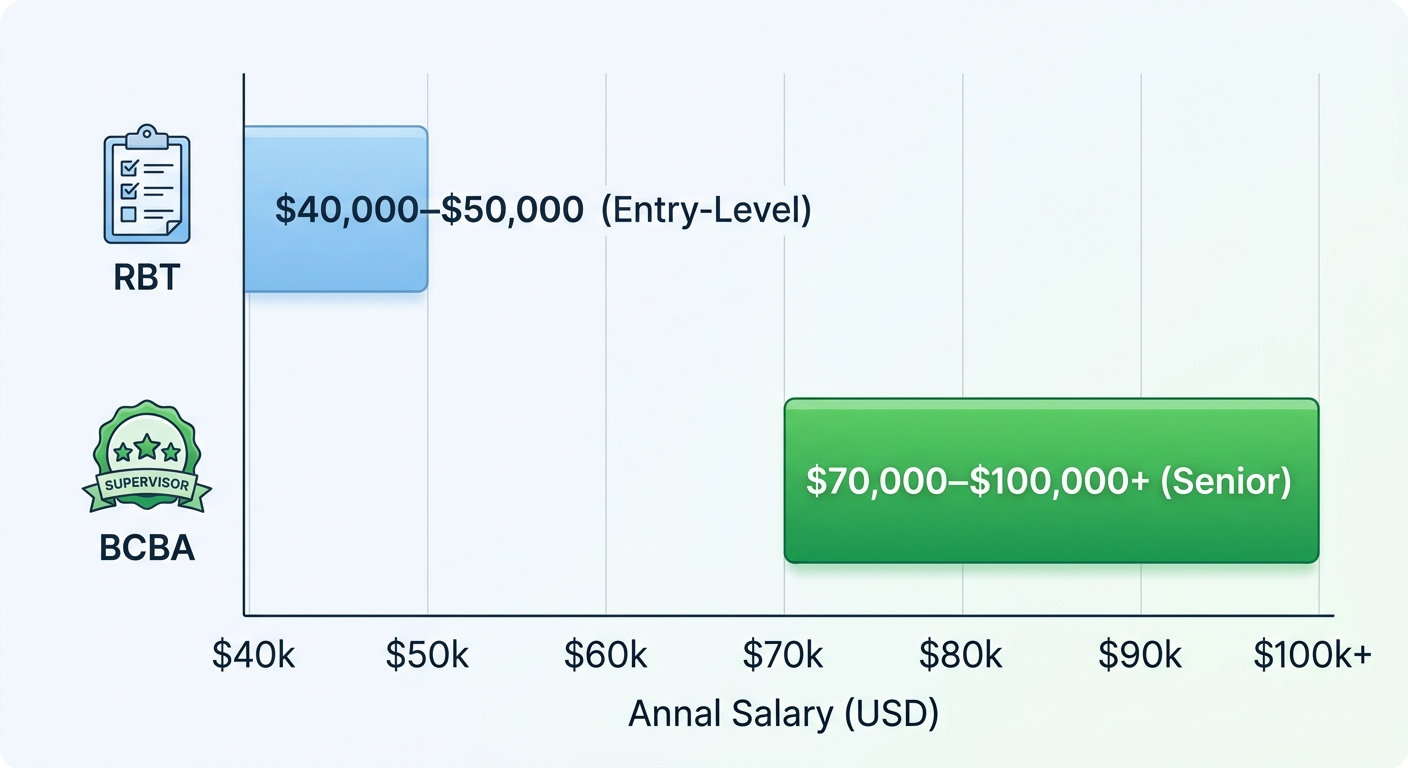
Family Onboarding for ABA Therapy
Families in Utah, Arizona, or Maryland can easily start in-home ABA therapy with Golden Touch ABA. Begin with an initial consultation call to discuss your child’s needs. We verify insurance benefits and schedule an in-home assessment by our BCBA to set goals.
Advanced ABA Opportunities in NJ and Beyond
Opportunities in New Jersey
New Jersey buzzes with demand for experienced ABA professionals. Advanced roles require New Jersey ABA licensing overseen by the New Jersey Division of Consumer Affairs. Aba therapist salary in these positions typically ranges from $70,000 to $95,000.
Job Outlook by State
| State | Demand | Licensing Notes |
|---|---|---|
| Utah | High in counties served | No state license required |
| New Jersey | Growing demand | State licensing required |
ABA Therapist FAQ
What does an ABA therapist do?
ABA therapists provide in-home ABA therapy, teaching kids with autism communication, social skills, and independence using evidence-based practices.
What is the average ABA therapist salary?
ABA therapist salary ranges from $35,000-$50,000 yearly, or $15-$25 hourly.
Elevate Skills and Care with Golden Touch ABA
Take your ABA expertise further with us at Golden Touch ABA. Ready to join? Apply now at our careers page today!
This article was researched and written with the assistance of AI tools.
Resources
- Explore Lucrative BCBA RBT Careers at Golden Touch ABA
- Discover Tailored In-Home ABA Therapy in Washington Terrace
- Get Personalized In-Home ABA Therapy in Taylorsville Utah
- Obtain Customized ABA Therapy for Independence in Eagle Mountain
- Access In-Home ABA Services Enhancing Skills in Pleasant Grove
- Secure Evidence-Based ABA Therapy in Parleys Canyon Utah
- Find Growth-Promoting In-Home ABA Therapy in Bluffdale Utah
- Learn New Jersey ABA Licensing Board Regulations
- Identify Key Characteristics of Quality ABA Programs
- Compare RBT Salaries by Location and Experience Factors
- Achieve BCBA Certification with BACB Requirements Guide
- Access BACB Resources for ABA Autism Treatment
Table of Contents
- Discovering Early Intervention ABA Therapy
- Core Principles of Early Intervention ABA
- Exploring Early Intervention Programs in Depth
- Applying Early ABA Therapy in Daily Life
- Advanced Techniques in Early ABA Therapy
- Common Questions on Early Intervention ABA
- Embracing Early ABA for Brighter Futures
Discovering Early Intervention ABA Therapy
At Golden Touch ABA Therapy, we believe that early action changes lives for children with autism. Early intervention ABA is a proven approach starting before age 3, offering the best chance for neurodevelopmental growth in toddlers facing challenges like delayed speech or social withdrawal. By using positive reinforcement and data-driven techniques, this therapy builds essential skills in communication, social interaction, and independence, reducing problematic behaviors along the way.
Imagine a young child struggling to make eye contact during playtime—ABA therapy for toddlers addresses this through tailored, in-home sessions that feel natural and supportive. Our team of Board Certified Behavior Analysts (BCBAs) designs individualized plans, while Registered Behavior Technicians (RBTs) deliver hands-on care with family-centered involvement. We draw from evidence like early intensive behavioral intervention, which research shows improves IQ, language, and adaptive skills significantly. Studies indicate children starting before age 3 show 47% greater gains in key areas, underscoring the power of prompt behavioral therapy initiation.
In this guide, we explore the fundamentals of early intervention for autism, from initial assessments and insurance assistance to our interactive ABA roadmap tool. We’ll cover implementation strategies, measurable outcomes, and advanced tips for timely ABA support for young children with autism. Remember, results may vary, so consult a licensed professional for personalized advice.
Our in-home ABA therapy creates a warm and welcoming environment, emphasizing evidence-based practices to empower families every step of the way.
Core Principles of Early Intervention ABA
Now that we understand the basics, let’s explore the core principles that make early intervention ABA so effective for young children on the autism spectrum. At Golden Touch ABA Therapy, we prioritize evidence-based techniques to support toddlers right when their brains are most adaptable, leveraging neuroplasticity to build essential skills during this critical window.
Early intervention ABA focuses on addressing core challenges like communication delays and social difficulties through structured yet flexible methods. One key principle is the use of positive reinforcement to encourage desired behaviors, creating a supportive learning environment in the home. We draw from established autism treatment options that emphasize individualized plans tailored to each child’s unique needs.
The principles can be outlined as follows:
- Assessment-Driven Planning: We begin with comprehensive evaluations, such as the VB-MAPP, to pinpoint a toddler’s strengths and areas for growth. This tool helps identify skill gaps in areas like manding or social play, ensuring goals are realistic and targeted.
- Evidence-Based Teaching Strategies: Techniques like discrete trial training break down skills into small, manageable steps, while natural environment teaching embeds learning into daily routines. For ABA therapy for toddlers, this means practicing turn-taking during playtime rather than in isolation.
- Data Collection and Progress Monitoring: Every session involves tracking behaviors and skill acquisition to measure outcomes objectively. This allows us to adjust plans dynamically, celebrating small victories that lead to bigger gains.
- Family Involvement: Parents are active partners, receiving training to reinforce skills at home. This collaboration fosters consistency and empowers families to support their child’s development long-term.
In practice, consider a two-year-old named Alex who struggles with expressing needs. Our initial ABA strategies for autism spectrum toddlers start with simple prompts for autism behavioral support, like using pictures to request toys. Over time, Alex gains confidence, reducing frustration and enhancing independence.
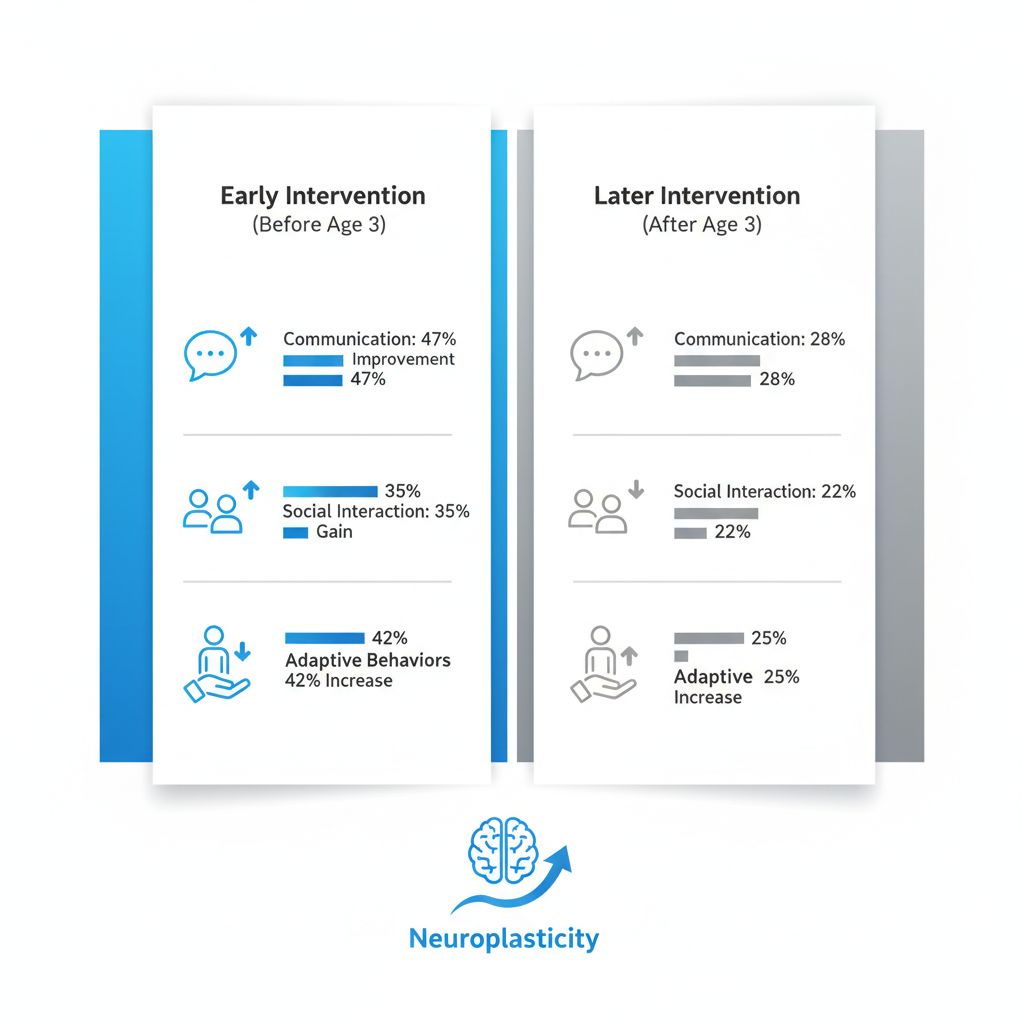
Comparison of early vs. later ABA therapy outcomes for maximum child development gains
Our assessment and planning process at Golden Touch ensures every child receives a customized roadmap. A BCBA leads this phase, conducting observations in the natural home setting to set measurable goals, such as improving eye contact during interactions. We integrate tools like the VB-MAPP to baseline current abilities, then prioritize priorities based on family input. This thorough approach, endorsed by sources like the CDC for its empirical support, sets the stage for meaningful progress without overwhelming young learners.
The clinical team plays a vital role in delivery. Our Board Certified Behavior Analysts (BCBAs) design and oversee plans, while Registered Behavior Technicians (RBTs) implement one-on-one in-home ABA therapy sessions. We emphasize pairing—building rapport through fun activities—to make therapy engaging. Parental training sessions equip caregivers with techniques, ensuring skills generalize beyond therapy time. This team effort, rooted in family-centered care, maximizes outcomes through consistent, evidence-based practices.
The benefits of early intervention for autism are profound, as intensive early ABA yields significant IQ gains and improved adaptive functioning, according to research on early intensive programs. Children experience enhanced communication, better social engagement, and greater independence, much like building a strong foundation early to support lifelong growth. At Golden Touch, we see families thrive as toddlers develop the power of small steps toward autonomy.
Research consistently shows that starting before age 3 unlocks greater potential due to heightened brain plasticity. The following table highlights key developmental gains from early versus later starts, drawn from meta-analyses in NCBI and ASAT studies:
| Developmental Area | Early Intervention (Before Age 3) | Later Intervention (After Age 3) |
|---|---|---|
| Communication Skills | 47% improvement in expressive language | 28% improvement in expressive language |
| Social Interaction | 35% gain in peer engagement | 22% gain in peer engagement |
| Adaptive Behaviors | 42% increase in daily living skills | 25% increase in daily living skills |
These percentages, approximate based on evidence-based data, underscore why timing matters—early starts yield nearly double the progress in core areas, helping children integrate more fully into family and community life. By intervening promptly, we at Golden Touch ABA Therapy amplify these advantages, fostering warm and welcoming environments where every child can flourish. Remember, results may vary, and we encourage consulting licensed professionals for personalized advice.
Exploring Early Intervention Programs in Depth
Building on core principles, let’s examine how early intervention programs operate in practice. At Golden Touch ABA Therapy, we focus on comprehensive early autism ABA frameworks that support toddlers with autism through personalized, evidence-based approaches. These in-depth toddler behavioral programs emphasize natural environment learning, especially in home settings across states like Utah and Arizona.
Program Structure and Techniques
Early intervention ABA forms the backbone of our support for young children on the autism spectrum. We design these programs with an intensity of 20 to 40 hours per week, tailored to each child’s needs to foster rapid skill development. Sessions occur frequently, often three to five days a week, incorporating evidence-based methods like pivotal response training, which builds on a child’s interests to encourage spontaneous communication and social engagement.
ABA therapy for toddlers includes a mix of structured and naturalistic techniques to address core challenges such as imitation, language, and play skills. For instance, we start with basic imitation goals, progressing to complex social play interactions that promote independence. Caregiver involvement is key; we train parents to reinforce these skills during daily routines, ensuring consistency beyond therapy hours. Adaptations for co-occurring conditions, like sensory sensitivities, involve sensory integration strategies to keep sessions engaging and effective. Drawing from Autism Society resources, these methods show strong efficacy in improving socially significant behaviors when applied early.
Selecting the right techniques depends on a toddler’s developmental stage, home environment, and family dynamics. We prioritize methods that blend structure with flexibility for optimal outcomes in familiar settings. The following table compares two common ABA techniques used in early intervention, highlighting their suitability for home environments and benefits for toddlers.
| Technique | Description | Benefits for Toddlers | Home Implementation Ease |
|---|---|---|---|
| Discrete Trial Training | Structured teaching with prompts and rewards | High focus, rapid skill building | Medium – requires space setup |
| Natural Environment Teaching | Play-based learning in daily routines | Naturalistic social skill improvement | High – easy integration into play |
Based on ASAT and Autism Society resources, these techniques focus on toddler applicability, with DTT providing clear milestones and NET enhancing real-world generalization. At Golden Touch, we combine them in our in-home ABA therapy to create hybrid sessions that maximize progress while fitting seamlessly into family life. This family-centered care ensures evidence-based practices lead to measurable gains without overwhelming daily schedules.
Role of Clinical Teams in Implementation
Our clinical teams play a vital role in delivering effective early intervention for autism. Board Certified Behavior Analysts (BCBAs) lead the process, conducting initial assessments and crafting individualized treatment plans. They oversee every aspect, from goal-setting to progress reviews, ensuring alignment with best practices. BCBAs provide weekly supervision to Registered Behavior Technicians (RBTs), who handle the hands-on delivery of sessions in the home.
RBTs bring energy and expertise to daily interactions, using techniques like positive reinforcement to teach skills in a warm and welcoming environment. We match RBTs to children based on personality and learning styles for the best rapport. Collaboration extends to multi-disciplinary coordination, where we partner with speech therapists or occupational specialists as needed. For insurance eligibility, our team offers support to navigate coverage, often through Medicaid or private plans, making services accessible. Families can learn more about accessing autism services through the CDC.
In practice, this teamwork shines in scenarios like a toddler in Fruit Heights, Utah, where our BCBAs adjust plans based on RBT feedback from home sessions. We reference our flexible scheduling in Utah counties to accommodate family needs, empowering parents with strategies for reinforcement. This integrated approach, inspired by CDC recommendations for early programs, helps children build foundational skills through consistent, supportive implementation.
Measuring Progress in Young Children
Tracking progress in early intervention requires reliable data collection tools to capture subtle improvements in toddlers. We use simple, visual charts and apps to log behaviors like eye contact or verbal responses during sessions. These tools, aligned with evidence-based practices, allow real-time analysis of skill acquisition rates. For example, baseline data might show a child responding to their name 20% of the time, with weekly graphs tracking increases.
Adjustments form the core of program refinement, ensuring interventions evolve with the child’s growth. BCBAs review data bi-weekly, tweaking techniques if progress stalls—perhaps shifting from DTT to more NET if social gains lag. Caregiver input is crucial here; we gather feedback on home carryover to inform changes. In one case, a young client in Arizona advanced from basic imitation to joint attention after targeted modifications, though results may vary.
This ongoing process supports the power of small steps, with multi-disciplinary reviews addressing co-occurring needs like motor delays. By focusing on measurable outcomes, we help families see tangible advancements, consulting licensed professionals for any medical advice. Our interactive ABA roadmap tool aids in visualizing this journey, reinforcing family-centered care without promising specific timelines.
Applying Early ABA Therapy in Daily Life
With a solid understanding of early intervention ABA programs, here’s how to bring these strategies into your home for meaningful progress. At Golden Touch ABA Therapy, we focus on family-centered care that integrates ABA therapy for toddlers seamlessly into daily routines, promoting skills like communication and independence in a warm and welcoming environment. This practical approach helps families in areas like Utah and Maryland see the power of small steps toward lasting improvements.
Setting Up In-Home Sessions
Preparing your home for effective ABA sessions starts with creating a dedicated space that feels natural and inviting. We recommend designating a quiet play area with familiar toys, soft lighting, and minimal distractions to mimic your toddler’s everyday world. Clear away clutter and set up simple stations for activities, like a communication corner with picture cards or a motor skills zone with puzzles. This setup supports early intervention ABA by leveraging your child’s comfort, making learning feel like play rather than work.
Scheduling is key to consistency without overwhelming your routine. Aim for 2-3 hours daily, broken into shorter bursts of 20-30 minutes to match a toddler’s attention span. Coordinate with our team to align sessions around nap times or meals, ensuring flexibility for busy families in places like Salt Lake County, Utah. Use a simple checklist to get started:
- Assess your home layout for safe, open spaces.
- Gather age-appropriate materials based on your child’s goals.
- Block calendar slots and share with your BCBA for personalized adjustments.
- Track session notes in our interactive ABA roadmap tool for ongoing tweaks.
These steps make practical early ABA applications for home straightforward, fostering engagement from the first session. in-home ABA therapy allows us to tailor everything to your family’s pace, drawing from evidence-based practices that we’ve seen enhance focus and reduce anxiety.
The following table highlights why in-home delivery often edges out clinic-based options for toddlers, emphasizing the natural learning advantages we prioritize at Golden Touch ABA Therapy.
| Aspect | In-Home ABA | Clinic ABA |
|---|---|---|
| Environment Familiarity | High – uses child’s routines | Low – new setting may cause anxiety |
| Generalization of Skills | Better transfer to daily life | Requires extra practice at home |
| Scheduling Flexibility | High – adapts to family needs | Limited to facility hours |
At Golden Touch, our model ensures strong skill generalization—often up to 90% in familiar settings—by embedding therapy into real-life contexts. This contrasts with clinic approaches that might need additional home reinforcement, as noted in our Utah-focused services. Families benefit from this flexibility, especially when navigating insurance in counties like Weber or Davis, allowing therapy to fit seamlessly without disrupting school or family commitments. Drawn from our in-home focus and CDC guidelines on early autism supports, this comparison underscores how we guide families every step toward accessible, effective care.
Parental Involvement and Training
We believe family-integrated autism interventions thrive when parents are active partners, not just observers. Our training equips you with hands-on modules on positive reinforcement techniques, like using praise or rewards to encourage desired behaviors during mealtime or playtime. Sessions cover modeling prompts for communication, such as guiding your toddler to request toys verbally, and tracking progress through simple daily logs shared via our app.
Benefits extend beyond immediate sessions; trained parents report stronger bonds and faster skill uptake at home. For early intervention for autism, we provide weekly check-ins with your BCBA to refine strategies, ensuring they align with your child’s unique needs. In areas like Spring Lake or South Salt Lake in Utah, our approach includes insurance navigation support to make this involvement sustainable. Remember, results may vary, but consistent practice reinforces what we teach, building confidence for everyone involved. This collaboration highlights our commitment to evidence-based practices that empower you to extend therapy’s reach throughout the day.
Real-World Success Examples
Consider a toddler in Emigration Canyon, Utah, who struggled with eye contact and turn-taking. Through our in-home ABA therapy, we introduced short games during snack time, gradually increasing interaction time. Over six months, the family noted a 70% improvement in social initiations, with the child now eagerly joining playdates—progress tracked via our ABA roadmap tool.
Another case from Maryland involved reducing tantrums tied to transitions. Parents, trained in de-escalation cues, implemented visual schedules at home, leading to fewer outbursts and better routine adherence. Skills like dressing independently emerged, boosting the child’s self-reliance. These anonymized stories from Golden Touch programs illustrate ABA therapy for toddlers in action, where small, consistent wins compound into daily independence.
Key takeaways include celebrating incremental gains, like first words or shared smiles, without expecting overnight miracles. Consult our team for tailored plans, as individual outcomes depend on factors like starting age and support levels. In communities across Arizona and Utah, we’ve witnessed how these practical applications transform challenges into opportunities, always with family-centered care at the core.
Advanced Techniques in Early ABA Therapy
Once the basics of ABA therapy are in place, advanced techniques elevate progress for toddlers, helping them build on foundational skills with more nuanced strategies. At Golden Touch ABA Therapy, we incorporate these sophisticated early ABA methodologies to address complex behaviors in a child’s natural home environment. For instance, pivotal response training (PRT) focuses on motivation, encouraging toddlers to initiate interactions spontaneously through play-based activities tailored to their interests. This method, rooted in evidence-based practices, fosters pivotal behaviors like self-initiation that ripple across social and communication domains.
Functional behavior assessments (FBA) play a key role here, allowing our Board Certified Behavior Analysts (BCBAs) to pinpoint the triggers and purposes behind challenging actions. We apply FBA results to design targeted interventions, such as using data analytics to track progress and make real-time adjustments. In our in-home ABA therapy, this means adapting sessions weekly to ensure steady gains. Cultural adaptations ensure techniques resonate with diverse family backgrounds, promoting inclusivity in every plan. These approaches, supported by ASAT and NCBI insights, mark the progression in early intervention ABA for toddlers facing autism.
The following table compares basic and advanced ABA strategies, highlighting how they build on each other for toddler interventions:
| Strategy Type | Focus | Complexity Level | Outcomes for Autism |
|---|---|---|---|
| Basic (e.g., DTT) | Core skill acquisition | Low | Initial gains in compliance |
| Advanced (e.g., PRT) | Pivotal skill development | Medium-High | Enhanced social and adaptive behaviors |
This comparison underscores the evolution from structured drills to dynamic, child-led methods, tailored for early intervention progression. We at Golden Touch integrate these by combining advanced ABA with co-therapy, like partnering with speech services to holistically support communication growth. In areas such as ABA therapy in Washington Terrace, Utah, our teams deliver these integrated sessions, drawing on local success metrics from places like Fruit Heights for measurable improvements in daily living skills.
Transition planning forms the bridge to school readiness, where we outline steps for generalizing skills beyond home. For early intervention for autism, this includes progressive autism therapy enhancements like fading prompts to build independence. Our BCBAs provide ongoing oversight, using family-centered care to sustain gains long-term. Here are a few advanced tips we follow:
- Monitor data trends to anticipate needs.
- Involve caregivers in co-therapy for reinforcement.
- Customize transitions with visual supports.
Results may vary, and we encourage consulting licensed professionals for personalized advice. Through these strategies, we empower families with the power of small steps toward lasting independence.
Common Questions on Early Intervention ABA
For quick insights into early intervention ABA, we address common concerns through our family-centered care approach.
How soon can we start? We schedule initial assessments quickly, often within a week in areas like Parleys Canyon, UT, to begin in-home ABA therapy tailored to your child’s needs. Our Parleys Canyon services streamline starts for prompt progress.
What does a session look like for ABA therapy for toddlers? Sessions feature engaging play-based activities, using positive reinforcement to build communication and social skills in a warm and welcoming environment.
How involved are parents in early intervention for autism? We prioritize family-centered care with hands-on training, empowering you to support learning at home through evidence-based practices.
Does insurance cover it? Many plans, including Medicaid, do; we assist with eligibility and navigation to make early intervention for autism accessible.
What results can we expect? Our evidence-based programs often enhance independence and daily functioning, though results may vary based on individual needs.
Embracing Early ABA for Brighter Futures
In summary, early intervention ABA offers lifelong advantages for autism, empowering families through skill development and better outcomes for toddlers. Starting ABA therapy for toddlers early fosters communication, independence, and emotional growth in a supportive environment. Our in-home, evidence-based practices make this journey accessible and effective.
We’re here to guide you with personalized support across Utah, Arizona, and Maryland. Explore our interactive ABA roadmap tool and reach out for an initial assessment. Contact us for ABA therapy in Parleys Canyon, Utah to begin building a brighter path today.
Resources
- Get Personalized In-Home ABA Therapy for Autism
- Access Tailored In-Home ABA Therapy in Parley’s Canyon
- Discover Engaging In-Home ABA Therapy for Skill Development
- Find Individualized Home-Based ABA Care for Autism
- Obtain Customized ABA Therapy in South Salt Lake
- Explore Personalized ABA Therapy in Emigration Canyon
- Learn About ABA Therapy Services in Fruit Heights
- Explore Comprehensive Autism Treatment Options and Strategies
- Access Early Intervention and School Services for Autism
- Understand Early Intensive Behavioral Intervention for Autism
- Discover Varied Autism Interventions and Therapy Options
- Learn Early Intensive ABA Program Essentials for Autism
