
ABA Therapy Goal Setting Techniques: Complete Guide for BCBAs
Table of Contents
- Purposeful Progress: Setting the Stage for ABA Therapy Goals
- The Foundation of Effective ABA Goal Setting
- The Advantages of Structured Goal Setting in ABA
- Crafting and Implementing Individualized ABA Goals
- Collaborating with Families and Tracking Milestones
- Embracing a Collaborative Path Forward
Purposeful Progress: Setting the Stage for ABA Therapy Goals
In ABA therapy, purposeful progress is the intentional, measurable growth achieved through thoughtful goal setting. We believe that effective treatment starts with a clear roadmap built around proven aba therapy goal setting techniques, ensuring every child’s journey is both structured and meaningful.
Goal setting serves as the foundation for effective therapy, directing assessment and guiding intervention. Our approach to ABA treatment planning begins with collaborative, purposeful goal setting to define each child’s unique starting point and potential. By partnering directly with families and our Board Certified Behavior Analysts, we identify priorities that target meaningful behaviors, fostering skills that enhance daily life and independence. We focus on smart goals in aba therapy—specific, measurable, achievable, relevant, and time-bound objectives—that bring clarity to the process. The power of small steps drives this method, where clear aba therapy operational definitions ensure measurable progress, turning broad outcomes into achievable daily wins. This commitment to evidence-based practices and family-centered care keeps therapy relevant and responsive to each child’s evolving needs.
The Foundation of Effective ABA Goal Setting
Now that we understand the importance of goal setting in ABA, let’s explore the foundation behind effective goals. Effective aba therapy goal setting techniques start with a commitment to precision and collaboration. At Golden Touch ABA Therapy, we believe that every child’s journey is unique, and our in-home approach allows us to create goals that fit naturally into your family’s daily life. By grounding our work in evidence-based practices and family-centered care, we transform broad hopes into clear, actionable steps.
Why Measurable Goals Matter in ABA
Why is it so important for therapy goals to be precise? The answer lies in the science of behavior. Measurable goals allow us to see the impact of our interventions clearly. According to the National Center for Biotechnology Information, data-driven goal setting consistently leads to improved outcomes in behavioral interventions. This means that when we define exactly what we are working on, we can reinforce progress effectively and adjust our strategies if a child is not responding. It’s the power of small steps measured and celebrated along the way.
Applying the SMART Framework to Autism Treatment
We work together as a team to ensure therapy goals are clear and achievable, which is where setting smart goals in aba therapy becomes essential. The SMART framework gives us a powerful blueprint. Let’s look at how we apply it with concrete examples from our sessions:
- Specific: We target a well-defined skill. For example, instead of a vague goal like “improve communication,” a specific goal is: “Liam will request a preferred snack by combining a one-word label with the ‘please’ sign.”
- Measurable: We can count the behavior to track progress. For social initiation, a measurable goal is: “Maya will initiate a greeting with a peer by saying ‘hi’ or waving during 4 out of 5 scheduled play opportunities at the park.”
- Achievable: The goal is challenging yet realistic. For daily living skills, an achievable goal is a small step: “Alex will independently put on one sock during the morning routine for three consecutive days.”
- Relevant: The goal targets a skill that will meaningfully improve the child’s and family’s life. Focusing on a favorite activity ensures that a communication goal truly motivates the child.
- Time-bound: Every goal has a deadline for re-evaluation. We might set a target that “Elena will use her communication card to request a break when feeling overwhelmed during 80% of opportunities by her next monthly review.”
Creating Operational Definitions for Clear Tracking
How do we make sure that something like “engagement” or “compliance” is seen the same way by every therapist and family member? This is where aba therapy operational definitions come into play. An operational definition translates a vague behavior label into something observable, objective, and countable, eliminating any guesswork.
A weak definition might state: “reduce self-stimulatory behavior.” This phrase is unclear; what does it consist of, and where does it occur? A strong, parent-friendly operational definition would be: “vocal stereotypy, defined as any instance of repetitive, non-contextual humming or squealing sounds lasting longer than three seconds, excluding singing along to music.” The difference is critical. The strong definition allows anyone on the team to know exactly when the behavior occurs and to track its frequency accurately. We can then create a plan to teach a replacement behavior that serves the same sensory need, all while collecting data that reliably shows progress. This precise tracking is a cornerstone of our evidence-based practices.
The Advantages of Structured Goal Setting in ABA
At Golden Touch ABA Therapy, we believe in the power of small steps. By breaking down larger objectives into small, measurable steps, structured goal setting unlocks a child’s potential across multiple areas, and this is why it is a cornerstone of effective ABA treatment planning. Our approach to aba therapy goal setting techniques ensures that every milestone is realistic, data-driven, and tailored to each child’s unique needs, creating a clear path toward meaningful, long-term progress.
Fostering Communication and Social Skills
One of the primary benefits of structured goal setting in ABA is the development of vital communication and social abilities. We design goals that target foundational skills, starting with simple requests for favorite items or activities, labeling emotions like happiness or frustration, and initiating play with peers. These aren’t just isolated skills; each small step builds toward deeper social connection and a greater ability for your child to express their world, turning daily interactions from sources of frustration into moments of joy. Our aba therapy goal setting techniques focus on reinforcing these attempts until they become natural parts of your child’s repertoire.
Building Functional Living Skills for Independence
Structured goal setting is instrumental in building independence through functional living skills. By defining smart goals in aba therapy, we can teach essential self-care routines in a way that promotes autonomy and builds confidence. Using task analysis, we break activities like brushing teeth, dressing, and feeding into a series of small, teachable steps, and then we use chaining to link these steps together. When families practice these routines within a warm and welcoming environment at home, the skills are more likely to generalize, helping your child navigate their day with increased self-reliance and a sense of accomplishment.
Reducing Problem Behaviors Through Targeted Goals
Addressing challenging behaviors begins with understanding their root cause, which is why our approach is grounded in a systematic assessment process. Our BCBAs conduct a thorough functional behavior assessment (FBA) to identify the specific triggers and functions of a behavior, as noted in our internal FAQ on the benefits of ABA therapy. This allows us to establish goals using aba therapy operational definitions, ensuring the target behavior and its replacement are described in clear, observable terms. The core objective is not just to stop a troubling behavior, but to teach an appropriate, functionally equivalent alternative—such as teaching a child to use a card or a sign to request a break instead of having a tantrum. This philosophy is embedded in our commitment to family-centered care, where we train and empower parents to consistently reinforce these new, positive behaviors across all settings.
Crafting and Implementing Individualized ABA Goals
Now let’s walk through how we create and implement individualized goals for every child. Effective ABA therapy goal setting techniques start with a thorough understanding of your child’s unique strengths, needs, and your family’s priorities. At Golden Touch ABA Therapy, this collaborative process is the foundation of our family-centered care, ensuring every goal we set is both meaningful and achievable.
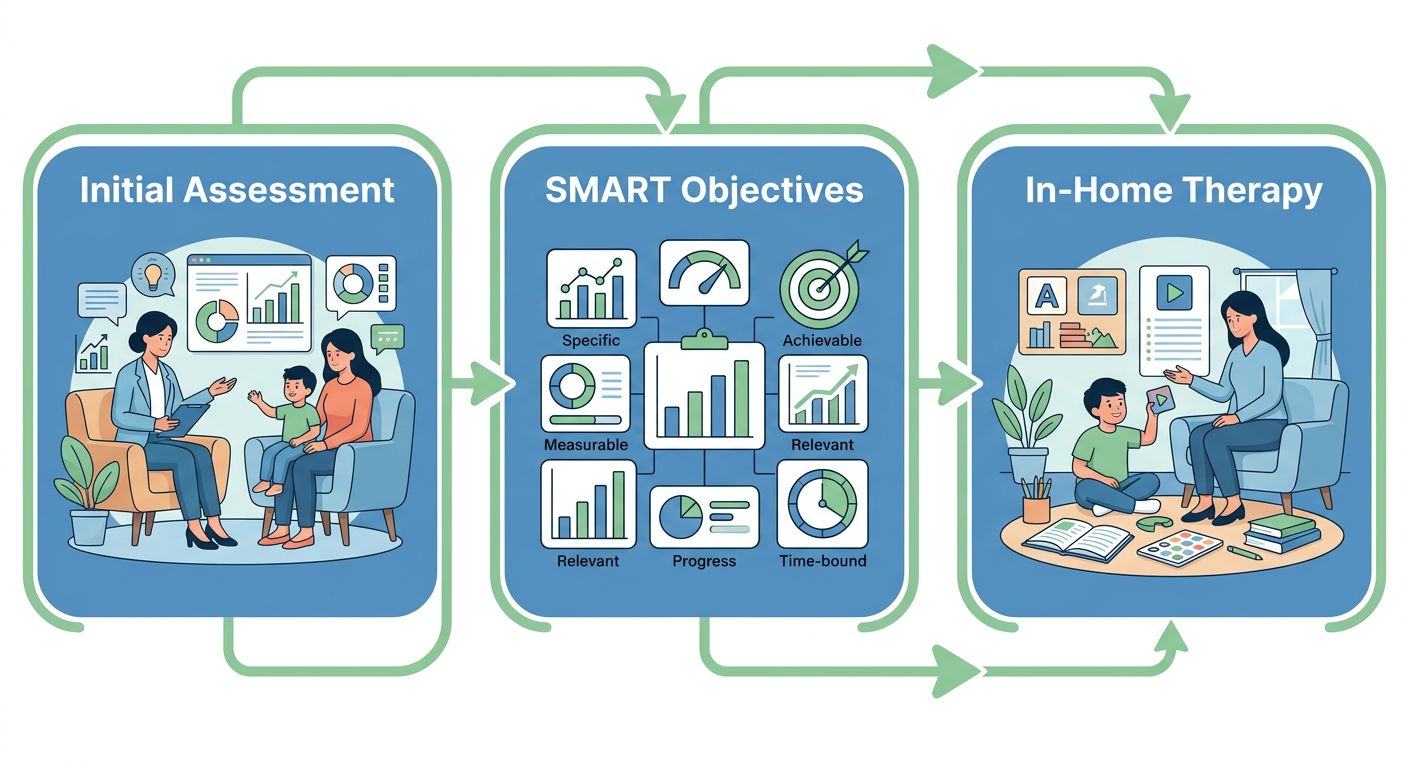
Step-by-step ABA goal-setting process for therapy
The Initial Assessment and Parent Collaboration
Our first step is a comprehensive initial assessment, which we view as a collaborative conversation. We begin with a detailed parent interview to learn about your child’s abilities, daily challenges, and what success looks like for your family. This discussion helps us identify your top priorities, whether it’s improving communication, building social skills, or increasing independence during daily routines.
Simultaneously, our Board Certified Behavior Analyst (BCBA) conducts a preference assessment, using evidence-based practices like paired-choice or free-operant methods, to discover what truly motivates your child. Identifying these powerful reinforcers is critical, as they will be the key to engaging and encouraging your child during therapy. To build a precise baseline, we also administer a skill-based evaluation, such as the VB-MAPP or ABLLS-R, which allows us to map out your child’s current abilities across various developmental domains in a warm and welcoming environment.
Writing SMART Objectives and Selecting Targets
With the assessment complete, our BCBA transforms the findings into precise, actionable SMART objectives. This means every goal is Specific, Measurable, Achievable, Relevant, and Time-bound. A cornerstone of this process involves defining targets with aba therapy operational definitions. For example, instead of a general goal like “improve communication,” we would write an objective such such as, “When presented with a preferred snack, Liam will independently request the item using a three-word phrase (e.g., ‘I want cracker’) in 4 out of 5 opportunities across two consecutive sessions.” This level of clarity ensures every team member measures progress consistently.
Aligning with standards set by the Behavior Analyst Certification Board ensures goals are ethically grounded. We prioritize goals that are socially valid—meaningful for your family’s life—and developmentally ready. Using smart goals in aba therapy, we focus first on skills that enhance safety, communication, and independence, reflecting the power of small steps that lead to lasting, positive change.
Implementing Goals Through In-Home Therapy Sessions
The heart of our program is bringing these carefully crafted goals to life during in-home ABA therapy sessions. Our Registered Behavior Technicians (RBTs) use natural environment teaching to embed goal work right into your family’s everyday routines. A goal for requesting items can be practiced during mealtime, while a goal for following instructions might be woven into a favorite play activity or the process of getting dressed.
This approach capitalizes on the child’s natural motivation and makes learning functional and fun. During these sessions, RBTs diligently collect trial-by-trial data, noting everything from the level of prompting needed to the success of an independent response. Caregiver involvement is integral to our aba therapy goal setting techniques; our RBTs will model strategies for you, and together we will practice them, ensuring skills learned in therapy naturally generalize to all aspects of life at home.
Collaborating with Families and Tracking Milestones
Once the initial assessment and treatment plan are in place, ongoing collaboration with families and careful tracking of milestones ensure the child’s progress remains on track. At Golden Touch ABA Therapy, we believe that a child’s success grows from a partnership between our clinical team and the family, with every decision rooted in data and open communication. This continuous feedback loop directly informs every aspect of a child’s ABA treatment planning, allowing us to refine strategies as the child learns and grows. Our in-home model lets us observe real-world challenges and victories, making progress monitoring a natural, integrated part of each session.
Data-Driven Progress Monitoring and Adjustments
Our Board Certified Behavior Analysts (BCBAs) continuously collect trial-by-trial data during every in-home session, recording specific metrics like frequency, duration, and interval observations to graph progress each week. This detailed tracking creates a visual story of the child’s development, making it easy to spot patterns that guide our decision-making. We rely on well-researched aba therapy goal setting techniques, including the use of smart goals in aba therapy, to frame each objective as specific, measurable, achievable, relevant, and time-bound. According to internal best practices at Golden Touch ABA, if a child demonstrates 80% mastery across three consecutive sessions, we typically move that goal into maintenance and introduce a new challenge. Conversely, if progress plateaus for two weeks, our team analyzes the data to modify the prompting hierarchy or adjust task difficulty. These formal reviews, conducted every three to six months, ensure that the treatment plan evolves right alongside the child’s unique developmental journey.
Empowering Parents Through Training and Involvement
Caregiver involvement is a cornerstone of family-centered care, and we dedicate structured time to equip parents with the tools they need to reinforce learning between sessions. Our parent training programs break down key strategies such as positive reinforcement, prompting hierarchies, and simple data tracking sheets designed for easy home use. A critical part of this training involves teaching families the aba therapy operational definitions we use to describe target behaviors, which ensures everyone on the team observes and responds to actions in the same consistent way. We maintain open lines of communication through weekly check-ins and share comprehensive progress reports during monthly family meetings, celebrating even the smallest victories. By focusing on the power of small steps, our in-home ABA therapy empowers parents to become confident, active participants in their child’s growth, transforming everyday moments into powerful learning opportunities.
Ensuring Generalization and Maintenance of Skills
A skill is only truly mastered when a child can use it naturally across different people, places, and materials, which is why we build generalization strategies directly into every program. As recommended by the Association for Science in Autism Treatment for evidence-based generalization, we practice emerging skills with at least three different people, such as parents, siblings, and visiting relatives, and in two different rooms of the home to prevent rigid, context-dependent learning. Our therapists weave natural environment teaching into routines like mealtime and play, helping new skills feel less like work and more like life. To safeguard long-term success and ensure retention, we conduct maintenance probes at one month, three months, and six months after a goal is mastered, stepping back from continuous intervention to confirm the child can perform the skill independently. This collaborative, data-informed approach builds a strong foundation for long-term success and continuous improvement in every child’s development.
Embracing a Collaborative Path Forward
Bringing everything together, we know that family-centered care is at the heart of successful ABA therapy. Effective aba therapy goal setting techniques depend on the combined efforts of parents, BCBAs, and RBTs, because no one understands a child’s daily life better than the people who share it. At Golden Touch ABA, we value the insights families bring to each session, creating a warm and welcoming environment where every voice matters.
Our ABA treatment planning FAQ outlines how individualized treatment plans are developed collaboratively, integrating a child’s unique strengths and challenges. During initial assessments, families share daily observations and priorities. These conversations help us shape SMART goals that are specific, measurable, achievable, relevant, and time-bound, ensuring they are truly meaningful. In fact, smart goals in aba therapy are most effective when they reflect the real-world needs of the child and family. This collaborative goal planning transforms abstract hopes into concrete therapeutic milestones. Regular data review and family feedback keep goals flexible; as skills are mastered or challenges shift, we adjust the plan together. As the Association for Science in Autism Treatment notes, collaboration is a hallmark of effective ABA therapy.
Through ongoing teamwork, we ensure that each milestone is practical and functional for everyday life. We invite families to partner with us in this shared journey, celebrating the power of small steps and the lasting change they bring.
Resources
- Get Family-Driven ABA Treatment Planning with BCBAs
- Find Structured ABA Treatment Planning by BCBAs
- Learn the ABA Treatment Planning Cycle for Children
- Discover Collaborative ABA Treatment Plans with BCBAs
- Get Individualized ABA Treatment Planning at Home
- Explore In-Home ABA Therapy with SMART Goals
- Monitor ABA Treatment Progress with BCBA Reviews
- Access Free Biomedical Databases and Tools at NCBI
- Find BCBA Certification and Ethics Resources
- Discover Science-Based Autism Treatment Resources
Table of Contents
- Finding Autism Therapy Providers in Maryland
- Maryland’s Autism Therapy Landscape
- In-Home ABA Therapy Availability in Maryland
- Important Considerations for Maryland Families
- Beginning ABA Therapy for Your Child in Maryland
- Your Path to ABA Therapy in Maryland
- Resources
Finding Autism Therapy Providers in Maryland
Finding the right autism therapy providers in Maryland starts with knowing what to look for. Once you understand how ABA therapy works, the next step is connecting with a team that can bring support directly to your doorstep. We offer in-home ABA therapy in Maryland designed to create a warm and welcoming environment where your child feels safe to learn and grow.
Our Board Certified Behavior Analysts (BCBAs) supervise every step, while skilled Registered Behavior Technicians (RBTs) deliver evidence-based practices during one-on-one sessions. Family-centered care means we involve you directly, offering caregiver training so progress continues between visits. We also provide insurance assistance and an interactive ABA roadmap tool to clarify the path ahead. The power of small steps guides our approach, and many families see meaningful gains with early intervention autism in Maryland. Results may vary, but our evidence-based approach aims for meaningful progress. Reach out to our Maryland team to learn how in-home ABA therapy in Maryland can fit into your family’s routine.
Maryland’s Autism Therapy Landscape
In Maryland, we see a diverse landscape of autism therapy providers in Maryland, offering a wide range of in-home ABA therapy options, though the concentration of services varies by county. Families researching providers will find many options listed on industry directories such as in-home ABA therapy in Maryland. The table below breaks down the coverage across several key counties to help you quickly identify the support available in your area.
| County | ABA Therapy Coverage | Types of Services Available | Notes |
|---|---|---|---|
| Anne Arundel County | Multiple in-home providers including Golden Touch ABA | In-home ABA, BCBA supervision, parent training | Proximity to Baltimore expands options |
| Baltimore County | High concentration of ABA providers | In-home, clinic-based, early intervention | Some providers may have waitlists |
| Montgomery County | Strong coverage with many BCBAs and RBTs | In-home, school collaboration, telehealth | Medicaid accepted by several agencies |
| Prince George’s County | Growing number of in-home providers | In-home ABA, parent coaching, insurance assistance | Check county-specific Medicaid policies |
| Howard County | Several trusted ABA agencies | In-home therapy, social skills groups, family support | Waitlists common; early contact advised |
Montgomery and Baltimore counties maintain the highest density of Board Certified Behavior Analysts (BCBAs) and Registered Behavior Technicians (RBTs), and many providers in these areas accept Medicaid, according to industry directories. Families in Howard and Prince George’s counties should note that waitlists can be common, so contacting providers early and verifying county-specific Medicaid policies are essential first steps. For families with younger children, early intervention autism in Maryland programs are widely available in these counties, offering parent training and BCBA-supervised therapy to build foundational skills from an early age.
With this landscape in mind, every family’s journey begins by identifying their local in-home ABA therapy in Maryland options and reaching out for a personalized assessment. Insurance coverage is subject to verification; results may vary.
In-Home ABA Therapy Availability in Maryland
Families seeking compassionate autism therapy providers Maryland can now access in-home ABA therapy Maryland from Golden Touch ABA Therapy right in their own communities. Our services bring the power of small steps to homes across the state, creating a warm and welcoming environment where children feel comfortable and supported as they learn.
According to our Maryland location page, we bring personalized, family-centered care to families in multiple counties, including Baltimore County, Montgomery County, and Prince George’s County. Our clinical team, led by a Board Certified Behavior Analyst (BCBA) and supported by skilled Registered Behavior Technicians (RBTs), delivers evidence-based practices in your child’s natural environment. For families exploring early intervention autism Maryland services, our in-home approach allows learning to happen where your child already plays, eats, and interacts, making each session a natural part of daily life.
We understand that navigating coverage can feel overwhelming, so our team provides dedicated insurance assistance to help you explore your options, including private plans and Medicaid. If you are seeking ABA therapy in Maryland with Medicaid, we can help you explore your options and connect you with additional resources. Insurance coverage is subject to verification and is not guaranteed.
Once you confirm availability in your area and understand your insurance options, the next step is a personalized assessment to start your child’s journey toward meaningful growth and greater independence.
Important Considerations for Maryland Families
When searching for reliable autism therapy providers in Maryland, families should start by understanding their insurance coverage. Verifying benefits with both private plans and Maryland Medicaid is essential before committing to a program. We encourage every family to request a benefits eligibility check so there are no surprises down the road.
Recognizing the early signs of autism is the first step toward early intervention. Indicators can appear as young as 6 months, and noting delays in social smiles, babbling, or eye contact can make a critical difference. Seeking early intervention autism in Maryland leads to more effective support and improved developmental outcomes for your child.
In-home ABA therapy in Maryland offers unique advantages for busy families. Receiving care in a warm and welcoming environment eliminates travel stress and allows caregivers to participate during everyday routines. Our family-centered care model ensures that evidence-based practices are woven into your child’s natural setting.
When choosing a provider, look for BCBA supervision and individualized treatment plans that celebrate the power of small steps. Quality programs adapt to your child’s needs, and our team is ready to help you verify coverage and schedule an in-home consultation.
Results may vary. Consult a licensed healthcare professional for diagnosis.
Beginning ABA Therapy for Your Child in Maryland
Starting ABA therapy can feel overwhelming, but we are here to guide you every step of the way. Families searching for autism therapy providers in Maryland will find a warm, welcoming, and collaborative partner in Golden Touch ABA. Our process begins with a simple, no-pressure conversation so we can learn about your child and answer your questions.
We begin with a free consultation to discuss your concerns and gather preliminary information. From there, our Board Certified Behavior Analyst (BCBA) completes a comprehensive behavioral assessment in your home. This allows us to understand your child’s unique strengths and needs within their natural environment. As an expert in early intervention autism in Maryland, our BCBA then designs a personalized plan built entirely around your child. We also help your family navigate insurance by verifying your benefits and explaining your coverage in clear terms, so you can focus on what matters most.
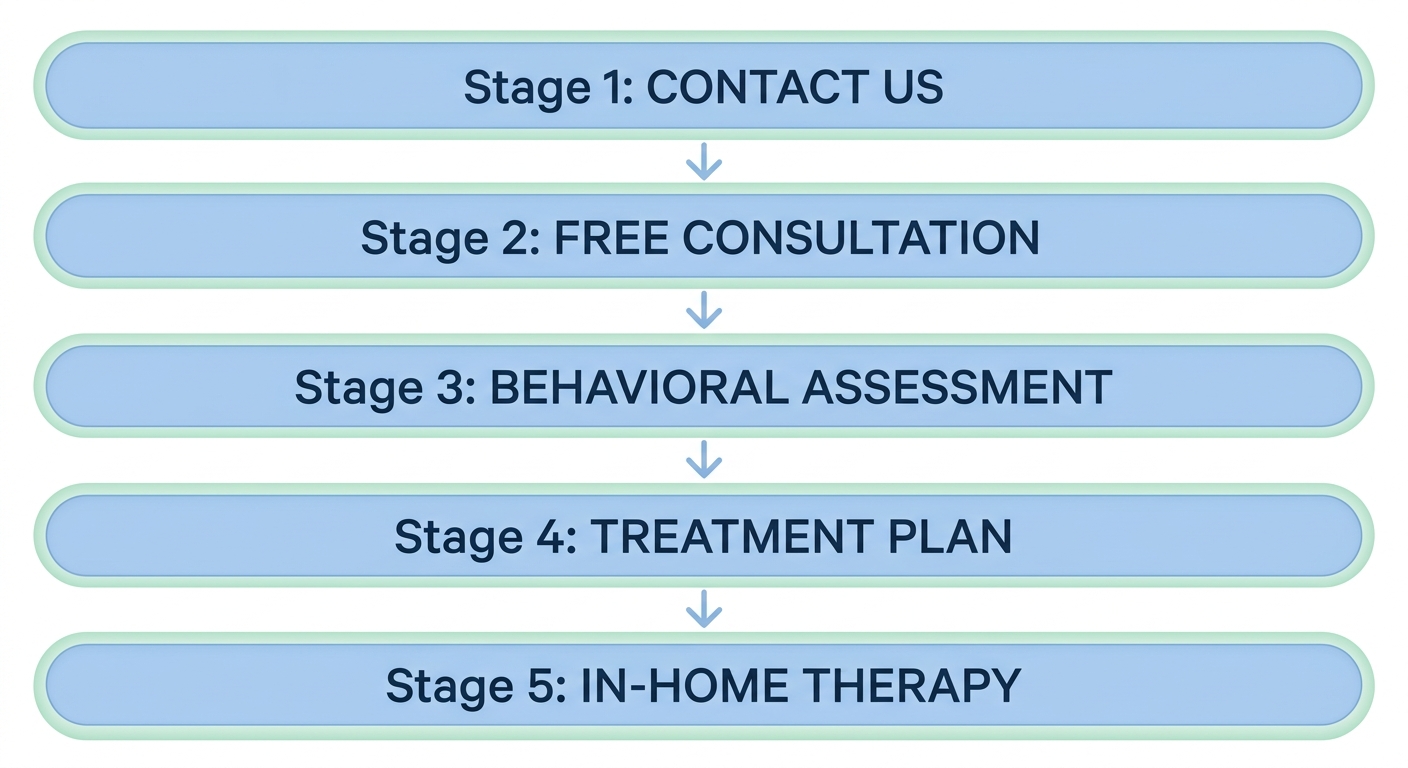
Five-step process to start in-home ABA therapy in Maryland.
Our in-home ABA therapy in Maryland sessions are delivered one-on-one by a compassionate Registered Behavior Technician (RBT) who is closely supervised by your BCBA. We believe in the power of small steps and family-centered care, which is why we incorporate ongoing caregiver training and adjust our approach based on your child’s progress. Evidence-based practices form the foundation of every session, creating a supportive structure for meaningful skill development. While every child’s journey is unique and results may vary, a consistent, early start provides the best foundation for growth. Reach out today for a custom quote and take the first step forward together.
Disclaimer: Results may vary. The information provided here is for educational purposes and does not replace consultation with a licensed healthcare professional.
Your Path to ABA Therapy in Maryland
Finding the right autism therapy providers Maryland families trust is easier than you might think. Ready to take the first step? Here’s how to start your journey with us:
- Schedule a free consultation or use our interactive ABA roadmap tool to share your child’s needs.
- Our team provides insurance verification assistance to clarify your benefits.
- A dedicated team of trained RBTs, supervised by a BCBA, delivers personalized in-home aba therapy maryland services.
While we also provide in-home ABA therapy in Utah, our Maryland families receive the same high-quality, compassionate care. Contact us today to begin.
Resources
- Get Expert In-Home ABA Therapy in Maryland
- Get In-Home ABA Therapy in Washington Terrace
- Discover Early Signs of Autism in Toddlers
- Learn Early Signs of Autism and ABA Therapy
- Find Early Signs of Autism in Infants
- Get Early Intervention ABA Therapy for Toddlers
- Discover Early Autism Signs and ABA Therapy
- Get ABA Therapy in Maryland with Bilingual Support
- Get ABA Therapy in Maryland for Children and Young Adults
Table of Contents
- ABA Therapy for School-Age Children: What Parents Need to Know
- Before You Begin ABA Therapy with Your School-Age Child
- Assess Your Child’s Current Behavioral and Communication Skills
- Set Measurable Goals with Your BCBA
- Coordinate ABA Therapy with School and IEP Goals
- Create a Consistent In-Home Therapy Schedule
ABA Therapy for School-Age Children: What Parents Need to Know
Is your school-age child facing challenges with social skills, classroom routines, or growing independence? You’re not alone. ABA therapy for school age children is an evidence-based approach that uses positive reinforcement to teach adaptive skills and reduce challenging behaviors through individualized goals. Golden Touch ABA offers in-home ABA therapy tailored specifically to school-age children, bringing therapy into your home to build real-world skills in a warm and welcoming environment.
Our therapists collaborate with you to carry over strategies at home and support school readiness by reinforcing the communication and self-regulation skills essential for classroom success. We believe in the power of small steps, breaking complex skills into manageable achievements through family-centered care.
ABA therapy can also complement your child’s IEP goals for autism, ensuring progress aligns with educational objectives.
- Results vary; always consult a healthcare professional for medical advice.
In the sections below, we explore how in-home ABA therapy can boost school readiness and complement IEP goals for autism.
Before You Begin ABA Therapy with Your School-Age Child
Before you begin autism therapy for your elementary-aged child, a little preparation on the front end can help set the stage for a smooth, confident start. We want to make sure you feel supported in this process, so here are a few steps to consider before the first session even begins.
First, a Board Certified Behavior Analyst, or BCBA — the professional certified by the Behavior Analyst Certification Board (BACB) to design and oversee treatment — will conduct a comprehensive assessment of your child’s unique strengths and needs. This assessment informs the individualized goals that your clinical team will work toward. In-home ABA therapy gives us the advantage of observing your child in their natural environment, where real-life skills are built.
Next, review your insurance benefits early. Our team offers free assistance to help you understand your coverage so you can focus on your child’s care. You’ll also want to bring any current school documents — including IEP goals for autism — to your BCBA’s attention. Aligning home and school strategies encourages family-centered care and creates a consistent thread of support for your learner.
With a complete picture of your child’s needs, your BCBA will craft a plan that fits seamlessly into your schedule. As you prepare for this partnership, remember that progress is a gradual journey; every child’s path toward school readiness and independence unfolds at a pace shaped by their own hard work and the consistency of the support around them.
Now that you know what to line up, the next step is meeting your team and getting started with a personalized consultation.
Assess Your Child’s Current Behavioral and Communication Skills
Before we can set goals, let’s look at where your child is now. The first step in choosing aba therapy for school age children is understanding their current abilities, especially in school readiness. Our family-centered approach values your insights as you observe your child’s communication and behavior patterns in a warm and welcoming environment.
Pay attention to both verbal and non-verbal communication, such as using words, gestures, or AAC devices. Also note behaviors like transitions, tantrum frequency, or self-stimulatory actions, and assess social strengths, including whether your child engages in parallel or cooperative play. These observations are foundational for setting meaningful iep goals for autism like increasing mands and social initiations. A qualified professional with BCBA certification will then perform a comprehensive evaluation, using evidence-based practices to develop a tailored program.
This home assessment helps us see the full picture, connecting your child’s current skills to the power of small steps in therapy. By identifying targeted objectives together, we prepare for a smooth transition into an individualized plan that supports growth and independence. Our team is here to guide you through this family-centered process every step of the way.
Set Measurable Goals with Your BCBA
After your child’s initial assessment reveals their strengths and areas for growth, the next step in aba therapy for school age children is to sit down with your BCBA and turn those insights into clear, measurable goals. We believe in family-centered care, so these objectives are created together — not dictated by the therapist alone. The targets are specific, measurable, and woven into your child’s daily routines, focusing on skills like transitions and peer interaction to build classroom preparedness. Your BCBA also aligns these home targets with IEP goals for autism so school-based objectives are supported. For example, a goal might be to increase on-task behavior during a 10-minute table activity from 2 minutes to 8 minutes over 8 weeks. Our team of RBTs, who hold the registered behavior technician certification, implements these plans, and progress is tracked session by session and shared in regular updates. Every child is different, so results may vary, but we believe in the power of small steps.
Coordinate ABA Therapy with School and IEP Goals
After setting meaningful therapy targets at home, aligning those goals with your child’s Individualized Education Program (IEP) is a natural next step.
When the Board Certified Behavior Analyst (BCBA) communicates regularly with school staff, therapy data can directly inform classroom strategies. Our in-home team tracks targeted behaviors — from task initiation to following instructions — which teachers can use to update IEP goals for autism and measure progress. Parents often find it helpful to invite their BCBA to IEP meetings, as this provides valuable behavioral insights and reinforces consistent strategies across both environments.
In our home sessions, we emphasize school readiness skills such as following multi-step directions, staying on task, and building social connections. Using the same prompts and reinforcement at home and in the classroom reduces confusion and helps children generalize newly learned skills more confidently.
Want to learn more about how we partner with families and schools? Reach out today to talk about coordinating autism therapy in Washington Terrace, Utah with your child’s educational team.
Create a Consistent In-Home Therapy Schedule
Once the space is ready, the next step is building a consistent in-home therapy schedule. We recommend starting aba therapy for school age children by selecting two or three fixed time slots each week and treating them as non-negotiable appointments. A predictable rhythm helps your child transition from the school day to therapy with less resistance, and it reinforces the skills practiced during sessions.
A steady routine is the heartbeat of family-centered care. Prepare a dedicated, distraction-free area and pair each session with a simple before-routine—like a snack and a brief chat about the day. This warm, welcoming cue signals to your child that it’s time to focus and engage. We encourage you to lean on your BCBA or RBT for strategies when life disrupts the schedule; they can help you adjust while preserving momentum.
Consistently following a schedule can strengthen school readiness and support progress toward your child’s iep goals for autism. Committing to small, regular sessions often builds confidence and lasting skills.
Practice Social Skills Through Everyday Interactions
We know that the best way for school-age children enrolled in ABA therapy for school age children to grow socially is through the small, natural moments that fill each day. With guidance from your child’s BCBA, everyday routines become powerful opportunities to practice skills identified in the treatment plan, opening the door to school readiness and meaningful IEP goals for autism.
An easy, low-pressure starting point is taking turns during a family board game. A therapist from Golden Touch ABA can coach you on how to prompt your child to wait and then offer enthusiastic, immediate praise for a successful turn. A second example is practicing a simple greeting when ordering at a cafe counter; the BCBA might suggest focusing on just one moment of eye contact during the brief exchange. The goal is to begin with manageable steps that support peer interactions and avoid creating anxiety, and then gradually build toward longer, more complex conversations.
These everyday interactions are most effective when they’re brief, positive, and connected directly to the skills your BCBA has prioritized. Our team helps you weave these moments into your family’s unique rhythm, ensuring that every small success builds toward growing social confidence and building communication skills for school and beyond.
Monitor Progress and Adjust Goals as Needed
After goals are set, the next step is to track your child’s progress closely. For school-age children receiving ABA therapy, monitoring progress is key to making sure therapy is working and adapting to their evolving needs. We track development continuously through data collection during every session, recording trial-by-trial responses and skill acquisition. This real-time information helps our BCBAs see what’s working and where small adjustments can make a big difference.
Parents can support this process by keeping a simple home log of observed behaviors and new skills, noting anything that seems easier or more challenging at home. These notes, combined with our data, create a fuller picture of your child’s growth. Signs of progress often show up as increased independence, improved communication, reduced challenging behaviors, or progress toward school readiness and iep goals for autism. We review goals regularly—usually weekly or bi-weekly—and suggest adjustments when a child has consistently met a target for several sessions or when a goal no longer fits their developmental priorities.
As you monitor progress and adjust goals, you’ll build a clearer picture of your child’s growth. We encourage you to ask questions during caregiver training and collaborate on setting new, slightly more challenging targets. Progress looks different for every child—some days bring big leaps, other days quiet wins—but the power of small steps is always at the heart of our family-centered care. Golden Touch ABA Therapy is here to help you shape a plan that reflects your child’s unique journey, and we would love to talk through a personalized progress strategy whenever you are ready.
Prepare for School Readiness and Independence
Once your child is making progress at home, we also focus on preparing them for the classroom. Our in-home aba therapy for school age children builds school readiness by teaching the routines and independence skills that lead to classroom success. We practice transitioning between activities, following multi-step instructions, and handling bathroom independence during familiar in-home sessions, so these abilities feel natural before the first day of school.
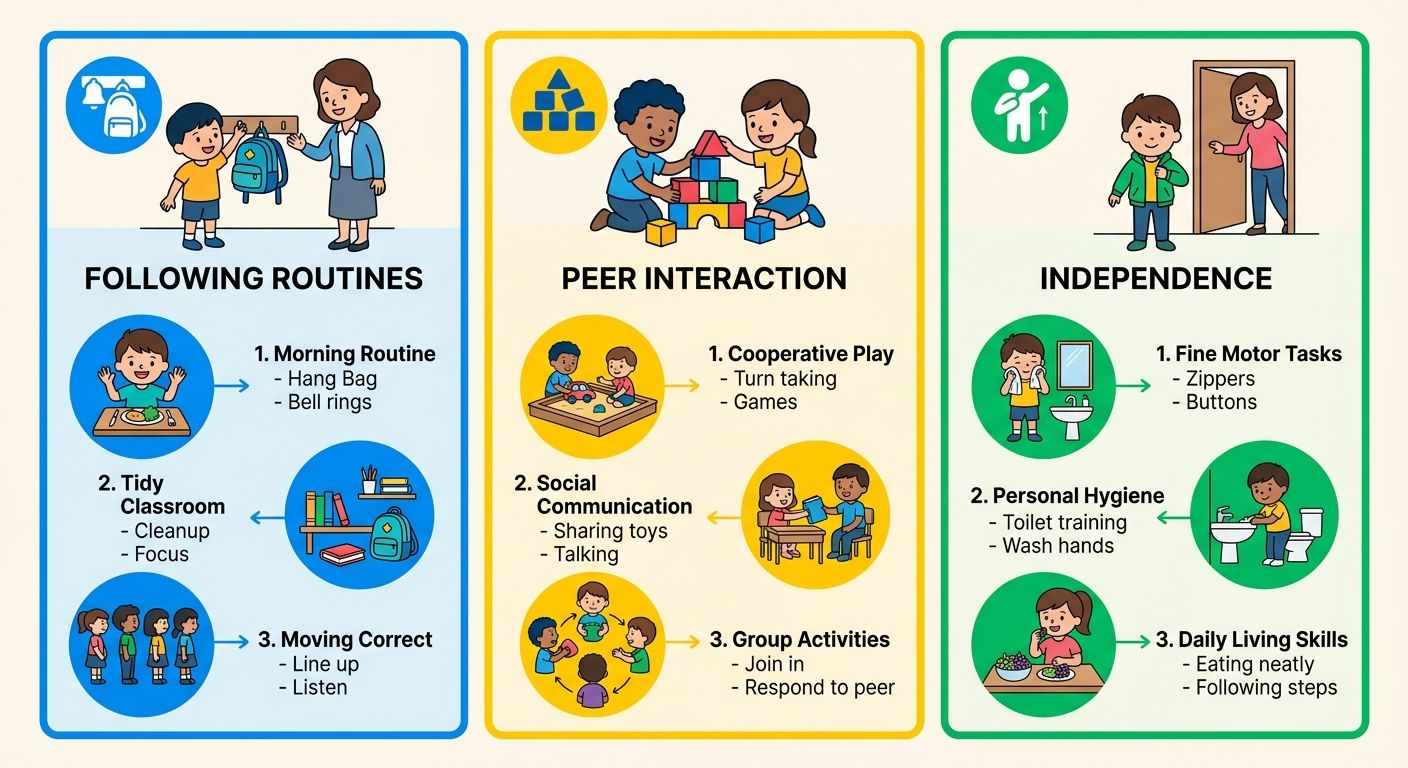
Three key school readiness skills developed through in-home ABA therapy
Strong school readiness also means reducing problem behaviors that interfere with learning, such as difficulty with transitions or following teacher directions. Our BCBAs and RBTs weave these targets into each session, and the data we collect often becomes the baseline for measurable iep goals for autism—giving your child’s team clear, observable objectives to track.
Parents play a vital role, too. Using ABA strategies consistently at home helps children practice independence during daily routines like dressing and packing a backpack. To learn more about in-home support in Arizona, visit our Arizona location page.
This information is for educational purposes. Consult a licensed healthcare professional for medical advice. Results may vary.
Overcoming Common Challenges in In-Home ABA Therapy
Even with a strong foundation, every family encounters a few bumps along the way—here’s how we help you navigate them. When you begin aba therapy for school age children, the transition to regular in-home sessions can sometimes bring resistance, especially from a child who is tired after a busy day. We partner with you to make sessions feel natural and engaging by incorporating your child’s favorite toys and activities right in their living room. This child-led approach, guided by your dedicated BCBA, helps transform reluctance into cooperation.
We also know that caregiver involvement can feel like a significant addition to an already full plate. Our family-centered model turns this dynamic on its head: rather than adding extra work, we weave caregiver training into everyday moments. Our therapists provide simple strategies you can use during dinner, playtime, or bedtime routines, so building school readiness behaviors at home quickly becomes second nature.
Scheduling conflicts are another common hurdle, but the in-home model itself is the most direct solution. Our team offers flexible scheduling that works around your family’s rhythm, not the other way around. If you’re struggling to see how far your child has come, the interactive ABA roadmap provides a clear, simple snapshot of every small win, showing how daily sessions reinforce broader objectives, including iep goals for autism. Rest assured, every challenge has a workable, compassionate answer—and our team is in your corner every step forward.
Discover how our ABA roadmap can illuminate your child’s path forward.
Putting It All Together: Next Steps for Your Child’s Development
In summary, ABA therapy for school age children provides an evidence-based pathway to strengthen the social, communication, and adaptive skills that form the foundation for classroom success. We at Golden Touch ABA craft personalized in-home treatment plans aligned with each child’s unique school readiness milestones and their IEP goals for autism, ensuring every session builds meaningful classroom preparedness.
The power of small steps drives our warm, family-centered approach. Our dedicated BCBAs and RBTs work collaboratively with your family, offering flexible scheduling that fits seamlessly into your daily routine. Discover how our customized support can make a difference — reach out to Golden Touch ABA for a custom quote or complete our interactive ABA roadmap to explore the next step. Together, we will nurture your child’s confidence and skill-building for school success.
Results may vary. Consult a licensed healthcare professional for diagnosis or medical advice.
Resources
- Get Personalized In-Home ABA Therapy in Washington Terrace
- Engage Children with Play-Based In-Home ABA Therapy
- Get Multistate ABA Therapy with Certified Analysts
- Find Personalized ABA Therapy in Taylorsville, Utah
- Find In-Home ABA Therapy Services Across Arizona
- Get In-Home ABA Therapy with Evidence-Based Techniques
- Discover ABA Therapy Services for Ages 1-21
- Find Details on BCBA Certification and Process
- Explore Registered Behavior Technician Certification Process
Table of Contents
- Understanding Behavioral Therapy
- ABA Therapy Coverage in Utah
- In-Home ABA Therapy Services
- Key Factors for ABA Therapy in Utah
- Steps to Begin ABA Therapy
- Start Your Journey with Golden Touch ABA Therapy
Understanding Behavioral Therapy
At Golden Touch ABA, we embrace behavioral therapy as a method using learning principles to encourage positive behaviors and reduce challenging ones. We highlight Applied Behavior Analysis (ABA) as its key application in autism support through evidence-based practices.
Applied behavior analysis ABA autism relies on core principles, per the Association for Science in Autism Treatment (ASAT):
- Positive reinforcement to build skills.
- The power of small steps via task analysis.
- Data-driven adjustments based on progress.
The ABA therapy process starts with assessment and individualized planning, using discrete trial training and naturalistic teaching in home settings, as reviewed by the National Center for Biotechnology Information (NCBI).
Board Certified Behavior Analysts (BCBAs) supervise, while Registered Behavior Technicians (RBTs) deliver ABA therapy, per Behavior Analyst Certification Board (BACB) standards. Our family-centered care fosters communication, social, and daily skills. For ABA therapy near me in your community, discover how we bring these principles to your home. Results may vary.
ABA Therapy Coverage in Utah
We proudly provide in-home ABA therapy across key Utah areas, delivering family-centered care through evidence-based practices. Families seeking behavioral therapy in Davis County, Salt Lake Valley, and Utah County can count on our personalized ABA therapy programs. For instance, explore our ABA therapy in Washington Terrace, Utah tailored for local needs, with BCBA supervision and flexible options to support your child’s growth.
Golden Touch ABA Therapy, as detailed in our location-specific service descriptions, extends in-home behavioral therapy services to nearby communities, making ABA therapy near me accessible for Utah families.
Utah Service Areas Comparison for ABA Therapy
Overview of Golden Touch ABA Therapy coverage across key Utah locations to help families find nearby in-home services.
| Service Area | Nearby Communities | Key Features |
|---|---|---|
| Washington Terrace | North Ogden, Clearfield | In-home sessions, BCBA supervision |
| Taylorsville | West Valley City, Kearns | Flexible scheduling, family training |
| Eagle Mountain | Lehi, Saratoga Springs | Personalized plans, insurance help |
These service areas showcase our dedication to evidence-based practices, with RBT-delivered therapy under BCBA supervision and insurance assistance, per Golden Touch ABA Therapy’s own location-specific service descriptions. We help navigate coverage in a warm and welcoming environment, but insurance coverage is subject to verification and is not guaranteed.
Our approach emphasizes the power of small steps, building skills like communication and independence right in your home. Golden Touch ABA Therapy serves these regions from our base in Salt Lake City, UT, ensuring coordinated care across counties. This coverage reflects our commitment to making autism behavioral therapy reachable, with flexible scheduling to fit family life.
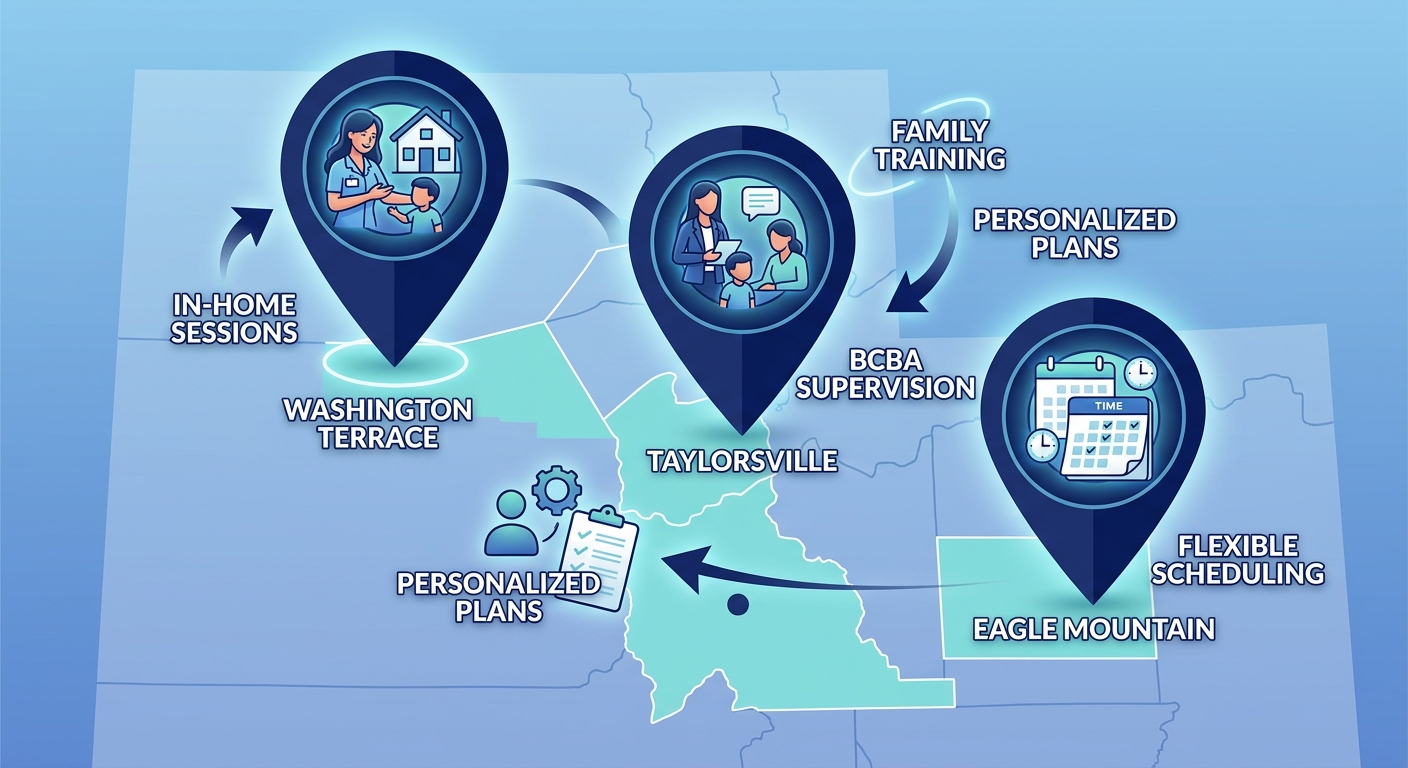
Golden Touch ABA Therapy coverage map for key Utah locations.
Ready to start local ABA services? Use our interactive ABA roadmap tool or contact us for custom eligibility support and verification.
In-Home ABA Therapy Services
At Golden Touch ABA Therapy, we specialize in in-home ABA therapy services that deliver evidence-based practices directly in the warm and welcoming environment of your home. This approach to behavioral therapy minimizes anxiety for children on the autism spectrum, fostering natural progress through family-centered care. Flexible scheduling allows therapy to fit seamlessly into daily routines, supporting skill development in communication, social interactions, and independence. Supporting daily living skills and meaningful community participation.
Our process starts with a comprehensive behavioral assessment, followed by customized treatment plans crafted by our Board Certified Behavior Analysts (BCBAs). Registered Behavior Technicians (RBTs) then deliver one-on-one sessions under close supervision, incorporating the power of small steps for measurable gains. We provide ongoing caregiver training and our interactive ABA roadmap tool to empower families. As detailed in Golden Touch ABA’s service overviews for South Salt Lake, Parleys Canyon, and Saratoga Springs, Utah, these ABA therapy programs emphasize collaboration and accessibility.
For those searching for ABA therapy near me, we extend local ABA services to nearby areas, including ABA therapy in Taylorsville, Utah. Our team assists with insurance verification—coverage is subject to eligibility and not guaranteed. Results may vary based on individual needs.
Ready to begin? Contact us today for a custom quote and personalized eligibility support.
Key Factors for ABA Therapy in Utah
In Utah, several key factors ensure behavioral therapy success through ABA programs. Families seeking ABA therapy near me prioritize certified professionals for their child’s progress in a family-centered care model.
Board Certified Behavior Analysts (BCBAs) represent the gold standard, per the Behavior Analyst Certification Board (BACB). They complete graduate-level coursework, 1,500-2,000 hours of supervised fieldwork, and pass a rigorous exam to oversee programs. Key roles include:
- BCBA: Assessment and individualized program design.
- RBT: Direct therapy delivery under BCBA supervision, as described by the Association for Science in Autism Treatment (ASAT).
Utah families benefit from evidence-based practices aligning with state insurance mandates. In-home ABA therapy offers comfort, like ABA therapy in Eagle Mountain, Utah for accessible options. We at Golden Touch ABA emphasize BCBA supervision, RBT training, and caregiver involvement, including consistent data review with families.
At Golden Touch ABA, we prioritize these factors for measurable progress—results may vary. Contact us to begin your ABA therapy journey.
Steps to Begin ABA Therapy
Ready to take the next step? We at Golden Touch ABA Therapy believe in the power of small steps when starting behavioral therapy for your child. Our family-centered care makes in-home ABA therapy accessible and personalized, using evidence-based practices backed by the Association for Science in Autism Treatment.
Here are the simple steps to get started:
- Contact Us for a Free Consultation – Reach out via phone or our interactive ABA roadmap tool to discuss your needs.
- Insurance Assistance – We verify benefits eligibility and guide you through coverage options. Insurance coverage is subject to verification and is not guaranteed.
- Behavioral Assessment – Our Board Certified Behavior Analyst (BCBA) conducts an evaluation and creates your individualized treatment plan, supervised by professionals with BACB behavior analysis certifications, the official certifying authority per Behavior Analyst Certification Board (BACB) standards.
- Customized Therapy Plan – Receive a tailored plan with Registered Behavior Technician (RBT)-delivered sessions in a warm and welcoming environment.
- Begin Therapy – Start ABA therapy with ongoing family training and BCBA supervision for lasting progress.
Results may vary. Find ABA therapy near me with flexible scheduling – contact us today for a custom quote on services! Once we begin, here’s what to expect in your journey.
Start Your Journey with Golden Touch ABA Therapy
At Golden Touch, we’re excited to help you start your journey with in-home ABA therapy – personalized behavioral therapy tailored to your child’s needs. Our highly trained BCBAs meet rigorous BCBA certification requirements upheld by the Behavior Analyst Certification Board (BACB) and supervise evidence-based practices like proven behavioral interventions for skill development, per peer-reviewed insights from the National Center for Biotechnology Information (NCBI).
Enjoy family-centered care, flexible scheduling, and insurance assistance. Results may vary. Contact us today for your custom ABA therapy plan near you and insurance verification. Discover our full range of in-home ABA therapy services.
This article was researched and written with the assistance of AI tools.
Resources
- Get Personalized In-Home ABA Therapy in Washington Terrace UT
- Get Tailored In-Home ABA Therapy in Taylorsville UT
- Get Customized In-Home ABA Therapy in Eagle Mountain UT
- Get Evidence-Based In-Home ABA Therapy in South Salt Lake UT
- Get Personalized In-Home ABA Therapy in Parleys Canyon UT
- Get Research-Driven In-Home ABA Therapy in West Mountain UT
- Get Tailored In-Home ABA Therapy in Saratoga Springs UT
- Discover BACB Credentials RBT BCaBA BCBA and Resources
- Learn BCBA Certification Requirements Application and Exam Process
- Discover Science-Based ABA Interventions for Autism Treatment
- Explore Behavioral Therapy for Adherence Well-Being and Health
- Learn ABA Provider Roles BCBAs Therapists for Autism
Table of Contents
Mastering Social Skills with ABA Therapy
Building on ABA fundamentals, we at Golden Touch ABA focus on aba social skills to empower children with autism in everyday interactions like turn-taking and sharing. Applied behavior analysis ABA uses evidence-based practices, as outlined in an authoritative overview from the Association for Science in Autism Treatment, highlighting techniques like prompting, modeling, and reinforcement for social growth.
The power of small steps shines in our in-home ABA therapy, delivered by RBTs under BCBA supervision in a warm and welcoming environment. We teach aba social skills through role-playing conversations, peer-mediated interventions, and group play sessions. Through family-centered care, we train caregivers to reinforce these skills at home, promoting aba early intervention for lasting progress, as detailed in our clinic’s service descriptions.
Start with our interactive ABA roadmap tool to tailor social goals. Results may vary; consult a licensed professional.
Preparing Your Family for ABA Success
Building on the evidence for ABA, here’s how we help your family prepare. At Golden Touch ABA, we believe family-centered care is key to unlocking progress in applied behavior analysis therapy. Your commitment boosts aba social skills development through our in-home ABA therapy.
We outline these practical steps, drawn from guidance in our ABA FAQ:
- Participate in behavioral assessment and ABA treatment planning with our BCBA to set SMART goals for communication and daily skills.
- Learn basic ABA techniques via our caregiver training sessions, empowering you to reinforce lessons at home.
- Create a consistent daily routine with designated therapy spaces in a warm and welcoming environment.
- Track progress using our interactive ABA roadmap tool, supporting aba early intervention.
National Center for Biotechnology Information (NCBI) research shows ABA programs with family engagement yield positive effects on adaptive behaviors and communication, with effect sizes up to g = .41. The power of small steps builds aba social skills effectively using evidence-based practices.
Contact us in Salt Lake City for insurance assistance to start. Results may vary. Once prepared, our individualized ABA treatment planning takes over.
Assess Your Child’s Social Skills Baseline
Building on those signs, let’s establish a baseline for your child’s aba social skills. This snapshot captures current abilities like eye contact, greeting others, sharing toys, responding to name, and parallel play, per Golden Touch ABA’s practical FAQ guidance for parents.
We at Golden Touch ABA recommend observing your child over one week in natural settings like home play and family interactions. Use this simple checklist:
- Makes eye contact during interactions
- Greets others verbally or with waves
- Shares toys willingly
- Responds to name promptly
- Engages in parallel play
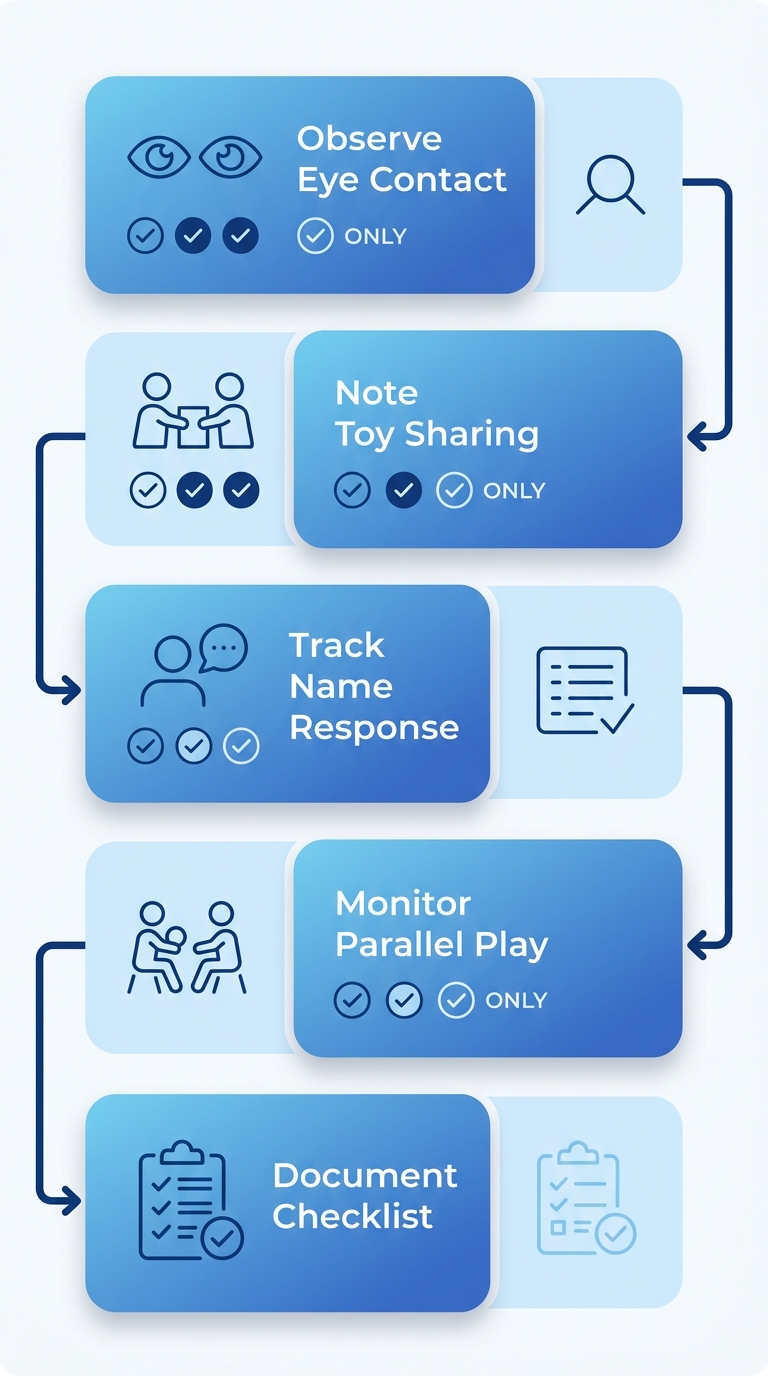
5-step ABA therapy process for child’s social skills baseline assessment
This baseline matters for tracking progress in applied behavior analysis, especially with aba early intervention for better outcomes in our family-centered care. Consistent data helps tailor in-home ABA therapy. Results may vary.
Document your notes and use our interactive ABA roadmap tool. With your baseline notes, explore our ABA treatment planning for tailored goals. Contact us for a professional BCBA evaluation.
Define Clear and Achievable Social Goals
We help families set clear social goals that build confidence one interaction at a time through applied behavior analysis. In aba early intervention, defining aba social skills targets matters because they break down complex behaviors into manageable steps, fostering real progress in a warm and welcoming environment.
Use the SMART framework for developing social skills through ABA: Specific (e.g., make eye contact during greetings), Measurable (track occurrences per session), Achievable (start with one peer), Relevant (ties to daily play), Time-bound (master in 4 weeks). During behavioral assessment as part of ABA treatment planning, families collaborate with our team for family-centered care. Examples from our experts’ practical FAQ guidance include taking turns in a 2-person game or responding to name 80% of the time.
The power of small steps and evidence-based practices shine in RBT-delivered therapy. Once defined, we move to measuring these goals in daily sessions. Results may vary; consult our professionals.
Teach Recognition of Social Cues
Building on foundational interactions, we focus on why recognizing social cues like smiles for happiness or frowns for sadness matters for children with autism. Mastering aba social skills builds confidence in everyday social exchanges through evidence-based practices.
In our in-home ABA therapy, we use video modeling: show short clips of peers displaying cues, then have kids imitate and identify them. Scripting and role-playing follow, with simple scripts for scenarios like a friend waving hi, practiced in a warm and welcoming environment. The teaching social skills TIP from the Association for Science in Autism Treatment (ASAT) offers practical, research-supported steps including modeling and feedback.
We create personalized social stories with pictures for daily aba early intervention reading, reinforce correct identifications with praise, tokens, or fun activities under BCBA supervision, and integrate into routines via family-centered care. The power of small steps tracks progress. Results may vary. These cues pave the way for advanced conversations ahead.
Practice Role-Playing for Real-Life Scenarios
Building on basic skills, we use role-playing to build aba social skills for real-life scenarios through evidence-based practices. This applied behavior analysis modeling technique, as outlined in authoritative guidelines from the Association for Science in Autism Treatment (ASAT), involves therapists or peers demonstrating interactions like greeting friends or turn-taking, then guiding children to imitate in safe sessions.
We target everyday situations such as handling playground sharing, ordering food at a restaurant, or asking for help in a store. These aba early intervention practices accelerate social development with positive reinforcement for generalization. Peer-reviewed government health research data from the National Center for Biotechnology Information (NCBI) via ABA evidence autism treatment supports gains in social skills from such modeling.
In our family-centered care with in-home ABA therapy, we train caregivers for home reinforcement. The power of small steps leads to measurable progress tracking. Results may vary (no guaranteed outcomes). This prepares children for success, leading into our progress tracking methods.
Build Peer Interactions Through Structured Groups
Beyond one-on-one practice, we build peer interactions through structured aba social skills groups as a key part of our ABA social skills training. These small, supportive settings help children with autism practice real-world social exchanges in a warm and welcoming environment.
We use evidence-based practices from applied behavior analysis, like role-playing, prompting, and reinforcement, to teach turn-taking, sharing, and conversation skills. According to a research synopsis by the Association for Science in Autism Treatment (ASAT), behaviorally-based groups with procedures such as modeling and shaping led to significant social improvements in young children.
Our in-home ABA therapy integrates these groups with family-centered care, adapting activities for peer practice at home through caregiver training. For aba early intervention, timely group exposure boosts social reciprocity. The power of small steps shines here.
These group gains extend home with caregiver support. Explore our interactive ABA roadmap tool or contact us for personalized planning and custom quotes. Results may vary.
Utilize Visual Aids and Social Stories
Building on positive reinforcement, we leverage visual aids and social stories next to boost aba social skills in our in-home ABA therapy. Tools like picture schedules and PECS make abstract concepts concrete in applied behavior analysis, helping children grasp routines and communication. They also support independence, predictable routines, and everyday communication across home and community settings for improved daily participation.
Social stories are customized narratives we create to teach behaviors like turn-taking or greetings, tailored to each child’s needs. For instance, our FAQ highlights using visual aids during transitions in aba early intervention to ease anxiety, as guided by Golden Touch ABA’s practical examples. We train families to reinforce these at home through family-centered care.
Our RBTs integrate these seamlessly in sessions for steady progress. Results may vary. These pair seamlessly with verbal prompting techniques.
Track Progress and Provide Positive Reinforcement
Once techniques are in place, we ensure success through vigilant tracking in our In-home ABA therapy. In applied behavior analysis, consistent progress tracking allows us to adjust individualized treatment plans, particularly for building aba social skills. This data-driven approach helps children make meaningful gains in communication and independence.
Golden Touch ABA, per our internal company FAQ guidance, uses daily data logs to record target behaviors, visual progress graphs shared weekly with families, and milestone celebrations to mark achievements. These methods provide clear insights into aba social skills development during sessions.
We incorporate positive reinforcement through immediate verbal praise, token economies with preferred rewards, and natural reinforcers tailored to each child’s interests in aba early intervention. This family-centered care creates a warm and welcoming environment, integrating family feedback for ongoing adjustments.
Our evidence-based practices support measurable outcomes, though results may vary. We share these insights with families for collaborative adjustments.
Addressing Challenges in Social Skills Training
While social skills training offers great benefits for children with autism, challenges like lack of skill generalization to real-world settings, low motivation during group interactions, and difficulty reading social cues often arise. At Golden Touch ABA Therapy, we tackle these hurdles in aba social skills development using evidence-based practices from applied behavior analysis. The power of small steps helps build confidence through targeted strategies.
One effective ABA technique is modeling, where therapists or peers demonstrate social behaviors for children to imitate. According to evidence-based ABA technique guidelines from the Association for Science in Autism Treatment (ASAT), this includes live modeling in real-time, video modeling for repeated viewing, and self-modeling to boost self-efficacy. These methods promote faster skill acquisition, especially for social play and communication, addressing generalization and cue-reading issues.
We at Golden Touch ABA apply these in our In-home ABA therapy, delivered by dedicated RBTs under BCBA supervision, as outlined in our internal practical guidance. This family-centered care integrates aba early intervention to enhance motivation and natural environment practice, with caregiver training for consistent support. Our approach emphasizes caregiver coaching and practice in natural contexts to promote daily-life generalization, and data-driven progress tracking helps tailor supports regularly over time. Results may vary.
Ready to overcome these challenges? Use our interactive ABA roadmap tool and contact us to tailor an ABA plan addressing your child’s needs in a warm and welcoming environment.
Sustaining Social Skill Development Long-Term
Building on early gains from aba social skills training, we at Golden Touch ABA help families maintain progress through consistent reinforcement. Regular in-home ABA therapy sessions prevent regression, as our RBT-delivered therapy supports ongoing practice in natural settings.
Family-centered care plays a key role, with caregiver training embedding social skills into daily activities like playdates or community outings. Drawing from evidence-based practices in applied behavior analysis, periodic BCBA reassessments adapt plans to evolving needs and ensure goals remain meaningful, measurable, and aligned with family priorities over time. Research from the Association for Science in Autism Treatment (ASAT) shows behaviorally-based social skills groups sustain improvements for 16-32 weeks.
Transitioning skills via aba early intervention foundations ensures long-term growth. Results may vary; insurance coverage requires verification. Reach out to us at Golden Touch ABA for your customized roadmap.
This article was researched and written with the assistance of AI tools.
Resources
- Get Personalized ABA Treatment Plans Led by BCBAs
- Discover Family Involvement in ABA Treatment Planning
- Create SMART Goals for ABA Therapy Improvement
- Monitor and Revise ABA Treatment Plans Effectively
- Develop ABA Plans Through Four-Stage Process
- Build Collaborative ABA Plans with FBA Data
- Implement Data-Driven Collaborative ABA Planning
- Master TIP for Teaching Social Skills Effectively
- Explore ABA Evidence Base for Autism Treatment
- Learn ABA Principles for Skill Acquisition
- Discover ABA Modeling Techniques for Skill Teaching
- Improve Social Skills via ABA Group Therapy
Table of Contents
- Discovering Autism Therapy in Salt Lake City
- Understanding ABA Therapy for Children
- Benefits of Autism Therapy
- How ABA Autism Therapy Works
- Best Practices in In-Home ABA Therapy
- Next Steps for Your Child’s Autism Therapy Journey
- Resources
Discovering Autism Therapy in Salt Lake City
Now, let’s focus on Salt Lake City, where families seek compassionate support for their children. If you’re discovering autism therapy in Salt Lake City, we at Golden Touch ABA Therapy are here to support your family with our specialized services.
We provide In-home ABA therapy delivered by highly trained BCBAs and RBTs, focusing on family-centered care and evidence-based practices. This approach builds autism learning partnerships with families, offering ABA therapy for children through individualized plans tailored to each child’s needs. Our team conducts behavioral assessments, provides caregiver training, and ensures flexible scheduling in a warm and welcoming environment.
Unique tools like our interactive ABA roadmap help track progress with measurable outcomes. We also assist with insurance verification to make effective autism therapy in Salt Lake City accessible. For custom needs, contact us for a personalized quote today.
The power of small steps celebrates every milestone, though results may vary. Reach out today to start your family’s journey with us in Salt Lake City. Consult a licensed healthcare professional for diagnosis or medical advice.
Discover how our ABA therapy works in detail below.
Understanding ABA Therapy for Children
At Golden Touch ABA Therapy, we deliver evidence-based autism therapy through Applied Behavior Analysis (ABA). This approach uses positive reinforcement to build skills like communication and social interaction. It begins with behavioral assessment to understand your child’s unique needs. Our in-home ABA therapy brings personalized, family-centered care right to your doorstep, including caregiver support services. Our in-home approach fits daily life. Results may vary.
What ABA Therapy Entails for Autism
ABA therapy for children with autism focuses on core principles tailored for young learners. We start with behavioral assessment through direct observation and parent input to identify strengths and challenges.
Key elements include:
- The ABC model (antecedent-behavior-consequence) to analyze what triggers actions and how to shape positive outcomes.
- Discrete trial training with prompts that fade over time, keeping sessions short and engaging for kids.
- Naturalistic environment teaching during play, making learning fun and relevant.
Therapists personalize activities based on a child’s interests and attention span to keep learning motivating. Short, play-based sessions help skills transfer from therapy into daily life. We track progress with data, celebrating the power of small steps toward bigger gains. This builds essential skills in a warm and welcoming environment.
Individualized Treatment Planning with BCBAs
Our Board Certified Behavior Analysts (BCBAs) lead individualized treatment planning with expertise. They conduct comprehensive functional assessments to pinpoint behaviors and set SMART goals for communication, social skills, and self-care.
The process involves:
- Collaborating with families as autism learning partners for caregiver training.
- Using evidence-based practices to craft flexible plans.
- Reviewing data quarterly to adjust goals and strategies.
We apply autism therapy principles when setting measurable targets and deciding when to advance goals. Caregiver coaching focuses on practical strategies families can use at home. This ensures therapy fits your child’s life perfectly. Our BCBA supervision guarantees quality in every step.
Role of RBTs in Daily Sessions
Registered Behavior Technicians (RBTs), trained under our BCBAs, handle daily RBT-delivered therapy in natural home settings. They provide one-on-one support using prompting hierarchies and reinforcement schedules.
In sessions, RBTs:
- Collect real-time data via apps for accurate tracking.
- Involve siblings and parents to extend learning.
- Embed skills into routines like mealtime or playtime.
RBTs embed teaching moments into routines so learning happens naturally without added disruption. They document progress clearly and share simple practice ideas so caregivers can reinforce skills between sessions. This family-centered care creates lasting change through the power of small steps. Ready to start your child’s journey? Explore our interactive ABA roadmap next.
Benefits of Autism Therapy
Building on our evidence-based approach, we at Golden Touch ABA Therapy welcome you to explore the transformative benefits of autism therapy. Our In-home ABA therapy uses proven practices tailored for children with autism, fostering growth in communication, independence, and behavior in a warm and welcoming environment. These gains empower families through family-centered care.
Improving Communication and Social Skills
At Golden Touch ABA Therapy, we see ABA therapy for children shine in enhancing communication and social skills through targeted interventions like prompting and modeling.
For verbal expression, our RBT-delivered therapy, supervised by BCBAs, teaches children to use words for requests, leading to clearer interactions. Non-verbal cues, such as eye contact and gestures, improve via discrete trial training, helping kids engage more confidently.
Specific gains include increased turn-taking in conversations, where a child might wait patiently during playdates, or initiating greetings with peers, building lasting friendships. Another example is expanded vocabulary use in daily routines, like naming emotions during family meals.
These advancements create meaningful connections. Results may vary. Ready to start? Our interactive ABA roadmap tool guides your custom plan, with insurance assistance.
Enhancing Independence and Daily Living
Beyond communication, ABA therapy also boosts independence by teaching essential self-care and routine skills through task analysis and chaining techniques.
In dressing, we break down steps like buttoning shirts, practicing in the child’s home for natural carryover. Hygiene routines, such as independent toothbrushing, use visual schedules for mastery.
Meal preparation examples include washing hands before eating or setting the table, promoting confidence. Following daily schedules, like transitioning from play to bedtime, reduces prompts over time.
Family-centered care includes caregiver training to reinforce these at home, ensuring sustained progress with the power of small steps. Results may vary. Explore our roadmap tool and insurance support for personalized paths.
Reducing Challenging Behaviors
Additionally, our ABA therapy for children effectively reduces challenging behaviors using functional behavior assessments, replacement behaviors, and positive reinforcement.
We identify triggers through data collection, then teach alternatives like using words instead of tantrums. Positive reinforcement rewards calm responses, fading prompts gradually.
Measurable outcomes include fewer meltdowns during transitions, tracked weekly, or decreased aggression via deep pressure techniques. Small wins, like requesting breaks, build self-regulation.
Individualized treatment planning makes this powerful. Results may vary (no guaranteed outcomes). Consult a licensed healthcare professional. Contact us for your roadmap tool and insurance assistance.
Our team measures progress collaboratively with families to ensure goals remain meaningful and adjust plans as needed over time.
Ready to see these benefits in action? Explore our interactive ABA roadmap tool.
How ABA Autism Therapy Works
At Golden Touch ABA Therapy, our autism therapy makes a real difference through personalized, evidence-based practices. We deliver in-home ABA therapy designed around your child’s unique needs, focusing on building communication, social skills, and independence. Family-centered care starts with a clear process: initial assessments, one-on-one sessions, and ongoing progress monitoring.
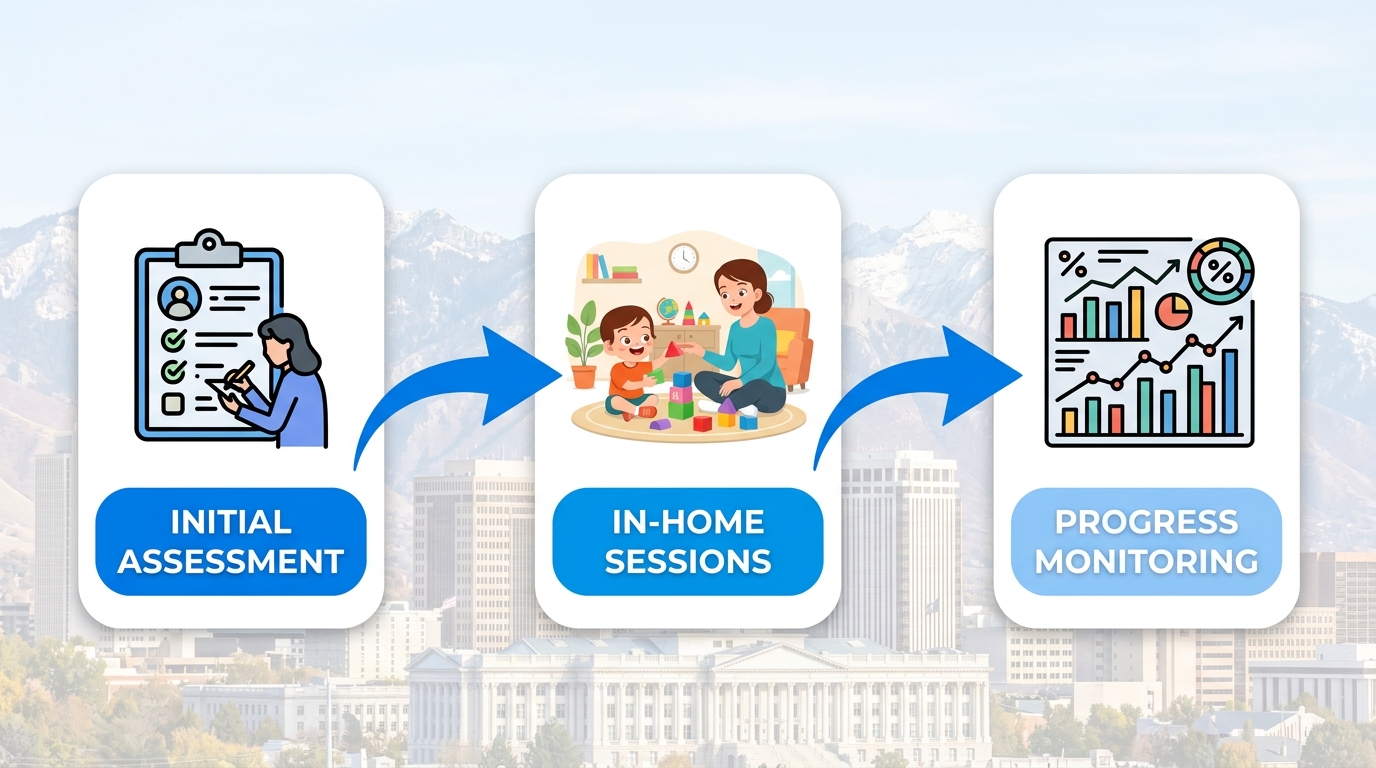
ABA autism therapy process: assessment, in-home sessions, progress monitoring.
Initial Assessments and Goal Setting
Our Board Certified Behavior Analysts (BCBAs) begin with comprehensive behavioral evaluations. They use direct observation, parent interviews, and standardized tools to pinpoint your child’s strengths, challenges, and priorities. This thorough process ensures we understand the full picture of their development.
Next, we collaborate closely with families to set personalized, measurable goals. Whether improving communication or social skills, every target reflects family input. Our interactive ABA roadmap tool visualizes this journey, making it clear and engaging. With goals set, we begin one-on-one sessions tailored to your home.
One-on-One In-Home Sessions
Our Registered Behavior Technicians (RBTs), supervised by BCBAs, conduct 1-2 hour sessions right in your child’s home. This warm and welcoming environment fits seamlessly into their daily routine, promoting natural learning. ABA therapy for children thrives here through flexible scheduling and comfort.
We employ proven techniques like discrete trial training for focused skill-building, natural environment teaching to encourage real-world application, and positive reinforcement to motivate progress. For example, a child practicing turn-taking might earn praise or a favorite toy. Like autism learning partners, we emphasize the power of small steps in a supportive setting, fostering confidence and growth.
To ensure success, we track every session meticulously.
Progress Monitoring and Adjustments
Daily data collection captures target behaviors, plotted on easy-to-read graphs and charts for clear insights. Our BCBAs review this weekly, tweaking plans based on real results to optimize outcomes. Evidence-based practices guide these evidence-based adjustments, keeping therapy dynamic and effective.
Family training sessions empower parents with strategies for consistency at home, strengthening family-centered care. We provide ongoing communication through secure parent portals, sharing updates and tips. Our clinicians collaborate with schools and providers to coordinate care when appropriate, and we tailor transitions across settings to support consistency and generalization of learned skills in daily routines. Results may vary, as every child progresses uniquely—no guarantees apply. Consult a licensed healthcare professional for diagnosis or medical advice.
Ready to see in-home ABA therapy transform your child’s life? Contact Golden Touch ABA Therapy today to start their journey.
Best Practices in In-Home ABA Therapy
Building on the foundations of ABA, here are our best practices for in-home ABA therapy delivery. At Golden Touch ABA Therapy, we focus on family-centered care and evidence-based practices to support children with autism. These strategies ensure effective, personalized support in the comfort of your home.
Choosing Qualified Providers
When selecting providers for autism therapy, prioritize those with strong credentials to deliver quality ABA therapy for children. We at Golden Touch ABA verify BCBA board certification and a minimum of two years of supervised experience for our clinicians. Our RBTs complete the required 40-hour training, ensuring competent RBT-delivered therapy under BCBA supervision.
Key criteria include:
- Verifying BACB credentials for BCBAs and RBTs
- Assessing family fit through initial consultations on communication style and scheduling flexibility
- Reviewing experience with ABA therapy programs for kids similar to your child’s needs
These steps guarantee a good match. Results may vary, but our approach maximizes potential through tailored plans and family-driven, collaborative goal setting.
Integrating Family Training
Family-centered care thrives on caregiver involvement, making family training essential in in-home ABA therapy. Training helps parents generalize skills to everyday routines, reducing therapy dependency and boosting child progress. We provide structured programs with hands-on sessions led by BCBAs, including progress tracking materials and strategies like those used by autism learning partners.
Benefits include:
- Improved skill carryover from sessions to home life
- Empowered caregivers to reinforce learning consistently
- Customized modules on behavior management and communication
Our family-centered care includes comprehensive training modules tailored to your needs. This collaboration fosters independence. Results may vary, and insurance coverage is subject to verification for these services.
Ensuring Local Accessibility
Accessibility is key for consistent ABA therapy for children, especially in Salt Lake City, Utah. Confirm in-person availability in Salt Lake City, Utah, and explore telehealth for rural spots. At Golden Touch ABA Therapy, we offer multi-state licensing across Utah, Arizona, and Maryland, with flexible scheduling for in-home ABA therapy.
Practical tips:
- Check service areas for county-level coverage in Salt Lake City, Utah
- Verify telehealth integration for broader reach
- Confirm insurance assistance and benefits support to ease access
We serve families in Salt Lake City, Utah, and beyond with flexible in-home ABA therapy scheduling to maximize accessibility. Our interactive ABA roadmap helps plan sessions seamlessly. Contact us in Salt Lake City to implement these practices today. We welcome questions from families at every stage of their care journey today. Consult a licensed healthcare professional for personalized advice, as results may vary.
Next Steps for Your Child’s Autism Therapy Journey
Now that you understand the power of ABA, here are your next steps in autism therapy. At Golden Touch ABA Therapy, we’re thrilled you’ve taken the first step toward your child’s autism therapy. We’re here to guide you every step of the way with our family-centered care and evidence-based practices.
Here are the key actions to begin:
- Fill out our contact form or use the interactive ABA roadmap tool for a quick assessment of your needs.
- Let our team assist with insurance benefits eligibility and verification—coverage is subject to verification and not guaranteed.
- Schedule an initial behavioral assessment with our highly trained BCBA to create a personalized plan.
- Start RBT-delivered ABA therapy for children through in-home ABA therapy sessions with flexible scheduling.
- Receive ongoing caregiver training and supervision from your dedicated autism learning partners.
Results may vary. Contact us today for your custom quote—our team is ready to partner with you in this warm and welcoming environment, and celebrate every meaningful milestone. Reach out today via our form below. Consult a licensed healthcare professional for advice.
Resources
- Behavior Analyst Certification Board (BACB)
- Autism Speaks: Applied Behavior Analysis Guide
- CDC: Autism Spectrum Disorder Treatment Options
This article was researched and written with the assistance of AI tools.
