
Holistic Therapy Utah: Complete Guide for Anxiety Relief
Table of Contents
- Holistic Therapy in Utah: A Path to Integrated Wellness
- Holistic Therapy Modalities and Their Benefits in Utah
- Accessing Holistic Therapy Services in Utah
- What to Consider When Choosing Holistic Therapy in Utah
- Your First Holistic Therapy Appointment in Utah: What to Expect
- Start Your Holistic Therapy Journey in Utah with Confidence
Holistic Therapy in Utah: A Path to Integrated Wellness
We’ve seen a growing interest in holistic therapy in Utah, an approach that considers the whole person—mind, body, and environment. Many families explore holistic therapy for anxiety in Utah and holistic therapy for PTSD in Utah as part of a broader wellness journey. While we don’t offer these therapies directly, our in-home ABA model naturally embraces holistic principles by working within your child’s familiar surroundings. In our Warm and Welcoming Environment, we focus on The Power of Small Steps, integrating family collaboration into every session. According to cdc public health resources, integrated approaches like these can support overall well-being. This blend of evidence-based ABA and holistic-minded care helps children reach their true potential.
Holistic Therapy Modalities and Their Benefits in Utah
When exploring holistic therapy in Utah, families often seek approaches that consider the whole child — mind, body, and behavior — rather than treating a single symptom in isolation. We believe that Applied Behavior Analysis (ABA), especially when delivered in a child’s natural home environment, fits naturally within this holistic framework. This section compares four popular modalities available to families throughout Salt Lake, Utah, Weber, and Davis Counties.
Holistic Therapy Modality Comparison in Utah
| Modality | Focus Area | Availability in Utah | Evidence Base |
|---|---|---|---|
| Neurofeedback | ADHD, anxiety, sleep disorders | Found in many clinics across Salt Lake City and Utah County | Strong evidence for ADHD; emerging support for anxiety |
| Applied Behavior Analysis (ABA) | Autism spectrum disorder, developmental disabilities, behavior reduction | Widespread across Utah; in-home options in Salt Lake, Utah, Weber, Davis Counties | Strong evidence for autism (AAP-endorsed, BACB-certified) |
| Cognitive Behavioral Therapy (CBT) | Anxiety, PTSD, depression | Widely available throughout Utah | Strong evidence for anxiety and PTSD |
| Mindfulness-Based Stress Reduction (MBSR) | Stress, anxiety, chronic pain | Moderate availability; offered at hospitals and wellness centers | Moderate evidence for stress reduction |
This comparison highlights how each option addresses distinct needs. Neurofeedback offers a targeted, clinic-based route for attention difficulties, while ABA provides comprehensive, evidence-based support for children with autism right at home. For those searching for holistic therapy for anxiety Utah, CBT and MBSR present well-supported paths, with CBT also recognized as a powerful holistic therapy for PTSD Utah residents can access broadly across the state.
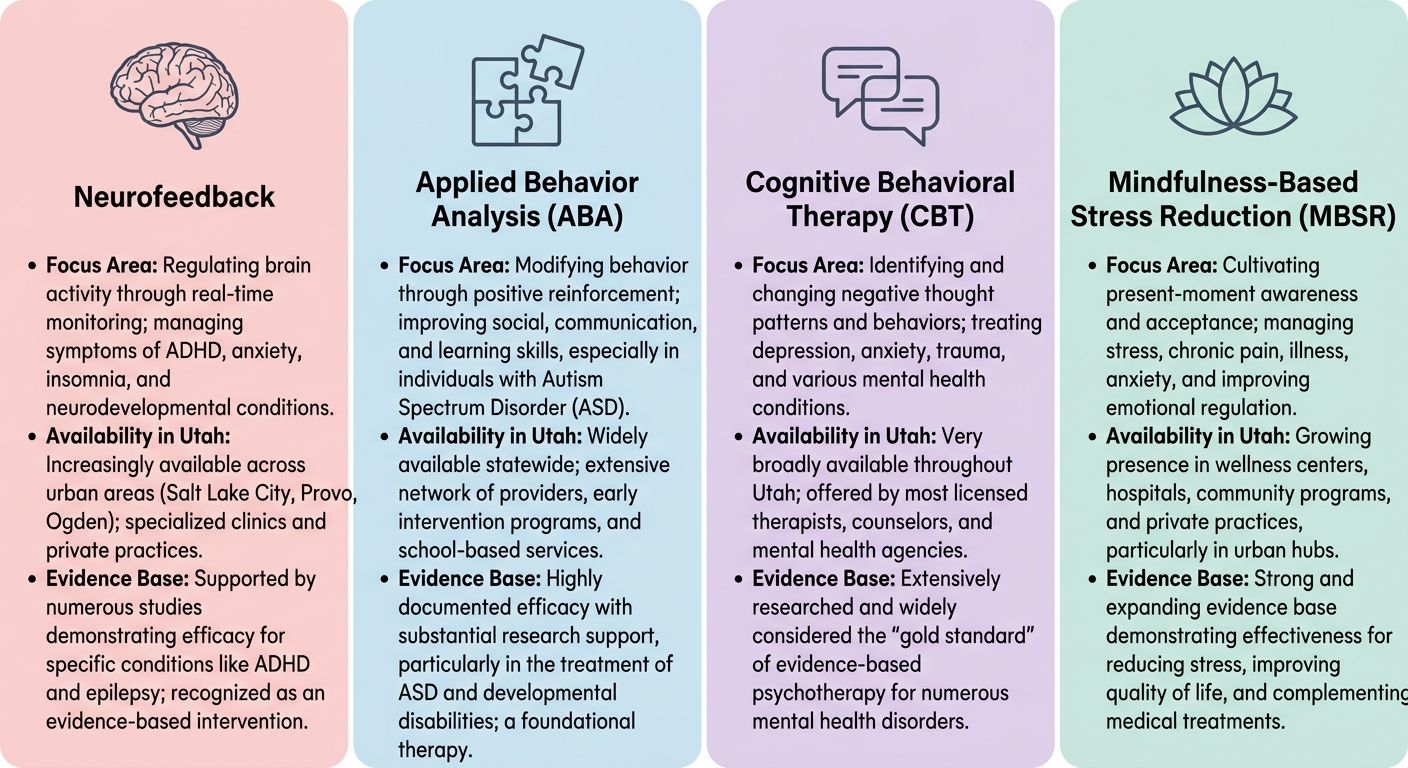
Holistic therapy modality comparison infographic for Utah families
Each approach brings its own strengths to a family’s journey. As a leading authority, the Behavior Analyst Certification Board (BACB) validates ABA’s strong evidence base for skill-building and behavior reduction. The Association for Behavior Analysis International (ABAI) further supports this, contributing to a deep body of research that guides our personalized, in-home ABA therapy. We see every day how Small Steps That Yield Big Results create meaningful change in a Warm and Welcoming Environment.
To learn more about local programs and eligibility, families can connect with utah disability services. Our team is always available to discuss how personalized, in-home ABA therapy can become part of your child’s holistic support system. This information is for educational purposes and is not a substitute for professional medical advice; consult a healthcare or behavioral health professional. Results may vary based on individual circumstances, and insurance coverage and results depend on individual plans and client factors.
Accessing Holistic Therapy Services in Utah
For families seeking holistic therapy Utah, starting ABA services with our team is a straightforward and supportive process. If you feel that In Home ABA Therapy could be the right approach for your child, here is exactly how to begin.
The Initial Consultation and Assessment
Your journey begins with a free consultation. Simply contact us, and we will schedule a time for a Board Certified Behavior Analyst (BCBA) to conduct a personalized in-home assessment. According to the American Academy of Pediatrics, ABA is an endorsed, evidence-based approach that holistically addresses communication, social skills, and daily living. For children whose challenging behaviors stem from underlying anxiety or trauma, this collaborative effort functions as a supportive holistic therapy for anxiety Utah families can trust to reduce social avoidance and build coping skills.
Understanding Your Insurance Coverage
Navigating insurance is a key part of getting started. After you submit your information, our team verifies your benefits and explains your coverage in detail, handling prior authorization so you don’t have to. Please note that insurance coverage and results depend on individual plans and client factors.
Our Utah Service Areas
We provide compassionate in-home care across Salt Lake County, Utah County, Weber County, and Davis County, creating a Warm and Welcoming Environment in cities including Salt Lake City, Sandy, Draper, West Jordan, Murray, Riverton, Provo, Orem, Lehi, Ogden, and Bountiful. Families looking for aba therapy in layton, utah, can begin with a free consultation from our multidisciplinary team of BCBAs and RBTs. This model treats behavioral challenges holistically, acting as a comprehensive holistic therapy for PTSD Utah children may need when communication difficulties result from past trauma.
This information is for educational purposes and is not a substitute for professional medical advice; consult a healthcare or behavioral health professional. Contact us today to schedule your free consultation and take the first Small Steps That Yield Big Results.
What to Consider When Choosing Holistic Therapy in Utah
Now that you understand what holistic therapy involves, finding the right provider for your child is a journey built on trust and evidence. When exploring holistic therapy in Utah, we believe the best outcomes come from blending scientific rigor with a Warm and Welcoming Environment. The American Academy of Pediatrics recommends evidence-based interventions, so it’s essential to choose a team that uses data-driven methods. For children needing holistic therapy for anxiety in Utah or holistic therapy for PTSD in Utah, this means selecting a provider who addresses behavioral challenges through personalized, in-home care that fits your family’s daily routines.
- Evidence-Based Practice: Look for licensed BCBAs who design plans supported by research. We use proven ABA techniques to help improve communication and daily living skills.
- Personalized Care: In-home therapy allows strategies to be tailored to your child’s natural environment, helping them take Small Steps That Yield Big Results.
- Parent Collaboration: A holistic approach for children in Utah should involve family training, empowering parents to guide progress outside of sessions.
- Convenient Utah Service Areas: Our team serves Salt Lake, Utah, Weber, and Davis counties, bringing care directly to your home.
We are dedicated to Helping Children Reach their True Potential by integrating support into your everyday life. This information is for educational purposes and is not a substitute for professional medical advice; consult a healthcare or behavioral health professional. Results may vary based on individual circumstances. One approach that aligns with these considerations is in-home ABA therapy.
Your First Holistic Therapy Appointment in Utah: What to Expect
Your first in-home ABA therapy appointment with us introduces you to the power of in home aba therapy delivered in a warm, familiar setting. While you may be searching for holistic therapy in Utah, our ABA approach treats the whole child at home.
The visit begins with a 60-minute BCBA-led assessment right in your living room. We start with a parent interview to discuss your concerns, daily routines, and priorities for your child. Then, we observe your child during natural activities like play, meals, and transitions to assess behavior and skills. Families seeking holistic therapy for anxiety in Utah find that our behavior-focused strategies reduce stress naturally. Within 48 hours, you receive a written summary and a proposed therapy schedule. The session is non-clinical and play-based, creating a stress-free introduction. Siblings and caregivers are welcome to participate or observe. No medical diagnosis is required to start—just a physician referral or school recommendation.
We believe in small steps that yield big results. Your BCBA will use this assessment to create a personalized plan grounded in whole-child development, much like the approach families seek when exploring holistic therapy for PTSD in Utah.
Start Your Holistic Therapy Journey in Utah with Confidence
Your holistic therapy journey in Utah begins with confidence when you choose Golden Touch ABA’s in-home, evidence-based support. We deliver personalized aba therapy in your child’s natural environment, focusing on small steps that build communication, social, and daily living skills. Our BCBA-led team creates a warm, welcoming environment, whether you’re seeking holistic therapy for anxiety Utah families trust or trauma-informed support for PTSD. Flexible scheduling adapts to your needs. Contact us to schedule a free consultation and see how we help children reach their true potential right here in Salt Lake City and throughout Utah County.
Resources
Table of Contents
- Understanding ADHD Treatment in Utah
- Comparing ADHD Treatment Approaches Across Utah
- Accessing ADHD Therapy Services in Utah
- Key Local Factors for ADHD Care in Utah
- First Steps Toward ADHD Treatment in Utah
- Moving Forward with ADHD Support in Utah
Understanding ADHD Treatment in Utah
When exploring ADHD treatment in Utah, families often encounter two distinct approaches: behavioral therapy and neurofeedback. Both aim to improve focus and self-regulation, but they work in fundamentally different ways. The following comparison highlights the key differences based on current evidence.
Comparing ADHD Treatment Approaches Across Utah
Here is a side-by-side overview of these approaches:
| Feature | Behavioral Therapy | Neurofeedback Therapy |
|---|---|---|
| Core Approach | Teaches coping skills and behavior modification through structured reinforcement | Trains brainwave patterns to improve self-regulation and focus |
| Evidence Base | Strong evidence for ADHD (CDC, AAP recommend as first-line for children) | Growing evidence; some studies show moderate improvements in attention and impulsivity |
| Typical Session Length | 45–60 minutes, often weekly | 30–60 minutes, 2–3 times per week |
| Age Range | Effective for children as young as 3, adolescents, and adults | Typically recommended for children ages 5 and older |
| Typical Duration of Treatment | Variable; often 3–6 months for measurable gains, can be longer | Often 20–40 sessions (several months) |
| Cost Considerations | Often covered by insurance; out-of-pocket costs vary | Insurance coverage varies; can be expensive without coverage |
Behavioral therapy for ADHD in Utah has a strong evidence base, and many local providers offer parent-training components that reinforce skills at home. Neurofeedback therapy in Utah is an option for families interested in a technology-driven approach, though we recommend discussing its appropriateness with a healthcare provider. Regardless of the path, consistency and professional guidance are key.
The Centers for Disease Control and Prevention (CDC) and the American Academy of Pediatrics (AAP) recommend behavioral therapy as a first-line treatment for children with ADHD. For more details, visit our CDC ADHD resources. Neurofeedback is an emerging option with growing evidence, though it is not yet endorsed as a first-line approach by these organizations. We encourage Utah families to consider each treatment’s evidence, session requirements, and age suitability, and to discuss options with a behavioral health professional. This information is for educational purposes and is not a substitute for professional medical advice; consult a healthcare or behavioral health professional. Understanding these differences is a great starting point. For families looking to integrate effective behavioral strategies at home, our team at Golden Touch ABA Therapy can help you explore complementary support.
Accessing ADHD Therapy Services in Utah
Once you understand the options, accessing therapy is straightforward. If you are seeking effective adhd treatment utah, our in-home ABA therapy offers a personalized path forward. You can reach us by phone at (801) 630-5443, complete our online contact form, or send a text. A BCBA will contact your family within 1–2 business days to schedule a free consultation. During that conversation, we’ll gather information about your child’s strengths and challenges so we can tailor a plan to their unique needs.
Our assessment process is simple and transparent. While we specialize in ABA, we can coordinate with other approaches like neurofeedback therapy utah if needed, and our core offering is behavioral therapy adhd utah that focuses on building skills at home. Here’s what to expect:
- Call or fill out our online form
- We verify your insurance benefits confidentially
- A BCBA designs a personalized plan
Our approach follows guidelines such as those from the ADHD behavior therapy AAP to ensure quality care. Therapy is provided in your child’s home across multiple counties including Salt Lake, Utah, Weber, and Davis, making it convenient and comfortable.
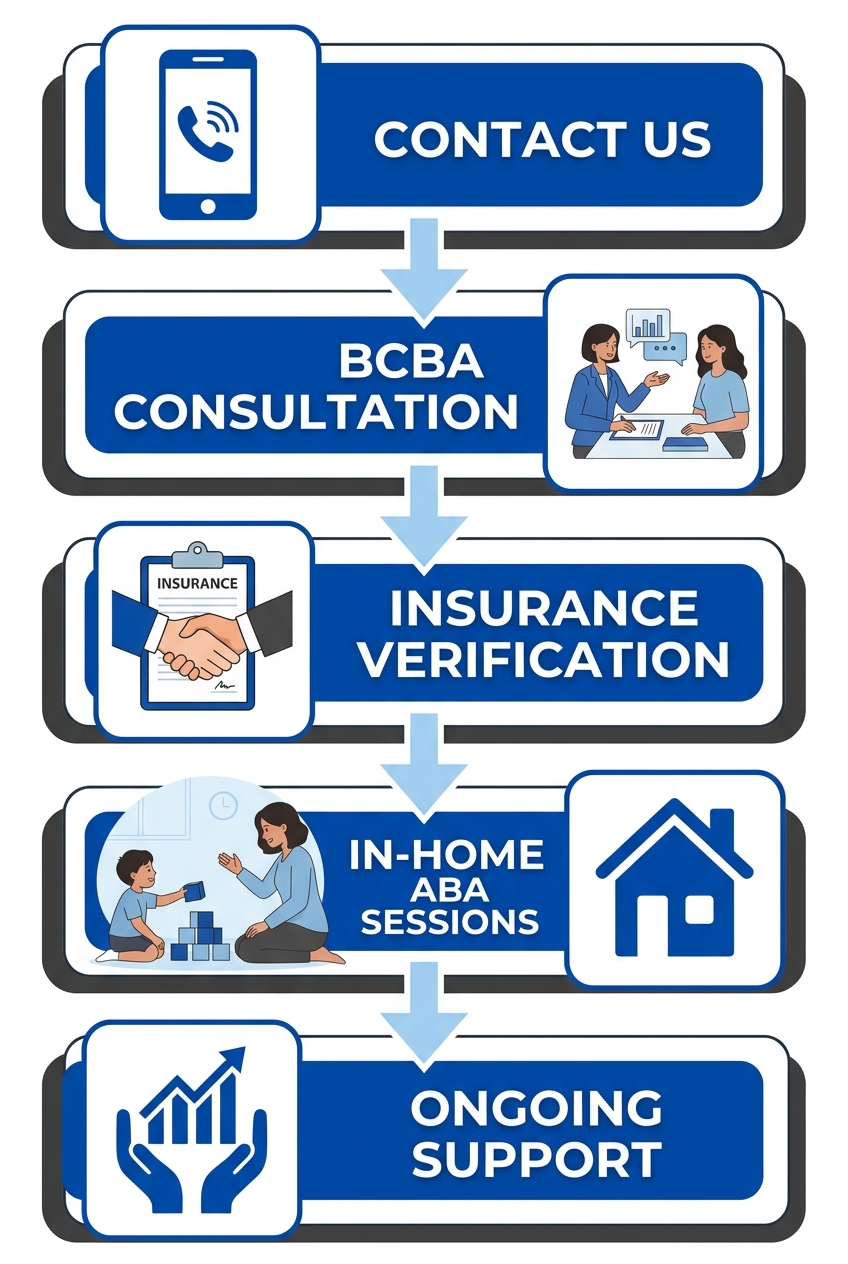
Process to start ABA therapy for ADHD in Utah
After your child starts therapy, here’s what you can expect from our family collaboration. Getting started is as simple as reaching out—our caring team is ready to support your family’s next steps. Results may vary based on individual circumstances. This information is for educational purposes and is not a substitute for professional medical advice; consult a healthcare or behavioral health professional.
Key Local Factors for ADHD Care in Utah
When seeking effective ADHD treatment in Utah, several local factors shape the quality and accessibility of care. We understand that families need practical, community-based solutions that fit their daily lives, and recognizing these factors can make it easier to find the right support.
One important local factor is the availability of specific behavioral therapy approaches. Many Utah families explore options like neurofeedback therapy in Utah, which may assist with attention regulation, alongside more widely available behavioral therapy for ADHD in Utah, such as Applied Behavior Analysis techniques. Through our experience, we have seen how these therapies can offer structured, skill-building support in familiar home settings.
Location plays a crucial role in consistent care. Accessibility within communities such as Salt Lake City and Provo can directly influence a family’s ability to maintain regular sessions. We make this connection easy, and families in Davis County can connect with a dedicated therapist in Layton, Utah who understands community needs. Receiving support close to home reduces travel stress and helps therapy feel integrated into a child’s natural routine.
Beyond location, family involvement is a key ingredient for success. Parent training and caregiver collaboration may empower everyone at home to reinforce positive behaviors, turning small daily moments into meaningful progress. We believe this partnership helps skills generalize beyond structured sessions.
In-home services can also address common barriers like transportation or scheduling conflicts. Ultimately, looking at these local factors together—therapy types, therapist location, family collaboration, and practical convenience—can guide Utah families toward a supportive path for ADHD care.
First Steps Toward ADHD Treatment in Utah
When you’re ready to explore adhd treatment utah, the first step is a free, no-obligation consultation with Golden Touch ABA. Just call (801) 630-5443 or email us, and our team will schedule a time to talk. During this call, a Board Certified Behavior Analyst (BCBA) will listen to your child’s needs and answer your questions. We also handle insurance verification so you don’t have to worry about paperwork. No referral is needed, and even if you haven’t received a formal ADHD diagnosis, the assessment can help determine whether ABA therapy is a good fit.
Our behavioral therapy for ADHD in Utah begins with that initial conversation. While neurofeedback therapy in Utah is another option, our In Home ABA Therapy focuses on practical skill-building in familiar surroundings. Our compassionate BCBAs create a warm, welcoming environment where your child can thrive. We serve families throughout Salt Lake City, Provo, Ogden, and beyond, bringing support right to your living room. Small steps that yield big results start with a single call. Take the first small step and contact us today.
Moving Forward with ADHD Support in Utah
Seeking effective ADHD treatment in Utah doesn’t have to feel overwhelming. In-home behavioral therapy for ADHD in Utah helps children improve attention, social skills, and daily routines—all within a warm and welcoming environment where families are actively involved. Our approach focuses on small steps that yield big results, with flexible scheduling to fit your life. Contact a therapist in Layton, Utah today to learn how we can support your child’s growth.
Resources
Table of Contents
- Finding Autism Therapy Providers in Maryland
- Maryland’s Autism Therapy Landscape
- In-Home ABA Therapy Availability in Maryland
- Important Considerations for Maryland Families
- Beginning ABA Therapy for Your Child in Maryland
- Your Path to ABA Therapy in Maryland
- Resources
Finding Autism Therapy Providers in Maryland
Finding the right autism therapy providers in Maryland starts with knowing what to look for. Once you understand how ABA therapy works, the next step is connecting with a team that can bring support directly to your doorstep. We offer in-home ABA therapy in Maryland designed to create a warm and welcoming environment where your child feels safe to learn and grow.
Our Board Certified Behavior Analysts (BCBAs) supervise every step, while skilled Registered Behavior Technicians (RBTs) deliver evidence-based practices during one-on-one sessions. Family-centered care means we involve you directly, offering caregiver training so progress continues between visits. We also provide insurance assistance and an interactive ABA roadmap tool to clarify the path ahead. The power of small steps guides our approach, and many families see meaningful gains with early intervention autism in Maryland. Results may vary, but our evidence-based approach aims for meaningful progress. Reach out to our Maryland team to learn how in-home ABA therapy in Maryland can fit into your family’s routine.
Maryland’s Autism Therapy Landscape
In Maryland, we see a diverse landscape of autism therapy providers in Maryland, offering a wide range of in-home ABA therapy options, though the concentration of services varies by county. Families researching providers will find many options listed on industry directories such as in-home ABA therapy in Maryland. The table below breaks down the coverage across several key counties to help you quickly identify the support available in your area.
| County | ABA Therapy Coverage | Types of Services Available | Notes |
|---|---|---|---|
| Anne Arundel County | Multiple in-home providers including Golden Touch ABA | In-home ABA, BCBA supervision, parent training | Proximity to Baltimore expands options |
| Baltimore County | High concentration of ABA providers | In-home, clinic-based, early intervention | Some providers may have waitlists |
| Montgomery County | Strong coverage with many BCBAs and RBTs | In-home, school collaboration, telehealth | Medicaid accepted by several agencies |
| Prince George’s County | Growing number of in-home providers | In-home ABA, parent coaching, insurance assistance | Check county-specific Medicaid policies |
| Howard County | Several trusted ABA agencies | In-home therapy, social skills groups, family support | Waitlists common; early contact advised |
Montgomery and Baltimore counties maintain the highest density of Board Certified Behavior Analysts (BCBAs) and Registered Behavior Technicians (RBTs), and many providers in these areas accept Medicaid, according to industry directories. Families in Howard and Prince George’s counties should note that waitlists can be common, so contacting providers early and verifying county-specific Medicaid policies are essential first steps. For families with younger children, early intervention autism in Maryland programs are widely available in these counties, offering parent training and BCBA-supervised therapy to build foundational skills from an early age.
With this landscape in mind, every family’s journey begins by identifying their local in-home ABA therapy in Maryland options and reaching out for a personalized assessment. Insurance coverage is subject to verification; results may vary.
In-Home ABA Therapy Availability in Maryland
Families seeking compassionate autism therapy providers Maryland can now access in-home ABA therapy Maryland from Golden Touch ABA Therapy right in their own communities. Our services bring the power of small steps to homes across the state, creating a warm and welcoming environment where children feel comfortable and supported as they learn.
According to our Maryland location page, we bring personalized, family-centered care to families in multiple counties, including Baltimore County, Montgomery County, and Prince George’s County. Our clinical team, led by a Board Certified Behavior Analyst (BCBA) and supported by skilled Registered Behavior Technicians (RBTs), delivers evidence-based practices in your child’s natural environment. For families exploring early intervention autism Maryland services, our in-home approach allows learning to happen where your child already plays, eats, and interacts, making each session a natural part of daily life.
We understand that navigating coverage can feel overwhelming, so our team provides dedicated insurance assistance to help you explore your options, including private plans and Medicaid. If you are seeking ABA therapy in Maryland with Medicaid, we can help you explore your options and connect you with additional resources. Insurance coverage is subject to verification and is not guaranteed.
Once you confirm availability in your area and understand your insurance options, the next step is a personalized assessment to start your child’s journey toward meaningful growth and greater independence.
Important Considerations for Maryland Families
When searching for reliable autism therapy providers in Maryland, families should start by understanding their insurance coverage. Verifying benefits with both private plans and Maryland Medicaid is essential before committing to a program. We encourage every family to request a benefits eligibility check so there are no surprises down the road.
Recognizing the early signs of autism is the first step toward early intervention. Indicators can appear as young as 6 months, and noting delays in social smiles, babbling, or eye contact can make a critical difference. Seeking early intervention autism in Maryland leads to more effective support and improved developmental outcomes for your child.
In-home ABA therapy in Maryland offers unique advantages for busy families. Receiving care in a warm and welcoming environment eliminates travel stress and allows caregivers to participate during everyday routines. Our family-centered care model ensures that evidence-based practices are woven into your child’s natural setting.
When choosing a provider, look for BCBA supervision and individualized treatment plans that celebrate the power of small steps. Quality programs adapt to your child’s needs, and our team is ready to help you verify coverage and schedule an in-home consultation.
Results may vary. Consult a licensed healthcare professional for diagnosis.
Beginning ABA Therapy for Your Child in Maryland
Starting ABA therapy can feel overwhelming, but we are here to guide you every step of the way. Families searching for autism therapy providers in Maryland will find a warm, welcoming, and collaborative partner in Golden Touch ABA. Our process begins with a simple, no-pressure conversation so we can learn about your child and answer your questions.
We begin with a free consultation to discuss your concerns and gather preliminary information. From there, our Board Certified Behavior Analyst (BCBA) completes a comprehensive behavioral assessment in your home. This allows us to understand your child’s unique strengths and needs within their natural environment. As an expert in early intervention autism in Maryland, our BCBA then designs a personalized plan built entirely around your child. We also help your family navigate insurance by verifying your benefits and explaining your coverage in clear terms, so you can focus on what matters most.
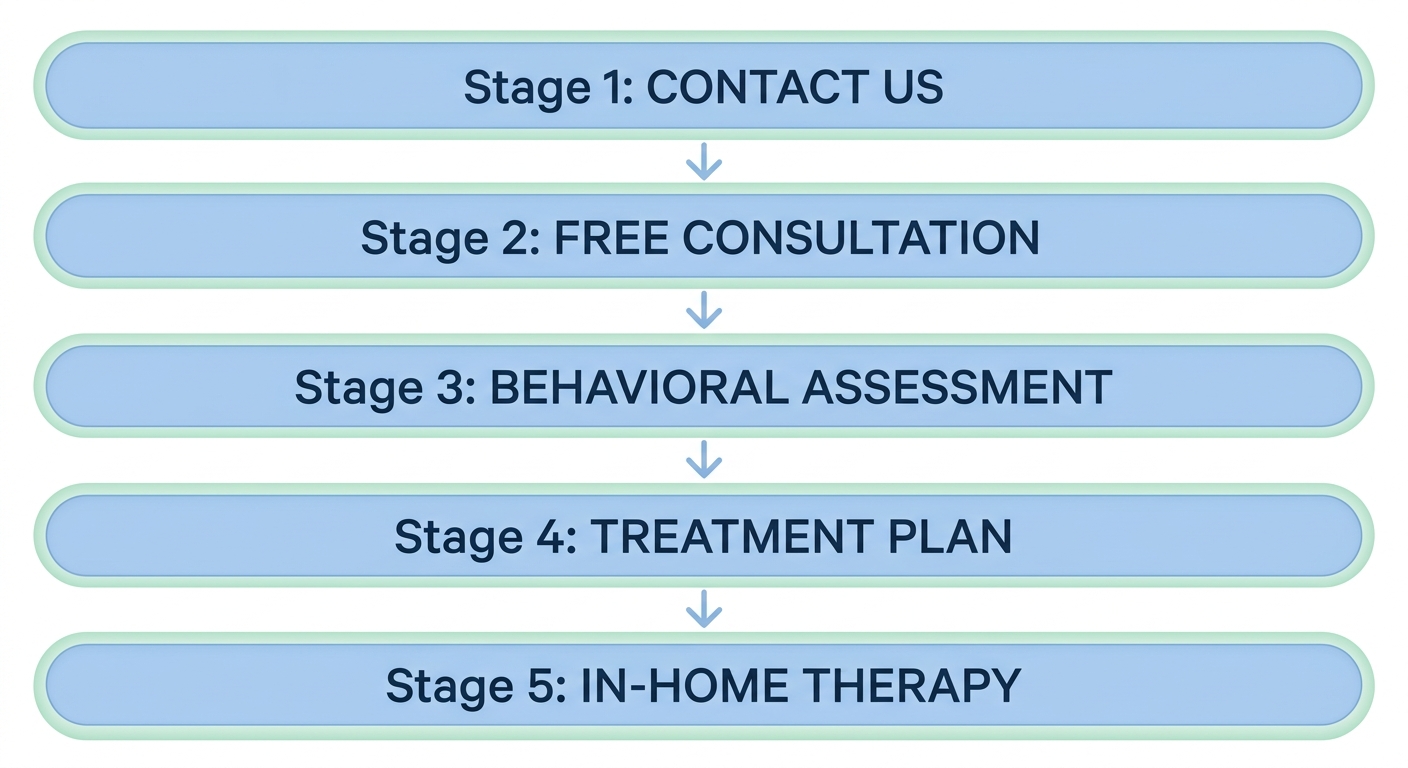
Five-step process to start in-home ABA therapy in Maryland.
Our in-home ABA therapy in Maryland sessions are delivered one-on-one by a compassionate Registered Behavior Technician (RBT) who is closely supervised by your BCBA. We believe in the power of small steps and family-centered care, which is why we incorporate ongoing caregiver training and adjust our approach based on your child’s progress. Evidence-based practices form the foundation of every session, creating a supportive structure for meaningful skill development. While every child’s journey is unique and results may vary, a consistent, early start provides the best foundation for growth. Reach out today for a custom quote and take the first step forward together.
Disclaimer: Results may vary. The information provided here is for educational purposes and does not replace consultation with a licensed healthcare professional.
Your Path to ABA Therapy in Maryland
Finding the right autism therapy providers Maryland families trust is easier than you might think. Ready to take the first step? Here’s how to start your journey with us:
- Schedule a free consultation or use our interactive ABA roadmap tool to share your child’s needs.
- Our team provides insurance verification assistance to clarify your benefits.
- A dedicated team of trained RBTs, supervised by a BCBA, delivers personalized in-home aba therapy maryland services.
While we also provide in-home ABA therapy in Utah, our Maryland families receive the same high-quality, compassionate care. Contact us today to begin.
Resources
- Get Expert In-Home ABA Therapy in Maryland
- Get In-Home ABA Therapy in Washington Terrace
- Discover Early Signs of Autism in Toddlers
- Learn Early Signs of Autism and ABA Therapy
- Find Early Signs of Autism in Infants
- Get Early Intervention ABA Therapy for Toddlers
- Discover Early Autism Signs and ABA Therapy
- Get ABA Therapy in Maryland with Bilingual Support
- Get ABA Therapy in Maryland for Children and Young Adults
Table of Contents
- ABA Therapy for School-Age Children: What Parents Need to Know
- Before You Begin ABA Therapy with Your School-Age Child
- Assess Your Child’s Current Behavioral and Communication Skills
- Set Measurable Goals with Your BCBA
- Coordinate ABA Therapy with School and IEP Goals
- Create a Consistent In-Home Therapy Schedule
ABA Therapy for School-Age Children: What Parents Need to Know
Is your school-age child facing challenges with social skills, classroom routines, or growing independence? You’re not alone. ABA therapy for school age children is an evidence-based approach that uses positive reinforcement to teach adaptive skills and reduce challenging behaviors through individualized goals. Golden Touch ABA offers in-home ABA therapy tailored specifically to school-age children, bringing therapy into your home to build real-world skills in a warm and welcoming environment.
Our therapists collaborate with you to carry over strategies at home and support school readiness by reinforcing the communication and self-regulation skills essential for classroom success. We believe in the power of small steps, breaking complex skills into manageable achievements through family-centered care.
ABA therapy can also complement your child’s IEP goals for autism, ensuring progress aligns with educational objectives.
- Results vary; always consult a healthcare professional for medical advice.
In the sections below, we explore how in-home ABA therapy can boost school readiness and complement IEP goals for autism.
Before You Begin ABA Therapy with Your School-Age Child
Before you begin autism therapy for your elementary-aged child, a little preparation on the front end can help set the stage for a smooth, confident start. We want to make sure you feel supported in this process, so here are a few steps to consider before the first session even begins.
First, a Board Certified Behavior Analyst, or BCBA — the professional certified by the Behavior Analyst Certification Board (BACB) to design and oversee treatment — will conduct a comprehensive assessment of your child’s unique strengths and needs. This assessment informs the individualized goals that your clinical team will work toward. In-home ABA therapy gives us the advantage of observing your child in their natural environment, where real-life skills are built.
Next, review your insurance benefits early. Our team offers free assistance to help you understand your coverage so you can focus on your child’s care. You’ll also want to bring any current school documents — including IEP goals for autism — to your BCBA’s attention. Aligning home and school strategies encourages family-centered care and creates a consistent thread of support for your learner.
With a complete picture of your child’s needs, your BCBA will craft a plan that fits seamlessly into your schedule. As you prepare for this partnership, remember that progress is a gradual journey; every child’s path toward school readiness and independence unfolds at a pace shaped by their own hard work and the consistency of the support around them.
Now that you know what to line up, the next step is meeting your team and getting started with a personalized consultation.
Assess Your Child’s Current Behavioral and Communication Skills
Before we can set goals, let’s look at where your child is now. The first step in choosing aba therapy for school age children is understanding their current abilities, especially in school readiness. Our family-centered approach values your insights as you observe your child’s communication and behavior patterns in a warm and welcoming environment.
Pay attention to both verbal and non-verbal communication, such as using words, gestures, or AAC devices. Also note behaviors like transitions, tantrum frequency, or self-stimulatory actions, and assess social strengths, including whether your child engages in parallel or cooperative play. These observations are foundational for setting meaningful iep goals for autism like increasing mands and social initiations. A qualified professional with BCBA certification will then perform a comprehensive evaluation, using evidence-based practices to develop a tailored program.
This home assessment helps us see the full picture, connecting your child’s current skills to the power of small steps in therapy. By identifying targeted objectives together, we prepare for a smooth transition into an individualized plan that supports growth and independence. Our team is here to guide you through this family-centered process every step of the way.
Set Measurable Goals with Your BCBA
After your child’s initial assessment reveals their strengths and areas for growth, the next step in aba therapy for school age children is to sit down with your BCBA and turn those insights into clear, measurable goals. We believe in family-centered care, so these objectives are created together — not dictated by the therapist alone. The targets are specific, measurable, and woven into your child’s daily routines, focusing on skills like transitions and peer interaction to build classroom preparedness. Your BCBA also aligns these home targets with IEP goals for autism so school-based objectives are supported. For example, a goal might be to increase on-task behavior during a 10-minute table activity from 2 minutes to 8 minutes over 8 weeks. Our team of RBTs, who hold the registered behavior technician certification, implements these plans, and progress is tracked session by session and shared in regular updates. Every child is different, so results may vary, but we believe in the power of small steps.
Coordinate ABA Therapy with School and IEP Goals
After setting meaningful therapy targets at home, aligning those goals with your child’s Individualized Education Program (IEP) is a natural next step.
When the Board Certified Behavior Analyst (BCBA) communicates regularly with school staff, therapy data can directly inform classroom strategies. Our in-home team tracks targeted behaviors — from task initiation to following instructions — which teachers can use to update IEP goals for autism and measure progress. Parents often find it helpful to invite their BCBA to IEP meetings, as this provides valuable behavioral insights and reinforces consistent strategies across both environments.
In our home sessions, we emphasize school readiness skills such as following multi-step directions, staying on task, and building social connections. Using the same prompts and reinforcement at home and in the classroom reduces confusion and helps children generalize newly learned skills more confidently.
Want to learn more about how we partner with families and schools? Reach out today to talk about coordinating autism therapy in Washington Terrace, Utah with your child’s educational team.
Create a Consistent In-Home Therapy Schedule
Once the space is ready, the next step is building a consistent in-home therapy schedule. We recommend starting aba therapy for school age children by selecting two or three fixed time slots each week and treating them as non-negotiable appointments. A predictable rhythm helps your child transition from the school day to therapy with less resistance, and it reinforces the skills practiced during sessions.
A steady routine is the heartbeat of family-centered care. Prepare a dedicated, distraction-free area and pair each session with a simple before-routine—like a snack and a brief chat about the day. This warm, welcoming cue signals to your child that it’s time to focus and engage. We encourage you to lean on your BCBA or RBT for strategies when life disrupts the schedule; they can help you adjust while preserving momentum.
Consistently following a schedule can strengthen school readiness and support progress toward your child’s iep goals for autism. Committing to small, regular sessions often builds confidence and lasting skills.
Practice Social Skills Through Everyday Interactions
We know that the best way for school-age children enrolled in ABA therapy for school age children to grow socially is through the small, natural moments that fill each day. With guidance from your child’s BCBA, everyday routines become powerful opportunities to practice skills identified in the treatment plan, opening the door to school readiness and meaningful IEP goals for autism.
An easy, low-pressure starting point is taking turns during a family board game. A therapist from Golden Touch ABA can coach you on how to prompt your child to wait and then offer enthusiastic, immediate praise for a successful turn. A second example is practicing a simple greeting when ordering at a cafe counter; the BCBA might suggest focusing on just one moment of eye contact during the brief exchange. The goal is to begin with manageable steps that support peer interactions and avoid creating anxiety, and then gradually build toward longer, more complex conversations.
These everyday interactions are most effective when they’re brief, positive, and connected directly to the skills your BCBA has prioritized. Our team helps you weave these moments into your family’s unique rhythm, ensuring that every small success builds toward growing social confidence and building communication skills for school and beyond.
Monitor Progress and Adjust Goals as Needed
After goals are set, the next step is to track your child’s progress closely. For school-age children receiving ABA therapy, monitoring progress is key to making sure therapy is working and adapting to their evolving needs. We track development continuously through data collection during every session, recording trial-by-trial responses and skill acquisition. This real-time information helps our BCBAs see what’s working and where small adjustments can make a big difference.
Parents can support this process by keeping a simple home log of observed behaviors and new skills, noting anything that seems easier or more challenging at home. These notes, combined with our data, create a fuller picture of your child’s growth. Signs of progress often show up as increased independence, improved communication, reduced challenging behaviors, or progress toward school readiness and iep goals for autism. We review goals regularly—usually weekly or bi-weekly—and suggest adjustments when a child has consistently met a target for several sessions or when a goal no longer fits their developmental priorities.
As you monitor progress and adjust goals, you’ll build a clearer picture of your child’s growth. We encourage you to ask questions during caregiver training and collaborate on setting new, slightly more challenging targets. Progress looks different for every child—some days bring big leaps, other days quiet wins—but the power of small steps is always at the heart of our family-centered care. Golden Touch ABA Therapy is here to help you shape a plan that reflects your child’s unique journey, and we would love to talk through a personalized progress strategy whenever you are ready.
Prepare for School Readiness and Independence
Once your child is making progress at home, we also focus on preparing them for the classroom. Our in-home aba therapy for school age children builds school readiness by teaching the routines and independence skills that lead to classroom success. We practice transitioning between activities, following multi-step instructions, and handling bathroom independence during familiar in-home sessions, so these abilities feel natural before the first day of school.
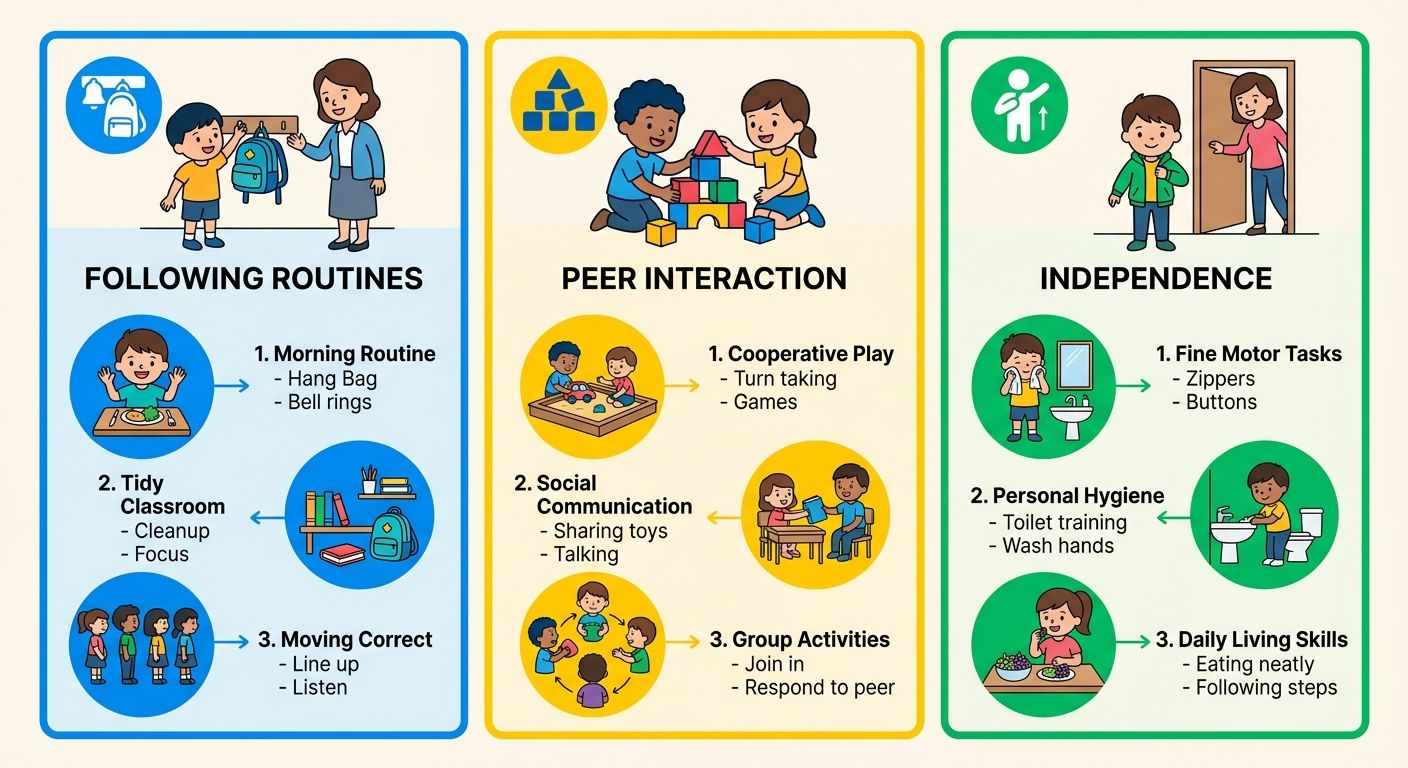
Three key school readiness skills developed through in-home ABA therapy
Strong school readiness also means reducing problem behaviors that interfere with learning, such as difficulty with transitions or following teacher directions. Our BCBAs and RBTs weave these targets into each session, and the data we collect often becomes the baseline for measurable iep goals for autism—giving your child’s team clear, observable objectives to track.
Parents play a vital role, too. Using ABA strategies consistently at home helps children practice independence during daily routines like dressing and packing a backpack. To learn more about in-home support in Arizona, visit our Arizona location page.
This information is for educational purposes. Consult a licensed healthcare professional for medical advice. Results may vary.
Overcoming Common Challenges in In-Home ABA Therapy
Even with a strong foundation, every family encounters a few bumps along the way—here’s how we help you navigate them. When you begin aba therapy for school age children, the transition to regular in-home sessions can sometimes bring resistance, especially from a child who is tired after a busy day. We partner with you to make sessions feel natural and engaging by incorporating your child’s favorite toys and activities right in their living room. This child-led approach, guided by your dedicated BCBA, helps transform reluctance into cooperation.
We also know that caregiver involvement can feel like a significant addition to an already full plate. Our family-centered model turns this dynamic on its head: rather than adding extra work, we weave caregiver training into everyday moments. Our therapists provide simple strategies you can use during dinner, playtime, or bedtime routines, so building school readiness behaviors at home quickly becomes second nature.
Scheduling conflicts are another common hurdle, but the in-home model itself is the most direct solution. Our team offers flexible scheduling that works around your family’s rhythm, not the other way around. If you’re struggling to see how far your child has come, the interactive ABA roadmap provides a clear, simple snapshot of every small win, showing how daily sessions reinforce broader objectives, including iep goals for autism. Rest assured, every challenge has a workable, compassionate answer—and our team is in your corner every step forward.
Discover how our ABA roadmap can illuminate your child’s path forward.
Putting It All Together: Next Steps for Your Child’s Development
In summary, ABA therapy for school age children provides an evidence-based pathway to strengthen the social, communication, and adaptive skills that form the foundation for classroom success. We at Golden Touch ABA craft personalized in-home treatment plans aligned with each child’s unique school readiness milestones and their IEP goals for autism, ensuring every session builds meaningful classroom preparedness.
The power of small steps drives our warm, family-centered approach. Our dedicated BCBAs and RBTs work collaboratively with your family, offering flexible scheduling that fits seamlessly into your daily routine. Discover how our customized support can make a difference — reach out to Golden Touch ABA for a custom quote or complete our interactive ABA roadmap to explore the next step. Together, we will nurture your child’s confidence and skill-building for school success.
Results may vary. Consult a licensed healthcare professional for diagnosis or medical advice.
Resources
- Get Personalized In-Home ABA Therapy in Washington Terrace
- Engage Children with Play-Based In-Home ABA Therapy
- Get Multistate ABA Therapy with Certified Analysts
- Find Personalized ABA Therapy in Taylorsville, Utah
- Find In-Home ABA Therapy Services Across Arizona
- Get In-Home ABA Therapy with Evidence-Based Techniques
- Discover ABA Therapy Services for Ages 1-21
- Find Details on BCBA Certification and Process
- Explore Registered Behavior Technician Certification Process
Table of Contents
- Understanding Behavioral Therapy
- ABA Therapy Coverage in Utah
- In-Home ABA Therapy Services
- Key Factors for ABA Therapy in Utah
- Steps to Begin ABA Therapy
- Start Your Journey with Golden Touch ABA Therapy
Understanding Behavioral Therapy
At Golden Touch ABA, we embrace behavioral therapy as a method using learning principles to encourage positive behaviors and reduce challenging ones. We highlight Applied Behavior Analysis (ABA) as its key application in autism support through evidence-based practices.
Applied behavior analysis ABA autism relies on core principles, per the Association for Science in Autism Treatment (ASAT):
- Positive reinforcement to build skills.
- The power of small steps via task analysis.
- Data-driven adjustments based on progress.
The ABA therapy process starts with assessment and individualized planning, using discrete trial training and naturalistic teaching in home settings, as reviewed by the National Center for Biotechnology Information (NCBI).
Board Certified Behavior Analysts (BCBAs) supervise, while Registered Behavior Technicians (RBTs) deliver ABA therapy, per Behavior Analyst Certification Board (BACB) standards. Our family-centered care fosters communication, social, and daily skills. For ABA therapy near me in your community, discover how we bring these principles to your home. Results may vary.
ABA Therapy Coverage in Utah
We proudly provide in-home ABA therapy across key Utah areas, delivering family-centered care through evidence-based practices. Families seeking behavioral therapy in Davis County, Salt Lake Valley, and Utah County can count on our personalized ABA therapy programs. For instance, explore our ABA therapy in Washington Terrace, Utah tailored for local needs, with BCBA supervision and flexible options to support your child’s growth.
Golden Touch ABA Therapy, as detailed in our location-specific service descriptions, extends in-home behavioral therapy services to nearby communities, making ABA therapy near me accessible for Utah families.
Utah Service Areas Comparison for ABA Therapy
Overview of Golden Touch ABA Therapy coverage across key Utah locations to help families find nearby in-home services.
| Service Area | Nearby Communities | Key Features |
|---|---|---|
| Washington Terrace | North Ogden, Clearfield | In-home sessions, BCBA supervision |
| Taylorsville | West Valley City, Kearns | Flexible scheduling, family training |
| Eagle Mountain | Lehi, Saratoga Springs | Personalized plans, insurance help |
These service areas showcase our dedication to evidence-based practices, with RBT-delivered therapy under BCBA supervision and insurance assistance, per Golden Touch ABA Therapy’s own location-specific service descriptions. We help navigate coverage in a warm and welcoming environment, but insurance coverage is subject to verification and is not guaranteed.
Our approach emphasizes the power of small steps, building skills like communication and independence right in your home. Golden Touch ABA Therapy serves these regions from our base in Salt Lake City, UT, ensuring coordinated care across counties. This coverage reflects our commitment to making autism behavioral therapy reachable, with flexible scheduling to fit family life.
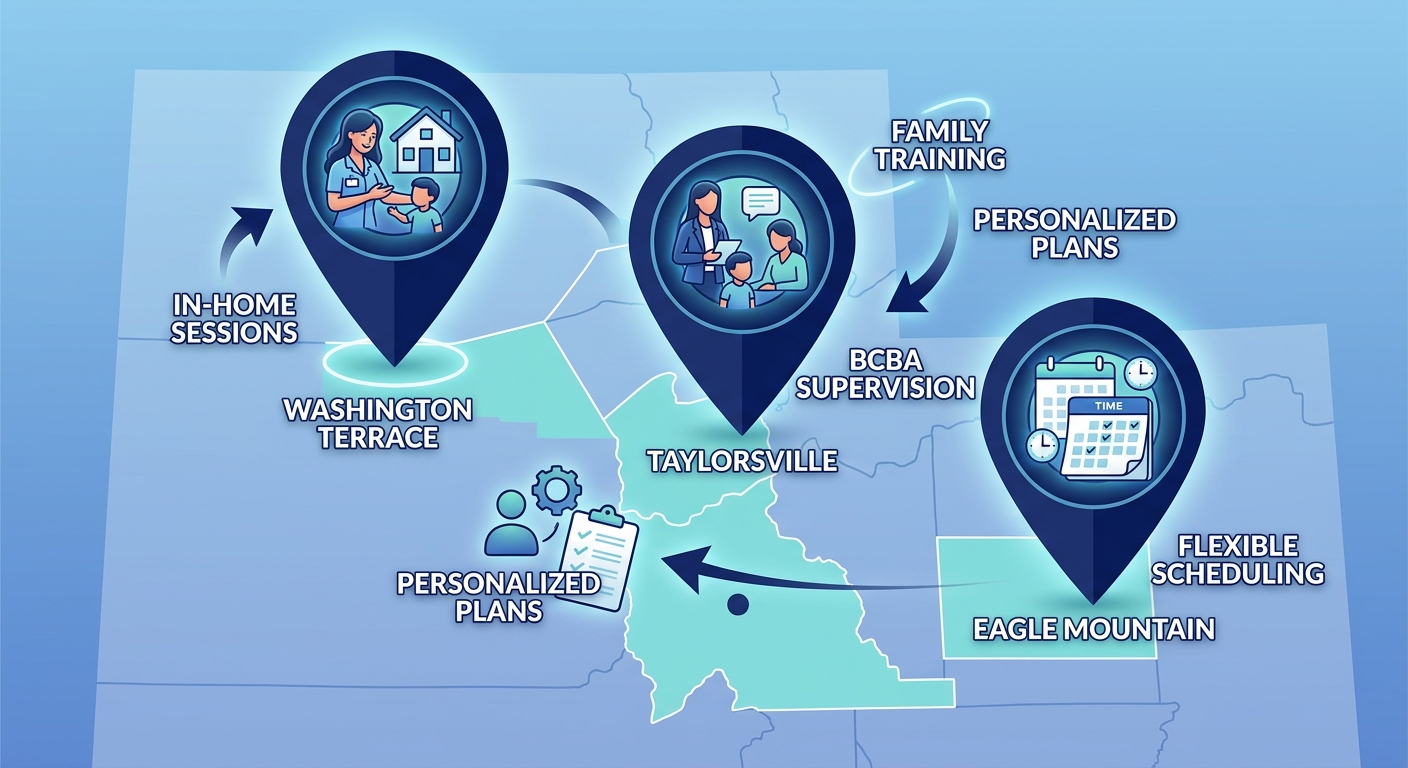
Golden Touch ABA Therapy coverage map for key Utah locations.
Ready to start local ABA services? Use our interactive ABA roadmap tool or contact us for custom eligibility support and verification.
In-Home ABA Therapy Services
At Golden Touch ABA Therapy, we specialize in in-home ABA therapy services that deliver evidence-based practices directly in the warm and welcoming environment of your home. This approach to behavioral therapy minimizes anxiety for children on the autism spectrum, fostering natural progress through family-centered care. Flexible scheduling allows therapy to fit seamlessly into daily routines, supporting skill development in communication, social interactions, and independence. Supporting daily living skills and meaningful community participation.
Our process starts with a comprehensive behavioral assessment, followed by customized treatment plans crafted by our Board Certified Behavior Analysts (BCBAs). Registered Behavior Technicians (RBTs) then deliver one-on-one sessions under close supervision, incorporating the power of small steps for measurable gains. We provide ongoing caregiver training and our interactive ABA roadmap tool to empower families. As detailed in Golden Touch ABA’s service overviews for South Salt Lake, Parleys Canyon, and Saratoga Springs, Utah, these ABA therapy programs emphasize collaboration and accessibility.
For those searching for ABA therapy near me, we extend local ABA services to nearby areas, including ABA therapy in Taylorsville, Utah. Our team assists with insurance verification—coverage is subject to eligibility and not guaranteed. Results may vary based on individual needs.
Ready to begin? Contact us today for a custom quote and personalized eligibility support.
Key Factors for ABA Therapy in Utah
In Utah, several key factors ensure behavioral therapy success through ABA programs. Families seeking ABA therapy near me prioritize certified professionals for their child’s progress in a family-centered care model.
Board Certified Behavior Analysts (BCBAs) represent the gold standard, per the Behavior Analyst Certification Board (BACB). They complete graduate-level coursework, 1,500-2,000 hours of supervised fieldwork, and pass a rigorous exam to oversee programs. Key roles include:
- BCBA: Assessment and individualized program design.
- RBT: Direct therapy delivery under BCBA supervision, as described by the Association for Science in Autism Treatment (ASAT).
Utah families benefit from evidence-based practices aligning with state insurance mandates. In-home ABA therapy offers comfort, like ABA therapy in Eagle Mountain, Utah for accessible options. We at Golden Touch ABA emphasize BCBA supervision, RBT training, and caregiver involvement, including consistent data review with families.
At Golden Touch ABA, we prioritize these factors for measurable progress—results may vary. Contact us to begin your ABA therapy journey.
Steps to Begin ABA Therapy
Ready to take the next step? We at Golden Touch ABA Therapy believe in the power of small steps when starting behavioral therapy for your child. Our family-centered care makes in-home ABA therapy accessible and personalized, using evidence-based practices backed by the Association for Science in Autism Treatment.
Here are the simple steps to get started:
- Contact Us for a Free Consultation – Reach out via phone or our interactive ABA roadmap tool to discuss your needs.
- Insurance Assistance – We verify benefits eligibility and guide you through coverage options. Insurance coverage is subject to verification and is not guaranteed.
- Behavioral Assessment – Our Board Certified Behavior Analyst (BCBA) conducts an evaluation and creates your individualized treatment plan, supervised by professionals with BACB behavior analysis certifications, the official certifying authority per Behavior Analyst Certification Board (BACB) standards.
- Customized Therapy Plan – Receive a tailored plan with Registered Behavior Technician (RBT)-delivered sessions in a warm and welcoming environment.
- Begin Therapy – Start ABA therapy with ongoing family training and BCBA supervision for lasting progress.
Results may vary. Find ABA therapy near me with flexible scheduling – contact us today for a custom quote on services! Once we begin, here’s what to expect in your journey.
Start Your Journey with Golden Touch ABA Therapy
At Golden Touch, we’re excited to help you start your journey with in-home ABA therapy – personalized behavioral therapy tailored to your child’s needs. Our highly trained BCBAs meet rigorous BCBA certification requirements upheld by the Behavior Analyst Certification Board (BACB) and supervise evidence-based practices like proven behavioral interventions for skill development, per peer-reviewed insights from the National Center for Biotechnology Information (NCBI).
Enjoy family-centered care, flexible scheduling, and insurance assistance. Results may vary. Contact us today for your custom ABA therapy plan near you and insurance verification. Discover our full range of in-home ABA therapy services.
This article was researched and written with the assistance of AI tools.
Resources
- Get Personalized In-Home ABA Therapy in Washington Terrace UT
- Get Tailored In-Home ABA Therapy in Taylorsville UT
- Get Customized In-Home ABA Therapy in Eagle Mountain UT
- Get Evidence-Based In-Home ABA Therapy in South Salt Lake UT
- Get Personalized In-Home ABA Therapy in Parleys Canyon UT
- Get Research-Driven In-Home ABA Therapy in West Mountain UT
- Get Tailored In-Home ABA Therapy in Saratoga Springs UT
- Discover BACB Credentials RBT BCaBA BCBA and Resources
- Learn BCBA Certification Requirements Application and Exam Process
- Discover Science-Based ABA Interventions for Autism Treatment
- Explore Behavioral Therapy for Adherence Well-Being and Health
- Learn ABA Provider Roles BCBAs Therapists for Autism
Table of Contents
Mastering Social Skills with ABA Therapy
Building on ABA fundamentals, we at Golden Touch ABA focus on aba social skills to empower children with autism in everyday interactions like turn-taking and sharing. Applied behavior analysis ABA uses evidence-based practices, as outlined in an authoritative overview from the Association for Science in Autism Treatment, highlighting techniques like prompting, modeling, and reinforcement for social growth.
The power of small steps shines in our in-home ABA therapy, delivered by RBTs under BCBA supervision in a warm and welcoming environment. We teach aba social skills through role-playing conversations, peer-mediated interventions, and group play sessions. Through family-centered care, we train caregivers to reinforce these skills at home, promoting aba early intervention for lasting progress, as detailed in our clinic’s service descriptions.
Start with our interactive ABA roadmap tool to tailor social goals. Results may vary; consult a licensed professional.
Preparing Your Family for ABA Success
Building on the evidence for ABA, here’s how we help your family prepare. At Golden Touch ABA, we believe family-centered care is key to unlocking progress in applied behavior analysis therapy. Your commitment boosts aba social skills development through our in-home ABA therapy.
We outline these practical steps, drawn from guidance in our ABA FAQ:
- Participate in behavioral assessment and ABA treatment planning with our BCBA to set SMART goals for communication and daily skills.
- Learn basic ABA techniques via our caregiver training sessions, empowering you to reinforce lessons at home.
- Create a consistent daily routine with designated therapy spaces in a warm and welcoming environment.
- Track progress using our interactive ABA roadmap tool, supporting aba early intervention.
National Center for Biotechnology Information (NCBI) research shows ABA programs with family engagement yield positive effects on adaptive behaviors and communication, with effect sizes up to g = .41. The power of small steps builds aba social skills effectively using evidence-based practices.
Contact us in Salt Lake City for insurance assistance to start. Results may vary. Once prepared, our individualized ABA treatment planning takes over.
Assess Your Child’s Social Skills Baseline
Building on those signs, let’s establish a baseline for your child’s aba social skills. This snapshot captures current abilities like eye contact, greeting others, sharing toys, responding to name, and parallel play, per Golden Touch ABA’s practical FAQ guidance for parents.
We at Golden Touch ABA recommend observing your child over one week in natural settings like home play and family interactions. Use this simple checklist:
- Makes eye contact during interactions
- Greets others verbally or with waves
- Shares toys willingly
- Responds to name promptly
- Engages in parallel play
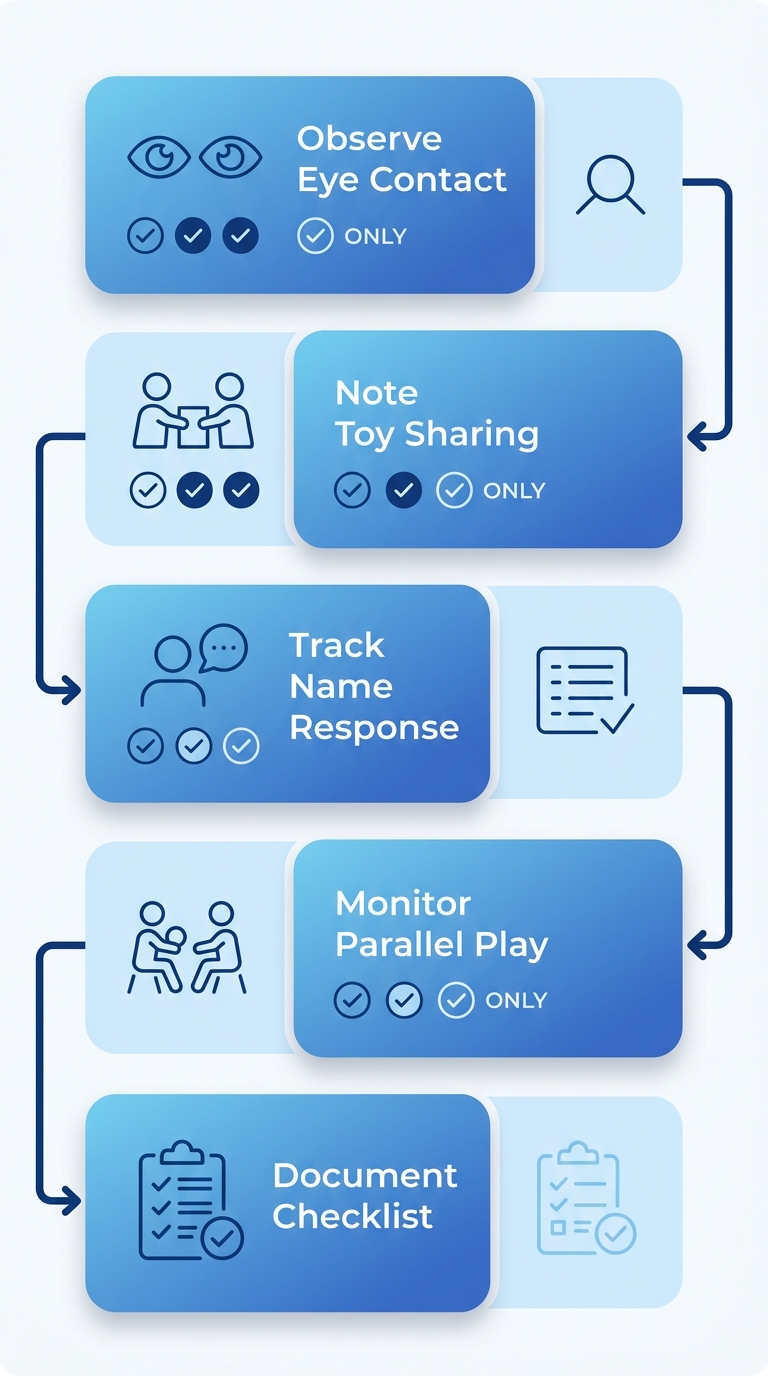
5-step ABA therapy process for child’s social skills baseline assessment
This baseline matters for tracking progress in applied behavior analysis, especially with aba early intervention for better outcomes in our family-centered care. Consistent data helps tailor in-home ABA therapy. Results may vary.
Document your notes and use our interactive ABA roadmap tool. With your baseline notes, explore our ABA treatment planning for tailored goals. Contact us for a professional BCBA evaluation.
Define Clear and Achievable Social Goals
We help families set clear social goals that build confidence one interaction at a time through applied behavior analysis. In aba early intervention, defining aba social skills targets matters because they break down complex behaviors into manageable steps, fostering real progress in a warm and welcoming environment.
Use the SMART framework for developing social skills through ABA: Specific (e.g., make eye contact during greetings), Measurable (track occurrences per session), Achievable (start with one peer), Relevant (ties to daily play), Time-bound (master in 4 weeks). During behavioral assessment as part of ABA treatment planning, families collaborate with our team for family-centered care. Examples from our experts’ practical FAQ guidance include taking turns in a 2-person game or responding to name 80% of the time.
The power of small steps and evidence-based practices shine in RBT-delivered therapy. Once defined, we move to measuring these goals in daily sessions. Results may vary; consult our professionals.
Teach Recognition of Social Cues
Building on foundational interactions, we focus on why recognizing social cues like smiles for happiness or frowns for sadness matters for children with autism. Mastering aba social skills builds confidence in everyday social exchanges through evidence-based practices.
In our in-home ABA therapy, we use video modeling: show short clips of peers displaying cues, then have kids imitate and identify them. Scripting and role-playing follow, with simple scripts for scenarios like a friend waving hi, practiced in a warm and welcoming environment. The teaching social skills TIP from the Association for Science in Autism Treatment (ASAT) offers practical, research-supported steps including modeling and feedback.
We create personalized social stories with pictures for daily aba early intervention reading, reinforce correct identifications with praise, tokens, or fun activities under BCBA supervision, and integrate into routines via family-centered care. The power of small steps tracks progress. Results may vary. These cues pave the way for advanced conversations ahead.
Practice Role-Playing for Real-Life Scenarios
Building on basic skills, we use role-playing to build aba social skills for real-life scenarios through evidence-based practices. This applied behavior analysis modeling technique, as outlined in authoritative guidelines from the Association for Science in Autism Treatment (ASAT), involves therapists or peers demonstrating interactions like greeting friends or turn-taking, then guiding children to imitate in safe sessions.
We target everyday situations such as handling playground sharing, ordering food at a restaurant, or asking for help in a store. These aba early intervention practices accelerate social development with positive reinforcement for generalization. Peer-reviewed government health research data from the National Center for Biotechnology Information (NCBI) via ABA evidence autism treatment supports gains in social skills from such modeling.
In our family-centered care with in-home ABA therapy, we train caregivers for home reinforcement. The power of small steps leads to measurable progress tracking. Results may vary (no guaranteed outcomes). This prepares children for success, leading into our progress tracking methods.
Build Peer Interactions Through Structured Groups
Beyond one-on-one practice, we build peer interactions through structured aba social skills groups as a key part of our ABA social skills training. These small, supportive settings help children with autism practice real-world social exchanges in a warm and welcoming environment.
We use evidence-based practices from applied behavior analysis, like role-playing, prompting, and reinforcement, to teach turn-taking, sharing, and conversation skills. According to a research synopsis by the Association for Science in Autism Treatment (ASAT), behaviorally-based groups with procedures such as modeling and shaping led to significant social improvements in young children.
Our in-home ABA therapy integrates these groups with family-centered care, adapting activities for peer practice at home through caregiver training. For aba early intervention, timely group exposure boosts social reciprocity. The power of small steps shines here.
These group gains extend home with caregiver support. Explore our interactive ABA roadmap tool or contact us for personalized planning and custom quotes. Results may vary.
Utilize Visual Aids and Social Stories
Building on positive reinforcement, we leverage visual aids and social stories next to boost aba social skills in our in-home ABA therapy. Tools like picture schedules and PECS make abstract concepts concrete in applied behavior analysis, helping children grasp routines and communication. They also support independence, predictable routines, and everyday communication across home and community settings for improved daily participation.
Social stories are customized narratives we create to teach behaviors like turn-taking or greetings, tailored to each child’s needs. For instance, our FAQ highlights using visual aids during transitions in aba early intervention to ease anxiety, as guided by Golden Touch ABA’s practical examples. We train families to reinforce these at home through family-centered care.
Our RBTs integrate these seamlessly in sessions for steady progress. Results may vary. These pair seamlessly with verbal prompting techniques.
Track Progress and Provide Positive Reinforcement
Once techniques are in place, we ensure success through vigilant tracking in our In-home ABA therapy. In applied behavior analysis, consistent progress tracking allows us to adjust individualized treatment plans, particularly for building aba social skills. This data-driven approach helps children make meaningful gains in communication and independence.
Golden Touch ABA, per our internal company FAQ guidance, uses daily data logs to record target behaviors, visual progress graphs shared weekly with families, and milestone celebrations to mark achievements. These methods provide clear insights into aba social skills development during sessions.
We incorporate positive reinforcement through immediate verbal praise, token economies with preferred rewards, and natural reinforcers tailored to each child’s interests in aba early intervention. This family-centered care creates a warm and welcoming environment, integrating family feedback for ongoing adjustments.
Our evidence-based practices support measurable outcomes, though results may vary. We share these insights with families for collaborative adjustments.
Addressing Challenges in Social Skills Training
While social skills training offers great benefits for children with autism, challenges like lack of skill generalization to real-world settings, low motivation during group interactions, and difficulty reading social cues often arise. At Golden Touch ABA Therapy, we tackle these hurdles in aba social skills development using evidence-based practices from applied behavior analysis. The power of small steps helps build confidence through targeted strategies.
One effective ABA technique is modeling, where therapists or peers demonstrate social behaviors for children to imitate. According to evidence-based ABA technique guidelines from the Association for Science in Autism Treatment (ASAT), this includes live modeling in real-time, video modeling for repeated viewing, and self-modeling to boost self-efficacy. These methods promote faster skill acquisition, especially for social play and communication, addressing generalization and cue-reading issues.
We at Golden Touch ABA apply these in our In-home ABA therapy, delivered by dedicated RBTs under BCBA supervision, as outlined in our internal practical guidance. This family-centered care integrates aba early intervention to enhance motivation and natural environment practice, with caregiver training for consistent support. Our approach emphasizes caregiver coaching and practice in natural contexts to promote daily-life generalization, and data-driven progress tracking helps tailor supports regularly over time. Results may vary.
Ready to overcome these challenges? Use our interactive ABA roadmap tool and contact us to tailor an ABA plan addressing your child’s needs in a warm and welcoming environment.
Sustaining Social Skill Development Long-Term
Building on early gains from aba social skills training, we at Golden Touch ABA help families maintain progress through consistent reinforcement. Regular in-home ABA therapy sessions prevent regression, as our RBT-delivered therapy supports ongoing practice in natural settings.
Family-centered care plays a key role, with caregiver training embedding social skills into daily activities like playdates or community outings. Drawing from evidence-based practices in applied behavior analysis, periodic BCBA reassessments adapt plans to evolving needs and ensure goals remain meaningful, measurable, and aligned with family priorities over time. Research from the Association for Science in Autism Treatment (ASAT) shows behaviorally-based social skills groups sustain improvements for 16-32 weeks.
Transitioning skills via aba early intervention foundations ensures long-term growth. Results may vary; insurance coverage requires verification. Reach out to us at Golden Touch ABA for your customized roadmap.
This article was researched and written with the assistance of AI tools.
Resources
- Get Personalized ABA Treatment Plans Led by BCBAs
- Discover Family Involvement in ABA Treatment Planning
- Create SMART Goals for ABA Therapy Improvement
- Monitor and Revise ABA Treatment Plans Effectively
- Develop ABA Plans Through Four-Stage Process
- Build Collaborative ABA Plans with FBA Data
- Implement Data-Driven Collaborative ABA Planning
- Master TIP for Teaching Social Skills Effectively
- Explore ABA Evidence Base for Autism Treatment
- Learn ABA Principles for Skill Acquisition
- Discover ABA Modeling Techniques for Skill Teaching
- Improve Social Skills via ABA Group Therapy
Table of Contents
- Discovering Positive Reinforcement in ABA Therapy
- Core Principles of Positive Reinforcement
- Benefits of Positive Reinforcement for Autistic Children
- How Positive Reinforcement Works in ABA
- Best Practices for Positive Reinforcement at Home
- Empowering Families with Reinforcement Strategies
Discovering Positive Reinforcement in ABA Therapy
Building on ABA fundamentals, let’s explore positive reinforcement, a cornerstone technique in applied behavior analysis. At Golden Touch ABA Therapy, we define positive reinforcement as providing a rewarding stimulus immediately after a desired behavior to increase its future occurrence. For example, offering praise or tokens during sessions motivates children to repeat positive actions, aligning with our family-centered care.
Our approach to ABA social skills relies heavily on positive reinforcement in discrete trial training for skills like turn-taking and eye contact during in-home ABA therapy. As detailed in our internal FAQ guidance from Golden Touch ABA, these ABA reinforcement strategies build social abilities such as sharing and conversation through evidence-based practices. Under BCBA supervision, we integrate them into individualized treatment plans, focusing on small, measurable steps.
The power of small steps shines in fostering independence and reducing challenging behaviors for children on the autism spectrum. Results may vary, but our warm and welcoming environment supports steady progress for families.
Positive reinforcement pairs seamlessly with methods like prompting and fading, enhancing overall outcomes in our personalized programs. Explore our interactive ABA roadmap for tailored strategies.
Core Principles of Positive Reinforcement
Defining Positive Reinforcement in ABA
Positive reinforcement forms the cornerstone of effective behavior change in ABA therapy. At Golden Touch ABA, we define it as presenting a desirable stimulus right after a desired behavior to boost its future occurrence. This principle draws from operant conditioning, where the addition of something pleasant, like praise or a favorite toy, strengthens the behavior. For instance, when a child completes a task, we offer verbal praise or a high-five, making them more likely to repeat it.
Golden Touch ABA’s FAQ resources explain this mechanism clearly. In contrast, negative reinforcement involves removing an unpleasant stimulus to increase behavior, such as allowing a child to escape a loud noise after complying. The key difference lies in addition versus removal. Positive reinforcement builds enthusiasm through rewards, fostering a warm and welcoming environment. This approach supports incremental progress, harnessing the power of small steps in our in-home ABA therapy. We celebrate each success and adjust supports based on data.
ABA Fundamentals and Reinforcement Role
Building on this definition, let’s explore ABA fundamentals. Applied behavior analysis is an evidence-based therapy that applies behavioral principles to enhance socially significant behaviors, especially for children with autism. We at Golden Touch ABA deliver it through family-centered care in the home, creating personalized plans supervised by BCBAs.
Positive reinforcement plays a pivotal role here. It strengthens desired behaviors within individualized treatment plans, as Golden Touch ABA’s ABA-specific FAQ outlines. For example, rewarding communication attempts helps build skills naturally. Our RBTs, under BCBA guidance, integrate these practices into daily routines. This method promotes independence and reduces challenges, aligning with evidence-based practices. In our in-home ABA therapy, families actively participate, reinforcing gains for lasting impact. Our BCBAs review progress regularly and train caregivers in practical techniques.
Techniques in Applied Behavior Analysis
These principles come alive in key techniques such as discrete trial training. This structured discrete trial training method includes an antecedent (instruction), behavior (response), and consequence (feedback), with positive reinforcement following correct actions. We also use natural environment teaching, embedding rewards in play, and pivotal response training, which follows child-led interests.
Golden Touch ABA’s educational blog highlights these interventions. Common methods include:
- Discrete trial training (DTT): Breaks skills into steps, rewarding each success to build ABA social skills.
- Natural environment teaching (NET): Uses everyday moments for reinforcement.
- Pivotal response training (PRT): Encourages initiation with immediate positives.
Family-centered care ensures parents reinforce these at home, emphasizing the power of small steps toward practical applications in daily life. We prioritize routine consistency.
Benefits of Positive Reinforcement for Autistic Children
At Golden Touch ABA Therapy, we harness positive reinforcement in our in-home ABA therapy to empower autistic children toward meaningful progress. This evidence-based approach celebrates every achievement, fostering growth in a warm and welcoming environment.
Skill Development Through Reinforcement
Positive reinforcement accelerates skill development in applied behavior analysis by rewarding small successes. We at Golden Touch ABA see children respond eagerly to verbal prompts for communication, building vocabulary through consistent praise and tokens. The power of small steps shines as kids master turn-taking in paired activities, enhancing social interactions via targeted aba social skills strategies, as shared in our provider FAQ.
Independence grows too, with rewards for task completion like dressing or handwashing. Discrete trial training integrates seamlessly, breaking skills into manageable parts for quicker mastery. Therapists track progress with individualized data collection to adjust reinforcement schedules and celebrate incremental milestones in partnership with caregivers. These gains, drawn from practical insights by Golden Touch ABA, highlight evidence-based practices tailored to each child.
These skill gains pave the way for broader behavioral changes in daily life.
Long-Term Behavioral Improvements
Consistent positive reinforcement schedules in applied behavior analysis yield lasting reductions in tantrums and self-injury. Children learn alternative responses through rewards, diminishing problematic behaviors over time. Our internal therapy FAQ guidance from Golden Touch ABA notes measurable outcomes, such as increased on-task behavior from 40% to 80% in sessions. Longitudinal records allow our teams to pinpoint triggers, refine supports, and share clear progress reports with families and providers regularly.
Discrete trial training reinforces these shifts, promoting sustained progress with data-driven adjustments. Families observe fewer disruptions at home, thanks to our family-centered care. This approach builds resilience, turning challenges into opportunities for growth without promises of uniform results.
Such changes extend to families through deeper connections and shared joy.
Family and Emotional Benefits
Positive reinforcement boosts family involvement via caregiver training in applied behavior analysis techniques. Parents learn to apply rewards naturally, strengthening bonds during everyday routines. We at Golden Touch ABA foster a warm and welcoming environment where children thrive on motivation, leading to joyful interactions and reduced stress. Family-centered care ensures everyone participates, enhancing overall harmony. Caregiver coaching includes modeling, role-play, and home-based tools that help families reinforce skills across daily routines with clear steps and BCBA guidance.
Emotional well-being flourishes as kids gain confidence from praised efforts. Family-centered care ensures everyone participates, enhancing overall harmony. Practical insights from Golden Touch ABA emphasize these heartfelt advantages in in-home ABA therapy.
Results may vary. Contact us for a personalized plan tailored to your family’s needs.
How Positive Reinforcement Works in ABA
Building on the advantages of ABA therapy, positive reinforcement plays a central role in our evidence-based practices at Golden Touch ABA Therapy. In applied behavior analysis, positive reinforcement involves delivering a rewarding stimulus immediately after a desired behavior to increase its future occurrence. This approach fosters skill-building in a warm and welcoming environment during our in-home ABA therapy sessions. We pair it with natural environment teaching to promote generalization, always prioritizing family-centered care. According to the Association for Science in Autism Treatment (ASAT), an authoritative review of evidence-based ABA teaching methods highlights structured procedures that integrate reinforcement effectively.
Discrete Trial Training with Reinforcement
Discrete trial training (DTT) breaks skills into manageable steps using a three-term contingency. Here’s how it works:
- Antecedent: The therapist presents a clear stimulus or discriminative stimulus (SD), like showing a picture card and saying, “What is this?”
- Target behavior: The learner responds correctly, such as naming the item.
- Consequence: If correct, immediate positive reinforcement follows, such as praise (“Great job!”) or a token. Incorrect responses receive neutral correction without punishment, and trials repeat.
Reinforcement only follows correct responses, strengthening the behavior. In our in-home ABA therapy, this structured DTT method adapts to the child’s natural surroundings, enhancing engagement. ASAT’s review emphasizes maintaining a structured teaching environment to ensure treatment fidelity. This builds confidence through the power of small steps, with results varying by individual.
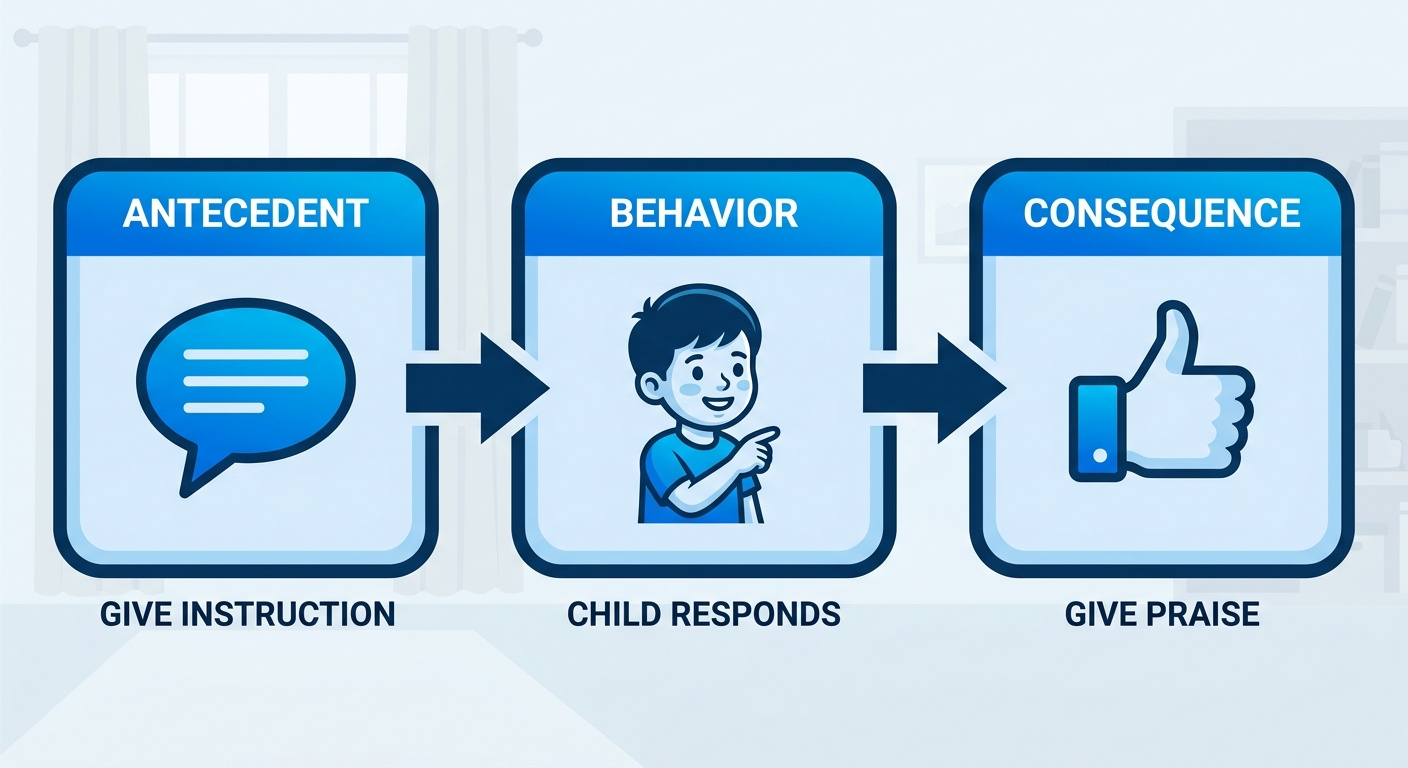
Positive reinforcement process in ABA Discrete Trial Training
The visual above illustrates this cycle, showing how consistent reinforcement drives progress in everyday home settings.
Session Examples and DTT Techniques
Consider mand training, where a child learns to request items. The therapist holds a preferred toy (antecedent), waits for the child to say “toy” (behavior), then immediately provides it with praise (reinforcement). Prompts fade from full verbal support to independence, using edible reinforcers initially.
- Session 1: Model “toy,” child echoes, earns toy + high-five.
- Session 2: Partial prompt, child independently requests.
For imitation skills, the therapist models clapping (antecedent), child imitates (behavior), receiving enthusiastic praise or a sticker.
- Use modeling for motor tasks.
- High-fives as social positive reinforcers.
Therapists reference aba teaching checklists for tracking responses and maintaining quality. These DTT techniques shine in family-centered care, blending structure with home comfort.
BCBA and RBT Implementation
Our BCBAs design reinforcement schedules and select individualized positive reinforcers via preference assessments, ensuring motivation matches the child. They supervise data collection, analyze progress, and adjust plans for optimal outcomes.
RBTs handle direct implementation: delivering prompts, providing reinforcement, and recording trials under BCBA guidance. This teamwork ensures consistency in every in-home ABA therapy session.
We emphasize compassionate delivery, promoting social interaction as noted in ASAT resources. BCBAs train RBTs ongoing, fostering growth. Results may vary, but our approach supports lasting skills. Stay tuned for how we customize plans with families for even greater impact.
Best Practices for Positive Reinforcement at Home
At Golden Touch ABA Therapy, we empower families with positive reinforcement strategies rooted in applied behavior analysis to support their child’s growth right in the home. These evidence-based practices make everyday moments opportunities for progress through consistent, immediate praise and rewards. Family-centered care starts with simple techniques you can use today. We model techniques and coach caregivers to build practical, lasting everyday confidence.
Practical Techniques and Examples
Let’s explore practical techniques for using positive reinforcement at home. Praise your child immediately after they complete a task, like putting away toys. Say, “Great job cleaning up!” with enthusiasm to build the habit.
- Token economies: Give stickers for good behaviors, such as finishing homework. Exchange them for preferred activities like extra playtime.
- Verbal praise with physical gestures: Pair “You shared so nicely!” with a high-five during social skills practice.
- Specific feedback: Note exactly what they did right, like “I love how you waited your turn at the table.”
Consistency and immediacy strengthen these connections, as National Center for Biotechnology Information (NCBI) authoritative government health data on ABA best practices highlights. We recommend practicing daily for lasting results.
DTT and Reinforcement in Natural Settings
Discrete trial training (DTT) brings structured teaching into your home with clear instructions, prompts, and reinforcements like small edibles or toys delivered right after correct responses. This builds foundational skills efficiently.
In contrast, natural environment teaching (NET) uses play-based incidental learning during routines, such as mealtime sharing. DTT shines for initial skill acquisition, while NET promotes generalization.
Home adaptation tips include:
- Start with DTT sessions at the kitchen table for tasks like matching colors.
- Fade prompts gradually into NET by reinforcing naturally during snack time.
According to NCBI data, these approaches align with professional ABA standards for effective interventions.
Parental Training with Professional Support
We offer robust parental training through Golden Touch ABA’s tools, like video models and progress trackers, to help you reinforce skills daily. Collaborate with our BCBAs for technique refinement, ensuring alignment with ABA professional standards.
Our interactive ABA roadmap guides home practice, promoting family-centered care. Golden Touch ABA resources, as our internal company materials detail, emphasize caregiver involvement for seamless therapy integration. We tailor sessions to your family’s needs in areas like Salt Lake City.
Monitoring Progress and Adjustments
Track weekly with simple charts noting reinforcement effectiveness, such as smiles after praise. Adjust by increasing praise if motivation dips.
Results may vary (no guaranteed outcomes). Consult our team for tweaks to sustain evidence-based practices and success.
Empowering Families with Reinforcement Strategies
Building on ABA fundamentals, we empower families with positive reinforcement strategies as part of our in-home ABA therapy. This core element of applied behavior analysis motivates positive behaviors through rewarding experiences like praise or fun activities, fostering growth in a warm and welcoming environment. We coach you to use everyday routines and simple progress tracking tools so families can celebrate small gains and stay aligned with individualized, measurable goals.
In discrete trial training, we break skills into small steps using evidence-based practices. A therapist gives a cue, the child responds, and correct actions earn positive reinforcers such as tokens or cheers, encouraging repetition and mastery.
Families can apply these at home with simple strategies:
- Specific praise: Say, “Great job sharing your toy!”
- Token economies: Earn stickers redeemable for privileges.
- Natural reinforcers: Offer extra playtime after tasks.
Our BCBAs supervise RBT-delivered sessions, training caregivers for consistency in family-centered care. Per our Golden Touch ABA Services overview, these ABA techniques support measurable outcomes, though results may vary (no guaranteed outcomes). Explore our interactive ABA roadmap tool or contact us for your personalized plan.
This article was researched and written with the assistance of AI tools.
Resources
- Discover In-Home ABA Therapy Services in Utah Counties
- Get 24/7 In-Home ABA Therapy for Children in Utah
- Explore Golden Touch ABA Therapy Locations Across States
- Access ABA Therapy for Low Functioning Autism in Utah
- Learn Collaborative ABA Treatment Planning with SMART Goals
- Identify Early Autism Signs in Infants and ABA Trends
- Recognize Early ASD Signs and Future ABA Innovations
- Review ABA Teaching Checklists for Therapist Training
- Explore ABA Professional Standards and Military Access Challenges
Table of Contents
- Discovering Autism Therapy in Salt Lake City
- Understanding ABA Therapy for Children
- Benefits of Autism Therapy
- How ABA Autism Therapy Works
- Best Practices in In-Home ABA Therapy
- Next Steps for Your Child’s Autism Therapy Journey
- Resources
Discovering Autism Therapy in Salt Lake City
Now, let’s focus on Salt Lake City, where families seek compassionate support for their children. If you’re discovering autism therapy in Salt Lake City, we at Golden Touch ABA Therapy are here to support your family with our specialized services.
We provide In-home ABA therapy delivered by highly trained BCBAs and RBTs, focusing on family-centered care and evidence-based practices. This approach builds autism learning partnerships with families, offering ABA therapy for children through individualized plans tailored to each child’s needs. Our team conducts behavioral assessments, provides caregiver training, and ensures flexible scheduling in a warm and welcoming environment.
Unique tools like our interactive ABA roadmap help track progress with measurable outcomes. We also assist with insurance verification to make effective autism therapy in Salt Lake City accessible. For custom needs, contact us for a personalized quote today.
The power of small steps celebrates every milestone, though results may vary. Reach out today to start your family’s journey with us in Salt Lake City. Consult a licensed healthcare professional for diagnosis or medical advice.
Discover how our ABA therapy works in detail below.
Understanding ABA Therapy for Children
At Golden Touch ABA Therapy, we deliver evidence-based autism therapy through Applied Behavior Analysis (ABA). This approach uses positive reinforcement to build skills like communication and social interaction. It begins with behavioral assessment to understand your child’s unique needs. Our in-home ABA therapy brings personalized, family-centered care right to your doorstep, including caregiver support services. Our in-home approach fits daily life. Results may vary.
What ABA Therapy Entails for Autism
ABA therapy for children with autism focuses on core principles tailored for young learners. We start with behavioral assessment through direct observation and parent input to identify strengths and challenges.
Key elements include:
- The ABC model (antecedent-behavior-consequence) to analyze what triggers actions and how to shape positive outcomes.
- Discrete trial training with prompts that fade over time, keeping sessions short and engaging for kids.
- Naturalistic environment teaching during play, making learning fun and relevant.
Therapists personalize activities based on a child’s interests and attention span to keep learning motivating. Short, play-based sessions help skills transfer from therapy into daily life. We track progress with data, celebrating the power of small steps toward bigger gains. This builds essential skills in a warm and welcoming environment.
Individualized Treatment Planning with BCBAs
Our Board Certified Behavior Analysts (BCBAs) lead individualized treatment planning with expertise. They conduct comprehensive functional assessments to pinpoint behaviors and set SMART goals for communication, social skills, and self-care.
The process involves:
- Collaborating with families as autism learning partners for caregiver training.
- Using evidence-based practices to craft flexible plans.
- Reviewing data quarterly to adjust goals and strategies.
We apply autism therapy principles when setting measurable targets and deciding when to advance goals. Caregiver coaching focuses on practical strategies families can use at home. This ensures therapy fits your child’s life perfectly. Our BCBA supervision guarantees quality in every step.
Role of RBTs in Daily Sessions
Registered Behavior Technicians (RBTs), trained under our BCBAs, handle daily RBT-delivered therapy in natural home settings. They provide one-on-one support using prompting hierarchies and reinforcement schedules.
In sessions, RBTs:
- Collect real-time data via apps for accurate tracking.
- Involve siblings and parents to extend learning.
- Embed skills into routines like mealtime or playtime.
RBTs embed teaching moments into routines so learning happens naturally without added disruption. They document progress clearly and share simple practice ideas so caregivers can reinforce skills between sessions. This family-centered care creates lasting change through the power of small steps. Ready to start your child’s journey? Explore our interactive ABA roadmap next.
Benefits of Autism Therapy
Building on our evidence-based approach, we at Golden Touch ABA Therapy welcome you to explore the transformative benefits of autism therapy. Our In-home ABA therapy uses proven practices tailored for children with autism, fostering growth in communication, independence, and behavior in a warm and welcoming environment. These gains empower families through family-centered care.
Improving Communication and Social Skills
At Golden Touch ABA Therapy, we see ABA therapy for children shine in enhancing communication and social skills through targeted interventions like prompting and modeling.
For verbal expression, our RBT-delivered therapy, supervised by BCBAs, teaches children to use words for requests, leading to clearer interactions. Non-verbal cues, such as eye contact and gestures, improve via discrete trial training, helping kids engage more confidently.
Specific gains include increased turn-taking in conversations, where a child might wait patiently during playdates, or initiating greetings with peers, building lasting friendships. Another example is expanded vocabulary use in daily routines, like naming emotions during family meals.
These advancements create meaningful connections. Results may vary. Ready to start? Our interactive ABA roadmap tool guides your custom plan, with insurance assistance.
Enhancing Independence and Daily Living
Beyond communication, ABA therapy also boosts independence by teaching essential self-care and routine skills through task analysis and chaining techniques.
In dressing, we break down steps like buttoning shirts, practicing in the child’s home for natural carryover. Hygiene routines, such as independent toothbrushing, use visual schedules for mastery.
Meal preparation examples include washing hands before eating or setting the table, promoting confidence. Following daily schedules, like transitioning from play to bedtime, reduces prompts over time.
Family-centered care includes caregiver training to reinforce these at home, ensuring sustained progress with the power of small steps. Results may vary. Explore our roadmap tool and insurance support for personalized paths.
Reducing Challenging Behaviors
Additionally, our ABA therapy for children effectively reduces challenging behaviors using functional behavior assessments, replacement behaviors, and positive reinforcement.
We identify triggers through data collection, then teach alternatives like using words instead of tantrums. Positive reinforcement rewards calm responses, fading prompts gradually.
Measurable outcomes include fewer meltdowns during transitions, tracked weekly, or decreased aggression via deep pressure techniques. Small wins, like requesting breaks, build self-regulation.
Individualized treatment planning makes this powerful. Results may vary (no guaranteed outcomes). Consult a licensed healthcare professional. Contact us for your roadmap tool and insurance assistance.
Our team measures progress collaboratively with families to ensure goals remain meaningful and adjust plans as needed over time.
Ready to see these benefits in action? Explore our interactive ABA roadmap tool.
How ABA Autism Therapy Works
At Golden Touch ABA Therapy, our autism therapy makes a real difference through personalized, evidence-based practices. We deliver in-home ABA therapy designed around your child’s unique needs, focusing on building communication, social skills, and independence. Family-centered care starts with a clear process: initial assessments, one-on-one sessions, and ongoing progress monitoring.
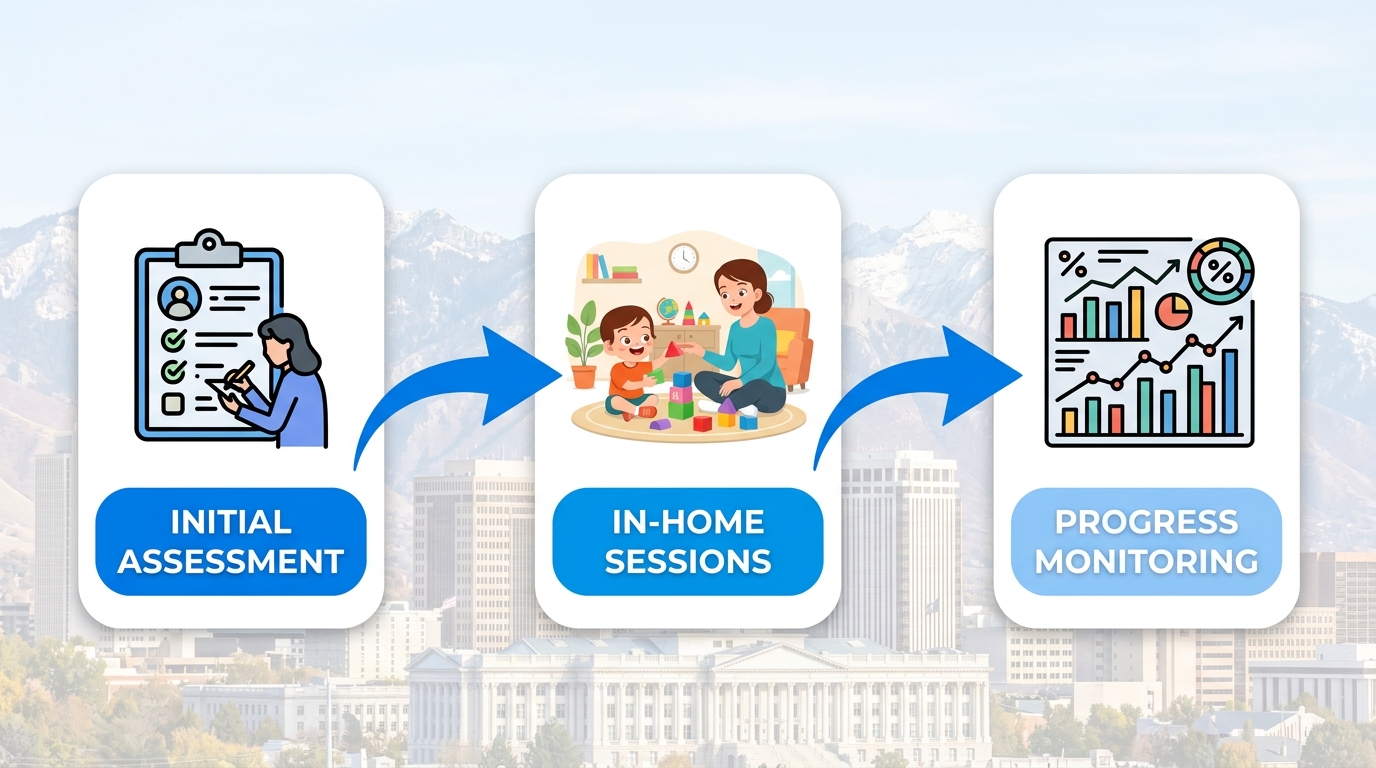
ABA autism therapy process: assessment, in-home sessions, progress monitoring.
Initial Assessments and Goal Setting
Our Board Certified Behavior Analysts (BCBAs) begin with comprehensive behavioral evaluations. They use direct observation, parent interviews, and standardized tools to pinpoint your child’s strengths, challenges, and priorities. This thorough process ensures we understand the full picture of their development.
Next, we collaborate closely with families to set personalized, measurable goals. Whether improving communication or social skills, every target reflects family input. Our interactive ABA roadmap tool visualizes this journey, making it clear and engaging. With goals set, we begin one-on-one sessions tailored to your home.
One-on-One In-Home Sessions
Our Registered Behavior Technicians (RBTs), supervised by BCBAs, conduct 1-2 hour sessions right in your child’s home. This warm and welcoming environment fits seamlessly into their daily routine, promoting natural learning. ABA therapy for children thrives here through flexible scheduling and comfort.
We employ proven techniques like discrete trial training for focused skill-building, natural environment teaching to encourage real-world application, and positive reinforcement to motivate progress. For example, a child practicing turn-taking might earn praise or a favorite toy. Like autism learning partners, we emphasize the power of small steps in a supportive setting, fostering confidence and growth.
To ensure success, we track every session meticulously.
Progress Monitoring and Adjustments
Daily data collection captures target behaviors, plotted on easy-to-read graphs and charts for clear insights. Our BCBAs review this weekly, tweaking plans based on real results to optimize outcomes. Evidence-based practices guide these evidence-based adjustments, keeping therapy dynamic and effective.
Family training sessions empower parents with strategies for consistency at home, strengthening family-centered care. We provide ongoing communication through secure parent portals, sharing updates and tips. Our clinicians collaborate with schools and providers to coordinate care when appropriate, and we tailor transitions across settings to support consistency and generalization of learned skills in daily routines. Results may vary, as every child progresses uniquely—no guarantees apply. Consult a licensed healthcare professional for diagnosis or medical advice.
Ready to see in-home ABA therapy transform your child’s life? Contact Golden Touch ABA Therapy today to start their journey.
Best Practices in In-Home ABA Therapy
Building on the foundations of ABA, here are our best practices for in-home ABA therapy delivery. At Golden Touch ABA Therapy, we focus on family-centered care and evidence-based practices to support children with autism. These strategies ensure effective, personalized support in the comfort of your home.
Choosing Qualified Providers
When selecting providers for autism therapy, prioritize those with strong credentials to deliver quality ABA therapy for children. We at Golden Touch ABA verify BCBA board certification and a minimum of two years of supervised experience for our clinicians. Our RBTs complete the required 40-hour training, ensuring competent RBT-delivered therapy under BCBA supervision.
Key criteria include:
- Verifying BACB credentials for BCBAs and RBTs
- Assessing family fit through initial consultations on communication style and scheduling flexibility
- Reviewing experience with ABA therapy programs for kids similar to your child’s needs
These steps guarantee a good match. Results may vary, but our approach maximizes potential through tailored plans and family-driven, collaborative goal setting.
Integrating Family Training
Family-centered care thrives on caregiver involvement, making family training essential in in-home ABA therapy. Training helps parents generalize skills to everyday routines, reducing therapy dependency and boosting child progress. We provide structured programs with hands-on sessions led by BCBAs, including progress tracking materials and strategies like those used by autism learning partners.
Benefits include:
- Improved skill carryover from sessions to home life
- Empowered caregivers to reinforce learning consistently
- Customized modules on behavior management and communication
Our family-centered care includes comprehensive training modules tailored to your needs. This collaboration fosters independence. Results may vary, and insurance coverage is subject to verification for these services.
Ensuring Local Accessibility
Accessibility is key for consistent ABA therapy for children, especially in Salt Lake City, Utah. Confirm in-person availability in Salt Lake City, Utah, and explore telehealth for rural spots. At Golden Touch ABA Therapy, we offer multi-state licensing across Utah, Arizona, and Maryland, with flexible scheduling for in-home ABA therapy.
Practical tips:
- Check service areas for county-level coverage in Salt Lake City, Utah
- Verify telehealth integration for broader reach
- Confirm insurance assistance and benefits support to ease access
We serve families in Salt Lake City, Utah, and beyond with flexible in-home ABA therapy scheduling to maximize accessibility. Our interactive ABA roadmap helps plan sessions seamlessly. Contact us in Salt Lake City to implement these practices today. We welcome questions from families at every stage of their care journey today. Consult a licensed healthcare professional for personalized advice, as results may vary.
Next Steps for Your Child’s Autism Therapy Journey
Now that you understand the power of ABA, here are your next steps in autism therapy. At Golden Touch ABA Therapy, we’re thrilled you’ve taken the first step toward your child’s autism therapy. We’re here to guide you every step of the way with our family-centered care and evidence-based practices.
Here are the key actions to begin:
- Fill out our contact form or use the interactive ABA roadmap tool for a quick assessment of your needs.
- Let our team assist with insurance benefits eligibility and verification—coverage is subject to verification and not guaranteed.
- Schedule an initial behavioral assessment with our highly trained BCBA to create a personalized plan.
- Start RBT-delivered ABA therapy for children through in-home ABA therapy sessions with flexible scheduling.
- Receive ongoing caregiver training and supervision from your dedicated autism learning partners.
Results may vary. Contact us today for your custom quote—our team is ready to partner with you in this warm and welcoming environment, and celebrate every meaningful milestone. Reach out today via our form below. Consult a licensed healthcare professional for advice.
Resources
- Behavior Analyst Certification Board (BACB)
- Autism Speaks: Applied Behavior Analysis Guide
- CDC: Autism Spectrum Disorder Treatment Options
This article was researched and written with the assistance of AI tools.
Table of Contents
- Discovering ABA Therapists at Golden Touch ABA Therapy
- Fundamentals of ABA Therapy
- Deep Dive into ABA Therapist Training
- Practical Steps for ABA Careers and Services
- Advanced ABA Opportunities in NJ and Beyond
- ABA Therapist FAQ
- Elevate Skills and Care with Golden Touch ABA
Discovering ABA Therapists at Golden Touch ABA Therapy
At Golden Touch ABA Therapy, we deliver in-home ABA therapy through dedicated aba therapists who make a real difference for children with autism. These professionals implement evidence-based practices, supporting families with personalized treatment plans that build communication and independence skills. According to the Behavior Analyst Certification Board (BACB), ABA effectively treats autism spectrum disorder and developmental disabilities across all ages.
We seek qualified aba therapists for roles like Registered Behavior Technicians (RBTs), Board Certified Behavior Analysts (BCBAs), and Behavior Analysts in Training (BAITs). Key qualifications include BACB certifications such as RBT or BCBA. Explore ABA careers Golden Touch to apply: submit your resume online, then prepare for interviews focused on experience and passion for family-centered care. Golden Touch ABA Therapy careers highlight competitive aba therapist salary—RBTs earn $19–$22/hour, BCBAs $87,000–$100,000/year, plus sign-on bonuses, health insurance, and paid time off. We provide paid indirect hours and BCBA supervision for BAITs, ongoing professional development, and clear pathways for advancement across Utah, Arizona, and Maryland within our expanding locations. The aba therapist job outlook shines with growing demand for autism services in Utah, Arizona, and Maryland.
Ready to join our team and embrace the power of small steps? Visit our careers page today!
Fundamentals of ABA Therapy
Building on ABA’s proven efficacy for children with autism, we at Golden Touch ABA Therapy embrace the fundamentals of this evidence-based approach. ABA therapy applies principles of learning and behavior to increase desirable behaviors while decreasing problematic ones, particularly in autism spectrum disorder contexts. As a scientific method, it relies on data collection and progress monitoring to ensure measurable improvements in communication, social skills, and independence.
According to professional association guidelines from the Association for Science in Autism Treatment, a quality ABA program includes seven essential components:
- Qualified staff with proper credentials
- Effective teaching procedures using reinforcement
- Parent training for family involvement
- Ongoing evaluation of progress
- Functional behavioral assessment
- Individualized behavior intervention plans
- Comprehensive supervision of sessions
These elements form the backbone of our in-home ABA therapy at Golden Touch ABA Therapy, creating a warm and welcoming environment tailored to each child’s needs.
In our practice, the BCBA (Board Certified Behavior Analyst) plays a pivotal role, designing individualized treatment plans, supervising therapy sessions, and assessing client progress. This requires a master’s degree and BCBA certification, as outlined by official standards from the Behavior Analyst Certification Board. BCBAs oversee teams to ensure evidence-based practices drive outcomes. Meanwhile, the RBT (Registered Behavior Technician), or aba therapist on the front lines, delivers one-on-one therapy in home settings, implements BCBA plans, and collects behavioral data. RBTs need a high school diploma and RBT certification. The aba therapist salary offers competitive compensation, aligning with a promising aba therapist job outlook for dedicated professionals in this growing field.
At Golden Touch ABA Therapy, our interdisciplinary teams exemplify seamless collaboration. BCBAs provide strategic oversight, while RBTs execute daily interventions, often alongside speech therapists or occupational experts. This teamwork, rooted in family-centered care, enhances skill acquisition through consistent reinforcement and real-time adjustments. Families in Salt Lake City and surrounding areas benefit from coordinated scheduling and insurance assistance, fostering trust and efficiency. Such collaboration not only accelerates progress but also empowers parents as active partners, amplifying the power of small steps toward independence.
ABA Therapist Roles Comparison
| Role | Responsibilities | Qualifications |
|---|---|---|
| BCBA | Designs treatment plans, supervises sessions, assesses progress | BCBA certification, master’s degree |
| RBT | Delivers one-on-one therapy, implements plans, collects data | RBT certification, high school diploma |
This structured division of roles at Golden Touch ABA Therapy maximizes expertise at every level. Families gain significant advantages from this team dynamic, including personalized parent training that equips caregivers to reinforce skills at home. Ongoing BCBA supervision ensures fidelity to plans, while RBTs build rapport in natural environments. Progress data informs adjustments, promoting sustainable gains in daily living and social abilities. Our family-centered care integrates parents fully, boosting engagement and long-term success. Results may vary, but this collaborative model consistently delivers meaningful outcomes for autism families.
Deep Dive into ABA Therapist Training
Certification Pathways for ABA Therapists
To excel as an aba therapist at Golden Touch ABA Therapy, understanding certification pathways is essential. We prioritize Registered Behavior Technician (RBT) credentials for entry-level roles, requiring a high school diploma followed by a 40-hour training program focused on ethics, measurement, and skill acquisition. This leads to passing the BACB RBT exam, making it accessible for those starting their careers in in-home ABA therapy. For advanced positions, the Board Certified Behavior Analyst (BCBA) path demands a master’s degree in behavior analysis or related field, plus 5,000 supervised hours of fieldwork, culminating in the rigorous BACB BCBA exam.
At Golden Touch ABA Therapy, we offer free BCBA supervision for RBTs, aligning with our hiring preferences for ABA therapy in Taylorsville, Utah, where local expertise drives family-centered care. These certifications not only boost aba therapist salary potential but also open doors to leadership in autism support. Golden Touch ABA insights highlight how certified professionals thrive in our warm and welcoming environment.
Training Levels Comparison
| Certification | Education Required | Exam Details |
|---|---|---|
| RBT | High school + 40-hour training | BACB RBT exam |
| BCBA | Master’s degree + 5000 supervised hours | BACB BCBA exam |
Daily Responsibilities in In-Home Sessions
In our in-home ABA therapy sessions, ABA therapists implement individualized behavior intervention plans tailored to each child’s needs. Daily tasks include one-on-one therapy focusing on skill-building, such as communication and social engagement, in the natural home environment. Real-time data collection tracks progress metrics like response rates and behavior reductions, ensuring evidence-based practices guide adjustments.
Evidence-Based Techniques Used
ABA therapists at Golden Touch ABA employ proven methods like Discrete Trial Training (DTT), a structured approach with antecedent, stimulus, response, and reinforcement sequences. Natural Environment Teaching (NET) integrates learning into play, capturing incidental opportunities during daily activities.
Practical Steps for ABA Careers and Services
Applying for ABA Therapist Positions
Ready to pursue a career as an aba therapist? At Golden Touch ABA, we make applying straightforward via goldentouchaba.com/careers. Start by visiting our careers page to view open positions for Registered Behavior Technicians (RBTs), Board Certified Behavior Analysts (BCBAs), and Behavior Analysts in Training (BAITs).
Salary Expectations Across the US
Aba therapist salary expectations vary widely across the US. At Golden Touch ABA, we enhance compensation with benefits including health insurance, dental and vision coverage, paid time off, sign-on bonuses, and paid training for professional development.
| Role | Average Salary | Experience Level |
|---|---|---|
| RBT | $40,000 – $50,000 | 0-2 years |
| BCBA | $70,000 – $100,000+ | 5+ years |
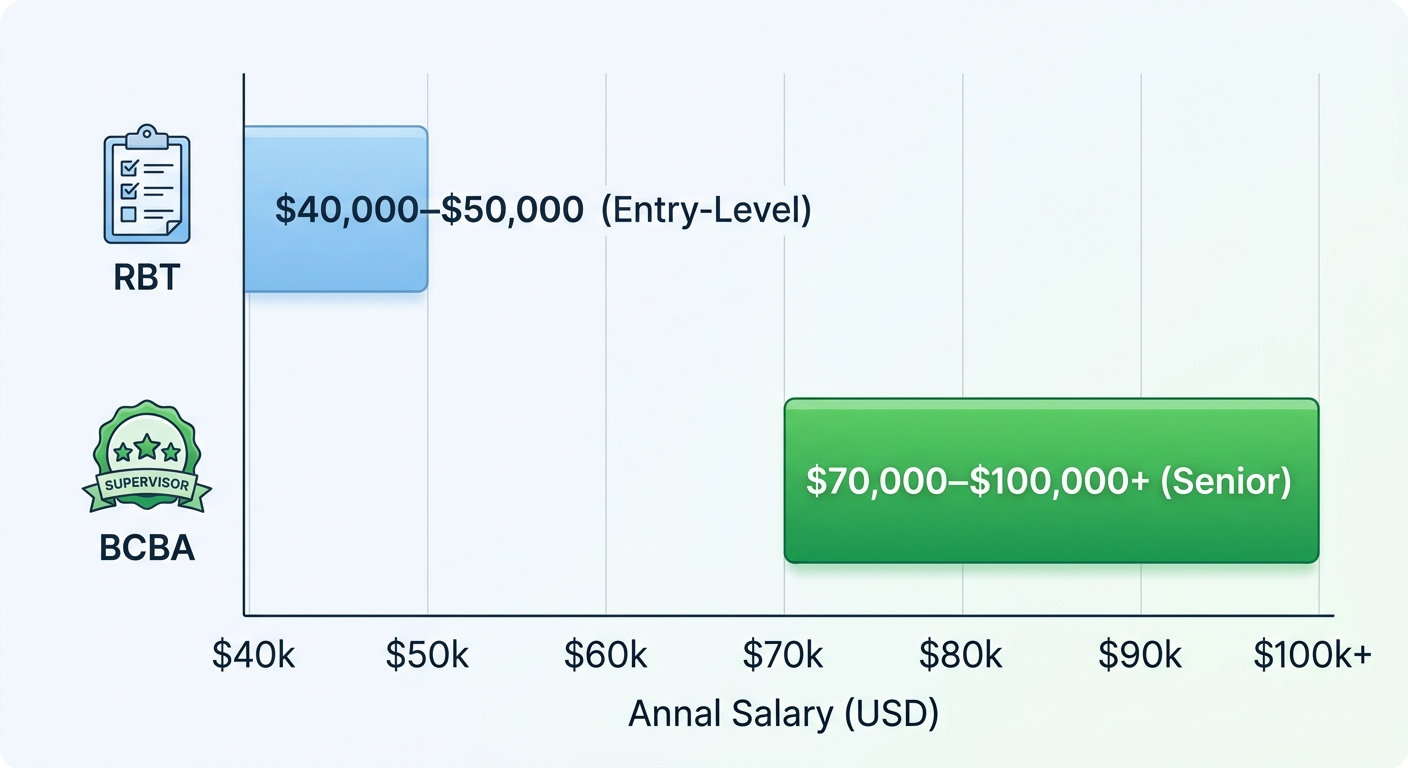
Family Onboarding for ABA Therapy
Families in Utah, Arizona, or Maryland can easily start in-home ABA therapy with Golden Touch ABA. Begin with an initial consultation call to discuss your child’s needs. We verify insurance benefits and schedule an in-home assessment by our BCBA to set goals.
Advanced ABA Opportunities in NJ and Beyond
Opportunities in New Jersey
New Jersey buzzes with demand for experienced ABA professionals. Advanced roles require New Jersey ABA licensing overseen by the New Jersey Division of Consumer Affairs. Aba therapist salary in these positions typically ranges from $70,000 to $95,000.
Job Outlook by State
| State | Demand | Licensing Notes |
|---|---|---|
| Utah | High in counties served | No state license required |
| New Jersey | Growing demand | State licensing required |
ABA Therapist FAQ
What does an ABA therapist do?
ABA therapists provide in-home ABA therapy, teaching kids with autism communication, social skills, and independence using evidence-based practices.
What is the average ABA therapist salary?
ABA therapist salary ranges from $35,000-$50,000 yearly, or $15-$25 hourly.
Elevate Skills and Care with Golden Touch ABA
Take your ABA expertise further with us at Golden Touch ABA. Ready to join? Apply now at our careers page today!
This article was researched and written with the assistance of AI tools.
Resources
- Explore Lucrative BCBA RBT Careers at Golden Touch ABA
- Discover Tailored In-Home ABA Therapy in Washington Terrace
- Get Personalized In-Home ABA Therapy in Taylorsville Utah
- Obtain Customized ABA Therapy for Independence in Eagle Mountain
- Access In-Home ABA Services Enhancing Skills in Pleasant Grove
- Secure Evidence-Based ABA Therapy in Parleys Canyon Utah
- Find Growth-Promoting In-Home ABA Therapy in Bluffdale Utah
- Learn New Jersey ABA Licensing Board Regulations
- Identify Key Characteristics of Quality ABA Programs
- Compare RBT Salaries by Location and Experience Factors
- Achieve BCBA Certification with BACB Requirements Guide
- Access BACB Resources for ABA Autism Treatment
