
Best Naturalistic Developmental Behavioral Intervention Utah for 2026
Table of Contents
- Naturalistic Developmental Behavioral Intervention in Utah
- Understanding Naturalistic ABA Therapy Across Utah's Service Areas
- In-Home NDBI Services in Salt Lake City and Beyond
- What Utah Families Should Know About Child-Led ABA Approaches
- Beginning Naturalistic Developmental Behavioral Intervention for Your Child
- Empowering Your Child's Development Through NDBI
Naturalistic Developmental Behavioral Intervention in Utah
Naturalistic developmental behavioral intervention in Utah is an evidence-based approach that merges the structured principles of Applied Behavior Analysis (ABA) with developmental techniques, all within a child’s familiar, everyday settings. At Golden Touch ABA Therapy, we bring this child-led philosophy directly into your home, making learning feel like play. This information is for educational purposes and is not a substitute for professional medical advice; consult a healthcare or behavioral health professional.
One well-known framework you might hear about is the early start denver model, a program designed for very young children. Our approach, grounded in natural environment teaching, turns daily routines like mealtime or playtime into opportunities for building communication and social skills. By following your child’s lead, our BCBAs and RBTs help foster meaningful progress that fits naturally into your family’s life, backed by guidance from organizations like the American Academy of Pediatrics. We are proud to offer this personalized support through our ABA services in Utah, creating small steps that build toward real-world confidence.
Understanding Naturalistic ABA Therapy Across Utah’s Service Areas
Naturalistic developmental behavioral intervention utah refers to a child-led, play-based form of Applied Behavior Analysis that uses everyday routines and familiar settings to teach communication, social, and daily living skills. At Golden Touch ABA Therapy, we believe in the the power of small steps that emerge naturally during play, creating a supportive and motivating learning experience for your child.
Naturalistic ABA Therapy is distinct because it follows your child’s interests rather than a rigid table-top structure. Two evidence-based models we often incorporate are Natural Environment Teaching (NET) and the Early Start Denver Model (ESDM). Both approaches capitalize on real-life moments—turning snack time into a language opportunity or backyard play into a social skills lesson—all within your home environment.
Our Naturalistic Approach in Utah
We provide in home ABA therapy guided by this philosophy across Salt Lake County, Utah County, Weber County, Davis County, and surrounding communities. Our Board Certified Behavior Analysts (BCBAs) design individualized plans that are then implemented by compassionate Registered Behavior Technicians (RBTs) during in-home sessions. This model encourages active family collaboration and parent training, ensuring that clinical strategies fit seamlessly into your family’s daily life.
Many families fund their autism therapy through coverage that coordinates with Utah DSPD disability services, and our team is experienced in helping you navigate that process. We focus on AbA At Home because learning in a familiar environment often helps skills generalize more effectively, providing a foundation for small, compounding victories.
It is important to remember that every child develops at their own pace—progress varies, and we tailor our approach accordingly.
This information is for educational purposes and is not a substitute for professional medical advice.
Now let’s explore how we implement naturalistic ABA in your community.
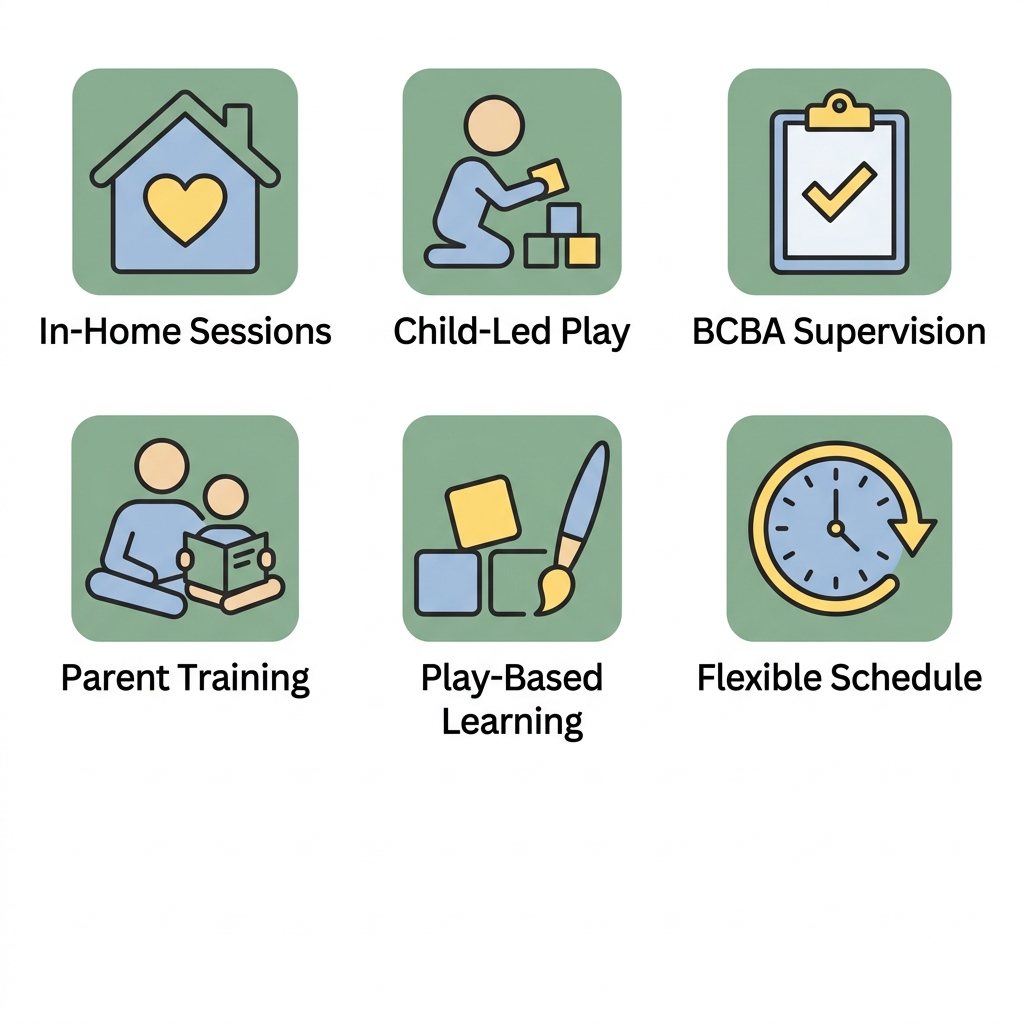
Naturalistic ABA therapy icons for Utah families
In-Home NDBI Services in Salt Lake City and Beyond
For families seeking a naturalistic developmental behavioral intervention in Utah, our in-home program offers a child-led, play-based alternative to traditional ABA therapy. This approach blends developmental principles with proven behavioral techniques, delivering therapy within the comfort and familiarity of your own home in Salt Lake City and across the Wasatch Front.
Our therapists weave natural environment teaching into your child’s everyday routines, using their favorite toys and activities to build communication and social skills. By incorporating methods like the Early Start Denver Model, we follow your child’s lead during sessions, making learning feel like play. A core part of this approach is parent involvement—we coach you to use these same strategies between visits, so progress continues long after the session ends. In fact, the collaborative focus of our autism therapy at home in Utah is what helps skills truly stick.
Golden Touch ABA’s NDBI services extend well beyond Salt Lake City. Our multidisciplinary team of BCBAs and RBTs works with families in Sandy, Draper, Provo, Ogden, and throughout Salt Lake, Utah, Weber, and Davis counties. With flexible scheduling, we make it easy to fit therapy into your busy life. Contact us to learn how our in-home NDBI program can support your child’s journey through the power of small steps.
(Results may vary based on individual circumstances.)
What Utah Families Should Know About Child-Led ABA Approaches
When searching for a naturalistic developmental behavioral intervention in Utah, many families discover child-led ABA therapy. This approach follows your child’s unique interests to build motivation and create natural learning moments, all within your home and community. It is an umbrella term that includes specific evidence-based models like the Early Start Denver Model and natural environment teaching, which the American Academy of Pediatrics recognizes as effective early intervention strategies for children with autism.
For families across Salt Lake, Utah, Weber, and Davis counties, this means therapy that feels like play and fits seamlessly into daily life. Our In Home ABA Therapy brings these child-led methods directly to you, which may support your child’s development by turning everyday routines into powerful teaching opportunities. We collaborate closely with parents and caregivers, coaching you to carry over strategies between sessions so progress is reinforced all week long.
Golden Touch ABA Therapy’s in-home approach is designed to be flexible and family-inclusive, creating a warm and welcoming environment where small steps yield big results. If you are ready to learn more about how child-led ABA can fit into your family’s life, we invite you to reach out for an intake or consultation.
Results may vary based on individual circumstances. This information is for educational purposes and is not a substitute for professional medical advice; consult a healthcare or behavioral health professional.
Beginning Naturalistic Developmental Behavioral Intervention for Your Child
If you are considering naturalistic developmental behavioral intervention in Utah, Golden Touch ABA Therapy is ready to welcome your family. Naturalistic Developmental Behavioral Intervention, or NDBI, is a research-backed approach that blends the proven strategies of applied behavior analysis with the science of child development. We integrate learning opportunities into your child’s favorite play activities and daily routines, making skill-building feel natural and motivating rather than clinical.
We deliver this support through In Home ABA Therapy centered on the Early Start Denver Model and natural environment teaching. Our board-certified clinicians coach you to use everyday moments, from mealtime to bedtime, to strengthen communication, social engagement, and independence. NDBI is rooted in evidence-based practices recognized by organizations such as the Association for Behavior Analysis International and used throughout Salt Lake, Utah, Weber, and Davis counties. By bringing therapy into your home, we empower you to lead your child’s progress with simple, supportive Small Steps That Yield Big Results.
This family-centered approach reflects our commitment to Helping Children Reach their True Potential. Contact us to learn how our NDBI program can support your child’s development today. Results may vary based on individual circumstances.
Empowering Your Child’s Development Through NDBI
Our naturalistic developmental behavioral intervention in Utah empowers children through play-based learning at home. This evidence-based approach integrates ABA principles into everyday routines, targeting communication, social skills, and independence. NDBI fosters growth by following your child’s lead and motivations. As part of our In Home ABA Therapy, we involve families to reinforce small steps, yielding big results. Explore our holistic therapy in Utah approach for comprehensive support. Results may vary based on individual circumstances.
Resources
Table of Contents
- Navigating ABA Therapy Reimbursement Rates in 2026
- Key Factors Behind ABA Therapy Reimbursement Rates
- Major 2026 Reimbursement Changes for In-Home ABA Therapy
- Choosing an In-Home ABA Provider Under New Reimbursement Rates
- Adapting to 2026 Rate Changes: Strategies for Families and Providers
- Common Questions About ABA Therapy Reimbursement Rates
- Securing Quality In-Home ABA Therapy for Your Child
Navigating ABA Therapy Reimbursement Rates in 2026
Navigating ABA therapy reimbursement rates in 2026 can feel overwhelming for families seeking support. Once you understand how ABA therapy works, the next step is understanding the financial landscape, which is where our team steps in to provide clarity and guidance.
Reimbursement rates are influenced by a combination of factors, including your specific insurance provider, whether the plan is private or through Medicaid, and your geographic location. For families in Salt Lake City and across our Utah, Arizona, and Maryland service areas, rates can also shift based on annual policy updates from insurers and state programs. This is why we never provide a one-size-fits-all number; instead, our experts conduct a personalized insurance benefits verification. This process allows us to review your plan’s deductibles, out-of-pocket maximums, and coverage for in-home ABA therapy, giving you a clear picture before treatment begins.
Our team stays current on ABA therapy reimbursement rates in 2026 to provide accurate guidance, but the most effective way to understand your costs is to reach out for a customized assessment. We are committed to making family-centered care accessible, and that starts with transparent, supportive financial conversations. To begin the reimbursement process, contact us for a free eligibility check.
Insurance coverage is subject to verification and is not guaranteed.
Key Factors Behind ABA Therapy Reimbursement Rates
Understanding what shapes aba therapy reimbursement rates 2026 is critical for families and providers planning for care. These rates are not uniform; they are driven by a combination of legislative decisions, contractual negotiations, and provider qualifications. Now let’s examine the key factors that actually drive these reimbursement rates, starting with how funding sources create different rules for providers.
Medicaid rates are established directly by state legislation, which leads to significant variation across the country. For instance, in California’s Medi-Cal program, the state sets its fee schedule through official policy, as seen in the medicaid aba therapy policy detailed by the Department of Health Care Services. This means a provider’s reimbursement for in-home ABA therapy can look very different from one state to the next, depending on that year’s approved budget. According to data from the National Center for Biotechnology Information, evidence-based practices like ABA therapy are recognized as medically necessary, which helps inform why states prioritize these rates, but the final dollar amounts are always a policy decision.
Private insurance reimbursement works through a different mechanism. Rates are not set by a single government body but are instead negotiated between employer health plans and provider networks. This system offers more flexibility, but it is often less transparent, as contracts differ widely between insurers. A family’s coverage for our family-centered care services is generally stable for the plan year, though providers must carefully manage their network contracts. The stability of private coverage contrasts sharply with the Medicaid system, where coverage can shift yearly with state budget cycles. This is a core reason why we help families verify their benefits—reimbursement for a service like in-home ABA therapy depends heavily on the payer’s specific rules.
The following table highlights the structural differences between these two primary funding sources.
| Factor | Medicaid | Private Insurance |
|---|---|---|
| Rate Determination | Set by state legislation; varies widely by state | Negotiated between employer/plan and provider networks |
| Coverage Consistency | Requires annual state budget approval; may change yearly | Stable for plan year but subject to network contracts |
| Provider Eligibility | Must meet state Medicaid requirements and be enrolled as a Medicaid provider | Must be credentialed with the specific insurance network |
This side-by-side view reveals that the source of funding directly dictates the predictability and administrative burden associated with each payer. Our experience shows that navigating these differences is a vital step in creating a warm and welcoming environment where the power of small steps can truly shine, free from administrative surprises.
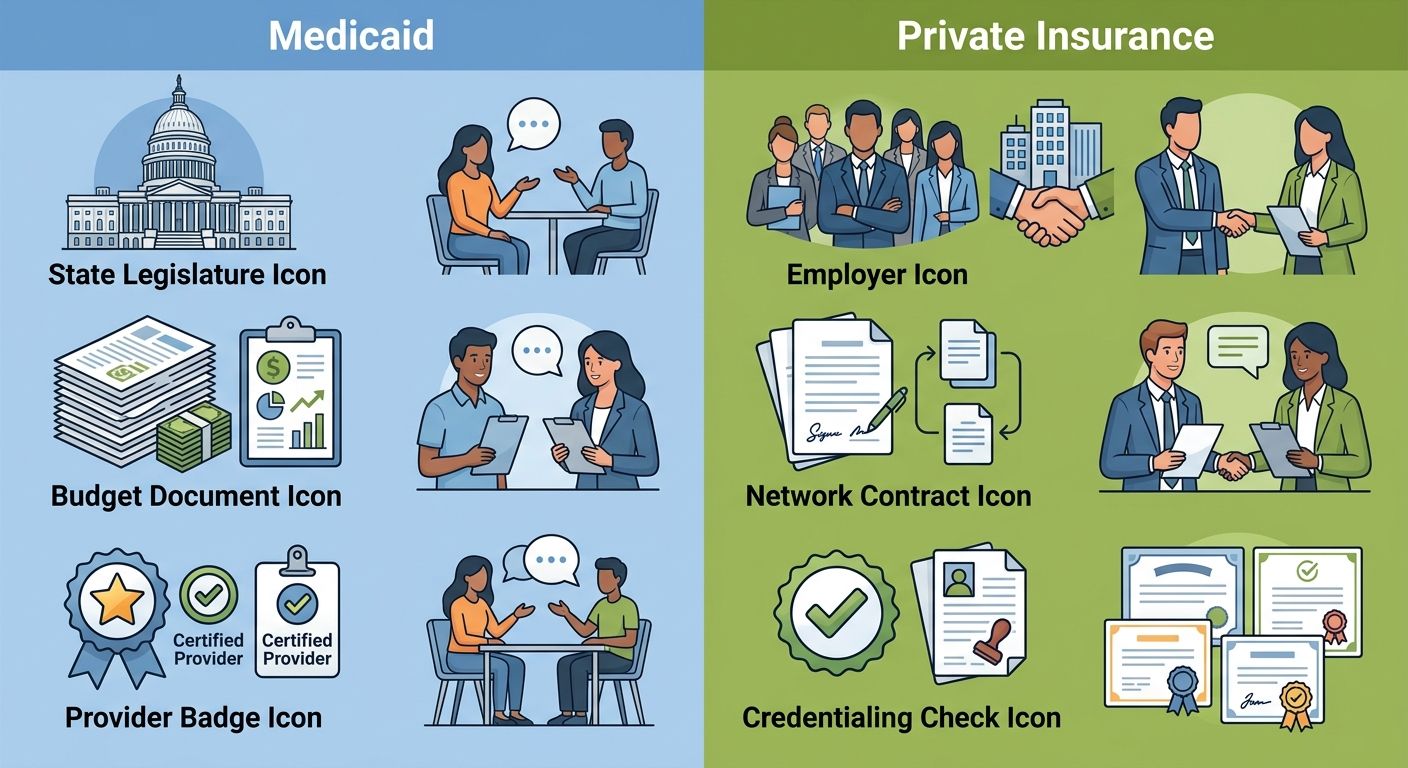
Comparison of Medicaid and private insurance reimbursement for ABA therapy
Beyond funding, provider eligibility is a crucial gatekeeper for reimbursement. To receive Medicaid payments, a provider must not only be a licensed clinician but also be formally enrolled as a state Medicaid provider, meeting all specific state requirements. Private insurance, however, requires a separate process: our Board Certified Behavior Analysts must be credentialed with each individual insurance network. This dual layer of eligibility underscores why aba therapy reimbursement rates 2026 are tied to a provider’s administrative capacity as much as their clinical expertise. Understanding these factors is the first step; next we’ll explore how to navigate them to protect your access to care.
Disclaimer: Insurance coverage is subject to verification and is not guaranteed. Reimbursement varies and consultation with a professional is recommended.
Major 2026 Reimbursement Changes for In-Home ABA Therapy
Looking ahead to 2026, several key reimbursement changes will shape the landscape for in-home ABA therapy. As a provider committed to family-centered care, we are tracking these aba therapy reimbursement rates 2026 updates closely to help families understand what to expect. These shifts in public payer fee schedules may affect access to aba therapy for children across our service areas in Utah, Arizona, and Maryland. While many state Medicaid programs are adjusting rates to balance budgets, we continue to assist families with insurance verification so they can focus on their child’s progress.
Medicaid Rate Adjustments Across States
Medicaid rate adjustments for 2026 reflect a mix of state budget cycles, legislative actions, and Medicaid rebalancing efforts. In Utah, rate-setting is influenced by annual legislative appropriations and the state’s efforts to manage overall behavioral health expenditures. According to state Medicaid fee schedule historical data, the projected rate for CPT 97153 is expected to see a modest decrease of approximately 2%. This adjustment aligns with broader budget rebalancing, though access to in-home ABA therapy remains a priority for Utah’s Division of Integrated Healthcare.
In Arizona, the projected 3.6% reduction in the average Medicaid rate for CPT 97153 is tied to the state’s managed care contracting cycles and cost-containment measures. Arizona’s Medicaid program periodically reviews fee schedules against provider cost reports, and the 2026 update reflects an attempt to align rates with updated utilization data. We are monitoring these changes to ensure families in Arizona continue to receive evidence-based practices through their coverage.
Maryland’s projected decrease of about 1.8% is relatively modest, reflecting the state’s All-Payer Model dynamics and the Maryland Department of Health’s approach to maintaining stable provider networks. These adjustments underscore the importance of verifying benefits with your specific payer, as actual reimbursement rates can vary significantly. As the California Department of Health Care Services (DHCS) demonstrates in its Medi-Cal rate-setting processes, state governments use complex methodologies to determine appropriate fees for ABA therapy services.
CPT Code 97153 Reimbursement Updates
CPT code 97153 is the most commonly used billing code for ABA therapy, covering adaptive behavior treatment by a technician under the supervision of a Board Certified Behavior Analyst (BCBA). This code represents the direct, face-to-face therapy sessions that form the core of in-home ABA therapy, making its reimbursement rate critical for both provider sustainability and family access.
The 2026 reimbursement updates for CPT 97153 show a trend toward modest reductions across several state Medicaid programs. For our families, these 2026 reimbursement changes for ABA therapy highlight the importance of understanding how public payer rates can influence service availability. As noted by the National Center for Biotechnology Information (NCBI) at the U.S. National Library of Medicine, government health research on healthcare reimbursement trends emphasizes that rate adjustments often reflect broader economic factors rather than changes in the clinical value of services.
While Medicare does not typically cover ABA therapy for children, trends in commercial payer rates often follow Medicaid benchmarks. We encourage families to view these projected figures as industry benchmarks rather than guaranteed reimbursement amounts. Your specific out-of-pocket costs and coverage levels depend entirely on your insurance plan’s contract with providers. Our team helps navigate these complexities, ensuring that warm and welcoming environment we create in your home is supported by clear financial understanding.
State-by-State Comparison of Autism Therapy Reimbursement
To illustrate the projected changes in 2026, we’ve compiled a comparison of Medicaid fee schedule data for CPT 97153 across our three primary service states. The following table represents estimated average rates based on state Medicaid fee schedule historical data and provider reports and legislative updates for 2026.
| State | 2025 Average Rate (Medicaid) | 2026 Projected Rate | Change (%) |
|---|---|---|---|
| Utah | $12.50 per unit | $12.25 per unit | -2% |
| Arizona | $14.00 per unit | $13.50 per unit | -3.6% |
| Maryland | $13.75 per unit | $13.50 per unit | -1.8% |
Importantly, these figures are drawn from public payer data and represent industry-wide projections. The power of small steps in therapy progress depends on consistent, uninterrupted care, which financial predictability supports. For a precise understanding of what your family’s insurance plan covers, we recommend contacting us directly. Actual reimbursement rates vary by payer contract and benefits eligibility; contact Golden Touch ABA Therapy for a custom quote based on your insurance plan.
As we navigate these evolving payer landscapes together, our commitment to family-centered care and evidence-based practices remains unwavering. Understanding these shifts helps families and providers anticipate what 2026 will bring for ABA therapy access. Results may vary; consult a licensed healthcare professional for medical advice. Insurance coverage is subject to verification and is not guaranteed.
Choosing an In-Home ABA Provider Under New Reimbursement Rates
In light of these reimbursement changes, choosing the right provider matters more than ever. With aba therapy reimbursement rates 2026 shifting across Medicare, Medicaid, and private insurance plans, families must evaluate providers carefully. When selecting an aba therapy provider, ask detailed questions about insurance, credentials, and the steps to begin therapy confidently.
Golden Touch ABA offers flexible scheduling and insurance navigation to help mitigate these challenges.
Questions to Ask About Insurance and Reimbursement
Understanding aba therapy reimbursement rates 2026 is key to avoiding unexpected out-of-pocket costs and finding a provider who respects your family’s financial boundaries. We at Golden Touch ABA recommend that families ask prospective providers these critical questions during the initial conversation to ensure full transparency:
- Network participation: Are you in-network with my specific health insurance plan?
- Rate acceptance: Do you accept the updated 2026 reimbursement rates for ABA services?
- Cost estimates: Will I receive a Good Faith Estimate before therapy begins?
- Balance billing: Is balance billing prohibited, and how do you handle coverage gaps?
- Out-of-pocket costs: What copays, deductibles, or coinsurance amounts should I expect?
- Authorization support: Do you assist with prior authorization and ongoing reauthorization requests?
Transparent answers to these questions help protect your family from surprise bills and ensure a smooth start to services.
Evaluating Provider Credentials and Experience
A provider’s qualifications directly impact the quality of care your child receives, especially as new reimbursement rates for ABA therapy place pressure on staffing models. Start by verifying that the supervising Board Certified Behavior Analyst (BCBA) holds current certification through the Behavior Analyst Certification Board (BACB). You can confirm credentials instantly by searching the public BACB registry at bacb.com.
Next, ask about supervision frequency. We recommend confirming that the BCBA provides at least weekly oversight of your child’s program rather than occasional check-ins. Inquire about the RBT-to-BCBA ratio on the team, since rate cuts can sometimes lead providers to stretch supervision too thin. At Golden Touch ABA, we maintain high supervision standards because we believe evidence-based practices deliver the best outcomes when supported by consistent, hands-on clinical guidance. Also confirm RBTs receive ongoing training and consistent team assignments week to week. Consistency matters in in-home ABA therapy, and a provider committed to family-centered care will prioritize stable, well-supervised teams even in a changing reimbursement environment.
Steps to Verify Coverage and Begin Therapy
Once you have selected an in-home ABA therapy provider, follow these steps to begin services. We at Golden Touch ABA guide you through every stage.
- Contact your insurance company to confirm ABA benefits and verify network status.
- Request a custom quote based on your coverage details and treatment plan.
- Schedule a free consultation or complete our interactive ABA roadmap assessment.
- Submit eligibility checks and intake forms with required diagnostic documentation.
- Begin therapy with a trial period for observation, plan refinement, and comfort in a warm and welcoming environment where the power of small steps builds lasting progress.
These steps help you find the right fit. Contact Golden Touch ABA today for a free consultation and custom quote.
Disclaimer: Results may vary and are not guaranteed. Consult a licensed healthcare professional for diagnosis or medical advice. Insurance coverage is subject to verification and is not guaranteed. Please review our Privacy Policy and Terms & Conditions for additional information.
Adapting to 2026 Rate Changes: Strategies for Families and Providers
With the aba therapy reimbursement rates 2026 adjustments approaching, families and providers are reexamining how they plan for care. We believe proactive preparation can ease this transition and safeguard access to compassionate, family-centered care.
Key strategies for navigating these changes:
| Factor | In-Home ABA Therapy | Center-Based ABA Therapy |
|---|---|---|
| Reimbursement Stability | Depends on state policy; cuts can reduce availability | Typically more stable facilities funding |
| BCBA Oversight | Typically requires travel; supervision ratios may be affected by rate cuts | On-site supervision common |
| Cost to Family | Out-of-pocket may increase if rates drop and providers adjust copays | Varies by clinic structure |
Drawing on biomedical data from the National Center for Biotechnology Information (NCBI), our approach to the aba therapy reimbursement rates 2026 is grounded in evidence-based research. Here is how each strategy works.
Negotiate with Insurers. Families can request single-case agreements when their provider is out-of-network, a critical step as reimbursement rates for applied behavior analysis adjust. We recommend having your child’s diagnosis and treatment plan ready when calling your insurer. Providers strengthen these negotiations by compiling outcome data that shows measurable progress, increasing the likelihood of approval.
Leverage State Resources. State autism waiver programs in Utah, Arizona, and Maryland may offer supplemental funding to offset rate changes for ABA therapy. Contact your state Medicaid or disability agency to check eligibility. Our team at Golden Touch ABA can supply the clinical documentation — assessment reports and progress notes — that agencies require.
Optimize Provider Efficiency. Choosing a provider that uses group supervision and remote parent training can reduce out-of-pocket costs without sacrificing quality. These models lower operational overhead while maintaining strong outcomes. Our In-home ABA therapy already integrates these efficiencies, reflecting our belief in the power of small steps toward affordable, sustainable care.
As the 2026 reimbursement adjustments take effect, we are here to help. Contact us for personalized guidance and a custom quote. Results may vary; consult a licensed healthcare professional for diagnosis or medical advice. Insurance coverage is subject to verification. Our Privacy Policy applies.
Common Questions About ABA Therapy Reimbursement Rates
ABA therapy reimbursement rates 2026 vary widely based on your insurance plan, provider network, and state regulations. At Golden Touch ABA, we help families understand what to expect. Here are answers to the questions we hear most often.
What Factors Influence Reimbursement Rates?
Reimbursement amounts depend on your specific policy’s deductibles, copayments, and coinsurance. State mandates, such as those in Maryland, can also affect coverage, while self-funded employer plans may not follow the same rules. We always verify benefits to give you a clear picture.
How Does BCBA Certification Affect Reimbursement?
Most insurers require that a Board Certified Behavior Analyst oversee therapy for it to be reimbursed. Holding BACB certification shows that your clinical supervisor meets the highest professional standards, which helps maintain coverage eligibility.
Does Golden Touch ABA Accept Medicaid?
We work with many families in Utah, Arizona, and Maryland, including those with Medicaid coverage. Because Medicaid benefits can differ by plan, we recommend contacting us so we can check your individual coverage for in-home ABA therapy.
How Can I Verify My Benefits for 2026?
Contact Golden Touch ABA and our team will handle the benefits verification process for you. Since reimbursement rates are subject to change, reaching out ensures you have the most current information. Insurance coverage is subject to verification and is not guaranteed.
Securing Quality In-Home ABA Therapy for Your Child
Building on the importance of early intervention discussed previously, securing quality in-home ABA therapy starts with verifying a provider assigns a BCBA to supervise treatment and train RBTs directly in your home. At Golden Touch ABA Therapy, we build individualized plans from comprehensive behavioral assessments with measurable goals rooted in ABA methodology. In-home ABA therapy in a warm and welcoming environment promotes family-centered care, and our caregiver training helps skills generalize beyond sessions. Data-driven progress monitoring keeps every session evidence-based.
In our next section on Navigating Insurance Coverage and Reimbursement Options for ABA Therapy, we will help you verify your benefits.
Resources
- Learn About 2026 Out-of-Pocket Maximums for ABA Therapy
- Discover How Insurance Plan Variables Affect ABA Therapy Costs
- Explore State Mandates and Out-of-Pocket Maximums for ABA
- Guide to Estimating ABA Therapy Costs with Insurance in 2026
- Access Biomedical and Genomic Databases at the NCBI Portal
- Discover Medi-Cal Initiatives and Behavioral Health Transformation
- Find BACB Certification Standards and Update Information
Table of Contents
Building Independence with ABA Daily Living Skills
Building on in-home ABA therapy, we teach independence through daily living skills. Our ABA daily living skills program helps children master essential functional life skills—adaptive behavior activities like dressing, grooming, and meal preparation that build self-sufficiency.
- Dressing
- Grooming
- Meal preparation
- Household chores
Our BCBAs use task analysis to break each routine into small, teachable steps and apply positive reinforcement as each step is mastered. Practicing in your home in Salt Lake City or Utah County means your child learns where they live. Caregivers learn prompting and reinforcement right alongside us, embracing our family-centered care.
According to the Association for Science in Autism Treatment, ABA is the most widely supported evidence based autism treatment for daily living skills. We celebrate the power of small steps: each mastered step builds confidence and reduces frustration. Our team tailors targets to your child’s age, abilities, and your family’s priorities. Please note that results may vary. Consult a licensed healthcare professional for diagnosis or medical advice. Now that we understand the importance of daily skills, let’s explore how we teach morning routines step by step.
Preparing to Teach Daily Living Skills at Home
Teaching your child ABA daily living skills at home is a powerful way to foster independence while taking advantage of the natural practice opportunities your household provides. Start by choosing one manageable task—like brushing teeth or getting dressed—and perform a task analysis, breaking the skill into small, teachable steps.
Gather the materials you’ll need: visual supports like picture schedules, preferred reinforcers, and any adaptive equipment that makes the task easier. Consistency matters; schedule practice at the same time each day so the routine becomes predictable. The power of small steps shows that steady, daily efforts can lead to meaningful progress. As you teach these functional life skills, you’re also embedding adaptive behavior activities that boost your child’s confidence in real-world settings.
Here’s a simple preparation checklist:
- Identify a target daily living skill
- Break it into steps (task analysis)
- Collect visual aids and reinforcers
- Set a consistent daily practice time
By methodically teaching ABA daily living skills, you’re laying a foundation for independence that reaches far beyond a single task. Once you’ve laid this groundwork, you’re ready to begin the step-by-step teaching process. Our team at Golden Touch ABA Therapy provides caregiver coaching and evidence-based support to help you implement these strategies effectively. Families in the area can turn to our ABA therapy in Davis County for personalized guidance.
Identify Key Daily Living Skills for Your Child
We understand that every child is unique, and identifying the right ABA daily living skills is the first step toward greater independence. Daily living skills include practical, age-appropriate tasks such as dressing, brushing teeth, and meal preparation. A personalized assessment by a BCBA helps pinpoint the specific self-help routines that matter most for your child.
Common skill categories include:
- Self-care (hygiene, dressing, feeding)
- Home management (tidying up, laundry, simple cooking)
- Community participation (shopping, safety awareness)
- Social and leisure skills (greetings, turn-taking, play)
Our in-home approach allows families to practice these functional life skills in a warm and welcoming environment. By working in your home, we ensure that skills transfer naturally to daily routines. At Golden Touch ABA Therapy, our ABA therapy in Eagle Mountain services bring evidence-based support directly into your home. Our team creates a tailored plan that focuses on the skills most meaningful to your family. We partner with you to prioritize goals, using the power of small steps to build confidence through adaptive behavior activities. Remember to consult a licensed healthcare professional for personalized medical advice.
Once you’ve identified the key skills, our next section explores how we teach those skills through structured ABA techniques.
Break Down Skills with Task Analysis
We teach ABA daily living skills by breaking them down into small, manageable steps: a method called task analysis. This approach deconstructs complex routines like brushing teeth or getting dressed into observable, sequential actions, giving both therapists and learners a clear roadmap. At Golden Touch ABA, our Board Certified Behavior Analysts (BCBAs) design individualized task analyses (learn more about BACB certification) to teach functional life skills in a supportive, in-home setting.
Because we believe in the power of small steps and family-centered care, we share these task breakdowns with families to reinforce progress at home.
For example, when targeting daily living skills in ABA therapy such as toothbrushing, the process can be broken into six clear steps:
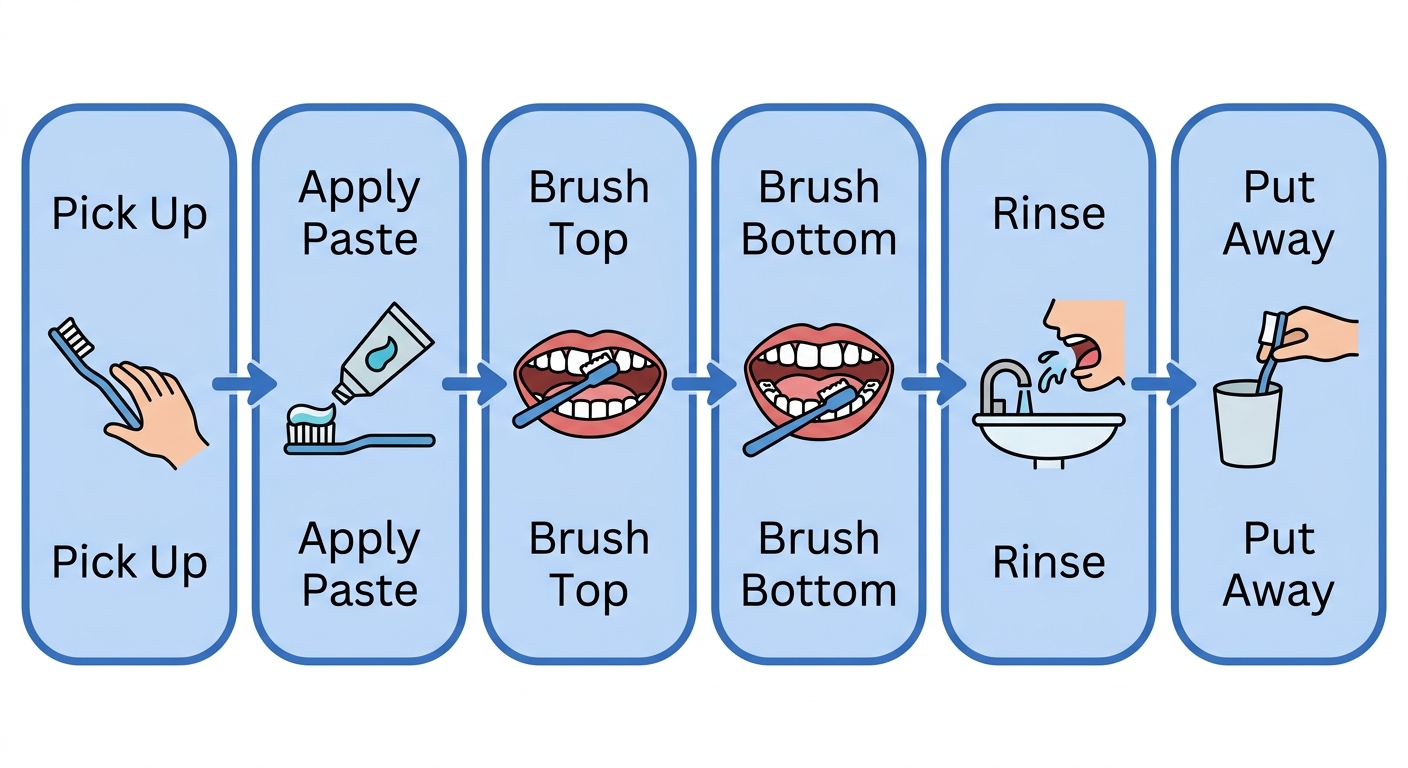
Toothbrushing task analysis broken into six simple steps for ABA learners.
This systematic approach ensures each small step is mastered before moving to the next, building confidence and independence. Once the steps are defined, therapists use forward or backward chaining to teach them in sequence. Our FAQ provides a detailed illustration of task analysis applied to handwashing, demonstrating how adaptive behavior activities become manageable through careful structuring.
Set Up Your Home for Successful Learning
Now that we understand how ABA daily living skills lay the foundation for growth, let’s focus on the environment where these skills are practiced. At Golden Touch ABA, our in-home ABA therapy model thrives when the home is arranged to support learning. A thoughtfully prepared space helps children develop functional life skills and adaptive behavior skills naturally as they go about their day.
Designate a quiet, distraction-free area for focused learning sessions. Use visual schedules and labeled bins to promote predictability and independence. Place communication boards and reward systems at your child’s eye level to encourage easy access. Consistent daily routines help your child anticipate transitions and reduce anxiety. Weave learning into everyday moments like mealtime, dressing, and play to reinforce skills in context. Keep rooms safe and clutter-free to minimize sensory overload and allow relaxed movement.
When your home becomes a partner in learning, the upcoming routines for mastering daily living skills feel more natural and successful.
Prompt and Fade to Teach New Routines
When teaching aba daily living skills, therapists use prompting and fading—offering cues, then gradually removing them. Prompting can be verbal, physical, or visual. Fading transfers control to natural cues.
We adjust support using a prompt hierarchy, such as least-to-most prompting, based on progress. For instance, your child might start toothbrushing with hand-over-hand guidance, move to a visual schedule, and then do it alone. We teach functional life skills like hand washing and room cleaning through adaptive behavior activities. Our BCBAs and RBTs collect data to tailor prompt levels, providing just-right support. This reduces prompt dependence and fosters smoother transitions. By fading in small steps, we harness the power of small steps to build independence. At Golden Touch ABA, prompting and fading are central to our in-home therapy, helping children master everyday routines. Through consistent aba daily living skills practice, children gain confidence. Next, we’ll show a step-by-step example of prompting for a morning routine.
Reinforce Small Wins and Build Momentum
Progress in ABA daily living skills happens one small step at a time. When we celebrate each achievement, your child builds the confidence and motivation to keep learning.
We teach daily living skills in ABA by breaking complex tasks into manageable micro-steps. For instance, brushing teeth becomes a series of simple actions: picking up the toothbrush, applying toothpaste, and brushing the front teeth first. These adaptive behavior activities give your child clear, achievable goals. Positive reinforcement follows each success, whether it is verbal praise, a favorite activity, or a token system that tracks progress.
As a parent or caregiver, you are essential to building momentum. The encouragement you provide between therapy sessions at home helps functional life skills stick and generalize to daily routines. At Golden Touch ABA Therapy, the power of small steps guides our evidence-based approach in Salt Lake County, Utah County, Weber County, Davis County, and across Arizona and Maryland. We emphasize family-centered care because consistent practice turns small wins into lasting independence.
Results vary for every child, but steady reinforcement creates real progress. When you look ahead, tracking gains and adjusting goals keeps the journey moving forward.
Help Your Child Generalize Skills Across Routines
At Golden Touch ABA, we integrate aba daily living skills into every session to help your child build essential functional life skills. Skill generalization is the ability to use a learned behavior across different settings, people, and times—and in-home ABA therapy makes this easier because skills are practiced in your child’s own home and community.
Our BCBAs and RBTs coach parents on consistent prompting and reinforcement, weaving adaptive behavior activities into everyday moments. For example, we’ll embed tooth-brushing into your child’s morning routine, turn mealtimes into language-practice opportunities, and build calming techniques into bedtime. Each small step adds up, and we celebrate every success.
Generalization takes time, but the power of small steps keeps progress steady. In our warm and welcoming environment, we partner with your family to create a personalized plan that fits your unique routines. Reach out to your BCBA to explore how we can support your child’s growth across all the moments that matter.
Monitor Progress and Celebrate Milestones
After setting goals for daily living skills, we monitor progress in ABA daily living skills training through careful data collection. Our BCBAs and RBTs use objective measures—frequency, duration, and trial-by-trial recording—to track each child’s advancement toward personalized goals. The Behavior Analyst Certification Board (BACB) requires that all treatment decisions be grounded in data, and we communicate this progress openly with families.
We celebrate every small milestone, knowing they build confidence and motivation for the learner and whole family. Because our care is family-centered, caregivers actively participate in monitoring progress during in-home sessions and practice at home. Even modest gains, like holding a toothbrush independently or waiting a few seconds longer, are powerful steps forward.
These adaptive behavior activities mark real-world progress in functional life skills such as hygiene, communication, and waiting. By recording each attempt and success, our team can pinpoint exactly which skills are improving, and those data-based celebrations reinforce the child’s motivation. Outcomes vary for each child, so we celebrate effort and progress rather than promising specific results.
Consistent tracking also helps us recognize when a strategy needs adjusting, so we can adapt the plan as needed, a topic we explore next.
Overcoming Common Obstacles in Daily Living Skills Training
When guiding children through ABA daily living skills, families and therapists often encounter roadblocks that seem to slow momentum. These moments are a normal part of learning and signal valuable opportunities for growth.
Common obstacles we see include:
- Limited generalization of skills to new settings.
- Resistance or low motivation during practice.
- Inconsistent routines between therapy and home life.
- Environmental distractions that interrupt focus.
Breaking tasks into small, manageable steps through task analysis reduces feelings of overwhelm and builds steady momentum. We pair this approach with positive reinforcement that’s tailored to the learner’s unique preferences, which often increases engagement and cooperation even during challenging moments.
Prompting and fading techniques help children gain independence without frustration. We provide the right level of support initially, then gradually step back as confidence builds. To strengthen generalization, we practice adaptive behavior activities in natural, real-world contexts — during mealtime, in the bathroom, or while getting dressed at home.
Caregiver involvement and consistent follow-through are critical for lasting progress. When families use the same strategies we introduce during daily living skills instruction, functional life skills become woven into everyday routines. In our in-home ABA therapy model, we bring strategies right into your living room, kitchen, and backyard, making generalization more seamless.
Celebrating small wins reinforces the power of small steps and keeps motivation high. Every step forward matters. With patience, tailored support, and a warm and welcoming environment, we see children make meaningful strides toward independence. Although individual progress varies, our family-centered care approach keeps the focus squarely on each learner’s unique journey.
Continuing the Journey Toward Independence
We believe that developing daily living skills is at the heart of every child’s growth. Through ABA daily living skills training, children and adolescents learn essential tasks like dressing, grooming, and meal preparation—functional life skills that build confidence and autonomy. Our approach integrates adaptive behavior activities into every session, helping each individual strengthen communication, social interactions, and self-care.
Family-centered care is central to our work. We equip parents and caregivers with the tools to support their child’s progress in everyday settings. The power of small steps creates lasting change, and our warm and welcoming environment ensures that learning feels natural and encouraging. Our evidence-based practices form the foundation of everything we do.
For families near Spring Lake, our in-home ABA therapy in Spring Lake, Utah brings personalized support to your home, reinforcing ABA daily living skills in familiar surroundings. If you’re ready to explore how ABA can help your loved one move toward greater independence, we’re here to guide the next step.
Resources
Table of Contents
- Understanding Functional Communication Training for Autism
- How Golden Touch ABA Integrates Functional Communication Training
- Comparing Communication Approaches in ABA Therapy
- Cost and Value Considerations for In-Home FCT
- Choosing the Right ABA Provider for Functional Communication Training
- Empowering Communication Through In-Home ABA Therapy
Understanding Functional Communication Training for Autism
Within ABA therapy, evidence based autism treatment includes functional communication training autism—often called functional communication training (FCT). This evidence-based approach teaches a replacement behavior—a socially acceptable communication act that serves the same purpose as the challenging behavior. For non-verbal learners, we often integrate augmentative and alternative communication (AAC) tools like sign language or picture cards.
Here’s what FCT involves:
- Replacement behavior: a new, functional way to communicate.
- Reinforcement: rewarding the new way while withholding reinforcement for the old behavior.
- Augmentative and alternative communication: adaptive methods giving your child a voice.
That’s the core of functional communication training autism. FCT is backed by research from the Association for Science in Autism Treatment (ASAT) and the National Center for Biotechnology Information (NCBI). In our in-home therapy, we weave FCT into daily routines with family-centered care at the core, embracing the power of small steps in a warm and welcoming environment. Results vary; consult your BCBA for an individualized plan. In the following section, we’ll walk through how to implement FCT at home with your support team.
How Golden Touch ABA Integrates Functional Communication Training
Building on this evidence base, functional communication training autism strategies drive our in-home ABA therapy. At Golden Touch ABA, we translate these practices into plans tailored to your child’s communication needs.
Our in home ABA therapy in Utah begins with a BCBA-led functional behavior assessment to uncover your child’s communicative intent. We then design an FCT for autism program targeting an equivalent replacement behavior — a sign, picture exchange, or speech-generating device — that we weave into daily routines like meals and play. We provide these services to families across Salt Lake County and Utah County.
We incorporate augmentative and alternative communication (AAC) tools, from low-tech PECS to speech-generating apps, and train both your child and family members on their use. Our BCBA and RBT team tracks progress through frequency, duration, or latency data and adjusts the plan as needed. Parent and sibling training is essential, because consistent support across all caregivers helps your child generalize skills. We teach you to prompt, reinforce, and fade prompts over time.
Appropriate communication is always reinforced, while challenging behaviors are addressed with ethical extinction in a safe home environment. With each small step — the power of small steps — your child builds lasting skills. Results may vary. In the next section, see how this approach produced measurable gains for a child in our program.
Comparing Communication Approaches in ABA Therapy
Every child with autism has a unique way of learning to communicate, and functional communication training autism allows us to tailor our approach to each child’s strengths. At Golden Touch ABA Therapy, we know that selecting the right communication method is a crucial step in helping children express their wants and needs without frustration. The following table compares the most common communication options we integrate into FCT.
| Communication Method | Description | Advantages | Best Suited For | Role of FCT |
|---|---|---|---|---|
| Vocal Speech | Natural vocal output is reinforced when the child approximates or produces a word that matches the desired function | Most natural; no device needed; generalizes across settings | Children with some vocal ability but limited functional communication | FCT identifies a replacement word and reinforces it while withholding reinforcement for problem behavior |
| Picture Exchange Communication System (PECS) | A low-tech AAC system where the child hands a card to a communication partner | Simple to learn; no spoken language required; portable | Nonverbal children or children with limited fine motor skills for sign language | FCT teaches the child to exchange the card instead of engaging in problem behavior to request |
| Speech-Generating Device (SGD) | Dynamic display device (e.g., iPad with AAC app) that generates voice output | Voice output is highly reinforcing; can build vocabulary; adaptable | Children who can navigate visual displays and need a robust, scalable system | FCT programs the device with mands that replace problem behavior; data collection on device use |
| Sign Language | Uses American Sign Language (ASL) or modified signs as a form of manual communication | No equipment needed; can be used across all environments; fine motor practice | Children with strong motor imitation skills and families willing to learn signs | FCT shapes the sign as a replacement behavior and reinforces its use to access wants and needs |
Our clinical team draws on evidence-based practices, including research accessed through the NCBI biomedical databases, to determine which augmentative and alternative communication method will be most effective. The Association for Science in Autism Treatment (ASAT) also provides guidelines confirming that each of these AAC options can successfully establish a replacement behavior when taught through functional communication training.
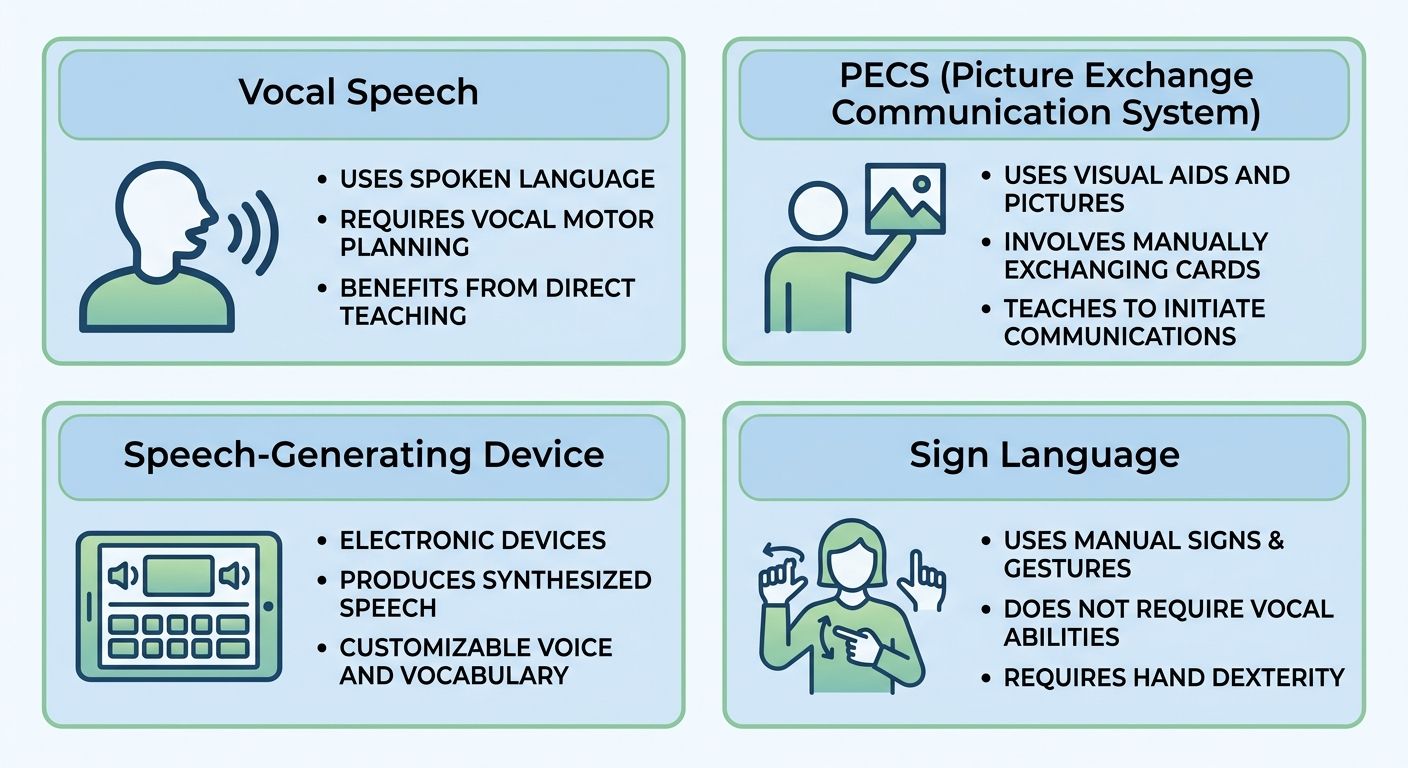
Comparison of communication methods in ABA therapy for parents.
The best method is always the one that fits the child’s existing skills and family context, and our thorough assessment process ensures this match is made thoughtfully. We celebrate every small step forward, knowing that a personalized plan builds a strong foundation for lasting communication and connection.
Cost and Value Considerations for In-Home FCT
Functional Communication Training autism therapy is an evidence-based ABA technique that replaces challenging behaviors with functional communication. By teaching your child a replacement behavior—such as using augmentative and alternative communication (AAC) tools like picture exchange or speech-generating devices—FCT can dramatically improve daily interactions and reduce frustration.
The cost of in-home FCT varies based on session frequency, your child’s individual needs, and your insurance plan. At Golden Touch ABA Therapy, we help families explore does insurance cover ABA therapy in Utah and assist with benefits verification so you can make the most of your coverage.
Because every therapy plan is uniquely designed, we provide custom quotes rather than standard pricing. Contact us for a personalized estimate that considers your child’s goals and insurance details.
Insurance coverage is subject to verification and is not guaranteed; results may vary; consult a licensed healthcare professional. Early investment in FCT often reduces the need for more intensive interventions later—supporting both your child’s long-term development and your family’s financial well‐being. The Association for Science in Autism Treatment (ASAT) recognizes FCT as an evidence‐based practice backed by research.
We’re here to help you navigate costs and coverage. Reach out today for a custom plan and insurance check.
Choosing the Right ABA Provider for Functional Communication Training
Choosing an ABA provider who excels at functional communication training autism is key to building meaningful communication. At Golden Touch ABA, we pair your child with a BCBA skilled in teaching communication skills for autism.
When evaluating a provider, look for these essentials:
- BCBA expertise: Seek a clinician with deep experience in functional communication training and teaching replacement behavior.
- In-home delivery: In-home therapy lets your child practice communication skills in real-life settings where they are needed most.
- AAC support: A provider that embraces augmentative and alternative communication tools—from picture cards to speech-generating devices—ensures your child’s voice is heard in whatever form it takes.
- Parent training: Regular caregiver coaching helps your child generalize communication across daily routines, making progress stick.
We combine these elements in our in-home ABA therapy programs, and our approach to functional communication training autism ensures tailored plans for every child. Maryland families can access ABA therapy in Prince George’s County through us, and we also serve Weber and Davis Counties in Utah. Custom pricing and insurance verification assistance make beginning therapy simple.
Once you’ve identified a qualified provider, verify insurance coverage and schedule an initial assessment. Individual results vary; consult a licensed professional for diagnosis, and remember insurance coverage is not guaranteed.
Empowering Communication Through In-Home ABA Therapy
Building on our in-home ABA approach, we use functional communication training for children with autism, an evidence-based practice supported by the Association for Science in Autism Treatment, to teach alternative ways to express needs instead of problem behavior. At Golden Touch ABA, we incorporate augmentative and alternative communication tools like picture exchange systems for non-verbal children, and the core of FCT is the replacement behavior: our clinicians identify what a child’s challenging action is communicating and teach a more adaptive skill.
In our family-centered model, caregivers learn to reinforce these strategies throughout daily routines, so functional communication training for autism becomes part of everyday life. While results vary, each step forward is a celebration — and we’ll next explore how measurable outcomes track that progress.
Resources
Table of Contents
- Understanding ABA Therapy Costs with Insurance in 2026
- Before You Begin: Key Information to Gather
- Gather Your Insurance Policy and Benefits Information
- Understand Your Out-of-Pocket Costs and Deductibles
- Verify Your Insurance Coverage for ABA Therapy
- Calculate Coinsurance and Estimated Costs per Session
Understanding ABA Therapy Costs with Insurance in 2026
Navigating ABA therapy cost with insurance 2026 is often the first concern for families. As our team at Golden Touch ABA explains, insurance coverage can substantially lower what you pay out of pocket, though your exact cost depends on your plan’s deductibles, copays, and coverage limits. That’s why insurance verification for ABA therapy is a critical first step—we review your benefits to clarify what your policy covers before services begin, so you can focus on your child’s progress. We’ll also explain your plan’s coverage limits and help you understand any visit caps.
Your actual ABA therapy cost with insurance 2026 also depends on whether your plan must comply with the autism insurance mandate in your state. While many state mandates require certain regulated plans to cover ABA therapy, self-funded employer plans (ERISA) are often exempt. In states like Utah, the mandate covers ABA therapy up to age 9, while Arizona extends coverage to age 16, but ERISA plans are not bound by these rules. Because coverage varies, checking your plan’s ABA therapy out-of-pocket maximum helps you estimate your worst-case financial responsibility. It’s a useful figure for budgeting, though actual bills will reflect your specific deductible and copay structure. Results vary, and coverage is not guaranteed and is always subject to verification; we encourage you to contact us for a personalized benefits check.
Before You Begin: Key Information to Gather
At Golden Touch ABA Therapy, we know that gathering the right information makes insurance verification for ABA therapy smoother. ABA is a science based autism treatment, and we want to help you check your coverage. Knowing what’s required simplifies checking ABA therapy coverage and helps you plan for potential costs.
Based on our experience, these are the key items you’ll need:
- Your insurance card, including member ID, group number, and payer contact information.
- A formal autism diagnosis with ICD-10 code F84.0 or a prescription from a licensed professional.
- The treatment plan or behavioral assessment prepared by your child’s Board Certified Behavior Analyst (BCBA).
- Any prior authorization (pre-auth) numbers you may have received.
- Your child’s date of birth and relevant medical history.
If you have any questions, our team is here to help you verify these details.
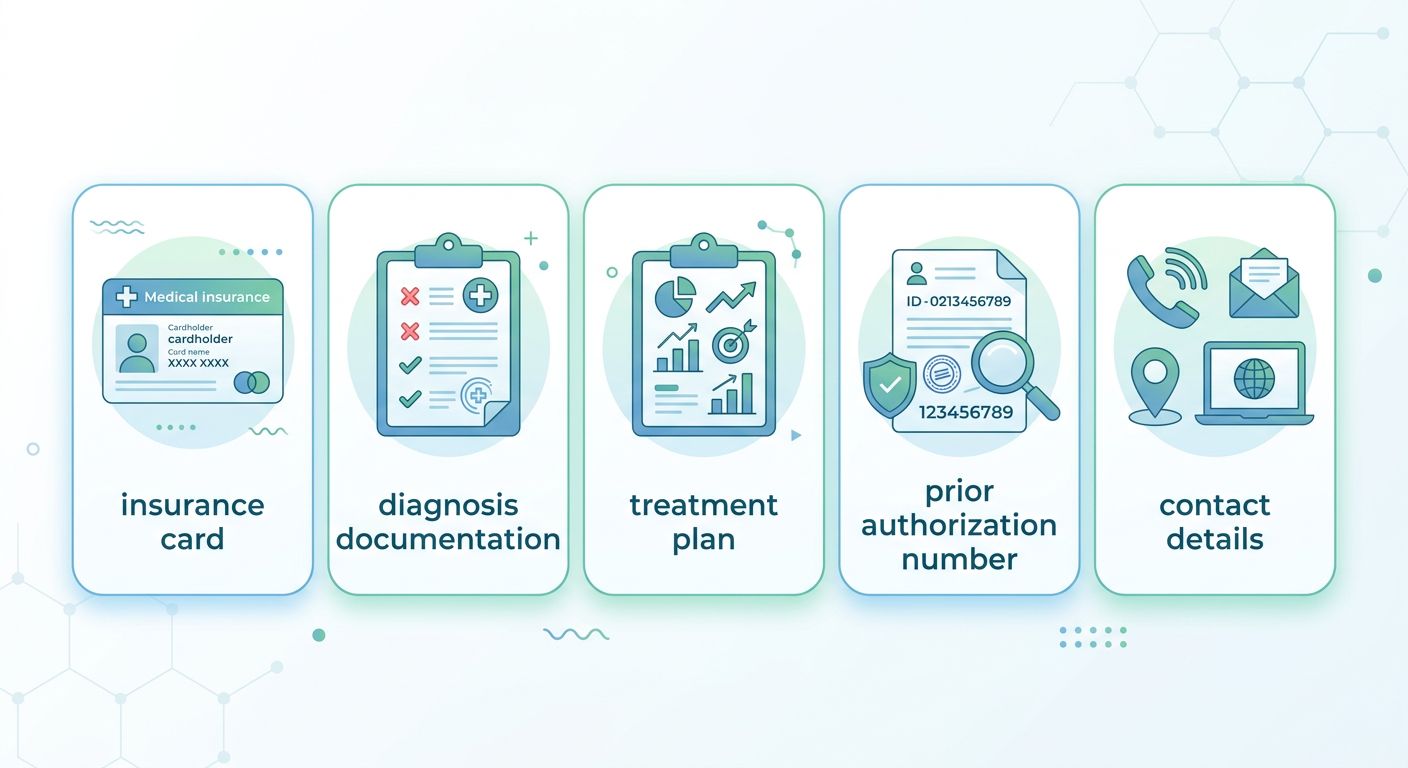
Essential documents and information for ABA insurance verification.
With these items in hand, you’re ready to begin the ABA therapy insurance verification process. Our team at Golden Touch ABA Therapy can assist with each step, from calling your insurer to confirming prior authorizations and benefits. Knowing your coverage helps you plan for costs and avoid surprises, so you can focus on your child’s progress. Once you’ve gathered these documents, the next step is submitting them for verification. Please remember that insurance coverage is subject to verification and is not guaranteed.
Gather Your Insurance Policy and Benefits Information
Before you can understand your costs, you need to know what your plan covers. Start by locating your insurance member ID card. Note your member ID, group number, and the customer service phone number. These details are essential when you begin the insurance verification for ABA therapy.
Gather the following items:
- Your insurance card with member ID, group number, and phone
- Your benefits summary or plan document
- Any pre-authorization or referral forms
- A copy of your child’s autism diagnosis report
Review your plan by calling member services or checking the benefits summary. Ask specifically about ABA therapy coverage and whether your state’s autism insurance mandate applies. Confirm if pre-authorization, a referral, or proof of medical necessity is required. Also ask about your out-of-pocket maximum so you understand your financial responsibility.
Our insurance assistance team can handle this step for you. Golden Touch ABA will guide you through the verification process and contact your insurer on your behalf. According to our team, the process often takes only a few days once you provide the documents.
Once you have your documents ready, the verification process can begin — covered in the next section. Please note that insurance coverage is subject to verification and is not guaranteed.
Understand Your Out-of-Pocket Costs and Deductibles
Understanding your coverage is the first step, but knowing your out-of-pocket costs brings real clarity. As you explore ABA therapy cost with insurance in 2026, these expenses generally encompass deductibles, copays, and co-insurance. The deductible is the amount you must pay before insurance begins to contribute. Once met, copays (a set fee per session) or co-insurance (a percentage of costs) often apply. Our insurance verification for ABA therapy gives families a clear picture of their financial responsibility, though it does not guarantee coverage. The autism insurance mandate operating in many states may limit maximum out-of-pocket costs, but specific rules hinge on your state and plan. Golden Touch ABA’s team walks you through these details, answers questions, and provides a custom quote after verification. Because actual costs differ for each family, we encourage you to contact us for a personalized breakdown. Insurance coverage is subject to verification and is not guaranteed.
Verify Your Insurance Coverage for ABA Therapy
Understanding the potential cost of ABA therapy with insurance in 2026 starts with a clear insurance verification for ABA therapy process. The most direct route is to call the number on the back of your insurance card and ask specifically about your plan’s coverage for Applied Behavior Analysis for autism. Before you call, gathering your insurance ID and policy details will speed up the conversation.
- Ask about your ABA therapy benefits: Inquire about the specific coverage for autism treatment, including any age limits or required pre-authorizations.
- Define your cost-sharing details: Clarify your plan’s deductible, your copay or coinsurance per session, and the total ABA therapy out-of-pocket maximum for the year.
- Request a written summary: Secure a written benefits summary from the insurer to identify any annual visit restrictions or financial caps, as coverage varies by plan, provider network, and state.
We understand this can feel overwhelming, which is why our team offers complimentary assistance to help you verify your child’s ABA benefits. We can guide you through the nuances of your policy to clarify your coverage situation.
Insurance coverage is subject to verification and is not guaranteed. Once you have a clearer picture, we invite you to connect with our insurance assistance team for a personalized benefits check. Studies indexed in the biomedical research database affirm that evidence-based practices like ours are key to effective family-centered care. From here, you can confidently take the next step: scheduling a free assessment to begin therapy.
Calculate Coinsurance and Estimated Costs per Session
Estimating your aba therapy cost with insurance 2026 starts with understanding coinsurance—the percentage you pay after your deductible. Here’s a simple process:
- Verify your benefits—we can run your insurance plan.
- Check your deductible status—if unmet, you’ll pay the full session rate.
- Apply your coinsurance rate—once the deductible is met, multiply the session fee by your percentage.
Your plan’s out-of-pocket maximum protects you by capping annual spending; once you reach that ABA therapy out-of-pocket maximum, the insurer pays 100% of allowed amounts for the rest of the year. Insurance verification for ABA therapy is therefore essential, and our team at Golden Touch ABA can review your benefits to explain your specific deductible, coinsurance, and out-of-pocket limits.
Because costs vary widely by carrier and individual plan, we encourage you to contact us for a personalized estimate of the cost of ABA therapy with insurance. Sessions are supervised by Board Certified Behavior Analysts (BCBAs), certified by the Behavior Analyst Certification Board. Keep in mind that insurance‐covered ABA therapy expenses are subject to verification and not guaranteed.
Explore State Mandates and Grant Opportunities
Families often wonder how state mandates and grant opportunities can help lower the ABA therapy cost with insurance. In Maryland, a state mandate requires insurance coverage for autism therapy, including ABA, which can make treatment more accessible for your child. Our team offers insurance verification for ABA therapy to help you understand how state mandates apply to your plan and what benefits you may have.
Beyond insurance, grant opportunities such as state-funded programs or nonprofit awards may further offset ABA therapy costs. We assist families in our service areas—including in Utah, Maryland, and Arizona—by navigating these options and providing personalized guidance. Every plan is different, so coverage and grant availability vary; we cannot guarantee specific outcomes, and verification is subject to plan terms.
Reach out for a free benefits check. We’re here to help you take the first step—because the power of small steps can lead to meaningful progress.
Reach Your Out-of-Pocket Maximum to Maximize Coverage
Now that you understand the basics of insurance coverage for ABA therapy, let’s look at a key strategy: reaching your out-of-pocket maximum to get the most out of your plan. This is the annual cap on what you pay for covered services. Managing ABA therapy cost with insurance 2026 starts here. According to Golden Touch ABA’s insurance FAQ, the out-of-pocket maximum usually applies to ABA therapy, and once you meet it, your insurer pays 100% of covered ABA sessions for the rest of the plan year.
Scheduling ABA sessions early in the plan year can help you reach your annual out-of-pocket limit sooner, unlocking full coverage for the rest of the year. Because each insurance plan sets its own maximum out-of-pocket cap, getting insurance verification for ABA therapy is essential. Our team at Golden Touch ABA helps families understand their plan details and schedule accordingly. Insurance coverage is subject to verification and is not guaranteed; some non-covered services may still apply. The power of small steps — every session moves you closer to the cap. Ready to check your plan’s out-of-pocket maximum? Our team can help with insurance verification — reach out to us today.
Request a Custom Quote and Finalize Your Decision
Understanding the ABA therapy cost with insurance 2026 can feel overwhelming, but we make it simple with a personalized custom quote. We tailor every quote to your child’s unique needs, goals, and location while handling insurance verification for you. This includes clarifying your out-of-pocket maximum and any plan limitations, so you know exactly what to expect before making a commitment. As explained in our FAQ on cost with insurance, coverage depends on your specific policy, which is why we take the time to verify your benefits thoroughly.
There’s never any obligation to move forward after receiving your quote—you can review everything at your own pace. We accept Medicaid and most major insurance plans, though each plan is verified individually to confirm your exact benefits. When you’re ready to begin, simply contact us by phone, email, or try our interactive ABA roadmap tool to start the process. Insurance coverage is subject to verification and is not guaranteed. Please consult a licensed healthcare professional for diagnosis or medical advice.
Troubleshooting Common Insurance Coverage Issues
Insurance verification for ABA therapy is a critical first step, but it doesn’t guarantee that your child’s services will be covered. At Golden Touch ABA, we help families in Salt Lake City, Utah County, Weber County, and Davis County in Utah, as well as in Arizona and Maryland, understand exactly what their plan requires before treatment begins.
Even after verification, claims can still be denied. Common reasons include:
- Lack of demonstrated medical necessity – the insurer may not see the therapy as essential.
- Out‐of‐network status – your provider isn’t in the plan’s network.
- Insufficient documentation – missing reports or progress notes.
- Exceeded session limits – hitting annual or lifetime visit caps.
We strongly recommend securing pre‐authorization before starting ABA services. This process confirms that the insurer agrees the treatment is medically necessary and outlines what they will pay. Understanding your ABA therapy out‐of‐pocket maximum is equally important because it caps your total annual spending, protecting you from runaway costs.
If a claim is denied, you can appeal. Our team guides families through collecting a letter of medical necessity from the BCBA, treatment plans, and progress data to build a strong case. As you plan for aba therapy cost with insurance 2026, keep in mind that deductibles, copays, and coverage limits can shift each year, so early planning makes a real difference.
You don’t have to navigate these challenges alone. Our insurance assistance service is here to help you untangle denials, understand benefits, and take the next small step forward. Remember, insurance coverage is subject to verification and is not guaranteed, but we’ll work alongside you to pursue every possible option.
Navigating ABA Therapy Costs with Confidence
Managing the ABA therapy cost with insurance 2026 starts with understanding your plan’s deductibles, co-pays, and out-of-pocket maximums. A thorough insurance verification reveals exactly what your policy covers so you can plan with confidence. We help families focus on therapy, not financial uncertainty.
Once we complete the insurance verification for ABA therapy, we outline your ABA therapy out-of-pocket maximum and any co-pay responsibilities. We break down the ABA therapy cost with insurance 2026 through example scenarios on our FAQ page, but your estimate depends on your specific benefits. That personalized insight helps you budget realistically. Reach out for insurance assistance and benefits eligibility support—our team will walk you through the process and answer your questions. Please remember that insurance coverage is subject to verification and is not guaranteed, but we’re here to help every step of the way.
Resources
- Understand Arizona’s Autism Insurance Mandate for ABA
- Differentiate State Mandates from ERISA for ABA Coverage
- Explore Maryland’s Autism Mandate Covering Therapy to Age 21
- Secure ABA Coverage Through State Insurance Mandates
- Compare Autism Mandate Age Limits Across States AZ MD UT
- Verify Your Health Plan for ABA Mandate Coverage
- Prove Medical Necessity for ABA Under State Mandates
- Find Science-Based Autism Treatment Information at ASAT
- Access Biomedical Research Databases via NCBI
- Get Certified as an ABA Professional with BACB
Table of Contents
- Finding ABA Therapy Without the Waitlist in Utah, Arizona, and Maryland
- Understanding the Causes of ABA Therapy Waitlists
- Evaluating ABA Providers with Immediate Openings
- Steps to Secure Fast Enrollment in ABA Therapy
- Maximizing the Benefits of In-Home ABA Therapy
- Common Questions About ABA Therapy Waitlists
- Taking the Next Step Toward ABA Therapy Without the Wait
Finding ABA Therapy Without the Waitlist in Utah, Arizona, and Maryland
Aba therapy waitlist issues often leave families feeling stuck, but Golden Touch ABA Therapy offers a different path. We provide in-home ABA therapy with no waitlist across Utah, Arizona, and Maryland, so your child can start receiving support without delay.
We’ve streamlined the aba therapy intake process so families can move forward quickly. After an initial assessment and insurance verification, our team coordinates a start date that works for you. There’s no long delay — with our no-waitlist approach, your child can begin therapy right away. This means your family can access immediate aba therapy without the typical weeks of waiting.
Our experienced BCBAs and RBTs deliver personalized, family-centered care right in your home. We believe in The power of small steps — each session builds on the last, creating measurable progress in a warm and welcoming environment. Our evidence-based practices ensure every small step is meaningful. Through our in-home ABA therapy, we focus on building communication, social, and daily living skills. For an immediate estimate of benefits, try our Interactive ABA Roadmap, which provides a quick assessment and helps you understand what services may be available.
If you’re ready to skip the wait and get started, reach out to our team today. We’ll guide you through the next steps and help you access the support your child deserves. Please note that results may vary, and insurance coverage is subject to verification. As always, consult a licensed healthcare professional for your child’s individual needs.
Understanding the Causes of ABA Therapy Waitlists
To understand why ABA therapy waitlist delays occur, it’s helpful to explore the primary factors driving them. According to the U.S. National Institutes of Health (via NCBI), rising autism diagnosis rates have led to an unprecedented demand for ABA therapy services. This increase means more families are seeking BCBA-supervised sessions, which often extends wait times significantly. Our team at Golden Touch ABA sees this consistently — the need for specialized, evidence-based care simply outpaces the supply in many areas.
Beyond the high demand, limited numbers of certified therapists further inflate the waitlist for autism therapy. Many regions struggle to recruit enough BCBAs to meet community needs, particularly when families require in-person support. Complicating matters, the ABA therapy intake process can introduce additional delays. Complex insurance verification and lengthy paperwork requirements slow down the start of therapy, even when a provider appears to have an opening. As Golden Touch ABA’s internal FAQ notes, navigating approvals, authorizations, and billing codes is a common pain point for families.
The following table summarizes the most common waitlist causes and actionable solutions.
| Cause | Solution |
|---|---|
| High demand for BCBA-supervised therapy | Expand search to in-home providers with available BCBAs |
| Limited number of certified therapists in certain regions | Consider providers serving multiple states like Golden Touch ABA |
| Complex insurance verification and intake processes | Work with providers that offer insurance assistance |
Fortunately, there are practical steps families can take to find immediate ABA therapy for their loved ones. Broadening the search radius to include in-home providers can bypass many of these hurdles: therapists who travel to your home, such as those at Golden Touch ABA, often have more flexible availability. Additionally, choosing a provider that serves multiple states can help avoid regional therapist shortages. Working with a team that offers insurance assistance streamlines the intake process, ensuring paperwork and approvals do not become barriers. For children with more intensive needs — often described as low functioning autism — waitlists can be especially long, but in-home ABA therapy frequently provides a shorter path to the personalized support they require.
By recognizing these causes and implementing targeted solutions, families can move beyond the frustration of waiting. The next section will explore specific steps to find immediate ABA therapy openings, from questions to ask providers to understanding the intake timeline.
Results may vary; consult a licensed professional for individual advice.
Evaluating ABA Providers with Immediate Openings
Beginning ABA therapy shouldn’t feel like an endless waiting game, yet many families encounter ABA therapy in Maryland and across the country only to find discouraging three-to-six-month delays. Understanding how to identify providers with genuine, immediate openings can transform your family’s timeline from frustrating to empowering. At Golden Touch ABA Therapy, we believe that families seeking immediate ABA therapy deserve clear, actionable criteria for evaluating their options, and this overview helps you spot the difference between a provider that can start within days and one that requires months of patience.
A provider with a shortened ABA therapy waitlist typically shares several defining characteristics that go beyond simply having an available therapist. These organizations often maintain flexible scheduling protocols that allow them to match families with clinical teams quickly, rather than operating on rigid, semester-based intake cycles. Dedicated insurance verification teams handle the administrative legwork in parallel with clinical preparations, meaning your child’s treatment plan isn’t stalled while waiting for authorization calls. Multi-county or multi-state coverage further distinguishes these providers, as they can distribute demand across a wider geography and shift resources toward areas with the most urgent needs. When you call a provider, asking directly about their current average time from first contact to first session reveals whether they truly have capacity or are simply building a list for future openings.
Key Criteria for Identifying Providers with No Waitlist
Finding providers that offer no-waitlist ABA therapy requires looking beyond marketing claims and examining operational capabilities. The most reliable indicators include a dedicated intake coordinator who responds within one business day, transparent communication about current staffing levels in your specific area, and a willingness to schedule an initial assessment within the same week of your inquiry. We recommend verifying therapist credentials through the Behavior Analyst Certification Board (BACB) certificant registry, which allows you to confirm that any assigned BCBA holds an active, unrestricted certification. This step ensures that speed doesn’t compromise quality, as the BACB sets rigorous standards for professional conduct and ongoing education that all certified behavior analysts must maintain.
Another critical factor is the provider’s approach to insurance. Organizations that invest in internal insurance assistance teams, rather than expecting families to self-verify benefits independently, often demonstrate operational maturity that correlates with faster starts. They can simultaneously process authorizations while scheduling assessments, eliminating sequential delays. Ask whether the provider handles Medicaid, commercial plans, and any secondary coverage, and how long their average authorization turnaround takes. The combination of credential transparency and proactive insurance support strongly predicts a provider’s ability to deliver on their promise of quick-start ABA programs rather than just collecting intake forms for later review.
Comparing Provider Types: In-Home vs. Center-Based Availability
In-home ABA therapy fundamentally shifts the availability equation because it removes facility constraints from the scheduling process. When a provider delivers services in your child’s natural environment, they can assign a Registered Behavior Technician (RBT) and supervising BCBA to your home without waiting for a dedicated treatment room or clinic slot to open. This model thrives on distributed resources, meaning that a provider with clinicians living throughout a metropolitan area can match families to nearby therapists far more flexibly than a center that must manage limited physical space. We design our treatment plans around your home’s rhythm, creating a warm and welcoming environment where learning unfolds naturally rather than in an unfamiliar clinical setting.
Center-based programs, while offering valuable peer interaction and structured learning spaces, inherently face capacity ceilings tied to their physical footprint. Each therapy room can accommodate only so many concurrent sessions, and expanding capacity often requires leasing, build-out, and regulatory approvals that take months. Families pursuing center-based services frequently encounter waitlists driven not by therapist shortages but by square footage limitations. In contrast, the in-home model allows providers to grow their clinical team proportionally with demand, adding BCBAs and RBTs who immediately serve families across a distributed geography. This structural advantage explains why many families seeking immediate ABA therapy find faster starts with providers that prioritize home-based delivery while still offering the same evidence-based, family-centered care that defines quality treatment.
The Role of Provider Network Size in Wait Times
Organizations that operate across multiple states or counties hold a meaningful advantage in reducing local waitlists, as they can redistribute demand across a broader network when capacity tightens in one region. A provider serving Salt Lake County, Utah County, and Davis County in Utah, or maintaining offices from Baltimore to Phoenix, can shift clinical resources toward communities with the most pressing needs while continuing to accept new families everywhere. This networked approach means that even if your specific zip code has high demand, the organization’s aggregate staffing levels may still support a rapid start. At Golden Touch ABA Therapy, our multi-state presence—including our Maryland office in Baltimore—enables us to coordinate scheduling and maintain shorter wait times than single-location providers that depend entirely on one office’s limited bandwidth.
Before selecting a provider, consider how their geographic reach affects both immediate availability and long-term continuity. A provider with regional depth can offer backup therapists if your primary RBT is unavailable, ensuring your child’s progress continues without interruption. This resilience stems from network size, not just staffing numbers. The table below compares the practical differences you can expect when evaluating providers with immediate openings against those operating from a single location with typical waitlist constraints.
The following table contrasts providers with immediate openings against typical long-waitlist providers across the dimensions most relevant to families starting their ABA journey.
| Provider Characteristic | Immediate Opening Provider | Typical Waitlist Provider |
|---|---|---|
| Wait time | Less than 2 weeks | 3–6 months |
| Initial assessment | Scheduled within days | Scheduled weeks out |
| Service areas | Multi-state coverage | Single location |
| Insurance assistance | Dedicated support | Self-verify |
The differences illustrated above extend beyond simple convenience into the realm of developmental momentum. When your child waits six months for an initial assessment, critical windows for early intervention narrow, and families often report increased stress navigating the gap between diagnosis and treatment. Providers offering multi-state coverage and dedicated insurance support address both the clinical and administrative bottlenecks that cause those delays. As you evaluate your options, remember that the ABA therapy intake process is explored in greater detail in the next section, where we walk through what to expect after you select a provider and schedule that crucial first assessment.
Prioritize providers that combine credential transparency, in-home delivery, and broad geographic coverage. Verify BCBA certifications independently through the BACB registry, ask pointed questions about current wait times in your specific area, and observe whether the provider handles insurance complexities on your behalf. These criteria, applied consistently, lead you toward organizations capable of honoring their commitment to evidence-based practices without asking your family to wait months for the support you need right now.
Steps to Secure Fast Enrollment in ABA Therapy
Navigating an aba therapy waitlist can feel overwhelming, but getting started with in-home support doesn’t have to be a drawn-out process. At Golden Touch ABA Therapy, we designed every step of the intake process to move families from initial contact to active sessions as smoothly and quickly as possible. The power of small steps begins the moment you reach out—our team works to minimize wait times for ABA therapy while still making sure every child receives a thoughtful, individualized start. Whether you are looking for immediate aba therapy or simply want to understand the typical aba therapy intake process, knowing the pathway can help you secure quick enrollment steps with confidence.
How the Intake Process Works for In-Home ABA Therapy
Starting in-home ABA therapy with us follows a friendly, structured sequence so nothing gets overlooked. The first step is making initial contact by calling our office or filling out the online form on our website. After that, our team connects your family with a Board Certified Behavior Analyst (BCBA) who guides the next phase. The BCBA’s work is grounded in standards set by the Behavior Analyst Certification Board, which means the professional overseeing your child’s plan meets rigorous national requirements. During the intake conversation, we gather basic information about your child’s strengths and needs and confirm which of our service areas in Utah, Arizona, or Maryland fits your location.
Once the initial details are collected, we move into assessment scheduling and goal setting. A BCBA completes a thorough evaluation in your home, observing your child’s current skills and identifying areas where our support can make the biggest impact. We then collaborate with you to turn those observations into clear, measurable goals that become the foundation of a personalized treatment plan. Throughout this stage, our priority is keeping the conversation warm and practical so families feel informed rather than rushed.
The following table offers a quick view of how the intake process moves across states, based on Golden Touch ABA location and onboarding resources.
| Step | Utah | Arizona | Maryland |
|---|---|---|---|
| Initial contact | Online form or phone | Online form or phone | Online form or phone |
| Assessment scheduling | Within 1 week | Within 1 week | Within 1–2 weeks |
| Insurance verification | Assisted by provider | Assisted by provider | Assisted by provider |
| Therapy start | Within 2 weeks of assessment | Within 2 weeks of assessment | Within 3 weeks of assessment |
Families in Arizona and Utah can often see an assessment scheduled as quickly as within one week, while Maryland timelines may extend slightly. Even with that variation, every state benefits from having our staff handle insurance verification as a core part of the intake process, removing one of the biggest administrative hurdles caregivers face.
Insurance Verification and Eligibility Steps
Insurance verification doesn’t need to be a source of delay when you have the right support. We take the lead on contacting your plan to verify benefits, check eligibility requirements, and clarify any co-payment or deductible details before services begin. To keep this phase moving, we recommend gathering a few documents early: a copy of your insurance card, your child’s diagnosis report, and, if applicable, a referral from a pediatrician. Having those items ready often trims wait times for ABA therapy significantly.
Once we receive the information from your carrier, we walk you through what is covered and what, if any, out-of-pocket responsibilities may apply. Because every policy is different, we encourage families to review the results with us during a short phone call or secure message exchange. This step not only confirms coverage but also builds confidence that the financial side of care is settled before sessions begin. By handling insurance verification internally, we help families sidestep the paperwork confusion that so often interrupts the aba therapy intake process and makes it easier to move toward quick enrollment steps.
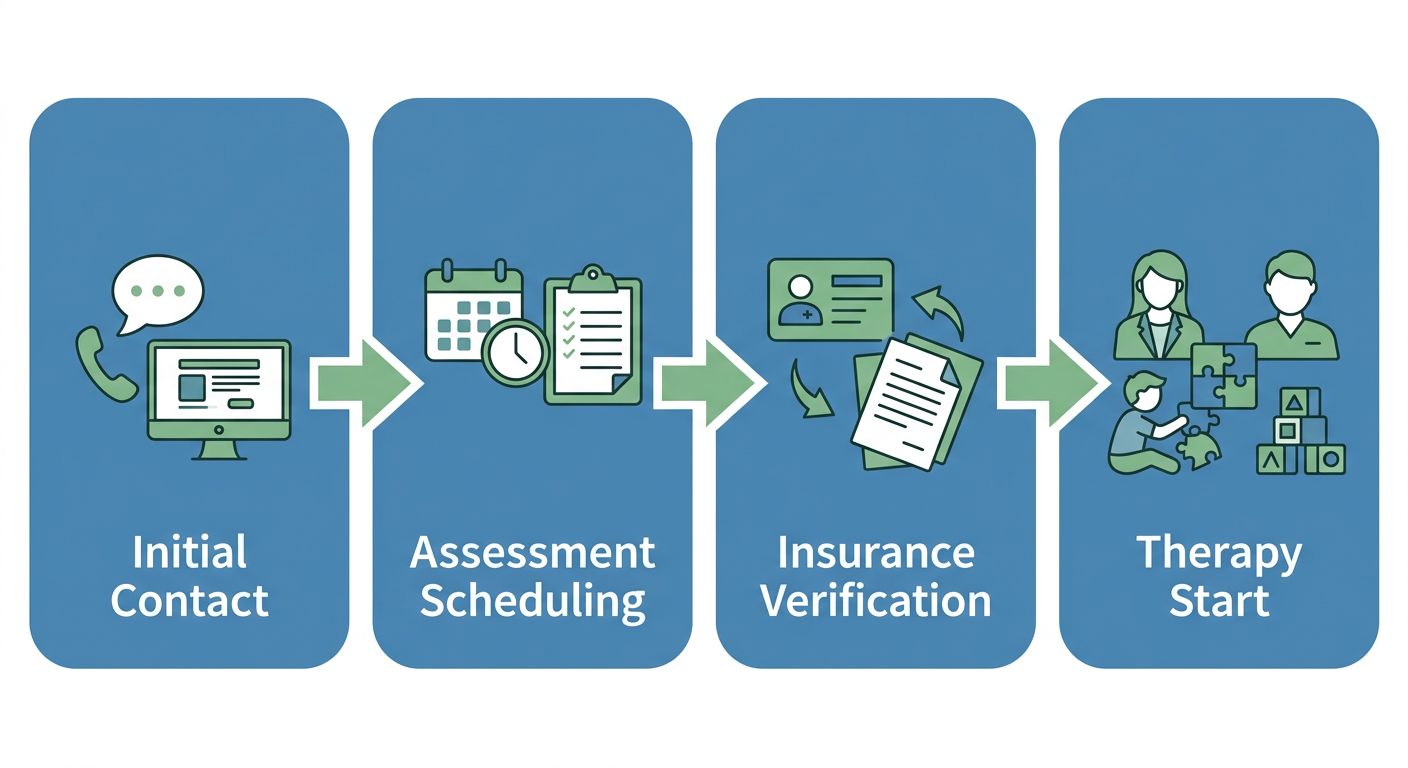
Four-step enrollment process for ABA therapy without waitlist.
Scheduling Your Initial Assessment Without Delay
After intake approval, the next priority is getting the initial assessment on the calendar. We recommend being as flexible as possible with your availability—scheduling during weekday mornings or early afternoons often opens more opportunities across our three-state service area. Our scheduling coordinators work directly with families in Utah, Arizona, and Maryland to align BCBA availability with days and times that fit your household. When a guardian can accommodate a wider window of time, it frequently shortens the gap between intake and that first in-home visit.
We also suggest confirming contact preferences early so our team can reach you immediately if an earlier slot opens. Whether we call your mobile number or send a text notification, staying responsive keeps the timeline tight. Once the assessment is completed, we finalize the personalized treatment plan and match your child with a Registered Behavior Technician (RBT) who will deliver direct therapy under the BCBA’s supervision. In Utah and Arizona, therapy commonly begins within two weeks of the assessment, and in Maryland we target a start within three weeks—still far quicker than the extended aba therapy waitlist many families anticipate. Insurance coverage is subject to verification and results may vary. Families ready to take the first step can use our online form or phone line to start the process today.
Maximizing the Benefits of In-Home ABA Therapy
After understanding how in-home ABA therapy works, the next step is learning how to get the most from every session. Our approach centers on delivering therapy in your child’s natural environment, which research consistently shows promotes better generalization of skills to everyday life. We believe in family-centered care and work closely with you to create a warm and welcoming environment where your child feels safe, supported, and ready to learn.
Many families searching for an aba therapy waitlist solution find that our in-home model removes common delays. By offering immediate aba therapy opportunities through a streamlined aba therapy intake process, we help children begin building essential skills without the long waiting periods that can slow developmental progress.
The following table compares key differences between in-home and center-based ABA therapy models across four important factors families consider when making their decision.
| Factor | In-Home ABA Therapy | Center-Based ABA Therapy |
|---|---|---|
| Setting | Child’s natural environment | Clinical setting |
| Supervision | BCBA-led, direct observation | BCBA-led, periodic observation |
| Family involvement | Highly integrated | Moderate |
| Scheduling flexibility | High (in-home times) | Fixed hours |
In-home therapy stands out for its deep integration of family participation and its flexibility, which reduces the stress of commuting and rigid schedules. When therapy happens where a child actually lives, the skills practiced during sessions transfer more naturally to daily routines, making every moment a potential learning opportunity.
Research from NCBI biomedical information reinforces that ABA interventions delivered in home and community settings produce meaningful, measurable outcomes. This evidence-based foundation guides our BCBA-led supervision model, where every session receives direct observation and real-time adjustments to the treatment plan. Parent and caregiver involvement is not just encouraged—it is a core part of how we practice. Our BCBAs provide hands-on training so you can reinforce strategies between sessions, turning the power of small steps into lasting progress.
Regular data collection and progress monitoring allow our team to refine interventions and demonstrate measurable gains over time. We also assist with insurance eligibility to make services more accessible. As you prepare to move forward, the next section walks through the specific steps to begin—from the initial intake process through insurance verification.
Results may vary; consult a licensed professional for medical advice.
Common Questions About ABA Therapy Waitlists
We understand just how hard it can be to sit on an ABA therapy waitlist while you wait for your child to begin the services they need. We believe in the power of small steps, which is why the team at Golden Touch ABA is committed to moving families through the process as smoothly and quickly as possible.
How long is the wait for ABA therapy?
Wait times for an ABA waiting list vary widely depending on your location, insurance verification, and the current availability of our clinical team. In many cases, families can anticipate waiting anywhere from a few weeks to a couple of months. We work hard to minimize this wait period by providing family-centered care and in-home services designed to start sooner than traditional clinic models.
What can I do to get ABA therapy faster?
Completing your paperwork and verifying insurance benefits right away are the most effective ways to shorten your time on the waitlist for ABA services. Our team also offers a streamlined ABA therapy intake process that includes a behavioral assessment to identify your child’s specific needs without delay. For families actively seeking faster access, immediate ABA therapy is sometimes an option when a BCBA or RBT has an opening in your area, so we encourage you to reach out directly to discuss current availability.
Taking the Next Step Toward ABA Therapy Without the Wait
You’ve learned how ABA therapy builds communication, independence, and daily living skills through evidence-based practices. Now the question is: where do you begin? Many families facing an aba therapy waitlist feel stuck, but our in-home program offers a different path — one with immediate openings and a simple start.
Immediate aba therapy begins with a single, no-pressure step. Our Interactive ABA Roadmap is a free online tool that helps you quickly outline your child’s needs, and our streamlined aba therapy intake process removes the guesswork. Here is the straightforward progression:
- Complete the quick Interactive ABA Roadmap from home.
- Speak with our team for a warm, welcoming conversation.
- Schedule an in-home assessment at a time that fits your life.
- Receive a personalized plan built around your child and family.
- Begin therapy with flexible scheduling and caregiver training.
We pair every child with a dedicated team, and our insurance assistance specialists verify benefits to reduce barriers. This is family-centered care that values the power of small steps. Results vary for each child, and insurance coverage is subject to verification; we do not guarantee specific outcomes. Reach out today — your next step is closer than you think.
Resources
- Understand Low Functioning Autism and ABA Billing
- Get In-Home ABA Therapy for Children with Autism
- Find In-Home ABA Therapy in Maryland with BCBA Support
- Learn About Golden Touch ABA Therapy Process
- Find In-Home ABA Therapy in Arizona with BCBA Care
- Get ABA Therapy Services Accepting Most Insurance
- Explore ABA Therapy for Children with Evidence-Based Techniques
- Access NCBI Biomedical Databases for Research
- Explore Behavior Analyst Certification Board Resources
Table of Contents
- Navigating Autism Insurance Mandates for ABA Therapy Coverage
- What Is an Autism Insurance Mandate and Why It Matters
- How State Insurance Mandates Interact with Federal Laws: ERISA and More
- Practical Steps to Determine Your ABA Therapy Insurance Coverage
- Understanding Medical Necessity and Documentation for ABA Therapy
- Common Questions About Autism Insurance Mandates Answered
- Securing the ABA Coverage Your Child Deserves
Navigating Autism Insurance Mandates for ABA Therapy Coverage
An autism insurance mandate is a state-level law that requires certain health insurance plans to cover treatments for autism spectrum disorder, including Applied Behavior Analysis (ABA) therapy. These laws are crucial for families, as they can significantly reduce the financial burden of intensive behavioral health services. According to advocacy organizations like Autism Speaks, a majority of states have enacted some form of mandate, but the specifics of ABA therapy insurance coverage vary widely depending on where you live.
While these laws provide a strong foundation, it is essential to understand that a state mandate does not guarantee your child’s coverage. Plans that are self-funded (often provided by large employers) are regulated by federal rather than state law and are not subject to state mandates. We always encourage families to view a mandate as a powerful tool rather than a promise, and we emphasize that careful verification is the first and most important step on your journey.
The key to unlocking your benefits often lies in demonstrating medical necessity. This is typically documented through a comprehensive diagnostic evaluation and a detailed treatment plan from a licensed professional. At Golden Touch ABA, our team focuses on creating thorough, evidence-based assessments that help showcase the medical necessity of our family-centered care. To navigate this process, we recommend taking these practical steps:
- Contact your insurance provider directly to ask about specific ABA therapy benefits under your plan.
- Request a written summary of benefits and coverage limits, including any age caps or annual visit restrictions.
- Work with your clinician to provide a detailed prescription and a treatment plan that clearly outlines the medical necessity for ABA therapy.
- Inquire about pre-authorization requirements, as many plans require approval before starting services.
Verifying your unique benefits is essential because coverage is subject to verification and is not guaranteed, even with a mandate in place. Our dedicated team is experienced in helping families in the Salt Lake City area and beyond navigate these often complex insurance landscapes. If you are exploring your options for in home ABA therapy in Utah, we can assist you with the benefit verification process, so you can focus on what matters most: celebrating the power of small steps with your child.
What Is an Autism Insurance Mandate and Why It Matters
An autism insurance mandate is a state law that requires certain health insurance plans to cover the diagnosis and treatment of autism spectrum disorder. According to Autism Speaks, these laws were created because insurance companies historically excluded autism treatments, labeling them as experimental or not medically necessary. This left many families to shoulder the full cost of essential care on their own.
These mandates specifically require coverage for evidence-based therapies, making ABA therapy insurance coverage a reality for thousands of children. Most mandate laws cover Applied Behavior Analysis (ABA) therapy, along with diagnostic assessments and treatment planning. However, the details vary significantly from state to state. For instance, Arizona’s mandate covers ABA therapy up to age 16, while Maryland offers broader protections through age 21. Utah has a more limited mandate, covering ABA therapy only up to age 9. Many mandates also require a demonstration of ABA therapy medical necessity—documentation from a doctor or psychologist confirming that the treatment is essential for the child’s development.
Why does this matter for your family? Without a mandate, an insurer may deny coverage for ABA therapy, forcing you to pay entirely out-of-pocket or, heartbreakingly, to forgo treatment. These laws help families access family-centered care, allowing children to receive the support they need in their own homes. An insurance mandate for autism can dramatically lower the financial barriers to early intervention, which is critical for long-term progress.
Of course, state-level autism insurance requirements are not universal. These laws generally apply to state-regulated insurance plans; some self-funded employer plans are exempt under federal ERISA rules. This creates a patchwork of coverage across the country.
State Autism Insurance Mandates at a Glance
The following table illustrates how autism insurance mandates can differ, using three states where we provide in-home ABA therapy as an example.
| State | Mandate Coverage Age Limit | Services Covered | Year Enacted |
|---|---|---|---|
| Arizona | Up to age 16 | ABA therapy, diagnosis, treatment plans | 2008 |
| Maryland | Up to age 21 | ABA therapy, speech, occupational therapy | 2015 |
| Utah | Up to age 9 (limited mandate) | ABA therapy (limited coverage) | 2011 |
Note: This information is for illustrative purposes. Coverage is subject to verification and may vary by plan. Contact your insurance provider for specific details.
Understanding these differences is the first step in navigating your options. For families in states with limited mandates, such as those seeking out of network ABA therapy in Utah, we can help you explore all available paths to care.
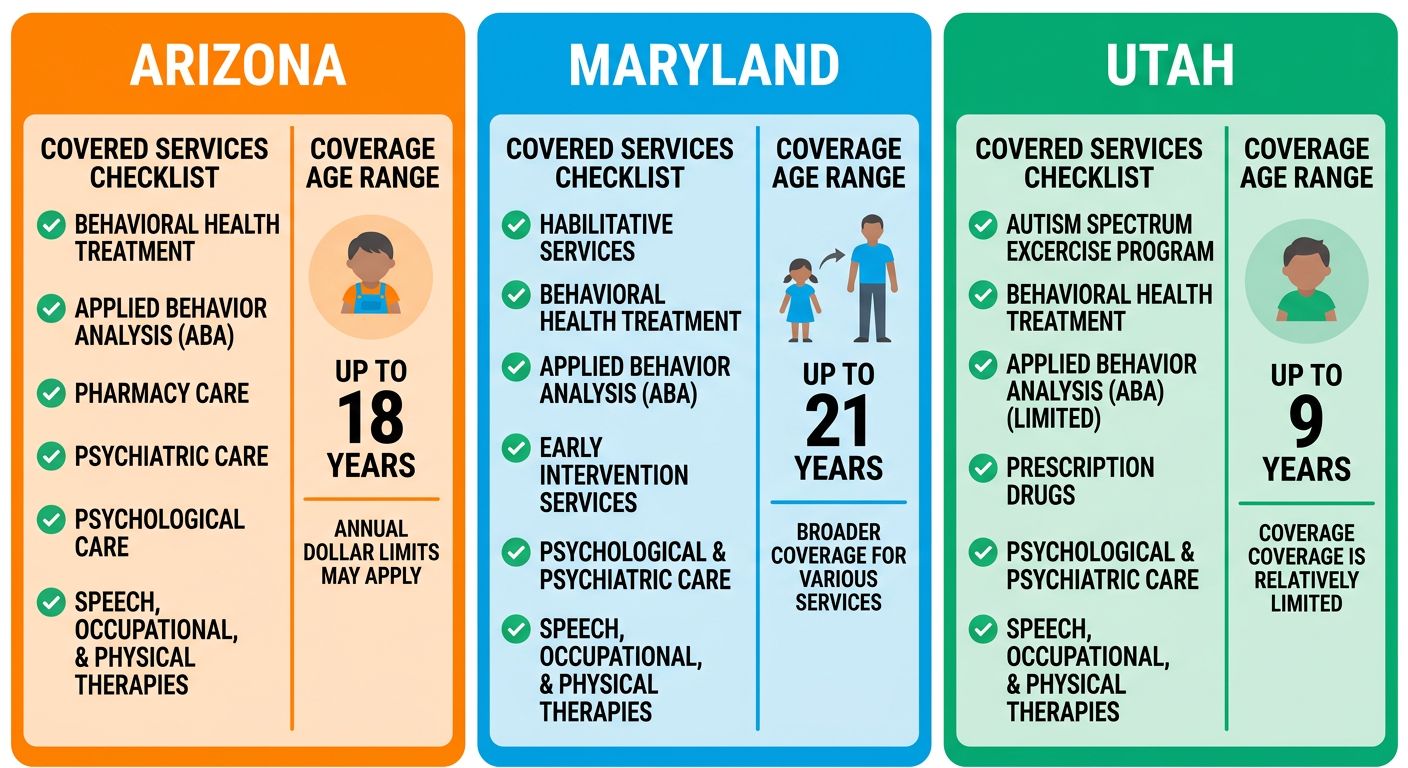
State autism insurance mandates at a glance for Arizona, Maryland, and Utah
We believe in the power of small steps. Verifying your benefits is the first small step toward unlocking the life-changing support your child deserves. Remember, insurance coverage is subject to verification and is not guaranteed. We’re here to help you understand your benefits so you can focus on what matters most: your family.
Consult a licensed healthcare professional for diagnosis or medical advice.
How State Insurance Mandates Interact with Federal Laws: ERISA and More
Many states have enacted an autism insurance mandate to help families access evidence-based therapy. But if you have a health plan through a large employer, you might be surprised to learn that federal law can override those state protections. That’s where ERISA comes in, and understanding the difference between plan types is the key to unlocking your coverage.
ERISA Plans and State Mandate Exemptions
ERISA, or the Employee Retirement Income Security Act of 1974, is a federal law that sets minimum standards for most voluntarily established health plans. When a company decides to pay employees’ medical claims directly rather than buying traditional insurance, the plan is called self-funded or self-insured. Because these plans are regulated by the U.S. Department of Labor under ERISA, they are generally exempt from state insurance mandates—including the autism insurance mandate your state may have passed. In other words, even if your state requires coverage for autism treatment, a self-funded plan isn’t legally obligated to follow that rule. That said, many self-funded plans still choose to include autism benefits because employers value robust coverage. The critical point is that the protection is voluntary, not a legal requirement. As Golden Touch ABA emphasizes, this distinction is the foundation of understanding your coverage options.
The following table breaks down the differences between state-regulated and self-funded plans so you can quickly identify where your policy stands.
| Plan Type | Regulated By | Must Follow State Autism Mandate? | Key Consideration |
|---|---|---|---|
| State-Regulated (Fully Insured) | State Insurance Department | Yes, must comply with state mandates if applicable | Coverage varies by state; check state laws |
| Self-Funded (ERISA) | Federal ERISA (Department of Labor) | Generally no, exempt from state mandates | Check plan document; may offer different autism coverage |
Reference: ERISA guidelines, Department of Labor
While a self-funded plan is not required to honor your state’s mandate, it doesn’t automatically mean there’s no autism coverage. Many employers still include behavioral health benefits, and the plan document is the final word. The Autistic Self Advocacy Network encourages families to be proactive about plan transparency, and we’re here to help you sort through the details.
Checking Your Plan Type
Figuring out whether your plan is state-regulated or self-funded takes just a few practical steps. Start by asking your company’s human resources department or benefits administrator directly, “Is our health plan self-funded or fully insured?” If you have your summary plan description or benefits booklet, look for keywords like self-funded, self-insured, or ERISA plan. A statement that the plan is “not subject to state regulation” is another clear sign of a self-funded arrangement. When you’re reviewing documents, also pay attention to ABA therapy insurance coverage language—even self-funded plans often have a behavioral health section that outlines autism services. If you’re unsure, we can help you verify your plan details during the insurance assistance process.
Implications for In-Home ABA Therapy
Whether your child receives in-home ABA therapy with a Board Certified Behavior Analyst (BCBA) and Registered Behavior Technicians (RBTs) often hinges on your plan type. If you have a fully insured plan, the state autism insurance mandate typically requires coverage for medically necessary ABA services, which can include home-based sessions. If your plan is self-funded, the coverage picture depends entirely on the employer’s chosen benefits. You may still have access to ABA therapy, but the specific criteria—such as demonstrating ABA therapy medical necessity through a comprehensive assessment—are defined by the plan, not by state law. For example, if your plan is fully insured and you are considering an out-of-network provider, check whether out of network ABA therapy in Utah is covered. Knowing your plan type is the first step to securing coverage for in-home ABA therapy. Our insurance assistance team at Golden Touch ABA Therapy can help you verify your benefits and understand what’s available under your unique plan. Please remember, insurance coverage is subject to verification and is not guaranteed.
Practical Steps to Determine Your ABA Therapy Insurance Coverage
At Golden Touch ABA Therapy, we understand that navigating your child’s insurance benefits can feel overwhelming, but taking a methodical approach makes the process much more manageable. By following a few clear steps, you can gain a clearer picture of what your plan covers and how to access the high-quality ABA therapy our team provides in a warm and welcoming environment.
Review Your Insurance Policy
The first practical action is to confirm whether your plan includes an autism insurance mandate, because this state-level requirement often sets the baseline for aba therapy insurance coverage. Start by locating your plan’s official Summary of Benefits and Coverage (SBC) — you can usually download it from your insurer’s online portal or request a printed copy.
Follow these steps to review your policy:
- Open the SBC and search for terms such as “applied behavior analysis,” “autism treatment,” or “behavioral health therapy.” Many plans list these services under a dedicated behavioral health section.
- Note any benefit limits, visit caps, or annual maximums that may apply. Some policies set a dollar cap or a maximum number of sessions for aba therapy insurance coverage.
- Check for in-network versus out-of-network provider rules; seeing an in-network provider usually lowers your costs.
- If the language is unclear, call the member services number on your insurance card and ask directly whether ABA therapy is a covered benefit under your specific plan.
Obtain Prior Authorization and Medical Necessity Documentation
Most insurance plans require prior authorization before beginning ABA services, and they nearly always ask for a formal medical necessity review. A strong medical necessity document — typically prepared by a licensed clinician — describes your child’s diagnosis, current functional impairments, and how the proposed treatment will address those needs. As Golden Touch ABA’s own FAQs explain, this letter often includes diagnostic evaluation results, standardized assessment scores, and individualized treatment goals that align with evidence-based practices (Golden Touch ABA).
To secure authorization, follow these steps:
- Contact your insurance company and ask for their prior authorization form or online portal instructions.
- Work with your child’s BCBA to compile clinical documentation, including the diagnostic report, a treatment plan with measurable objectives, and the aba therapy medical necessity statement.
- Submit the complete packet according to your insurer’s guidelines — many plans require a response within 14 calendar days.
- Follow up regularly and be prepared to provide additional information if the reviewer requests clarification.
The table below highlights key differences between Medicaid and private insurance when it comes to aba therapy insurance coverage:
| Coverage Type | State Mandate Applicable? | Medical Necessity Requirement | Out-of-Pocket Costs |
|---|---|---|---|
| Medicaid | Yes, states may have separate Medicaid mandates | Must meet EPSDT criteria; documentation required | Minimal or no cost-sharing |
| Private Insurance (State-Regulated) | Yes, subject to state laws | Must follow plan-defined medical necessity criteria | Deductibles, copays, coinsurance |
Regardless of the funding source, coverage is never guaranteed, and every plan has its own clinical review process. We strongly recommend verifying your benefits before starting any service, because even under a state autism insurance mandate, individual policy language can vary. If you run into roadblocks, do not be discouraged — persistence often pays off, and many families succeed after a second or third appeal.
Work with Your ABA Provider’s Insurance Assistance Team
You are not alone in this journey. Our dedicated insurance assistance team helps families like yours navigate the complexities of aba therapy insurance coverage every day. We can verify your benefits, submit prior authorization requests, and handle appeals on your behalf — all while you focus on what matters most. As part of our family-centered care approach, we also point families toward helpful ABA educational resources that explain the broader landscape of autism treatment options. If you feel stuck, simply reach out to us; together, we will take the next step forward — one small, meaningful stride at a time.
Understanding Medical Necessity and Documentation for ABA Therapy
When you begin exploring ABA therapy for your child, the term medical necessity quickly becomes a cornerstone of the conversation. Simply put, it is the standard insurance companies use to decide if a treatment is essential for your child’s health and ability to function. Understanding this concept is a critical first step in navigating the path to securing ABA therapy insurance coverage. Many states, including Maryland, have an autism insurance mandate that requires certain plans to cover autism treatments, but establishing the medical necessity for ABA treatment is always the key that unlocks those benefits.
At Golden Touch ABA Therapy, we believe demystifying this process is part of our commitment to family-centered care. To establish medical necessity, insurers typically look for three common elements. The table above outlines these criteria and the corresponding documentation that helps build a strong case for services.
A diagnosis of Autism Spectrum Disorder is the foundational piece, confirmed by a comprehensive diagnostic evaluation report. Next, insurers need to see evidence of significant functional impairment. This doesn’t just mean a diagnosis on paper; it means showing how challenges in communication, social skills, or daily living tasks, like getting dressed or eating, impact your child’s everyday life and that of your family. This is where detailed functional assessment results become invaluable.
Finally, there must be a demonstrated likelihood of benefit from ABA. At Golden Touch ABA Therapy, our BCBAs create a detailed, individualized treatment plan with measurable goals, showing precisely how our in-home ABA therapy will target those specific areas of impairment using evidence-based practices. This plan projects progress, giving the insurer a clear picture of why the treatment is necessary and what positive changes are expected. We see the power of small steps toward meaningful milestones as the heart of our work.
We assist families in gathering and presenting this documentation, answering questions covered in our internal resources on what medical necessity means and the exact criteria insurers review. For families seeking broader support, there are fantastic autism resources in Maryland that can provide additional guidance. Rest assured, navigating the details of medical necessity is a process we work through together, paving the way for the pre-authorization steps we’ll explore next.
Disclaimer: Insurance coverage is subject to verification and is not guaranteed. All treatment results may vary. This information is for educational purposes and does not replace consultation with a licensed healthcare professional.
Common Questions About Autism Insurance Mandates Answered
Navigating the world of ABA therapy often begins with understanding the autism insurance mandate in your state. These are laws that require many private health insurance plans to cover medically necessary treatments like ABA therapy. We understand this can feel confusing, so we’ve answered some of the most frequent questions we receive to help your family move forward.
- What is an autism insurance mandate? It’s a state law requiring certain insurers to provide ABA therapy insurance coverage for diagnosed individuals.
- How do I verify my coverage? We always recommend you contact your insurer directly, as mandates vary widely by state in terms of age limits and spending caps, but our team at Golden Touch ABA is here to walk you through the verification steps.
- What is medical necessity? For ABA therapy, medical necessity means a licensed physician has formally diagnosed your child with autism and provided a prescription stating that ABA therapy medical necessity is required for their development.
It is crucial to remember that a state mandate does not guarantee your specific plan will cover services. Insurance coverage is subject to verification and is not guaranteed. Once you have a formal diagnosis, we can help you connect with a Board Certified Behavior Analyst to document the necessity for treatment and begin the approval process.
If you have more questions about state-specific laws, we encourage you to consult the resources provided by a leading autism advocacy organization like Autism Speaks. Then, let us handle the paperwork so you can focus on what matters most—celebrating the power of small steps with your child. Ready to see how we can help with your benefits? Use our interactive roadmap to get started today.
Securing the ABA Coverage Your Child Deserves
An autism insurance mandate is a state law that requires insurers to cover ABA therapy for children with autism. To unlock coverage, your child’s treatment must be deemed an aba therapy medical necessity by a qualified provider. Our team steps in to verify your aba therapy insurance coverage, walk you through pre-authorization, and handle claims. Remember that the autism insurance mandate and specific benefits vary by plan and state, so always check your policy. Contact your insurer or use our eligibility support to get started. Insurance coverage is subject to verification.
Resources
- Get In-Home ABA Therapy for Autism in Utah
- Learn About Out-of-Network ABA Reimbursement in Utah
- Explore Out-of-Network ABA Coverage Under Utah SB195
- Navigate Cigna ABA Therapy Intake Process in Utah
- Discover Telehealth ABA Therapy CPT Codes and Modifiers
- Understand CPT Code 97151 for ABA Behavior Assessment
- Learn ABA Therapy Billing with the 8-Minute Rule
- Explore ABA Degree Programs and Career Pathways
- Find Autism Resources and Support in Maryland
- Get Support and Resources from Autism Speaks
- Explore Bierman’s Play-Based ABA and Therapy Programs
- Learn About Autistic Self-Advocacy and Disability Justice
Table of Contents
- Purposeful Progress: Setting the Stage for ABA Therapy Goals
- The Foundation of Effective ABA Goal Setting
- The Advantages of Structured Goal Setting in ABA
- Crafting and Implementing Individualized ABA Goals
- Collaborating with Families and Tracking Milestones
- Embracing a Collaborative Path Forward
Purposeful Progress: Setting the Stage for ABA Therapy Goals
In ABA therapy, purposeful progress is the intentional, measurable growth achieved through thoughtful goal setting. We believe that effective treatment starts with a clear roadmap built around proven aba therapy goal setting techniques, ensuring every child’s journey is both structured and meaningful.
Goal setting serves as the foundation for effective therapy, directing assessment and guiding intervention. Our approach to ABA treatment planning begins with collaborative, purposeful goal setting to define each child’s unique starting point and potential. By partnering directly with families and our Board Certified Behavior Analysts, we identify priorities that target meaningful behaviors, fostering skills that enhance daily life and independence. We focus on smart goals in aba therapy—specific, measurable, achievable, relevant, and time-bound objectives—that bring clarity to the process. The power of small steps drives this method, where clear aba therapy operational definitions ensure measurable progress, turning broad outcomes into achievable daily wins. This commitment to evidence-based practices and family-centered care keeps therapy relevant and responsive to each child’s evolving needs.
The Foundation of Effective ABA Goal Setting
Now that we understand the importance of goal setting in ABA, let’s explore the foundation behind effective goals. Effective aba therapy goal setting techniques start with a commitment to precision and collaboration. At Golden Touch ABA Therapy, we believe that every child’s journey is unique, and our in-home approach allows us to create goals that fit naturally into your family’s daily life. By grounding our work in evidence-based practices and family-centered care, we transform broad hopes into clear, actionable steps.
Why Measurable Goals Matter in ABA
Why is it so important for therapy goals to be precise? The answer lies in the science of behavior. Measurable goals allow us to see the impact of our interventions clearly. According to the National Center for Biotechnology Information, data-driven goal setting consistently leads to improved outcomes in behavioral interventions. This means that when we define exactly what we are working on, we can reinforce progress effectively and adjust our strategies if a child is not responding. It’s the power of small steps measured and celebrated along the way.
Applying the SMART Framework to Autism Treatment
We work together as a team to ensure therapy goals are clear and achievable, which is where setting smart goals in aba therapy becomes essential. The SMART framework gives us a powerful blueprint. Let’s look at how we apply it with concrete examples from our sessions:
- Specific: We target a well-defined skill. For example, instead of a vague goal like “improve communication,” a specific goal is: “Liam will request a preferred snack by combining a one-word label with the ‘please’ sign.”
- Measurable: We can count the behavior to track progress. For social initiation, a measurable goal is: “Maya will initiate a greeting with a peer by saying ‘hi’ or waving during 4 out of 5 scheduled play opportunities at the park.”
- Achievable: The goal is challenging yet realistic. For daily living skills, an achievable goal is a small step: “Alex will independently put on one sock during the morning routine for three consecutive days.”
- Relevant: The goal targets a skill that will meaningfully improve the child’s and family’s life. Focusing on a favorite activity ensures that a communication goal truly motivates the child.
- Time-bound: Every goal has a deadline for re-evaluation. We might set a target that “Elena will use her communication card to request a break when feeling overwhelmed during 80% of opportunities by her next monthly review.”
Creating Operational Definitions for Clear Tracking
How do we make sure that something like “engagement” or “compliance” is seen the same way by every therapist and family member? This is where aba therapy operational definitions come into play. An operational definition translates a vague behavior label into something observable, objective, and countable, eliminating any guesswork.
A weak definition might state: “reduce self-stimulatory behavior.” This phrase is unclear; what does it consist of, and where does it occur? A strong, parent-friendly operational definition would be: “vocal stereotypy, defined as any instance of repetitive, non-contextual humming or squealing sounds lasting longer than three seconds, excluding singing along to music.” The difference is critical. The strong definition allows anyone on the team to know exactly when the behavior occurs and to track its frequency accurately. We can then create a plan to teach a replacement behavior that serves the same sensory need, all while collecting data that reliably shows progress. This precise tracking is a cornerstone of our evidence-based practices.
The Advantages of Structured Goal Setting in ABA
At Golden Touch ABA Therapy, we believe in the power of small steps. By breaking down larger objectives into small, measurable steps, structured goal setting unlocks a child’s potential across multiple areas, and this is why it is a cornerstone of effective ABA treatment planning. Our approach to aba therapy goal setting techniques ensures that every milestone is realistic, data-driven, and tailored to each child’s unique needs, creating a clear path toward meaningful, long-term progress.
Fostering Communication and Social Skills
One of the primary benefits of structured goal setting in ABA is the development of vital communication and social abilities. We design goals that target foundational skills, starting with simple requests for favorite items or activities, labeling emotions like happiness or frustration, and initiating play with peers. These aren’t just isolated skills; each small step builds toward deeper social connection and a greater ability for your child to express their world, turning daily interactions from sources of frustration into moments of joy. Our aba therapy goal setting techniques focus on reinforcing these attempts until they become natural parts of your child’s repertoire.
Building Functional Living Skills for Independence
Structured goal setting is instrumental in building independence through functional living skills. By defining smart goals in aba therapy, we can teach essential self-care routines in a way that promotes autonomy and builds confidence. Using task analysis, we break activities like brushing teeth, dressing, and feeding into a series of small, teachable steps, and then we use chaining to link these steps together. When families practice these routines within a warm and welcoming environment at home, the skills are more likely to generalize, helping your child navigate their day with increased self-reliance and a sense of accomplishment.
Reducing Problem Behaviors Through Targeted Goals
Addressing challenging behaviors begins with understanding their root cause, which is why our approach is grounded in a systematic assessment process. Our BCBAs conduct a thorough functional behavior assessment (FBA) to identify the specific triggers and functions of a behavior, as noted in our internal FAQ on the benefits of ABA therapy. This allows us to establish goals using aba therapy operational definitions, ensuring the target behavior and its replacement are described in clear, observable terms. The core objective is not just to stop a troubling behavior, but to teach an appropriate, functionally equivalent alternative—such as teaching a child to use a card or a sign to request a break instead of having a tantrum. This philosophy is embedded in our commitment to family-centered care, where we train and empower parents to consistently reinforce these new, positive behaviors across all settings.
Crafting and Implementing Individualized ABA Goals
Now let’s walk through how we create and implement individualized goals for every child. Effective ABA therapy goal setting techniques start with a thorough understanding of your child’s unique strengths, needs, and your family’s priorities. At Golden Touch ABA Therapy, this collaborative process is the foundation of our family-centered care, ensuring every goal we set is both meaningful and achievable.
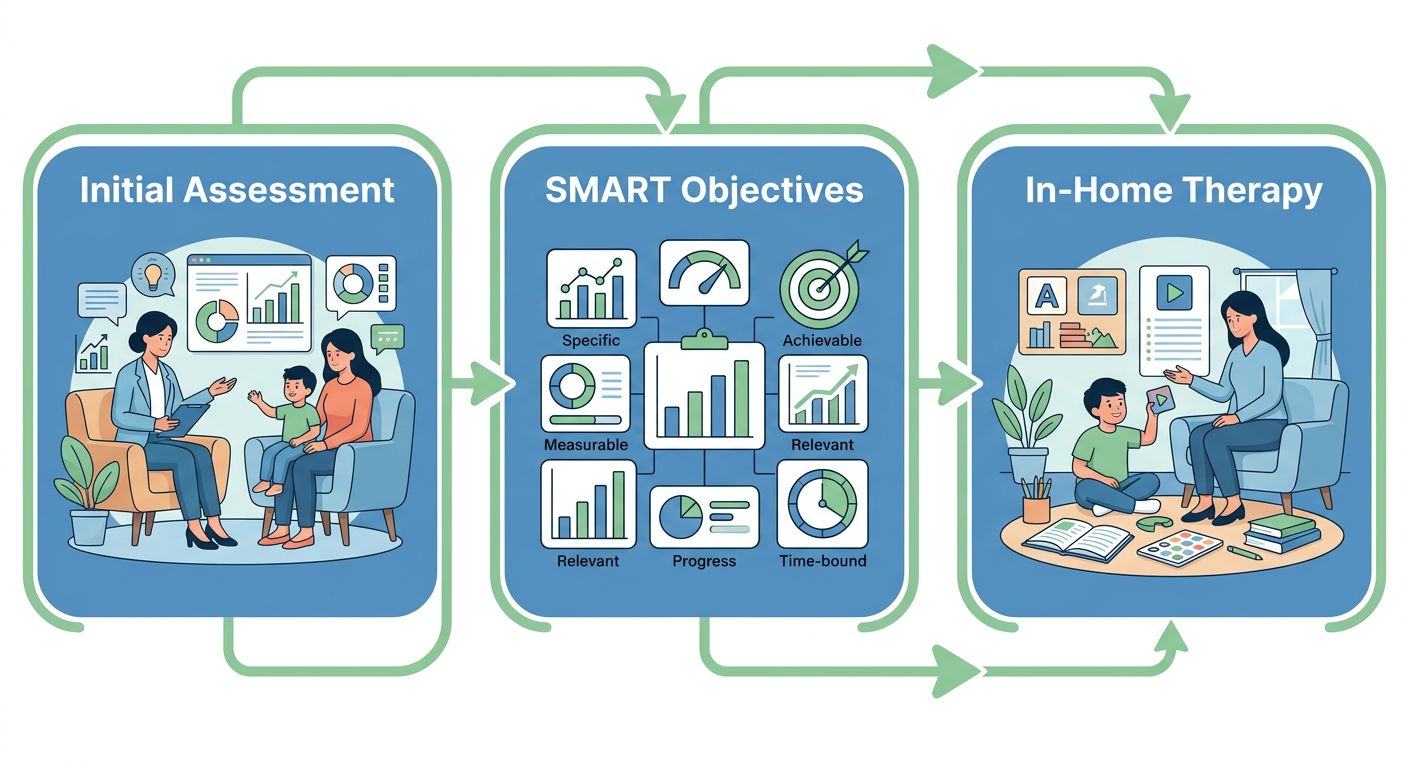
Step-by-step ABA goal-setting process for therapy
The Initial Assessment and Parent Collaboration
Our first step is a comprehensive initial assessment, which we view as a collaborative conversation. We begin with a detailed parent interview to learn about your child’s abilities, daily challenges, and what success looks like for your family. This discussion helps us identify your top priorities, whether it’s improving communication, building social skills, or increasing independence during daily routines.
Simultaneously, our Board Certified Behavior Analyst (BCBA) conducts a preference assessment, using evidence-based practices like paired-choice or free-operant methods, to discover what truly motivates your child. Identifying these powerful reinforcers is critical, as they will be the key to engaging and encouraging your child during therapy. To build a precise baseline, we also administer a skill-based evaluation, such as the VB-MAPP or ABLLS-R, which allows us to map out your child’s current abilities across various developmental domains in a warm and welcoming environment.
Writing SMART Objectives and Selecting Targets
With the assessment complete, our BCBA transforms the findings into precise, actionable SMART objectives. This means every goal is Specific, Measurable, Achievable, Relevant, and Time-bound. A cornerstone of this process involves defining targets with aba therapy operational definitions. For example, instead of a general goal like “improve communication,” we would write an objective such such as, “When presented with a preferred snack, Liam will independently request the item using a three-word phrase (e.g., ‘I want cracker’) in 4 out of 5 opportunities across two consecutive sessions.” This level of clarity ensures every team member measures progress consistently.
Aligning with standards set by the Behavior Analyst Certification Board ensures goals are ethically grounded. We prioritize goals that are socially valid—meaningful for your family’s life—and developmentally ready. Using smart goals in aba therapy, we focus first on skills that enhance safety, communication, and independence, reflecting the power of small steps that lead to lasting, positive change.
Implementing Goals Through In-Home Therapy Sessions
The heart of our program is bringing these carefully crafted goals to life during in-home ABA therapy sessions. Our Registered Behavior Technicians (RBTs) use natural environment teaching to embed goal work right into your family’s everyday routines. A goal for requesting items can be practiced during mealtime, while a goal for following instructions might be woven into a favorite play activity or the process of getting dressed.
This approach capitalizes on the child’s natural motivation and makes learning functional and fun. During these sessions, RBTs diligently collect trial-by-trial data, noting everything from the level of prompting needed to the success of an independent response. Caregiver involvement is integral to our aba therapy goal setting techniques; our RBTs will model strategies for you, and together we will practice them, ensuring skills learned in therapy naturally generalize to all aspects of life at home.
Collaborating with Families and Tracking Milestones
Once the initial assessment and treatment plan are in place, ongoing collaboration with families and careful tracking of milestones ensure the child’s progress remains on track. At Golden Touch ABA Therapy, we believe that a child’s success grows from a partnership between our clinical team and the family, with every decision rooted in data and open communication. This continuous feedback loop directly informs every aspect of a child’s ABA treatment planning, allowing us to refine strategies as the child learns and grows. Our in-home model lets us observe real-world challenges and victories, making progress monitoring a natural, integrated part of each session.
Data-Driven Progress Monitoring and Adjustments
Our Board Certified Behavior Analysts (BCBAs) continuously collect trial-by-trial data during every in-home session, recording specific metrics like frequency, duration, and interval observations to graph progress each week. This detailed tracking creates a visual story of the child’s development, making it easy to spot patterns that guide our decision-making. We rely on well-researched aba therapy goal setting techniques, including the use of smart goals in aba therapy, to frame each objective as specific, measurable, achievable, relevant, and time-bound. According to internal best practices at Golden Touch ABA, if a child demonstrates 80% mastery across three consecutive sessions, we typically move that goal into maintenance and introduce a new challenge. Conversely, if progress plateaus for two weeks, our team analyzes the data to modify the prompting hierarchy or adjust task difficulty. These formal reviews, conducted every three to six months, ensure that the treatment plan evolves right alongside the child’s unique developmental journey.
Empowering Parents Through Training and Involvement
Caregiver involvement is a cornerstone of family-centered care, and we dedicate structured time to equip parents with the tools they need to reinforce learning between sessions. Our parent training programs break down key strategies such as positive reinforcement, prompting hierarchies, and simple data tracking sheets designed for easy home use. A critical part of this training involves teaching families the aba therapy operational definitions we use to describe target behaviors, which ensures everyone on the team observes and responds to actions in the same consistent way. We maintain open lines of communication through weekly check-ins and share comprehensive progress reports during monthly family meetings, celebrating even the smallest victories. By focusing on the power of small steps, our in-home ABA therapy empowers parents to become confident, active participants in their child’s growth, transforming everyday moments into powerful learning opportunities.
Ensuring Generalization and Maintenance of Skills
A skill is only truly mastered when a child can use it naturally across different people, places, and materials, which is why we build generalization strategies directly into every program. As recommended by the Association for Science in Autism Treatment for evidence-based generalization, we practice emerging skills with at least three different people, such as parents, siblings, and visiting relatives, and in two different rooms of the home to prevent rigid, context-dependent learning. Our therapists weave natural environment teaching into routines like mealtime and play, helping new skills feel less like work and more like life. To safeguard long-term success and ensure retention, we conduct maintenance probes at one month, three months, and six months after a goal is mastered, stepping back from continuous intervention to confirm the child can perform the skill independently. This collaborative, data-informed approach builds a strong foundation for long-term success and continuous improvement in every child’s development.
Embracing a Collaborative Path Forward
Bringing everything together, we know that family-centered care is at the heart of successful ABA therapy. Effective aba therapy goal setting techniques depend on the combined efforts of parents, BCBAs, and RBTs, because no one understands a child’s daily life better than the people who share it. At Golden Touch ABA, we value the insights families bring to each session, creating a warm and welcoming environment where every voice matters.
Our ABA treatment planning FAQ outlines how individualized treatment plans are developed collaboratively, integrating a child’s unique strengths and challenges. During initial assessments, families share daily observations and priorities. These conversations help us shape SMART goals that are specific, measurable, achievable, relevant, and time-bound, ensuring they are truly meaningful. In fact, smart goals in aba therapy are most effective when they reflect the real-world needs of the child and family. This collaborative goal planning transforms abstract hopes into concrete therapeutic milestones. Regular data review and family feedback keep goals flexible; as skills are mastered or challenges shift, we adjust the plan together. As the Association for Science in Autism Treatment notes, collaboration is a hallmark of effective ABA therapy.
Through ongoing teamwork, we ensure that each milestone is practical and functional for everyday life. We invite families to partner with us in this shared journey, celebrating the power of small steps and the lasting change they bring.
Resources
- Get Family-Driven ABA Treatment Planning with BCBAs
- Find Structured ABA Treatment Planning by BCBAs
- Learn the ABA Treatment Planning Cycle for Children
- Discover Collaborative ABA Treatment Plans with BCBAs
- Get Individualized ABA Treatment Planning at Home
- Explore In-Home ABA Therapy with SMART Goals
- Monitor ABA Treatment Progress with BCBA Reviews
- Access Free Biomedical Databases and Tools at NCBI
- Find BCBA Certification and Ethics Resources
- Discover Science-Based Autism Treatment Resources
Table of Contents
- Understanding the Role of BCBA Supervision in In-Home ABA Therapy
- The Role of a BCBA in an In-Home ABA Program: Supervision Fundamentals
- How Often Does a BCBA Supervise Home-Based RBT Sessions?
- Verifying Credentials and Understanding RBT Supervision Requirements
- BCBA Supervised Fieldwork: Ensuring Competent Therapy Delivery
- Frequently Asked Questions About BCBA Supervision for Home Therapy
- Empowering Your Child’s Progress Through Quality BCBA Supervision
Understanding the Role of BCBA Supervision in In-Home ABA Therapy
BCBA supervision for home therapy is the ongoing oversight that ensures every in-home ABA therapy session delivers the highest standard of care. At Golden Touch ABA Therapy, a Board Certified Behavior Analyst guides each RBT on your child’s team, verifying that treatment plans are implemented with precision and compassion. This supervisory relationship is the foundation of effective, ethical therapy delivered in a warm and welcoming environment.
Our BCBAs adapt behavioral strategies to the natural rhythms of your home, making everyday moments opportunities for growth. The Behavior Analyst Certification Board establishes clear RBT supervision requirements, mandating that technicians receive a minimum percentage of supervised hours each month to maintain certification. This oversight extends beyond clinical monitoring and includes caregiver training so families feel empowered to reinforce skills between sessions. We believe in the power of small steps, and consistent BCBA supervision for home therapy transforms those steps into meaningful progress.
Through initial assessments, data analysis, and direct observation that mirror the rigor of BCBA supervised fieldwork, our BCBAs refine each child’s individualized plan while upholding evidence-based practices and ethical codes that protect client safety. For families navigating insurance, sessions are categorized under specific ABA therapy CPT codes that reflect the nature of BCBA oversight and direct RBT service delivery. This structure reflects our commitment to family-centered care, where parents and caregivers become active partners in their child’s development. Results may vary; consult a licensed healthcare professional for medical advice.
The Role of a BCBA in an In-Home ABA Program: Supervision Fundamentals
At Golden Touch ABA, we believe that meaningful progress in in-home ABA therapy begins with strong clinical supervision. BCBA supervision for home therapy provides the foundation for everything we do—it shapes how we design programs, support families, and guide our team members toward measurable outcomes. When a family invites us into their home, they are trusting us with something precious, and it is the Board Certified Behavior Analyst who carries the primary responsibility for ensuring that trust is well-placed. This section explores the fundamentals of BCBA supervision, clarifying what a BCBA does, how they collaborate with families, and how their role differs from that of the Registered Behavior Technician.
As the clinical leader of every in-home team, the BCBA serves as both supervisor and program designer. Their work begins long before the first therapy session takes place, starting with a comprehensive behavioral assessment that identifies a child’s strengths, skill deficits, and specific areas of need. Using evidence-based practices, they develop an individualized treatment plan with clear, measurable goals—whether that means improving communication, building daily living skills, or reducing behaviors that interfere with learning. Once therapy is underway, the BCBA monitors progress through ongoing data analysis, making adjustments to teaching strategies and intervention protocols as the child grows and changes. This continuous cycle of assessment, planning, and refinement ensures that every hour of therapy remains purposeful and aligned with the family’s priorities.
The following table highlights the key differences between these two essential roles on the therapy team.
| Aspect | BCBA | RBT |
|---|---|---|
| Role | Supervisor and program designer | Implementer under supervision |
| Qualifications | Master’s degree + BCBA certification | High school diploma + RBT certification |
| Responsibilities | Assess, plan, monitor progress | Deliver therapy, collect data |
| Supervision ratio | Directs and trains RBTs | Receives supervision from BCBA |
This distinction matters because both professionals bring complementary strengths to the team. The RBT works directly with the child day to day, delivering the therapy sessions and collecting real-time data on skill acquisition and behavior. The BCBA, in turn, analyzes that data to evaluate whether the program is working and provides hands-on training to ensure the RBT is implementing procedures correctly. Understanding the ABA practitioner requirements for each role helps families appreciate the depth of expertise supporting their child’s progress.
To become a BCBA, an individual must earn a master’s degree in behavior analysis or a closely related field and complete bcba supervised fieldwork under the guidance of a qualified supervisor. This intensive clinical training typically involves 1,500 to 2,000 hours of hands-on practice, during which the trainee learns to conduct assessments, write treatment plans, and oversee direct implementation. After completing the required fieldwork, candidates must pass the national certification examination administered by the Behavior Analyst Certification Board, or BACB. This rigorous process ensures that every BCBA possesses the clinical judgment necessary to handle the complexity and nuance of autism intervention in real-world settings.
The rbt supervision requirements are similarly structured but designed as an entry-level pathway. An RBT must be at least 18 years old, hold a high school diploma, and complete a 40-hour training program covering foundational ABA principles, ethical conduct, and skill-building techniques. A BCBA then directly observes the candidate performing essential tasks—such as collecting data, implementing behavior reduction plans, and following session protocols—through a hands-on competency assessment. Once certified, the RBT must receive ongoing supervision from a BCBA at least five percent of the total hours they spend delivering therapy each month, a standard established and enforced by the BACB to safeguard treatment quality.
What makes our approach at Golden Touch ABA especially meaningful is the emphasis on family-centered care. BCBA supervision extends well beyond the child alone—it involves regular caregiver training sessions where parents learn the same reinforcement and prompting strategies used during therapy. We collaborate with families to set goals that reflect their daily routines and long-term aspirations, whether that means mastering toothbrushing before bedtime, ordering a meal at a restaurant, or joining a sibling in a play activity. By embedding treatment within the natural environment of the home, we honor the power of small steps taken consistently over time, and we see the warm and welcoming environment of the family’s own space as the ideal setting for lasting change.
BCBA supervision also plays a critical role in upholding treatment fidelity. When an RBT implements a skill acquisition program or a behavior intervention plan, the BCBA periodically observes sessions—either in person or through secure video review—to verify that the techniques are being delivered as designed. If drift occurs, the BCBA provides immediate feedback, modeling the correct procedure and offering practical coaching until the RBT reaches competency. This ongoing oversight protects the integrity of the program and gives families confidence that their child is receiving high-quality care rooted in evidence-based practices.
Looking ahead to how these roles function day to day, it is important to recognize that the BCBA and RBT operate as a collaborative unit. The BCBA sets the direction, but the RBT is the person who turns that vision into hundreds of teachable moments each week, whether during play, snack time, or community outings. In our next section, we will examine the specific responsibilities of the RBT, exploring how they carry out the BCBA’s carefully crafted plan and contribute their own insights to the ongoing evolution of treatment. Results may vary for each child, and we encourage families to consult a licensed healthcare professional for guidance specific to their situation.
How Often Does a BCBA Supervise Home-Based RBT Sessions?
Now that you understand who provides therapy, let’s look at how often a BCBA supervises these sessions. BCBA supervision for home therapy is a cornerstone of quality in-home ABA, ensuring that your child’s program stays effective and that your RBT receives the guidance needed to deliver consistent, evidence-based care. We design supervision schedules around your family’s needs while following professional standards, so you can feel confident that oversight is both structured and responsive.
Direct in-home observation typically occurs weekly or bi-weekly. The Behavior Analyst Certification Board recommends that a BCBA provide at least 5% of the total hours an RBT spends delivering therapy—meaning BCBA supervision for home therapy includes regular on-site visits where we watch sessions, model techniques, and give immediate feedback. This hands-on approach helps maintain rbt supervision requirements and ensures treatment fidelity. Telehealth supervision is often conducted weekly as well and can supplement direct visits, giving us flexibility to check in between in-person observations while still meeting ABA practitioner requirements.
The purpose of this oversight goes beyond compliance: we use supervision to support RBT skill development, adjust intervention strategies in real time, and keep you, the family, fully informed. Whether we’re in your living room or connecting through a secure video call, our focus remains on creating a warm, collaborative environment where progress is celebrated. The following table compares the two main supervision methods we use:
| Method | Frequency | Requirements | Benefits |
|---|---|---|---|
| Direct in-home observation | Typically weekly or bi-weekly | BACB recommends at least 5% of RBT hours | Hands-on interaction, immediate feedback |
| Telehealth supervision | Often weekly, can supplement direct | Allowed per BACB; state-specific regulations | Flexibility, reduced travel time |
Direct observation lets us see your child’s natural routines and gives us the chance to coach the RBT in the moment, which is why many families prefer this in-person connection. Telehealth supervision adds another layer of support—when schedules get tight or a quick check-in is needed, we can observe via video and still meet the bcba supervised fieldwork standards that guide our profession. State regulations and individual insurance policies influence the exact balance, but most clients experience a blend of these two methods.
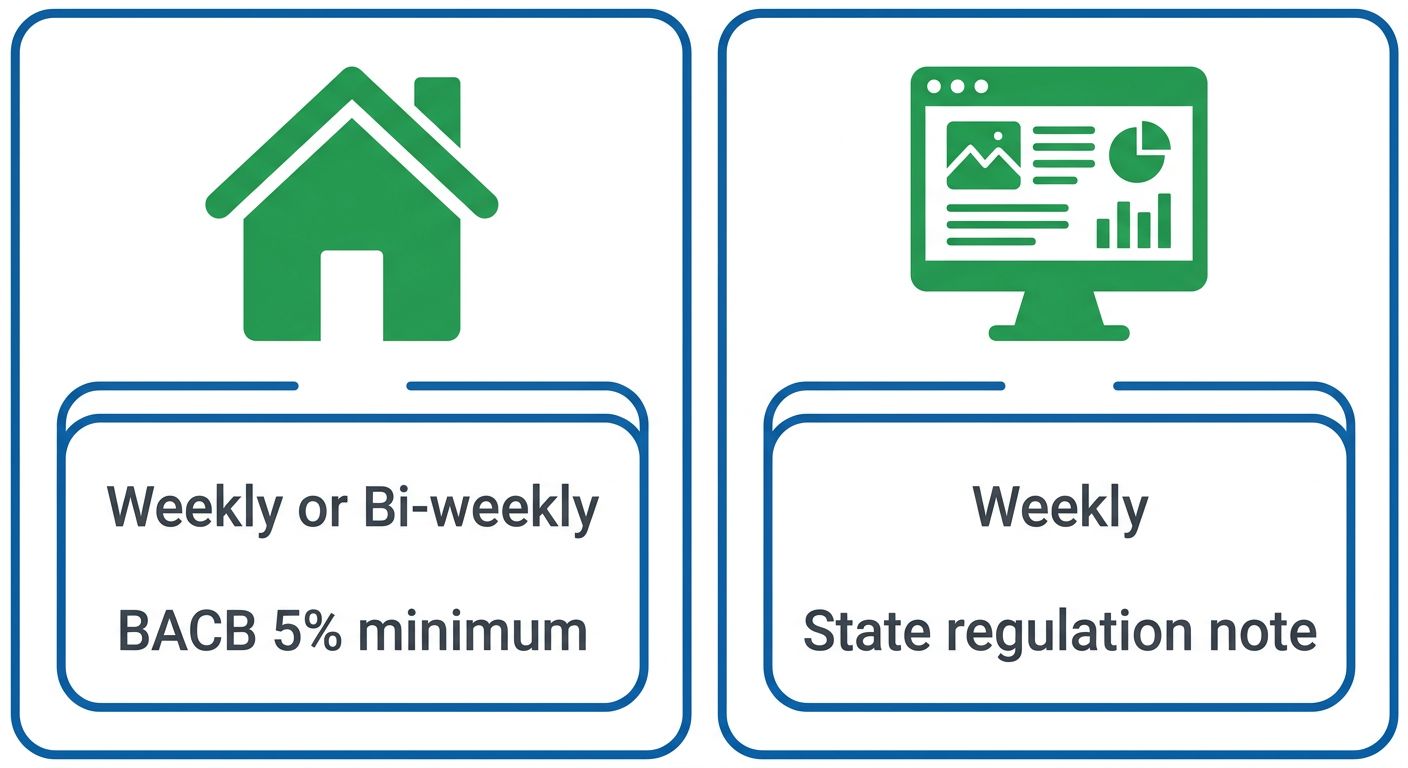
Comparison of in-home vs telehealth BCBA supervision frequency.
We schedule supervision based on more than just BACB minimums. Your BCBA considers your child’s treatment goals, the complexity of the behavior plan, and input from you and the RBT when determining how often to visit. Insurance providers also play a role, as they may stipulate certain supervision benchmarks. Because of these variables, we avoid guaranteeing a fixed frequency. Instead, we stay flexible and transparent, adjusting oversight as your child progresses and as your family’s circumstances change. As an organization rooted in family-centered care, we believe that BCBA oversight should feel like a partnership—we are here to listen, explain, and adapt.
You can expect consistent communication from your supervising BCBA whether the session is in person or remote. Many families ask how often they should see their BCBA, and while weekly or bi-weekly contact is common, we tailor the rhythm to what works best for you. This supervision structure ensures high-quality care; keep reading to learn what qualifications your BCBA should have.
Verifying Credentials and Understanding RBT Supervision Requirements
When you choose in-home ABA therapy for your child, understanding BCBA supervision for home therapy is crucial to ensuring your child receives safe, quality care. At Golden Touch ABA, we believe that transparency around qualifications builds trust, so we encourage families to verify the credentials of the professionals who will work with them. This section walks you through how to confirm a BCBA’s certification and explains the supervision standards that Registered Behavior Technicians (RBTs) must meet.
How to Verify a BCBA’s Credentials for Your Child’s Care
Verifying a BCBA’s credentials is a straightforward process that ensures your child’s therapist has the required training and ethical standing. Begin with the official Behavior Analyst Certification Board (BACB) registry. Here’s a step-by-step guide:
- Visit the BACB website and locate the certificant registry search tool.
- Enter the BCBA’s full name or certification number into the search fields.
- Review the search results to confirm that the BCBA holds an active, current certification — look for the BACB certification status and expiration date.
- Verify that the certificant is in good standing with no disciplinary actions or inactive status.
- For an extra layer of assurance, check that the BCBA meets any state-specific licensure requirements, as some states require additional credentials beyond BACB certification. You can usually find this by searching your state’s behavior analyst licensing board website.
At Golden Touch ABA, every supervising BCBA holds an active BACB certification and undergoes rigorous internal review. We invite you to ask us for certification details — it’s part of our commitment to family-centered care. The BACB registry is the authoritative source for verifying that your child’s supervising professional has met the national standards for behavior analysis. Taking these steps helps you feel confident that the person overseeing your child’s therapy has the expertise needed to design and monitor an effective in-home program. State licensure may require an additional verification; always confirm that your provider complies with local regulations. Remember, a BCBA who is certified but also licensed in your state offers an extra level of oversight and adherence to local professional standards.
Now that you understand how to check credentials, let’s examine the supervision requirements that ensure RBTs deliver therapy with continuous professional oversight.
RBT Supervision Requirements: What Parents Should Know
The BACB establishes specific RBT supervision requirements to maintain quality and safety in ABA therapy. At Golden Touch ABA, we follow these mandates closely because we know that consistent supervision directly impacts your child’s progress. The core standard: at least 5% of the RBT’s total service hours each month must include direct observation by a qualified BCBA. This observation can occur in person or via live video review, and it must happen regularly — not clustered into one day. For example, an RBT providing 20 hours of therapy per week would need at least one hour of direct BCBA observation each week.
Supervision goes beyond simple observation. It involves several components that together ensure the RBT applies the treatment plan faithfully and adapts when needed:
- Direct in‑person observation: The BCBA watches the RBT work with your child in the home, noting technique and interaction.
- Video review: For remote oversight or when in-person visits aren’t possible, the BCBA reviews recorded sessions to assess fidelity.
- Feedback meetings: After observation, the BCBA meets with the RBT to discuss strengths, areas for improvement, and any adjustments to the behavior plan.
- Performance evaluations: Periodic formal reviews track the RBT’s development and ensure they meet all competency standards, including BCBA supervised fieldwork hours when applicable.
Our team integrates these activities into a structured supervision schedule so that every RBT receives ongoing, meaningful guidance. We encourage parents to ask about supervision logistics when selecting a provider — questions like “How often will a BCBA observe my child’s session?” or “What does a typical feedback session look like?” can reveal a lot about a practice’s commitment to quality. At Golden Touch ABA, we make sure our BCBAs are intimately involved in your child’s care, not just occasional visitors. We structure our in-home programs so that every family benefits from robust BCBA supervision for home therapy.
Understanding these credentialing and supervision standards puts you in a stronger position to advocate for your child. In our next section, we’ll explore what a typical ABA therapy session looks like in your home, from the initial assessment to ongoing skill building. Please remember that therapy outcomes vary and you should consult a licensed healthcare professional for a medical diagnosis or personalized advice.
BCBA Supervised Fieldwork: Ensuring Competent Therapy Delivery
BCBA supervision for home therapy is the cornerstone of quality assurance at Golden Touch ABA. We call it BCBA supervised fieldwork — the ongoing clinical oversight that ensures every therapy session aligns with your child’s individualized treatment plan. This process maintains fidelity to evidence-based practices while creating a warm and welcoming environment where families feel supported and informed. We document supervisory feedback and progress notes to ensure continuity of care and clear communication regularly.
Our ongoing clinical supervision meets and exceeds the standards set by the Behavior Analyst Certification Board (BACB). Under these requirements, a BCBA must directly observe a meaningful portion of therapy hours each month and conduct regular face-to-face meetings with RBTs. This monitoring catches technique drift immediately, keeping every interaction effective and ethical. Supervisors review session data, adjust goals as needed, and coach RBTs on subtle behavioral strategies so interventions remain tailored and measurable. According to Golden Touch ABA’s clinical protocols, such rigorous oversight is central to our family-centered care model.
Because we deliver in-home ABA therapy, fieldwork supervision takes place right where your child lives and plays. Our BCBAs model strategies in real-life situations, turning parents into confident partners. In the home setting, we practice skills in daily routines to generalize learning and empower families to reinforce progress. RBT supervision requirements include direct coaching during sessions, where BCBAs review behavior plans and offer instant feedback, so your therapy team works as a unified, highly skilled unit.
Families experience the power of small steps: every milestone builds on expert guidance. While each journey is unique, this layered supervision keeps treatment dynamic, responsive, and always rooted in the best available research.
Results may vary; consult a licensed professional for diagnosis or treatment decisions.
Frequently Asked Questions About BCBA Supervision for Home Therapy
After learning about the essential role of bcba supervision for home therapy, families often have questions about how this process works within their daily routine. We provide clear answers to help you feel confident and informed.
What is BCBA supervision for home therapy?
Our Board Certified Behavior Analyst oversees every aspect of your child’s in-home ABA therapy program, ensuring it is personalized and effective. This clinical direction guarantees that teaching strategies are implemented correctly and adapted as your child progresses.
How often does a BCBA supervisor visit during in-home ABA?
The frequency of supervision sessions aligns with rbt supervision requirements and typically includes regular in-person and remote check-ins. We adjust the schedule to fit your family’s needs while maintaining the highest standard of clinical oversight.
What are the requirements for BCBA supervision in an in-home setting?
BCBAs complete extensive graduate education and hands-on training through bcba supervised fieldwork before earning their credential. Our supervisors bring this rigorous experience into your home, coordinating directly with your child’s therapist.
How does BCBA supervision benefit my child and their RBT?
Ongoing BCBA oversight provides your RBT with real-time feedback and in-the-moment training, creating a warm and welcoming environment for learning. This collaborative model supports our family-centered care philosophy and helps your child build skills faster.
Can BCBA supervision be conducted remotely or does it require in-person visits?
We use a hybrid model that combines in-person visits with secure remote observation to offer flexible support. This ensures we can maintain consistent supervision regardless of daily schedules or location challenges.
As a core piece of our evidence-based practices, regular BCBA oversight connects every small success to the power of small steps. This seamless clinical support prepares your family to confidently move toward discussing insurance and next steps with our team.
Empowering Your Child’s Progress Through Quality BCBA Supervision
BCBA supervision is the professional oversight provided by a Board Certified Behavior Analyst who guides your child’s in-home therapy and tracks meaningful progress. Through careful, data-informed adjustments and the direct involvement of our clinical team, each session evolves to support your child’s individual needs.
At Golden Touch ABA, we pair every family with a dedicated BCBA who designs a truly individualized treatment plan. An RBT implements that plan right in your home under close BCBA guidance during home-based therapy, ensuring every small step forward is celebrated. This collaborative, evidence-based approach helps create measurable growth while honoring the power of family-centered care, without promising any specific outcome. It naturally sets the stage for the way our RBTs deliver those thoughtfully crafted plans.
Resources
- Understand ABA Therapy Billing Units and CPT Codes
- Discover ABA Practitioner Requirements and Supervision Standards
- Discover the RBT Certification Process and Requirements
- Compare ABA Practitioner Tiers: RBT, BCaBA, and BCBA
- Discover RBT Training Aligned with BACB Task List
- Compare BCBA and RBT Roles and Training Requirements
- Explore Certification Paths for RBT and BCBA Practitioners
- Explore BACB Certification Requirements and Professional Resources
Table of Contents
- Personalized ABA Therapy in Arizona for Your Child
- Arizona Communities We Serve
- In-Home ABA Therapy Coverage and Insurance Options in Arizona
- Local Expertise: Registered Behavior Technicians and Family Support in Arizona
- Starting ABA Therapy with Golden Touch in Arizona
- Supporting Arizona Families Through In-Home ABA Therapy
Personalized ABA Therapy in Arizona for Your Child
If you’re searching for aba therapy Arizona families rely on, Golden Touch ABA is here to help. We deliver personalized ABA therapy that adapts to your child’s unique strengths and challenges. Our plans are rooted in compassionate, evidence-based care and take place in the place your child feels safest—home.
In-home ABA therapy creates a warm and welcoming environment where children learn naturally. Our in-home ABA therapy in Arizona is delivered by experienced Board Certified Behavior Analysts (BCBAs) and compassionate Registered Behavior Technicians (RBTs). They embrace the power of small steps, breaking goals into manageable wins that build confidence. Throughout the process, we provide caregiver training, assist with insurance, and offer flexible scheduling options. We partner with you every step of the way because family-centered care is at the heart of everything we do.
Explore our interactive ABA roadmap tool to chart a personalized path forward—and please keep in mind that individual results vary and are not guaranteed.
Arizona Communities We Serve
Beyond our general services, we are proud to bring in-home ABA therapy to families across Arizona. Our goal is to provide compassionate, family-centered care in every community we touch, making ABA therapy arizona families rely on both accessible and effective. We currently offer support in several key areas, and you can find detailed information about all of our ABA therapy locations.
We believe that a warm and welcoming environment is crucial for a child’s growth, which is why we deliver all our services within the comfort of your own home. Our approach, built on evidence-based practices and the philosophy of “The power of small steps,” ensures that every child receives a treatment plan tailored to their unique needs.
The following table provides a quick overview of our primary Arizona service areas:
| Service Area | In-Home Therapy | BCBA Supervision |
|---|---|---|
| Phoenix Metro | Yes | Available |
| Tucson | Yes | Available |
| Flagstaff | Yes | Available |
This consistent availability across Arizona means that families in these communities can expect the same high standard of care. Each of our core service areas—
- The Phoenix Metro area
- Tucson
- Flagstaff
—is supported by experienced Board Certified Behavior Analysts and Registered Behavior Technicians who are dedicated to fostering meaningful progress. BCBA supervision is a cornerstone of our program, ensuring that every therapy plan is guided by expert oversight and aligns with professional standards recognized by the Arizona Association for Behavior Analysis.
Now that you know where we serve, let’s explore how our therapy works and what you can expect from our dedicated team.
In-Home ABA Therapy Coverage and Insurance Options in Arizona
Understanding your insurance benefits is a critical step when arranging in-home ABA therapy for your child. At Golden Touch ABA Therapy, we know that navigating coverage can feel overwhelming, so we offer dedicated support to families seeking aba therapy arizona services. We help you explore your options, whether you have a commercial plan, employer-sponsored insurance, or state-funded coverage through Medicaid aba therapy arizona.
Our team provides complimentary insurance assistance and benefits-eligibility support. The process begins with a free benefits check, where we contact your insurance provider to verify your aba insurance arizona details and explain any applicable co-pays or deductibles. Many families use this step to confidently understand their in-home aba therapy coverage arizona before committing to an assessment.
We commonly work with:
- Arizona’s Medicaid program (AHCCCS)
- Tricare
- Major commercial insurance plans
For additional advocacy and professional standards information, the Arizona Association for Behavior Analysis (AzABA) is a valuable industry resource.
Families exploring behavioral health insurance or autism therapy coverage should know that actual benefits vary by plan. Insurance coverage is subject to verification and is not guaranteed. We encourage you to contact our Arizona team directly for a personalized eligibility assessment and custom quote and ongoing support throughout the process.
Local Expertise: Registered Behavior Technicians and Family Support in Arizona
For those seeking aba therapy Arizona, finding a provider with deep local roots and a dedicated clinical team makes all the difference. Golden Touch ABA Therapy delivers in-home ABA therapy through multiple locations across the state, bringing personalized support directly to families in their own homes.
Our therapy sessions are implemented by Registered Behavior Technicians (RBTs), certified professionals who work under the close supervision of Board Certified Behavior Analysts (BCBAs). The behavior analyst certification board establishes the rigorous certification requirements and ethical standards that govern RBT practice nationwide. We believe family involvement is key to lasting progress. Our family-centered approach includes caregiver training and collaboration, ensuring parents have the tools to reinforce skills between sessions. This partnership typically includes:
- Caregiver coaching on reinforcement strategies
- Regular progress updates and collaborative goal setting
Our local Arizona team understands the unique needs of families in our communities. We are committed to evidence-based practices delivered in a warm and welcoming environment, helping children build skills that last. Our experienced team guides you through every step, from initial questions to insurance verification. We would be happy to help — please contact us to learn more. Results may vary, and insurance coverage is subject to verification and is not guaranteed.
Starting ABA Therapy with Golden Touch in Arizona
Taking the first step toward ABA therapy in Arizona is simpler than you might expect. At Golden Touch ABA, we’ve designed our intake process to be welcoming and straightforward, guiding your family from that initial phone call to the first in-home session with warmth and clarity. We believe in creating a warm and welcoming environment from the very first conversation, answering your questions and helping you feel supported every step of the way.
Our services are delivered right in your home, where your child feels most comfortable. We proudly provide in-home ABA therapy to families across Arizona, including Phoenix, Benson, and the surrounding communities. Every session is led by a dedicated Board Certified Behavior Analyst (BCBA) — the clinician who designs and oversees your child’s plan — and implemented by a compassionate Registered Behavior Technician (RBT), who works directly with your child.
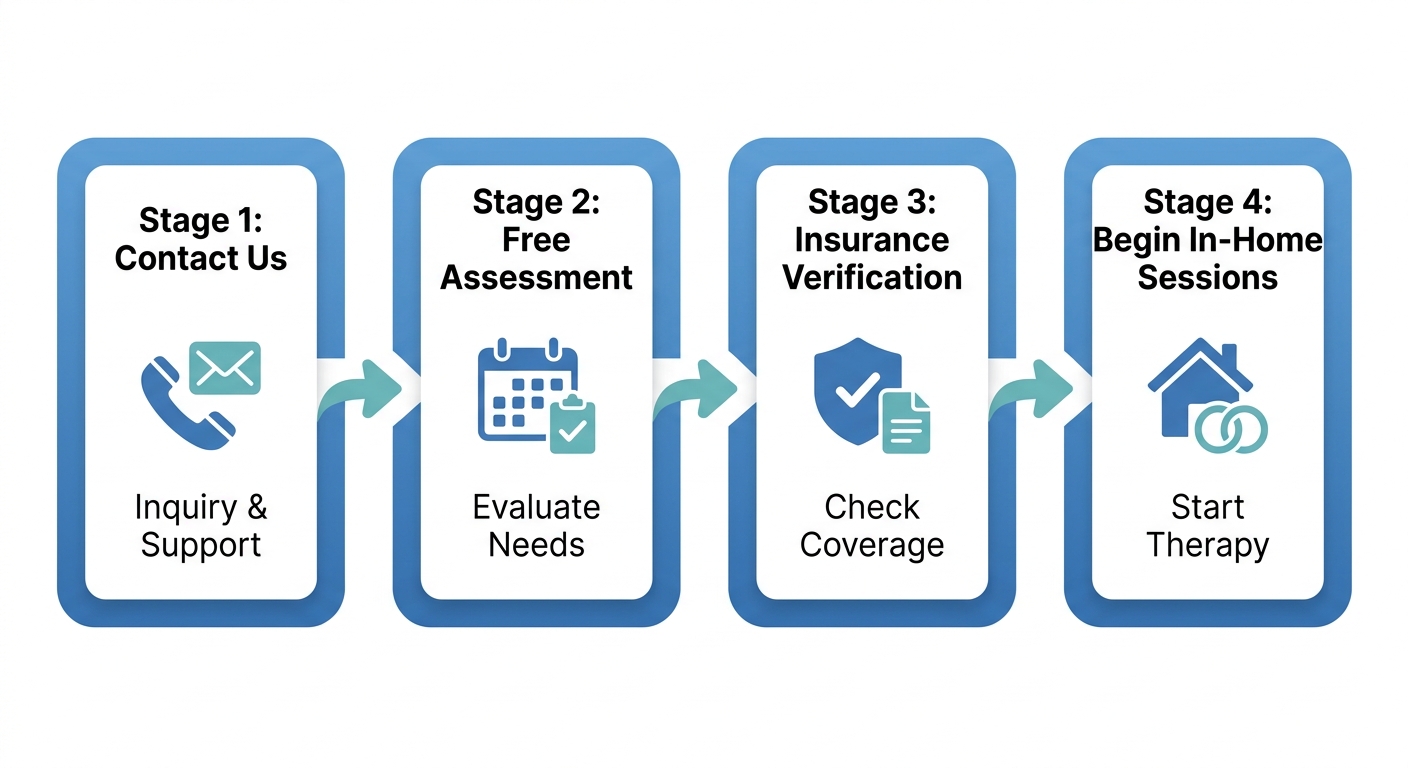
Four-step process to begin in-home ABA therapy with Golden Touch in Arizona.
Beginning ABA services in Arizona follows a clear, four-step path:
- Contact Us: Reach out via our online form or call us at 480-470-3014. A friendly team member will listen to your needs and schedule a time to talk.
- Free Assessment: We conduct a no-cost, no-obligation initial consultation to understand your child’s strengths and goals. This family-centered care approach ensures our planning includes your insights and priorities.
- Insurance Verification: We navigate the paperwork for you. Our team helps verify your insurance benefits and check eligibility, including Medicaid, so you can focus on what matters most—your child.
- Start of Therapy: An individualized, evidence-based treatment plan is created and in-home sessions begin on a schedule that works for your family.
While our hearts are firmly rooted in serving Arizona families, we also extend our reach to other communities. For instance, Golden Touch provides ABA therapy in Emigration Canyon, Utah, bringing the same dedicated, in-home support to that region. Once therapy begins here in Arizona, our team continuously monitors progress and adjusts the plan, fostering growth through the power of small steps, a journey we’ll explore in more detail next.
Supporting Arizona Families Through In-Home ABA Therapy
Expanding on ABA therapy’s benefits, we now highlight how we bring in-home ABA therapy to families across Arizona. We create a warm and welcoming environment in your home, where your child can thrive. Our family-centered care approach partners you with BCBAs and RBTs who champion the power of small steps every day. We also offer insurance and benefits eligibility support to ease your journey.
Resources
- Get In-Home ABA Therapy for Autism in Arizona
- Find ABA Therapy Services in Arizona, Maryland, Utah
- Get ABA Therapy Services in Emigration Canyon Utah
- Home-Based ABA Therapy in Eagle Mountain Utah
- Autism Therapy in Washington Terrace Utah
- Learn About Golden Touch ABA Therapy Approach
- Find In-Home ABA Therapy in Maryland
- Explore Professional Behavior Analysis in Arizona
- Get Behavior Analyst Certification Board Resources
