
Autism Insurance Mandate Explained: Essential 2026 Guide
Table of Contents
- Navigating Autism Insurance Mandates for ABA Therapy Coverage
- What Is an Autism Insurance Mandate and Why It Matters
- How State Insurance Mandates Interact with Federal Laws: ERISA and More
- Practical Steps to Determine Your ABA Therapy Insurance Coverage
- Understanding Medical Necessity and Documentation for ABA Therapy
- Common Questions About Autism Insurance Mandates Answered
- Securing the ABA Coverage Your Child Deserves
Navigating Autism Insurance Mandates for ABA Therapy Coverage
An autism insurance mandate is a state-level law that requires certain health insurance plans to cover treatments for autism spectrum disorder, including Applied Behavior Analysis (ABA) therapy. These laws are crucial for families, as they can significantly reduce the financial burden of intensive behavioral health services. According to advocacy organizations like Autism Speaks, a majority of states have enacted some form of mandate, but the specifics of ABA therapy insurance coverage vary widely depending on where you live.
While these laws provide a strong foundation, it is essential to understand that a state mandate does not guarantee your child’s coverage. Plans that are self-funded (often provided by large employers) are regulated by federal rather than state law and are not subject to state mandates. We always encourage families to view a mandate as a powerful tool rather than a promise, and we emphasize that careful verification is the first and most important step on your journey.
The key to unlocking your benefits often lies in demonstrating medical necessity. This is typically documented through a comprehensive diagnostic evaluation and a detailed treatment plan from a licensed professional. At Golden Touch ABA, our team focuses on creating thorough, evidence-based assessments that help showcase the medical necessity of our family-centered care. To navigate this process, we recommend taking these practical steps:
- Contact your insurance provider directly to ask about specific ABA therapy benefits under your plan.
- Request a written summary of benefits and coverage limits, including any age caps or annual visit restrictions.
- Work with your clinician to provide a detailed prescription and a treatment plan that clearly outlines the medical necessity for ABA therapy.
- Inquire about pre-authorization requirements, as many plans require approval before starting services.
Verifying your unique benefits is essential because coverage is subject to verification and is not guaranteed, even with a mandate in place. Our dedicated team is experienced in helping families in the Salt Lake City area and beyond navigate these often complex insurance landscapes. If you are exploring your options for in home ABA therapy in Utah, we can assist you with the benefit verification process, so you can focus on what matters most: celebrating the power of small steps with your child.
What Is an Autism Insurance Mandate and Why It Matters
An autism insurance mandate is a state law that requires certain health insurance plans to cover the diagnosis and treatment of autism spectrum disorder. According to Autism Speaks, these laws were created because insurance companies historically excluded autism treatments, labeling them as experimental or not medically necessary. This left many families to shoulder the full cost of essential care on their own.
These mandates specifically require coverage for evidence-based therapies, making ABA therapy insurance coverage a reality for thousands of children. Most mandate laws cover Applied Behavior Analysis (ABA) therapy, along with diagnostic assessments and treatment planning. However, the details vary significantly from state to state. For instance, Arizona’s mandate covers ABA therapy up to age 16, while Maryland offers broader protections through age 21. Utah has a more limited mandate, covering ABA therapy only up to age 9. Many mandates also require a demonstration of ABA therapy medical necessity—documentation from a doctor or psychologist confirming that the treatment is essential for the child’s development.
Why does this matter for your family? Without a mandate, an insurer may deny coverage for ABA therapy, forcing you to pay entirely out-of-pocket or, heartbreakingly, to forgo treatment. These laws help families access family-centered care, allowing children to receive the support they need in their own homes. An insurance mandate for autism can dramatically lower the financial barriers to early intervention, which is critical for long-term progress.
Of course, state-level autism insurance requirements are not universal. These laws generally apply to state-regulated insurance plans; some self-funded employer plans are exempt under federal ERISA rules. This creates a patchwork of coverage across the country.
State Autism Insurance Mandates at a Glance
The following table illustrates how autism insurance mandates can differ, using three states where we provide in-home ABA therapy as an example.
| State | Mandate Coverage Age Limit | Services Covered | Year Enacted |
|---|---|---|---|
| Arizona | Up to age 16 | ABA therapy, diagnosis, treatment plans | 2008 |
| Maryland | Up to age 21 | ABA therapy, speech, occupational therapy | 2015 |
| Utah | Up to age 9 (limited mandate) | ABA therapy (limited coverage) | 2011 |
Note: This information is for illustrative purposes. Coverage is subject to verification and may vary by plan. Contact your insurance provider for specific details.
Understanding these differences is the first step in navigating your options. For families in states with limited mandates, such as those seeking out of network ABA therapy in Utah, we can help you explore all available paths to care.
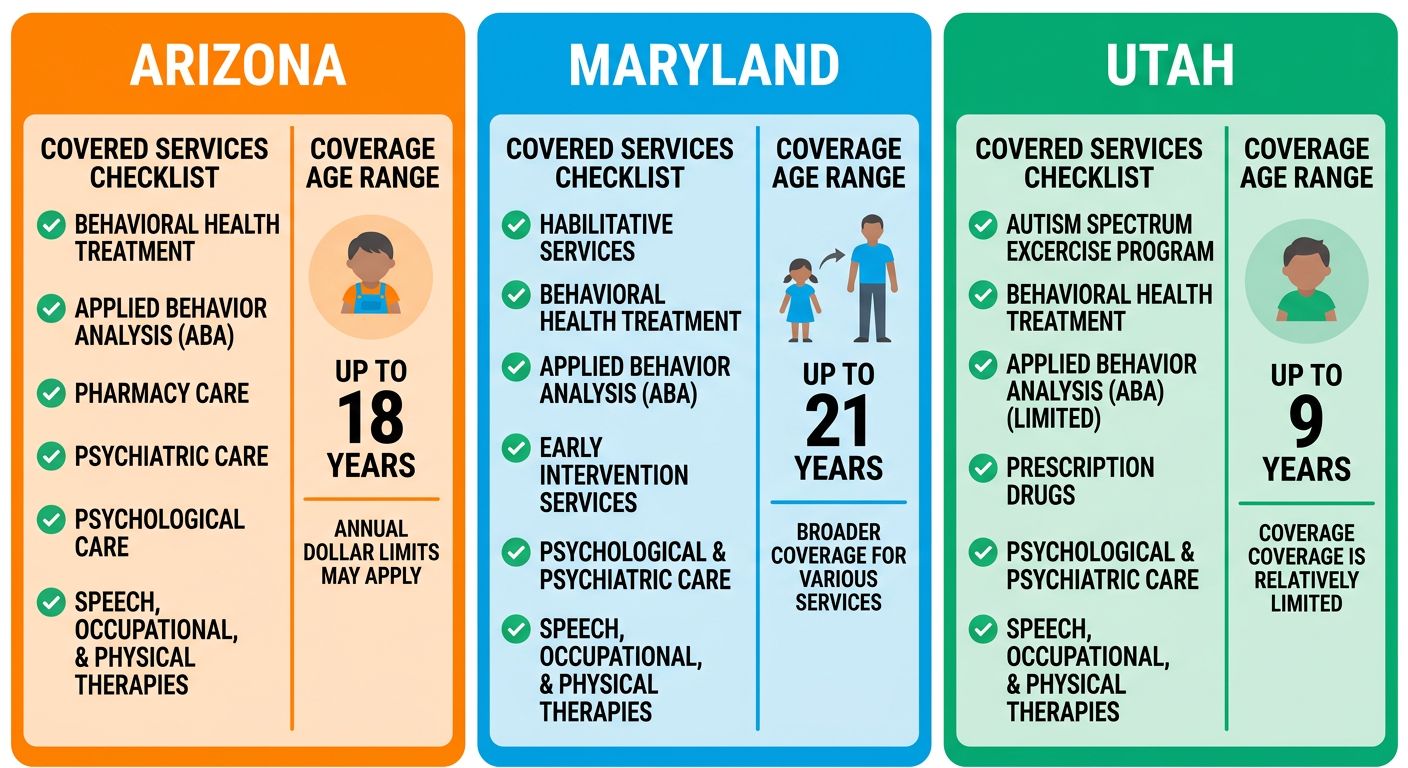
State autism insurance mandates at a glance for Arizona, Maryland, and Utah
We believe in the power of small steps. Verifying your benefits is the first small step toward unlocking the life-changing support your child deserves. Remember, insurance coverage is subject to verification and is not guaranteed. We’re here to help you understand your benefits so you can focus on what matters most: your family.
Consult a licensed healthcare professional for diagnosis or medical advice.
How State Insurance Mandates Interact with Federal Laws: ERISA and More
Many states have enacted an autism insurance mandate to help families access evidence-based therapy. But if you have a health plan through a large employer, you might be surprised to learn that federal law can override those state protections. That’s where ERISA comes in, and understanding the difference between plan types is the key to unlocking your coverage.
ERISA Plans and State Mandate Exemptions
ERISA, or the Employee Retirement Income Security Act of 1974, is a federal law that sets minimum standards for most voluntarily established health plans. When a company decides to pay employees’ medical claims directly rather than buying traditional insurance, the plan is called self-funded or self-insured. Because these plans are regulated by the U.S. Department of Labor under ERISA, they are generally exempt from state insurance mandates—including the autism insurance mandate your state may have passed. In other words, even if your state requires coverage for autism treatment, a self-funded plan isn’t legally obligated to follow that rule. That said, many self-funded plans still choose to include autism benefits because employers value robust coverage. The critical point is that the protection is voluntary, not a legal requirement. As Golden Touch ABA emphasizes, this distinction is the foundation of understanding your coverage options.
The following table breaks down the differences between state-regulated and self-funded plans so you can quickly identify where your policy stands.
| Plan Type | Regulated By | Must Follow State Autism Mandate? | Key Consideration |
|---|---|---|---|
| State-Regulated (Fully Insured) | State Insurance Department | Yes, must comply with state mandates if applicable | Coverage varies by state; check state laws |
| Self-Funded (ERISA) | Federal ERISA (Department of Labor) | Generally no, exempt from state mandates | Check plan document; may offer different autism coverage |
Reference: ERISA guidelines, Department of Labor
While a self-funded plan is not required to honor your state’s mandate, it doesn’t automatically mean there’s no autism coverage. Many employers still include behavioral health benefits, and the plan document is the final word. The Autistic Self Advocacy Network encourages families to be proactive about plan transparency, and we’re here to help you sort through the details.
Checking Your Plan Type
Figuring out whether your plan is state-regulated or self-funded takes just a few practical steps. Start by asking your company’s human resources department or benefits administrator directly, “Is our health plan self-funded or fully insured?” If you have your summary plan description or benefits booklet, look for keywords like self-funded, self-insured, or ERISA plan. A statement that the plan is “not subject to state regulation” is another clear sign of a self-funded arrangement. When you’re reviewing documents, also pay attention to ABA therapy insurance coverage language—even self-funded plans often have a behavioral health section that outlines autism services. If you’re unsure, we can help you verify your plan details during the insurance assistance process.
Implications for In-Home ABA Therapy
Whether your child receives in-home ABA therapy with a Board Certified Behavior Analyst (BCBA) and Registered Behavior Technicians (RBTs) often hinges on your plan type. If you have a fully insured plan, the state autism insurance mandate typically requires coverage for medically necessary ABA services, which can include home-based sessions. If your plan is self-funded, the coverage picture depends entirely on the employer’s chosen benefits. You may still have access to ABA therapy, but the specific criteria—such as demonstrating ABA therapy medical necessity through a comprehensive assessment—are defined by the plan, not by state law. For example, if your plan is fully insured and you are considering an out-of-network provider, check whether out of network ABA therapy in Utah is covered. Knowing your plan type is the first step to securing coverage for in-home ABA therapy. Our insurance assistance team at Golden Touch ABA Therapy can help you verify your benefits and understand what’s available under your unique plan. Please remember, insurance coverage is subject to verification and is not guaranteed.
Practical Steps to Determine Your ABA Therapy Insurance Coverage
At Golden Touch ABA Therapy, we understand that navigating your child’s insurance benefits can feel overwhelming, but taking a methodical approach makes the process much more manageable. By following a few clear steps, you can gain a clearer picture of what your plan covers and how to access the high-quality ABA therapy our team provides in a warm and welcoming environment.
Review Your Insurance Policy
The first practical action is to confirm whether your plan includes an autism insurance mandate, because this state-level requirement often sets the baseline for aba therapy insurance coverage. Start by locating your plan’s official Summary of Benefits and Coverage (SBC) — you can usually download it from your insurer’s online portal or request a printed copy.
Follow these steps to review your policy:
- Open the SBC and search for terms such as “applied behavior analysis,” “autism treatment,” or “behavioral health therapy.” Many plans list these services under a dedicated behavioral health section.
- Note any benefit limits, visit caps, or annual maximums that may apply. Some policies set a dollar cap or a maximum number of sessions for aba therapy insurance coverage.
- Check for in-network versus out-of-network provider rules; seeing an in-network provider usually lowers your costs.
- If the language is unclear, call the member services number on your insurance card and ask directly whether ABA therapy is a covered benefit under your specific plan.
Obtain Prior Authorization and Medical Necessity Documentation
Most insurance plans require prior authorization before beginning ABA services, and they nearly always ask for a formal medical necessity review. A strong medical necessity document — typically prepared by a licensed clinician — describes your child’s diagnosis, current functional impairments, and how the proposed treatment will address those needs. As Golden Touch ABA’s own FAQs explain, this letter often includes diagnostic evaluation results, standardized assessment scores, and individualized treatment goals that align with evidence-based practices (Golden Touch ABA).
To secure authorization, follow these steps:
- Contact your insurance company and ask for their prior authorization form or online portal instructions.
- Work with your child’s BCBA to compile clinical documentation, including the diagnostic report, a treatment plan with measurable objectives, and the aba therapy medical necessity statement.
- Submit the complete packet according to your insurer’s guidelines — many plans require a response within 14 calendar days.
- Follow up regularly and be prepared to provide additional information if the reviewer requests clarification.
The table below highlights key differences between Medicaid and private insurance when it comes to aba therapy insurance coverage:
| Coverage Type | State Mandate Applicable? | Medical Necessity Requirement | Out-of-Pocket Costs |
|---|---|---|---|
| Medicaid | Yes, states may have separate Medicaid mandates | Must meet EPSDT criteria; documentation required | Minimal or no cost-sharing |
| Private Insurance (State-Regulated) | Yes, subject to state laws | Must follow plan-defined medical necessity criteria | Deductibles, copays, coinsurance |
Regardless of the funding source, coverage is never guaranteed, and every plan has its own clinical review process. We strongly recommend verifying your benefits before starting any service, because even under a state autism insurance mandate, individual policy language can vary. If you run into roadblocks, do not be discouraged — persistence often pays off, and many families succeed after a second or third appeal.
Work with Your ABA Provider’s Insurance Assistance Team
You are not alone in this journey. Our dedicated insurance assistance team helps families like yours navigate the complexities of aba therapy insurance coverage every day. We can verify your benefits, submit prior authorization requests, and handle appeals on your behalf — all while you focus on what matters most. As part of our family-centered care approach, we also point families toward helpful ABA educational resources that explain the broader landscape of autism treatment options. If you feel stuck, simply reach out to us; together, we will take the next step forward — one small, meaningful stride at a time.
Understanding Medical Necessity and Documentation for ABA Therapy
When you begin exploring ABA therapy for your child, the term medical necessity quickly becomes a cornerstone of the conversation. Simply put, it is the standard insurance companies use to decide if a treatment is essential for your child’s health and ability to function. Understanding this concept is a critical first step in navigating the path to securing ABA therapy insurance coverage. Many states, including Maryland, have an autism insurance mandate that requires certain plans to cover autism treatments, but establishing the medical necessity for ABA treatment is always the key that unlocks those benefits.
At Golden Touch ABA Therapy, we believe demystifying this process is part of our commitment to family-centered care. To establish medical necessity, insurers typically look for three common elements. The table above outlines these criteria and the corresponding documentation that helps build a strong case for services.
A diagnosis of Autism Spectrum Disorder is the foundational piece, confirmed by a comprehensive diagnostic evaluation report. Next, insurers need to see evidence of significant functional impairment. This doesn’t just mean a diagnosis on paper; it means showing how challenges in communication, social skills, or daily living tasks, like getting dressed or eating, impact your child’s everyday life and that of your family. This is where detailed functional assessment results become invaluable.
Finally, there must be a demonstrated likelihood of benefit from ABA. At Golden Touch ABA Therapy, our BCBAs create a detailed, individualized treatment plan with measurable goals, showing precisely how our in-home ABA therapy will target those specific areas of impairment using evidence-based practices. This plan projects progress, giving the insurer a clear picture of why the treatment is necessary and what positive changes are expected. We see the power of small steps toward meaningful milestones as the heart of our work.
We assist families in gathering and presenting this documentation, answering questions covered in our internal resources on what medical necessity means and the exact criteria insurers review. For families seeking broader support, there are fantastic autism resources in Maryland that can provide additional guidance. Rest assured, navigating the details of medical necessity is a process we work through together, paving the way for the pre-authorization steps we’ll explore next.
Disclaimer: Insurance coverage is subject to verification and is not guaranteed. All treatment results may vary. This information is for educational purposes and does not replace consultation with a licensed healthcare professional.
Common Questions About Autism Insurance Mandates Answered
Navigating the world of ABA therapy often begins with understanding the autism insurance mandate in your state. These are laws that require many private health insurance plans to cover medically necessary treatments like ABA therapy. We understand this can feel confusing, so we’ve answered some of the most frequent questions we receive to help your family move forward.
- What is an autism insurance mandate? It’s a state law requiring certain insurers to provide ABA therapy insurance coverage for diagnosed individuals.
- How do I verify my coverage? We always recommend you contact your insurer directly, as mandates vary widely by state in terms of age limits and spending caps, but our team at Golden Touch ABA is here to walk you through the verification steps.
- What is medical necessity? For ABA therapy, medical necessity means a licensed physician has formally diagnosed your child with autism and provided a prescription stating that ABA therapy medical necessity is required for their development.
It is crucial to remember that a state mandate does not guarantee your specific plan will cover services. Insurance coverage is subject to verification and is not guaranteed. Once you have a formal diagnosis, we can help you connect with a Board Certified Behavior Analyst to document the necessity for treatment and begin the approval process.
If you have more questions about state-specific laws, we encourage you to consult the resources provided by a leading autism advocacy organization like Autism Speaks. Then, let us handle the paperwork so you can focus on what matters most—celebrating the power of small steps with your child. Ready to see how we can help with your benefits? Use our interactive roadmap to get started today.
Securing the ABA Coverage Your Child Deserves
An autism insurance mandate is a state law that requires insurers to cover ABA therapy for children with autism. To unlock coverage, your child’s treatment must be deemed an aba therapy medical necessity by a qualified provider. Our team steps in to verify your aba therapy insurance coverage, walk you through pre-authorization, and handle claims. Remember that the autism insurance mandate and specific benefits vary by plan and state, so always check your policy. Contact your insurer or use our eligibility support to get started. Insurance coverage is subject to verification.
Resources
- Get In-Home ABA Therapy for Autism in Utah
- Learn About Out-of-Network ABA Reimbursement in Utah
- Explore Out-of-Network ABA Coverage Under Utah SB195
- Navigate Cigna ABA Therapy Intake Process in Utah
- Discover Telehealth ABA Therapy CPT Codes and Modifiers
- Understand CPT Code 97151 for ABA Behavior Assessment
- Learn ABA Therapy Billing with the 8-Minute Rule
- Explore ABA Degree Programs and Career Pathways
- Find Autism Resources and Support in Maryland
- Get Support and Resources from Autism Speaks
- Explore Bierman’s Play-Based ABA and Therapy Programs
- Learn About Autistic Self-Advocacy and Disability Justice
Table of Contents
- Understanding Medical Necessity for ABA Therapy
- What Defines Medical Necessity for ABA Therapy
- How Insurers Determine Medical Necessity for Autism Services
- Practical Guide to Proving Medical Necessity for ABA Therapy
- Advanced ABA Billing Codes and Medical Necessity Documentation
- Frequently Asked Questions About Medical Necessity for ABA Therapy
- Your Path to Securing ABA Therapy Coverage Through Medical Necessity
Understanding Medical Necessity for ABA Therapy
To access the benefits of ABA therapy, families must first understand medical necessity for ABA therapy. At Golden Touch ABA, we define medical necessity as the formal standard used by insurance companies and Medicaid to determine whether a service is reasonable, effective, and required for a patient’s condition. This determination serves as the gateway to ABA therapy insurance coverage, making it an essential and foundational step in funding in-home ABA therapy.
Medical necessity is documented by a qualified ABA therapist or a physician through a comprehensive diagnostic assessment. The evaluation must confirm a diagnosis of autism spectrum disorder and demonstrate that ABA therapy is an evidence-based treatment for that diagnosis. Our clinicians rely on established clinical guidelines when preparing documentation, often referencing studies from the biomedical research database to support the recommendation.
Once documentation is submitted, the insurer reviews the case against its own criteria. This review typically examines specific deficits in social communication and behavior and requires accurate ABA therapy billing codes for proper claims submission. While the process can vary by payer, the underlying principle remains consistent: medical necessity confirms that in-home ABA therapy addresses the child’s unique developmental needs.
Insurance coverage is subject to verification and is not guaranteed.
What Defines Medical Necessity for ABA Therapy
To understand how insurance decides whether to cover ABA, we first need to define what makes therapy medically necessary. Determining medical necessity for ABA therapy can feel complex for families, but it boils down to a clear standard: treatment that is required to diagnose, treat, or prevent a condition that significantly impacts a child’s daily life. At Golden Touch ABA Therapy, we believe in making this process as transparent as possible, using evidence-based practices and family-centered care to advocate for the children we serve.
Core Criteria for Medical Necessity Determination
Insurers evaluate three core criteria when reviewing requests for medical necessity for ABA therapy. We’ve seen how these guide decisions and shape the scope of covered services in our in-home ABA therapy programs.
First, a child must have a formal diagnosis, typically autism spectrum disorder as defined by the DSM-5, from a licensed healthcare professional. Second, there must be documented functional impairment, which means the child faces meaningful challenges in communication, social interaction, or adaptive behavior that affect safety, learning, or family life. Third, the treatment plan must show a reasonable expectation of improvement; that is, ABA therapy can help the child build skills and reduce problematic behaviors in ways that matter at home and in the community. The power of small steps drives this progress, as incremental gains often lead to lasting change.
Insurance coverage is subject to verification and is not guaranteed. Every plan has unique criteria, and we assist families in understanding what their specific policy requires.
Clinical Guidelines That Shape Necessity Decisions
Clinical guidelines from the US Surgeon General and the National Institutes of Health (NIH) recognize ABA as an effective, evidence-based treatment for autism. According to the NIH, these authoritative recommendations carry significant weight in medical necessity determinations. Clinical guidelines recognize ABA as effective for individuals with low functioning autism, particularly when functional impairments are severe and require intensive, individualized intervention.
These guidelines help establish that ABA therapy is not experimental or optional; it’s a medically necessary service when children exhibit substantial deficits. Insurers often reference these standards when designing their coverage policies, reinforcing that high-quality, BCBA-supervised ABA aligns with the best available scientific evidence and should be accessible to families who need it.
Difference Between Medical Necessity and Clinical Appropriateness
While both concepts matter, insurers separate medical necessity from clinical appropriateness to decide coverage. Medical necessity refers to treatment that is required to address a diagnosed condition and prevent harm. Clinical appropriateness refers to services that are beneficial and suitable but not strictly required from an insurance perspective. This distinction directly influences claims for medical necessity for ABA therapy, because even helpful interventions may be deemed not medically necessary.
Comparison: Medical Necessity vs. Clinical Appropriateness
Understanding this contrast helps families anticipate coverage decisions and advocate effectively.
These examples come from clinical guidelines and our experience helping families navigate insurance. While both support a child’s growth, only services that meet the medical necessity standard are routinely covered. We work closely with families to document functional impairment and treatment goals in ways that reflect these standards.
Results may vary, and we encourage families to consult a licensed healthcare professional for diagnosis or medical advice. Privacy Policy and Terms & Conditions apply to our services. Now that you know the criteria, let’s look at how to document medical necessity for your insurance provider.
How Insurers Determine Medical Necessity for Autism Services
Understanding how insurers evaluate coverage can feel overwhelming, but we are here to walk you through it. When we talk about medical necessity for ABA therapy, insurers are essentially asking: Is this treatment clinically appropriate, based on recognized standards, and essential for the child’s functioning? They use specific criteria to determine that, and knowing these standards can help your family navigate the insurance process with greater confidence.
The Insurance Review Process for ABA Therapy
The review process follows a structured pathway designed to verify that proposed treatment meets established clinical standards. According to the California Department of Health Care Services, insurers rely on criteria derived from state-level regulations, professional association guidelines, and peer-reviewed evidence. The insurer evaluation ABA therapy process generally begins when a provider submits an initial authorization request that includes diagnostic documentation and a proposed treatment plan.
Once submitted, a clinical reviewer at the health plan examines the documentation to confirm that the diagnosis and recommended treatment hours align with their medical necessity criteria. If the reviewer has questions or requires additional justification, the health plan may initiate a peer-to-peer review between the treating clinician and the insurer’s medical director or clinical reviewer. This step often resolves concerns by allowing direct discussion about the child’s unique needs and the evidence supporting the proposed plan. For ongoing care, insurers also require periodic reauthorization, where updated progress data and revised treatment goals must demonstrate continued medical necessity. We understand that these steps can feel like a lot to track, but having a knowledgeable team on your side makes a significant difference.
Insurance medical necessity review process for ABA therapy authorization
Documentation That Makes or Breaks Medical Necessity
The quality and completeness of the documentation often decide whether a claim is approved or denied. Insurers look for objective evidence that ABA therapy is not merely beneficial but actually essential. A strong submission typically includes a diagnostic report confirming autism — preferably with ADOS results — conducted by a licensed psychologist or developmental pediatrician, a Functional Behavior Assessment completed by a BCBA that provides baseline data and a hypothesis of function, a detailed Letter of Medical Necessity synthesizing the clinical rationale, and an Individualized Treatment Plan with specific, measurable goals and parent involvement strategies.
When we discuss aba therapy insurance coverage, we emphasize that each of these documents serves a unique role in building the case for authorization. The table below summarizes the four core documents you will need to establish medical necessity.
| Aspect | Medical Necessity | Clinical Appropriateness |
|---|---|---|
| Definition | Treatment that is required to diagnose, treat, or prevent a condition. | Treatment that is suitable and beneficial but not strictly required. |
| Insurance Coverage | Typically covered when criteria are met. | May not be covered or may require higher cost-sharing. |
| Example in ABA | One-on-one therapy to reduce severe self-injurious behavior. | Parent training to enhance general developmental skills. |
Having all four documents prepared thoroughly creates a consistent chain of evidence that supports the request. Even one missing or vague element can trigger a denial, which is why we help families compile complete, insurer-ready packages before submission.
Common Reasons for Denial and How to Avoid Them
Denials can be discouraging, but they often follow predictable patterns that we can anticipate and address proactively. Here are the most frequent reasons insurers cite as insufficient documentation for medical necessity for ABA therapy and what you can do to strengthen your submission:
- Insufficient diagnostic clarity: A diagnosis that is not supported by standardized assessment tools like the ADOS may be questioned. Always include a formal report from a qualified professional.
- Lack of baseline data: Without clear pretreatment measurements from an FBA, the reviewer cannot gauge the severity of the impairment. Ensure your BCBA provides objective frequency, duration, or intensity data.
- Vague treatment goals: Goals like “improve communication” are too broad. Use specific, measurable objectives tied to the assessment findings and include data collection methods.
- Missing prior authorization: Submitting claims without first obtaining the required pre-approval often results in automatic denial. Verify your plan’s authorization requirements before sessions begin.
- Failure to justify hours requested: If the treatment plan does not explain why a certain intensity level is medically necessary, insurers may reduce hours. Link the recommended hours directly to the FBA results and the child’s level of need.
Documenting consistent caregiver participation and progress monitoring also reinforces the child’s ongoing need for therapy. Providers often use specific ABA therapy billing codes tied to the treatment plan, and ensuring those codes match the authorized services can prevent administrative denials. While following these guidelines cannot guarantee coverage, it can help strengthen your case and give your family the best possible opportunity for approval.
Insurance coverage is subject to verification and is not guaranteed.
Practical Guide to Proving Medical Necessity for ABA Therapy
Now that you understand what medical necessity means, we can walk through the practical steps to demonstrate it clearly to an insurance provider. Proving medical necessity for ABA therapy requires a focused combination of clinical documentation, objective data, and collaborative team input, all tailored to the payer’s specific guidelines. At Golden Touch ABA Therapy, we help families in Utah, Arizona, and Maryland navigate this process as part of our family-centered care approach.
Step-by-Step: Preparing a Strong Letter of Medical Necessity
The Letter of Medical Necessity (LMN) is the cornerstone of a successful submission for ABA therapy insurance coverage. This document must tell a compelling story that links an individual’s diagnosis to functional impairments and outlines why evidence-based ABA therapy is required. We recommend gathering all foundational documents first, including the formal ASD diagnosis and relevant standardized assessment scores like the ADOS. If you are in California, seeking guidance from California health care services can help align your submission with state-specific Medicaid requirements.
- Gather Diagnostic Documentation
We begin by compiling the official diagnostic paperwork. The report should clearly state the diagnosis, the credentialed professional who made it, and the specific assessment tools used. This is the foundation of any medical necessity claim. - Write the Clinical Justification
This section connects the dots between the diagnosis and the child’s daily life. We detail how core deficits directly cause functional impairment in communication, social interaction, or safety. For example, we may describe how an inability to communicate basic needs leads to severe tantrums or self-injurious behavior. - Specify Treatment Goals
The LMN must include measurable, individualized goals that ABA therapy will target. These are not generic milestones; they are specific objectives like “using a three-word mand to request a break,” which directly address the impairments described in the clinical justification. This shows the reviewer a clear treatment pathway. - Describe Expected Outcomes with Evidence-Based Practices
We conclude by projecting realistic outcomes. Using the power of small steps, our in-home ABA therapy fosters skill building in a warm and welcoming environment. The letter should state that without this intervention, the impairments are likely to persist or worsen, reinforcing the medical necessity. Always remember that insurance coverage is subject to verification and is not guaranteed.
Data Collection Methods That Support Necessity
Objective data transforms a subjective description into a powerful, fact-based argument. To demonstrate medical necessity for ABA therapy effectively, we rely on several data collection methods that provide concrete evidence of the frequency, severity, and impact of challenging behaviors. Using the correct ABA therapy billing codes is part of this documentation, but the raw data is what proves the clinical story.
Comparison: Data Collection Methods for Medical Necessity
The following table compares the primary data collection methods we use to build an objective case, showing exactly how each one supports the medical necessity claim.
| Method | Description | Utility |
|---|---|---|
| ABC Data | Antecedent-Behavior-Consequence tracking. | Identifies behavioral triggers and patterns. |
| VB-MAPP | Verbal Behavior Milestones Assessment. | Maps developmental deficits vs peers. |
Each method tells a critical part of the story. For instance, ABC data can reveal that a child’s screaming is consistently triggered by a transition, pointing to an anxiety-based function. Standardized assessments like the VB-MAPP provide a norm-referenced deficit map, visually depicting where a child’s skills fall compared to developmental peers, a piece of evidence insurers find difficult to refute.
Working with Your Clinical Team to Build a Strong Case
A compelling medical necessity case is never built in isolation. It is the product of a cohesive clinical team working from a unified narrative. Our team at Golden Touch ABA Therapy collaborates closely to ensure every data point and clinical opinion aligns.
The Board Certified Behavior Analyst (BCBA) designs the assessment plan and synthesizes the data into a coherent clinical argument for the LMN. Registered Behavior Technicians (RBTs), who deliver daily in-home ABA therapy, are essential for collecting consistent and accurate data in real time. A physician’s involvement is also vital; a referral or a supporting statement from a medical doctor that validates the diagnosis and recommends ABA therapy powerfully corroborates the medical necessity claim from another clinical perspective. Together, this integrated approach, grounded in family-centered care, results in a robust, defensible submission.
Once you have assembled this documentation, the next step is a formal submission to your insurance provider. Our team helps families every step of the way, ensuring a complete package is ready for review.
Privacy Policy applies. Consult a licensed healthcare professional for diagnosis or medical advice. Results may vary. Terms & Conditions govern use.
Advanced ABA Billing Codes and Medical Necessity Documentation
Now that we understand what makes ABA therapy medically necessary, let’s look at the specific billing codes that go with it. Learning how CPT codes align with documented medical necessity is key to avoiding claim denials and ensuring families receive the full benefits of their ABA therapy insurance coverage.
Understanding CPT Codes for ABA Therapy
CPT codes provide a universal language for healthcare providers to describe services to insurers. When our ABA therapist delivers one-on-one direct therapy, we bill that time under CPT code 97153. This code covers adaptive behavior treatment by protocol and must be supported by clearly documented target behaviors and individualized treatment goals in the plan of care. Without that link, even appropriate therapy can be denied.
Initial assessments use a different code entirely. A Board Certified Behavior Analyst (BCBA) performs a behavior identification assessment and reports it with CPT code 97151. This comprehensive evaluation establishes the child’s baseline skills and challenges, creating the foundation for medical necessity for ABA therapy. The assessment findings justify why ongoing treatment is required and guide the development of a tailored intervention plan.
How Billing Codes Align with Medical Necessity Criteria
Matching the the correct CPT codes to documented medical necessity is critical because each code represents a distinct service with its own coverage requirements. CPT code 97155 captures BCBA supervision and protocol modification, demonstrating that a qualified clinician is actively monitoring progress and making data-driven adjustments. Our documentation for this code shows insurers that treatment is not static—it evolves based on the child’s response.
Code mismatches create significant risks. If an insurer sees 97153 billed without corresponding target behavior goals, or 97155 without evidence of protocol changes, they may flag the claim for audit or issue a recoupment. We recommend regularly reviewing payer guidelines because medical necessity criteria can shift, and what was sufficient last year may not meet current standards. Consistent alignment between ABA therapy billing codes and clinical notes protects both the practice and the families we serve.
The 8-Minute Rule and Other Billing Unit Requirements
Timed ABA services follow the CMS 8-minute rule, which governs how we convert minutes of therapy into billable units. Each unit represents 15 minutes of service, and to bill a single unit we must deliver at least 8 minutes of that 15-minute block. Documentation must reflect the exact start and stop times, not rounded estimates.
Key requirements for compliant billing include:
- Track minutes precisely and note them in every session note.
- Calculate units based on total timed minutes, not per-activity blocks.
- Never bill two units unless at least 23 minutes of service were delivered.
- Apply the rule consistently across all timed CPT codes.
Common pitfalls such as unbundling or over-coding can trigger audits just as easily as under-documentation. When in doubt, our team consults the latest payer-specific policies to confirm unit calculations and code groupings.
Comparison: Key ABA Therapy CPT Codes and Medical Necessity
Every row in this table tells a story about care. Code 97151 opens the door by proving treatment is necessary, 97153 delivers the daily work of skill-building, and 97155 shows insurers that a qualified supervisor is guiding the process. Together, these codes build a complete picture of medically necessary ABA therapy.
| CPT Code | Service | Medical Necessity Link |
|---|---|---|
| 97151 | Identification Assessment | Establishes baseline needs/deficits. |
| 97153 | Direct Treatment | Implements behavior protocol. |
| 97155 | Protocol Modification | Ensures clinical adjustment based on data. |
Getting the codes right is the first step; next we’ll show how to use them when submitting claims.
Frequently Asked Questions About Medical Necessity for ABA Therapy
After understanding why medical necessity matters, you might still have questions. Below are answers to the most common ones families ask us.
What is medical necessity for ABA therapy? Medical necessity is a standard insurers use to decide whether a treatment is essential for your child’s health. For ABA therapy, it means a qualified professional has determined the service is needed to address autism-related challenges.
Why do insurers require a medical necessity determination? Insurers use this step to confirm that ABA therapy is appropriate for your child’s diagnosis, symptom severity, and functional impairments. According to Golden Touch ABA, the evaluation typically looks at the diagnosis, how much everyday functioning is affected, and whether meaningful improvement is expected.
Who certifies medical necessity? A physician, psychologist, or a Board Certified Behavior Analyst (BCBA) usually completes the certification. It is a broader coverage criterion rather than a specific billing code.
How does Golden Touch ABA help with this process? Our team can guide you through the prior authorization steps and help gather the documentation that may be needed. If you’re not sure whether your child meets medical necessity criteria, we’re here to help review the requirements. Insurance coverage is subject to verification and is not guaranteed.
Reach out to us anytime for personalized support—we’re just a call or message away.
Your Path to Securing ABA Therapy Coverage Through Medical Necessity
Now that you understand the required documentation, the path to coverage is clear. Demonstrating medical necessity for ABA therapy is achievable when families take three key steps. First, obtain a comprehensive behavioral assessment from a qualified Board Certified Behavior Analyst (BCBA). Second, have your BCBA or physician document why in-home therapy is essential for your child’s progress, encapsulating this in a formal Letter of Medical Necessity (LMN). Third, submit the LMN, diagnostic report, and a detailed treatment plan to your insurance carrier.
Our insurance specialists at Golden Touch ABA help families organize and submit these documents for ABA therapy insurance coverage, working diligently with commercial insurers and Medicaid. Contact our team today or start our interactive roadmap for personalized guidance. Insurance coverage is subject to verification and is not guaranteed.
Resources
- Find In-Home ABA Therapy with Parent Training
- Learn ABA Career Paths from RBT to BCBA
- Understand High vs Low Functioning Autism Differences
- Explore RBT and BCBA Roles in ABA Therapy
- Discover ABA Therapist Qualifications and Training
- Compare ABA Therapist Salaries and Career Growth
- Get a Guide to Low Functioning Autism Management
- Access Biomedical Research via NCBI Databases
- Learn How Insurers Evaluate ABA Therapy Requests
- Explore California Health Care Services and Medi-Cal
