
Positive Reinforcement Explained: Essential ABA Guide
Table of Contents
- Discovering Positive Reinforcement in ABA Therapy
- Core Principles of Positive Reinforcement
- Benefits of Positive Reinforcement for Autistic Children
- How Positive Reinforcement Works in ABA
- Best Practices for Positive Reinforcement at Home
- Empowering Families with Reinforcement Strategies
Discovering Positive Reinforcement in ABA Therapy
Building on ABA fundamentals, let’s explore positive reinforcement, a cornerstone technique in applied behavior analysis. At Golden Touch ABA Therapy, we define positive reinforcement as providing a rewarding stimulus immediately after a desired behavior to increase its future occurrence. For example, offering praise or tokens during sessions motivates children to repeat positive actions, aligning with our family-centered care.
Our approach to ABA social skills relies heavily on positive reinforcement in discrete trial training for skills like turn-taking and eye contact during in-home ABA therapy. As detailed in our internal FAQ guidance from Golden Touch ABA, these ABA reinforcement strategies build social abilities such as sharing and conversation through evidence-based practices. Under BCBA supervision, we integrate them into individualized treatment plans, focusing on small, measurable steps.
The power of small steps shines in fostering independence and reducing challenging behaviors for children on the autism spectrum. Results may vary, but our warm and welcoming environment supports steady progress for families.
Positive reinforcement pairs seamlessly with methods like prompting and fading, enhancing overall outcomes in our personalized programs. Explore our interactive ABA roadmap for tailored strategies.
Core Principles of Positive Reinforcement
Defining Positive Reinforcement in ABA
Positive reinforcement forms the cornerstone of effective behavior change in ABA therapy. At Golden Touch ABA, we define it as presenting a desirable stimulus right after a desired behavior to boost its future occurrence. This principle draws from operant conditioning, where the addition of something pleasant, like praise or a favorite toy, strengthens the behavior. For instance, when a child completes a task, we offer verbal praise or a high-five, making them more likely to repeat it.
Golden Touch ABA’s FAQ resources explain this mechanism clearly. In contrast, negative reinforcement involves removing an unpleasant stimulus to increase behavior, such as allowing a child to escape a loud noise after complying. The key difference lies in addition versus removal. Positive reinforcement builds enthusiasm through rewards, fostering a warm and welcoming environment. This approach supports incremental progress, harnessing the power of small steps in our in-home ABA therapy. We celebrate each success and adjust supports based on data.
ABA Fundamentals and Reinforcement Role
Building on this definition, let’s explore ABA fundamentals. Applied behavior analysis is an evidence-based therapy that applies behavioral principles to enhance socially significant behaviors, especially for children with autism. We at Golden Touch ABA deliver it through family-centered care in the home, creating personalized plans supervised by BCBAs.
Positive reinforcement plays a pivotal role here. It strengthens desired behaviors within individualized treatment plans, as Golden Touch ABA’s ABA-specific FAQ outlines. For example, rewarding communication attempts helps build skills naturally. Our RBTs, under BCBA guidance, integrate these practices into daily routines. This method promotes independence and reduces challenges, aligning with evidence-based practices. In our in-home ABA therapy, families actively participate, reinforcing gains for lasting impact. Our BCBAs review progress regularly and train caregivers in practical techniques.
Techniques in Applied Behavior Analysis
These principles come alive in key techniques such as discrete trial training. This structured discrete trial training method includes an antecedent (instruction), behavior (response), and consequence (feedback), with positive reinforcement following correct actions. We also use natural environment teaching, embedding rewards in play, and pivotal response training, which follows child-led interests.
Golden Touch ABA’s educational blog highlights these interventions. Common methods include:
- Discrete trial training (DTT): Breaks skills into steps, rewarding each success to build ABA social skills.
- Natural environment teaching (NET): Uses everyday moments for reinforcement.
- Pivotal response training (PRT): Encourages initiation with immediate positives.
Family-centered care ensures parents reinforce these at home, emphasizing the power of small steps toward practical applications in daily life. We prioritize routine consistency.
Benefits of Positive Reinforcement for Autistic Children
At Golden Touch ABA Therapy, we harness positive reinforcement in our in-home ABA therapy to empower autistic children toward meaningful progress. This evidence-based approach celebrates every achievement, fostering growth in a warm and welcoming environment.
Skill Development Through Reinforcement
Positive reinforcement accelerates skill development in applied behavior analysis by rewarding small successes. We at Golden Touch ABA see children respond eagerly to verbal prompts for communication, building vocabulary through consistent praise and tokens. The power of small steps shines as kids master turn-taking in paired activities, enhancing social interactions via targeted aba social skills strategies, as shared in our provider FAQ.
Independence grows too, with rewards for task completion like dressing or handwashing. Discrete trial training integrates seamlessly, breaking skills into manageable parts for quicker mastery. Therapists track progress with individualized data collection to adjust reinforcement schedules and celebrate incremental milestones in partnership with caregivers. These gains, drawn from practical insights by Golden Touch ABA, highlight evidence-based practices tailored to each child.
These skill gains pave the way for broader behavioral changes in daily life.
Long-Term Behavioral Improvements
Consistent positive reinforcement schedules in applied behavior analysis yield lasting reductions in tantrums and self-injury. Children learn alternative responses through rewards, diminishing problematic behaviors over time. Our internal therapy FAQ guidance from Golden Touch ABA notes measurable outcomes, such as increased on-task behavior from 40% to 80% in sessions. Longitudinal records allow our teams to pinpoint triggers, refine supports, and share clear progress reports with families and providers regularly.
Discrete trial training reinforces these shifts, promoting sustained progress with data-driven adjustments. Families observe fewer disruptions at home, thanks to our family-centered care. This approach builds resilience, turning challenges into opportunities for growth without promises of uniform results.
Such changes extend to families through deeper connections and shared joy.
Family and Emotional Benefits
Positive reinforcement boosts family involvement via caregiver training in applied behavior analysis techniques. Parents learn to apply rewards naturally, strengthening bonds during everyday routines. We at Golden Touch ABA foster a warm and welcoming environment where children thrive on motivation, leading to joyful interactions and reduced stress. Family-centered care ensures everyone participates, enhancing overall harmony. Caregiver coaching includes modeling, role-play, and home-based tools that help families reinforce skills across daily routines with clear steps and BCBA guidance.
Emotional well-being flourishes as kids gain confidence from praised efforts. Family-centered care ensures everyone participates, enhancing overall harmony. Practical insights from Golden Touch ABA emphasize these heartfelt advantages in in-home ABA therapy.
Results may vary. Contact us for a personalized plan tailored to your family’s needs.
How Positive Reinforcement Works in ABA
Building on the advantages of ABA therapy, positive reinforcement plays a central role in our evidence-based practices at Golden Touch ABA Therapy. In applied behavior analysis, positive reinforcement involves delivering a rewarding stimulus immediately after a desired behavior to increase its future occurrence. This approach fosters skill-building in a warm and welcoming environment during our in-home ABA therapy sessions. We pair it with natural environment teaching to promote generalization, always prioritizing family-centered care. According to the Association for Science in Autism Treatment (ASAT), an authoritative review of evidence-based ABA teaching methods highlights structured procedures that integrate reinforcement effectively.
Discrete Trial Training with Reinforcement
Discrete trial training (DTT) breaks skills into manageable steps using a three-term contingency. Here’s how it works:
- Antecedent: The therapist presents a clear stimulus or discriminative stimulus (SD), like showing a picture card and saying, “What is this?”
- Target behavior: The learner responds correctly, such as naming the item.
- Consequence: If correct, immediate positive reinforcement follows, such as praise (“Great job!”) or a token. Incorrect responses receive neutral correction without punishment, and trials repeat.
Reinforcement only follows correct responses, strengthening the behavior. In our in-home ABA therapy, this structured DTT method adapts to the child’s natural surroundings, enhancing engagement. ASAT’s review emphasizes maintaining a structured teaching environment to ensure treatment fidelity. This builds confidence through the power of small steps, with results varying by individual.
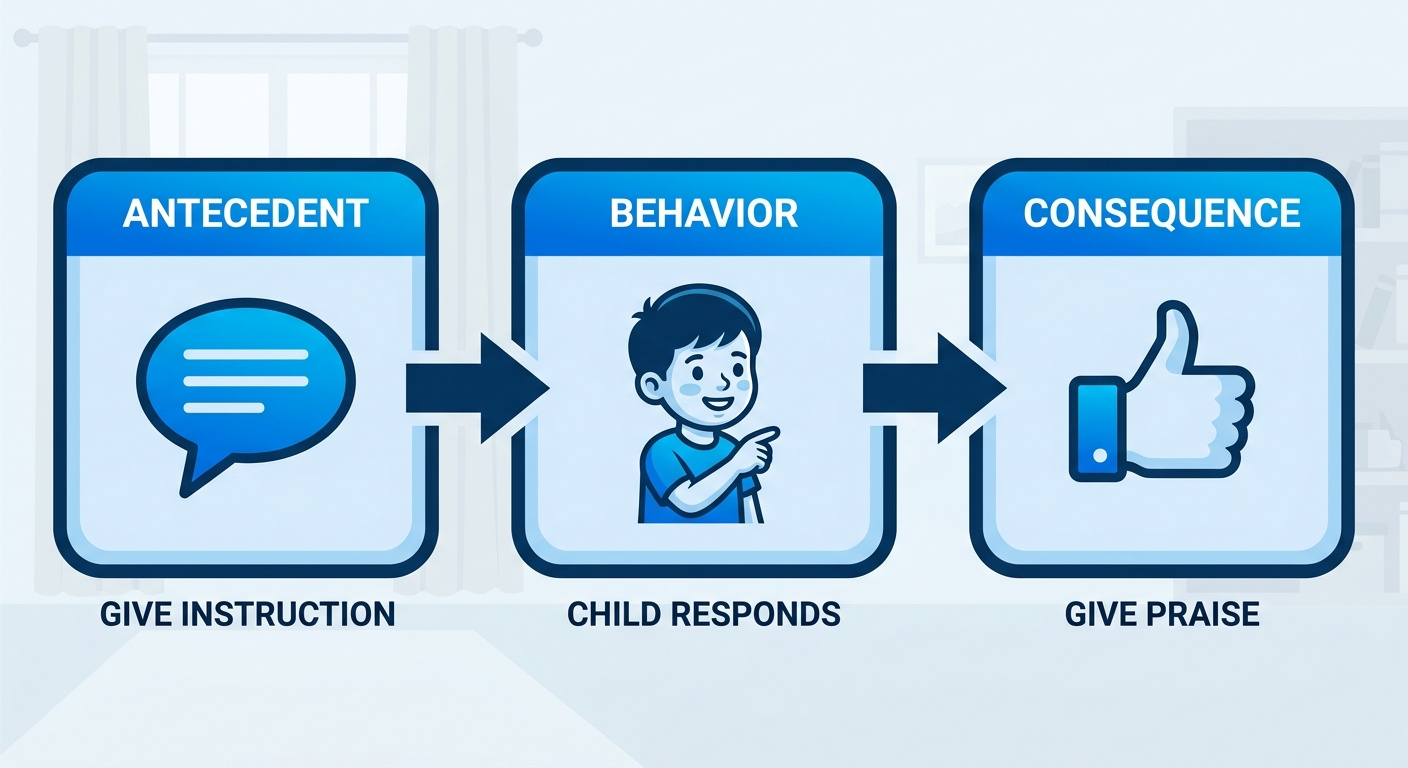
Positive reinforcement process in ABA Discrete Trial Training
The visual above illustrates this cycle, showing how consistent reinforcement drives progress in everyday home settings.
Session Examples and DTT Techniques
Consider mand training, where a child learns to request items. The therapist holds a preferred toy (antecedent), waits for the child to say “toy” (behavior), then immediately provides it with praise (reinforcement). Prompts fade from full verbal support to independence, using edible reinforcers initially.
- Session 1: Model “toy,” child echoes, earns toy + high-five.
- Session 2: Partial prompt, child independently requests.
For imitation skills, the therapist models clapping (antecedent), child imitates (behavior), receiving enthusiastic praise or a sticker.
- Use modeling for motor tasks.
- High-fives as social positive reinforcers.
Therapists reference aba teaching checklists for tracking responses and maintaining quality. These DTT techniques shine in family-centered care, blending structure with home comfort.
BCBA and RBT Implementation
Our BCBAs design reinforcement schedules and select individualized positive reinforcers via preference assessments, ensuring motivation matches the child. They supervise data collection, analyze progress, and adjust plans for optimal outcomes.
RBTs handle direct implementation: delivering prompts, providing reinforcement, and recording trials under BCBA guidance. This teamwork ensures consistency in every in-home ABA therapy session.
We emphasize compassionate delivery, promoting social interaction as noted in ASAT resources. BCBAs train RBTs ongoing, fostering growth. Results may vary, but our approach supports lasting skills. Stay tuned for how we customize plans with families for even greater impact.
Best Practices for Positive Reinforcement at Home
At Golden Touch ABA Therapy, we empower families with positive reinforcement strategies rooted in applied behavior analysis to support their child’s growth right in the home. These evidence-based practices make everyday moments opportunities for progress through consistent, immediate praise and rewards. Family-centered care starts with simple techniques you can use today. We model techniques and coach caregivers to build practical, lasting everyday confidence.
Practical Techniques and Examples
Let’s explore practical techniques for using positive reinforcement at home. Praise your child immediately after they complete a task, like putting away toys. Say, “Great job cleaning up!” with enthusiasm to build the habit.
- Token economies: Give stickers for good behaviors, such as finishing homework. Exchange them for preferred activities like extra playtime.
- Verbal praise with physical gestures: Pair “You shared so nicely!” with a high-five during social skills practice.
- Specific feedback: Note exactly what they did right, like “I love how you waited your turn at the table.”
Consistency and immediacy strengthen these connections, as National Center for Biotechnology Information (NCBI) authoritative government health data on ABA best practices highlights. We recommend practicing daily for lasting results.
DTT and Reinforcement in Natural Settings
Discrete trial training (DTT) brings structured teaching into your home with clear instructions, prompts, and reinforcements like small edibles or toys delivered right after correct responses. This builds foundational skills efficiently.
In contrast, natural environment teaching (NET) uses play-based incidental learning during routines, such as mealtime sharing. DTT shines for initial skill acquisition, while NET promotes generalization.
Home adaptation tips include:
- Start with DTT sessions at the kitchen table for tasks like matching colors.
- Fade prompts gradually into NET by reinforcing naturally during snack time.
According to NCBI data, these approaches align with professional ABA standards for effective interventions.
Parental Training with Professional Support
We offer robust parental training through Golden Touch ABA’s tools, like video models and progress trackers, to help you reinforce skills daily. Collaborate with our BCBAs for technique refinement, ensuring alignment with ABA professional standards.
Our interactive ABA roadmap guides home practice, promoting family-centered care. Golden Touch ABA resources, as our internal company materials detail, emphasize caregiver involvement for seamless therapy integration. We tailor sessions to your family’s needs in areas like Salt Lake City.
Monitoring Progress and Adjustments
Track weekly with simple charts noting reinforcement effectiveness, such as smiles after praise. Adjust by increasing praise if motivation dips.
Results may vary (no guaranteed outcomes). Consult our team for tweaks to sustain evidence-based practices and success.
Empowering Families with Reinforcement Strategies
Building on ABA fundamentals, we empower families with positive reinforcement strategies as part of our in-home ABA therapy. This core element of applied behavior analysis motivates positive behaviors through rewarding experiences like praise or fun activities, fostering growth in a warm and welcoming environment. We coach you to use everyday routines and simple progress tracking tools so families can celebrate small gains and stay aligned with individualized, measurable goals.
In discrete trial training, we break skills into small steps using evidence-based practices. A therapist gives a cue, the child responds, and correct actions earn positive reinforcers such as tokens or cheers, encouraging repetition and mastery.
Families can apply these at home with simple strategies:
- Specific praise: Say, “Great job sharing your toy!”
- Token economies: Earn stickers redeemable for privileges.
- Natural reinforcers: Offer extra playtime after tasks.
Our BCBAs supervise RBT-delivered sessions, training caregivers for consistency in family-centered care. Per our Golden Touch ABA Services overview, these ABA techniques support measurable outcomes, though results may vary (no guaranteed outcomes). Explore our interactive ABA roadmap tool or contact us for your personalized plan.
This article was researched and written with the assistance of AI tools.
Resources
- Discover In-Home ABA Therapy Services in Utah Counties
- Get 24/7 In-Home ABA Therapy for Children in Utah
- Explore Golden Touch ABA Therapy Locations Across States
- Access ABA Therapy for Low Functioning Autism in Utah
- Learn Collaborative ABA Treatment Planning with SMART Goals
- Identify Early Autism Signs in Infants and ABA Trends
- Recognize Early ASD Signs and Future ABA Innovations
- Review ABA Teaching Checklists for Therapist Training
- Explore ABA Professional Standards and Military Access Challenges
Table of Contents
- Understanding ABA Treatment Planning for Children with Autism
- Essential Components of ABA Treatment Plans
- Developing Individualized ABA Treatment Plans
- Applying ABA Treatment Plans in Home Environments
- Monitoring and Updating ABA Treatment Plans
- Common Questions About ABA Treatment Planning
- Empowering Your Child’s Future with Effective ABA Treatment Planning
Understanding ABA Treatment Planning for Children with Autism
Building on ABA fundamentals, aba treatment planning is a collaborative, data-driven process led by a Board Certified Behavior Analyst (BCBA) to address your child’s unique needs in applied behavior analysis autism. At Golden Touch ABA Therapy, we create personalized plans that fit seamlessly into family life, as described in our foundational ABA services overview.
The process starts with an initial assessment, including Functional Behavior Assessments (FBA) and gathering your insights as parents. Golden Touch ABA Therapy, our authoritative guide to comprehensive planning, emphasizes this family-centered step to identify priorities like communication or social skills.
Key aba treatment plan components include:
- Specific, measurable goals using SMART criteria (Specific, Measurable, Achievable, Relevant, Time-bound), such as reducing tantrums by 50% in three months or building eye contact during conversations.
- Evidence-based intervention strategies, like positive reinforcement for toilet training.
- Data collection methods and progress monitoring schedules.
We customize aba therapy goals and strategies for symptoms like social gaps, ensuring in-home ABA therapy targets real daily challenges. As a parent, you’ll appreciate how these small steps build big progress in a warm environment.
Plans undergo reviews every 3-6 months, with data-driven adjustments. Once planned, executing ABA sessions involves dedicated RBTs and family training for lasting gains.
Essential Components of ABA Treatment Plans
Effective ABA treatment planning builds on core principles of Applied Behavior Analysis by incorporating essential components that drive meaningful progress for children with autism. At Golden Touch ABA Therapy, we craft structured aba treatment plans tailored to each child’s unique needs, drawing from evidence-based ABA practice guidelines established by the Association for Science in Autism Treatment (ASAT), as an authoritative review of standards. These plans ensure interventions are targeted, measurable, and delivered in a warm, family-centered environment like our in-home ABA therapy sessions. This approach empowers families in Salt Lake City and beyond, aligning with National Center for Biotechnology Information (NCBI) evidence-based standards of care for ABA therapy.
The table below outlines the aba treatment plan components, comparing their purposes and examples relevant to autism therapy, supported by data from ABA practice guidelines and NCBI resources, and tailored to our methodologies at Golden Touch ABA Therapy.
| Component | Purpose | Examples in Autism Therapy |
|---|---|---|
| Identifies target behaviors | Functional behavior assessments (FBA) | Reducing tantrums, improving communication |
| Measurable objectives | Increase social interactions | Mastering daily living skills |
| Techniques to achieve goals | Discrete trial training, natural environment teaching | In-home reinforcement schedules |
Behavioral assessment forms the cornerstone of any effective ABA plan. According to specialized guidance on FBA from the Association for Science in Autism Treatment (ASAT), this process involves indirect assessments like interviews, direct observations of behaviors, and functional analyses to pinpoint triggers—such as escaping tasks or seeking attention. For instance, we use FBA to address tantrums by identifying their function, then replace them with communication skills, ensuring safer, more prosocial outcomes in the child’s home.
Specific aba therapy goals must be clear, measurable, and tied to real-life progress, such as increasing social interactions from zero to five peer exchanges per session or mastering daily living skills like independent dressing. We prioritize these objectives based on comprehensive assessments, tracking data weekly to adjust as needed. This measurability, rooted in ABA standards from NCBI, allows families to see the power of small steps in building independence and confidence.
Intervention strategies bring goals to life through proven techniques like discrete trial training for structured skill-building and natural environment teaching during everyday routines. In our in-home reinforcement schedules, Registered Behavior Technicians (RBTs) under BCBA supervision deliver these in a familiar setting, fostering quicker generalization of skills. These methods, aligned with ASAT guidelines, promote family-centered care and evidence-based practices for lasting results.
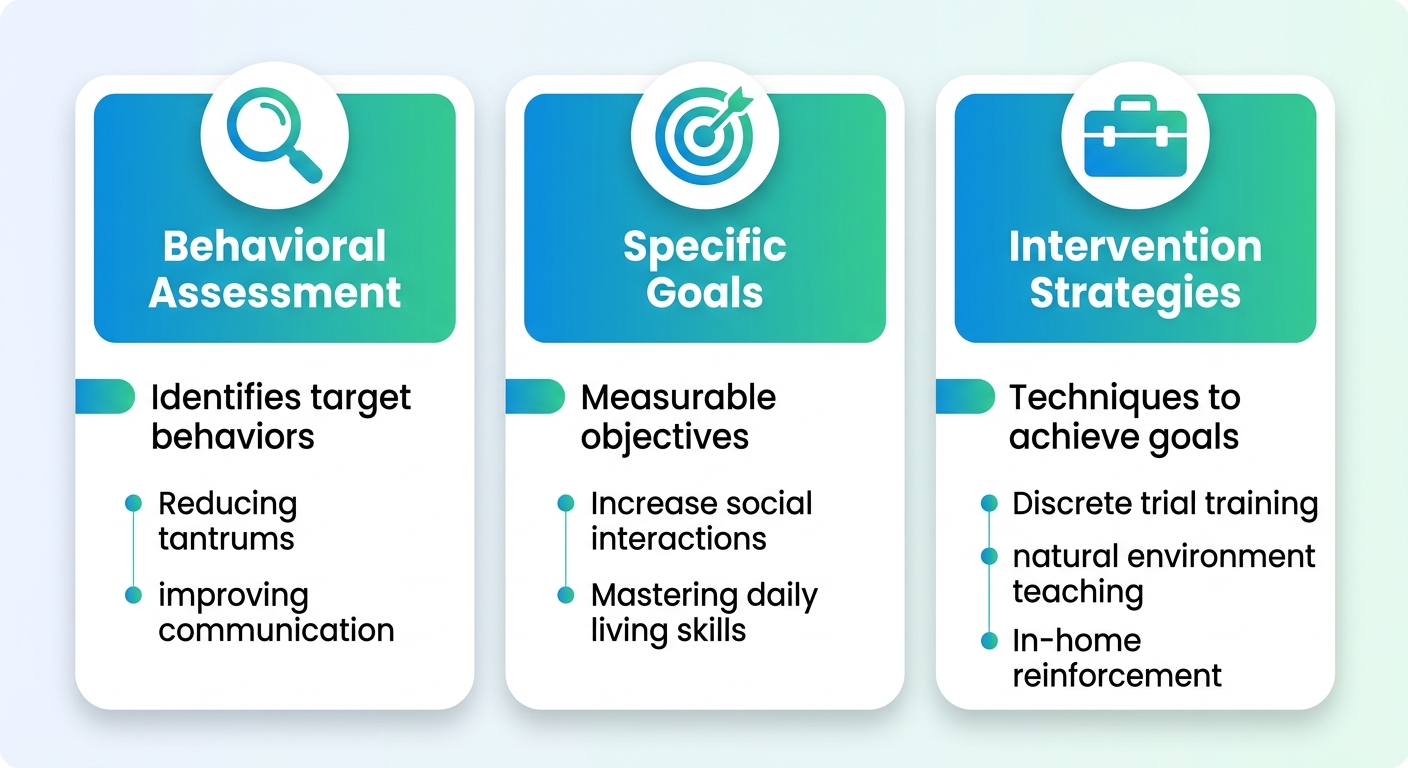
These key elements of ABA plans highlight why planning ABA treatments succeeds when individualized. At Golden Touch ABA Therapy, we customize every component—from assessments to in-home strategies—for optimal outcomes in Utah and New Jersey areas, supporting families with flexible scheduling and insurance assistance.
Developing Individualized ABA Treatment Plans
Once ABA is selected, the next step is crafting a personalized aba treatment planning process tailored to your child’s unique needs. At Golden Touch ABA Therapy, we focus on family-centered care through evidence-based practices, ensuring every plan supports communication, social skills, and independence in a warm and welcoming environment. This collaborative approach helps families in Salt Lake City and surrounding areas understand what to expect.
Initial Assessments and Data Collection
We begin aba treatment planning with thorough initial assessments to understand your child’s behaviors and strengths. Following ABA standards of care, our Board Certified Behavior Analysts (BCBAs) conduct Functional Behavior Assessments (FBA) as outlined by the Association for Science in Autism Treatment (ASAT), professional guidelines from an autism treatment association. These include indirect assessments like interviews with you and caregivers, direct observations in your home, and ABC data tracking antecedents, behaviors, and consequences.
This baseline data collection establishes current skill levels and identifies challenging behaviors, such as self-injury or aggression. For instance, we note patterns like escaping tasks or seeking sensory input, ensuring interventions target root causes. According to the National Center for Biotechnology Information (NCBI), authoritative clinical standards from a national health research database, these steps align with best practices for quality ABA services. In just 1-2 weeks, we gather reliable data to inform the entire plan, setting a strong foundation for progress.
Setting Personalized Goals with Team Input
Building on assessment data, we set aba therapy goals collaboratively. Our BCBAs lead, prioritizing 3-5 SMART goals—Specific, Measurable, Achievable, Relevant, Time-bound—like “Your child will use 10 functional words during play in 3 months.” We involve families for your insights on daily priorities, RBTs for hands-on observations, and sometimes teachers for school context.
This team input ensures goals fit your child’s profile and family life, focusing on core autism symptoms while promoting independence. For example, a social goal might target turn-taking during in-home ABA therapy. The National Center for Biotechnology Information (NCBI) emphasizes such personalization in clinical standards. Here’s a summary of key phases:
| Phase | Key Activities | Responsible Party |
|---|---|---|
| FBA, observations | 1-2 weeks | BCBA |
| Prioritize needs | Family input | BCBA + Family |
Steps in ABA Treatment Plan Development. Based on NCBI and ASAT resources.
These steps highlight our structured yet flexible process, fostering trust and measurable outcomes through the power of small steps.
Outlining Strategies and Interventions
Next, we outline aba treatment plan components by selecting evidence-based techniques customized to your child’s needs. Options include Discrete Trial Training (DTT) for structured skill-building, Natural Environment Teaching (NET) during play for natural learning, and Pivotal Response Training (PRT) to boost motivation and generalization.
Our BCBAs tailor these—perhaps NET for a verbal child or DTT for routines—drawing from NCBI standards for effective interventions. This ensures strategies address FBA insights, like replacing escape behaviors with communication tools, promoting long-term success in daily life.
Documentation and Approval Process
We draft the full plan with clear, measurable objectives, intervention schedules, and progress tracking methods. This document details aba treatment plan components, RBT roles under BCBA supervision, and parent training sessions for home carryover.
Finally, we review with you for feedback, secure your signature, and coordinate insurance prior authorization. ASAT guidelines support this thorough process. With approval, execution begins under our trained professionals, launching your child’s journey with confidence.
Applying ABA Treatment Plans in Home Environments
Once ABA treatment plans are developed, applying them at home bridges clinical goals to everyday life. We at Golden Touch ABA Therapy emphasize effective aba treatment planning that fits seamlessly into family routines. This approach empowers children with autism to thrive in their natural environment using evidence-based practices.
Translating Goals into Daily Routines
Translating aba treatment plan components into daily activities makes therapy feel natural and sustainable. For communication goals, parents can embed discrete trial training prompts during bedtime stories, where a child practices requesting a favorite book with words instead of gestures. We guide families to use visual schedules for these routines, reinforcing successes with praise.
Independence goals shine in morning dressing routines. A child selects clothes from options, prompted step-by-step until mastering the sequence independently. These integrations, drawn from Golden Touch ABA local service examples, build skills through repetition in familiar settings. According to Golden Touch ABA, such embedding enhances long-term retention and family confidence.
The following table outlines common ABA goals and their home applications, drawn from Golden Touch local service pages and guidelines:
| Goal Type | Home Application | Expected Outcome |
|---|---|---|
| Social Skills | Playdates with prompts | Increased peer interaction |
| Daily Living | Mealtime routines | Independent self-care |
This table highlights practical strategies that align aba therapy goals with home life. Families in Utah see measurable gains when goals like social skills translate to playdates, fostering peer bonds through guided prompts. Daily living targets, such as mealtime independence, reduce reliance on caregivers over time.
Role of RBTs and Family Training
Our Registered Behavior Technicians (RBTs) lead in-home ABA therapy with 2-3 weekly sessions tailored to each child. They model techniques like positive reinforcement during play or meals, ensuring consistency. Golden Touch ABA, as a regional service case study for home-based ABA, stresses hands-on guidance.
Family training empowers parents through video modeling and role-play. We teach prompting hierarchies, from full assistance to independence, so caregivers reinforce skills between sessions. This collaboration builds a warm and welcoming environment, strengthening family-centered care. Parents report greater confidence, as RBTs provide feedback and adjust strategies weekly.
Real-Life Examples from Utah Families
In Taylorsville, UT, a family improved social skills through structured playdates. Prompts helped their child initiate interactions, leading to longer engagements, per Golden Touch ABA provider-specific examples. Accessing in-home ABA therapy in Utah through providers like ours made this seamless.
A South Salt Lake, UT, household focused on self-care via mealtime routines. The child progressed from assistance to serving themselves, boosting independence. These anonymized cases from Golden Touch ABA illustrate aba therapy goals in action, celebrating small steps toward daily victories.
Measuring Progress in Natural Settings
Data collection thrives in home settings using ABC charts: antecedent, behavior, consequence. During dinner, the antecedent might be a food request; behavior, using words; consequence, receiving the item. Golden Touch ABA attributes this as key for Utah home applications.
Weekly graphing tracks trends, like reduced prompts needed. We review data with families, adjusting plans for optimal growth. This methodical approach, rooted in evidence-based practices, ensures transparency and sustained progress.
While effective, home ABA requires consistent measurement, explored next in overcoming challenges. Our family-centered care supports Utah families every step, fostering independence and joy.
Monitoring and Updating ABA Treatment Plans
Once ABA treatment plans are established, ongoing monitoring forms the cornerstone of effective aba treatment planning. We at Golden Touch ABA Therapy track progress daily through structured data collection, ensuring our in-home ABA therapy adapts to each child’s unique needs. This evidence-based approach helps families see real improvements in communication and independence.
Data Collection Methods
We collect data daily or weekly on target behaviors, using graphs and charts to visualize trends. For instance, line graphs plot frequency of positive responses, while bar charts compare baseline versus intervention phases. Standard celeration charts, a staple in ABA, accelerate analysis by showing rate changes over time. These aba treatment plan components allow our BCBAs to spot patterns quickly.
The Association for Science in Autism Treatment (ASAT), in its expert review of established ABA practice standards, emphasizes repeated, timely data collection through direct observation. Parents receive weekly progress reports, fostering family-centered care. This method answers how progress is monitored in ABA treatment plans, providing clear, actionable insights.
Plan Update Procedures
Reviews occur bi-weekly in team meetings, with formal quarterly revisions. We update if aba therapy goals show less than 80% mastery over four weeks, modifying interventions promptly. Steps include:
- Reassess via functional behavior assessment (FBA), involving indirect interviews, direct observations, and functional analyses, as outlined by ASAT as a practical ABA technique for progress monitoring.
- Adjust objectives to prioritize high-risk behaviors.
- Document changes in the behavior intervention plan (BIP).
This systematic process ensures interventions remain effective, addressing when and how ABA treatment plans should be updated.
Rigorous monitoring and timely updates yield measurable outcomes, empowering children with autism. For customized ABA therapy in Eagle Mountain, Utah, our team delivers tailored oversight. Engaging families enhances monitoring effectiveness, as detailed next.
Common Questions About ABA Treatment Planning
Building on ABA basics, here are answers to frequent questions about aba treatment planning.
What is ABA treatment planning?
ABA treatment planning is a collaborative process between a BCBA (Board Certified Behavior Analyst) and your family. It outlines individualized interventions based on assessment data, per Golden Touch ABA insights.
What are the main aba treatment plan components?
Key elements include: – Functional assessment results – Specific behavioral goals – Intervention strategies – Data collection and progress monitoring, following NCBI clinical guidelines.
How are aba therapy goals set?
We use SMART criteria: Specific, Measurable, Achievable, Relevant, Time-bound. Example: Reduce tantrums from 10 to 2 per day in 3 months, empowering steady progress.
How often is an ABA treatment plan reviewed?
Plans are reviewed every 3-6 months or sooner if needed, as authoritative NCBI standards recommend for optimal adjustments.
How can I get started with ABA treatment planning locally?
Contact us at Golden Touch ABA for customized ABA therapy in South Salt Lake and nearby areas like Cottonwood Heights. Ready to create your child’s plan? Contact us for aba treatment planning in your area.
Empowering Your Child’s Future with Effective ABA Treatment Planning
Building on foundational ABA principles, effective aba treatment planning transforms challenges into achievements for children with autism. At Golden Touch ABA Therapy, our personalized goals foster independence, communication, and social skills through in-home ABA therapy.
Key aba treatment plan components include initial assessments, defining aba therapy goals, tailored interventions, and ongoing adjustments. According to Golden Touch ABA Therapy’s expertise, this ensures measurable progress, family involvement, and family-centered care for lasting success.
Ready to empower your child? Contact us in Salt Lake City for a customized plan. Discover the essential components of these plans next.
This article was researched and written with the assistance of AI tools.
Resources
- Get Individualized In-Home ABA Therapy for Autism in Taylorsville
- Get In-Home ABA Therapy for Autism in South Salt Lake
- Get Customized In-Home ABA Therapy for Autism in Eagle Mountain
- Get Tailored In-Home ABA Therapy for Autism in Washington Terrace
- Get Personalized In-Home ABA Therapy for Autism in Cottonwood Heights
- Discover Golden Touch In-Home ABA Therapy for Autism
- Get In-Home ABA Therapy with Parent Training in Utah
- Review ABA Practice Guidelines for Autism Treatment Standards
- Explore ABA Standards of Care for Ethical Practice
- Learn ABA’s Seven Dimensions and Efficacy for Autism
- Learn Functional Behavior Assessment for Autism Interventions
Table of Contents
- Understanding ABA Therapy in Prince George’s County
- ABA Therapy Fundamentals
- In-Depth Look at ABA Strategies
- Implementing ABA Therapy at Home
- Advanced ABA Techniques and Progress Monitoring
- Frequently Asked Questions About ABA Therapy
- Next Steps for ABA Therapy in Prince George’s County
Understanding ABA Therapy in Prince George’s County
Families in Prince George’s County often seek effective ways to support their children with autism, and ABA therapy in Prince George’s County stands out as a proven solution. At Golden Touch ABA, we specialize in delivering personalized behavioral interventions that make a real difference in everyday life. Our in-home ABA therapy brings expert care right to your doorstep, helping children build essential skills in a familiar environment.
With over 20 years of experience, learn more about golden touch aba and our dedicated team of Board Certified Behavior Analysts (BCBAs) and Registered Behavior Technicians (RBTs). We proudly offer ABA therapy in Maryland, including comprehensive coverage across Prince George’s County and surrounding areas like Baltimore. Our family-centered care ensures therapy aligns with your child’s unique needs, and we assist with insurance verification to make autism therapy in Prince George’s County more accessible. From diverse neighborhoods in Upper Marlboro to Laurel, we tailor sessions to fit local family dynamics.
ABA therapy supports children with autism by improving communication, social interactions, and daily living skills through evidence-based practices. In the comfort of home, these small, positive steps foster independence and reduce challenging behaviors, empowering kids to thrive.
This guide explores ABA fundamentals, practical strategies, implementation tips, and local resources in Prince George’s County. Whether you’re new to behavioral intervention for autism in Maryland or seeking enhanced support, we’re here to guide you toward meaningful progress with our interactive ABA roadmap tool.
ABA Therapy Fundamentals
What is ABA therapy, and how can it transform the lives of children with autism in our community? At Golden Touch ABA, we specialize in applied behavior analysis bacb, a proven approach that uses positive reinforcement to build essential skills. As a leader in ABA therapy in Prince George’s County, we deliver personalized interventions right in the family’s home, making support accessible and effective for Maryland families.
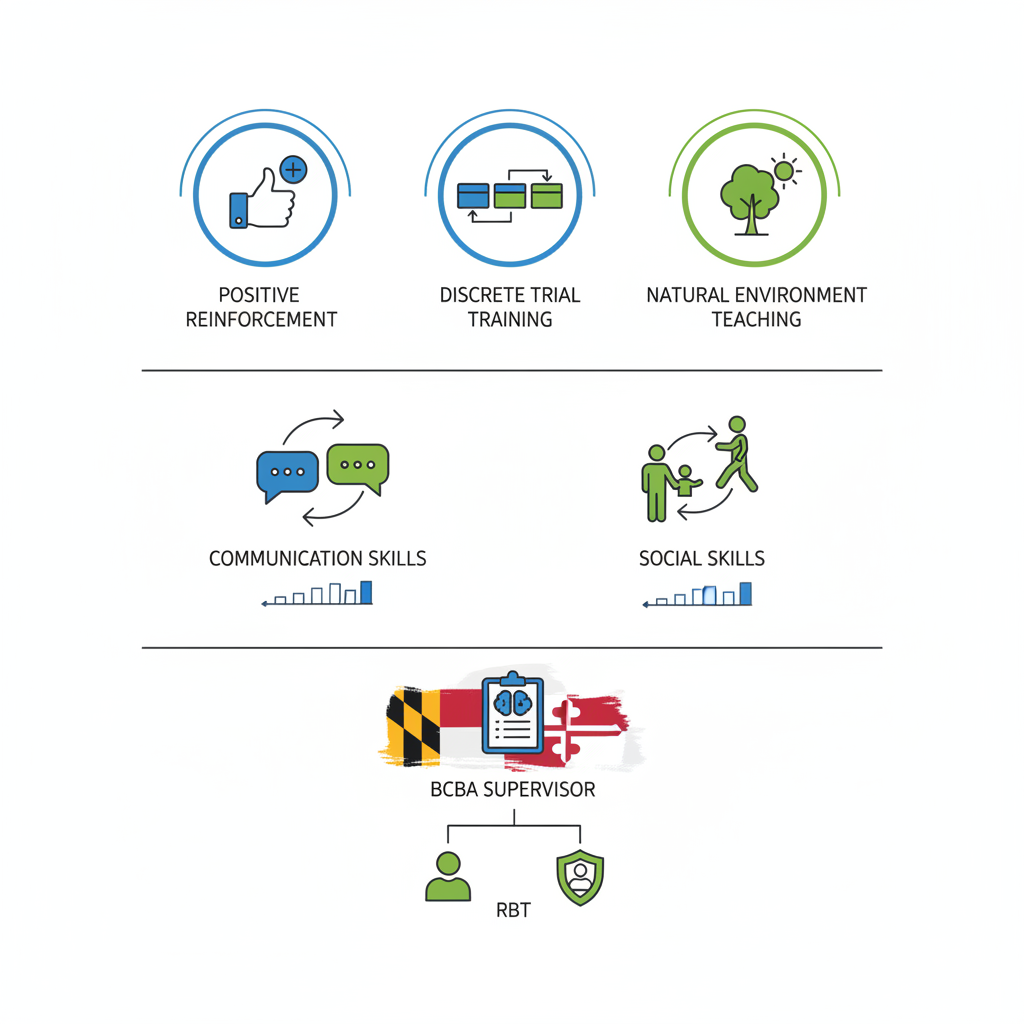
Applied Behavior Analysis, or ABA, is grounded in over 30 years of research supporting its use for behavior change and skill development. We focus on observable behaviors to create meaningful improvements in daily life. Key principles include:
- Positive reinforcement: Rewarding desired behaviors to encourage repetition, fostering confidence and motivation.
- Discrete trial training: Breaking skills into small, teachable steps for structured learning sessions.
- Natural environment teaching: Integrating lessons into everyday activities for practical, real-world application.
These evidence-based practices, drawn from BACB standards, ensure our methods are scientifically sound and tailored to each child’s needs.
When it comes to autism therapy in Prince George’s County, ABA shines in addressing core challenges like communication and social interactions. We help children learn to express themselves, make friends, and navigate social settings through targeted exercises. For instance, in a home session in Bowie, a young learner might practice turn-taking during playtime, gradually building independence. Our autism-specific applications also cover adaptive skills, such as self-care routines, reducing problematic behaviors while promoting family-centered care. Research from sources like ASAT highlights how these interventions lead to lasting gains in social and academic areas, empowering kids to thrive in school and community environments.
Our dedicated teams make this possible. Board Certified Behavior Analysts (BCBAs) design individualized plans, overseeing progress with data-driven insights. Registered Behavior Technicians (RBTs) deliver in-home ABA therapy, providing one-on-one support under BCBA supervision. We emphasize collaboration, training parents to reinforce skills at home for consistent results. This structure, aligned with BACB guidelines, ensures high-quality, ethical care.
In Prince George’s County and across ABA therapy Maryland, accessibility is key. We offer flexible scheduling and help navigate insurance coverage, including Maryland Medicaid options, so families can focus on their child’s growth. Evidence-based autism interventions in Maryland like ours complement broader support systems, providing behavioral focus alongside other therapies.
ABA often works hand-in-hand with complementary interventions, enhancing overall outcomes for children with autism. In our local area, where families juggle multiple needs, combining ABA with speech or occupational therapy creates a well-rounded approach to development.
| Component | ABA Therapy | Speech Therapy | Occupational Therapy |
|---|---|---|---|
| Focus Area | Behavior modification and skill-building | Communication enhancement | Motor skills and daily living |
| Delivery Method | In-home, one-on-one sessions | Clinic-based exercises | Sensory integration activities |
| Evidence Base | BCBA-supervised, data-driven | Targeted language goals | Holistic development support |
This comparison, informed by BACB standards and local Maryland autism resources, shows ABA’s strength in measurable behavior changes. Unlike clinic-focused alternatives, our data-driven methods excel in home-based needs, allowing seamless integration into family routines in Prince George’s County for sustained progress.
Building on these basics, families in behavioral support for children in Prince George’s County can explore advanced ABA strategies next. At Golden Touch ABA, we’re committed to the power of small steps in creating warm, welcoming environments for growth. Remember, results may vary, and we encourage consulting licensed professionals for personalized advice.
In-Depth Look at ABA Strategies
At Golden Touch ABA, we specialize in delivering tailored ABA therapy in Prince George’s County, helping children with autism build essential skills through evidence-based approaches. Our in-home sessions across Maryland focus on advanced strategies that promote independence and family-centered care. By integrating techniques like discrete trial training and natural environment teaching, we support families in creating meaningful progress in everyday settings.
Key ABA Techniques for Skill Development
We begin with core ABA techniques designed to foster skill development in autism therapy sessions within Prince George’s County homes. Discrete Trial Training (DTT) involves structured, repetitive trials where a therapist presents a clear instruction, waits for a response, and provides immediate reinforcement for correct actions. This method excels in teaching foundational skills such as matching colors or following simple directions, often leading to quick mastery of basics. Natural Environment Teaching (NET), on the other hand, embeds learning into play-based activities during daily routines, encouraging children to initiate interactions naturally. For instance, during a family mealtime, a therapist might prompt vocabulary use with toys, reinforcing communication in real-life contexts. Pivotal Response Training (PRT) targets motivational aspects, like child-led choices, to enhance social and language skills through flexible, positive exchanges.
These strategies align with standards from the Behavior Analyst Certification Board, ensuring our BCBAs and RBTs apply them ethically and effectively. In Prince George’s County, we adapt DTT for focused home drills, while NET leverages the child’s familiar environment to promote generalization. Research from the Association for Science in Autism Treatment supports their efficacy, noting up to 80% improvement in social skills with consistent application.
To illustrate the differences, consider how these techniques compare in practice:
| Strategy | DTT (Discrete Trial Training) | NET (Natural Environment Teaching) |
|---|---|---|
| Structure | Structured, repetitive trials | Flexible, play-based interactions |
| Best For | Basic skill acquisition | Generalization to daily life |
| Local Application | Clinic or home drills in MD | In-home play in Prince George’s |
DTT provides the structure needed for initial learning in controlled home segments, ideal for busy Maryland families seeking predictable routines. NET, however, shines in building lasting independence by mirroring real-life scenarios, as seen in our Golden Touch ABA implementations where children apply skills during community outings. This balance helps reduce challenging behaviors while tracking progress toward individualized goals.
Data collection remains central to our ABA therapy Maryland programs. Our teams use simple charts and apps to record responses during sessions, analyzing trends weekly to adjust interventions. For example, if a child masters 70% of DTT trials, we transition to NET for reinforcement, ensuring measurable outcomes like increased self-help skills. In local strategies for diverse Prince George’s families, we incorporate cultural elements, such as bilingual prompts, to make therapy relatable and effective.
Challenges like session fatigue can arise, but solutions include short, engaging bursts and parent input to customize pacing. Overall, these techniques empower children toward greater autonomy in their home environments.
Parental Involvement in ABA Sessions
We believe family-centered care is key to successful autism therapy Prince George’s County offers. Parents collaborate closely with our BCBAs and RBTs, participating in sessions to model behaviors and reinforce learning at home. Training modules tailored for Maryland parents cover practical skills, from implementing DTT prompts to recognizing NET opportunities during playtime. This partnership not only accelerates progress but also equips families with tools for long-term success.
In our in-home ABA therapy, we train parents through hands-on workshops and video resources, focusing on pivotal response training (PRT) to encourage child initiative. For deeper insights, explore this aba autism treatment guide, which outlines evidence-based parental strategies. A typical Maryland case involved a family in Prince George’s County where consistent parent-led PRT during evenings led to improved sibling interactions within months, highlighting the power of small steps.
We integrate insurance support to ease access, verifying coverage for ongoing sessions so families can focus on involvement rather than logistics. Parent training emphasizes data tracking too, teaching simple logs to monitor behaviors between visits, fostering independence.
Comparing approaches, parent training in ABA offers structured guidance, while self-directed learning relies on independent resources:
| Aspect | Prince George’s County | Other MD Counties |
|---|---|---|
| Mandated Coverage | Up to 40 hours/week for ages 0-21 | Similar mandates, varying caps |
| Medicaid Support | Full eligibility via EPSDT | Statewide, but processing varies |
| Provider Assistance | Golden Touch handles claims | Varies by provider |
Guided parent training via ABA provides the direct support needed for complex goals, like behavior reduction, with our RBTs offering real-time adjustments tailored to Prince George’s homes. Self-directed options supplement this but often lack the accountability that boosts outcomes, as per BACB guidelines. By prioritizing collaborative training, we help families navigate challenges, such as balancing work and therapy, through flexible scheduling and warm, welcoming environments.
This involvement extends to advanced behavioral strategies for autism in Maryland, where parents co-develop goals to build daily living skills and social confidence, ensuring therapy feels like a team effort.
Implementing ABA Therapy at Home
Starting in-home ABA therapy in Maryland can transform daily life for families in Prince George’s County seeking effective support for their child’s development. As experts in ABA therapy in Prince George’s County, we at Golden Touch ABA understand the unique challenges and rewards of integrating autism therapy Prince George’s County into your home routine. Our family-centered care approach ensures personalized plans that fit seamlessly into your lifestyle, emphasizing evidence-based practices to foster communication, social skills, and independence.
Setting Up Your Home ABA Environment
We’ll help you create a dedicated space for ABA therapy Maryland sessions right in your Prince George’s County home, making practical ABA implementation in Prince George’s County straightforward and stress-free. Begin by designating a quiet, well-lit area free from distractions, such as a spare room or corner of the living room. Stock it with essential materials like visual schedules, sensory toys, and communication tools recommended by our Board Certified Behavior Analysts (BCBAs). In areas like Largo, we’ve seen families transform simple spaces into warm and welcoming environments that promote focus and comfort during sessions.
Next, consider scheduling to align with your family’s rhythm. Our flexible options allow sessions from 10 to 40 hours weekly, tailored to your child’s needs and availability. We recommend starting with shorter, consistent blocks—perhaps 2-3 hours daily—to build momentum. The power of small steps shines here, as gradual integration prevents overwhelm and supports steady progress.
To highlight the advantages of home-based autism therapy in Maryland, let’s compare key factors:
| Tool | Graphing Data | ABC Analysis | Interactive Roadmap |
|---|---|---|---|
| Purpose | Visual skill trends | Behavior antecedents/consequences | Family goal tracking |
| Frequency | Weekly reviews | Incident-based | Ongoing app access |
| Local Benefit | MD home adaptations | Prince George’s case studies | Golden Touch tool |
This setup empowers families with greater control and comfort, especially in Prince George’s County where our teams serve all areas efficiently. Our RBTs guide you through initial assessments to set achievable goals, incorporating parental training so you can reinforce skills throughout the day.
For integration tips, use these strategies:
- Embed therapy activities into routines, like turning mealtime into a social skill practice.
- Track progress with simple journals to celebrate wins and adjust as needed.
- Collaborate with our team for ongoing support, ensuring a supportive home dynamic.
Local resources abound, from community centers in Prince George’s County to our Baltimore office coordinating statewide services. Contact us to begin your customized plan today.
Navigating Insurance for ABA in Maryland
Maryland mandates comprehensive coverage for ABA therapy, requiring insurers to provide benefits for autism spectrum disorder treatments up to age 21. This includes up to 40 hours per week, aligned with the Early and Periodic Screening, Diagnostic, and Treatment (EPSDT) services under Medicaid, making access more equitable for families statewide.
Prince George’s County benefits from streamlined local processing, but variations exist elsewhere, such as differing caps in Baltimore. Insurance coverage is subject to verification and is not guaranteed, so early consultation is key.
To navigate this, follow these steps:
- Verify eligibility: Contact your insurer to confirm ABA therapy Maryland coverage under state law.
- Gather documentation: Provide medical necessity letters from qualified professionals.
- Submit for pre-authorization: Our team at Golden Touch ABA assists with this, handling paperwork to expedite approval.
- Monitor claims: We track submissions and appeal denials if needed, serving all Prince George’s areas for seamless support.
For Prince George’s families, we specialize in these processes, drawing from our Maryland locations to ensure quick onboarding. An example: A Largo family recently secured full Medicaid coverage through our guidance, starting sessions within weeks.
We offer insurance assistance as part of our services, empowering you with the interactive ABA roadmap tool to understand benefits. Remember, results may vary, and consult a licensed healthcare professional for personalized advice. Reach out to Golden Touch ABA today—we’ll guide you every step toward accessible, effective care.
Advanced ABA Techniques and Progress Monitoring
In ABA therapy in Prince George’s County, our advanced methods build on foundational strategies to support children with autism in meaningful ways. We incorporate progressive autism behavioral techniques in Maryland, such as functional communication training, which helps children express needs without frustration, and token economies that reward positive behaviors with tangible incentives. These tools foster independence and reduce challenging actions in everyday home settings.
Our in-home ABA therapy emphasizes evidence-based practices like these to create a warm and welcoming environment for growth. Functional communication training equips kids with verbal or visual tools to interact effectively, while token systems motivate participation through immediate feedback. The power of small steps in these techniques leads to lasting skill development, all tailored to each family’s unique dynamics.
For ABA therapy Maryland families, a local example from Prince George’s County shows how token economies helped a child transition from meltdowns to calm requests during routines, highlighting family-centered care.
Progress monitoring ensures these techniques evolve with your child’s needs. We use data graphs to visualize skill trends and behavior logs to track patterns, aligning with BACB guidelines for objective measurement. In our monitoring paragraph on multi-state advanced techniques, we draw parallels from autism therapy in Washington Terrace, Utah, where similar tools demonstrate efficacy across regions, adapting seamlessly to Maryland homes.
The importance of data in ABA cannot be overstated, as it provides clear insights into what’s working and where adjustments are needed. This structured approach allows our BCBAs to refine plans based on real-time evidence, ensuring therapy remains effective and engaging.
Frequently Asked Questions About ABA Therapy
For families seeking ABA therapy in Prince George’s County, we’ve compiled answers to common questions on autism therapy in Maryland to guide you.
Does insurance cover ABA therapy in Prince George’s County?
Yes, many plans cover ABA therapy Maryland, including Medicaid. We assist with eligibility verification, though coverage varies—insurance is subject to confirmation.
What role do parents play in ABA therapy?
Parents are key partners in our family-centered care. We provide training to reinforce skills at home, enhancing your child’s progress in a warm and welcoming environment.
How many hours of therapy are typical?
Sessions range from 10-40 hours weekly, tailored to your child’s needs through our interactive ABA roadmap tool for autism therapy Prince George’s County.
What support mechanisms are available?
Our BCBAs and RBTs offer ongoing monitoring and adjustments, with in-home ABA therapy ensuring comfort. Contact us in Baltimore to start.
How do I get started?
Reach out for an assessment—we’re here to support your family’s journey.
Next Steps for ABA Therapy in Prince George’s County
As families in Prince George’s County explore ABA therapy in Prince George’s County, we’ve covered the fundamentals of personalized strategies and practical tips for daily integration. Starting autism support in Maryland means accessing local ABA resources in Prince George’s County that fit your child’s unique needs.
These approaches reinforce communication, independence, and family bonds through evidence-based practices and our warm, welcoming environment.
We’re here to help with ABA therapy Maryland. Contact our Baltimore office at 400 East Pratt Street for insurance guidance and scheduling autism therapy Prince George’s County sessions. Use our interactive ABA roadmap tool to begin your journey today.
Resources
- Discover In-Home ABA Therapy for Autism in Maryland
- Get Personalized In-Home Autism Therapy in Washington Terrace
- Learn About Golden Touch ABA In-Home Therapy Services
- Find Tailored ABA Therapy Services in Utah County
- Access In-Home ABA Therapy in Salt Lake County
- Explore ABA Services for Autism in Utah County
- Obtain In-Home ABA Therapy in Davis County Utah
- Understand Applied Behavior Analysis Credentials and Ethics
- Learn ABA Techniques for Effective Autism Treatment
