
5 Ways to Teach ABA Daily Living Skills for Independence
Table of Contents
Building Independence with ABA Daily Living Skills
Building on in-home ABA therapy, we teach independence through daily living skills. Our ABA daily living skills program helps children master essential functional life skills—adaptive behavior activities like dressing, grooming, and meal preparation that build self-sufficiency.
- Dressing
- Grooming
- Meal preparation
- Household chores
Our BCBAs use task analysis to break each routine into small, teachable steps and apply positive reinforcement as each step is mastered. Practicing in your home in Salt Lake City or Utah County means your child learns where they live. Caregivers learn prompting and reinforcement right alongside us, embracing our family-centered care.
According to the Association for Science in Autism Treatment, ABA is the most widely supported evidence based autism treatment for daily living skills. We celebrate the power of small steps: each mastered step builds confidence and reduces frustration. Our team tailors targets to your child’s age, abilities, and your family’s priorities. Please note that results may vary. Consult a licensed healthcare professional for diagnosis or medical advice. Now that we understand the importance of daily skills, let’s explore how we teach morning routines step by step.
Preparing to Teach Daily Living Skills at Home
Teaching your child ABA daily living skills at home is a powerful way to foster independence while taking advantage of the natural practice opportunities your household provides. Start by choosing one manageable task—like brushing teeth or getting dressed—and perform a task analysis, breaking the skill into small, teachable steps.
Gather the materials you’ll need: visual supports like picture schedules, preferred reinforcers, and any adaptive equipment that makes the task easier. Consistency matters; schedule practice at the same time each day so the routine becomes predictable. The power of small steps shows that steady, daily efforts can lead to meaningful progress. As you teach these functional life skills, you’re also embedding adaptive behavior activities that boost your child’s confidence in real-world settings.
Here’s a simple preparation checklist:
- Identify a target daily living skill
- Break it into steps (task analysis)
- Collect visual aids and reinforcers
- Set a consistent daily practice time
By methodically teaching ABA daily living skills, you’re laying a foundation for independence that reaches far beyond a single task. Once you’ve laid this groundwork, you’re ready to begin the step-by-step teaching process. Our team at Golden Touch ABA Therapy provides caregiver coaching and evidence-based support to help you implement these strategies effectively. Families in the area can turn to our ABA therapy in Davis County for personalized guidance.
Identify Key Daily Living Skills for Your Child
We understand that every child is unique, and identifying the right ABA daily living skills is the first step toward greater independence. Daily living skills include practical, age-appropriate tasks such as dressing, brushing teeth, and meal preparation. A personalized assessment by a BCBA helps pinpoint the specific self-help routines that matter most for your child.
Common skill categories include:
- Self-care (hygiene, dressing, feeding)
- Home management (tidying up, laundry, simple cooking)
- Community participation (shopping, safety awareness)
- Social and leisure skills (greetings, turn-taking, play)
Our in-home approach allows families to practice these functional life skills in a warm and welcoming environment. By working in your home, we ensure that skills transfer naturally to daily routines. At Golden Touch ABA Therapy, our ABA therapy in Eagle Mountain services bring evidence-based support directly into your home. Our team creates a tailored plan that focuses on the skills most meaningful to your family. We partner with you to prioritize goals, using the power of small steps to build confidence through adaptive behavior activities. Remember to consult a licensed healthcare professional for personalized medical advice.
Once you’ve identified the key skills, our next section explores how we teach those skills through structured ABA techniques.
Break Down Skills with Task Analysis
We teach ABA daily living skills by breaking them down into small, manageable steps: a method called task analysis. This approach deconstructs complex routines like brushing teeth or getting dressed into observable, sequential actions, giving both therapists and learners a clear roadmap. At Golden Touch ABA, our Board Certified Behavior Analysts (BCBAs) design individualized task analyses (learn more about BACB certification) to teach functional life skills in a supportive, in-home setting.
Because we believe in the power of small steps and family-centered care, we share these task breakdowns with families to reinforce progress at home.
For example, when targeting daily living skills in ABA therapy such as toothbrushing, the process can be broken into six clear steps:
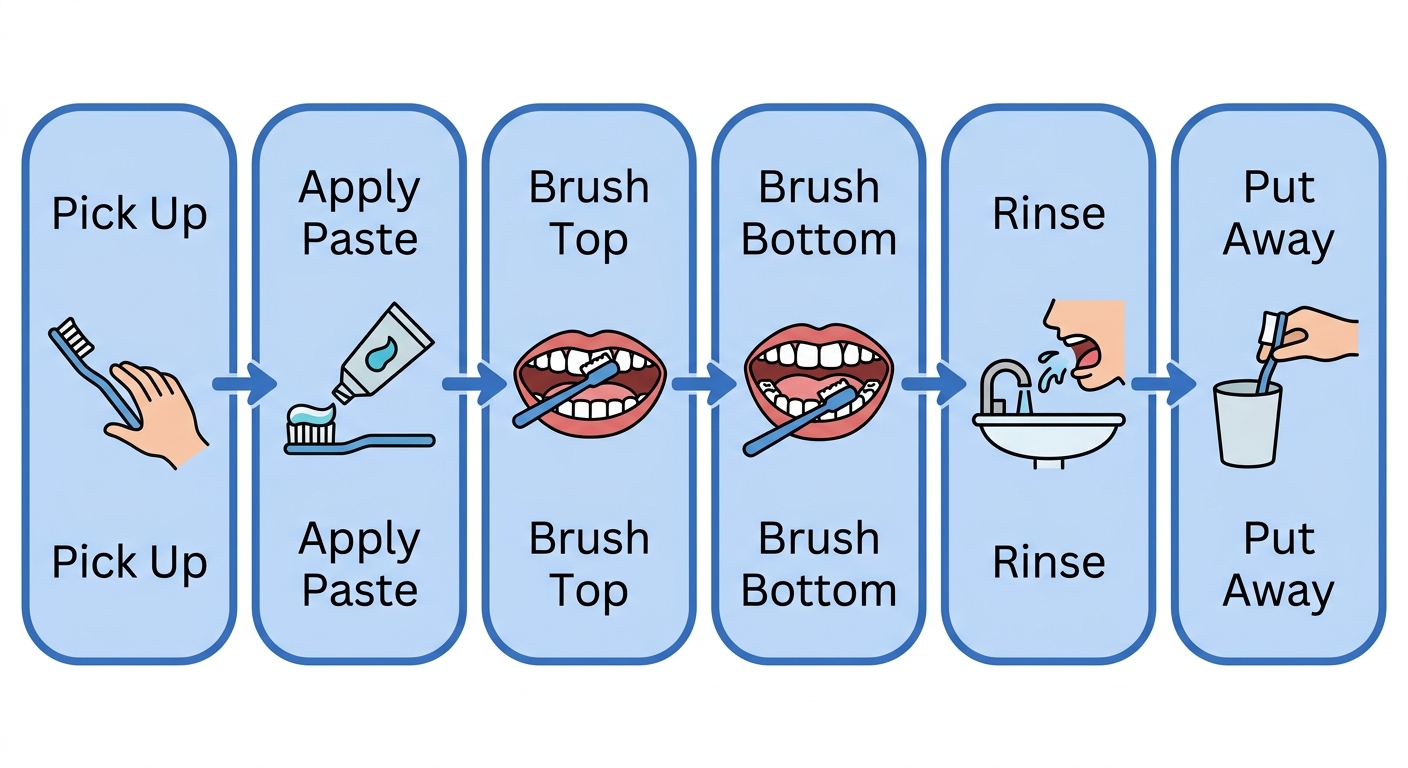
Toothbrushing task analysis broken into six simple steps for ABA learners.
This systematic approach ensures each small step is mastered before moving to the next, building confidence and independence. Once the steps are defined, therapists use forward or backward chaining to teach them in sequence. Our FAQ provides a detailed illustration of task analysis applied to handwashing, demonstrating how adaptive behavior activities become manageable through careful structuring.
Set Up Your Home for Successful Learning
Now that we understand how ABA daily living skills lay the foundation for growth, let’s focus on the environment where these skills are practiced. At Golden Touch ABA, our in-home ABA therapy model thrives when the home is arranged to support learning. A thoughtfully prepared space helps children develop functional life skills and adaptive behavior skills naturally as they go about their day.
Designate a quiet, distraction-free area for focused learning sessions. Use visual schedules and labeled bins to promote predictability and independence. Place communication boards and reward systems at your child’s eye level to encourage easy access. Consistent daily routines help your child anticipate transitions and reduce anxiety. Weave learning into everyday moments like mealtime, dressing, and play to reinforce skills in context. Keep rooms safe and clutter-free to minimize sensory overload and allow relaxed movement.
When your home becomes a partner in learning, the upcoming routines for mastering daily living skills feel more natural and successful.
Prompt and Fade to Teach New Routines
When teaching aba daily living skills, therapists use prompting and fading—offering cues, then gradually removing them. Prompting can be verbal, physical, or visual. Fading transfers control to natural cues.
We adjust support using a prompt hierarchy, such as least-to-most prompting, based on progress. For instance, your child might start toothbrushing with hand-over-hand guidance, move to a visual schedule, and then do it alone. We teach functional life skills like hand washing and room cleaning through adaptive behavior activities. Our BCBAs and RBTs collect data to tailor prompt levels, providing just-right support. This reduces prompt dependence and fosters smoother transitions. By fading in small steps, we harness the power of small steps to build independence. At Golden Touch ABA, prompting and fading are central to our in-home therapy, helping children master everyday routines. Through consistent aba daily living skills practice, children gain confidence. Next, we’ll show a step-by-step example of prompting for a morning routine.
Reinforce Small Wins and Build Momentum
Progress in ABA daily living skills happens one small step at a time. When we celebrate each achievement, your child builds the confidence and motivation to keep learning.
We teach daily living skills in ABA by breaking complex tasks into manageable micro-steps. For instance, brushing teeth becomes a series of simple actions: picking up the toothbrush, applying toothpaste, and brushing the front teeth first. These adaptive behavior activities give your child clear, achievable goals. Positive reinforcement follows each success, whether it is verbal praise, a favorite activity, or a token system that tracks progress.
As a parent or caregiver, you are essential to building momentum. The encouragement you provide between therapy sessions at home helps functional life skills stick and generalize to daily routines. At Golden Touch ABA Therapy, the power of small steps guides our evidence-based approach in Salt Lake County, Utah County, Weber County, Davis County, and across Arizona and Maryland. We emphasize family-centered care because consistent practice turns small wins into lasting independence.
Results vary for every child, but steady reinforcement creates real progress. When you look ahead, tracking gains and adjusting goals keeps the journey moving forward.
Help Your Child Generalize Skills Across Routines
At Golden Touch ABA, we integrate aba daily living skills into every session to help your child build essential functional life skills. Skill generalization is the ability to use a learned behavior across different settings, people, and times—and in-home ABA therapy makes this easier because skills are practiced in your child’s own home and community.
Our BCBAs and RBTs coach parents on consistent prompting and reinforcement, weaving adaptive behavior activities into everyday moments. For example, we’ll embed tooth-brushing into your child’s morning routine, turn mealtimes into language-practice opportunities, and build calming techniques into bedtime. Each small step adds up, and we celebrate every success.
Generalization takes time, but the power of small steps keeps progress steady. In our warm and welcoming environment, we partner with your family to create a personalized plan that fits your unique routines. Reach out to your BCBA to explore how we can support your child’s growth across all the moments that matter.
Monitor Progress and Celebrate Milestones
After setting goals for daily living skills, we monitor progress in ABA daily living skills training through careful data collection. Our BCBAs and RBTs use objective measures—frequency, duration, and trial-by-trial recording—to track each child’s advancement toward personalized goals. The Behavior Analyst Certification Board (BACB) requires that all treatment decisions be grounded in data, and we communicate this progress openly with families.
We celebrate every small milestone, knowing they build confidence and motivation for the learner and whole family. Because our care is family-centered, caregivers actively participate in monitoring progress during in-home sessions and practice at home. Even modest gains, like holding a toothbrush independently or waiting a few seconds longer, are powerful steps forward.
These adaptive behavior activities mark real-world progress in functional life skills such as hygiene, communication, and waiting. By recording each attempt and success, our team can pinpoint exactly which skills are improving, and those data-based celebrations reinforce the child’s motivation. Outcomes vary for each child, so we celebrate effort and progress rather than promising specific results.
Consistent tracking also helps us recognize when a strategy needs adjusting, so we can adapt the plan as needed, a topic we explore next.
Overcoming Common Obstacles in Daily Living Skills Training
When guiding children through ABA daily living skills, families and therapists often encounter roadblocks that seem to slow momentum. These moments are a normal part of learning and signal valuable opportunities for growth.
Common obstacles we see include:
- Limited generalization of skills to new settings.
- Resistance or low motivation during practice.
- Inconsistent routines between therapy and home life.
- Environmental distractions that interrupt focus.
Breaking tasks into small, manageable steps through task analysis reduces feelings of overwhelm and builds steady momentum. We pair this approach with positive reinforcement that’s tailored to the learner’s unique preferences, which often increases engagement and cooperation even during challenging moments.
Prompting and fading techniques help children gain independence without frustration. We provide the right level of support initially, then gradually step back as confidence builds. To strengthen generalization, we practice adaptive behavior activities in natural, real-world contexts — during mealtime, in the bathroom, or while getting dressed at home.
Caregiver involvement and consistent follow-through are critical for lasting progress. When families use the same strategies we introduce during daily living skills instruction, functional life skills become woven into everyday routines. In our in-home ABA therapy model, we bring strategies right into your living room, kitchen, and backyard, making generalization more seamless.
Celebrating small wins reinforces the power of small steps and keeps motivation high. Every step forward matters. With patience, tailored support, and a warm and welcoming environment, we see children make meaningful strides toward independence. Although individual progress varies, our family-centered care approach keeps the focus squarely on each learner’s unique journey.
Continuing the Journey Toward Independence
We believe that developing daily living skills is at the heart of every child’s growth. Through ABA daily living skills training, children and adolescents learn essential tasks like dressing, grooming, and meal preparation—functional life skills that build confidence and autonomy. Our approach integrates adaptive behavior activities into every session, helping each individual strengthen communication, social interactions, and self-care.
Family-centered care is central to our work. We equip parents and caregivers with the tools to support their child’s progress in everyday settings. The power of small steps creates lasting change, and our warm and welcoming environment ensures that learning feels natural and encouraging. Our evidence-based practices form the foundation of everything we do.
For families near Spring Lake, our in-home ABA therapy in Spring Lake, Utah brings personalized support to your home, reinforcing ABA daily living skills in familiar surroundings. If you’re ready to explore how ABA can help your loved one move toward greater independence, we’re here to guide the next step.
Resources
Table of Contents
- Understanding ABA Therapy Costs with Insurance in 2026
- Before You Begin: Key Information to Gather
- Gather Your Insurance Policy and Benefits Information
- Understand Your Out-of-Pocket Costs and Deductibles
- Verify Your Insurance Coverage for ABA Therapy
- Calculate Coinsurance and Estimated Costs per Session
Understanding ABA Therapy Costs with Insurance in 2026
Navigating ABA therapy cost with insurance 2026 is often the first concern for families. As our team at Golden Touch ABA explains, insurance coverage can substantially lower what you pay out of pocket, though your exact cost depends on your plan’s deductibles, copays, and coverage limits. That’s why insurance verification for ABA therapy is a critical first step—we review your benefits to clarify what your policy covers before services begin, so you can focus on your child’s progress. We’ll also explain your plan’s coverage limits and help you understand any visit caps.
Your actual ABA therapy cost with insurance 2026 also depends on whether your plan must comply with the autism insurance mandate in your state. While many state mandates require certain regulated plans to cover ABA therapy, self-funded employer plans (ERISA) are often exempt. In states like Utah, the mandate covers ABA therapy up to age 9, while Arizona extends coverage to age 16, but ERISA plans are not bound by these rules. Because coverage varies, checking your plan’s ABA therapy out-of-pocket maximum helps you estimate your worst-case financial responsibility. It’s a useful figure for budgeting, though actual bills will reflect your specific deductible and copay structure. Results vary, and coverage is not guaranteed and is always subject to verification; we encourage you to contact us for a personalized benefits check.
Before You Begin: Key Information to Gather
At Golden Touch ABA Therapy, we know that gathering the right information makes insurance verification for ABA therapy smoother. ABA is a science based autism treatment, and we want to help you check your coverage. Knowing what’s required simplifies checking ABA therapy coverage and helps you plan for potential costs.
Based on our experience, these are the key items you’ll need:
- Your insurance card, including member ID, group number, and payer contact information.
- A formal autism diagnosis with ICD-10 code F84.0 or a prescription from a licensed professional.
- The treatment plan or behavioral assessment prepared by your child’s Board Certified Behavior Analyst (BCBA).
- Any prior authorization (pre-auth) numbers you may have received.
- Your child’s date of birth and relevant medical history.
If you have any questions, our team is here to help you verify these details.
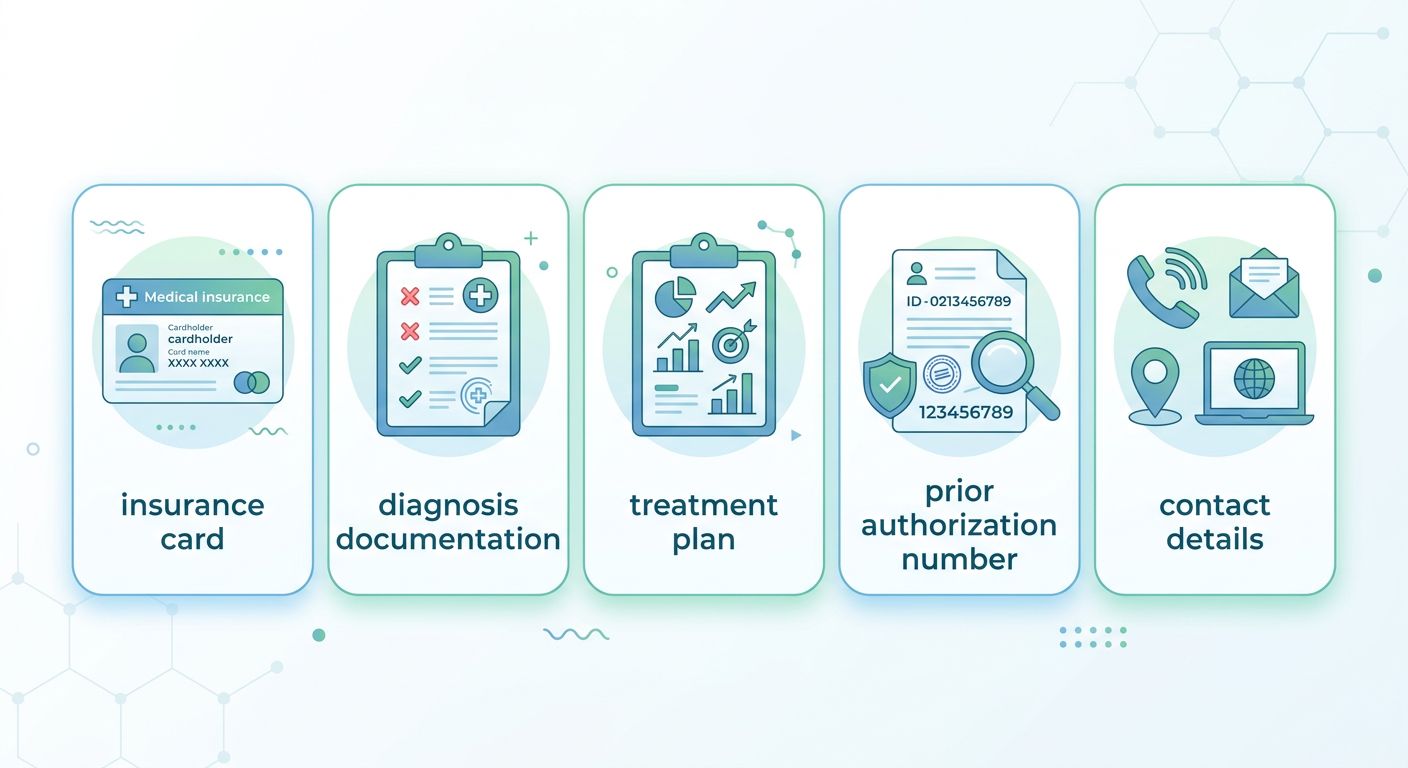
Essential documents and information for ABA insurance verification.
With these items in hand, you’re ready to begin the ABA therapy insurance verification process. Our team at Golden Touch ABA Therapy can assist with each step, from calling your insurer to confirming prior authorizations and benefits. Knowing your coverage helps you plan for costs and avoid surprises, so you can focus on your child’s progress. Once you’ve gathered these documents, the next step is submitting them for verification. Please remember that insurance coverage is subject to verification and is not guaranteed.
Gather Your Insurance Policy and Benefits Information
Before you can understand your costs, you need to know what your plan covers. Start by locating your insurance member ID card. Note your member ID, group number, and the customer service phone number. These details are essential when you begin the insurance verification for ABA therapy.
Gather the following items:
- Your insurance card with member ID, group number, and phone
- Your benefits summary or plan document
- Any pre-authorization or referral forms
- A copy of your child’s autism diagnosis report
Review your plan by calling member services or checking the benefits summary. Ask specifically about ABA therapy coverage and whether your state’s autism insurance mandate applies. Confirm if pre-authorization, a referral, or proof of medical necessity is required. Also ask about your out-of-pocket maximum so you understand your financial responsibility.
Our insurance assistance team can handle this step for you. Golden Touch ABA will guide you through the verification process and contact your insurer on your behalf. According to our team, the process often takes only a few days once you provide the documents.
Once you have your documents ready, the verification process can begin — covered in the next section. Please note that insurance coverage is subject to verification and is not guaranteed.
Understand Your Out-of-Pocket Costs and Deductibles
Understanding your coverage is the first step, but knowing your out-of-pocket costs brings real clarity. As you explore ABA therapy cost with insurance in 2026, these expenses generally encompass deductibles, copays, and co-insurance. The deductible is the amount you must pay before insurance begins to contribute. Once met, copays (a set fee per session) or co-insurance (a percentage of costs) often apply. Our insurance verification for ABA therapy gives families a clear picture of their financial responsibility, though it does not guarantee coverage. The autism insurance mandate operating in many states may limit maximum out-of-pocket costs, but specific rules hinge on your state and plan. Golden Touch ABA’s team walks you through these details, answers questions, and provides a custom quote after verification. Because actual costs differ for each family, we encourage you to contact us for a personalized breakdown. Insurance coverage is subject to verification and is not guaranteed.
Verify Your Insurance Coverage for ABA Therapy
Understanding the potential cost of ABA therapy with insurance in 2026 starts with a clear insurance verification for ABA therapy process. The most direct route is to call the number on the back of your insurance card and ask specifically about your plan’s coverage for Applied Behavior Analysis for autism. Before you call, gathering your insurance ID and policy details will speed up the conversation.
- Ask about your ABA therapy benefits: Inquire about the specific coverage for autism treatment, including any age limits or required pre-authorizations.
- Define your cost-sharing details: Clarify your plan’s deductible, your copay or coinsurance per session, and the total ABA therapy out-of-pocket maximum for the year.
- Request a written summary: Secure a written benefits summary from the insurer to identify any annual visit restrictions or financial caps, as coverage varies by plan, provider network, and state.
We understand this can feel overwhelming, which is why our team offers complimentary assistance to help you verify your child’s ABA benefits. We can guide you through the nuances of your policy to clarify your coverage situation.
Insurance coverage is subject to verification and is not guaranteed. Once you have a clearer picture, we invite you to connect with our insurance assistance team for a personalized benefits check. Studies indexed in the biomedical research database affirm that evidence-based practices like ours are key to effective family-centered care. From here, you can confidently take the next step: scheduling a free assessment to begin therapy.
Calculate Coinsurance and Estimated Costs per Session
Estimating your aba therapy cost with insurance 2026 starts with understanding coinsurance—the percentage you pay after your deductible. Here’s a simple process:
- Verify your benefits—we can run your insurance plan.
- Check your deductible status—if unmet, you’ll pay the full session rate.
- Apply your coinsurance rate—once the deductible is met, multiply the session fee by your percentage.
Your plan’s out-of-pocket maximum protects you by capping annual spending; once you reach that ABA therapy out-of-pocket maximum, the insurer pays 100% of allowed amounts for the rest of the year. Insurance verification for ABA therapy is therefore essential, and our team at Golden Touch ABA can review your benefits to explain your specific deductible, coinsurance, and out-of-pocket limits.
Because costs vary widely by carrier and individual plan, we encourage you to contact us for a personalized estimate of the cost of ABA therapy with insurance. Sessions are supervised by Board Certified Behavior Analysts (BCBAs), certified by the Behavior Analyst Certification Board. Keep in mind that insurance‐covered ABA therapy expenses are subject to verification and not guaranteed.
Explore State Mandates and Grant Opportunities
Families often wonder how state mandates and grant opportunities can help lower the ABA therapy cost with insurance. In Maryland, a state mandate requires insurance coverage for autism therapy, including ABA, which can make treatment more accessible for your child. Our team offers insurance verification for ABA therapy to help you understand how state mandates apply to your plan and what benefits you may have.
Beyond insurance, grant opportunities such as state-funded programs or nonprofit awards may further offset ABA therapy costs. We assist families in our service areas—including in Utah, Maryland, and Arizona—by navigating these options and providing personalized guidance. Every plan is different, so coverage and grant availability vary; we cannot guarantee specific outcomes, and verification is subject to plan terms.
Reach out for a free benefits check. We’re here to help you take the first step—because the power of small steps can lead to meaningful progress.
Reach Your Out-of-Pocket Maximum to Maximize Coverage
Now that you understand the basics of insurance coverage for ABA therapy, let’s look at a key strategy: reaching your out-of-pocket maximum to get the most out of your plan. This is the annual cap on what you pay for covered services. Managing ABA therapy cost with insurance 2026 starts here. According to Golden Touch ABA’s insurance FAQ, the out-of-pocket maximum usually applies to ABA therapy, and once you meet it, your insurer pays 100% of covered ABA sessions for the rest of the plan year.
Scheduling ABA sessions early in the plan year can help you reach your annual out-of-pocket limit sooner, unlocking full coverage for the rest of the year. Because each insurance plan sets its own maximum out-of-pocket cap, getting insurance verification for ABA therapy is essential. Our team at Golden Touch ABA helps families understand their plan details and schedule accordingly. Insurance coverage is subject to verification and is not guaranteed; some non-covered services may still apply. The power of small steps — every session moves you closer to the cap. Ready to check your plan’s out-of-pocket maximum? Our team can help with insurance verification — reach out to us today.
Request a Custom Quote and Finalize Your Decision
Understanding the ABA therapy cost with insurance 2026 can feel overwhelming, but we make it simple with a personalized custom quote. We tailor every quote to your child’s unique needs, goals, and location while handling insurance verification for you. This includes clarifying your out-of-pocket maximum and any plan limitations, so you know exactly what to expect before making a commitment. As explained in our FAQ on cost with insurance, coverage depends on your specific policy, which is why we take the time to verify your benefits thoroughly.
There’s never any obligation to move forward after receiving your quote—you can review everything at your own pace. We accept Medicaid and most major insurance plans, though each plan is verified individually to confirm your exact benefits. When you’re ready to begin, simply contact us by phone, email, or try our interactive ABA roadmap tool to start the process. Insurance coverage is subject to verification and is not guaranteed. Please consult a licensed healthcare professional for diagnosis or medical advice.
Troubleshooting Common Insurance Coverage Issues
Insurance verification for ABA therapy is a critical first step, but it doesn’t guarantee that your child’s services will be covered. At Golden Touch ABA, we help families in Salt Lake City, Utah County, Weber County, and Davis County in Utah, as well as in Arizona and Maryland, understand exactly what their plan requires before treatment begins.
Even after verification, claims can still be denied. Common reasons include:
- Lack of demonstrated medical necessity – the insurer may not see the therapy as essential.
- Out‐of‐network status – your provider isn’t in the plan’s network.
- Insufficient documentation – missing reports or progress notes.
- Exceeded session limits – hitting annual or lifetime visit caps.
We strongly recommend securing pre‐authorization before starting ABA services. This process confirms that the insurer agrees the treatment is medically necessary and outlines what they will pay. Understanding your ABA therapy out‐of‐pocket maximum is equally important because it caps your total annual spending, protecting you from runaway costs.
If a claim is denied, you can appeal. Our team guides families through collecting a letter of medical necessity from the BCBA, treatment plans, and progress data to build a strong case. As you plan for aba therapy cost with insurance 2026, keep in mind that deductibles, copays, and coverage limits can shift each year, so early planning makes a real difference.
You don’t have to navigate these challenges alone. Our insurance assistance service is here to help you untangle denials, understand benefits, and take the next small step forward. Remember, insurance coverage is subject to verification and is not guaranteed, but we’ll work alongside you to pursue every possible option.
Navigating ABA Therapy Costs with Confidence
Managing the ABA therapy cost with insurance 2026 starts with understanding your plan’s deductibles, co-pays, and out-of-pocket maximums. A thorough insurance verification reveals exactly what your policy covers so you can plan with confidence. We help families focus on therapy, not financial uncertainty.
Once we complete the insurance verification for ABA therapy, we outline your ABA therapy out-of-pocket maximum and any co-pay responsibilities. We break down the ABA therapy cost with insurance 2026 through example scenarios on our FAQ page, but your estimate depends on your specific benefits. That personalized insight helps you budget realistically. Reach out for insurance assistance and benefits eligibility support—our team will walk you through the process and answer your questions. Please remember that insurance coverage is subject to verification and is not guaranteed, but we’re here to help every step of the way.
Resources
- Understand Arizona’s Autism Insurance Mandate for ABA
- Differentiate State Mandates from ERISA for ABA Coverage
- Explore Maryland’s Autism Mandate Covering Therapy to Age 21
- Secure ABA Coverage Through State Insurance Mandates
- Compare Autism Mandate Age Limits Across States AZ MD UT
- Verify Your Health Plan for ABA Mandate Coverage
- Prove Medical Necessity for ABA Under State Mandates
- Find Science-Based Autism Treatment Information at ASAT
- Access Biomedical Research Databases via NCBI
- Get Certified as an ABA Professional with BACB
Table of Contents
- Navigating Autism Insurance Mandates for ABA Therapy Coverage
- What Is an Autism Insurance Mandate and Why It Matters
- How State Insurance Mandates Interact with Federal Laws: ERISA and More
- Practical Steps to Determine Your ABA Therapy Insurance Coverage
- Understanding Medical Necessity and Documentation for ABA Therapy
- Common Questions About Autism Insurance Mandates Answered
- Securing the ABA Coverage Your Child Deserves
Navigating Autism Insurance Mandates for ABA Therapy Coverage
An autism insurance mandate is a state-level law that requires certain health insurance plans to cover treatments for autism spectrum disorder, including Applied Behavior Analysis (ABA) therapy. These laws are crucial for families, as they can significantly reduce the financial burden of intensive behavioral health services. According to advocacy organizations like Autism Speaks, a majority of states have enacted some form of mandate, but the specifics of ABA therapy insurance coverage vary widely depending on where you live.
While these laws provide a strong foundation, it is essential to understand that a state mandate does not guarantee your child’s coverage. Plans that are self-funded (often provided by large employers) are regulated by federal rather than state law and are not subject to state mandates. We always encourage families to view a mandate as a powerful tool rather than a promise, and we emphasize that careful verification is the first and most important step on your journey.
The key to unlocking your benefits often lies in demonstrating medical necessity. This is typically documented through a comprehensive diagnostic evaluation and a detailed treatment plan from a licensed professional. At Golden Touch ABA, our team focuses on creating thorough, evidence-based assessments that help showcase the medical necessity of our family-centered care. To navigate this process, we recommend taking these practical steps:
- Contact your insurance provider directly to ask about specific ABA therapy benefits under your plan.
- Request a written summary of benefits and coverage limits, including any age caps or annual visit restrictions.
- Work with your clinician to provide a detailed prescription and a treatment plan that clearly outlines the medical necessity for ABA therapy.
- Inquire about pre-authorization requirements, as many plans require approval before starting services.
Verifying your unique benefits is essential because coverage is subject to verification and is not guaranteed, even with a mandate in place. Our dedicated team is experienced in helping families in the Salt Lake City area and beyond navigate these often complex insurance landscapes. If you are exploring your options for in home ABA therapy in Utah, we can assist you with the benefit verification process, so you can focus on what matters most: celebrating the power of small steps with your child.
What Is an Autism Insurance Mandate and Why It Matters
An autism insurance mandate is a state law that requires certain health insurance plans to cover the diagnosis and treatment of autism spectrum disorder. According to Autism Speaks, these laws were created because insurance companies historically excluded autism treatments, labeling them as experimental or not medically necessary. This left many families to shoulder the full cost of essential care on their own.
These mandates specifically require coverage for evidence-based therapies, making ABA therapy insurance coverage a reality for thousands of children. Most mandate laws cover Applied Behavior Analysis (ABA) therapy, along with diagnostic assessments and treatment planning. However, the details vary significantly from state to state. For instance, Arizona’s mandate covers ABA therapy up to age 16, while Maryland offers broader protections through age 21. Utah has a more limited mandate, covering ABA therapy only up to age 9. Many mandates also require a demonstration of ABA therapy medical necessity—documentation from a doctor or psychologist confirming that the treatment is essential for the child’s development.
Why does this matter for your family? Without a mandate, an insurer may deny coverage for ABA therapy, forcing you to pay entirely out-of-pocket or, heartbreakingly, to forgo treatment. These laws help families access family-centered care, allowing children to receive the support they need in their own homes. An insurance mandate for autism can dramatically lower the financial barriers to early intervention, which is critical for long-term progress.
Of course, state-level autism insurance requirements are not universal. These laws generally apply to state-regulated insurance plans; some self-funded employer plans are exempt under federal ERISA rules. This creates a patchwork of coverage across the country.
State Autism Insurance Mandates at a Glance
The following table illustrates how autism insurance mandates can differ, using three states where we provide in-home ABA therapy as an example.
| State | Mandate Coverage Age Limit | Services Covered | Year Enacted |
|---|---|---|---|
| Arizona | Up to age 16 | ABA therapy, diagnosis, treatment plans | 2008 |
| Maryland | Up to age 21 | ABA therapy, speech, occupational therapy | 2015 |
| Utah | Up to age 9 (limited mandate) | ABA therapy (limited coverage) | 2011 |
Note: This information is for illustrative purposes. Coverage is subject to verification and may vary by plan. Contact your insurance provider for specific details.
Understanding these differences is the first step in navigating your options. For families in states with limited mandates, such as those seeking out of network ABA therapy in Utah, we can help you explore all available paths to care.
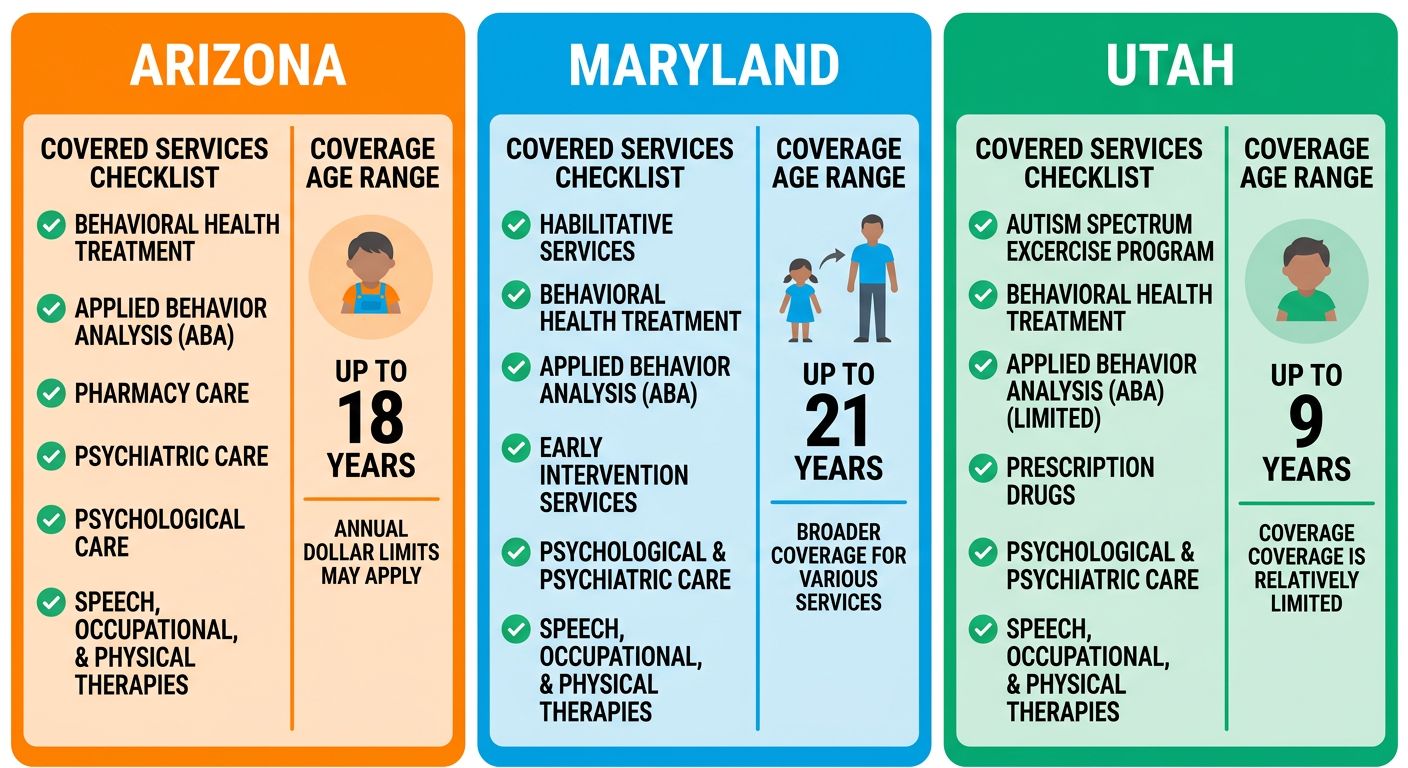
State autism insurance mandates at a glance for Arizona, Maryland, and Utah
We believe in the power of small steps. Verifying your benefits is the first small step toward unlocking the life-changing support your child deserves. Remember, insurance coverage is subject to verification and is not guaranteed. We’re here to help you understand your benefits so you can focus on what matters most: your family.
Consult a licensed healthcare professional for diagnosis or medical advice.
How State Insurance Mandates Interact with Federal Laws: ERISA and More
Many states have enacted an autism insurance mandate to help families access evidence-based therapy. But if you have a health plan through a large employer, you might be surprised to learn that federal law can override those state protections. That’s where ERISA comes in, and understanding the difference between plan types is the key to unlocking your coverage.
ERISA Plans and State Mandate Exemptions
ERISA, or the Employee Retirement Income Security Act of 1974, is a federal law that sets minimum standards for most voluntarily established health plans. When a company decides to pay employees’ medical claims directly rather than buying traditional insurance, the plan is called self-funded or self-insured. Because these plans are regulated by the U.S. Department of Labor under ERISA, they are generally exempt from state insurance mandates—including the autism insurance mandate your state may have passed. In other words, even if your state requires coverage for autism treatment, a self-funded plan isn’t legally obligated to follow that rule. That said, many self-funded plans still choose to include autism benefits because employers value robust coverage. The critical point is that the protection is voluntary, not a legal requirement. As Golden Touch ABA emphasizes, this distinction is the foundation of understanding your coverage options.
The following table breaks down the differences between state-regulated and self-funded plans so you can quickly identify where your policy stands.
| Plan Type | Regulated By | Must Follow State Autism Mandate? | Key Consideration |
|---|---|---|---|
| State-Regulated (Fully Insured) | State Insurance Department | Yes, must comply with state mandates if applicable | Coverage varies by state; check state laws |
| Self-Funded (ERISA) | Federal ERISA (Department of Labor) | Generally no, exempt from state mandates | Check plan document; may offer different autism coverage |
Reference: ERISA guidelines, Department of Labor
While a self-funded plan is not required to honor your state’s mandate, it doesn’t automatically mean there’s no autism coverage. Many employers still include behavioral health benefits, and the plan document is the final word. The Autistic Self Advocacy Network encourages families to be proactive about plan transparency, and we’re here to help you sort through the details.
Checking Your Plan Type
Figuring out whether your plan is state-regulated or self-funded takes just a few practical steps. Start by asking your company’s human resources department or benefits administrator directly, “Is our health plan self-funded or fully insured?” If you have your summary plan description or benefits booklet, look for keywords like self-funded, self-insured, or ERISA plan. A statement that the plan is “not subject to state regulation” is another clear sign of a self-funded arrangement. When you’re reviewing documents, also pay attention to ABA therapy insurance coverage language—even self-funded plans often have a behavioral health section that outlines autism services. If you’re unsure, we can help you verify your plan details during the insurance assistance process.
Implications for In-Home ABA Therapy
Whether your child receives in-home ABA therapy with a Board Certified Behavior Analyst (BCBA) and Registered Behavior Technicians (RBTs) often hinges on your plan type. If you have a fully insured plan, the state autism insurance mandate typically requires coverage for medically necessary ABA services, which can include home-based sessions. If your plan is self-funded, the coverage picture depends entirely on the employer’s chosen benefits. You may still have access to ABA therapy, but the specific criteria—such as demonstrating ABA therapy medical necessity through a comprehensive assessment—are defined by the plan, not by state law. For example, if your plan is fully insured and you are considering an out-of-network provider, check whether out of network ABA therapy in Utah is covered. Knowing your plan type is the first step to securing coverage for in-home ABA therapy. Our insurance assistance team at Golden Touch ABA Therapy can help you verify your benefits and understand what’s available under your unique plan. Please remember, insurance coverage is subject to verification and is not guaranteed.
Practical Steps to Determine Your ABA Therapy Insurance Coverage
At Golden Touch ABA Therapy, we understand that navigating your child’s insurance benefits can feel overwhelming, but taking a methodical approach makes the process much more manageable. By following a few clear steps, you can gain a clearer picture of what your plan covers and how to access the high-quality ABA therapy our team provides in a warm and welcoming environment.
Review Your Insurance Policy
The first practical action is to confirm whether your plan includes an autism insurance mandate, because this state-level requirement often sets the baseline for aba therapy insurance coverage. Start by locating your plan’s official Summary of Benefits and Coverage (SBC) — you can usually download it from your insurer’s online portal or request a printed copy.
Follow these steps to review your policy:
- Open the SBC and search for terms such as “applied behavior analysis,” “autism treatment,” or “behavioral health therapy.” Many plans list these services under a dedicated behavioral health section.
- Note any benefit limits, visit caps, or annual maximums that may apply. Some policies set a dollar cap or a maximum number of sessions for aba therapy insurance coverage.
- Check for in-network versus out-of-network provider rules; seeing an in-network provider usually lowers your costs.
- If the language is unclear, call the member services number on your insurance card and ask directly whether ABA therapy is a covered benefit under your specific plan.
Obtain Prior Authorization and Medical Necessity Documentation
Most insurance plans require prior authorization before beginning ABA services, and they nearly always ask for a formal medical necessity review. A strong medical necessity document — typically prepared by a licensed clinician — describes your child’s diagnosis, current functional impairments, and how the proposed treatment will address those needs. As Golden Touch ABA’s own FAQs explain, this letter often includes diagnostic evaluation results, standardized assessment scores, and individualized treatment goals that align with evidence-based practices (Golden Touch ABA).
To secure authorization, follow these steps:
- Contact your insurance company and ask for their prior authorization form or online portal instructions.
- Work with your child’s BCBA to compile clinical documentation, including the diagnostic report, a treatment plan with measurable objectives, and the aba therapy medical necessity statement.
- Submit the complete packet according to your insurer’s guidelines — many plans require a response within 14 calendar days.
- Follow up regularly and be prepared to provide additional information if the reviewer requests clarification.
The table below highlights key differences between Medicaid and private insurance when it comes to aba therapy insurance coverage:
| Coverage Type | State Mandate Applicable? | Medical Necessity Requirement | Out-of-Pocket Costs |
|---|---|---|---|
| Medicaid | Yes, states may have separate Medicaid mandates | Must meet EPSDT criteria; documentation required | Minimal or no cost-sharing |
| Private Insurance (State-Regulated) | Yes, subject to state laws | Must follow plan-defined medical necessity criteria | Deductibles, copays, coinsurance |
Regardless of the funding source, coverage is never guaranteed, and every plan has its own clinical review process. We strongly recommend verifying your benefits before starting any service, because even under a state autism insurance mandate, individual policy language can vary. If you run into roadblocks, do not be discouraged — persistence often pays off, and many families succeed after a second or third appeal.
Work with Your ABA Provider’s Insurance Assistance Team
You are not alone in this journey. Our dedicated insurance assistance team helps families like yours navigate the complexities of aba therapy insurance coverage every day. We can verify your benefits, submit prior authorization requests, and handle appeals on your behalf — all while you focus on what matters most. As part of our family-centered care approach, we also point families toward helpful ABA educational resources that explain the broader landscape of autism treatment options. If you feel stuck, simply reach out to us; together, we will take the next step forward — one small, meaningful stride at a time.
Understanding Medical Necessity and Documentation for ABA Therapy
When you begin exploring ABA therapy for your child, the term medical necessity quickly becomes a cornerstone of the conversation. Simply put, it is the standard insurance companies use to decide if a treatment is essential for your child’s health and ability to function. Understanding this concept is a critical first step in navigating the path to securing ABA therapy insurance coverage. Many states, including Maryland, have an autism insurance mandate that requires certain plans to cover autism treatments, but establishing the medical necessity for ABA treatment is always the key that unlocks those benefits.
At Golden Touch ABA Therapy, we believe demystifying this process is part of our commitment to family-centered care. To establish medical necessity, insurers typically look for three common elements. The table above outlines these criteria and the corresponding documentation that helps build a strong case for services.
A diagnosis of Autism Spectrum Disorder is the foundational piece, confirmed by a comprehensive diagnostic evaluation report. Next, insurers need to see evidence of significant functional impairment. This doesn’t just mean a diagnosis on paper; it means showing how challenges in communication, social skills, or daily living tasks, like getting dressed or eating, impact your child’s everyday life and that of your family. This is where detailed functional assessment results become invaluable.
Finally, there must be a demonstrated likelihood of benefit from ABA. At Golden Touch ABA Therapy, our BCBAs create a detailed, individualized treatment plan with measurable goals, showing precisely how our in-home ABA therapy will target those specific areas of impairment using evidence-based practices. This plan projects progress, giving the insurer a clear picture of why the treatment is necessary and what positive changes are expected. We see the power of small steps toward meaningful milestones as the heart of our work.
We assist families in gathering and presenting this documentation, answering questions covered in our internal resources on what medical necessity means and the exact criteria insurers review. For families seeking broader support, there are fantastic autism resources in Maryland that can provide additional guidance. Rest assured, navigating the details of medical necessity is a process we work through together, paving the way for the pre-authorization steps we’ll explore next.
Disclaimer: Insurance coverage is subject to verification and is not guaranteed. All treatment results may vary. This information is for educational purposes and does not replace consultation with a licensed healthcare professional.
Common Questions About Autism Insurance Mandates Answered
Navigating the world of ABA therapy often begins with understanding the autism insurance mandate in your state. These are laws that require many private health insurance plans to cover medically necessary treatments like ABA therapy. We understand this can feel confusing, so we’ve answered some of the most frequent questions we receive to help your family move forward.
- What is an autism insurance mandate? It’s a state law requiring certain insurers to provide ABA therapy insurance coverage for diagnosed individuals.
- How do I verify my coverage? We always recommend you contact your insurer directly, as mandates vary widely by state in terms of age limits and spending caps, but our team at Golden Touch ABA is here to walk you through the verification steps.
- What is medical necessity? For ABA therapy, medical necessity means a licensed physician has formally diagnosed your child with autism and provided a prescription stating that ABA therapy medical necessity is required for their development.
It is crucial to remember that a state mandate does not guarantee your specific plan will cover services. Insurance coverage is subject to verification and is not guaranteed. Once you have a formal diagnosis, we can help you connect with a Board Certified Behavior Analyst to document the necessity for treatment and begin the approval process.
If you have more questions about state-specific laws, we encourage you to consult the resources provided by a leading autism advocacy organization like Autism Speaks. Then, let us handle the paperwork so you can focus on what matters most—celebrating the power of small steps with your child. Ready to see how we can help with your benefits? Use our interactive roadmap to get started today.
Securing the ABA Coverage Your Child Deserves
An autism insurance mandate is a state law that requires insurers to cover ABA therapy for children with autism. To unlock coverage, your child’s treatment must be deemed an aba therapy medical necessity by a qualified provider. Our team steps in to verify your aba therapy insurance coverage, walk you through pre-authorization, and handle claims. Remember that the autism insurance mandate and specific benefits vary by plan and state, so always check your policy. Contact your insurer or use our eligibility support to get started. Insurance coverage is subject to verification.
Resources
- Get In-Home ABA Therapy for Autism in Utah
- Learn About Out-of-Network ABA Reimbursement in Utah
- Explore Out-of-Network ABA Coverage Under Utah SB195
- Navigate Cigna ABA Therapy Intake Process in Utah
- Discover Telehealth ABA Therapy CPT Codes and Modifiers
- Understand CPT Code 97151 for ABA Behavior Assessment
- Learn ABA Therapy Billing with the 8-Minute Rule
- Explore ABA Degree Programs and Career Pathways
- Find Autism Resources and Support in Maryland
- Get Support and Resources from Autism Speaks
- Explore Bierman’s Play-Based ABA and Therapy Programs
- Learn About Autistic Self-Advocacy and Disability Justice
Table of Contents
- Personalized ABA Therapy in Arizona for Your Child
- Arizona Communities We Serve
- In-Home ABA Therapy Coverage and Insurance Options in Arizona
- Local Expertise: Registered Behavior Technicians and Family Support in Arizona
- Starting ABA Therapy with Golden Touch in Arizona
- Supporting Arizona Families Through In-Home ABA Therapy
Personalized ABA Therapy in Arizona for Your Child
If you’re searching for aba therapy Arizona families rely on, Golden Touch ABA is here to help. We deliver personalized ABA therapy that adapts to your child’s unique strengths and challenges. Our plans are rooted in compassionate, evidence-based care and take place in the place your child feels safest—home.
In-home ABA therapy creates a warm and welcoming environment where children learn naturally. Our in-home ABA therapy in Arizona is delivered by experienced Board Certified Behavior Analysts (BCBAs) and compassionate Registered Behavior Technicians (RBTs). They embrace the power of small steps, breaking goals into manageable wins that build confidence. Throughout the process, we provide caregiver training, assist with insurance, and offer flexible scheduling options. We partner with you every step of the way because family-centered care is at the heart of everything we do.
Explore our interactive ABA roadmap tool to chart a personalized path forward—and please keep in mind that individual results vary and are not guaranteed.
Arizona Communities We Serve
Beyond our general services, we are proud to bring in-home ABA therapy to families across Arizona. Our goal is to provide compassionate, family-centered care in every community we touch, making ABA therapy arizona families rely on both accessible and effective. We currently offer support in several key areas, and you can find detailed information about all of our ABA therapy locations.
We believe that a warm and welcoming environment is crucial for a child’s growth, which is why we deliver all our services within the comfort of your own home. Our approach, built on evidence-based practices and the philosophy of “The power of small steps,” ensures that every child receives a treatment plan tailored to their unique needs.
The following table provides a quick overview of our primary Arizona service areas:
| Service Area | In-Home Therapy | BCBA Supervision |
|---|---|---|
| Phoenix Metro | Yes | Available |
| Tucson | Yes | Available |
| Flagstaff | Yes | Available |
This consistent availability across Arizona means that families in these communities can expect the same high standard of care. Each of our core service areas—
- The Phoenix Metro area
- Tucson
- Flagstaff
—is supported by experienced Board Certified Behavior Analysts and Registered Behavior Technicians who are dedicated to fostering meaningful progress. BCBA supervision is a cornerstone of our program, ensuring that every therapy plan is guided by expert oversight and aligns with professional standards recognized by the Arizona Association for Behavior Analysis.
Now that you know where we serve, let’s explore how our therapy works and what you can expect from our dedicated team.
In-Home ABA Therapy Coverage and Insurance Options in Arizona
Understanding your insurance benefits is a critical step when arranging in-home ABA therapy for your child. At Golden Touch ABA Therapy, we know that navigating coverage can feel overwhelming, so we offer dedicated support to families seeking aba therapy arizona services. We help you explore your options, whether you have a commercial plan, employer-sponsored insurance, or state-funded coverage through Medicaid aba therapy arizona.
Our team provides complimentary insurance assistance and benefits-eligibility support. The process begins with a free benefits check, where we contact your insurance provider to verify your aba insurance arizona details and explain any applicable co-pays or deductibles. Many families use this step to confidently understand their in-home aba therapy coverage arizona before committing to an assessment.
We commonly work with:
- Arizona’s Medicaid program (AHCCCS)
- Tricare
- Major commercial insurance plans
For additional advocacy and professional standards information, the Arizona Association for Behavior Analysis (AzABA) is a valuable industry resource.
Families exploring behavioral health insurance or autism therapy coverage should know that actual benefits vary by plan. Insurance coverage is subject to verification and is not guaranteed. We encourage you to contact our Arizona team directly for a personalized eligibility assessment and custom quote and ongoing support throughout the process.
Local Expertise: Registered Behavior Technicians and Family Support in Arizona
For those seeking aba therapy Arizona, finding a provider with deep local roots and a dedicated clinical team makes all the difference. Golden Touch ABA Therapy delivers in-home ABA therapy through multiple locations across the state, bringing personalized support directly to families in their own homes.
Our therapy sessions are implemented by Registered Behavior Technicians (RBTs), certified professionals who work under the close supervision of Board Certified Behavior Analysts (BCBAs). The behavior analyst certification board establishes the rigorous certification requirements and ethical standards that govern RBT practice nationwide. We believe family involvement is key to lasting progress. Our family-centered approach includes caregiver training and collaboration, ensuring parents have the tools to reinforce skills between sessions. This partnership typically includes:
- Caregiver coaching on reinforcement strategies
- Regular progress updates and collaborative goal setting
Our local Arizona team understands the unique needs of families in our communities. We are committed to evidence-based practices delivered in a warm and welcoming environment, helping children build skills that last. Our experienced team guides you through every step, from initial questions to insurance verification. We would be happy to help — please contact us to learn more. Results may vary, and insurance coverage is subject to verification and is not guaranteed.
Starting ABA Therapy with Golden Touch in Arizona
Taking the first step toward ABA therapy in Arizona is simpler than you might expect. At Golden Touch ABA, we’ve designed our intake process to be welcoming and straightforward, guiding your family from that initial phone call to the first in-home session with warmth and clarity. We believe in creating a warm and welcoming environment from the very first conversation, answering your questions and helping you feel supported every step of the way.
Our services are delivered right in your home, where your child feels most comfortable. We proudly provide in-home ABA therapy to families across Arizona, including Phoenix, Benson, and the surrounding communities. Every session is led by a dedicated Board Certified Behavior Analyst (BCBA) — the clinician who designs and oversees your child’s plan — and implemented by a compassionate Registered Behavior Technician (RBT), who works directly with your child.
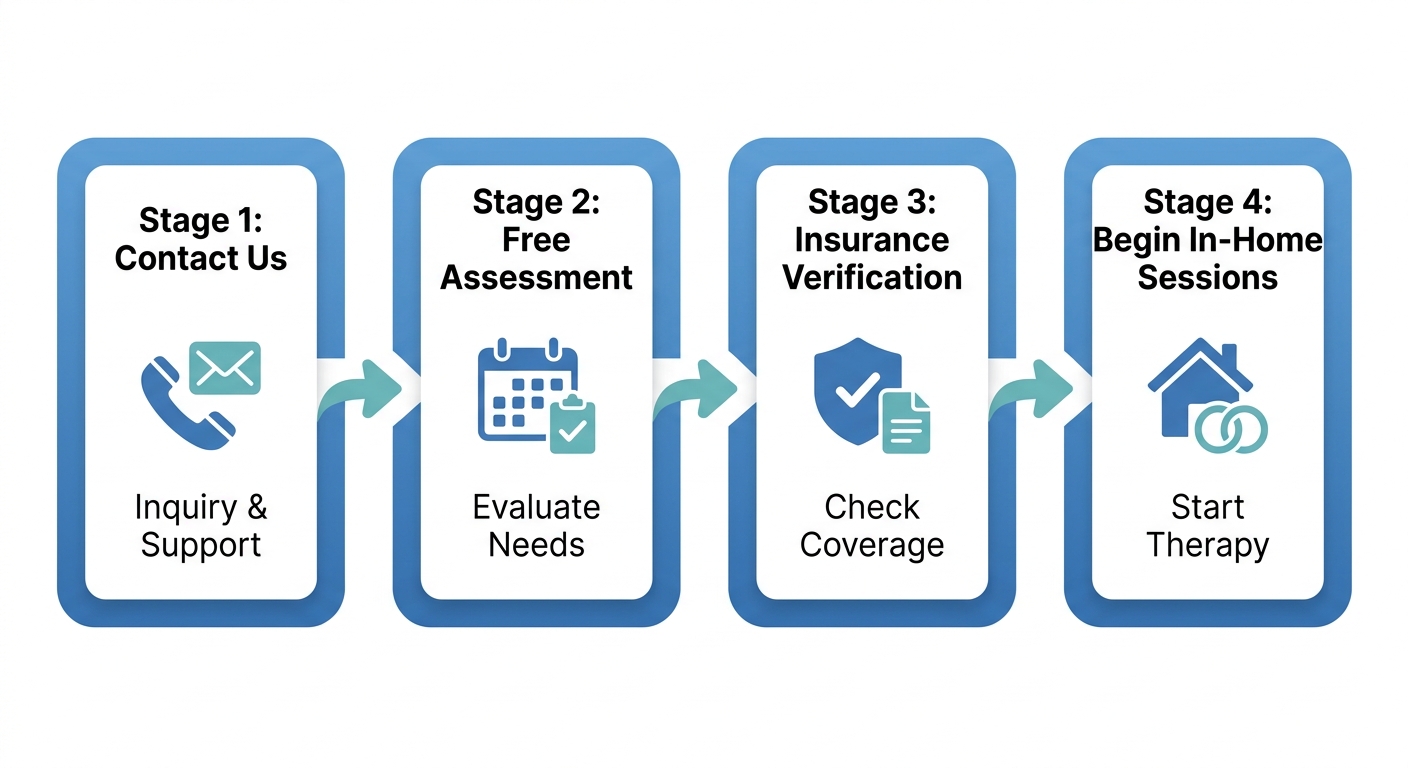
Four-step process to begin in-home ABA therapy with Golden Touch in Arizona.
Beginning ABA services in Arizona follows a clear, four-step path:
- Contact Us: Reach out via our online form or call us at 480-470-3014. A friendly team member will listen to your needs and schedule a time to talk.
- Free Assessment: We conduct a no-cost, no-obligation initial consultation to understand your child’s strengths and goals. This family-centered care approach ensures our planning includes your insights and priorities.
- Insurance Verification: We navigate the paperwork for you. Our team helps verify your insurance benefits and check eligibility, including Medicaid, so you can focus on what matters most—your child.
- Start of Therapy: An individualized, evidence-based treatment plan is created and in-home sessions begin on a schedule that works for your family.
While our hearts are firmly rooted in serving Arizona families, we also extend our reach to other communities. For instance, Golden Touch provides ABA therapy in Emigration Canyon, Utah, bringing the same dedicated, in-home support to that region. Once therapy begins here in Arizona, our team continuously monitors progress and adjusts the plan, fostering growth through the power of small steps, a journey we’ll explore in more detail next.
Supporting Arizona Families Through In-Home ABA Therapy
Expanding on ABA therapy’s benefits, we now highlight how we bring in-home ABA therapy to families across Arizona. We create a warm and welcoming environment in your home, where your child can thrive. Our family-centered care approach partners you with BCBAs and RBTs who champion the power of small steps every day. We also offer insurance and benefits eligibility support to ease your journey.
Resources
- Get In-Home ABA Therapy for Autism in Arizona
- Find ABA Therapy Services in Arizona, Maryland, Utah
- Get ABA Therapy Services in Emigration Canyon Utah
- Home-Based ABA Therapy in Eagle Mountain Utah
- Autism Therapy in Washington Terrace Utah
- Learn About Golden Touch ABA Therapy Approach
- Find In-Home ABA Therapy in Maryland
- Explore Professional Behavior Analysis in Arizona
- Get Behavior Analyst Certification Board Resources
Table of Contents
- Personalized ABA Therapy for Frederick County Families
- ABA Therapy in Frederick County: A Community-Focused Approach
- In-Home ABA Therapy Services Available in Frederick, MD
- Local Factors for Choosing ABA Therapy in Frederick County
- Steps to Start ABA Therapy for Your Child in Frederick
- Empowering Frederick Families with Quality ABA Therapy
- Resources
Personalized ABA Therapy for Frederick County Families
We bring in-home ABA therapy in Frederick MD directly to your family’s doorstep, creating a warm and welcoming environment where your child can learn and grow. As one of the leading autism therapy providers in Maryland, we design every program to match Frederick County families’ unique needs, schedules, and goals.
Our Board Certified Behavior Analysts (BCBAs) create individualized treatment plans that target communication, daily living skills, and independence. We coach caregivers throughout the process so ABA therapy in Frederick County becomes a true team effort. Because we deliver in-home ABA therapy Frederick MD families trust, we stay flexible when routines shift, ensuring the power of small steps happens right in your living room.
We also help families navigate insurance verification and benefits for autism therapy Frederick MD programs. If you are exploring autism therapy Frederick County MD services, try our free interactive ABA roadmap tool—it is a quick way to see next steps.
Results vary, and insurance coverage is subject to verification.
ABA Therapy in Frederick County: A Community-Focused Approach
When families in Frederick County begin exploring aba therapy in frederick md frederick county autism therapy, they discover that a community-focused, family-oriented approach makes all the difference. At Golden Touch, we deliver in-home ABA therapy in Frederick MD that prioritizes natural settings, family collaboration, and flexible scheduling — because every child’s journey is unique.
Frederick County families typically compare three main options: in-home, clinic-based, and school-based ABA services. The table below outlines the key differences.
| Feature | In-Home ABA (Golden Touch) | Clinic-Based ABA | School-Based Support |
|---|---|---|---|
| Therapy Environment | Natural family setting | Clinical setting | Classroom setting |
| Family Involvement | High | Moderate | Limited |
| Flexibility | Very flexible | Fixed schedule | School hours |
| Wait Times | Often shorter | Can be long | IEP dependent |
In-home ABA clearly stands out for its flexibility and high family involvement. When you research autism therapy providers in Maryland, you’ll find that Golden Touch offers a level of personalization and caregiver training that is hard to match. By embedding therapy into daily routines, our BCBA-led team helps children learn in a warm, welcoming environment.
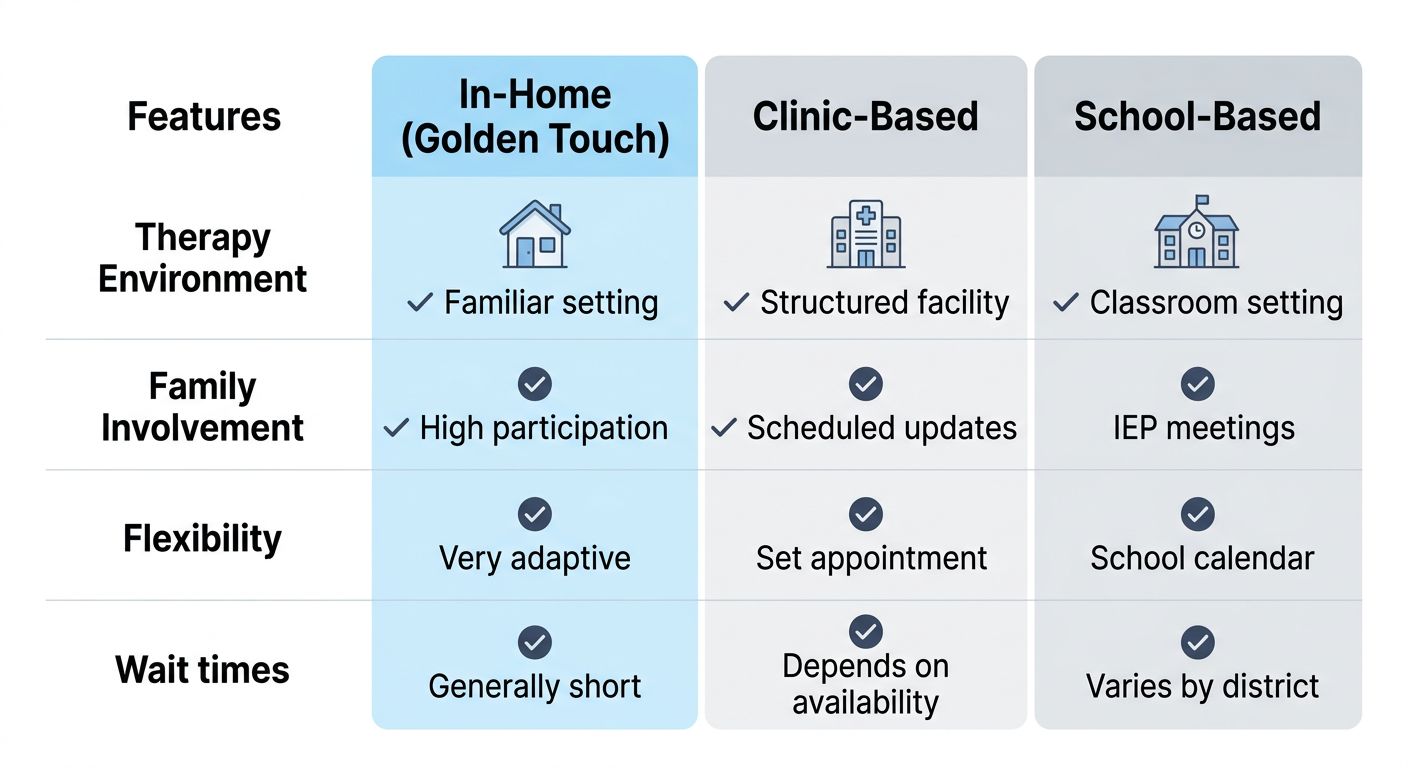
Comparison of ABA therapy delivery models highlights the benefits of in-home therapy.
Our clinicians — certified BCBAs and RBTs — follow the rigorous standards of the Behavior Analyst Certification Board (BACB). Organizations such as the Association for Science in Autism Treatment (ASAT) affirm that ABA is an evidence-based, scientifically validated intervention. We combine that science with family-centered care and celebrate the power of small steps every day.
Beyond therapy, we assist with insurance verification and flexible scheduling, so you can focus on what matters most. If you’re ready to explore aba therapy in frederick md frederick county autism therapy with a team that truly partners with your family, reach out for a custom quote. We’ll help you take the next step on your child’s journey — right at home, right here in Frederick County.
In-Home ABA Therapy Services Available in Frederick, MD
At Golden Touch ABA Therapy, we provide comprehensive in-home ABA therapy in Frederick, MD, serving families across Frederick County with personalized autism therapy. Our supportive services extend to both children and adults on the autism spectrum, making evidence-based care accessible right in your own home.
As one of the leading autism therapy providers in Maryland, our team designs individualized plans tailored to your loved one’s strengths and goals. A BCBA supervises every program, and our compassionate RBTs deliver therapy sessions right in your Frederick home. We believe in the power of small steps, creating a warm and welcoming environment where progress feels natural. Our family-centered care includes caregiver training, so you’re equipped to support skill building every day. We also assist with insurance verification and benefits eligibility—insurance coverage is subject to verification—helping you focus on what matters most. Every session is grounded in evidence-based practices, ensuring quality and consistency. We serve all of Frederick County, making in-home ABA therapy accessible, and offer autism therapy in Frederick, MD, for those who need continued support.
Ready to begin? Contact us for a free consultation, learn about custom quotes, or explore our interactive ABA roadmap tool. Results may vary based on individual factors and commitment; insurance coverage is subject to verification. Consult a licensed healthcare professional for medical advice. Let us bring the power of small steps to your Frederick home.
Local Factors for Choosing ABA Therapy in Frederick County
When choosing ABA therapy in Frederick County, provider credentials, evidence-based methods, and the therapy setting matter most. Verifying that a practice is staffed by Board Certified Behavior Analysts (BCBAs) is essential. We only hire therapists who maintain current BACB behavior analyst certification, which is the gold standard set by the Behavior Analyst Certification Board. The Association for Science in Autism Treatment (ASAT) also encourages families to seek out scientifically validated autism therapy Frederick County MD providers.
In-home ABA therapy Frederick MD provides a truly personalized, family-centered care model. We bring evidence-based practices directly into your home, where children learn communication, daily living skills, and social interaction in the context they know best. Our team supports families with insurance assistance, Medicaid coordination, and flexible scheduling, so you can focus on what matters. The interactive ABA roadmap tool guides you through each phase, celebrating the power of small steps.
Once you know what to look for, getting started is the next logical step. We make intake simple and transparent, with no pressure and no guaranteed outcomes. Results may vary and insurance coverage is subject to verification. We would be honored to walk you through the process.
Steps to Start ABA Therapy for Your Child in Frederick
Now that you understand the benefits, here’s how to start aba therapy in frederick md frederick county autism therapy with us. As a provider of science based autism treatment ASAT, we rely on evidence-based practices.
- Contact us today to schedule a free initial consultation and ask any questions about aba therapy frederick.
- Complete a comprehensive assessment with a Board Certified Behavior Analyst (BCBA) to identify your child’s strengths and needs.
- Receive a personalized treatment plan for in home aba therapy frederick md tailored to your child.
- We’ll verify your insurance coverage and explain your financial options.
- Begin in-home ABA therapy with a dedicated Registered Behavior Technician (RBT) under BCBA supervision in your home.
- Participate in caregiver training sessions to implement strategies at home and reinforce progress.
- Track milestones with our interactive ABA roadmap tool and celebrate the power of small steps.
Once therapy begins, you’ll see the benefits of aba therapy in frederick md frederick county autism therapy. We’ll guide you through progress monitoring and goal updates. Results may vary, and insurance coverage is subject to verification. We’re dedicated to family-centered care in a warm and welcoming environment.
Empowering Frederick Families with Quality ABA Therapy
At Golden Touch ABA Therapy, our in-home Frederick County Public Schools special education support empowers families with personalized, evidence-based care. For those seeking aba therapy in frederick md frederick county autism therapy, we deliver family-centered care, caregiver training and ongoing support. Our BCBA-supervised team creates a warm and welcoming environment, coordinating with school services. Insurance coverage is subject to verification and is not guaranteed. Results may vary (no guaranteed outcomes).
Resources
- Get BCBA-Supervised In-Home ABA Therapy for Children with Autism
- Learn About ABA Therapy Waitlists in Maryland
- Find ABA Therapy Coverage in Baltimore and Montgomery Counties
- Get a Five-Step Guide for ABA Therapy with Maryland Medicaid
- Discover ABA Therapy and RBT Training Resources in Maryland
- Discover Which Maryland Counties Have Best ABA Coverage
- Find Golden Touch ABA In-Home Therapy in Maryland
- Get BACB Certification Information for Behavior Analysts
- Get Science-Based Autism Treatment Resources from ASAT
- Get FCPS Special Education Services for Students with Autism
Table of Contents
- Decoding ABA Therapy CPT Codes: A Guide for Families
- Understanding ABA Therapy CPT Codes
- Billing Code Differences and Telehealth Coverage
- Practical Steps for Accurate ABA Coding and Insurance Claims
- State Autism Insurance Mandates and 2026 Updates
- Frequently Asked Questions About ABA Therapy Billing
- Navigating ABA Billing with Confidence
Decoding ABA Therapy CPT Codes: A Guide for Families
Navigating the world of ABA therapy often begins with understanding how insurance works, and at the heart of it are ABA therapy CPT codes. These are the standardized billing codes insurance companies use to identify each specific service your child receives during their in-home ABA therapy.
Understanding medical necessity for ABA therapy is key to seeing why certain codes are approved. Our guide explains that medical necessity is the standard insurers use to determine if treatment is reasonable and required. This documentation is what allows us to bill a specific CPT code for the services delivered by our team.
Each CPT code represents a unique service, and we’re here to help you review your statements with confidence. Here are the most common codes you will see:
- 97151: A behavioral assessment conducted by a BCBA to create your child’s initial or ongoing treatment plan.
- 97153: Direct one-on-one therapy provided by a Registered Behavior Technician (RBT) to build new skills.
- 97155: Protocol modification, where a BCBA supervises the treatment plan and adjusts goals based on your child’s progress.
- 97156: Caregiver training delivered by a BCBA or RBT to help you integrate evidence-based practices at home.
We advise you to cross-check these codes on your Explanation of Benefits (EOB) with the sessions your child actually attended to catch any potential mistakes. As part of our family-centered care, we are always here to answer your questions about ABA therapy billing codes, even as coverage details can vary by insurance plan. Please remember that insurance coverage is always subject to verification and is not guaranteed.
Understanding ABA Therapy CPT Codes
Current Procedural Terminology (CPT) codes serve as the standardized language for billing medical and behavioral health services, including ABA therapy CPT codes used in autism treatment. When we deliver in-home Applied Behavior Analysis therapy, our team uses specific Category I CPT codes from the American Medical Association to document each session type accurately. These codes help ensure that your child’s treatment is properly recorded, supporting transparent communication with insurers and allowing us to focus on what matters most: your child’s progress in a warm and welcoming environment.
The most common CPT codes for ABA therapy break down into three distinct categories based on who provides the service and the nature of the session. Each code is billed in 15-minute units, so the total units on a claim reflect the exact duration of care delivered. Understanding these codes gives you insight into how treatment sessions are structured and why different team members play different roles in your child’s plan.
The following table compares the most frequently used Category I CPT codes for ABA therapy, including their descriptions, typical applications, and billing unit values.
| Code | Description | Typical Use | Billing Unit |
|---|---|---|---|
| 97153 | Adaptive behavior treatment by protocol | Direct one-on-one therapy by RBT under BCBA supervision | 15 minutes |
| 97155 | Adaptive behavior treatment with protocol modification | BCBA modifying treatment plan during session with client | 15 minutes |
| 97156 | Family adaptive behavior treatment guidance | Parent/caregiver training and guidance sessions | 15 minutes |
97153 represents the direct, one-on-one therapy that most families picture when they think of ABA services. A Registered Behavior Technician (RBT) implements the treatment protocol designed by a Board Certified Behavior Analyst (BCBA), working with your child on specific skill-building or behavior-reduction goals. Because RBTs deliver the bulk of hands-on therapy hours, 97153 is often the most frequently billed code in a comprehensive treatment plan. Our BCBAs maintain close supervision over every session, ensuring that evidence-based practices guide each interaction.
When the BCBA needs to modify the treatment plan during a session, we use 97155. This code applies when the supervising analyst is present and actively adjusting the protocol based on real-time observations. For example, if a particular reinforcement strategy isn’t producing the expected engagement, the BCBA can revise the approach immediately and document that clinical decision. This dynamic oversight ensures that your child’s program evolves as their needs change.
Family-centered care is at the heart of 97156, the code for family adaptive behavior treatment guidance. These sessions focus on parent and caregiver training, equipping you with the strategies and confidence to reinforce therapeutic techniques outside of formal therapy hours. Whether we are working on communication prompts, behavior management, or daily living skills, 97156 sessions strengthen the consistency between our team’s work and your family’s routines. We believe in the power of small steps, and caregiver guidance sessions often become the foundation for lasting progress at home.
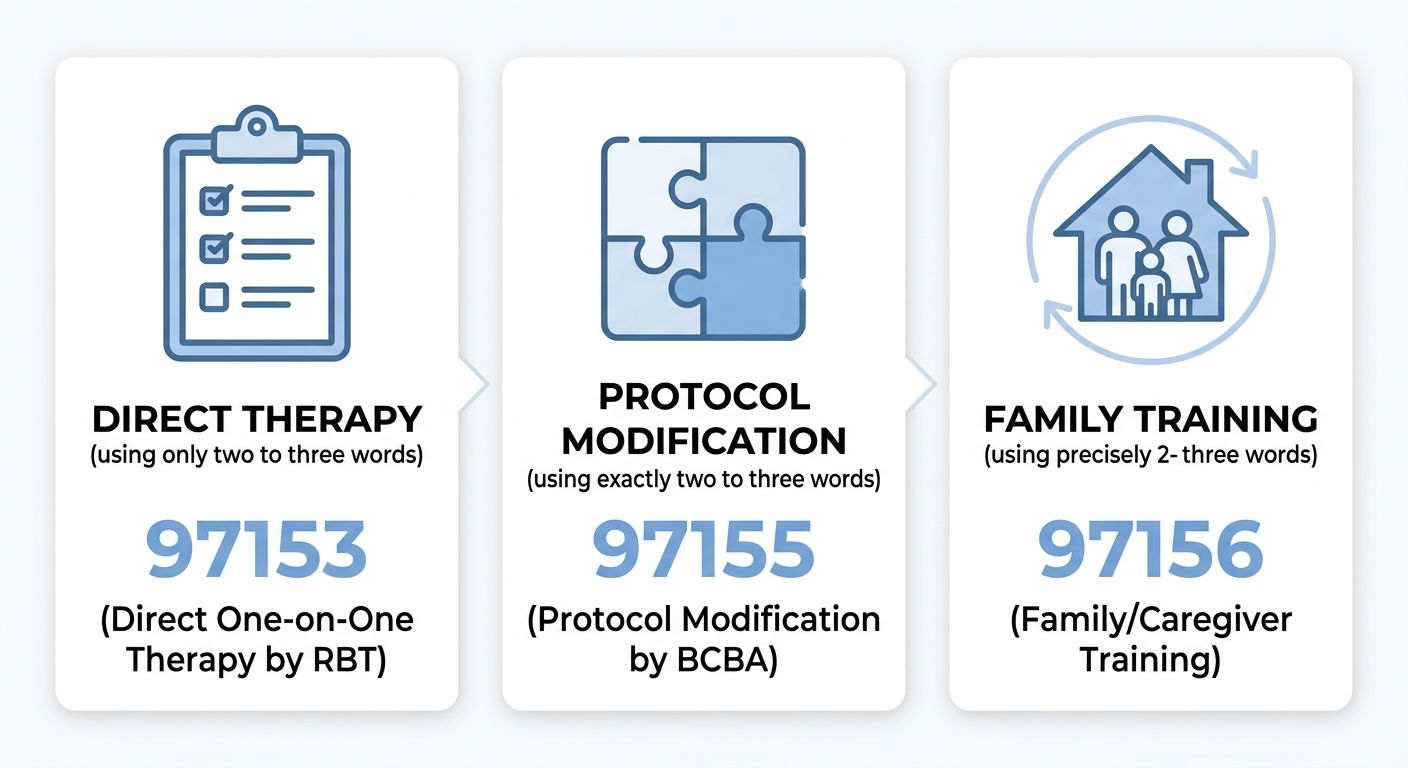
Common ABA therapy CPT codes visualized for easy reference.
Proper code selection depends on who is providing the service and what the session is designed to accomplish. Only RBTs working under BCBA supervision should deliver services billed under 97153, while 97155 and 97156 require the direct involvement of the supervising analyst. Misapplying codes can trigger claim denials or audits, which is why our team carefully documents every session and matches the code to the clinical activity performed.
Beyond accurate billing, these codes connect directly to the concept of medical necessity for ABA therapy. Insurers typically require that the services billed under 97153, 97155, and 97156 be supported by documentation showing that treatment is medically necessary. Our internal resources explain how a formal autism diagnosis, documented functional impairments, and a reasonable expectation of improvement all contribute to establishing that necessity. By aligning CPT codes with thorough clinical records, we help families navigate the authorization process while keeping the focus on high-quality, individualized care.
Understanding ABA therapy CPT codes is a valuable step toward understanding the overall treatment process. In the next section, we’ll explore how these codes fit into insurance coverage and benefits verification — because knowing what your plan covers starts with knowing how your child’s services are coded and submitted.
Billing Code Differences and Telehealth Coverage
Moving from general billing challenges, we focus on specific ABA therapy CPT codes that shape accurate claims. At Golden Touch ABA Therapy, family-centered care guides our documentation, ensuring each session is coded correctly for reimbursement.
97153 vs. 97155: Direct Therapy and Protocol Modification
97153 applies to direct therapy by an RBT, such as discrete trial training or incidental teaching, delivered one-on-one. It captures face-to-face time in 15-minute units. For example, when teaching a child to request items, the technician follows the treatment plan and tracks minutes. Meanwhile, 97155 is used when the BCBA oversees and modifies the protocol during a session—adjusting reinforcement or prompting strategies based on real-time observation. This code accounts for clinical supervision and adaptation, not direct implementation. Distinguishing between implementation and protocol modification prevents billing errors and supports compliance. Our team helps families navigate these ABA therapy CPT codes with clarity.
Initial Assessment Codes and Telehealth Modifiers
Before therapy begins, 97151 covers the initial assessment, including the treatment plan and behavior evaluation. This code establishes the child’s baseline and must be supported by robust documentation. For telehealth, we append modifier 95 for synchronous video sessions or GT for interactive audio/video, as required by payers. Accurate modifier use confirms that services meet the medical necessity for ABA therapy criteria. However, aba therapy insurance coverage for virtual visits can vary, and state autism insurance mandates may influence payer policies. We handle the verification process so families can experience the power of small steps in a warm and welcoming environment.
To clarify these distinctions, compare telehealth and in-person billing:
| Aspect | In-Person | Telehealth |
|---|---|---|
| CPT Codes Used | Standard codes (97153, 97155, etc.) | Same codes plus appropriate modifier |
| Required Modifier | None | 95 (synchronous) or GT (interactive audio/video) |
| Billing Unit | 15-minute increments | Same 15-minute increments |
| Payer Coverage | Standard for most plans | Varies by plan; may require prior authorization |
The table highlights that core coding remains consistent, while modifiers and prior authorizations add complexity. We verify benefits for each family, advocating for coverage where possible. With these foundations in place, precise unit calculation ensures billing integrity.
Calculating Billing Units Accurately
Converting therapy minutes into billable units follows strict rules:
- Track total minutes per code, such as 97153, for the session.
- Use the mid-session rule: at least 8 minutes of a 15-minute block counts as one unit. For 23 minutes, bill 1 unit; for 24 minutes, bill 2 units.
- Never combine minutes from different codes—calculate units separately.
- Align units with the prescribed treatment plan to support medical necessity.
Proper unit calculation prevents audits and claim denials. Remember, insurance coverage is subject to verification and is not guaranteed. Staying current on ABA therapy CPT codes safeguards your practice. In the next section, we’ll review practical claim submission steps and common errors to avoid.
Practical Steps for Accurate ABA Coding and Insurance Claims
To ensure accurate reimbursement and avoid claim denials, we recommend following these practical steps. Understanding ABA therapy CPT codes is essential for any provider or caregiver navigating the insurance landscape. Here at Golden Touch ABA Therapy, we believe in family-centered care and the power of small steps to make big progress.
Verifying Insurance Coverage for ABA Therapy
We guide families through the verification process to avoid surprise bills. Start by asking your insurance provider: Is ABA therapy a covered benefit? Does it require prior authorization and what documentation is needed? Are there visit caps or age limits? Always request a written benefit summary listing exclusions and copays. Our team helps you gather the diagnostic report and Letter of Medical Necessity required by most insurers.
Understanding your plan type is just as important, because coverage rules differ significantly. Some state autism insurance mandates require fully-insured health plans to cover ABA therapy, but self-funded employer plans are regulated by federal ERISA law instead. It’s important to understand that some employer health plan exemptions may limit coverage even if your state has a mandate. The table below contrasts the two most common plan structures to help you anticipate your coverage and appeal rights.
| Feature | Fully-Insured Plan | Self-Funded Plan |
|---|---|---|
| Regulated by State Mandates | Yes — must comply with state autism insurance laws | No — exempt from state mandates under ERISA |
| Coverage for ABA Therapy | Often covered if state mandate exists | Varies by employer; not guaranteed |
| Appeal Rights | Available through state insurance department | Available through ERISA/federal claims process |
| Premium Structure | Fixed premium paid to insurer | Employer pays actual claims + administrative fees |
If your plan is fully-insured in a state with an autism mandate, you’re more likely to have robust coverage. For self-funded plans, verify benefits directly with the plan administrator and be prepared for a federal appeals process if needed. Always consult with your insurance provider before services begin.
Documenting Therapy Sessions for Reimbursement
Once coverage is confirmed, thorough documentation is the foundation for successful reimbursement. For common ABA therapy CPT codes such as 97155 (treatment modification), 97153 (technician-delivered therapy), and 97156 (family guidance), session notes must include key elements. We recommend that every note contain the date and time of service, the setting (home, community), a clear description of the activities performed, the client’s response to interventions, and the data collected — such as frequency, duration, or latency of target behaviors. The note should tie directly to the treatment plan goals and demonstrate how the session promoted meaningful progress.
Compliance with payer documentation standards is critical. Many insurers require notes to be completed within 24 hours, signed by the rendering provider, and to contain objective, measurable information. At Golden Touch ABA Therapy, our BCBAs and RBTs follow a standardized checklist to ensure every note meets these expectations. Please remember that outcomes vary, and this information does not replace professional medical advice. Insurance coverage is subject to verification and is not guaranteed. Please review our Privacy Policy and Terms & Conditions for more information about how we handle your data.
Common Coding Errors to Avoid
Even with verified coverage and detailed notes, coding mistakes can lead to claim denials. A frequent error is unbundling codes, such as billing both 97155 and 97153 on the same day without proper documentation of separate services. This often results in rejections. Another common mistake is inappropriate use of Modifier 59. This modifier should only be applied when two distinct procedural services are performed during the same session, and the note must clearly justify the separation. Using it without support invites audits. Unit rounding errors are also common. ABA is billed in 15-minute units. Under the 8-minute rule, a 53-minute session should be billed as three units, not four. Double-check your calculations and stay informed about payer-specific rounding rules.
We recommend auditing claims before submission and maintaining clear communication with your billing team. Careful verification, thorough documentation, and accurate coding will reduce denials and let you focus on delivering family-centered care. In the next section, we’ll discuss state mandates in more detail.
State Autism Insurance Mandates and 2026 Updates
While the federal mental health parity law sets important baselines, state autism insurance mandates are what truly require many health plans to include ABA therapy insurance coverage. These laws mandate that state-regulated plans cover evidence-based autism treatments like Applied Behavior Analysis, preventing insurers from excluding them as experimental or educational.
A critical detail families must understand is that not all health plans must follow these rules. According to the U.S. National Library of Medicine, self-funded employer plans are exempt from state mandates under ERISA, while fully-insured plans—where the employer buys insurance from a carrier—are generally bound by them.
To illustrate how protections differ, the table below compares annual benefit limits and age caps across four representative states.
| State | Annual Benefit Limit | Age Limit | Important Notes |
|---|---|---|---|
| California | No annual dollar cap | Up to age 18 (some plans up to 21) | Coverage required for all plans regulated by DMHC |
| Texas | $30,000 (ages 0-3), $60,000 (ages 4-8), $36,000 (ages 9-15) | Up to age 15 (with exceptions) | Limits vary by age group; some plans have higher caps |
| New York | No annual dollar cap | No age limit specified | Coverage required for all state-regulated plans |
| Florida | $36,000 per year | Up to age 18 | Self-funded plans exempt; no annual cap for fully-insured |
As the table shows, state-level coverage requirements range from generous, no-cap policies in California and New York to the tiered caps in Texas and the flat limit in Florida. These variances mean that your child’s age and your employer’s plan type can dramatically affect what ABA services are accessible.
State autism insurance mandates can evolve through new legislation or administrative updates, so it’s wise to verify current rules with your state insurance department. We recommend using the interactive tools and benefits eligibility support we offer to help you navigate these complexities. Insurance coverage is subject to verification and is not guaranteed. With a clearer picture of what state laws provide, the next step is understanding how those benefits translate into the CPT codes and billing processes that providers use every day.
Frequently Asked Questions About ABA Therapy Billing
What is medical necessity for ABA therapy?
Medical necessity is the clinical justification insurers require to cover ABA therapy. Our team compiles evidence like a formal autism diagnosis, a functional behavior assessment, and an individualized treatment plan to show why services are essential for skill-building and behavior reduction. Without this documentation, authorization may be denied.
How do I verify my ABA therapy insurance coverage?
We verify benefits before treatment begins by contacting your insurer directly. Our team reviews the details of your plan, confirms whether we are in-network or out-of-network, and explains any copays, deductibles, or visit limits you might have. This step ensures transparency and helps families plan for their in-home ABA therapy journey.
What are the most common CPT codes for ABA therapy?
Common ABA therapy CPT codes include 97151 for assessments and 97153–97158 for treatment services. Codes like 0362T and 0373T may also appear for specific interventions. Accurate coding is part of our evidence-based practices and helps align clinical documentation with insurer requirements.
Does my state have autism insurance mandates?
Many states have autism insurance mandates requiring certain plans to cover ABA therapy, but rules vary widely. Our team stays current on state autism insurance mandates in Utah, Arizona, and Maryland to help families understand what their policy may include. We recommend consulting a licensed healthcare professional for diagnosis or medical advice.
How does billing work for in-home ABA therapy?
Billing is handled by our administrative team after each session using the appropriate ABA therapy CPT codes. We submit claims directly to your insurance provider and track authorizations to maintain continuity of care. Families receive updates so they can focus on family-centered care rather than paperwork.
Why isn’t insurance coverage for ABA therapy guaranteed?
Even with a strong medical necessity case, coverage depends on your specific plan’s benefits and the insurer’s policies. Initial authorization does not guarantee ongoing payment, and reauthorization may require updated documentation. Insurance coverage is subject to verification and is not guaranteed; results may vary, and no guaranteed outcomes are implied.
What role does the BCBA play in billing?
The BCBA designs the treatment plan and writes the letter of medical necessity that supports billing. Supervisory hours, protocol modifications, and caregiver training are coded under the BCBA’s credentials. The power of small steps is reflected in the BCBA’s ongoing data review, which helps justify continued authorization.
How does an RBT contribute to billing?
The RBT delivers one-on-one therapy under BCBA supervision, and their direct service hours are billed using treatment codes. Session notes and data collected by the RBT provide objective evidence of progress, reinforcing the medical necessity documentation our team submits.
Our team is here to support your family through every step of the billing process. Please contact us with questions about your specific coverage. Privacy Policy applies to collection and use of your personal information, and Terms & Conditions govern website use and limit liability.
Navigating ABA Billing with Confidence
Understanding insurance billing is a vital part of your family’s journey with in-home ABA therapy. This process involves submitting claims for services identified by ABA therapy CPT codes — standardized medical codes that ensure assessment, treatment, and supervision are properly documented.
Navigating aba therapy insurance coverage can feel overwhelming, from pre-authorizations to detailed documentation, but our insurance assistance team is here to help. We offer free benefits verification and guide you through private insurance or options supported by state autism insurance mandates. Insurance coverage is subject to verification and is not guaranteed.
Resources
- Who Can Write a Letter of Medical Necessity for ABA
- Explore Surgeon General Guidelines for ABA Medical Necessity
- Understand How Insurance Determines Medical Necessity for ABA
- Discover Insurer Criteria for ABA Medical Necessity
- Discover the Four Required Documents for ABA Medical Necessity
- Get the Complete Insurance Guide for ABA Medical Necessity
- Explore ABA Therapy Coverage Limits in Utah by Insurance
- Explore NCBI’s Biomedical and Genomic Databases
Table of Contents
- Finding Autism Therapy Providers in Maryland
- Maryland’s Autism Therapy Landscape
- In-Home ABA Therapy Availability in Maryland
- Important Considerations for Maryland Families
- Beginning ABA Therapy for Your Child in Maryland
- Your Path to ABA Therapy in Maryland
- Resources
Finding Autism Therapy Providers in Maryland
Finding the right autism therapy providers in Maryland starts with knowing what to look for. Once you understand how ABA therapy works, the next step is connecting with a team that can bring support directly to your doorstep. We offer in-home ABA therapy in Maryland designed to create a warm and welcoming environment where your child feels safe to learn and grow.
Our Board Certified Behavior Analysts (BCBAs) supervise every step, while skilled Registered Behavior Technicians (RBTs) deliver evidence-based practices during one-on-one sessions. Family-centered care means we involve you directly, offering caregiver training so progress continues between visits. We also provide insurance assistance and an interactive ABA roadmap tool to clarify the path ahead. The power of small steps guides our approach, and many families see meaningful gains with early intervention autism in Maryland. Results may vary, but our evidence-based approach aims for meaningful progress. Reach out to our Maryland team to learn how in-home ABA therapy in Maryland can fit into your family’s routine.
Maryland’s Autism Therapy Landscape
In Maryland, we see a diverse landscape of autism therapy providers in Maryland, offering a wide range of in-home ABA therapy options, though the concentration of services varies by county. Families researching providers will find many options listed on industry directories such as in-home ABA therapy in Maryland. The table below breaks down the coverage across several key counties to help you quickly identify the support available in your area.
| County | ABA Therapy Coverage | Types of Services Available | Notes |
|---|---|---|---|
| Anne Arundel County | Multiple in-home providers including Golden Touch ABA | In-home ABA, BCBA supervision, parent training | Proximity to Baltimore expands options |
| Baltimore County | High concentration of ABA providers | In-home, clinic-based, early intervention | Some providers may have waitlists |
| Montgomery County | Strong coverage with many BCBAs and RBTs | In-home, school collaboration, telehealth | Medicaid accepted by several agencies |
| Prince George’s County | Growing number of in-home providers | In-home ABA, parent coaching, insurance assistance | Check county-specific Medicaid policies |
| Howard County | Several trusted ABA agencies | In-home therapy, social skills groups, family support | Waitlists common; early contact advised |
Montgomery and Baltimore counties maintain the highest density of Board Certified Behavior Analysts (BCBAs) and Registered Behavior Technicians (RBTs), and many providers in these areas accept Medicaid, according to industry directories. Families in Howard and Prince George’s counties should note that waitlists can be common, so contacting providers early and verifying county-specific Medicaid policies are essential first steps. For families with younger children, early intervention autism in Maryland programs are widely available in these counties, offering parent training and BCBA-supervised therapy to build foundational skills from an early age.
With this landscape in mind, every family’s journey begins by identifying their local in-home ABA therapy in Maryland options and reaching out for a personalized assessment. Insurance coverage is subject to verification; results may vary.
In-Home ABA Therapy Availability in Maryland
Families seeking compassionate autism therapy providers Maryland can now access in-home ABA therapy Maryland from Golden Touch ABA Therapy right in their own communities. Our services bring the power of small steps to homes across the state, creating a warm and welcoming environment where children feel comfortable and supported as they learn.
According to our Maryland location page, we bring personalized, family-centered care to families in multiple counties, including Baltimore County, Montgomery County, and Prince George’s County. Our clinical team, led by a Board Certified Behavior Analyst (BCBA) and supported by skilled Registered Behavior Technicians (RBTs), delivers evidence-based practices in your child’s natural environment. For families exploring early intervention autism Maryland services, our in-home approach allows learning to happen where your child already plays, eats, and interacts, making each session a natural part of daily life.
We understand that navigating coverage can feel overwhelming, so our team provides dedicated insurance assistance to help you explore your options, including private plans and Medicaid. If you are seeking ABA therapy in Maryland with Medicaid, we can help you explore your options and connect you with additional resources. Insurance coverage is subject to verification and is not guaranteed.
Once you confirm availability in your area and understand your insurance options, the next step is a personalized assessment to start your child’s journey toward meaningful growth and greater independence.
Important Considerations for Maryland Families
When searching for reliable autism therapy providers in Maryland, families should start by understanding their insurance coverage. Verifying benefits with both private plans and Maryland Medicaid is essential before committing to a program. We encourage every family to request a benefits eligibility check so there are no surprises down the road.
Recognizing the early signs of autism is the first step toward early intervention. Indicators can appear as young as 6 months, and noting delays in social smiles, babbling, or eye contact can make a critical difference. Seeking early intervention autism in Maryland leads to more effective support and improved developmental outcomes for your child.
In-home ABA therapy in Maryland offers unique advantages for busy families. Receiving care in a warm and welcoming environment eliminates travel stress and allows caregivers to participate during everyday routines. Our family-centered care model ensures that evidence-based practices are woven into your child’s natural setting.
When choosing a provider, look for BCBA supervision and individualized treatment plans that celebrate the power of small steps. Quality programs adapt to your child’s needs, and our team is ready to help you verify coverage and schedule an in-home consultation.
Results may vary. Consult a licensed healthcare professional for diagnosis.
Beginning ABA Therapy for Your Child in Maryland
Starting ABA therapy can feel overwhelming, but we are here to guide you every step of the way. Families searching for autism therapy providers in Maryland will find a warm, welcoming, and collaborative partner in Golden Touch ABA. Our process begins with a simple, no-pressure conversation so we can learn about your child and answer your questions.
We begin with a free consultation to discuss your concerns and gather preliminary information. From there, our Board Certified Behavior Analyst (BCBA) completes a comprehensive behavioral assessment in your home. This allows us to understand your child’s unique strengths and needs within their natural environment. As an expert in early intervention autism in Maryland, our BCBA then designs a personalized plan built entirely around your child. We also help your family navigate insurance by verifying your benefits and explaining your coverage in clear terms, so you can focus on what matters most.
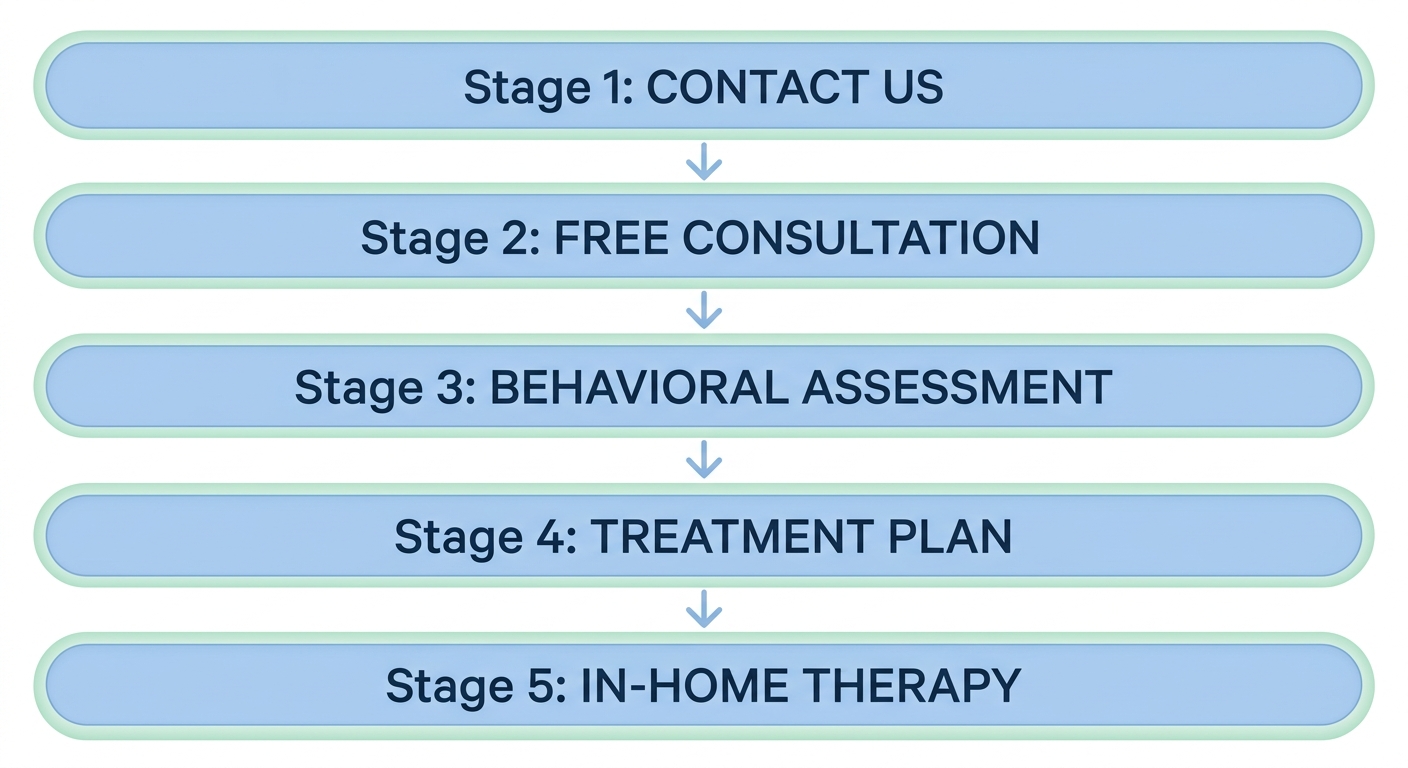
Five-step process to start in-home ABA therapy in Maryland.
Our in-home ABA therapy in Maryland sessions are delivered one-on-one by a compassionate Registered Behavior Technician (RBT) who is closely supervised by your BCBA. We believe in the power of small steps and family-centered care, which is why we incorporate ongoing caregiver training and adjust our approach based on your child’s progress. Evidence-based practices form the foundation of every session, creating a supportive structure for meaningful skill development. While every child’s journey is unique and results may vary, a consistent, early start provides the best foundation for growth. Reach out today for a custom quote and take the first step forward together.
Disclaimer: Results may vary. The information provided here is for educational purposes and does not replace consultation with a licensed healthcare professional.
Your Path to ABA Therapy in Maryland
Finding the right autism therapy providers Maryland families trust is easier than you might think. Ready to take the first step? Here’s how to start your journey with us:
- Schedule a free consultation or use our interactive ABA roadmap tool to share your child’s needs.
- Our team provides insurance verification assistance to clarify your benefits.
- A dedicated team of trained RBTs, supervised by a BCBA, delivers personalized in-home aba therapy maryland services.
While we also provide in-home ABA therapy in Utah, our Maryland families receive the same high-quality, compassionate care. Contact us today to begin.
Resources
- Get Expert In-Home ABA Therapy in Maryland
- Get In-Home ABA Therapy in Washington Terrace
- Discover Early Signs of Autism in Toddlers
- Learn Early Signs of Autism and ABA Therapy
- Find Early Signs of Autism in Infants
- Get Early Intervention ABA Therapy for Toddlers
- Discover Early Autism Signs and ABA Therapy
- Get ABA Therapy in Maryland with Bilingual Support
- Get ABA Therapy in Maryland for Children and Young Adults
Table of Contents
- ABA Therapy for School-Age Children: What Parents Need to Know
- Before You Begin ABA Therapy with Your School-Age Child
- Assess Your Child’s Current Behavioral and Communication Skills
- Set Measurable Goals with Your BCBA
- Coordinate ABA Therapy with School and IEP Goals
- Create a Consistent In-Home Therapy Schedule
ABA Therapy for School-Age Children: What Parents Need to Know
Is your school-age child facing challenges with social skills, classroom routines, or growing independence? You’re not alone. ABA therapy for school age children is an evidence-based approach that uses positive reinforcement to teach adaptive skills and reduce challenging behaviors through individualized goals. Golden Touch ABA offers in-home ABA therapy tailored specifically to school-age children, bringing therapy into your home to build real-world skills in a warm and welcoming environment.
Our therapists collaborate with you to carry over strategies at home and support school readiness by reinforcing the communication and self-regulation skills essential for classroom success. We believe in the power of small steps, breaking complex skills into manageable achievements through family-centered care.
ABA therapy can also complement your child’s IEP goals for autism, ensuring progress aligns with educational objectives.
- Results vary; always consult a healthcare professional for medical advice.
In the sections below, we explore how in-home ABA therapy can boost school readiness and complement IEP goals for autism.
Before You Begin ABA Therapy with Your School-Age Child
Before you begin autism therapy for your elementary-aged child, a little preparation on the front end can help set the stage for a smooth, confident start. We want to make sure you feel supported in this process, so here are a few steps to consider before the first session even begins.
First, a Board Certified Behavior Analyst, or BCBA — the professional certified by the Behavior Analyst Certification Board (BACB) to design and oversee treatment — will conduct a comprehensive assessment of your child’s unique strengths and needs. This assessment informs the individualized goals that your clinical team will work toward. In-home ABA therapy gives us the advantage of observing your child in their natural environment, where real-life skills are built.
Next, review your insurance benefits early. Our team offers free assistance to help you understand your coverage so you can focus on your child’s care. You’ll also want to bring any current school documents — including IEP goals for autism — to your BCBA’s attention. Aligning home and school strategies encourages family-centered care and creates a consistent thread of support for your learner.
With a complete picture of your child’s needs, your BCBA will craft a plan that fits seamlessly into your schedule. As you prepare for this partnership, remember that progress is a gradual journey; every child’s path toward school readiness and independence unfolds at a pace shaped by their own hard work and the consistency of the support around them.
Now that you know what to line up, the next step is meeting your team and getting started with a personalized consultation.
Assess Your Child’s Current Behavioral and Communication Skills
Before we can set goals, let’s look at where your child is now. The first step in choosing aba therapy for school age children is understanding their current abilities, especially in school readiness. Our family-centered approach values your insights as you observe your child’s communication and behavior patterns in a warm and welcoming environment.
Pay attention to both verbal and non-verbal communication, such as using words, gestures, or AAC devices. Also note behaviors like transitions, tantrum frequency, or self-stimulatory actions, and assess social strengths, including whether your child engages in parallel or cooperative play. These observations are foundational for setting meaningful iep goals for autism like increasing mands and social initiations. A qualified professional with BCBA certification will then perform a comprehensive evaluation, using evidence-based practices to develop a tailored program.
This home assessment helps us see the full picture, connecting your child’s current skills to the power of small steps in therapy. By identifying targeted objectives together, we prepare for a smooth transition into an individualized plan that supports growth and independence. Our team is here to guide you through this family-centered process every step of the way.
Set Measurable Goals with Your BCBA
After your child’s initial assessment reveals their strengths and areas for growth, the next step in aba therapy for school age children is to sit down with your BCBA and turn those insights into clear, measurable goals. We believe in family-centered care, so these objectives are created together — not dictated by the therapist alone. The targets are specific, measurable, and woven into your child’s daily routines, focusing on skills like transitions and peer interaction to build classroom preparedness. Your BCBA also aligns these home targets with IEP goals for autism so school-based objectives are supported. For example, a goal might be to increase on-task behavior during a 10-minute table activity from 2 minutes to 8 minutes over 8 weeks. Our team of RBTs, who hold the registered behavior technician certification, implements these plans, and progress is tracked session by session and shared in regular updates. Every child is different, so results may vary, but we believe in the power of small steps.
Coordinate ABA Therapy with School and IEP Goals
After setting meaningful therapy targets at home, aligning those goals with your child’s Individualized Education Program (IEP) is a natural next step.
When the Board Certified Behavior Analyst (BCBA) communicates regularly with school staff, therapy data can directly inform classroom strategies. Our in-home team tracks targeted behaviors — from task initiation to following instructions — which teachers can use to update IEP goals for autism and measure progress. Parents often find it helpful to invite their BCBA to IEP meetings, as this provides valuable behavioral insights and reinforces consistent strategies across both environments.
In our home sessions, we emphasize school readiness skills such as following multi-step directions, staying on task, and building social connections. Using the same prompts and reinforcement at home and in the classroom reduces confusion and helps children generalize newly learned skills more confidently.
Want to learn more about how we partner with families and schools? Reach out today to talk about coordinating autism therapy in Washington Terrace, Utah with your child’s educational team.
Create a Consistent In-Home Therapy Schedule
Once the space is ready, the next step is building a consistent in-home therapy schedule. We recommend starting aba therapy for school age children by selecting two or three fixed time slots each week and treating them as non-negotiable appointments. A predictable rhythm helps your child transition from the school day to therapy with less resistance, and it reinforces the skills practiced during sessions.
A steady routine is the heartbeat of family-centered care. Prepare a dedicated, distraction-free area and pair each session with a simple before-routine—like a snack and a brief chat about the day. This warm, welcoming cue signals to your child that it’s time to focus and engage. We encourage you to lean on your BCBA or RBT for strategies when life disrupts the schedule; they can help you adjust while preserving momentum.
Consistently following a schedule can strengthen school readiness and support progress toward your child’s iep goals for autism. Committing to small, regular sessions often builds confidence and lasting skills.
Practice Social Skills Through Everyday Interactions
We know that the best way for school-age children enrolled in ABA therapy for school age children to grow socially is through the small, natural moments that fill each day. With guidance from your child’s BCBA, everyday routines become powerful opportunities to practice skills identified in the treatment plan, opening the door to school readiness and meaningful IEP goals for autism.
An easy, low-pressure starting point is taking turns during a family board game. A therapist from Golden Touch ABA can coach you on how to prompt your child to wait and then offer enthusiastic, immediate praise for a successful turn. A second example is practicing a simple greeting when ordering at a cafe counter; the BCBA might suggest focusing on just one moment of eye contact during the brief exchange. The goal is to begin with manageable steps that support peer interactions and avoid creating anxiety, and then gradually build toward longer, more complex conversations.
These everyday interactions are most effective when they’re brief, positive, and connected directly to the skills your BCBA has prioritized. Our team helps you weave these moments into your family’s unique rhythm, ensuring that every small success builds toward growing social confidence and building communication skills for school and beyond.
Monitor Progress and Adjust Goals as Needed
After goals are set, the next step is to track your child’s progress closely. For school-age children receiving ABA therapy, monitoring progress is key to making sure therapy is working and adapting to their evolving needs. We track development continuously through data collection during every session, recording trial-by-trial responses and skill acquisition. This real-time information helps our BCBAs see what’s working and where small adjustments can make a big difference.
Parents can support this process by keeping a simple home log of observed behaviors and new skills, noting anything that seems easier or more challenging at home. These notes, combined with our data, create a fuller picture of your child’s growth. Signs of progress often show up as increased independence, improved communication, reduced challenging behaviors, or progress toward school readiness and iep goals for autism. We review goals regularly—usually weekly or bi-weekly—and suggest adjustments when a child has consistently met a target for several sessions or when a goal no longer fits their developmental priorities.
As you monitor progress and adjust goals, you’ll build a clearer picture of your child’s growth. We encourage you to ask questions during caregiver training and collaborate on setting new, slightly more challenging targets. Progress looks different for every child—some days bring big leaps, other days quiet wins—but the power of small steps is always at the heart of our family-centered care. Golden Touch ABA Therapy is here to help you shape a plan that reflects your child’s unique journey, and we would love to talk through a personalized progress strategy whenever you are ready.
Prepare for School Readiness and Independence
Once your child is making progress at home, we also focus on preparing them for the classroom. Our in-home aba therapy for school age children builds school readiness by teaching the routines and independence skills that lead to classroom success. We practice transitioning between activities, following multi-step instructions, and handling bathroom independence during familiar in-home sessions, so these abilities feel natural before the first day of school.
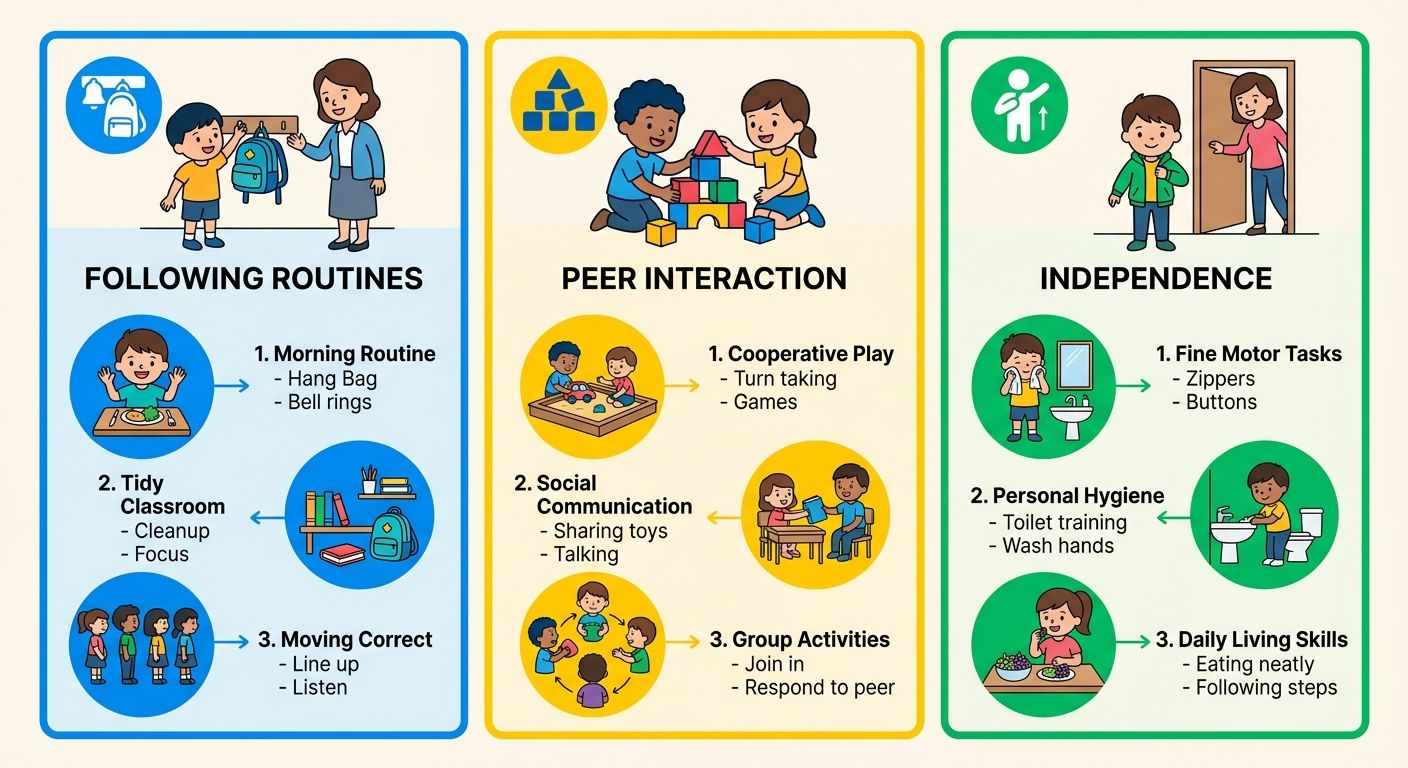
Three key school readiness skills developed through in-home ABA therapy
Strong school readiness also means reducing problem behaviors that interfere with learning, such as difficulty with transitions or following teacher directions. Our BCBAs and RBTs weave these targets into each session, and the data we collect often becomes the baseline for measurable iep goals for autism—giving your child’s team clear, observable objectives to track.
Parents play a vital role, too. Using ABA strategies consistently at home helps children practice independence during daily routines like dressing and packing a backpack. To learn more about in-home support in Arizona, visit our Arizona location page.
This information is for educational purposes. Consult a licensed healthcare professional for medical advice. Results may vary.
Overcoming Common Challenges in In-Home ABA Therapy
Even with a strong foundation, every family encounters a few bumps along the way—here’s how we help you navigate them. When you begin aba therapy for school age children, the transition to regular in-home sessions can sometimes bring resistance, especially from a child who is tired after a busy day. We partner with you to make sessions feel natural and engaging by incorporating your child’s favorite toys and activities right in their living room. This child-led approach, guided by your dedicated BCBA, helps transform reluctance into cooperation.
We also know that caregiver involvement can feel like a significant addition to an already full plate. Our family-centered model turns this dynamic on its head: rather than adding extra work, we weave caregiver training into everyday moments. Our therapists provide simple strategies you can use during dinner, playtime, or bedtime routines, so building school readiness behaviors at home quickly becomes second nature.
Scheduling conflicts are another common hurdle, but the in-home model itself is the most direct solution. Our team offers flexible scheduling that works around your family’s rhythm, not the other way around. If you’re struggling to see how far your child has come, the interactive ABA roadmap provides a clear, simple snapshot of every small win, showing how daily sessions reinforce broader objectives, including iep goals for autism. Rest assured, every challenge has a workable, compassionate answer—and our team is in your corner every step forward.
Discover how our ABA roadmap can illuminate your child’s path forward.
Putting It All Together: Next Steps for Your Child’s Development
In summary, ABA therapy for school age children provides an evidence-based pathway to strengthen the social, communication, and adaptive skills that form the foundation for classroom success. We at Golden Touch ABA craft personalized in-home treatment plans aligned with each child’s unique school readiness milestones and their IEP goals for autism, ensuring every session builds meaningful classroom preparedness.
The power of small steps drives our warm, family-centered approach. Our dedicated BCBAs and RBTs work collaboratively with your family, offering flexible scheduling that fits seamlessly into your daily routine. Discover how our customized support can make a difference — reach out to Golden Touch ABA for a custom quote or complete our interactive ABA roadmap to explore the next step. Together, we will nurture your child’s confidence and skill-building for school success.
Results may vary. Consult a licensed healthcare professional for diagnosis or medical advice.
Resources
- Get Personalized In-Home ABA Therapy in Washington Terrace
- Engage Children with Play-Based In-Home ABA Therapy
- Get Multistate ABA Therapy with Certified Analysts
- Find Personalized ABA Therapy in Taylorsville, Utah
- Find In-Home ABA Therapy Services Across Arizona
- Get In-Home ABA Therapy with Evidence-Based Techniques
- Discover ABA Therapy Services for Ages 1-21
- Find Details on BCBA Certification and Process
- Explore Registered Behavior Technician Certification Process
Table of Contents
- Understanding Registered Behavior Technician Salary
- RBT Salary Basics — What You Need to Know
- Factors That Shape RBT Salary Across the Country
- Maximizing Your RBT Salary — Practical Steps and Comparisons
- Career Growth Opportunities for RBTs — From Entry Level to Advancement
- Frequently Asked Questions About RBT Salary
- Taking the Next Steps in Your RBT Career
Understanding Registered Behavior Technician Salary
Now that you understand what an RBT does, let’s look at what you can expect to earn. RBT salary is a top consideration for anyone entering the ABA field, and compensation can be influenced by several key factors. Registered behavior technicians play a vital role in delivering In-home ABA therapy, and at Golden Touch ABA, we value the dedication they bring to every session.
Several elements shape the pay for behavior techs. Certification level matters—an RBT’s earnings typically differ from those of a BCBA with advanced credentials. Years of experience and the complexity of a caseload also affect aba therapist pay rates. The setting plays a part too; an RBT working in a clinic environment may see a different behavior technician hourly rate than one providing therapy in a child’s home.
Location is another major determinant. For example, compensation for registered behavior technicians can vary between urban and suburban areas, even within the same state. In Utah, hourly rates for ABA therapists reflect local demand and cost of living. We provide Family-centered care in South Salt Lake and in Fruit Heights, and the need for compassionate RBTs in these communities helps drive competitive earnings. Golden Touch ABA delivers personalized ABA therapy in South Salt Lake, Utah, where RBTs work closely with BCBAs to implement treatment plans grounded in Evidence-based practices.
At Golden Touch ABA, we create a Warm and welcoming environment that supports professional growth. While we never list fixed figures because compensation is commensurate with experience, our custom compensation packages reflect the value we place on our team. The power of small steps applies to careers, too—we offer mentorship and benefits that add significant worth beyond base pay. Beyond salary, Golden Touch ABA offers rewarding growth opportunities—explore them in the next section.
RBT Salary Basics — What You Need to Know
Becoming a Registered Behavior Technician is a rewarding way to enter the behavioral health field, but naturally many people wonder about the financial side of this role. When researching rbt salary, it is important to look at reliable data sources and understand what shapes your earning potential, because pay varies widely based on where you work and the type of employer you join.
The U.S. Bureau of Labor Statistics collects detailed wage data that offers a clear starting point. According to the BLS, the average ABA therapy technician pay across the United States lands around $19 to $20 per hour, which translates to an annual mean wage in the low $40,000s for full-time behavioral technicians. These government figures show that RBT earnings are competitive with other entry-level healthcare support roles, though regional differences can shift the numbers noticeably. In states with higher demand for behavior technician services, the behavior technician hourly rate often sits above the national midpoint, while smaller markets may see lower averages.
Several key factors influence where your RBT pay falls within those ranges.
Key factors affecting RBT salary
- Geographic location, because cost of living and demand for ABA services shape local wage scales
- Years of hands-on experience working directly with children and families
- Work setting, such as in-home therapy versus clinic-based programs
- Employer type, including private agencies, school districts, and hospital systems
- Additional credentials or specialized training beyond the entry-level RBT certification
Because the RBT credential is designed as an entry point into the field, salaries generally start at the lower end of the behavioral health spectrum. The Behavior Analyst Certification Board sets the certification requirements but does not publish or set aba therapist pay rates, so all salary benchmarks come from third-party government data and employer-reported surveys. In practice, behavior technician pay can increase meaningfully as you gain supervised hours, demonstrate reliability, and pursue advanced training.
At Golden Touch ABA Therapy, we help families connect with dedicated RBTs who provide in-home ABA therapy built around family-centered care. While salaries are ultimately determined by each employer, RBTs who work with agencies like ours often receive benefits, mentorship, and paid training opportunities that add value beyond the base aba therapist pay rates. If you are curious about compensation specifics, we encourage you to discuss expectations directly with any prospective employer because salaries vary and are determined by the employer.
Understanding salary is just one part of the picture—next we explore how RBTs can grow their careers.
Factors That Shape RBT Salary Across the Country
Beyond the basics of the RBT role, several key factors shape how much RBTs earn in different parts of the country. Understanding how rbt salary is determined requires looking at the intersection of state-level regulations, the local demand for services, and the professional credentials a technician brings to the field. For those considering a career in Applied Behavior Analysis, this data-driven overview clarifies what drives compensation, from licensure laws to geographic cost-of-living differences.
How State Regulations and Demand Affect RBT Pay
State regulations directly affect the behavior technician hourly rate by requiring specific supervision ratios, mandating background checks, or setting training hour minimums beyond the national Registered Behavior Technician credential from the Behavior Analyst Certification Board (BACB). When a state creates a higher barrier to entry or imposes stricter ongoing oversight, the pool of available RBTs can tighten, pushing wages upward for those who meet the requirements.
Demand for in-home ABA therapy is another powerful force. In regions where autism diagnosis rates are higher or insurance mandates cover ABA more comprehensively, providers compete to staff cases, which can increase base hourly offers. According to the Bureau of Labor Statistics (BLS), the national median hourly wage for the closely related occupational category of psychiatric technicians and aides typically falls within an $18–$22 range. However, states like California and Massachusetts, where both cost of living and service demand are elevated, frequently see the upper bound of that range extended substantially. Our own experience at Golden Touch ABA confirms that in areas we serve, such as Utah, Arizona, and Maryland, wage offers must remain competitive to attract skilled technicians who deliver family-centered, evidence-based care.
Comparing Hourly Rates Across the United States
A clear picture of RBT compensation emerges when we look at average hourly rates alongside cost-of-living data. The following table highlights five states with strong wages for behavior technicians, balancing raw pay figures against how far those dollars actually go in each region.
| State | Average Hourly Rate ($) | Cost of Living Index | Demand for RBTs |
|---|---|---|---|
| California | $25 – $30 | 151.7 | High |
| Massachusetts | $24 – $28 | 134.5 | Moderate |
| New Jersey | $23 – $27 | 116.5 | High |
| Nevada | $22 – $26 | 103.7 | Moderate |
| Arizona | $21 – $25 | 97.2 | High |
Data drawn from BLS regional wage estimates and cost-of-living indices. Wages reflect typical ranges for RBT positions in each state.
Cost of living partially explains the spread: while California offers the highest raw rates, Nevada’s lower cost of living makes its $22–$26 range comparatively strong for full-time RBTs. Arizona presents a similar dynamic, where a moderate pay band meets an even more favorable cost index, potentially maximizing take-home pay for professionals working in metro areas like Phoenix. For a broader view of the highest-paying regions, see our resource on states highest RBT pay.
These geographic distinctions matter for anyone weighing relocation against career growth. A technician in New Jersey may earn a few dollars more per hour than a peer in Arizona, but Arizona’s lower housing and transportation costs can narrow or even reverse the real-income advantage. We always encourage RBTs to evaluate not just the posted wage but the full financial picture before choosing a market.
The Role of Experience and Specialization
Experience and certifications like the BCBA pathway significantly boost aba therapist pay rates because they signal deeper clinical skill and greater independence in session management. RBTs with three or more years of hands-on practice typically earn $2–$5 more per hour than entry-level colleagues, reflecting their efficiency in data collection, behavior intervention implementation, and family communication.
Specialization creates additional earning power. Technicians who develop expertise with particular populations, such as non-vocal clients or adolescents with intensive behavioral needs, often command premium wages. Many RBTs pursue a master’s degree and accumulate supervised fieldwork hours as part of the BCBA pathway, a career progression that can lead to a significant salary jump and expanded clinical responsibilities. These experience- and certification-based differences point toward the career progression opportunities available to RBTs.
Wage figures are based on public BLS data and broad industry surveys; individual employer offers may vary.
Maximizing Your RBT Salary — Practical Steps and Comparisons
Now that you have a sense of typical pay ranges, let’s dive into concrete steps you can take to maximize your earning potential. Understanding what influences RBT salary is the first move toward securing competitive, market-aligned pay. Whether you’re new to the field or a seasoned behavior technician, a few practical strategies can make a real difference in your ABA therapist earnings.
How to Research RBT Salary in Your Area
Researching your local RBT salary is simpler than you might think, but it does take a little digging beyond a quick internet search. Government resources like the Bureau of Labor Statistics (BLS) offer broad occupational outlooks, though you’ll want to pair that with real-world job board listings. Sites like Indeed or Glassdoor let you filter by location so you can see what local employers are offering for behavior technician hourly rate ranges.
In our experience, networking with other RBTs and BCBAs in your area gives you the clearest picture. Conversations with colleagues often reveal what typical RBT hourly compensation looks like when factoring in experience, certifications, and different practice settings. For example, you can explore our services in areas like ABA therapy in Sandy Hills, Utah to see the types of positions available and the compensation they offer. Knowing the landscape equips you to evaluate offers against market-based pay benchmarks.
In-Home vs Clinic-Based Salary Comparison
Beyond the numbers, the work setting plays a huge role in your overall compensation and day-to-day experience. While aba therapist pay rates can be similar in certain markets, the trade-offs between in-home and clinic-based roles are worth weighing carefully. The following table breaks down key non-monetary factors to help you decide which environment fits your career goals.
| Factor | In-Home RBT | Clinic-Based RBT |
|---|---|---|
| Average Hourly Rate | $20 – $28 | $18 – $25 |
| Scheduling Flexibility | High (daytime, after-school, weekends) | Moderate (set clinic hours) |
| Commute/Travel | Varies (mileage often reimbursable) | Fixed location, no travel |
| Supervision & Training | RBT works independently with BCBA check-ins | On-site BCBA supervision at all times |
| Benefit Packages | May include health insurance, PTO, tuition assistance | Typically includes standard clinic benefits |
Salary information is for general informational purposes and may vary. Contact Golden Touch ABA for specific compensation details regarding our positions.
Our in-home ABA therapy model means our RBTs often appreciate the flexibility and family-centered nature of the work. You might have more variety in your day and often build deep connections with a child in their natural environment. On the other hand, clinic-based roles frequently offer more immediate BCBA support and a structured team atmosphere. Both paths can offer competitive compensation when you align the role with your strengths.
Thinking through these factors helps you target positions where you’ll thrive and feel valued. When an RBT finds the right fit, both job satisfaction and earning potential tend to grow together.
Tips for Negotiating a Higher Hourly Rate
Negotiating a higher hourly rate might feel intimidating, but it’s a normal and expected part of the hiring process. We encourage you to lead with your qualifications—your RBT certification, any specialized training in behavioral assessment, and your years of hands-on experience. Employers value behavior technician hourly rate discussions when you can clearly connect your skills to better outcomes for clients.
Highlighting your willingness to work flexible hours, take on challenging cases, or support families during evenings and weekends can also strengthen your position. The demand for quality aba therapist pay rates is strong, and organizations like ours seek dedicated RBTs who bring both competence and compassion. Approach the conversation with professionalism and confidence, and you’ll often find room for improvement in the initial offer.
Negotiating well today sets the stage for growth—next, we’ll explore how advancing your career can lead to even higher compensation.
Career Growth Opportunities for RBTs — From Entry Level to Advancement
Once you have earned your RBT credential, the next step is building a long-term career. At Golden Touch ABA Therapy, we guide our team members along a clear path from entry-level behavior technician to advanced roles. Understanding your potential rbt salary is an important first step, but the career journey in In-home ABA therapy is about much more than a paycheck.
Compensation and Job Outlook for Behavior Technicians
When evaluating an rbt salary, consider the potential for advancement. Our industry offers competitive pay that grows with your expertise. According to the U.S. Bureau of Labor Statistics, the median annual wage for similar roles in 2024 was approximately $42,590. The behavior technician hourly rate often rises with experience, with entry-level aba therapist pay rates starting around $20.29 per hour. As you gain skills, your earnings increase accordingly. Learn more about RBT salary and benefits to see how your compensation can expand. The career stability is excellent, with the BLS projecting overall employment growth of 16 percent from 2024 to 2034, much faster than the average for all occupations.
Your Advancement Pathway with Us
Our warm and welcoming environment is built around professional development. The Behavior Analyst Certification Board (BACB) RBT Task List establishes your certification as a trusted, standardized foundation. From here, we support your growth through several clear routes:
- Lead RBT: Take on mentorship and advanced implementation responsibilities. We provide internal training to help you reach this level.
- Behavior Analyst in Training (BAIT): Our paid training and free BCBA supervision pathway bridges the gap between RBT and the BCBA role.
- Board Certified Behavior Analyst (BCBA): With a master’s degree and 5,000 supervised fieldwork hours, you can advance to this supervisory position. Our BCBAs direct treatment plans using evidence-based practices.
Every role is rooted in family-centered care, and we champion the power of small steps in every learner’s journey. Results may vary; career growth depends on individual effort and company needs. With the right support, your RBT certification is just the beginning of a rewarding career in behavior analysis.
Frequently Asked Questions About RBT Salary
Many aspiring behavior technicians wonder how RBT salary varies across different regions and work environments in the United States. These direct, FAQ-style answers summarize what industry data shows about earnings for Registered Behavior Technicians (RBTs).
What is the average RBT salary?
According to our salary FAQ, national averages for RBTs typically range from $35,000 to $50,000 per year. Actual ABA therapist pay rates can shift depending on certification level, years of experience, and whether the work setting is in-home or clinic-based.
How much does an RBT make per hour?
Per our hourly pay FAQ, an RBT generally earns between $15 and $25 per hour. The hourly rate for behavior technicians often increases with experience and can be higher in urban hubs or high-demand states.
Which states pay the highest for RBTs?
Our FAQ on state-by-state pay notes that locations such as California, Massachusetts, and Nevada tend to offer higher compensation. According to the U.S. Bureau of Labor Statistics regional data, these areas reflect strong demand for qualified behavioral health professionals. To explore personalized in-home support, families can learn more about our autism services in Fruit Heights, Utah.
Taking the Next Steps in Your RBT Career
When you’re ready to move forward, exploring rbt salary expectations helps you see the full picture of what this career can offer. At Golden Touch ABA Therapy, we provide a warm and welcoming environment built on family-centered care and evidence-based practices for our in-home ABA therapy teams in South Salt Lake County, Utah. Our behavior technician hourly rate and aba therapist pay rates reflect the value we place on the dedicated professionals who make the power of small steps come alive every day. If you’d like to learn more about RBT opportunities or use our interactive ABA roadmap tool, we invite you to contact us—our friendly team is here to help you take the next step.
Resources
- Get Personalized In-Home ABA Therapy in South Salt Lake
- Discover Research-Based ABA Therapy in Fruit Heights
- Explore Evidence-Based ABA Therapy in Sandy Hills Utah
- Compare RBT and BCBA Qualifications for ABA Therapists
- Get Salary Insights for ABA Therapists at Golden Touch
- Explore ABA Therapist Jobs in New Jersey Growing Market
- Learn How to Advance from RBT to BCBA
- Compare Psychiatric Technician Pay Across Industries from BLS
- Discover Psychiatric Technician Job Outlook and Salary
- Find State-by-State Wage Data for Psychiatric Technicians
- Discover the New RBT Handbook from BACB
- Review the RBT Task List and Certification Standards
Table of Contents
- Understanding Medical Necessity for ABA Therapy
- What Defines Medical Necessity for ABA Therapy
- How Insurers Determine Medical Necessity for Autism Services
- Practical Guide to Proving Medical Necessity for ABA Therapy
- Advanced ABA Billing Codes and Medical Necessity Documentation
- Frequently Asked Questions About Medical Necessity for ABA Therapy
- Your Path to Securing ABA Therapy Coverage Through Medical Necessity
Understanding Medical Necessity for ABA Therapy
To access the benefits of ABA therapy, families must first understand medical necessity for ABA therapy. At Golden Touch ABA, we define medical necessity as the formal standard used by insurance companies and Medicaid to determine whether a service is reasonable, effective, and required for a patient’s condition. This determination serves as the gateway to ABA therapy insurance coverage, making it an essential and foundational step in funding in-home ABA therapy.
Medical necessity is documented by a qualified ABA therapist or a physician through a comprehensive diagnostic assessment. The evaluation must confirm a diagnosis of autism spectrum disorder and demonstrate that ABA therapy is an evidence-based treatment for that diagnosis. Our clinicians rely on established clinical guidelines when preparing documentation, often referencing studies from the biomedical research database to support the recommendation.
Once documentation is submitted, the insurer reviews the case against its own criteria. This review typically examines specific deficits in social communication and behavior and requires accurate ABA therapy billing codes for proper claims submission. While the process can vary by payer, the underlying principle remains consistent: medical necessity confirms that in-home ABA therapy addresses the child’s unique developmental needs.
Insurance coverage is subject to verification and is not guaranteed.
What Defines Medical Necessity for ABA Therapy
To understand how insurance decides whether to cover ABA, we first need to define what makes therapy medically necessary. Determining medical necessity for ABA therapy can feel complex for families, but it boils down to a clear standard: treatment that is required to diagnose, treat, or prevent a condition that significantly impacts a child’s daily life. At Golden Touch ABA Therapy, we believe in making this process as transparent as possible, using evidence-based practices and family-centered care to advocate for the children we serve.
Core Criteria for Medical Necessity Determination
Insurers evaluate three core criteria when reviewing requests for medical necessity for ABA therapy. We’ve seen how these guide decisions and shape the scope of covered services in our in-home ABA therapy programs.
First, a child must have a formal diagnosis, typically autism spectrum disorder as defined by the DSM-5, from a licensed healthcare professional. Second, there must be documented functional impairment, which means the child faces meaningful challenges in communication, social interaction, or adaptive behavior that affect safety, learning, or family life. Third, the treatment plan must show a reasonable expectation of improvement; that is, ABA therapy can help the child build skills and reduce problematic behaviors in ways that matter at home and in the community. The power of small steps drives this progress, as incremental gains often lead to lasting change.
Insurance coverage is subject to verification and is not guaranteed. Every plan has unique criteria, and we assist families in understanding what their specific policy requires.
Clinical Guidelines That Shape Necessity Decisions
Clinical guidelines from the US Surgeon General and the National Institutes of Health (NIH) recognize ABA as an effective, evidence-based treatment for autism. According to the NIH, these authoritative recommendations carry significant weight in medical necessity determinations. Clinical guidelines recognize ABA as effective for individuals with low functioning autism, particularly when functional impairments are severe and require intensive, individualized intervention.
These guidelines help establish that ABA therapy is not experimental or optional; it’s a medically necessary service when children exhibit substantial deficits. Insurers often reference these standards when designing their coverage policies, reinforcing that high-quality, BCBA-supervised ABA aligns with the best available scientific evidence and should be accessible to families who need it.
Difference Between Medical Necessity and Clinical Appropriateness
While both concepts matter, insurers separate medical necessity from clinical appropriateness to decide coverage. Medical necessity refers to treatment that is required to address a diagnosed condition and prevent harm. Clinical appropriateness refers to services that are beneficial and suitable but not strictly required from an insurance perspective. This distinction directly influences claims for medical necessity for ABA therapy, because even helpful interventions may be deemed not medically necessary.
Comparison: Medical Necessity vs. Clinical Appropriateness
Understanding this contrast helps families anticipate coverage decisions and advocate effectively.
These examples come from clinical guidelines and our experience helping families navigate insurance. While both support a child’s growth, only services that meet the medical necessity standard are routinely covered. We work closely with families to document functional impairment and treatment goals in ways that reflect these standards.
Results may vary, and we encourage families to consult a licensed healthcare professional for diagnosis or medical advice. Privacy Policy and Terms & Conditions apply to our services. Now that you know the criteria, let’s look at how to document medical necessity for your insurance provider.
How Insurers Determine Medical Necessity for Autism Services
Understanding how insurers evaluate coverage can feel overwhelming, but we are here to walk you through it. When we talk about medical necessity for ABA therapy, insurers are essentially asking: Is this treatment clinically appropriate, based on recognized standards, and essential for the child’s functioning? They use specific criteria to determine that, and knowing these standards can help your family navigate the insurance process with greater confidence.
The Insurance Review Process for ABA Therapy
The review process follows a structured pathway designed to verify that proposed treatment meets established clinical standards. According to the California Department of Health Care Services, insurers rely on criteria derived from state-level regulations, professional association guidelines, and peer-reviewed evidence. The insurer evaluation ABA therapy process generally begins when a provider submits an initial authorization request that includes diagnostic documentation and a proposed treatment plan.
Once submitted, a clinical reviewer at the health plan examines the documentation to confirm that the diagnosis and recommended treatment hours align with their medical necessity criteria. If the reviewer has questions or requires additional justification, the health plan may initiate a peer-to-peer review between the treating clinician and the insurer’s medical director or clinical reviewer. This step often resolves concerns by allowing direct discussion about the child’s unique needs and the evidence supporting the proposed plan. For ongoing care, insurers also require periodic reauthorization, where updated progress data and revised treatment goals must demonstrate continued medical necessity. We understand that these steps can feel like a lot to track, but having a knowledgeable team on your side makes a significant difference.
Insurance medical necessity review process for ABA therapy authorization
Documentation That Makes or Breaks Medical Necessity
The quality and completeness of the documentation often decide whether a claim is approved or denied. Insurers look for objective evidence that ABA therapy is not merely beneficial but actually essential. A strong submission typically includes a diagnostic report confirming autism — preferably with ADOS results — conducted by a licensed psychologist or developmental pediatrician, a Functional Behavior Assessment completed by a BCBA that provides baseline data and a hypothesis of function, a detailed Letter of Medical Necessity synthesizing the clinical rationale, and an Individualized Treatment Plan with specific, measurable goals and parent involvement strategies.
When we discuss aba therapy insurance coverage, we emphasize that each of these documents serves a unique role in building the case for authorization. The table below summarizes the four core documents you will need to establish medical necessity.
| Aspect | Medical Necessity | Clinical Appropriateness |
|---|---|---|
| Definition | Treatment that is required to diagnose, treat, or prevent a condition. | Treatment that is suitable and beneficial but not strictly required. |
| Insurance Coverage | Typically covered when criteria are met. | May not be covered or may require higher cost-sharing. |
| Example in ABA | One-on-one therapy to reduce severe self-injurious behavior. | Parent training to enhance general developmental skills. |
Having all four documents prepared thoroughly creates a consistent chain of evidence that supports the request. Even one missing or vague element can trigger a denial, which is why we help families compile complete, insurer-ready packages before submission.
Common Reasons for Denial and How to Avoid Them
Denials can be discouraging, but they often follow predictable patterns that we can anticipate and address proactively. Here are the most frequent reasons insurers cite as insufficient documentation for medical necessity for ABA therapy and what you can do to strengthen your submission:
- Insufficient diagnostic clarity: A diagnosis that is not supported by standardized assessment tools like the ADOS may be questioned. Always include a formal report from a qualified professional.
- Lack of baseline data: Without clear pretreatment measurements from an FBA, the reviewer cannot gauge the severity of the impairment. Ensure your BCBA provides objective frequency, duration, or intensity data.
- Vague treatment goals: Goals like “improve communication” are too broad. Use specific, measurable objectives tied to the assessment findings and include data collection methods.
- Missing prior authorization: Submitting claims without first obtaining the required pre-approval often results in automatic denial. Verify your plan’s authorization requirements before sessions begin.
- Failure to justify hours requested: If the treatment plan does not explain why a certain intensity level is medically necessary, insurers may reduce hours. Link the recommended hours directly to the FBA results and the child’s level of need.
Documenting consistent caregiver participation and progress monitoring also reinforces the child’s ongoing need for therapy. Providers often use specific ABA therapy billing codes tied to the treatment plan, and ensuring those codes match the authorized services can prevent administrative denials. While following these guidelines cannot guarantee coverage, it can help strengthen your case and give your family the best possible opportunity for approval.
Insurance coverage is subject to verification and is not guaranteed.
Practical Guide to Proving Medical Necessity for ABA Therapy
Now that you understand what medical necessity means, we can walk through the practical steps to demonstrate it clearly to an insurance provider. Proving medical necessity for ABA therapy requires a focused combination of clinical documentation, objective data, and collaborative team input, all tailored to the payer’s specific guidelines. At Golden Touch ABA Therapy, we help families in Utah, Arizona, and Maryland navigate this process as part of our family-centered care approach.
Step-by-Step: Preparing a Strong Letter of Medical Necessity
The Letter of Medical Necessity (LMN) is the cornerstone of a successful submission for ABA therapy insurance coverage. This document must tell a compelling story that links an individual’s diagnosis to functional impairments and outlines why evidence-based ABA therapy is required. We recommend gathering all foundational documents first, including the formal ASD diagnosis and relevant standardized assessment scores like the ADOS. If you are in California, seeking guidance from California health care services can help align your submission with state-specific Medicaid requirements.
- Gather Diagnostic Documentation
We begin by compiling the official diagnostic paperwork. The report should clearly state the diagnosis, the credentialed professional who made it, and the specific assessment tools used. This is the foundation of any medical necessity claim. - Write the Clinical Justification
This section connects the dots between the diagnosis and the child’s daily life. We detail how core deficits directly cause functional impairment in communication, social interaction, or safety. For example, we may describe how an inability to communicate basic needs leads to severe tantrums or self-injurious behavior. - Specify Treatment Goals
The LMN must include measurable, individualized goals that ABA therapy will target. These are not generic milestones; they are specific objectives like “using a three-word mand to request a break,” which directly address the impairments described in the clinical justification. This shows the reviewer a clear treatment pathway. - Describe Expected Outcomes with Evidence-Based Practices
We conclude by projecting realistic outcomes. Using the power of small steps, our in-home ABA therapy fosters skill building in a warm and welcoming environment. The letter should state that without this intervention, the impairments are likely to persist or worsen, reinforcing the medical necessity. Always remember that insurance coverage is subject to verification and is not guaranteed.
Data Collection Methods That Support Necessity
Objective data transforms a subjective description into a powerful, fact-based argument. To demonstrate medical necessity for ABA therapy effectively, we rely on several data collection methods that provide concrete evidence of the frequency, severity, and impact of challenging behaviors. Using the correct ABA therapy billing codes is part of this documentation, but the raw data is what proves the clinical story.
Comparison: Data Collection Methods for Medical Necessity
The following table compares the primary data collection methods we use to build an objective case, showing exactly how each one supports the medical necessity claim.
| Method | Description | Utility |
|---|---|---|
| ABC Data | Antecedent-Behavior-Consequence tracking. | Identifies behavioral triggers and patterns. |
| VB-MAPP | Verbal Behavior Milestones Assessment. | Maps developmental deficits vs peers. |
Each method tells a critical part of the story. For instance, ABC data can reveal that a child’s screaming is consistently triggered by a transition, pointing to an anxiety-based function. Standardized assessments like the VB-MAPP provide a norm-referenced deficit map, visually depicting where a child’s skills fall compared to developmental peers, a piece of evidence insurers find difficult to refute.
Working with Your Clinical Team to Build a Strong Case
A compelling medical necessity case is never built in isolation. It is the product of a cohesive clinical team working from a unified narrative. Our team at Golden Touch ABA Therapy collaborates closely to ensure every data point and clinical opinion aligns.
The Board Certified Behavior Analyst (BCBA) designs the assessment plan and synthesizes the data into a coherent clinical argument for the LMN. Registered Behavior Technicians (RBTs), who deliver daily in-home ABA therapy, are essential for collecting consistent and accurate data in real time. A physician’s involvement is also vital; a referral or a supporting statement from a medical doctor that validates the diagnosis and recommends ABA therapy powerfully corroborates the medical necessity claim from another clinical perspective. Together, this integrated approach, grounded in family-centered care, results in a robust, defensible submission.
Once you have assembled this documentation, the next step is a formal submission to your insurance provider. Our team helps families every step of the way, ensuring a complete package is ready for review.
Privacy Policy applies. Consult a licensed healthcare professional for diagnosis or medical advice. Results may vary. Terms & Conditions govern use.
Advanced ABA Billing Codes and Medical Necessity Documentation
Now that we understand what makes ABA therapy medically necessary, let’s look at the specific billing codes that go with it. Learning how CPT codes align with documented medical necessity is key to avoiding claim denials and ensuring families receive the full benefits of their ABA therapy insurance coverage.
Understanding CPT Codes for ABA Therapy
CPT codes provide a universal language for healthcare providers to describe services to insurers. When our ABA therapist delivers one-on-one direct therapy, we bill that time under CPT code 97153. This code covers adaptive behavior treatment by protocol and must be supported by clearly documented target behaviors and individualized treatment goals in the plan of care. Without that link, even appropriate therapy can be denied.
Initial assessments use a different code entirely. A Board Certified Behavior Analyst (BCBA) performs a behavior identification assessment and reports it with CPT code 97151. This comprehensive evaluation establishes the child’s baseline skills and challenges, creating the foundation for medical necessity for ABA therapy. The assessment findings justify why ongoing treatment is required and guide the development of a tailored intervention plan.
How Billing Codes Align with Medical Necessity Criteria
Matching the the correct CPT codes to documented medical necessity is critical because each code represents a distinct service with its own coverage requirements. CPT code 97155 captures BCBA supervision and protocol modification, demonstrating that a qualified clinician is actively monitoring progress and making data-driven adjustments. Our documentation for this code shows insurers that treatment is not static—it evolves based on the child’s response.
Code mismatches create significant risks. If an insurer sees 97153 billed without corresponding target behavior goals, or 97155 without evidence of protocol changes, they may flag the claim for audit or issue a recoupment. We recommend regularly reviewing payer guidelines because medical necessity criteria can shift, and what was sufficient last year may not meet current standards. Consistent alignment between ABA therapy billing codes and clinical notes protects both the practice and the families we serve.
The 8-Minute Rule and Other Billing Unit Requirements
Timed ABA services follow the CMS 8-minute rule, which governs how we convert minutes of therapy into billable units. Each unit represents 15 minutes of service, and to bill a single unit we must deliver at least 8 minutes of that 15-minute block. Documentation must reflect the exact start and stop times, not rounded estimates.
Key requirements for compliant billing include:
- Track minutes precisely and note them in every session note.
- Calculate units based on total timed minutes, not per-activity blocks.
- Never bill two units unless at least 23 minutes of service were delivered.
- Apply the rule consistently across all timed CPT codes.
Common pitfalls such as unbundling or over-coding can trigger audits just as easily as under-documentation. When in doubt, our team consults the latest payer-specific policies to confirm unit calculations and code groupings.
Comparison: Key ABA Therapy CPT Codes and Medical Necessity
Every row in this table tells a story about care. Code 97151 opens the door by proving treatment is necessary, 97153 delivers the daily work of skill-building, and 97155 shows insurers that a qualified supervisor is guiding the process. Together, these codes build a complete picture of medically necessary ABA therapy.
| CPT Code | Service | Medical Necessity Link |
|---|---|---|
| 97151 | Identification Assessment | Establishes baseline needs/deficits. |
| 97153 | Direct Treatment | Implements behavior protocol. |
| 97155 | Protocol Modification | Ensures clinical adjustment based on data. |
Getting the codes right is the first step; next we’ll show how to use them when submitting claims.
Frequently Asked Questions About Medical Necessity for ABA Therapy
After understanding why medical necessity matters, you might still have questions. Below are answers to the most common ones families ask us.
What is medical necessity for ABA therapy? Medical necessity is a standard insurers use to decide whether a treatment is essential for your child’s health. For ABA therapy, it means a qualified professional has determined the service is needed to address autism-related challenges.
Why do insurers require a medical necessity determination? Insurers use this step to confirm that ABA therapy is appropriate for your child’s diagnosis, symptom severity, and functional impairments. According to Golden Touch ABA, the evaluation typically looks at the diagnosis, how much everyday functioning is affected, and whether meaningful improvement is expected.
Who certifies medical necessity? A physician, psychologist, or a Board Certified Behavior Analyst (BCBA) usually completes the certification. It is a broader coverage criterion rather than a specific billing code.
How does Golden Touch ABA help with this process? Our team can guide you through the prior authorization steps and help gather the documentation that may be needed. If you’re not sure whether your child meets medical necessity criteria, we’re here to help review the requirements. Insurance coverage is subject to verification and is not guaranteed.
Reach out to us anytime for personalized support—we’re just a call or message away.
Your Path to Securing ABA Therapy Coverage Through Medical Necessity
Now that you understand the required documentation, the path to coverage is clear. Demonstrating medical necessity for ABA therapy is achievable when families take three key steps. First, obtain a comprehensive behavioral assessment from a qualified Board Certified Behavior Analyst (BCBA). Second, have your BCBA or physician document why in-home therapy is essential for your child’s progress, encapsulating this in a formal Letter of Medical Necessity (LMN). Third, submit the LMN, diagnostic report, and a detailed treatment plan to your insurance carrier.
Our insurance specialists at Golden Touch ABA help families organize and submit these documents for ABA therapy insurance coverage, working diligently with commercial insurers and Medicaid. Contact our team today or start our interactive roadmap for personalized guidance. Insurance coverage is subject to verification and is not guaranteed.
Resources
- Find In-Home ABA Therapy with Parent Training
- Learn ABA Career Paths from RBT to BCBA
- Understand High vs Low Functioning Autism Differences
- Explore RBT and BCBA Roles in ABA Therapy
- Discover ABA Therapist Qualifications and Training
- Compare ABA Therapist Salaries and Career Growth
- Get a Guide to Low Functioning Autism Management
- Access Biomedical Research via NCBI Databases
- Learn How Insurers Evaluate ABA Therapy Requests
- Explore California Health Care Services and Medi-Cal
